Characterization of Unlearnable Noise with Mid-Circuit-Measurement-Based Cycle Benchmarking
Pith reviewed 2026-07-01 06:19 UTC · model grok-4.3
The pith
Inserting mid-circuit measurements reverses Pauli cycles induced by Clifford gates and makes their noise components learnable.
A machine-rendered reading of the paper's core claim, the machinery that carries it, and where it could break.
Core claim
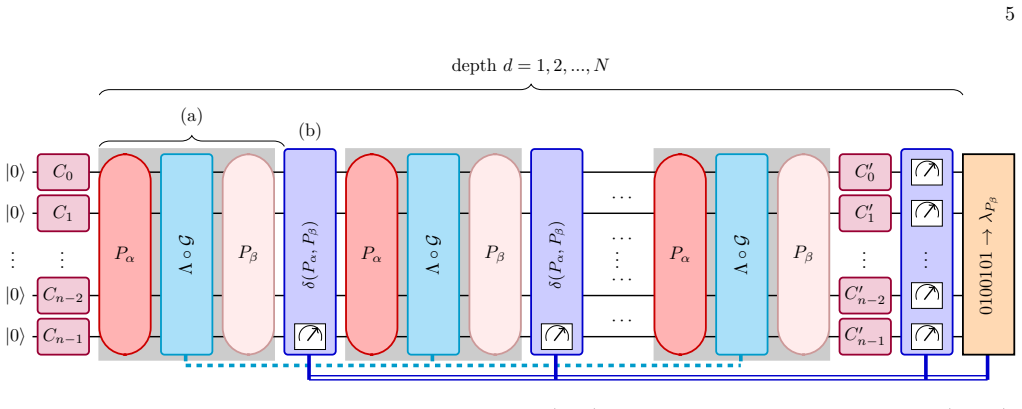
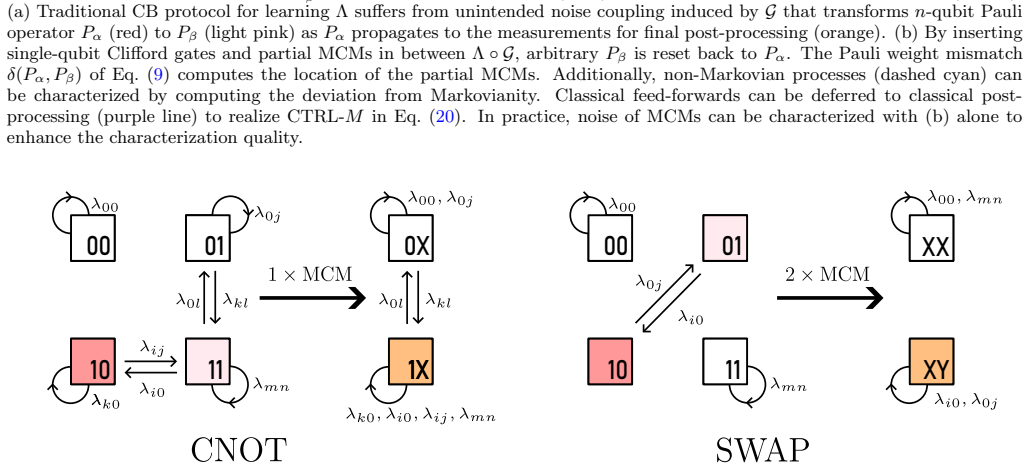
An insertion of mid-circuit measurements can reverse Pauli cycles induced by a general Clifford gate. This fact enables the revelation of a Pauli-noise learnability condition for Clifford gates and renders otherwise unidentifiable Pauli fidelities and non-Markovian noise learnable via repeated measurements and classical post-processing.
What carries the argument
mid-circuit-measurement-based generalized cycle benchmarking, which applies the deferred feed-forward principle to reverse Pauli cycles and isolate previously coupled error parameters.
If this is right
- Previously unlearnable Pauli error components in n-qubit Clifford gates become identifiable.
- The protocol isolates non-Markovian noise in addition to Markovian Pauli fidelities.
- Measurement-induced bit-flip bias and non-Markovian correlations define the applicability range of the Pauli noise model.
- The method is validated on superconducting hardware and benchmarked against conventional tomography.
Where Pith is reading between the lines
- The same reversal principle could be tested on non-Clifford gates to check whether the learnability condition generalizes.
- Full noise models obtained this way would directly feed into more accurate calibration routines for error-corrected circuits.
- Observed non-Markovian correlations suggest the protocol could be extended to quantify memory effects across multiple gate cycles.
Load-bearing premise
The protocol assumes sufficient state preparation quality to resolve the previously unlearnable noise components.
What would settle it
Running the protocol on a Clifford gate whose noise parameters remain coupled and unresolvable after mid-circuit measurements, when checked against full tomography, would show the reversal does not produce the claimed learnability.
Figures
read the original abstract
Noise characterization of multi-qubit entangling Clifford operations is a key practical bottleneck for quantum error mitigation and for the calibration, validation, and optimization of quantum error-correction protocols, especially in the presence of state preparation and measurement (SPAM) errors. Although cycle benchmarking can isolate some Pauli error components, it cannot resolve the problem of coupled error parameters, which leads to unlearnable degrees of freedom even in simple noisy gates, not to mention general $n$-qubit Clifford gates. Here we introduce mid-circuit-measurement-based generalized cycle benchmarking, a framework that makes otherwise unidentifiable Pauli fidelities and non-Markovian noise learnable via repeated measurements and classical post-processing. Applying the deferred feed-forward principle to generalized cycle benchmarking, we show that an insertion of mid-circuit measurements can reverse Pauli cycles induced by a general Clifford gate. This fact enables us to reveal a Pauli-noise learnability condition for Clifford gates. Assuming sufficient state preparation quality, we numerically demonstrate the feasibility of characterizing the previously unlearnable noise components. We implement the protocol on superconducting quantum processing units and validate its effectiveness in disambiguating the coupled noise components, benchmarked against conventional tomography. Finally, we observe consistent measurement-induced bit-flip bias and non-Markovian correlations, which define a range of applicability for the Pauli noise model and the proposed noise-characterization protocol.
Editorial analysis
A structured set of objections, weighed in public.
Referee Report
Summary. The paper introduces mid-circuit-measurement-based generalized cycle benchmarking, which applies the deferred feed-forward principle to insert mid-circuit measurements that reverse Pauli cycles induced by general Clifford gates. This reversal is used to derive a Pauli-noise learnability condition that renders previously unidentifiable coupled Pauli fidelities and certain non-Markovian components learnable through repeated measurements and classical post-processing. Numerical simulations demonstrate feasibility assuming sufficient state-preparation quality, and the protocol is implemented on superconducting QPUs with validation against conventional tomography; the work also reports measurement-induced bit-flip bias and non-Markovian correlations that bound the applicability of the underlying Pauli noise model.
Significance. If the reversal property is shown to hold exactly under the noise conditions present in the experiments, the protocol would address a practical bottleneck in characterizing multi-qubit Clifford noise by resolving unlearnable degrees of freedom, with direct relevance to error mitigation and quantum error correction calibration. The experimental implementation and explicit identification of non-Markovian effects provide concrete grounding for the model's range of validity.
major comments (1)
- [Abstract] Abstract (reversal claim) and the derivation of the learnability condition: the central assertion that mid-circuit measurements reverse Pauli cycles for arbitrary Clifford gates is load-bearing for making coupled fidelities learnable. The abstract reports observation of non-Markovian correlations and measurement-induced bias, yet the reversal is presented as following from the deferred feed-forward principle applied to a fixed Pauli channel; if the derivation does not incorporate time correlations or back-action during the cycle, the learnability condition does not extend to the reported experimental regime.
Simulated Author's Rebuttal
We thank the referee for their detailed review and for identifying this key point about the scope of our theoretical claims. We respond to the major comment below.
read point-by-point responses
-
Referee: [Abstract] Abstract (reversal claim) and the derivation of the learnability condition: the central assertion that mid-circuit measurements reverse Pauli cycles for arbitrary Clifford gates is load-bearing for making coupled fidelities learnable. The abstract reports observation of non-Markovian correlations and measurement-induced bias, yet the reversal is presented as following from the deferred feed-forward principle applied to a fixed Pauli channel; if the derivation does not incorporate time correlations or back-action during the cycle, the learnability condition does not extend to the reported experimental regime.
Authors: We agree that the derivation of the reversal property applies the deferred feed-forward principle to a fixed Pauli channel under the standard Markovian Pauli noise model and does not incorporate time correlations or measurement back-action. This is the framework in which the learnability condition for coupled fidelities is derived. The manuscript explicitly reports the experimental observation of measurement-induced bit-flip bias and non-Markovian correlations in order to bound the regime in which the Pauli noise model (and thus the protocol) remains applicable. Numerical demonstrations assume sufficient state-preparation quality, and experimental results are validated against tomography only where the model holds. We do not assert that the learnability condition extends outside this model. To address the concern, we will revise the abstract to state more explicitly that the reversal and learnability results are obtained under the Pauli noise assumption, with experimental deviations reported separately to delineate applicability. revision: partial
Circularity Check
No circularity: learnability condition derived from deferred feed-forward principle without reduction to inputs or self-citations
full rationale
The abstract derives the reversal of Pauli cycles and the resulting Pauli-noise learnability condition by applying the deferred feed-forward principle to generalized cycle benchmarking. No equations, fitted parameters, or self-citations are shown to reduce the central claim to a tautology or prior author result by construction. The protocol is presented as an extension that makes unidentifiable components learnable via new measurements and post-processing, with applicability bounded by observed non-Markovian effects rather than assumed in the derivation itself. This matches the default expectation of a self-contained derivation against external benchmarks.
Axiom & Free-Parameter Ledger
axioms (1)
- domain assumption Sufficient state preparation quality
Reference graph
Works this paper leans on
-
[1]
With this premise, the exact learn- ing protocol that we have been carefully developing is no longer applicable for isolating the measurement errors from the quantum gate errors
Approximate Learning In approximate noise learning, the problem of inter- est is whether noisy MCMs may still be a reliable state preparation resource for approximating unlearnable noise pairs, when the state-projection quality of the|1⟩state is no longer guaranteed. With this premise, the exact learn- ing protocol that we have been carefully developing i...
-
[2]
The task is to un- ravel the unlearnable noise pair{λ 0z, λzz }, which is only learnable as a product in standard CB
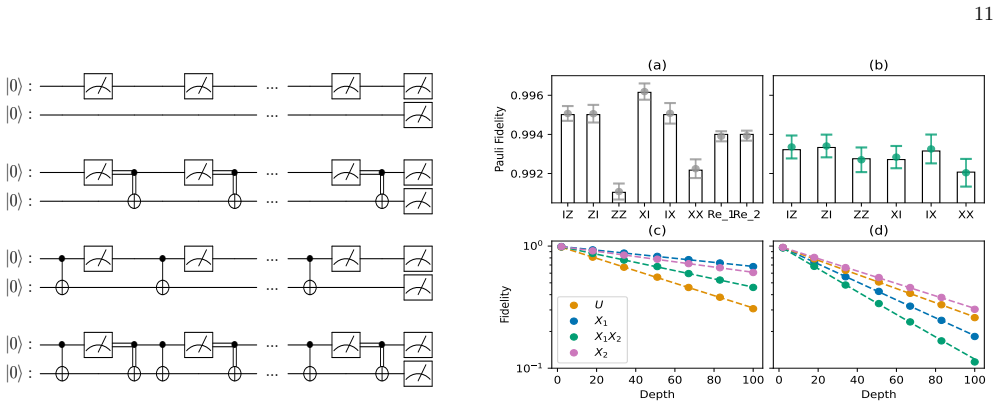
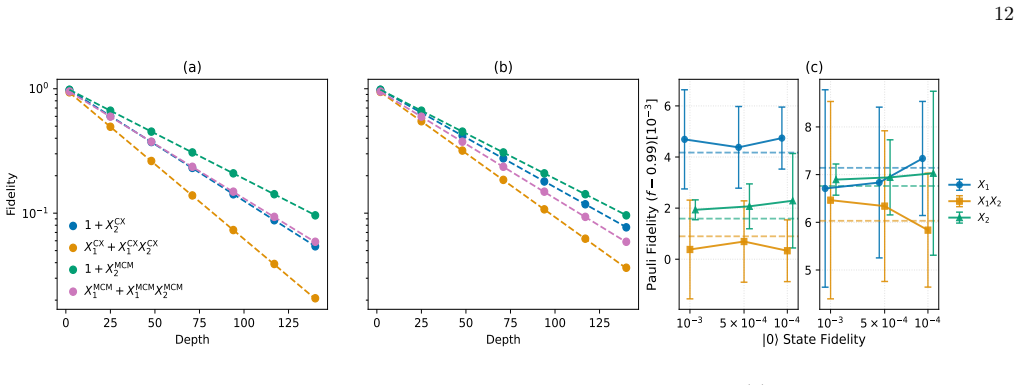
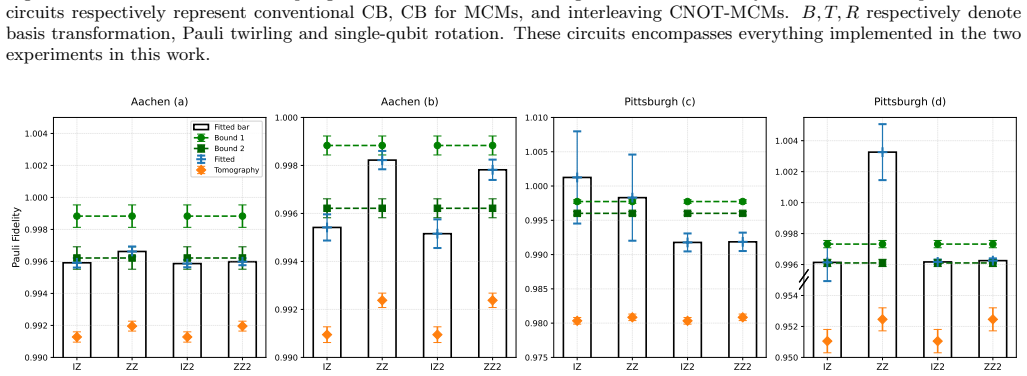
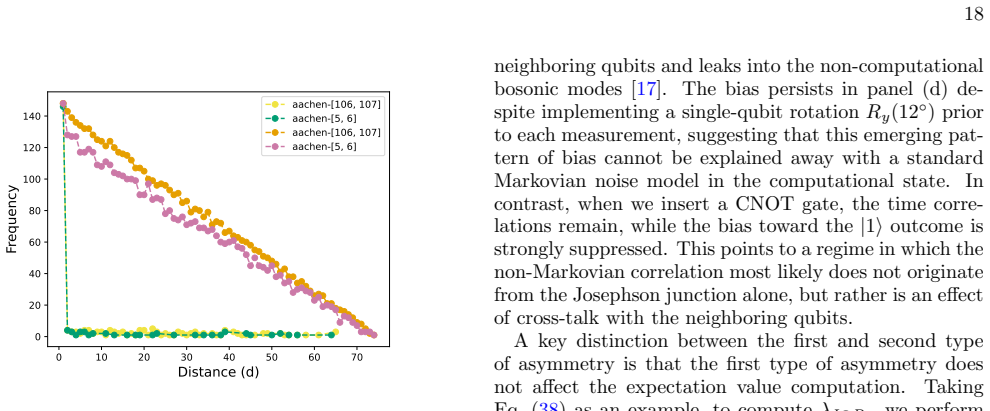
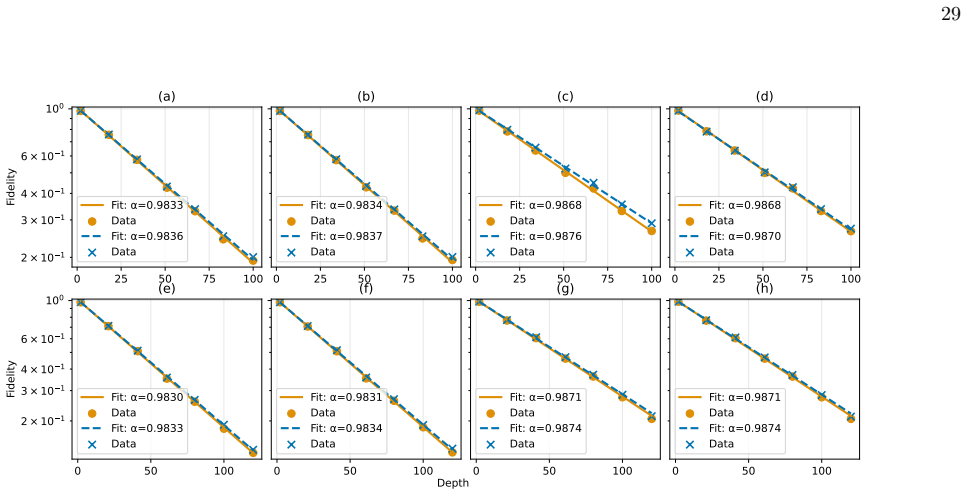
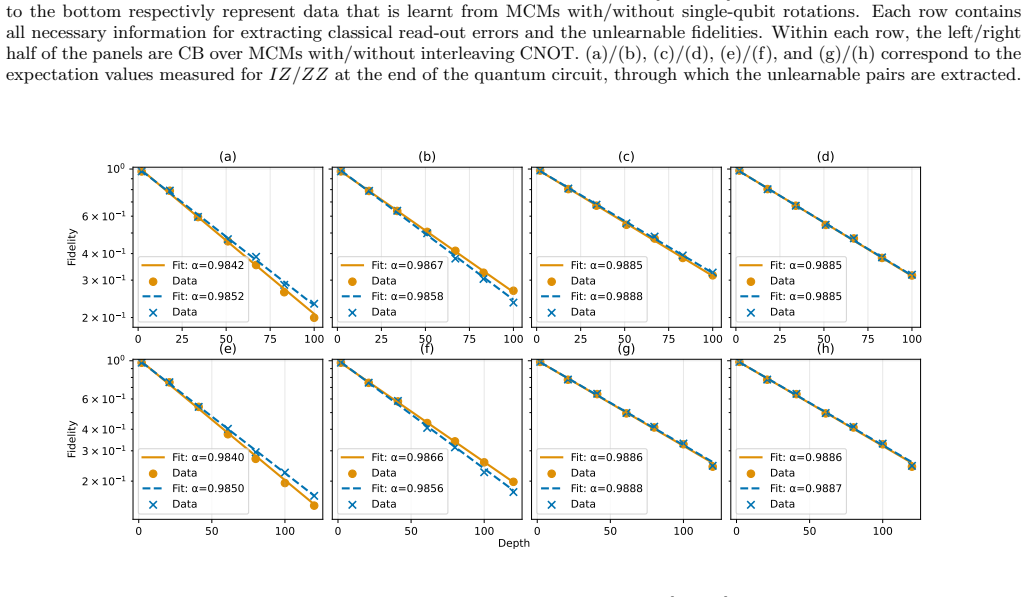
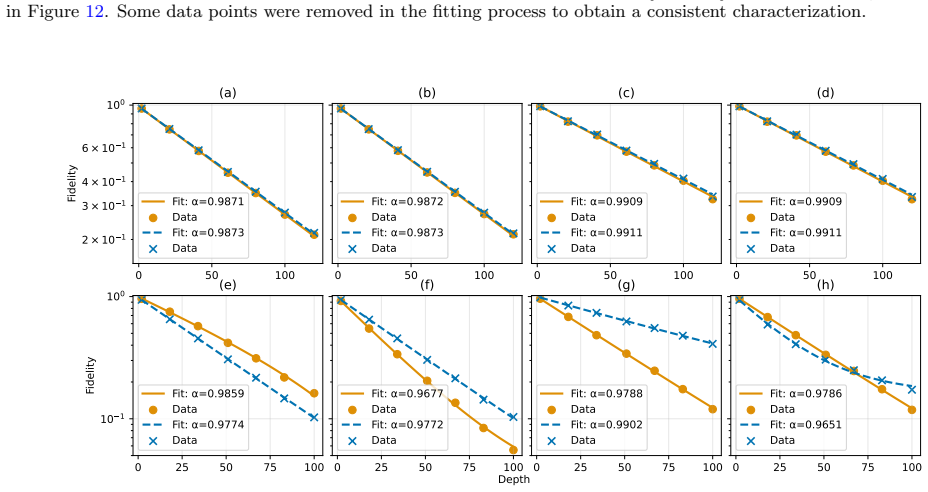
Unlearnable noise In the first experiment, the generalized CB procedure introduced in Section II is applied directly to character- ize CNOT gates, on two generations of quantum devices, ibm-aachenandibm-pittsburgh. The task is to un- ravel the unlearnable noise pair{λ 0z, λzz }, which is only learnable as a product in standard CB. To assess the quality of...
1920
-
[3]
They can be learned independently from the MCMs CB set and the CNOT-MCMs set
Classical Read-out Error In our characterization protocol, classical read-out er- rors can be learnt as the statistical difference between post-processed and non-post-processed data. They can be learned independently from the MCMs CB set and the CNOT-MCMs set. Although the detected classical read-out errors appear to be small in our experiment, they are i...
-
[4]
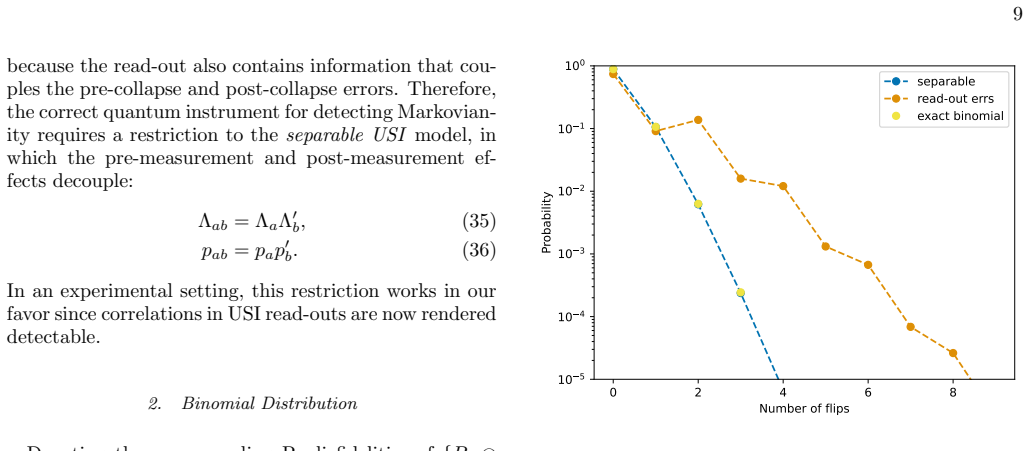
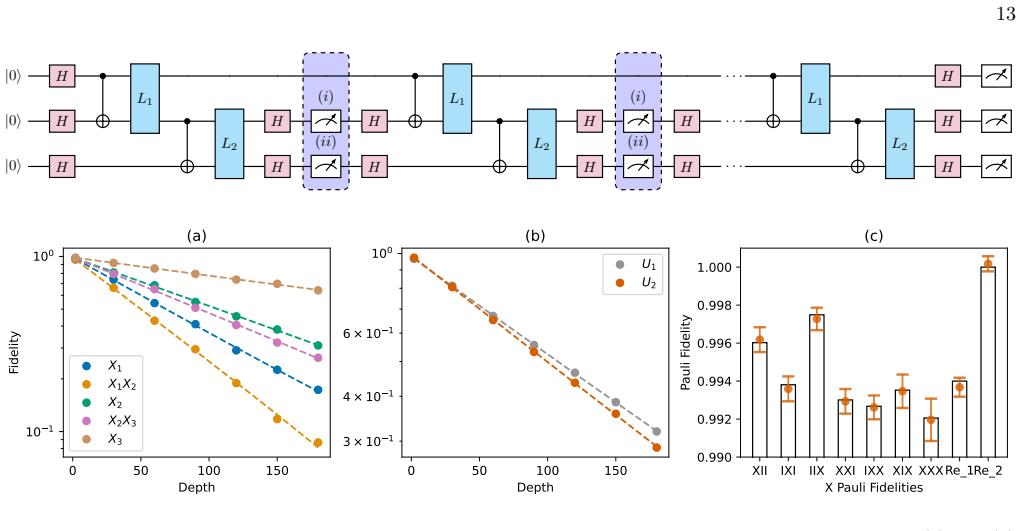
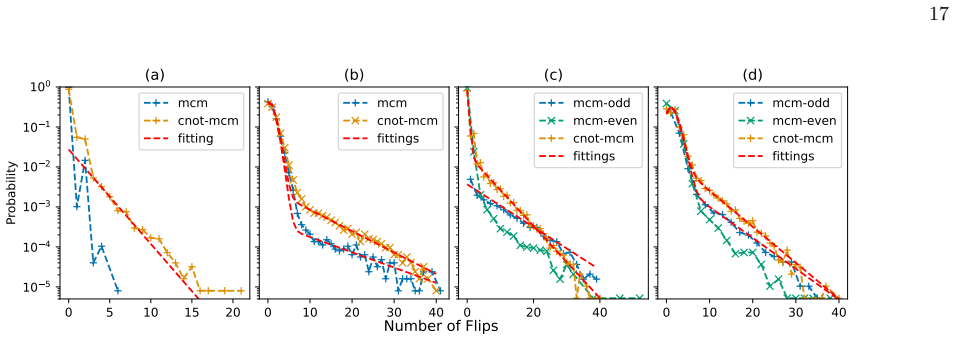
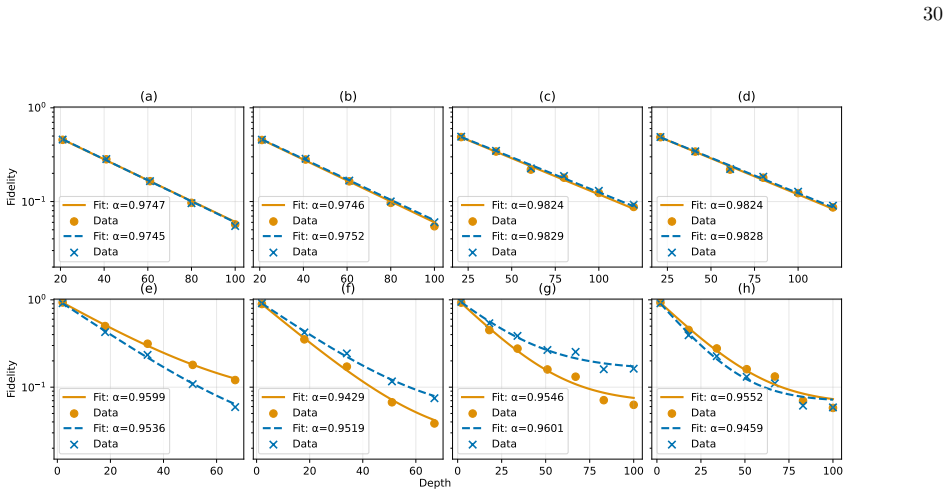
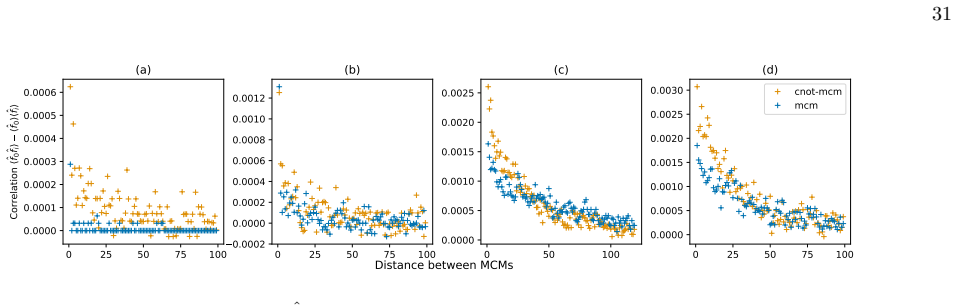
Binomial distribution In the second experiment, we apply the binomial anal- ysis to detect non-Markovian quantum effects, a key chal- lenge in quantum devices. Instead of performing bi- nomial expansion on the unlearnable pairs{λ 0z, λzz }, in this study, we perform binomial analysis directly on thelearnablefidelityλ z0, by expandingλ N z0 according to Eq...
1920
-
[5]
The first type of asymmetry is the afore- mentioned zig-zag distribution that appears in panels (a) and (c)
Asymmetries In Figure 9, we illustrate two types of asymmetry that emerge in panels (a), (c), and (d), when CB is performed on MCMs only. The first type of asymmetry is the afore- mentioned zig-zag distribution that appears in panels (a) and (c). It is characterized by its bias toward the even flips. In Figure 10, we simulate this effect by adding classic...
-
[6]
Based on previous studies [35], the emergence of exponen- tial tails finds a coherent explanation with the read-out dynamics when a leakage event takes place
Non-Markovian Contributions We propose a leakage model that explains the abnor- mal exponential tail observed in the binomial analysis on the quantum gates ofibm-aachenandibm-pittsburgh. Based on previous studies [35], the emergence of exponen- tial tails finds a coherent explanation with the read-out dynamics when a leakage event takes place. With super-...
-
[7]
Y. Kim, A. Eddins, S. Anand, K. X. Wei, E. van den Berg, S. Rosenblatt, H. Nayfeh, Y. Wu, M. Zaletel, K. Temme, and A. Kandala, Evidence for the utility of quantum computing before fault tolerance, Nature618, 500 (2023)
2023
-
[8]
Robledo-Moreno, M
J. Robledo-Moreno, M. Motta, H. Haas, A. Javadi- Abhari, P. Jurcevic, W. Kirby, S. Martiel, K. Sharma, S. Sharma, T. Shirakawa, I. Sitdikov, R.-Y. Sun, K. J. Sung, M. Takita, M. C. Tran, S. Yunoki, and A. Mezza- capo, Chemistry beyond the scale of exact diagonaliza- tion on a quantum-centric supercomputer, Sci. Adv11, eadu9991 (2025)
2025
-
[10]
van den Berg, Z
E. van den Berg, Z. K. Minev, A. Kandala, and K. Temme, Probabilistic error cancellation with sparse pauli–lindblad models on noisy quantum processors, Nat. Phys.19, 1116–1121 (2023)
2023
-
[11]
S. Filippov, M. Leahy, M. A. C. Rossi, and G. Garc´ ıa- P´ erez, Scalable tensor-network error mitigation for near- term quantum computing (2023), arXiv:2307.11740
- [12]
-
[13]
Mangini, M
S. Mangini, M. Cattaneo, D. Cavalcanti, S. Filippov, M. A. C. Rossi, and G. Garc´ ıa-P´ erez, Tensor network noise characterization for near-term quantum computers, Phys. Rev. Res.6, 033217 (2024)
2024
-
[14]
L. E. Fischer, M. Leahy, A. Eddins, N. Keenan, D. Fer- racin, M. A. C. Rossi, Y. Kim, A. He, F. Pietracaprina, B. Sokolov, S. Dooley, Z. Zimbor´ as, F. Tacchino, S. Man- iscalco, J. Goold, G. Garc´ ıa-P´ erez, I. Tavernelli, A. Kan- dala, and S. N. Filippov, Dynamical simulations of many- body quantum chaos on a quantum computer, Nat. Phys. 22, 302 (2026)
2026
-
[15]
C. H. Bennett, D. P. DiVincenzo, J. A. Smolin, and W. K. Wootters, Mixed-state entanglement and quantum error correction, Phys. Rev. A54, 3824–3851 (1996)
1996
-
[16]
Onorati, T
E. Onorati, T. Kohler, and T. S. Cubitt, Fitting quan- tum noise models to tomography data, Quantum7, 1197 (2023)
2023
-
[17]
Jayakumar, S
A. Jayakumar, S. Chessa, C. Coffrin, A. Y. Lokhov, M. Vuffray, and S. Misra, Universal framework for simul- taneous tomography of quantum states and spam noise, Quantum8, 1426 (2024)
2024
-
[18]
Erhard, J
A. Erhard, J. J. Wallman, L. Postler, M. Meth, R. Stricker, E. A. Martinez, P. Schindler, T. Monz, J. Emerson, and R. Blatt, Characterizing large-scale quantum computers via cycle benchmarking, Nat. Com- mun.10, 5347 (2019)
2019
-
[19]
Nielsen, J
E. Nielsen, J. K. Gamble, K. Rudinger, T. Scholten, K. Young, and R. Blume-Kohout, Gate set tomography, Quantum5, 557 (2021)
2021
-
[20]
S. Chen, Y. Liu, M. Otten, A. Seif, B. Fefferman, and L. Jiang, The learnability of Pauli noise, Nat. Commun. 14, 269 (2023)
2023
-
[21]
Bluvstein, S
D. Bluvstein, S. J. Evered, A. A. Geim, S. H. Li, H. Zhou, T. Manovitz, S. Ebadi, M. Cain, M. Kali- nowski, D. Hangleiter, J. P. Bonilla Ataides, N. Maskara, I. Cong, X. Gao, P. Sales Rodriguez, T. Karolyshyn, G. Semeghini, M. J. Gullans, M. Greiner, V. Vuleti´ c, and M. D. Lukin, Logical quantum processor based on reconfigurable atom arrays, Nature626, 58 (2024)
2024
-
[22]
Y. Yu, K. Yan, D. Biswas, V. N. Zhang, B. Harraz, C. Noel, C. Monroe, and A. Kozhanov, In situ mid- circuit qubit measurement and reset in a single-species trapped-ion quantum computing system, Phys. Rev. Res. 7, 043355 (2025)
2025
-
[23]
Bengtsson, A
A. Bengtsson, A. Opremcak, M. Khezri, D. Sank, A. Bourassa, K. J. Satzinger, S. Hong, C. Erickson, B. J. Lester, K. C. Miao, A. N. Korotkov, J. Kelly, Z. Chen, and P. V. Klimov, Model-based optimization of super- conducting qubit readout, Phys. Rev. Lett.132, 100603 (2024)
2024
-
[24]
V. A. Zhuravlev and S. N. Filippov, Quantum state to- mography via sequential uses of the same informationally incomplete measuring apparatus, Lobachevskii Journal of Mathematics41, 2405 (2020)
2020
-
[25]
I. A. Luchnikov and S. N. Filippov, Quantum evolution in the stroboscopic limit of repeated measurements, Phys. Rev. A95, 022113 (2017)
2017
-
[26]
Grimaudo, A
R. Grimaudo, A. Messina, A. Sergi, N. V. Vitanov, and S. N. Filippov, Two-qubit entanglement genera- tion through non-Hermitian Hamiltonians induced by re- peated measurements on an ancilla, Entropy22, 1184 (2020)
2020
-
[27]
A. D. C´ orcoles, M. Takita, K. Inoue, S. Lekuch, Z. K. Minev, J. M. Chow, and J. M. Gambetta, Exploiting dynamic quantum circuits in a quantum algorithm with superconducting qubits, Phys. Rev. Lett.127, 100501 (2021)
2021
-
[28]
A. Lemelin, C. Pere, O. Landon-Cardinal, and C. Coti, Mid-circuit measurement as an algorithmic primitive (2025), arXiv:2506.00118
-
[29]
Zhang, S
Z. Zhang, S. Chen, Y. Liu, and L. Jiang, Generalized cy- cle benchmarking algorithm for characterizing midcircuit measurements, PRX Quantum6, 010310 (2025). 21
2025
-
[30]
Hines and T
J. Hines and T. Proctor, Pauli noise learning for mid- circuit measurements, Phys. Rev. Lett.134, 020602 (2025)
2025
-
[31]
Hothem, J
D. Hothem, J. Hines, C. Baldwin, D. Gresh, R. Blume- Kohout, and T. Proctor, Measuring error rates of mid- circuit measurements, Nat. Commun.16, 5761 (2025)
2025
-
[32]
Introduction to Quantum Gate Set Tomography
D. Greenbaum, Introduction to quantum gate set tomog- raphy (2015), arXiv:1509.02921
work page internal anchor Pith review Pith/arXiv arXiv 2015
-
[33]
Z. Cai, R. Babbush, S. C. Benjamin, S. Endo, W. J. Hug- gins, Y. Li, J. R. McClean, and T. E. O’Brien, Quantum error mitigation, Rev. Mod. Phys.95, 045005 (2023)
2023
-
[34]
M. R. Geller and Z. Zhou, Efficient error models for fault- tolerant architectures and the pauli twirling approxima- tion, Phys. Rev. A88, 012314 (2013)
2013
-
[35]
S. T. Flammia and J. J. Wallman, Efficient estimation of Pauli channels, ACM Trans. Quantum Comput.1, 3 (2020)
2020
- [36]
-
[37]
D. McLaren, M. A. Graydon, and J. J. Wall- man, Stochastic errors in quantum instruments (2023), arXiv:2306.07418
-
[38]
A. H. Myerson, D. J. Szwer, S. C. Webster, D. T. C. Allcock, M. J. Curtis, G. Imreh, J. A. Sherman, D. N. Stacey, A. M. Steane, and D. M. Lucas, High-fidelity readout of trapped-ion qubits, Phys. Rev. Lett.100, 200502 (2008)
2008
-
[39]
Y. Quek, D. Stilck Fran¸ ca, S. Khatri, J. J. Meyer, and J. Eisert, Exponentially tighter bounds on limitations of quantum error mitigation, Nat. Phys.20, 1648 (2024), pMID: 39416853; PMCID: PMC11473368
2024
- [40]
-
[41]
Hazra, W
S. Hazra, W. Dai, T. Connolly, P. D. Kurilovich, Z. Wang, L. Frunzio, and M. H. Devoret, Benchmark- ing the readout of a superconducting qubit for repeated measurements, Phys. Rev. Lett.134, 100601 (2025). Appendix A: Mathematical Foundations of MCM Noise Learning In this section, we establish key results in MCM noise learning for generaln-qubit Clifford ...
2025
-
[42]
Pauli Propagation of Stochastic CNOT Theorem 5(Pauli Propagation for Stochastic CNOT). A stochastic CNOT, formed by tracing out the classical register of the QICF, replicates the Pauli transformation of a coherent CNOT gate onZ-type observables, up to a scalar prefactor from the classical readout error. For- mally, tracing out the classical register gives...
-
[43]
Learnable Degrees of Freedom Theorem 7.For cycles of quantum instruments, the classical read-out error is learnable SPAM-free if the pre- measurement and post-measurement errors are separable. Proof.Based on Theorems 2 and 5, the following can be learned via CB, isolating SPAM errors (pandqare dropped given the clear context): f1 =A(ω ZcZωZc+1Z)n +B,(A19)...
-
[44]
Lemma 1(Deferred Feed-Forward Principle for CB)
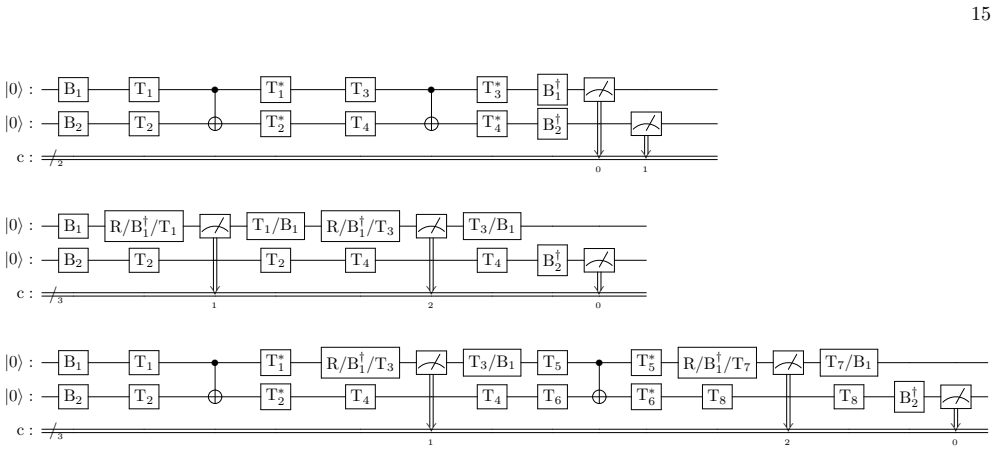
Deferred Feed-Forward Principle for Generalized CB Building on the learnability results for Markovian MCM errors, we establish the second key result in this work — that single-qubit Clifford gates, combined with MCMs, are sufficient to decouple all unlearnable degrees of freedom for arbitraryn-qubit Clifford gates. Lemma 1(Deferred Feed-Forward Principle ...
-
[45]
In this definition, the eventsa andbare separable
Binomial Distribution Consider a more restricted form of USI — a separable l= 1 USI, acting on qubitp: Nk(·) = X a,b∈Z2 pap′ b ΛaΛ′ b ⊗ X b p |k⟩⟩⟨⟨k|pX a p K (·).(C3) We adopt this representation to isolate a single-qubit measurement event from a parallel operation of MCMs governed by Theorem 6. In this definition, the eventsa andbare separable. The nota...
-
[46]
X keven N0 k ϵk 0(1−ϵ 0)N0−k # ×
Classical Read-out Error In Eq. (23), it is already assumed that the read-out er- rors are averaged due to randomized compilation. How- ever, we expect that the classical read-out assignment rate differs depending on the collapsed quantum basis state 0 or 1. In this section, we derive the effective read- out error fidelity due to randomized compilation. L...
-
[47]
Here, the effect of classical read-out errors on the binomial distribu- tion is further explored
Impact on Binomial Analysis In the previous sections, we derived the binomial ex- pression for binomial analysis directly from propagating the Paulis through the channels, and computed the im- pact of classical read-out errors on the fidelity. Here, the effect of classical read-out errors on the binomial distribu- tion is further explored. From Section IV...
discussion (0)
Sign in with ORCID, Apple, or X to comment. Anyone can read and Pith papers without signing in.