REVIEW 4 major objections 5 minor 30 references
Bias or Optimality? Disentangling Bayesian Inference and Learning Biases in Human Decision-Making
T0 review · 4 major / 5 minor · reviewed 2026-08-15 · deepseek-v4-flash
Pith's one-line read An objective Bayesian learner, when fit with standard Q-learning, appears to show the same positivity and confirmation biases found in human data.
desk verdict A smart and important critique of how confirmation bias is inferred from Q-learning fits, with a sound mathematical core that needs empirical support and a cleaner treatment of the update rule settings. read the letter →
The pith
A machine-rendered reading of the paper's core claim, the machinery that carries it, and where it could break.
The reading
What carries the argument
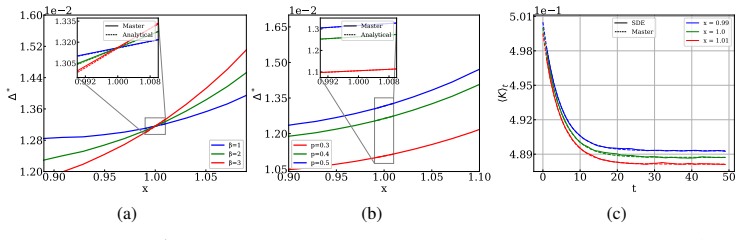
The central object is the exact mapping from Bayesian belief updating to Q-learning, condensed in the identity $\alpha_\pm = 1/(t+3)$: after $t$ pulls of an arm, the Bayesian agent's effective learning rate is the same for positive and negative prediction errors, so the learner is unbiased but its updates shrink over time. The argument is carried by a master equation, a bookkeeping equation for how the probability distribution over Q-values changes in time, closed at second order by Taylor-expanding the softmax choice rule. The resulting moment equations show that the action-switching probability $\langle K\rangle_t$ depends on the separation $\Delta_t = \langle(Q_1-Q_2)^2\rangle/2$, which evolves as $\Delta_{t+1} = (1-\alpha_t)^2 \Delta_t + p(1-p)\alpha_t^2$; the first term is a drift that shrinks the separation, the second is environmental noise that grows it, and decreasing $\alpha_t$ sustains a low switching rate in the same way that confirmation bias does.
What would settle it
Simulate a Bayesian agent in a counterfactual two-armed bandit where both arms update with $\alpha_\pm=1/(t+3)$, fit the standard constant asymmetric Q-learning model to its choices, and check whether the fitted asymmetry grows with trial count; if it does not, the paper's artifact mechanism fails.
Extended reading notes
Core claim
The paper establishes that Bayesian inference in a two-armed Bernoulli bandit is equivalent to a Q-learning agent with symmetric, decreasing learning rates: $\alpha_\pm = 1/(t+3)$. When an objective Bayesian agent's choices are fit with the standard constant-learning-rate Q-learning model, the fitted parameters recover positivity bias ($\alpha^c_+ > \alpha^c_-$) and confirmation bias ($\alpha^c_+ > \alpha^c_-$, $\alpha^u_- > \alpha^u_+$), exactly the patterns reported in human data. The mechanism is a shared reduction in action-switching probability: confirmation bias separates the estimated values of the arms, while decreasing learning rates let early random fluctuations separate the estimates and then lock them in place. The paper therefore concludes that apparent confirmation bias in human behavior can be an artifact of assuming constant learning rates, and it proposes a post-task third-arm choice whose predicted probabilities differ between the Bayesian and biased Q-learning accounts.
Load-bearing premise
The paper's central equivalence assumes the unchosen arm's estimate also learns at rate $1/(t+3)$, but the update rule used to derive that rate leaves the unchosen arm's estimate unchanged, so the bridge from the derived case to the fitted case is an assumption.
Editorial extensions
If this is right
- Re-fitting existing TABB data with a model whose learning rates decrease over time should reduce or remove the fitted positivity and confirmation biases, if the artifact account is correct.
- The two mechanisms predict different terminal estimates: Bayesian inference pulls both arms' Q-values toward the true reward probabilities, whereas biased constant-rate Q-learning pushes them apart.
- A test with a newly introduced third arm, whose reward rate lies between the two predicted terminal values, can separate the accounts because the Bayesian and biased Q-learning models predict different probabilities of choosing it.
- Claims that confirmation bias improves cumulative reward in bandit tasks may actually be capturing the benefit of decreasing learning rates, since both mechanisms lower switching without requiring a true bias.
Reading between the lines
- The paper leaves implicit that the same artifact could arise in any paradigm where a constant-learning-rate model is fit to data from an adaptive process with shrinking updates, such as exponential recency or Bayesian-filter-style learning.
- A testable extension is to introduce a change-point after learning has settled: a biased learner should stay overconfident, while a Bayesian learner should re-adapt, giving a behavioral separator beyond the third-arm probe.
- The moment-closure analysis could be applied to other generative model pairs to ask systematically which combinations of temporal learning-rate profiles and true biases are statistically distinguishable from constant-rate Q-learning.
Signed reviews
Editorial analysis
A structured set of objections, weighed in public.
Referee Report
Summary. The paper argues that the positivity and confirmation biases reported in human two-armed Bernoulli bandit (TABB) experiments can arise as fitting artifacts: even if an agent updates beliefs through objective Bayesian inference, fitting the standard Q-learning model with constant, asymmetric learning rates recovers both biases. The authors map Bayesian inference onto Q-learning with symmetric, decreasing learning rates, use master equations and a moment-closure approximation to show that both confirmation bias and decreasing learning rates reduce action-switching probabilities, fit Q-learning and Bayesian models to the data of Palminteri et al. (2017), and propose an experimental protocol to distinguish true biases from decreasing-learning-rate artifacts.
Significance. If the central claim is correct, the paper would substantially change the interpretation of a large empirical literature that infers positivity and confirmation biases from TABB data using constant-learning-rate Q-learning models. The master-equation treatment of action-switching dynamics is a useful theoretical contribution, and the proposed new-arm experiment in Sec. 3.2 gives concrete, falsifiable predictions that could separate the two accounts. The analytical derivations, especially Eqs. (28)-(30), are internally plausible and are validated against SDE simulations in Fig. 2. However, the load-bearing mapping in Eq. (7) has a setting inconsistency between the no-counterfactual update rule used in its derivation and the counterfactual setting that the paper says is its focus, and the empirical demonstration that fitting recovers biases is not described with sufficient detail to be checked.
major comments (4)
- [§2, Eq. (7)] The derivation of α± = 1/(t+3) uses the no-counterfactual update rule Eq. (3), where only the chosen arm's posterior changes, but the paper states that its focus is the counterfactual setting, in which both chosen and unchosen arms are updated. In the no-counterfactual setting the unchosen arm's effective learning rate is zero, not 1/(t+3), and for the chosen arm the denominator should be that arm's own observation count, not the global trial count. In the counterfactual setting, Eq. (3) is the wrong generative rule because both arms receive an observed reward each trial. The paper must state which setting Eq. (7) belongs to, derive the learning rates for both arms in the counterfactual setting, and reconcile Eq. (2), whose constraint α1+β1+α2+β2=t is incompatible with Eq. (7) when both arms are observed on every trial.
- [§2.2, Eqs. (29)-(30)] The master-equation analysis substitutes α_t = 1/(t+3) for both the chosen and unchosen arms, but this substitution is valid only under specific observation assumptions that are not stated. If the intended setting is counterfactual feedback, then the per-arm observation count is t and the substitution is plausible, but only after a correct counterfactual belief update is written down; if the intended setting is no-counterfactual feedback, the unchosen arm's learning rate is 0 throughout. Because Eqs. (29)-(30) are the theoretical basis for the claim that decreasing learning rates mimic confirmation bias, this ambiguity is load-bearing and must be resolved before the explanation can be accepted.
- [§3.1 and Fig. 1(a)] The abstract and Fig. 1(a) make the empirical claim that fitting the standard Q-learning model with asymmetric learning rates to data generated by a Bayesian agent recovers both positivity and confirmation biases, but the manuscript gives no simulation protocol: it does not report the number of simulated agents, the number of trials, the fitting procedure, the parameter ranges or initializations, the optimization algorithm, or the variability of the recovered learning rates across simulations. Without this information the central empirical demonstration cannot be reproduced or assessed, and the reader cannot tell whether the recovered asymmetries are robust or an artifact of a particular fitting schedule.
- [§2.1, Eq. (20)] The moment-closure approximation truncates the Taylor expansion at second order and assumes that the softmax nonlinearity is well approximated by its local behavior around the mean of the Q-distribution. The paper validates the approximation against SDE simulations for constant learning rates in Fig. 2, but it does not provide the same validation for the time-varying schedule α_t = 1/(t+3) over the trial horizons used in the human data. Since Eq. (30) is derived under this approximation, a direct comparison of the approximate and simulated ⟨K⟩_t for the Bayesian schedule would strengthen the paper's main mechanistic claim.
minor comments (5)
- [Eq. (2)] The notation α_i, β_i for beta-distribution counts conflicts with the learning-rate notation α^v_± used throughout; this is confusing in equations such as Eq. (7), where α appears in both roles.
- [Fig. 1(b)] The caption uses K_t before the text defines the ensemble-average action-switching probability; define ⟨K⟩_t in the caption or earlier in the text.
- [§3.2] The proposed new-arm experiment is described only at a conceptual level; the manuscript should specify how p_3 is chosen for each participant, how many trials are used, how the new arm is trained, and what decision rule will be used to prefer the Bayesian over the Q-learning account.
- [Eq. (13)] The shorthand Q^{+,v}_i and Q^{-,v}_i is used before it is defined; define these quantities immediately before Eq. (13).
- [Table 1] The table reports mean BIC and NLL across subjects but does not state the number of subjects, the standard error of the mean, or whether the BIC comparison is robust to the choice of fitting procedure; adding these details would strengthen the model-comparison section.
Circularity Check
No significant circularity: the claimed equivalence between Bayesian inference and Q-learning with decreasing symmetric learning rates is a direct algebraic mapping, and the master-equation analysis is self-contained.
full rationale
The paper's central claim is that Bayesian inference on a two-armed Bernoulli bandit can be rewritten as Q-learning with symmetric, decreasing learning rates, and that this temporal structure can produce the same reduced action-switching signature as confirmation bias when a constant-learning-rate Q-learning model is fit to the data. The derivation chain is self-contained and does not fit the target conclusion. Eq. 3 defines the Bayesian count update, Eq. 6 rewrites the posterior-mean update in Q-learning form, and Eq. 7 computes the resulting learning rate algebraically; no fitted parameter is renamed as a prediction. The master-equation analysis in Section 2 then independently derives moment dynamics (Eqs. 28-30) by substituting the derived alpha_t, and the analytic results are checked against SDE simulations. The model comparison with human data from Palminteri et al. (2017) is an empirical application, not a definitional input. Although the extension of Eq. 7 to the unchosen arm and to the counterfactual setting is mathematically questionable, because the unchosen arm's count does not advance under Eq. 3 and the paper uses the global trial count t rather than the per-arm count, this is a correctness concern about whether the equivalence holds in the intended setting, not a circular step, since the conclusion is not assumed in the premises. The paper also explicitly limits the equivalence to Bernoulli bandits, further indicating that the derivation is not being used to smuggle in the result.
Assumptions & free parameters
free parameters (3)
- Inverse temperature beta of the Bayesian and Q-learning agents =
not reported in the text
- Learning-rate asymmetries alpha_c+, alpha_c-, alpha_u+, alpha_u- in the fitted Q-learning model =
not reported in the text
- Demonstration schedule parameters alpha1, alpha2, tau_c in Fig. 3 =
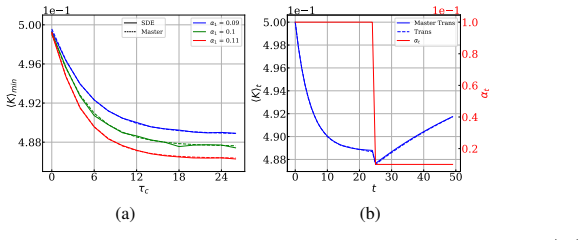
alpha1 = 0.1, alpha2 = 0.01, tau_c = 25 (also varied)
assumptions (5)
- standard math Beta-Bernoulli conjugacy and uniform prior: the agent's belief about each arm's reward probability is a Beta distribution updated by counting successes and failures.
- domain assumption In the counterfactual-feedback TABB task, the value of future information is independent of the current action, so the Bayes-optimal policy is the immediate greedy choice of Eq. 5.
- domain assumption Human choice probabilities follow a softmax with fixed inverse temperature beta over Q-values.
- ad hoc to paper The analytical derivations in Sec. 2 assume a symmetric environment p1 = p2 = p to isolate the effect of biases on action switching.
- ad hoc to paper The moment-closure approximation: the softmax nonlinearity is Taylor-expanded to second order around the distribution mean, truncating higher-order cumulants (Eqs. 19-20).
Cite this review
Pith. "Pith review of Bias or Optimality? Disentangling Bayesian Inference and Learning Biases in Human Decision-Making." pith.science (2026). https://pith.science/paper/JCFVBY3Q
@misc{pith2026250508049,
  author       = {Pith},
  title        = {Pith review of: Bias or Optimality? Disentangling Bayesian Inference and Learning Biases in Human Decision-Making},
  year         = {2026},
  howpublished = {\url{https://pith.science/paper/JCFVBY3Q}},
  note         = {Machine review of arXiv:2505.08049}
}
read the original abstract
Recent studies claim that human behavior in a two-armed Bernoulli bandit (TABB) task is described by positivity and confirmation biases, implying that humans do not integrate new information objectively. However, we find that even if the agent updates its belief via objective Bayesian inference, fitting the standard Q-learning model with asymmetric learning rates still recovers both biases. Bayesian inference cast as an effective Q-learning algorithm has symmetric, though decreasing, learning rates. We explain this by analyzing the stochastic dynamics of these learning systems using master equations. We find that both confirmation bias and unbiased but decreasing learning rates yield the same behavioral signatures. Finally, we propose experimental protocols to disentangle true cognitive biases from artifacts of decreasing learning rates.
Figures

Figures from the paper (1 more)

Reference graph
Works this paper leans on
-
[1]
Confirmation bias in human reinforcement learning: Evidence from counterfactual feedback processing
Stefano Palminteri, Germain Lefebvre, Emma J Kilford, and Sarah-Jayne Blakemore. Confirmation bias in human reinforcement learning: Evidence from counterfactual feedback processing. PLoS computational biology, 13 0 (8): 0 e1005684, 2017
work page 2017
-
[2]
Behavioural and neural characterization of optimistic reinforcement learning
Germain Lefebvre, Ma \"e l Lebreton, Florent Meyniel, Sacha Bourgeois-Gironde, and Stefano Palminteri. Behavioural and neural characterization of optimistic reinforcement learning. Nature Human Behaviour, 1 0 (4): 0 0067, 3 2017. ISSN 2397-3374. doi:10.1038/s41562-017-0067. URL https://doi.org/10.1038/s41562-017-0067
-
[3]
Hanneke E.M. den Ouden, Nathaniel D. Daw, Guillén Fernandez, Joris A. Elshout, Mark Rijpkema, Martine Hoogman, Barbara Franke, and Roshan Cools. Dissociable effects of dopamine and serotonin on reversal learning. Neuron, 80 0 (4): 0 1090--1100, 2013. ISSN 0896-6273. doi:https://doi.org/10.1016/j.neuron.2013.08.030. URL https://www.sciencedirect.com/scienc...
-
[4]
Genetic triple dissociation reveals multiple roles for dopamine in reinforcement learning
Michael J Frank, Ahmed A Moustafa, Heather M Haughey, Tim Curran, and Kent E Hutchison. Genetic triple dissociation reveals multiple roles for dopamine in reinforcement learning. Proceedings of the National Academy of Sciences, 104 0 (41): 0 16311--16316, 2007
work page 2007
-
[5]
Val \'e rian Chambon, H \'e lo \" se Th \'e ro, Marie Vidal, Henri Vandendriessche, Patrick Haggard, and Stefano Palminteri. Information about action outcomes differentially affects learning from self-determined versus imposed choices. Nature Human Behaviour, 4 0 (10): 0 1067--1079, 2020
work page 2020
-
[6]
Modeling changes in probabilistic reinforcement learning during adolescence
Liyu Xia, Sarah L Master, Maria K Eckstein, Beth Baribault, Ronald E Dahl, Linda Wilbrecht, and Anne Gabrielle Eva Collins. Modeling changes in probabilistic reinforcement learning during adolescence. PLoS computational biology, 17 0 (7): 0 e1008524, 2021
work page 2021
-
[7]
Antisocial punishment across societies
Benedikt Herrmann, Christian Thöni, and Simon Gächter. Antisocial punishment across societies. Science, 319 0 (5868): 0 1362--1367, 2008. doi:10.1126/science.1153808. URL https://www.science.org/doi/abs/10.1126/science.1153808
-
[8]
Bounded rational agents playing a public goods game
Prakhar Godara, Tilman Diego Al\'eman, and Stephan Herminghaus. Bounded rational agents playing a public goods game. Phys. Rev. E, 105: 0 024114, Feb 2022. doi:10.1103/PhysRevE.105.024114. URL https://link.aps.org/doi/10.1103/PhysRevE.105.024114
Show all 30 references
-
[9]
Bounded learning and planning in public goods games
Prakhar Godara and Stephan Herminghaus. Bounded learning and planning in public goods games. Phys. Rev. E, 107: 0 054140, May 2023. doi:10.1103/PhysRevE.107.054140. URL https://link.aps.org/doi/10.1103/PhysRevE.107.054140
2023 doi
-
[10]
Confusion cannot explain cooperative behavior in public goods games
Guangrong Wang, Jianbiao Li, Wenhua Wang, Xiaofei Niu, and Yue Wang. Confusion cannot explain cooperative behavior in public goods games. Proceedings of the National Academy of Sciences, 121 0 (10): 0 e2310109121, 2024. doi:10.1073/pnas.2310109121. URL https://www.pnas.org/doi...
2024 doi
-
[11]
Partners versus strangers: Random rematching in public goods experiments
James Andreoni and Rachel Croson. Partners versus strangers: Random rematching in public goods experiments. Handbook of experimental economics results, 1: 0 776--783, 2008
2008
-
[12]
Lee, and Eric-Jan Wagenmakers
Mark Steyvers, Michael D. Lee, and Eric-Jan Wagenmakers. A bayesian analysis of human decision-making on bandit problems. Journal of Mathematical Psychology, 53 0 (3): 0 168--179, 2009. ISSN 0022-2496. doi:https://doi.org/10.1016/j.jmp.2008.11.002. URL https://www.sciencedirec...
2009 doi
-
[13]
Forgetful bayes and myopic planning: Human learning and decision-making in a bandit setting
Shunan Zhang and Angela J Yu. Forgetful bayes and myopic planning: Human learning and decision-making in a bandit setting. Advances in neural information processing systems, 26, 2013
2013
-
[14]
Humans use directed and random exploration to solve the explore--exploit dilemma
Robert C Wilson, Andra Geana, John M White, Elliot A Ludvig, and Jonathan D Cohen. Humans use directed and random exploration to solve the explore--exploit dilemma. Journal of experimental psychology: General, 143 0 (6): 0 2074, 2014
2014
-
[15]
Brown, Michael N
Vanessa M. Brown, Michael N. Hallquist, Michael J. Frank, and Alexandre Y. Dombrovski. Humans adaptively resolve the explore-exploit dilemma under cognitive constraints: Evidence from a multi-armed bandit task. Cognition, 229: 0 105233, 2022. ISSN 0010-0277. doi:https://doi.or...
2022
-
[16]
Time pressure changes how people explore and respond to uncertainty
Charley M Wu, Eric Schulz, Timothy J Pleskac, and Maarten Speekenbrink. Time pressure changes how people explore and respond to uncertainty. Scientific reports, 12 0 (1): 0 4122, 2022
2022
-
[17]
Katehakis and Arthur F
Michael N. Katehakis and Arthur F. Veinott. The multi-armed bandit problem: Decomposition and computation. Mathematics of Operations Research, 12 0 (2): 0 262--268, 1987. doi:10.1287/moor.12.2.262. URL https://doi.org/10.1287/moor.12.2.262
1987 doi
-
[18]
The asymmetric learning rates of murine exploratory behavior in sparse reward environments
Hiroyuki Ohta, Kuniaki Satori, Yu Takarada, Masashi Arake, Toshiaki Ishizuka, Yuji Morimoto, and Tatsuji Takahashi. The asymmetric learning rates of murine exploratory behavior in sparse reward environments. Neural Networks, 143: 0 218--229, 2021. ISSN 0893-6080. doi:https://d...
2021 doi
-
[19]
Flexible combination of reward information across primates
Shiva Farashahi, Christopher H Donahue, Benjamin Y Hayden, Daeyeol Lee, and Alireza Soltani. Flexible combination of reward information across primates. Nature human behaviour, 3 0 (11): 0 1215--1224, 2019
2019
-
[20]
Theoretical neuroscience: computational and mathematical modeling of neural systems
Peter Dayan and Laurence F Abbott. Theoretical neuroscience: computational and mathematical modeling of neural systems. MIT press, 2005
2005
-
[21]
Optimal information processing and bayes's theorem
Arnold Zellner. Optimal information processing and bayes's theorem. The American Statistician, 42 0 (4): 0 278--280, 1988
1988
-
[22]
Towards a mathematical theory of cortical micro-circuits
Dileep George and Jeff Hawkins. Towards a mathematical theory of cortical micro-circuits. PLOS Computational Biology, 5 0 (10): 0 1--26, 10 2009. doi:10.1371/journal.pcbi.1000532. URL https://doi.org/10.1371/journal.pcbi.1000532
2009 doi
-
[23]
Bayesian models of cognition
Thomas L Griffiths, Charles Kemp, and Joshua B Tenenbaum. Bayesian models of cognition. 2008
2008
-
[24]
The statistical structures of reinforcement learning with asymmetric value updates
Kentaro Katahira. The statistical structures of reinforcement learning with asymmetric value updates. Journal of Mathematical Psychology, 87: 0 31--45, 2018. ISSN 0022-2496. doi:https://doi.org/10.1016/j.jmp.2018.09.002. URL https://www.sciencedirect.com/science/article/pii/S0...
2018 doi
-
[25]
Handbook of stochastic methods for physics, chemistry and the natural sciences
Crispin W Gardiner. Handbook of stochastic methods for physics, chemistry and the natural sciences. Springer series in synergetics, 1985
1985
-
[26]
Optimal Learning: Computational procedures for Bayes-adaptive Markov decision processes
Michael O'Gordon Duff. Optimal Learning: Computational procedures for Bayes-adaptive Markov decision processes. University of Massachusetts Amherst, 2002
2002
-
[27]
Probability models in engineering and science, volume 192
Haym Benaroya, Seon Mi Han, and Mark Nagurka. Probability models in engineering and science, volume 192. CRC press, 2005
2005
-
[28]
A Normative Account of Confirmation Bias During Reinforcement Learning
Germain Lefebvre, Christopher Summerfield, and Rafal Bogacz. A Normative Account of Confirmation Bias During Reinforcement Learning . Neural Computation, 34 0 (2): 0 307--337, 01 2022. ISSN 0899-7667. doi:10.1162/neco\_a\_01455. URL https://doi.org/10.1162/neco\_a\_01455
2022 doi
-
[29]
Moderate confirmation bias enhances decision-making in groups of reinforcement-learning agents
Clémence Bergerot, Wolfram Barfuss, and Pawel Romanczuk. Moderate confirmation bias enhances decision-making in groups of reinforcement-learning agents. PLOS Computational Biology, 20 0 (9): 0 1--22, 09 2024. doi:10.1371/journal.pcbi.1012404. URL https://doi.org/10.1371/journa...
2024 doi
-
[30]
write newline
" write newline "" before.all 'output.state := FUNCTION fin.entry add.period write newline FUNCTION new.sentence output.state after.block = 'skip output.state before.all = 'skip after.sentence 'output.state := if if FUNCTION not #0 #1 if FUNCTION and 'skip pop #0 if FUNCTION o...
Reviewed August 15, 2026 · model on record in the stance chip above.
Discussion (0). Continue with ORCID to comment.