Dialogue to Discovery: Attribute-Aware Preference Elicitation for Conversational Product Search Assistants
Pith reviewed 2026-06-25 22:39 UTC · model grok-4.3
The pith
D2D raises target-finding accuracy by 22-30% and shortens conversations 27.5% by prioritizing attribute queries in product search.
A machine-rendered reading of the paper's core claim, the machinery that carries it, and where it could break.
Core claim
D2D is an attribute-oriented preference elicitation framework that dynamically exploits the structure of product attributes to efficiently steer conversations toward the user's desired item by adaptively prioritizing the most informative queries and strategically timing product recommendations.
What carries the argument
Dialogue to Discovery (D2D), an attribute-oriented preference elicitation framework that exploits product attribute structure to prioritize queries and time recommendations.
If this is right
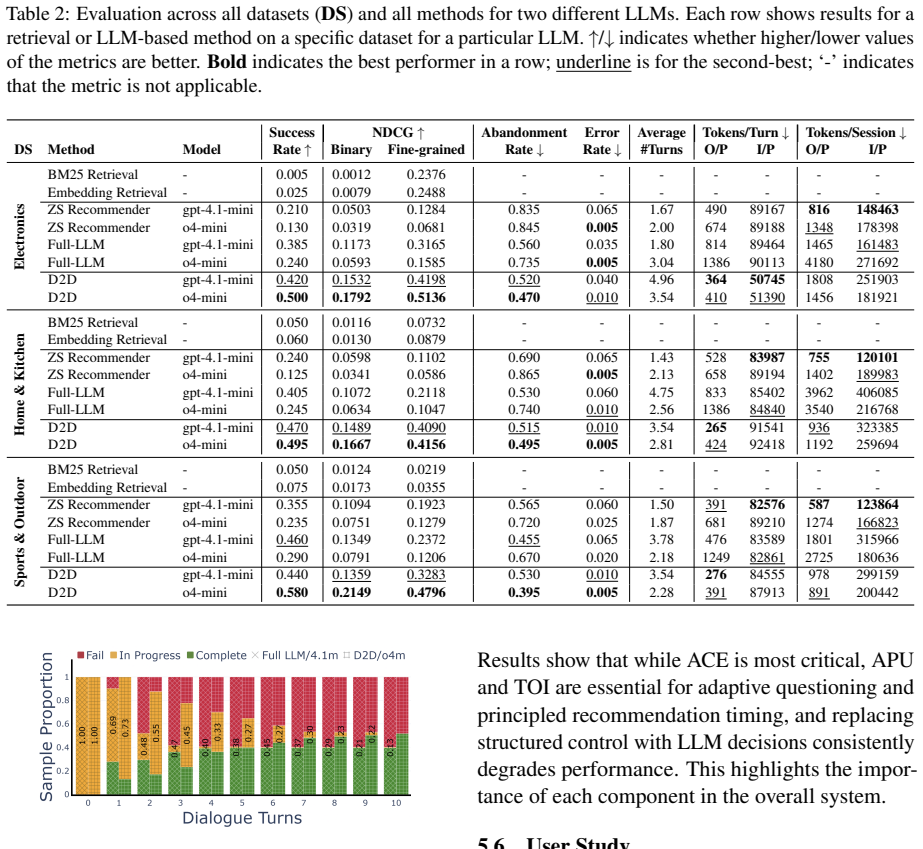
- Target-finding accuracy rises 22.2-29.9% over state-of-the-art baselines in the simulated setting.
- Session abandonment falls 6.6-16.1%.
- Average conversation length drops 27.5%.
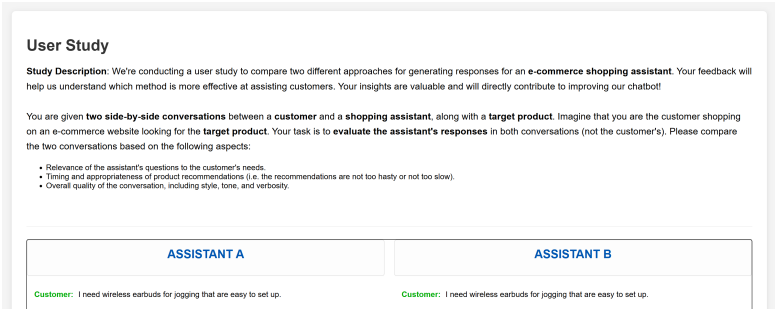
- Users report higher satisfaction and perceived efficiency in complementary studies.
Where Pith is reading between the lines
- The attribute-structure approach could transfer to conversational search in other item domains such as movies or jobs.
- Fewer queries per session might reduce server load in large-scale deployments.
- Testing against alternative user patience models would clarify robustness of the reported gains.
Load-bearing premise
Simulated conversations modeled with a multi-factor utilitarian patience framework accurately reflect real user behavior and abandonment patterns.
What would settle it
A deployment study with live users showing no measurable gains in accuracy or satisfaction over the same baselines would disprove the reported improvements.
Figures
read the original abstract
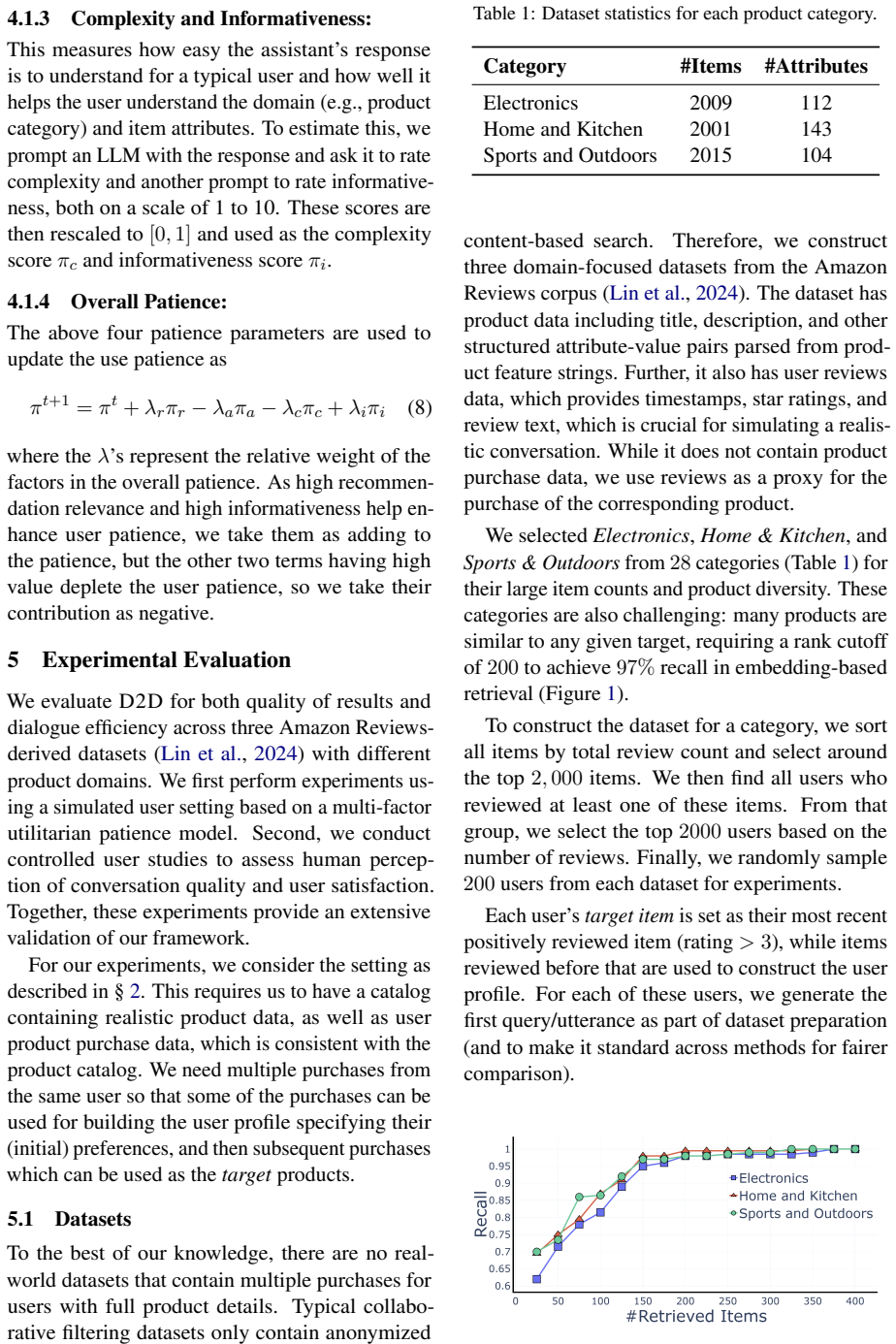
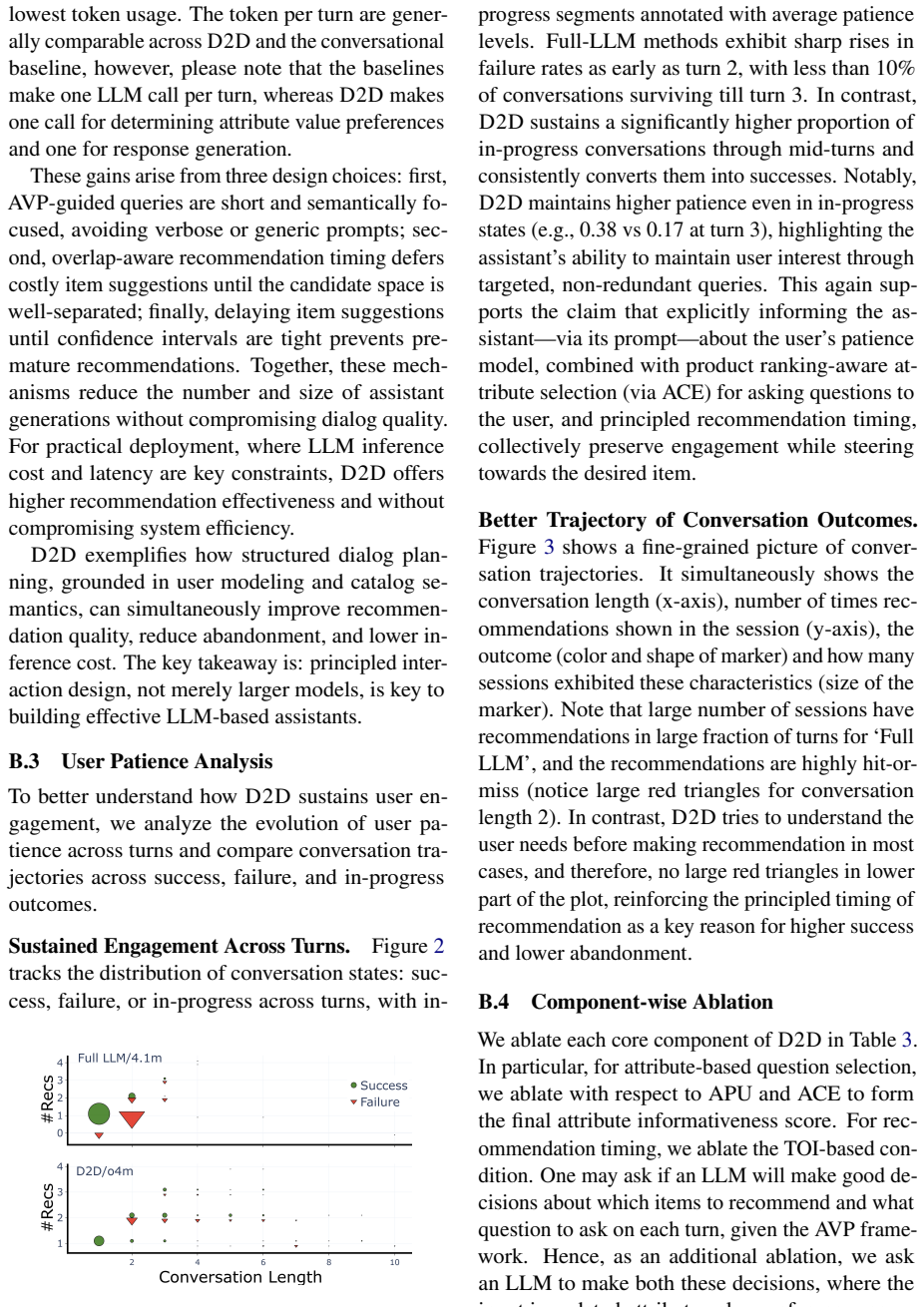
Conversational product search assistants offer a more expressive, natural, and interactive alternative to traditional keyword-based product search. With limited screen space, showing only a few items increases the need for precise preference elicitation, which can prolong conversations, leading to user frustration and session abandonment. Conversely, rushing to recommend items without a clear understanding of preferences risks poor matches and a degraded user experience. We present Dialogue to Discovery (D2D), an attribute-oriented preference elicitation framework that dynamically exploits the structure of product attributes to efficiently steer conversations toward the user's desired item. D2D adaptively prioritizes the most informative queries and strategically times product recommendations, reducing premature or off-target suggestions that harm engagement. To evaluate D2D, we curate three datasets from the Amazon Reviews corpus. In simulated conversations modelled using a multi-factor utilitarian patience framework, D2D achieves a 22.2-29.9% improvement in target-finding accuracy, 6.6-16.1% reduction in abandonment, and 27.5% shorter average conversations over the state-of-the-art baselines. A complementary user study further confirms significant gains in both user satisfaction and perceived efficiency.
Editorial analysis
A structured set of objections, weighed in public.
Referee Report
Summary. The paper introduces Dialogue to Discovery (D2D), an attribute-oriented preference elicitation framework for conversational product search that adaptively prioritizes informative attribute queries and strategically times recommendations to balance elicitation depth against user frustration. It curates three datasets from the Amazon Reviews corpus and evaluates D2D in simulated conversations under a multi-factor utilitarian patience framework, reporting 22.2-29.9% gains in target-finding accuracy, 6.6-16.1% reductions in abandonment, and 27.5% shorter conversations versus baselines, with a complementary user study cited for qualitative gains in satisfaction and efficiency.
Significance. If the simulation framework's assumptions about user patience and abandonment hold, D2D offers a practical advance in conversational search by exploiting attribute structure for more efficient elicitation. The multi-dataset curation and adaptive query/recommendation strategy are strengths that could influence future systems; however, the absence of simulation validation or quantitative user-study metrics reduces the immediate generalizability of the reported margins.
major comments (3)
- [Evaluation] Evaluation section (and abstract): All reported quantitative improvements (22.2-29.9% accuracy, 6.6-16.1% abandonment reduction, 27.5% shorter conversations) rest exclusively on conversations simulated under the multi-factor utilitarian patience framework, yet no parameter values, factor definitions, abandonment logic, or sensitivity analysis are provided, nor is any calibration against real user logs described.
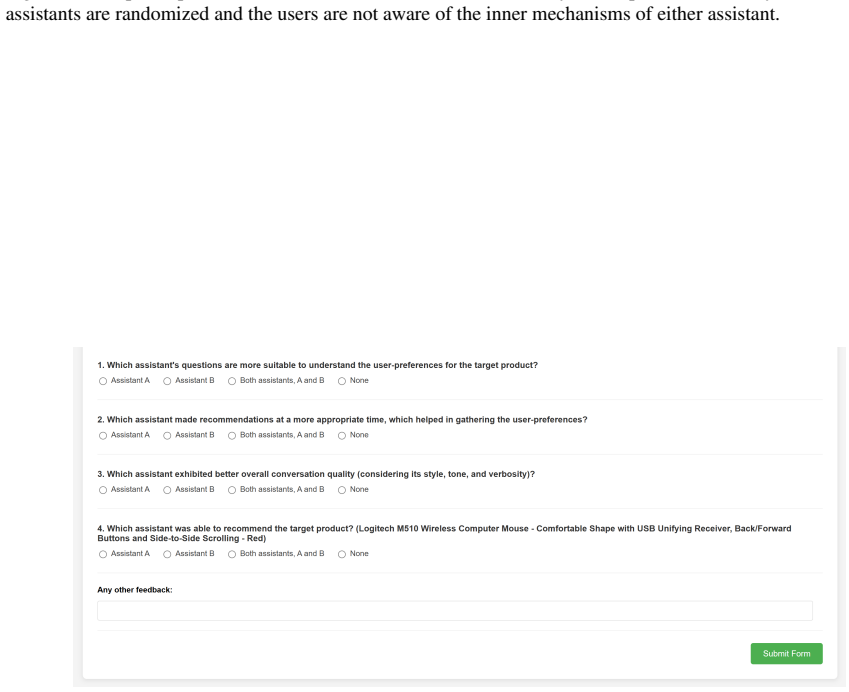
- [User study] User study paragraph: The study is invoked only to confirm 'significant gains in both user satisfaction and perceived efficiency' with no sample size, metrics, statistical tests, or numerical results supplied, so it cannot serve as independent corroboration of the simulation-derived claims.
- [Datasets] Dataset curation: The construction of the three Amazon Reviews datasets (attribute extraction, target-item selection for simulation, and conversation initialization) is not detailed enough to assess whether the reported margins generalize beyond the specific simulation setup.
minor comments (1)
- [Evaluation] No error bars, confidence intervals, or p-values accompany the percentage improvements, making it impossible to judge whether the margins are statistically distinguishable from baseline variance.
Simulated Author's Rebuttal
We thank the referee for the constructive comments, which highlight important areas for improving the clarity and reproducibility of our work. We address each major comment below and will revise the manuscript accordingly.
read point-by-point responses
-
Referee: [Evaluation] Evaluation section (and abstract): All reported quantitative improvements (22.2-29.9% accuracy, 6.6-16.1% abandonment reduction, 27.5% shorter conversations) rest exclusively on conversations simulated under the multi-factor utilitarian patience framework, yet no parameter values, factor definitions, abandonment logic, or sensitivity analysis are provided, nor is any calibration against real user logs described.
Authors: We agree that the simulation framework requires substantially more detail for reproducibility. In the revised manuscript, we will add a dedicated subsection (and appendix if needed) that fully specifies the multi-factor utilitarian patience framework, including exact parameter values, definitions of each factor, the complete abandonment logic, results of sensitivity analyses, and any calibration or validation steps performed against real user logs or alternative models. This will directly address the concern about generalizability. revision: yes
-
Referee: [User study] User study paragraph: The study is invoked only to confirm 'significant gains in both user satisfaction and perceived efficiency' with no sample size, metrics, statistical tests, or numerical results supplied, so it cannot serve as independent corroboration of the simulation-derived claims.
Authors: The user study was designed as a small-scale complementary qualitative assessment rather than a primary quantitative validation. We acknowledge the current description is insufficient. In revision, we will expand the paragraph to report the sample size, metrics collected, any statistical tests applied, and numerical results (or p-values) where available. If the study remains primarily qualitative, we will adjust the wording to avoid implying quantitative corroboration of the simulation results. revision: yes
-
Referee: [Datasets] Dataset curation: The construction of the three Amazon Reviews datasets (attribute extraction, target-item selection for simulation, and conversation initialization) is not detailed enough to assess whether the reported margins generalize beyond the specific simulation setup.
Authors: We agree that the dataset curation process must be described in greater detail to support reproducibility and assessment of generalizability. In the revised version, we will expand the relevant section to include step-by-step descriptions of attribute extraction methods, criteria and procedures for target-item selection, and the logic for conversation initialization across the three datasets derived from the Amazon Reviews corpus. revision: yes
Circularity Check
No significant circularity; results are empirical comparisons on simulated data
full rationale
The paper's central claims rest on empirical metrics (target-finding accuracy, abandonment rates, conversation length) obtained by running D2D and baselines inside a multi-factor utilitarian patience simulation on three curated Amazon datasets. No equations, fitted parameters renamed as predictions, self-definitional loops, or load-bearing self-citations appear in the derivation chain. The simulation framework and evaluation protocol are presented as external to the core algorithm, and the reported improvements are direct outcome comparisons rather than quantities forced by construction from the inputs. This is the normal case of a self-contained empirical study.
Axiom & Free-Parameter Ledger
Reference graph
Works this paper leans on
-
[1]
AI open , volume=
Advances and challenges in conversational recommender systems: A survey , author=. AI open , volume=. 2021 , publisher=
2021
-
[2]
Computer Speech & Language , volume=
The effect of preference elicitation methods on the user experience in conversational recommender systems , author=. Computer Speech & Language , volume=. 2025 , publisher=
2025
-
[3]
arXiv preprint arXiv:2303.14524 , year=
Chat-rec: Towards interactive and explainable llms-augmented recommender system , author=. arXiv preprint arXiv:2303.14524 , year=
-
[4]
2024 IEEE 40th International Conference on Data Engineering (ICDE) , pages=
Adapting large language models by integrating collaborative semantics for recommendation , author=. 2024 IEEE 40th International Conference on Data Engineering (ICDE) , pages=. 2024 , organization=
2024
-
[5]
arXiv preprint arXiv:2403.03952 , year=
Bridging language and items for retrieval and recommendation , author=. arXiv preprint arXiv:2403.03952 , year=
-
[6]
ACM Transactions on Information Systems (TOIS) , volume=
Cumulated gain-based evaluation of IR techniques , author=. ACM Transactions on Information Systems (TOIS) , volume=. 2002 , publisher=
2002
-
[7]
Proceedings of the 27th acm international conference on information and knowledge management , pages=
Towards conversational search and recommendation: System ask, user respond , author=. Proceedings of the 27th acm international conference on information and knowledge management , pages=
-
[8]
Proceedings of the 15th ACM conference on recommender systems , pages=
Partially observable reinforcement learning for dialog-based interactive recommendation , author=. Proceedings of the 15th ACM conference on recommender systems , pages=
-
[9]
Proceedings of the 44th international ACM SIGIR conference on research and development in information retrieval , pages=
Learning to ask appropriate questions in conversational recommendation , author=. Proceedings of the 44th international ACM SIGIR conference on research and development in information retrieval , pages=
-
[10]
Proceedings of the 43rd International ACM SIGIR Conference on Research and Development in Information Retrieval , pages=
Conversational recommendation: Formulation, methods, and evaluation , author=. Proceedings of the 43rd International ACM SIGIR Conference on Research and Development in Information Retrieval , pages=
-
[11]
Proceedings of the 13th international conference on web search and data mining , pages=
Estimation-action-reflection: Towards deep interaction between conversational and recommender systems , author=. Proceedings of the 13th international conference on web search and data mining , pages=
-
[12]
Proceedings of the 22nd ACM SIGKDD international conference on knowledge discovery and data mining , pages=
Towards conversational recommender systems , author=. Proceedings of the 22nd ACM SIGKDD international conference on knowledge discovery and data mining , pages=
-
[13]
Applied Intelligence , volume=
Conversational case-based reasoning , author=. Applied Intelligence , volume=. 2001 , publisher=
2001
-
[14]
Computer Speech & Language , volume=
The hidden information state model: A practical framework for POMDP-based spoken dialogue management , author=. Computer Speech & Language , volume=. 2010 , publisher=
2010
-
[15]
Rethinking the Evaluation for Conversational Recommendation in the Era of Large Language Models
Wang, Xiaolei and Tang, Xinyu and Zhao, Xin and Wang, Jingyuan and Wen, Ji-Rong. Rethinking the Evaluation for Conversational Recommendation in the Era of Large Language Models. Proceedings of the 2023 Conference on Empirical Methods in Natural Language Processing. 2023. doi:10.18653/v1/2023.emnlp-main.621
-
[16]
Companion Proceedings of the ACM on Web Conference 2025 , pages=
RecUserSim: A Realistic and Diverse User Simulator for Evaluating Conversational Recommender Systems , author=. Companion Proceedings of the ACM on Web Conference 2025 , pages=
2025
-
[17]
Proceedings of the 33rd ACM Conference on User Modeling, Adaptation and Personalization , pages=
Should We Tailor the Talk? Understanding the Impact of Conversational Styles on Preference Elicitation in Conversational Recommender Systems , author=. Proceedings of the 33rd ACM Conference on User Modeling, Adaptation and Personalization , pages=
-
[18]
Jin, Yucheng and Chen, Li and Cai, Wanling and Pu, Pearl , title =. 2021 , isbn =. doi:10.1145/3472307.3484164 , booktitle =
-
[19]
Xu, Lanling and Zhang, Junjie and Li, Bingqian and Wang, Jinpeng and Chen, Sheng and Zhao, Wayne Xin and Wen, Ji-Rong , title =. 2025 , volume =. doi:10.1145/3726871 , journal =
doi:10.1145/3726871 2025
-
[20]
Proceedings of the ACM Web Conference 2023 , pages=
Enhancing user personalization in conversational recommenders , author=. Proceedings of the ACM Web Conference 2023 , pages=
2023
-
[21]
arXiv preprint arXiv:2308.06212 , year=
A large language model enhanced conversational recommender system , author=. arXiv preprint arXiv:2308.06212 , year=
-
[22]
Findings of the Association for Computational Linguistics ACL 2024 , pages=
LLM-REDIAL: a large-scale dataset for conversational recommender systems created from user behaviors with llms , author=. Findings of the Association for Computational Linguistics ACL 2024 , pages=
2024
-
[23]
MUSE : A Multimodal Conversational Recommendation Dataset with Scenario-Grounded User Profiles
Wang, Zihan and Yang, Xiaocui and Liu, YongKang and Feng, Shi and Wang, Daling and Zhang, Yifei. MUSE : A Multimodal Conversational Recommendation Dataset with Scenario-Grounded User Profiles. Findings of the Association for Computational Linguistics: ACL 2025. 2025. doi:10.18653/v1/2025.findings-acl.58
-
[24]
University of Wisconsin, Madison, Tech
The cnet e-commerce data set , author=. University of Wisconsin, Madison, Tech. Report , year=
-
[25]
arXiv preprint arXiv:2402.01742 , year=
Towards optimizing the costs of llm usage , author=. arXiv preprint arXiv:2402.01742 , year=
-
[26]
arXiv preprint arXiv:2412.18715 , year=
Optimization and scalability of collaborative filtering algorithms in large language models , author=. arXiv preprint arXiv:2412.18715 , year=
-
[27]
ACM Transactions on Information Systems , volume=
How can recommender systems benefit from large language models: A survey , author=. ACM Transactions on Information Systems , volume=. 2025 , publisher=
2025
-
[28]
2025 , url =
Mearch AI , title =. 2025 , url =
2025
-
[29]
Malik and S
V. Malik and S. Kallumadi and S. Chaidaroon and S. Yadav and P. R. Suram and A. Puthenputhussery and S. Chen and M. Xie and A. Kashi and T. Lee and A. Magnani and C. Liao , title =. Amazon Science , year =
-
[30]
Magnani and D
A. Magnani and D. M. Bendersky and J. Lin and S. Yadav and F. Liu and N. Rossi and P. R. Suram and S. Chembolu and P. Chandran and H. Mohapatra and T. Lee and A. Magnani and C. Liao , title =. Proceedings of the 28th ACM SIGKDD Conference on Knowledge Discovery and Data Mining , year =
-
[31]
Trotman and J
A. Trotman and J. Degenhardt and S. Kallumadi , title =. CEUR Workshop Proceedings , volume =. 2017 , url =
2017
-
[32]
Catsy Blog , year =
Catsy , title =. Catsy Blog , year =
-
[33]
IEEE Transactions on Knowledge and Data Engineering , volume=
Recommender systems in the era of large language models (llms) , author=. IEEE Transactions on Knowledge and Data Engineering , volume=. 2024 , publisher=
2024
-
[34]
2025 , url =
Zendesk , title =. 2025 , url =
2025
-
[35]
2025 , url =
Tidio , title =. 2025 , url =
2025
-
[36]
2025 , url =
Intercom , title =. 2025 , url =
2025
-
[37]
2024 , url =
Amazon , title =. 2024 , url =
2024
-
[38]
2025 , url =
PSCon Team , title =. 2025 , url =
2025
-
[39]
Foundations and Trends
The probabilistic relevance framework: BM25 and beyond , author=. Foundations and Trends. 2009 , publisher=
2009
-
[40]
Proceedings of the 2023 Conference on Empirical Methods in Natural Language Processing , pages=
HutCRS: Hierarchical user-interest tracking for conversational recommender system , author=. Proceedings of the 2023 Conference on Empirical Methods in Natural Language Processing , pages=
2023
-
[41]
Mathematics , volume=
Extracting Implicit User Preferences in Conversational Recommender Systems Using Large Language Models , author=. Mathematics , volume=. 2025 , publisher=
2025
-
[42]
Proceedings of the 47th International ACM SIGIR Conference on Research and Development in Information Retrieval , pages=
Large language models for intent-driven session recommendations , author=. Proceedings of the 47th International ACM SIGIR Conference on Research and Development in Information Retrieval , pages=
-
[43]
He, Zhankui and Xie, Zhouhang and Jha, Rahul and Steck, Harald and Liang, Dawen and Feng, Yesu and Majumder, Bodhisattwa Prasad and Kallus, Nathan and Mcauley, Julian , title =. 2023 , isbn =. doi:10.1145/3583780.3614949 , booktitle =
-
[44]
Lin, Xinyu and Wang, Wenjie and Li, Yongqi and Feng, Fuli and Ng, See-Kiong and Chua, Tat-Seng , title =. 2024 , isbn =. doi:10.1145/3637528.3671884 , booktitle =
-
[45]
Xiao, Shitao and Liu, Zheng and Zhang, Peitian and Muennighoff, Niklas and Lian, Defu and Nie, Jian-Yun , title =. 2024 , url =. doi:10.1145/3626772.3657878 , booktitle =
-
[46]
Cai, Wanling and Jin, Yucheng and Chen, Li , title =. 2022 , isbn =. doi:10.1145/3491102.3517471 , booktitle =
-
[47]
Bauer, Christine and Zangerle, Eva and Said, Alan , title =. 2024 , issue_date =. doi:10.1145/3629170 , journal =
doi:10.1145/3629170 2024
-
[48]
Leave No Document Behind: Benchmarking Long-Context LLM s with Extended Multi-Doc QA
Wang, Minzheng and Chen, Longze and Cheng, Fu and Liao, Shengyi and Zhang, Xinghua and Wu, Bingli and Yu, Haiyang and Xu, Nan and Zhang, Lei and Luo, Run and Li, Yunshui and Yang, Min and Huang, Fei and Li, Yongbin. Leave No Document Behind: Benchmarking Long-Context LLM s with Extended Multi-Doc QA. Proceedings of the 2024 Conference on Empirical Methods...
-
[49]
Diriye, Abdigani and White, Ryen and Buscher, Georg and Dumais, Susan , title =. Proceedings of the 21st ACM International Conference on Information and Knowledge Management , pages =. 2012 , isbn =. doi:10.1145/2396761.2398399 , abstract =
-
[50]
Learning to Ask: Conversational Product Search via Representation Learning , volume=
Zou, Jie and Huang, Jimmy and Ren, Zhaochun and Kanoulas, Evangelos , year=. Learning to Ask: Conversational Product Search via Representation Learning , volume=. ACM Transactions on Information Systems , publisher=. doi:10.1145/3555371 , number=
discussion (0)
Sign in with ORCID, Apple, or X to comment. Anyone can read and Pith papers without signing in.