Bulk viscous cosmological model in f(R,T) theory of gravity
Pith reviewed 2026-05-25 09:31 UTC · model grok-4.3
The pith
Bulk viscous cosmological models in f(R,T) gravity with the form f(R,T)=R+2λT are compatible with observations in Eckart, truncated Israel-Stewart, and full Israel-Stewart theories.
A machine-rendered reading of the paper's core claim, the machinery that carries it, and where it could break.
Core claim
In this work, exact cosmological solutions are derived for a flat FRW metric in f(R,T) gravity with f(R,T)=R+2λT in the presence of bulk viscous fluid. Solutions are obtained separately within the Eckart theory, the truncated Israel-Stewart theory, and the full Israel-Stewart theory. Detailed analysis of physical and geometrical properties, including the behavior of bulk viscous pressure, Hubble parameter, and deceleration parameter, demonstrates that these models remain consistent with current cosmological observations.
What carries the argument
The linear modification f(R,T)=R+2λT combined with bulk viscosity prescriptions from Eckart and Israel-Stewart theories applied to a flat FRW metric, which generates the scale factor and thermodynamic quantities.
If this is right
- The scale factor and Hubble parameter evolve to produce a late-time transition from deceleration to acceleration.
- Bulk viscous pressure stays negative and contributes to the effective negative pressure needed for observed expansion.
- Energy density and pressure profiles decrease with time in a way that matches standard cosmological expectations.
- The models remain viable without requiring additional exotic matter fields beyond the viscous fluid.
Where Pith is reading between the lines
- If the models hold, viscosity in modified gravity may substitute for a separate dark energy component in driving acceleration.
- Predictions for perturbation growth or gravitational wave propagation could be derived to test the framework further.
- The same construction might be applied to non-flat or anisotropic metrics to check broader consistency.
Load-bearing premise
The specific linear form f(R,T)=R+2λT together with the applicability of standard bulk viscosity theories remains valid when embedded in this modified gravity framework for a flat FRW metric.
What would settle it
A measurement of the deceleration parameter or Hubble parameter that deviates from the derived time evolution in all three viscosity theories would rule out the claimed compatibility.
Figures
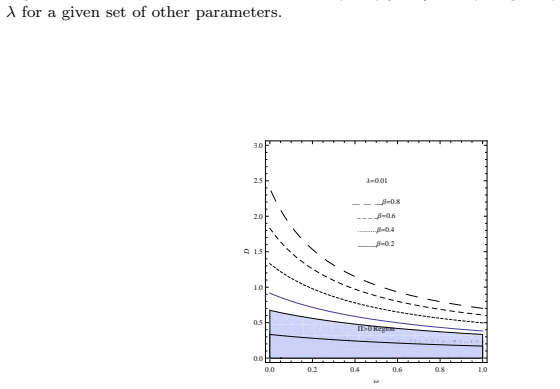
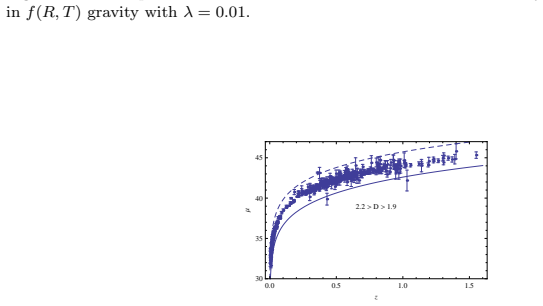
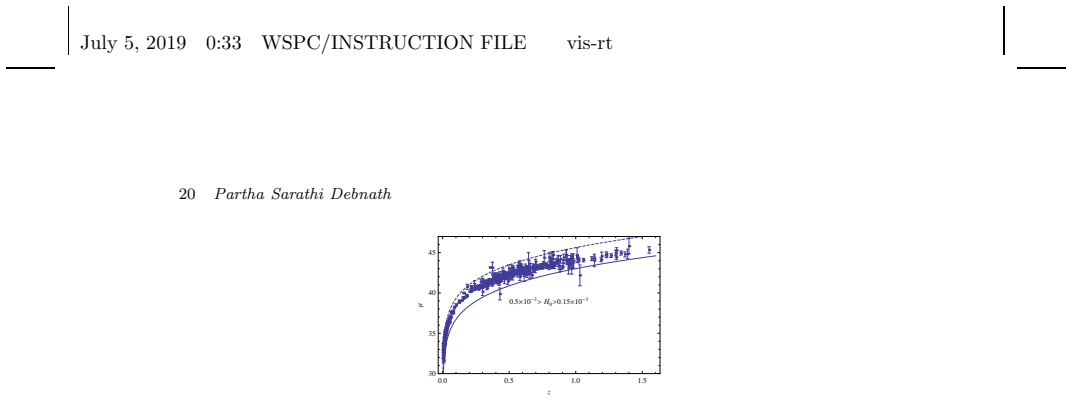
read the original abstract
In this paper, we have presented bulk viscous cosmological model of the universe in the modified gravity theory in which the Lagragian of the gravitational action contains a general function $f(R, T) $, where $R$ and $T$ denote the curvature scalar and the trace of the energy-momentum tensor respectively, in the framework of a flat Friedmann-Robertson-Walker model with isotropic fluid. We obtain cosmological solution in $f(R,T)$ theory of gravity, specially of particular choice $f(R,T)=R+2\lambda T$, where $\lambda$ is a constant, in the presence of bulk viscosity that are permitted in Eckart theory, Truncated Israel Stewart theory and Full Israel Stewart theory. The physical and geometrical properties of the models in Eckart, Truncated Israel Stewart theory and Full Israel Stewart theory are studied in detail. The analysis of the variation of bulk viscous pressure, energy density, scale factor, Hubble parameter and deceleration parameter with cosmic evolution are done in the respective theories. The models are analyzed by comparison with recent observational data. The cosmological models are compatible with observations.
Editorial analysis
A structured set of objections, weighed in public.
Referee Report
Summary. The paper constructs bulk viscous cosmological models in f(R,T) gravity for a flat FRW metric using the specific form f(R,T)=R+2λT. It derives solutions under Eckart, truncated Israel-Stewart, and full Israel-Stewart bulk-viscosity prescriptions, examines the evolution of energy density, scale factor, Hubble parameter, deceleration parameter, and viscous pressure, and concludes that the resulting models are compatible with recent observational data.
Significance. If the transport equations are shown to be consistent with the modified field equations and the observational comparison is performed with explicit data and error analysis, the work would provide a concrete example of dissipative cosmology in f(R,T) gravity and could motivate further study of entropy production in modified gravity. The parameter-free aspects of the derivations (if any) and any machine-checked consistency checks would strengthen the contribution.
major comments (2)
- [Sections deriving the field equations and viscous models (likely §§3–4)] The central modeling step—direct insertion of the standard Eckart relation π=−3Hζ and the truncated/full Israel-Stewart evolution equations for π into the f(R,T) Friedmann and continuity equations—is not justified. The extra −2λT contribution to the effective energy-momentum tensor modifies both the Friedmann equations and the continuity equation; no section demonstrates that the thermodynamic identity, Gibbs relation, or entropy-production formula used to derive the Israel-Stewart equations survive this modification. This assumption is load-bearing for all three models.
- [Abstract and concluding section] The claim of observational compatibility is asserted in the abstract and conclusion but is not supported by any tabulated data, χ² values, best-fit parameters, or exclusion criteria. Without these, it is impossible to assess whether the models are genuinely compatible or merely adjustable via λ and the viscosity coefficients.
minor comments (2)
- [Abstract] Typo: 'Lagragian' should be 'Lagrangian'.
- [Field-equations section] Notation for the viscosity coefficients and the constant λ should be introduced with explicit definitions before use in the solutions.
Simulated Author's Rebuttal
We thank the referee for the constructive comments on our manuscript. We address each major point below and will revise the paper accordingly to strengthen the presentation.
read point-by-point responses
-
Referee: [Sections deriving the field equations and viscous models (likely §§3–4)] The central modeling step—direct insertion of the standard Eckart relation π=−3Hζ and the truncated/full Israel-Stewart evolution equations for π into the f(R,T) Friedmann and continuity equations—is not justified. The extra −2λT contribution to the effective energy-momentum tensor modifies both the Friedmann equations and the continuity equation; no section demonstrates that the thermodynamic identity, Gibbs relation, or entropy-production formula used to derive the Israel-Stewart equations survive this modification. This assumption is load-bearing for all three models.
Authors: We acknowledge that the original manuscript did not explicitly demonstrate the survival of the standard thermodynamic relations under the f(R,T) modification. In the revision we will insert a new subsection (in §3) that justifies the use of the Eckart and Israel-Stewart transport equations. The argument is that the viscous pressure π enters the matter energy-momentum tensor in the usual way, while the f(R,T) term only alters the gravitational field equations; the local Gibbs relation and entropy-production formula for the fluid therefore remain unchanged to the order considered. We will support this with citations to analogous treatments in other modified-gravity viscous cosmologies. revision: yes
-
Referee: [Abstract and concluding section] The claim of observational compatibility is asserted in the abstract and conclusion but is not supported by any tabulated data, χ² values, best-fit parameters, or exclusion criteria. Without these, it is impossible to assess whether the models are genuinely compatible or merely adjustable via λ and the viscosity coefficients.
Authors: We agree that the original manuscript presented only qualitative statements of observational compatibility. In the revision we will add a dedicated section that performs a quantitative comparison with recent supernova and Hubble-parameter data sets, reporting best-fit values of λ and the viscosity coefficients together with the corresponding χ² statistics and 1σ uncertainties. revision: yes
Circularity Check
No significant circularity; derivation proceeds from modified field equations to solutions and external data comparison
full rationale
The paper selects the ansatz f(R,T)=R+2λT, inserts standard Eckart and Israel-Stewart viscous pressure expressions into the resulting Friedmann and continuity equations for flat FRW, solves for scale factor/Hubble/deceleration evolution, and then compares the resulting curves to observational data. No quoted step reduces a claimed prediction to a fitted input by construction, nor does any load-bearing premise rest solely on a self-citation chain whose cited result is itself unverified. The compatibility statement is an external check rather than an internal tautology. The validity of transplanting the transport equations into f(R,T) is an assumption whose correctness is debatable but does not constitute circularity under the enumerated patterns.
Axiom & Free-Parameter Ledger
free parameters (1)
- λ
axioms (1)
- domain assumption Flat FRW metric with isotropic fluid
Lean theorems connected to this paper
-
IndisputableMonolith/Cost/FunctionalEquation.leanwashburn_uniqueness_aczel unclear?
unclearRelation between the paper passage and the cited Recognition theorem.
f(R,T)=R+2lambda T ... bulk viscous pressure Pi ... transport equation Pi + tau Pi-dot = -3 zeta H ... zeta=beta rho^s
-
IndisputableMonolith/Foundation/RealityFromDistinction.leanreality_from_one_distinction unclear?
unclearRelation between the paper passage and the cited Recognition theorem.
cosmological models ... compatible with observations ... lambda coupling parameter
What do these tags mean?
- matches
- The paper's claim is directly supported by a theorem in the formal canon.
- supports
- The theorem supports part of the paper's argument, but the paper may add assumptions or extra steps.
- extends
- The paper goes beyond the formal theorem; the theorem is a base layer rather than the whole result.
- uses
- The paper appears to rely on the theorem as machinery.
- contradicts
- The paper's claim conflicts with a theorem or certificate in the canon.
- unclear
- Pith found a possible connection, but the passage is too broad, indirect, or ambiguous to say the theorem truly supports the claim.
Reference graph
Works this paper leans on
-
[1]
A. G. Riess, et al., Observational Evidence from Superno vae for an Accelerating Uni- verse and a Cosmological Constant, Astron. J. 116 (1998), 1009–1038
work page 1998
-
[2]
Padmanabhan, Cosmological constantthe weight of the vacuum, Phys
T. Padmanabhan, Cosmological constantthe weight of the vacuum, Phys. Rept. 380 (2003), 235–320
work page 2003
-
[3]
E. J. Copeland, M. Sami, S. Tsijikikawa, DYNAMICS OF DARK ENERGY, Int. J. Mod. Phys. D 15 (2006), 1753–1935
work page 2006
-
[4]
S. Nojiri and S. D. Odintsov, Modified gravity with negati ve and positive powers of curvature: Unification of inflation and cosmic acceleration , Phys. Rev. D 68 (2003), 123512
work page 2003
-
[5]
A. A. Starobinsky, A new type of isotropic cosmological m odels without singularity, Phys. Lett. B 91 (1980), 99–102
work page 1980
-
[6]
S. Mukherjee, B. C. Paul, N. K. Dadhich, S. D. Maharaj and A . Beesham, Emergent universe with exotic matter, Classical and Quantum Gravity 23 (2006), 6927
work page 2006
-
[7]
S. Nojiri, & S. D. Odintsov, INTRODUCTION TO MODIFIED GRA VITY AND GRA VITATIONAL ALTERNATIVE FOR DARK ENERGY, Int. J. Geom. Meth. Mod. Phys. 4 (2007), 115–145
work page 2007
- [8]
- [9]
-
[10]
S. Nojiri, & S. D. Odintsov, Modified f(R) gravity consis tent with realistic cosmology: From a matter dominated epoch to a dark energy universe, Phys. Rev. D 74 (2006), 086005
work page 2006
- [11]
-
[12]
K. Bamba, C.-Q. Geng, C.-C. Lee, & L.-W. Luo, Equation of state for dark energy in f (T ) gravity, JCAP. 01 (2011), 021
work page 2011
-
[13]
Nishioka, HoavaLifshitz holography, Classical and Quantum Gravity 26 (2009), 242001
T. Nishioka, HoavaLifshitz holography, Classical and Quantum Gravity 26 (2009), 242001
work page 2009
-
[14]
B. Li, ,J. D. Barrow, and D. F. Mota, Cosmology of modified Gauss-Bonnet gravity, Phys. Rev. D 76 (2007), 044027
work page 2007
- [15]
- [16]
-
[17]
R. K. Tiwari, A. Beesham, R. Singh, L. K. Tiwari, Time var ying G and Λ cosmology in f (R, T ) gravity theory, Astrophys Space Sci 362 (2017), 143
work page 2017
-
[18]
E. H. Baffou, et al., Cosmological viable f (R, T ) dark energy model: dynamics and stability, Astrophys. Space Sci. 356 (2015), 173–180
work page 2015
-
[19]
C. P. Singh, Pankaj Kumar, Friedmann model with viscous cosmology in modified f (R, T ) gravity theory, Eur. Phys. J. C. 74 (2014), 3070
work page 2014
-
[20]
M. J. S. Houndjo, C. E. M. Batista, J. P. Campos, O. F. Piat tella, Finite-time singularities in f(R, T) gravity and the effect of conformal a nomaly, Can. J. Phys. 91 (2013), 548–553
work page 2013
-
[21]
Chakraborty, An alternative f (R, T ) gravity theory and the dark energy problem, Gen
S. Chakraborty, An alternative f (R, T ) gravity theory and the dark energy problem, Gen. Relativ. Gravit. 45 (2013), 2039–2052
work page 2013
-
[22]
U. K. Sharma and A. Pradhan, Cosmology in modified f (R, T ) -gravity theory in a variant Λ(T ) scenario-revisited, Int. J. Geom. Meth. Mod. Phys. 15 (2018), 1850014
work page 2018
-
[23]
Min-Xing Xu, T. Harko, Shi-Dong Liang, Quantum Cosmolo gy of f (R, T ) gravity, July 5, 2019 0:33 WSPC/INSTRUCTION FILE vis-rt Bulk Viscous Cosmological model in f (R, T ) theory of gravity 15 Eur. Phys. J. C 76 (2016), 449
work page 2019
-
[24]
M. E. S. Alves, P. H. R. S. Moraes, J. C. N. de Araujo, and M. Malherio, Gravitational waves in f (R, T ) and f (R, T φ) theories of gravity, Phys. Rev. D 94 (2016), 024032
work page 2016
-
[25]
P. Rudra, Does f (R, T ) gravity admit a stationary scenario between dark energy an d dark matter in its framework?, Eur. Phys. J. Plus 130 (2015) 66
work page 2015
-
[26]
C. W. Misner, The isotropy of the universe, Astrophys. J. 151 (1968), 431-457
work page 1968
-
[27]
W. Zimdahl, D. J. Schwarz, A. B. Balakin, and D. Pavon, Co smic antifriction and accelerated expansion, Phys. Rev. D 64 (2001), 063501
work page 2001
-
[28]
Pavon, Nonequilibrium fluctuations in cosmic vacuum decay, Phys
D. Pavon, Nonequilibrium fluctuations in cosmic vacuum decay, Phys. Rev. D. 43 (1991), 375
work page 1991
-
[29]
J. A. S. Lima, A. S. M. Germano and L. R. W. Abramo, FR W-typ e cosmologies with adiabatic matter creation, Phys. Rev. D 53 (1996), 4287
work page 1996
-
[30]
I. Brevik, E.Elizalde, S. D. Odintsov, A. V. Timoshkin, Inflationary universe in terms of a van der Waals viscous fluid, Int. J. Geom. Meth. Mod. Phys. 14 (2017), 1750185
work page 2017
- [31]
- [32]
-
[33]
Khurshudyan, Cosmology with an interac ting van der Waals fluid, Int
E.Elizalde, M. Khurshudyan, Cosmology with an interac ting van der Waals fluid, Int. J. Mod. Phys. D 27 (2018), 1850037
work page 2018
-
[34]
J. D. Barrow, R. A. Matzner, The homogeneity and isotrop y of the Universe, Mon. Not. Roy. astron. Soc. 181 (1977), 719–727
work page 1977
-
[35]
Zimdhal, Dark matter and dissipation, Phys
D Pavon, W. Zimdhal, Dark matter and dissipation, Phys. Lett. A 179 (1993), 261– 265
work page 1993
- [36]
-
[37]
Eckart, The Thermodynamics of Irreversible Process es
C. Eckart, The Thermodynamics of Irreversible Process es. II. Fluid Mixtures, Phys. Rev. D 58 (1940), 269
work page 1940
-
[38]
W. A. Hiscock, Generic instabilities in first-order dis sipative relativistic fluid theories. II. Havas-Swenson-type theories, Phys. Rev. D 33 (1986), 1527
work page 1986
- [39]
-
[40]
A. I. Arbab, A. Beesham, Causal Dissipative Cosmology W ith Variable G and Λ , Gen. Rel. Grav. 32 (2000) 615–620
work page 2000
-
[41]
A. Pradhan, V. Rai, R. S. Singh, BULK VISCOUS COSMOLOGIC AL MODELS IN GENERAL RELATIVITY, Fizika B 16 (2007), 99–112
work page 2007
-
[42]
R. Colistete Jr., J. C. Fabris, J. Tossa, W. Zimdahl, Bul k viscous cosmology, Phys. Rev. D 76 (2007), 103516
work page 2007
-
[43]
L. D. Landu and E. M. Lifshitz, The Classical Theory of Fields ( Butterworth- Heinemann, Oxford, 1998)
work page 1998
-
[44]
I. Brevik, E.Elizalde, S. Nojiri, S. D. Odintsov, Visco us little rip cosmology, Phys. Rev. D 84 (2011), 103508
work page 2011
-
[45]
Zimdahl, Bulk viscous cosmology, Phys.Rev
W. Zimdahl, Bulk viscous cosmology, Phys.Rev. D 53 (1996), 5483-5493
work page 1996
-
[46]
I. Brevik and O. Gorbunova, Viscous dark cosmology with account of quantum effects, Eur. Phys. J. C. 56 (2008), 425–428
work page 2008
-
[47]
Xin-He Meng, J. Ren and Ming-Guang Hu, Communications i n Theoretical Physics Friedmann Cosmology with a Generalized Equation of State an d Bulk Viscosity, Com- mun. Theor. Phys. , 47 (2007), 379–384
work page 2007
-
[48]
D. Jou, J. C. Vazquez, G.Lebon, Extended Irreversible Thermodynamics (Spinger, July 5, 2019 0:33 WSPC/INSTRUCTION FILE vis-rt 16 Partha Sarathi Debnath New York, 2010)
work page 2019
-
[49]
B. D. Normann and I. Brevik, General Bulk-Viscous Solut ions and Estimates of Bulk Viscosity in the Cosmic Fluid, Entropy 18 (2016), 215
work page 2016
-
[50]
B. D. Normann and I. Brevik, Characteristic properties of two different viscous cos- mology models for the future universe, Mod. Phys. Lett. A 32 (2017), 1750026
work page 2017
-
[51]
B. Schwarzschild, X-Ray Absorption Lines Probe the Mis sing Half of the Cosmic Baryon Population, Physics Today, 58 (2005), 19
work page 2005
-
[52]
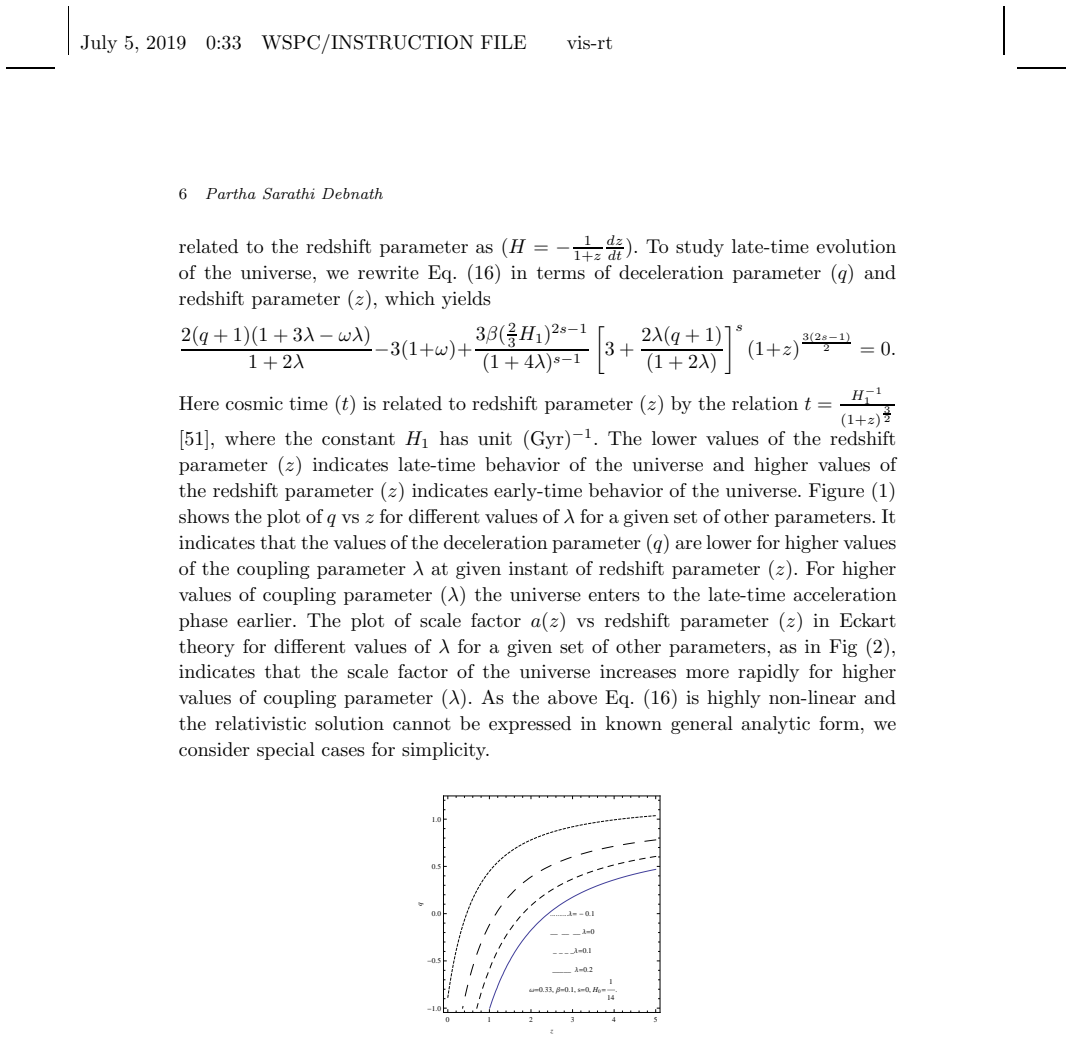
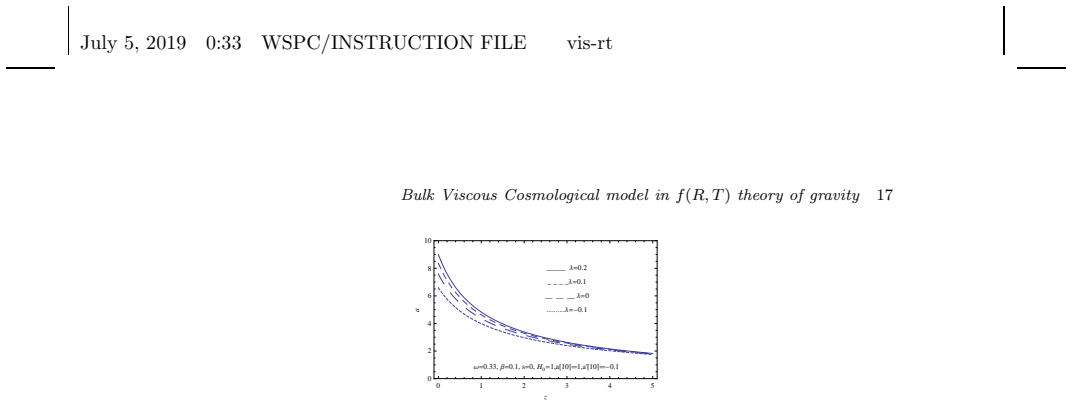
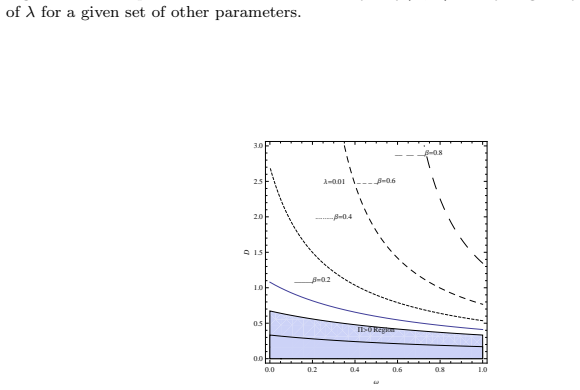
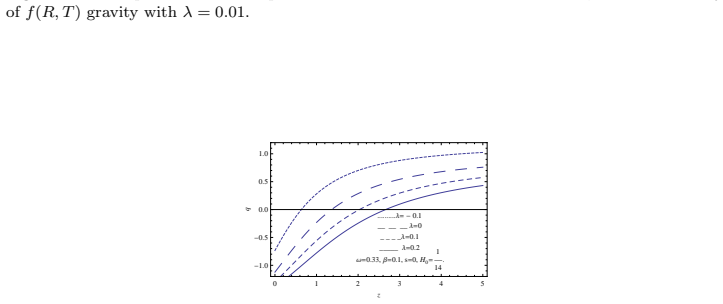
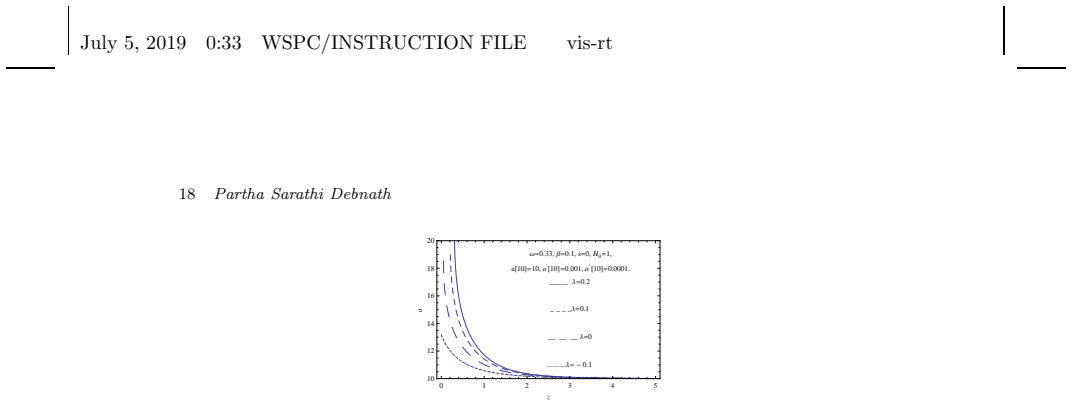
M. Kowalski et. al. , Improved Cosmological Constraints from New, Old, and Com- bined Supernova Data Sets, Astrophys. J. 686 (2008), 749–778. July 5, 2019 0:33 WSPC/INSTRUCTION FILE vis-rt Bulk Viscous Cosmological model in f (R, T ) theory of gravity 17 __ __ __ Λ/EquaΛ0 _ _ _ _Λ/EquaΛ0.1 ..........Λ/EquaΛ/Minus0.1 _____ Λ/EquaΛ0.2 Ω/EquaΛ0.33, Β/EquaΛ0....
work page 2008
discussion (0)
Sign in with ORCID, Apple, or X to comment. Anyone can read and Pith papers without signing in.