REVIEW 3 major objections 6 minor 2 cited by
Scaling Spike-driven Transformer with Efficient Spike Firing Approximation Training
T0 review · 3 major / 6 minor · reviewed 2026-08-12 · deepseek-v4-flash
Pith's one-line read Training spiking networks with integers instead of binary spikes lets them match ANN accuracy at 86.2% top-1 on ImageNet.
desk verdict Big empirical gains for scaled SNNs, but the integer-to-spike equivalence is proven only for a single neuron and is not shown to compose through the attention layers. read the letter →
The pith
A machine-rendered reading of the paper's core claim, the machinery that carries it, and where it could break.
The reading
What carries the argument
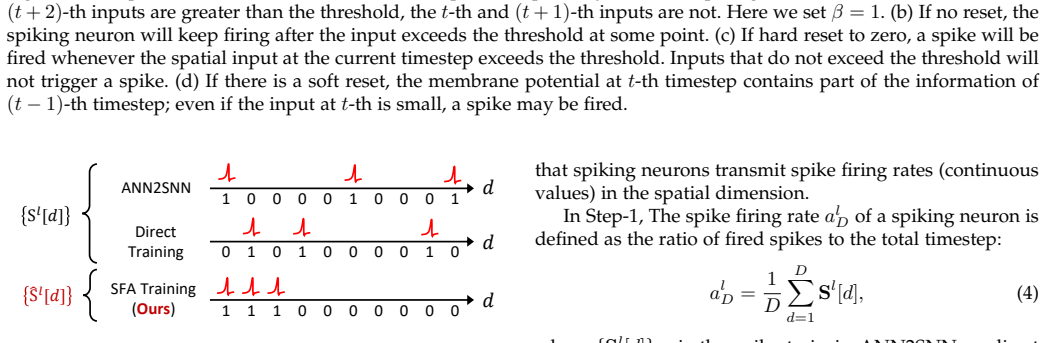
The load-bearing object is the integer fire function $\operatorname{Fire}_D(U)=\lfloor\operatorname{clip}(U,0,D)\rceil$ together with the identity in Proposition 1: feeding the membrane potential $U$ to an integrate-and-fire neuron with soft reset and threshold 1, with nonzero input only at the first of $D$ timesteps, produces a spike train whose sum equals $\operatorname{Fire}_D(U)$. This is what lets the network be trained as a one-timestep integer network and then expanded into $D$ timesteps of spike-driven inference, so the energy advantage comes from sparse additions triggered only when spikes arrive. The second mechanism is the changed firing pattern it induces: SFA firing is asynchronous and concentrated at early timesteps, whereas ANN-to-SNN conversion and vanilla direct training fire randomly and need all timesteps to compute a rate. Supporting machinery includes the E-SpikeFormer block, built from SpikeSepConv and efficient spike-driven self-attention with a widened value branch, and the Spike Sparse Convolution used in masked autoencoding, which restricts convolution to unmasked positions to prevent information leakage.
What would settle it
Take a trained E-SpikeFormer and run the same ImageNet image through both the one-timestep integer forward pass used in training and the $D$-timestep spike deployment; if the equivalence composes, the two forward passes must give identical activations and the same prediction, and any systematic mismatch would show that the reported spike-deployed accuracy is not what the training objective optimized.
Extended reading notes
Core claim
The central claim is that binary firing is not just a quantization nuisance but a mechanistic defect in spiking neurons, harming both spatial representation (a spike cannot encode how strong the input was) and temporal dynamics (reset can only forget a fixed amount). The proposed cure, Spike Firing Approximation (SFA), trains with the integer fire function $\operatorname{Fire}_D(U)=\lfloor\operatorname{clip}(U,0,D)\rceil$ and deploys at inference by replacing each integer with $D$ binary spikes from an integrate-and-fire neuron with soft reset and threshold 1. Proposition 1 gives the per-neuron identity $S^l_D=\sum_{d=1}^{D}\hat{S}^l[d]$, and the paper argues that this makes a one-timestep integer forward pass equivalent to a $D$-timestep spike-driven forward pass for the network. On top of this the paper builds E-SpikeFormer, an efficient spike-driven Transformer that removes energy-hungry reparameterized convolutions, and a masked-image-modeling pretraining scheme with Spike Sparse Convolution that prevents the feature collapse, measured by effective rank, that scaling induces in binary-spike networks. The result, as the paper states, is that directly trained SNNs reach ANN-level accuracy while preserving the low-power, sparse-addition inference path.
Load-bearing premise
The method assumes that what holds for one neuron whose input arrives in a single moment also holds for a whole network whose layers receive spikes spread over many moments, but the proof only covers the single-neuron, single-moment case.
Editorial extensions
If this is right
- Directly trained spiking networks can now reach 86.2% top-1 on ImageNet at 173M parameters, a higher accuracy than prior directly trained SNNs at this scale and comparable to several classical ANN backbones.
- Static-image training collapses to one timestep, cutting ImageNet training time by about 4.5x at the 10M scale while inference still runs as a single image presentation followed by $D$ spike steps.
- Inference power drops: the 10M E-SpikeFormer uses 3.0 mJ versus 11.9 mJ for the Meta-SpikeFormer baseline, and the spike firing rate decreases as timesteps advance, making later computation sparser.
- SFA-trained models fit asynchronous neuromorphic chips, because the $D$ spikes can be emitted in a short window without a global clock, unlike vanilla multi-timestep direct training.
- Combining SFA with masked-image-modeling pretraining and Spike Sparse Convolution avoids the performance degradation that still occurs when binary-spike networks are scaled with the same MIM strategy.
Reading between the lines
- Extension: Because $\operatorname{Fire}_D$ is uniform $D$-level quantization, SFA suggests a broader recipe: any ANN trained with $D$-level integer activations and threshold-normalized weights could be deployed as a spike-driven network, putting spike-driven efficiency within reach of standard quantization-aware training.
- Extension: The paper's firing-pattern analysis implies $D$ can be treated as a tunable accuracy-latency dial, so an adaptive version that spends fewer timesteps on easy inputs or early layers could extend the reported $1\times4$ versus $1\times8$ trade-off beyond the fixed settings tested.
- Extension: The effective-rank view of why binary networks fail to scale points to a practical diagnostic: monitor the encoder's effective rank during masked pretraining as an early indicator of downstream fine-tuning quality, potentially guiding architecture or mask-ratio choices without full fine-tuning.
Signed reviews
Editorial analysis
A structured set of objections, weighed in public.
Referee Report
Summary. The paper proposes Spike Firing Approximation (SFA), a training method that replaces binary spike activations with integer-valued activations (Fire_D) during training and converts them to spike trains during inference via IF-SR neurons with threshold 1. The authors also introduce an efficient spike-driven Transformer architecture (E-SpikeFormer) and a masked image modeling pre-training strategy with spike sparse convolution. They report state-of-the-art top-1 accuracies on ImageNet-1k at scales from 10M to 173M parameters (78.5% to 86.2%), with large improvements in training time and inference energy over prior SNNs, and validate the method on object detection, semantic segmentation, and neuromorphic action recognition. The central theoretical claim is that one-timestep integer training is losslessly equivalent to multi-timestep spike-driven inference via Proposition 1.
Significance. If the claimed training-inference equivalence and the reported results hold, this work would be a significant step toward scaling SNNs to practical vision backbones while retaining the low-power advantages of event-driven computation. The paper's strengths include extensive experiments across multiple tasks and model scales, concrete efficiency gains (e.g., 4.5x training acceleration, 3.9x inference energy improvement at the 10M scale), and a stated public code release. The analysis of spike firing patterns (asynchronous versus synchronous) and the discussion of neuromorphic chip implementation are also valuable. However, the central equivalence proof is limited to a single neuron under an unrealistic assumption, and the extension to whole deep networks, especially the nonlinear attention module, is not established. This gap undermines the claim that the reported inference accuracies follow from the training objective, so the theoretical foundation needs substantial strengthening before the results can be fully credited.
major comments (3)
- [Section 4.1, Proposition 1 and Fig. 6] The proof of the integer-to-spike equivalence assumes that for each neuron 'the input is zero at timesteps d = 2, ..., D' (after Eq. (16)). In a deep network this premise is violated for every layer after the first: each layer receives spikes from the previous layer across all D timesteps. The paper asserts, rather than proves, that one-timestep integer training equals D-timestep spike-driven inference for the whole network. For purely linear layers with nonnegative inputs the total spike count of an IF-SR neuron may be timing-invariant, but negative weights (which can occur) break this, and the E-SDSA module (Section 3.3) is quadratic: integer training computes a function of (sum_d Q[d], sum_d K[d], sum_d V[d]), while spike-driven inference accumulates sum_d (Q[d] K[d]^T V[d]); the cross-timestep products with d != e are not present in the inference computation, and the paper provides no argument that they vanish or are negligible. Please provide an end-to-end equivalence proof for linear layers with arbitrary weights and for the attention module, or, failing that, an experimental comparison of the one-step integer-trained model's accuracy versus the implemented D-step spike-driven inference accuracy for each model scale in Table 1.
- [Section 4.2, Eqs. (26)-(28)] The gradient-error derivation is dimensionally inconsistent. Eq. (27) defines Err^l as the integral over U of (Rect[0,D](U) - (1/D) round(clip(U,0,D))); the result of this integral is a constant (or divergent), but Eq. (28) reports a piecewise function of U, which is the integrand, not the integral. Consequently, the formal conclusion that larger D reduces the gradient error is not supported by the equations as written. Please correct the derivation or clarify what quantity is actually being computed; the empirical trend in the experiments may still hold, but the theoretical analysis needs repair.
- [Section 4.1, Eqs. (18)-(20)] The step from Eq. (19) to Eq. (20), where the 0.5 bias introduced by the round function is said to be 'incorporated into the weight,' is not formalized for a deep network. If every neuron's activation function is changed from round(clip(U,0,D)) to floor(clip(U,0,D)) by adding a constant 0.5 to the neuron's input, the network function changes unless the biases of the preceding layers are adjusted consistently. For the equivalence to be claimed, either the reparameterization must be specified explicitly for all layers, or the Fire_D function should be defined with floor from the outset.
minor comments (6)
- [Section 4.1, Eq. (16)] The notation in Eq. (16) appears to use {S^l[d]}_D for the spike train generated by IF-SR, but the output of IF-SR is the spike train {hat S^l[d]}_D; please correct the notation for consistency.
- [Fig. 3] The label 'al D = 0.3' in Fig. 3 seems to be a typo; it should likely read 'a^l_D = 0.3'.
- [Table 1] The row 'Spike-dirven Transformer' contains a typo; it should be 'Spike-driven Transformer'.
- [Section 3.4] The phrase 'K d=32' appears to be a formatting error; please clarify whether this is intended to denote the kernel size K^d = 32.
- [Section 4.2] Definitions 1 and 2 both use the symbol Err^l for different quantities (forward approximation error and backward gradient error); please use distinct symbols such as Err_fwd and Err_bwd to avoid ambiguity.
- [References, [24]] Reference [24] is a closely related prior work on integer-valued training and spike-driven inference by the same group; the paper cites it but does not discuss its relationship to the proposed SFA method. Please clarify the differences and the specific novelties introduced here.
Circularity Check
No significant circularity; the integer-to-spike equivalence is a designed identity, and the headline results are externally benchmarked.
-
self definitional
[Section 4.1, Proposition 1 (Eqs. 15-21)]
"Feeding the membrane potential input of Eq. (5) into an IF-SR neuron with Vth = 1, the spike train generated is: {S^l[d]}_D = IF-SR(U^l), ... The underlying assumption is that there is non-zero input only at timestep d = 1 ... Then the sum of the spike train is: S^l_D = floor(clip{U^l, 0, D}) ... Combining Eq. (17) and Eq. (20), we have: S^l_D = floor(clip{U^l, 0, D}) = sum_{d=1}^D S^l[d]."
Eq. (5) defines Fire_D as round(clip(U,0,D)); under the proof's assumption that nonzero input arrives only at d=1, an IF-SR neuron with Vth=1 fires floor(clip(U,0,D)) spikes, and the 0.5 difference between round and floor is absorbed into the weights. Hence S^l_D = sum_d S^l[d] holds by construction, not by an independent derivation. This designed quantizer-match is legitimate for a single neuron, but the paper extends it to whole networks by asserting Equivalence in Fig. 6 without proving that layer-wise spike-count identities compose through E-SDSA's quadratic attention, residual connections, and BN folding.
full rationale
The central SFA construction is not circular in the harmful sense: Fire_D is deliberately defined as the number of spikes an IF-SR neuron would emit, so Proposition 1 is a designed quantizer-to-spike identity rather than a fitted input disguised as a prediction. The ImageNet, COCO, ADE20K, and HAR-DVS results are measured on spike-driven inference and benchmarked against prior SNNs and ANNs, so the headline accuracies are external evidence, not self-confirming. Two concerns lower, but do not destroy, the paper's independent content. First, the layer-wise equivalence does not automatically compose through the nonlinear E-SDSA attention and residual paths; Fig. 6 asserts whole-network equivalence without a proof, leaving a correctness gap between the integer training objective and the deployed spike-driven computation. That is a verifiability issue, not a circular fit. Second, reference [24] by the same group already proposed integer-valued training and spike-driven inference for object detection, and the body introduces SFA without explicitly flagging that prior introduction; this is an attribution and novelty concern rather than load-bearing circularity. Overall, the paper's contributions are externally validated and not reduced to their inputs by definition, so the circularity score is low.
Assumptions & free parameters
free parameters (3)
- D (wave width / max integer activation) =
4 and 8 in main experiments
- MIM masking ratio mu =
not reported in main text
- E-SDSA channel expansion factor gamma =
not reported in main text
assumptions (5)
- domain assumption Spiking neurons transmit spike firing rates across spatial dimensions (Eq. 4).
- ad hoc to paper One-timestep integer training is equivalent to multi-timestep spike inference for the full deep network.
- domain assumption Binary spike firing is a fundamental mechanistic flaw that impairs spatial representation and temporal dynamics.
- domain assumption Power consumption can be estimated by counting spike-driven additions and multiplying by fixed per-operation energies.
- domain assumption Effective rank of the encoder output measures feature quality and predicts scaling behavior.
Cite this review
Pith. "Pith review of Scaling Spike-driven Transformer with Efficient Spike Firing Approximation Training." pith.science (2026). https://pith.science/paper/JENYDP7Z
@misc{pith2026241116061,
  author       = {Pith},
  title        = {Pith review of: Scaling Spike-driven Transformer with Efficient Spike Firing Approximation Training},
  year         = {2026},
  howpublished = {\url{https://pith.science/paper/JENYDP7Z}},
  note         = {Machine review of arXiv:2411.16061}
}
abstract
The ambition of brain-inspired Spiking Neural Networks (SNNs) is to become a low-power alternative to traditional Artificial Neural Networks (ANNs). This work addresses two major challenges in realizing this vision: the performance gap between SNNs and ANNs, and the high training costs of SNNs. We identify intrinsic flaws in spiking neurons caused by binary firing mechanisms and propose a Spike Firing Approximation (SFA) method using integer training and spike-driven inference. This optimizes the spike firing pattern of spiking neurons, enhancing efficient training, reducing power consumption, improving performance, enabling easier scaling, and better utilizing neuromorphic chips. We also develop an efficient spike-driven Transformer architecture and a spike-masked autoencoder to prevent performance degradation during SNN scaling. On ImageNet-1k, we achieve state-of-the-art top-1 accuracy of 78.5\%, 79.8\%, 84.0\%, and 86.2\% with models containing 10M, 19M, 83M, and 173M parameters, respectively. For instance, the 10M model outperforms the best existing SNN by 7.2\% on ImageNet, with training time acceleration and inference energy efficiency improved by 4.5$\times$ and 3.9$\times$, respectively. We validate the effectiveness and efficiency of the proposed method across various tasks, including object detection, semantic segmentation, and neuromorphic vision tasks. This work enables SNNs to match ANN performance while maintaining the low-power advantage, marking a significant step towards SNNs as a general visual backbone. Code is available at https://github.com/BICLab/Spike-Driven-Transformer-V3.
Figures


Figures from the paper (8 more)


Forward citations
Cited by 2 Pith papers
-
Quantized Spike-driven Transformer
A 4-bit quantized spike-driven transformer with multi-bit training and binary inference achieves 80.3% ImageNet accuracy with 6.8M parameters.
-
Spike2Former: Efficient Spiking Transformer for High-performance Image Segmentation
A spiking Mask2Former with normalized integer neurons achieves state-of-the-art SNN performance on ADE20K, CityScapes, and Pascal VOC, with claimed large energy savings.
Reference graph
Works this paper leans on
-
[1]
Towards spike-based machine intelligence with neuromorphic computing,
K. Roy, A. Jaiswal, and P . Panda, “Towards spike-based machine intelligence with neuromorphic computing,” Nature, vol. 575, no. 7784, pp. 607–617, 2019
2019
-
[2]
Opportunities for neuromorphic computing algorithms and applications,
C. D. Schuman, S. R. Kulkarni, M. Parsa, J. P . Mitchell, B. Kay et al. , “Opportunities for neuromorphic computing algorithms and applications,” Nature Computational Science, vol. 2, no. 1, pp. 10–19, 2022
2022
-
[3]
Networks of spiking neurons: The third generation of neural network models,
W. Maass, “Networks of spiking neurons: The third generation of neural network models,” Neural Networks , vol. 10, no. 9, pp. 1659–1671, 1997
1997
-
[4]
A million spiking-neuron integrated circuit with a scalable communication network and interface,
P . A. Merolla, J. V . Arthur, R. Alvarez-Icaza, A. S. Cassidy, J. Sawada, F. Akopyan, B. L. Jackson, N. Imam, C. Guo, Y. Naka- mura et al., “A million spiking-neuron integrated circuit with a scalable communication network and interface,” Science, vol. 345, no. 6197, pp. 668–673, 2014
2014
-
[5]
Loihi: A neuromorphic manycore processor with on-chip learning,
M. Davies, N. Srinivasa, T.-H. Lin, G. Chinya, Y. Cao, S. H. Choday, G. Dimou, P . Joshi, N. Imam, S. Jain et al. , “Loihi: A neuromorphic manycore processor with on-chip learning,” IEEE Micro, vol. 38, no. 1, pp. 82–99, 2018
2018
-
[6]
Towards artificial general intelligence with hybrid tianjic chip architecture,
J. Pei, L. Deng et al., “Towards artificial general intelligence with hybrid tianjic chip architecture,” Nature, vol. 572, no. 7767, pp. 106–111, 2019
2019
-
[7]
Accurate and efficient time- domain classification with adaptive spiking recurrent neural networks,
B. Yin, F. Corradi, and S. M. Boht ´e, “Accurate and efficient time- domain classification with adaptive spiking recurrent neural networks,” Nature Machine Intelligence, vol. 3, no. 10, pp. 905–913, 2021
2021
-
[8]
A long short-term memory for ai applications in spike-based neuromorphic hard- ware,
A. Rao, P . Plank, A. Wild, and W. Maass, “A long short-term memory for ai applications in spike-based neuromorphic hard- ware,” Nature Machine Intelligence, vol. 4, no. 5, pp. 467–479, 2022
2022
Show all 105 references
-
[9]
Neurozoom: Denoising and super resolving neuromor- phic events and spikes,
P . Duan, Y. Ma, X. Zhou, X. Shi, Z. W. Wang, T. Huang, and B. Shi, “Neurozoom: Denoising and super resolving neuromor- phic events and spikes,” IEEE Transactions on Pattern Analysis and Machine Intelligence, vol. 45, no. 12, pp. 15 219–15 232, 2023
2023
-
[10]
Spike-based dynamic computing with asynchronous sensing-computing neuromorphic chip,
M. Yao, O. Richter, G. Zhao, N. Qiao, Y. Xing, D. Wang, T. Hu, W. Fang, T. Demirci, M. De Marchi, L. Deng, T. Yan, C. Nielsen, S. Sheik, C. Wu, Y. Tian, B. Xu, and G. Li, “Spike-based dynamic computing with asynchronous sensing-computing neuromorphic chip,” Nature Communicatio...
2024
-
[11]
Spiking deep residual networks,
Y. Hu, H. Tang, and G. Pan, “Spiking deep residual networks,” IEEE Transactions on Neural Networks and Learning Systems, vol. 34, no. 8, pp. 5200–5205, 2023
2023
-
[12]
Enabling deep spiking neural networks with hybrid conversion and spike tim- ing dependent backpropagation,
N. Rathi, G. Srinivasan, P . Panda, and K. Roy, “Enabling deep spiking neural networks with hybrid conversion and spike tim- ing dependent backpropagation,” in International Conference on Learning Representations, 2020
2020
-
[14]
Progressive tandem learning for pattern recognition with deep spiking neural networks,
J. Wu, C. Xu, X. Han, D. Zhou, M. Zhang, H. Li, and K. C. Tan, “Progressive tandem learning for pattern recognition with deep spiking neural networks,” IEEE Transactions on Pattern Analysis and Machine Intelligence, vol. 44, no. 11, pp. 7824–7840, 2021
2021
-
[15]
Masked spiking transformer,
Z. Wang, Y. Fang, J. Cao, Q. Zhang, Z. Wang, and R. Xu, “Masked spiking transformer,” in Proceedings of the IEEE/CVF International Conference on Computer Vision, 2023, pp. 1761–1771
2023
-
[16]
Spatio-temporal backpropagation for training high-performance spiking neural networks,
Y. Wu, L. Deng, G. Li, J. Zhu, and L. Shi, “Spatio-temporal backpropagation for training high-performance spiking neural networks,” Frontiers in Neuroscience, vol. 12, p. 331, 2018
2018
-
[17]
Training spiking neural networks using lessons from deep learning,
J. K. Eshraghian, M. Ward, E. O. Neftci, X. Wang, G. Lenz, G. Dwivedi, M. Bennamoun, D. S. Jeong, and W. D. Lu, “Training spiking neural networks using lessons from deep learning,” Proceedings of the IEEE, vol. 111, no. 9, pp. 1016–1054, 2023
2023
-
[18]
Deep residual learning in spiking neural networks,
W. Fang, Z. Yu, Y. Chen, T. Huang, T. Masquelier, and Y. Tian, “Deep residual learning in spiking neural networks,” Advances in Neural Information Processing Systems , vol. 34, pp. 21 056–21 069, 2021
2021
-
[19]
Going deeper with directly-trained larger spiking neural networks,
H. Zheng, Y. Wu, L. Deng, Y. Hu, and G. Li, “Going deeper with directly-trained larger spiking neural networks,” in Proceedings of the AAAI Conference on Artificial Intelligence , vol. 35, no. 12, 2021, pp. 11 062–11 070
2021
-
[20]
Vtsnn: a virtual temporal spiking neural net- work,
X.-R. Qiu, Z.-R. Wang, Z. Luan, R.-J. Zhu, X. Wu, M.-L. Zhang, and L.-J. Deng, “Vtsnn: a virtual temporal spiking neural net- work,” Frontiers in Neuroscience, vol. 17, p. 1091097, 2023
2023
-
[21]
Attention spiking neural networks,
M. Yao, G. Zhao, H. Zhang, Y. Hu, L. Deng, Y. Tian, B. Xu, and G. Li, “Attention spiking neural networks,” IEEE Transactions on Pattern Analysis and Machine Intelligence , vol. 45, no. 8, pp. 9393– 9410, 2023
2023
-
[22]
Tensor decomposition based attention module for spiking neu- ral networks,
H. Deng, R. Zhu, X. Qiu, Y. Duan, M. Zhang, and L.-J. Deng, “Tensor decomposition based attention module for spiking neu- ral networks,” Knowledge-Based Systems, vol. 295, p. 111780, 2024
2024
-
[23]
Rsc- snn: Exploring the trade-off between adversarial robustness and accuracy in spiking neural networks via randomized smoothing coding,
K. Wu, M. Yao, Y. Chou, X. Qiu, R. Yang, B. Xu, and G. Li, “Rsc- snn: Exploring the trade-off between adversarial robustness and accuracy in spiking neural networks via randomized smoothing coding,” in Proceedings of the 32nd ACM International Conference on Multimedia, 2024, p...
2024
-
[24]
Integer-valued training and spike-driven inference spiking neural network for high-performance and energy-efficient object detection,
X. Luo, M. Yao, Y. Chou, B. Xu, and G. Li, “Integer-valued training and spike-driven inference spiking neural network for high-performance and energy-efficient object detection,” arXiv preprint arXiv:2407.20708, 2024
2024 arXiv
-
[25]
Spikingjelly: An open- source machine learning infrastructure platform for spike-based intelligence,
W. Fang, Y. Chen, J. Ding, Z. Yu, T. Masquelier, D. Chen, L. Huang, H. Zhou, G. Li, and Y. Tian, “Spikingjelly: An open- source machine learning infrastructure platform for spike-based intelligence,” Science Advances, vol. 9, no. 40, p. eadi1480, 2023
2023
-
[26]
Im-loss: information maximization loss for spiking neural net- works,
Y. Guo, Y. Chen, L. Zhang, X. Liu, Y. Wang, X. Huang, and Z. Ma, “Im-loss: information maximization loss for spiking neural net- works,” Advances in Neural Information Processing Systems, vol. 35, pp. 156–166, 2022
2022
-
[27]
Rethinking the performance comparison between snns and anns,
L. Deng, Y. Wu, X. Hu, L. Liang, Y. Ding, G. Li, G. Zhao, P . Li, and Y. Xie, “Rethinking the performance comparison between snns and anns,” Neural Networks, vol. 121, pp. 294–307, 2020
2020
-
[28]
Spike-driven transformer v2: Meta spiking neural network ar- chitecture inspiring the design of next-generation neuromorphic chips,
M. Yao, J. Hu, T. Hu, Y. Xu, Z. Zhou, Y. Tian, B. XU, and G. Li, “Spike-driven transformer v2: Meta spiking neural network ar- chitecture inspiring the design of next-generation neuromorphic chips,” in The Twelfth International Conference on Learning Repre- sentations, 2024
2024
-
[29]
Spike- driven transformer,
M. Yao, J. Hu, Z. Zhou, L. Yuan, Y. Tian, B. Xu, and G. Li, “Spike- driven transformer,” in Advances in Neural Information Processing Systems, vol. 36, 2023, pp. 64 043–64 058
2023
-
[30]
Masked autoencoders are scalable vision learners,
K. He, X. Chen, S. Xie, Y. Li, P . Doll ´ar, and R. Girshick, “Masked autoencoders are scalable vision learners,” in Proceedings of the IEEE/CVF Conference on Computer Vision and Pattern Recognition , 2022, pp. 16 000–16 009
2022
-
[31]
Designing bert for convolutional networks: Sparse and hierarchical masked FOR REVIEW 16 modeling,
K. Tian, Y. Jiang, C. Lin, L. Wang, Z. Yuan et al. , “Designing bert for convolutional networks: Sparse and hierarchical masked FOR REVIEW 16 modeling,” in The Eleventh International Conference on Learning Representations, 2022
2022
-
[32]
Imagenet: A large-scale hierarchical image database,
J. Deng, W. Dong, R. Socher, L.-J. Li, K. Li, and L. Fei-Fei, “Imagenet: A large-scale hierarchical image database,” in 2009 IEEE Conference on Computer Vision and Pattern Recognition. IEEE, 2009, pp. 248–255
2009
-
[33]
Microsoft coco: Common objects in context,
T.-Y. Lin, M. Maire, S. Belongie, J. Hays, P . Perona, D. Ramanan, P . Doll´ar, and C. L. Zitnick, “Microsoft coco: Common objects in context,” in European Conference on Computer Vision . Springer, 2014, pp. 740–755
2014
-
[34]
Scene parsing through ade20k dataset,
B. Zhou, H. Zhao, X. Puig, S. Fidler, A. Barriuso, and A. Torralba, “Scene parsing through ade20k dataset,” inProceedings of the IEEE Conference on Computer Vision and Pattern Recognition , 2017, pp. 633–641
2017
-
[35]
Hardvs: Revisiting human activity recognition with dynamic vision sensors,
X. Wang, Z. Wu, B. Jiang, Z. Bao, L. Zhu, G. Li, Y. Wang, and Y. Tian, “Hardvs: Revisiting human activity recognition with dynamic vision sensors,” in Proceedings of the AAAI Conference on Artificial Intelligence, vol. 38, no. 6, 2024, pp. 5615–5623
2024
-
[36]
Online training through time for spiking neural networks,
M. Xiao, Q. Meng, Z. Zhang, D. He, and Z. Lin, “Online training through time for spiking neural networks,” Advances in Neural Information Processing Systems, vol. 35, pp. 20 717–20 730, 2022
2022
-
[37]
Towards memory-and time-efficient backpropagation for train- ing spiking neural networks,
Q. Meng, M. Xiao, S. Yan, Y. Wang, Z. Lin, and Z.-Q. Luo, “Towards memory-and time-efficient backpropagation for train- ing spiking neural networks,” in Proceedings of the IEEE/CVF International Conference on Computer Vision, 2023, pp. 6166–6176
2023
-
[38]
Rethinking pretraining as a bridge from anns to snns,
Y. Lin, Y. Hu, S. Ma, D. Yu, and G. Li, “Rethinking pretraining as a bridge from anns to snns,” IEEE Transactions on Neural Networks and Learning Systems, pp. 1–14, 2022
2022
-
[39]
Memory-efficient reversible spiking neural networks,
H. Zhang and Y. Zhang, “Memory-efficient reversible spiking neural networks,” in Proceedings of the AAAI Conference on Ar- tificial Intelligence, vol. 38, no. 15, 2024, pp. 16 759–16 767
2024
-
[40]
High-performance temporal reversible spiking neural networks with o(l) training memory and o(1) inference cost,
J. Hu, M. Yao, X. Qiu, Y. Chou, Y. Cai, N. Qiao, Y. Tian, B. Xu, and G. Li, “High-performance temporal reversible spiking neural networks with o(l) training memory and o(1) inference cost,” arXiv preprint arXiv:2405.16466, 2024
2024 arXiv
-
[41]
Towards ultra low latency spiking neural networks for vision and sequential tasks using temporal pruning,
S. S. Chowdhury, N. Rathi, and K. Roy, “Towards ultra low latency spiking neural networks for vision and sequential tasks using temporal pruning,” in European Conference on Computer Vision. Springer, 2022, pp. 709–726
2022
-
[42]
Seenn: Towards temporal spiking early exit neural networks,
Y. Li, T. Geller, Y. Kim, and P . Panda, “Seenn: Towards temporal spiking early exit neural networks,” in Advances in Neural Infor- mation Processing Systems, vol. 36. Curran Associates, Inc., 2023, pp. 63 327–63 342
2023
-
[43]
Deep residual learning for image recognition,
K. He, X. Zhang, S. Ren, and J. Sun, “Deep residual learning for image recognition,” in Proceedings of the IEEE conference on computer vision and pattern recognition, 2016, pp. 770–778
2016
-
[44]
Identity mappings in deep residual networks,
K. He, X. Zhang, and S. Ren, “Identity mappings in deep residual networks,” in European conference on computer vision . Springer, 2016, pp. 630–650
2016
-
[45]
Advancing spiking neural networks toward deep residual learning,
Y. Hu, L. Deng, Y. Wu, M. Yao, and G. Li, “Advancing spiking neural networks toward deep residual learning,” IEEE Transac- tions on Neural Networks and Learning Systems , pp. 1–15, 2024
2024
-
[46]
Attention is all you need,
A. Vaswani, N. Shazeer, N. Parmar, J. Uszkoreit, L. Jones, A. N. Gomez, Ł. Kaiser, and I. Polosukhin, “Attention is all you need,” Advances in neural information processing systems , vol. 30, 2017
2017
-
[47]
An image is worth 16x16 words: Transformers for image recognition at scale,
A. Dosovitskiy, L. Beyer, A. Kolesnikov, D. Weissenborn, X. Zhai, T. Unterthiner, M. Dehghani, M. Minderer, G. Heigold, S. Gelly et al., “An image is worth 16x16 words: Transformers for image recognition at scale,” in International Conference on Learning Repre- sentations, 2020
2020
-
[48]
Spike transformer: Monocular depth estimation for spiking camera,
J. Zhang, L. Tang, Z. Yu, J. Lu, and T. Huang, “Spike transformer: Monocular depth estimation for spiking camera,” in European Conference on Computer Vision. Springer, 2022, pp. 34–52
2022
-
[49]
Com- plex dynamic neurons improved spiking transformer network for efficient automatic speech recognition,
Q. Wang, T. Zhang, M. Han, Y. Wang, D. Zhang, and B. Xu, “Com- plex dynamic neurons improved spiking transformer network for efficient automatic speech recognition,” in Proceedings of the AAAI Conference on Artificial Intelligence, vol. 37, no. 1, 2023, pp. 102–109
2023
-
[50]
Spikformer: When spiking neural network meets transformer,
Z. Zhou, Y. Zhu, C. He, Y. Wang, S. YAN, Y. Tian, and L. Yuan, “Spikformer: When spiking neural network meets transformer,” in The Eleventh International Conference on Learning Representations, 2023
2023
-
[51]
Metaformer is actually what you need for vision,
W. Yu, M. Luo, P . Zhou, C. Si, Y. Zhou, X. Wang, J. Feng, and S. Yan, “Metaformer is actually what you need for vision,” in Proceedings of the IEEE/CVF Conference on Computer Vision and Pattern Recognition, 2022, pp. 10 819–10 829
2022
-
[52]
MetaLA: Unified optimal linear approximation to softmax attention map,
Y. Chou, M. Yao, K. Wang, Y. Pan, R.-J. Zhu, J. Wu, Y. Zhong, Y. Qiao, B. XU, and G. Li, “MetaLA: Unified optimal linear approximation to softmax attention map,” in The Thirty-eighth Annual Conference on Neural Information Processing Systems ,
-
[53]
Bert: Pre- training of deep bidirectional transformers for language under- standing,
J. Devlin, M.-W. Chang, K. Lee, and K. Toutanova, “Bert: Pre- training of deep bidirectional transformers for language under- standing,” arXiv preprint arXiv:1810.04805, 2018
2018 arXiv
-
[54]
Beit: Bert pre-training of image transformers,
H. Bao, L. Dong, S. Piao, and F. Wei, “Beit: Bert pre-training of image transformers,” arXiv preprint arXiv:2106.08254, 2021
2021 arXiv
-
[55]
Image bert pre-training with online tokenizer,
J. Zhou, C. Wei, H. Wang, W. Shen, C. Xie, A. Yuille, and T. Kong, “Image bert pre-training with online tokenizer,” in International Conference on Learning Representations, 2021
2021
-
[56]
Masked feature prediction for self-supervised visual pre- training,
C. Wei, H. Fan, S. Xie, C.-Y. Wu, A. Yuille, and C. Feichten- hofer, “Masked feature prediction for self-supervised visual pre- training,” in Proceedings of the IEEE/CVF Conference on Computer Vision and Pattern Recognition, 2022, pp. 14 668–14 678
2022
-
[57]
Mcmae: Masked convolution meets masked autoencoders,
P . Gao, T. Ma, H. Li, Z. Lin, J. Dai, and Y. Qiao, “Mcmae: Masked convolution meets masked autoencoders,” in Advances in Neural Information Processing Systems , S. Koyejo, S. Mohamed, A. Agarwal, D. Belgrave, K. Cho, and A. Oh, Eds., vol. 35. Curran Associates, Inc., 2022, pp...
2022
-
[58]
Convnext v2: Co-designing and scaling convnets with masked autoencoders,
S. Woo, S. Debnath, R. Hu, X. Chen, Z. Liu, I. S. Kweon, and S. Xie, “Convnext v2: Co-designing and scaling convnets with masked autoencoders,” in Proceedings of the IEEE/CVF Conference on Computer Vision and Pattern Recognition, June 2023, pp. 16 133– 16 142
2023
-
[59]
Surrogate gradient learning in spiking neural networks: Bringing the power of gradient-based optimization to spiking neural networks,
E. O. Neftci, H. Mostafa, and F. Zenke, “Surrogate gradient learning in spiking neural networks: Bringing the power of gradient-based optimization to spiking neural networks,” IEEE Signal Processing Magazine, vol. 36, no. 6, pp. 51–63, 2019
2019
-
[60]
Gerstner, W
W. Gerstner, W. M. Kistler, R. Naud, and L. Paninski, Neuronal dynamics: From single neurons to networks and models of cognition . Cambridge University Press, 2014
2014
-
[61]
Neuromorphic silicon neuron cir- cuits,
G. Indiveri, B. Linares-Barranco, T. J. Hamilton, A. v. Schaik, R. Etienne-Cummings, T. Delbruck, S.-C. Liu, P . Dudek, P . H¨afliger, S. Renaud et al. , “Neuromorphic silicon neuron cir- cuits,” Frontiers in Neuroscience, vol. 5, p. 73, 2011
2011
-
[62]
Parallel spiking neurons with high efficiency and ability to learn long-term dependencies,
W. Fang, Z. Yu, Z. Zhou, D. Chen, Y. Chen, Z. Ma, T. Masquelier, and Y. Tian, “Parallel spiking neurons with high efficiency and ability to learn long-term dependencies,” in Advances in Neural Information Processing Systems, vol. 36, 2023, pp. 53 674–53 687
2023
-
[63]
Spiking neural networks with im- proved inherent recurrence dynamics for sequential learning,
W. Ponghiran and K. Roy, “Spiking neural networks with im- proved inherent recurrence dynamics for sequential learning,” in Proceedings of the AAAI Conference on Artificial Intelligence , vol. 36, no. 7, 2022, pp. 8001–8008
2022
-
[64]
Is conventional snn really efficient? a perspective from network quantization,
G. Shen, D. Zhao, T. Li, J. Li, and Y. Zeng, “Is conventional snn really efficient? a perspective from network quantization,” arXiv preprint arXiv:2311.10802, 2023
2023 arXiv
-
[65]
Liaf-net: Leaky integrate and analog fire network for lightweight and ef- ficient spatiotemporal information processing,
Z. Wu, H. Zhang, Y. Lin, G. Li, M. Wang, and Y. Tang, “Liaf-net: Leaky integrate and analog fire network for lightweight and ef- ficient spatiotemporal information processing,” IEEE Transactions on Neural Networks and Learning Systems, vol. 33, no. 11, pp. 6249– 6262, 2021
2021
-
[66]
Direct training for spiking neural networks: Faster, larger, better,
Y. Wu, L. Deng, G. Li, J. Zhu, Y. Xie, and L. Shi, “Direct training for spiking neural networks: Faster, larger, better,” in Proceedings of the AAAI Conference on Artificial Intelligence, vol. 33, no. 01, 2019, pp. 1311–1318
2019
-
[67]
Diet-snn: A low-latency spiking neural network with direct input encoding and leakage and threshold optimization,
N. Rathi and K. Roy, “Diet-snn: A low-latency spiking neural network with direct input encoding and leakage and threshold optimization,” IEEE Transactions on Neural Networks and Learning Systems, vol. 34, no. 6, pp. 3174–3182, 2023
2023
-
[68]
Event-driven learning for spiking neural networks,
W. Wei, M. Zhang, J. Zhang, A. Belatreche, J. Wu, Z. Xu, X. Qiu, H. Chen, Y. Yang, and H. Li, “Event-driven learning for spiking neural networks,” arXiv preprint arXiv:2403.00270, 2024
2024 arXiv
-
[69]
Mobilenetv2: Inverted residuals and linear bottlenecks,
M. Sandler, A. Howard, M. Zhu, A. Zhmoginov, and L.-C. Chen, “Mobilenetv2: Inverted residuals and linear bottlenecks,” in Proceedings of the IEEE Conference on Computer Vision and Pattern Recognition, 2018, pp. 4510–4520
2018
-
[70]
Batch normalization: Accelerating deep network training by reducing internal covariate shift,
S. Ioffe and C. Szegedy, “Batch normalization: Accelerating deep network training by reducing internal covariate shift,” in Interna- tional conference on machine learning. PMLR, 2015, pp. 448–456
2015
-
[71]
Xception: Deep learning with depthwise separable convolutions,
F. Chollet, “Xception: Deep learning with depthwise separable convolutions,” in Proceedings of the IEEE Conference on Computer Vision and Pattern Recognition, 2017, pp. 1251–1258
2017
-
[72]
Efficientvit: Enhanced linear at- tention for high-resolution low-computation visual recognition,
H. Cai, C. Gan, and S. Han, “Efficientvit: Enhanced linear at- tention for high-resolution low-computation visual recognition,” arXiv preprint arXiv:2205.14756, 2022. FOR REVIEW 17
2022 arXiv
-
[73]
Mobilevitv3: Mobile-friendly vision transformer with simple and effective fusion of local, global and input features,
S. N. Wadekar and A. Chaurasia, “Mobilevitv3: Mobile-friendly vision transformer with simple and effective fusion of local, global and input features,” arXiv preprint arXiv:2209.15159, 2022
2022 arXiv
-
[74]
Rethinking mobile block for efficient attention-based models,
J. Zhang, X. Li, J. Li, L. Liu, Z. Xue, B. Zhang, Z. Jiang, T. Huang, Y. Wang, and C. Wang, “Rethinking mobile block for efficient attention-based models,” in Proceedings of IEEE/CVF International Conference on Computer Vision, 2023, pp. 1389–1400
2023
-
[75]
Training data-efficient image transformers & distil- lation through attention,
H. Touvron, M. Cord, M. Douze, F. Massa, A. Sablayrolles, and H. J ´egou, “Training data-efficient image transformers & distil- lation through attention,” in International Conference on Machine Learning. PMLR, 2021, pp. 10 347–10 357
2021
-
[76]
How mask matters: Towards theoretical understandings of masked autoencoders,
Q. Zhang, Y. Wang, and Y. Wang, “How mask matters: Towards theoretical understandings of masked autoencoders,” Advances in Neural Information Processing Systems , vol. 35, pp. 27 127–27 139, 2022
2022
-
[77]
Pyramid vision transformer: A versatile backbone for dense prediction without convolutions,
W. Wang, E. Xie, X. Li, D.-P . Fan, K. Song, D. Liang, T. Lu, P . Luo, and L. Shao, “Pyramid vision transformer: A versatile backbone for dense prediction without convolutions,” in Proceedings of the IEEE/CVF International Conference on Computer Vision , 2021, pp. 568–578
2021
-
[78]
Swin transformer: Hierarchical vision transformer using shifted windows,
Z. Liu, Y. Lin, Y. Cao, H. Hu, Y. Wei, Z. Zhang, S. Lin, and B. Guo, “Swin transformer: Hierarchical vision transformer using shifted windows,” in Proceedings of the IEEE/CVF International Conference on Computer Vision, 2021, pp. 10 012–10 022
2021
-
[79]
Metaformer baselines for vision,
W. Yu, C. Si, P . Zhou, M. Luo, Y. Zhou, J. Feng, S. Yan, and X. Wang, “Metaformer baselines for vision,” IEEE Transactions on Pattern Analysis and Machine Intelligence , 2023
2023
-
[80]
Tokens-to-token vit: Training vision transformers from scratch on imagenet,
L. Yuan, Y. Chen, T. Wang, W. Yu, Y. Shi, Z.-H. Jiang, F. E. Tay, J. Feng, and S. Yan, “Tokens-to-token vit: Training vision transformers from scratch on imagenet,” in Proceedings of the IEEE/CVF International Conference on Computer Vision , 2021, pp. 558–567
2021
-
[81]
Scaling up your kernels to 31x31: Revisiting large kernel design in cnns,
X. Ding, X. Zhang, J. Han, and G. Ding, “Scaling up your kernels to 31x31: Revisiting large kernel design in cnns,” in Proceedings of the IEEE/CVF Conference on Computer Vision and Pattern Recogni- tion, 2022, pp. 11 963–11 975
2022
-
[82]
Focal self-attention for local-global interactions in vision transformers,
J. Yang, C. Li, P . Zhang, X. Dai, B. Xiao, L. Yuan, and J. Gao, “Focal self-attention for local-global interactions in vision transformers,” arXiv preprint arXiv:2107.00641, 2021
2021 arXiv
-
[83]
A convnet for the 2020s,
Z. Liu, H. Mao, C.-Y. Wu, C. Feichtenhofer, T. Darrell, and S. Xie, “A convnet for the 2020s,” in Proceedings of the IEEE/CVF Conference on Computer Vision and Pattern Recognition , 2022, pp. 11 976–11 986
2022
-
[84]
Bottleneck transformers for visual recognition,
A. Srinivas, T.-Y. Lin, N. Parmar, J. Shlens, P . Abbeel, and A. Vaswani, “Bottleneck transformers for visual recognition,” in Proceedings of the IEEE/CVF conference on computer vision and pattern recognition, 2021, pp. 16 519–16 529
2021
-
[85]
Crossformer++: A versatile vision transformer hinging on cross-scale attention,
W. Wang, W. Chen, Q. Qiu, L. Chen, B. Wu, B. Lin, X. He, and W. Liu, “Crossformer++: A versatile vision transformer hinging on cross-scale attention,” IEEE Transactions on Pattern Analysis and Machine Intelligence, vol. 46, no. 5, pp. 3123–3136, 2024
2024
-
[86]
Opti- mal ann-snn conversion for high-accuracy and ultra-low-latency spiking neural networks,
T. Bu, W. Fang, J. Ding, P . DAI, Z. Yu, and T. Huang, “Opti- mal ann-snn conversion for high-accuracy and ultra-low-latency spiking neural networks,” in International Conference on Learning Representations, 2021
2021
-
[87]
Fast-snn: Fast spiking neural network by converting quantized ann,
Y. Hu, Q. Zheng, X. Jiang, and G. Pan, “Fast-snn: Fast spiking neural network by converting quantized ann,” IEEE Transactions on Pattern Analysis and Machine Intelligence , vol. 45, no. 12, pp. 14 546–14 562, 2023
2023
-
[88]
Toward high-accuracy and low-latency spiking neural networks with two-stage optimization,
Z. Wang, Y. Zhang, S. Lian, X. Cui, R. Yan, and H. Tang, “Toward high-accuracy and low-latency spiking neural networks with two-stage optimization,” IEEE Transactions on Neural Networks and Learning Systems, pp. 1–15, 2023
2023
-
[89]
Temporal efficient training of spiking neural network via gradient re-weighting,
S. Deng, Y. Li, S. Zhang, and S. Gu, “Temporal efficient training of spiking neural network via gradient re-weighting,” in Interna- tional Conference on Learning Representations, 2022
2022
-
[90]
Training high-performance low-latency spiking neural networks by differentiation on spike representation,
Q. Meng, M. Xiao, S. Yan, Y. Wang, Z. Lin, and Z.-Q. Luo, “Training high-performance low-latency spiking neural networks by differentiation on spike representation,” in Proceedings of the IEEE/CVF Conference on Computer Vision and Pattern Recognition , 2022, pp. 12 444–12 453
2022
-
[91]
Gated attention coding for training high-performance and efficient spik- ing neural networks,
X. Qiu, R.-J. Zhu, Y. Chou, Z. Wang, L.-j. Deng, and G. Li, “Gated attention coding for training high-performance and efficient spik- ing neural networks,” in Proceedings of the AAAI Conference on Artificial Intelligence, vol. 38, no. 1, 2024, pp. 601–610
2024
-
[92]
Spikformer v2: Join the high accuracy club on imagenet with an snn ticket,
Z. Zhou, K. Che, W. Fang, K. Tian, Y. Zhu, S. Yan, Y. Tian, and L. Yuan, “Spikformer v2: Join the high accuracy club on imagenet with an snn ticket,” arXiv preprint arXiv:2401.02020, 2024
2024 arXiv
-
[93]
Cifar10-dvs: an event- stream dataset for object classification,
H. Li, H. Liu, X. Ji, G. Li, and L. Shi, “Cifar10-dvs: an event- stream dataset for object classification,” Frontiers in Neuroscience, vol. 11, p. 309, 2017
2017
-
[94]
Deformable detr: Deformable transformers for end-to-end object detection,
X. Zhu, W. Su, L. Lu, B. Li, X. Wang, and J. Dai, “Deformable detr: Deformable transformers for end-to-end object detection,” in International Conference on Learning Representations, 2020
2020
-
[95]
Spiking-yolo: Spiking neural network for energy-efficient object detection,
S. Kim, S. Park, B. Na, and S. Yoon, “Spiking-yolo: Spiking neural network for energy-efficient object detection,” Proceedings of the AAAI Conference on Artificial Intelligence, vol. 34, pp. 11 270–11 277, 2020
2020
-
[96]
Spike calibration: Fast and accurate conversion of spiking neural network for ob- ject detection and segmentation,
Y. Li, X. He, Y. Dong, Q. Kong, and Y. Zeng, “Spike calibration: Fast and accurate conversion of spiking neural network for ob- ject detection and segmentation,” arXiv preprint arXiv:2207.02702, 2022
2022 arXiv
-
[97]
Direct training high-performance spiking neural networks for object recognition and detection,
H. Zhang, Y. Li, B. He, X. Fan, Y. Wang, and Y. Zhang, “Direct training high-performance spiking neural networks for object recognition and detection,” Frontiers in Neuroscience , vol. 17, p. 1229951, 2023
2023
-
[98]
Deep directly-trained spiking neural networks for object detection,
Q. Su, Y. Chou, Y. Hu, J. Li, S. Mei, Z. Zhang, and G. Li, “Deep directly-trained spiking neural networks for object detection,” in Proceedings of the IEEE/CVF International Conference on Computer Vision, 2023, pp. 6555–6565
2023
-
[99]
Internimage: Exploring large-scale vision foundation models with deformable convolutions,
W. Wang, J. Dai, Z. Chen, Z. Huang, Z. Li, X. Zhu, X. Hu, T. Lu, L. Lu, H. Li et al. , “Internimage: Exploring large-scale vision foundation models with deformable convolutions,” in Proceedings of the IEEE/CVF Conference on Computer Vision and Pattern Recognition, 2023, pp. 14...
2023
-
[100]
Resnest: Split-attention networks,
H. Zhang, C. Wu, Z. Zhang, Y. Zhu, H. Lin, Z. Zhang, Y. Sun, T. He, J. Mueller, R. Manmatha et al. , “Resnest: Split-attention networks,” in Proceedings of the IEEE/CVF Conference on Computer Vision and Pattern Recognition, 2022, pp. 2736–2746
2022
-
[101]
Slowfast networks for video recognition,
C. Feichtenhofer, H. Fan, J. Malik, and K. He, “Slowfast networks for video recognition,” in Proceedings of the IEEE/CVF International Conference on Computer Vision, 2019, pp. 6202–6211
2019
-
[102]
Action-net: Multipath excitation for action recognition,
Z. Wang, Q. She, and A. Smolic, “Action-net: Multipath excitation for action recognition,” in Proceedings of the IEEE/CVF Conference on Computer Vision and Pattern Recognition , 2021, pp. 13 214– 13 223
2021
-
[103]
Is space-time attention all you need for video understanding?
G. Bertasius, H. Wang, and L. Torresani, “Is space-time attention all you need for video understanding?” in International Conference on Machine Learning. PMLR, 2021, p. 4
2021
-
[104]
Inherent redundancy in spiking neural networks,
M. Yao, J. Hu, G. Zhao, Y. Wang, Z. Zhang, B. Xu, and G. Li, “Inherent redundancy in spiking neural networks,” inProceedings of the IEEE/CVF International Conference on Computer Vision , 2023, pp. 16 924–16 934
2023
-
[105]
The effective rank: A measure of effective dimensionality,
O. Roy and M. Vetterli, “The effective rank: A measure of effective dimensionality,” in2007 15th European Signal Processing conference. IEEE, 2007, pp. 606–610
2007
-
[2024]
Available: https://openreview.net/forum?id= Y8YVCOMEpz
[Online]. Available: https://openreview.net/forum?id= Y8YVCOMEpz
Reviewed August 12, 2026 · model on record in the stance chip above.
Discussion (0). Continue with ORCID to comment.