REVIEW 3 major objections 4 minor 18 references
Existence of a time periodic solution for the compressible Euler equation with a time periodic outer force
T0 review · 3 major / 4 minor · reviewed 2026-08-14 · deepseek-v4-flash
Pith's one-line read A time-periodic entropy weak solution exists for the compressible Euler equations with a time-periodic outer force on a bounded interval.
desk verdict A genuinely new existence strategy for time-periodic Euler flows, but the theorem as stated is stronger than the fixed-point proof delivers and the key convergence lemmas are deferred to earlier papers. read the letter →
The pith
A machine-rendered reading of the paper's core claim, the machinery that carries it, and where it could break.
The reading
What carries the argument
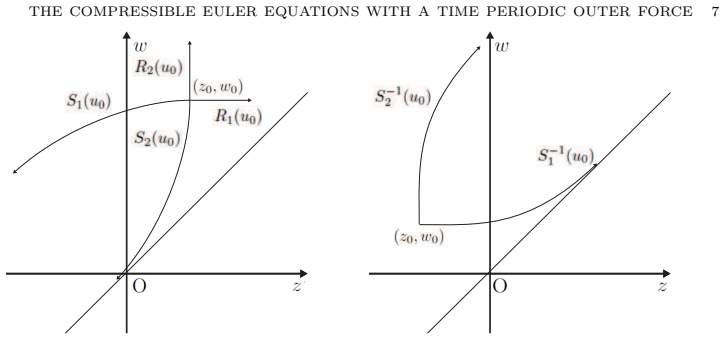
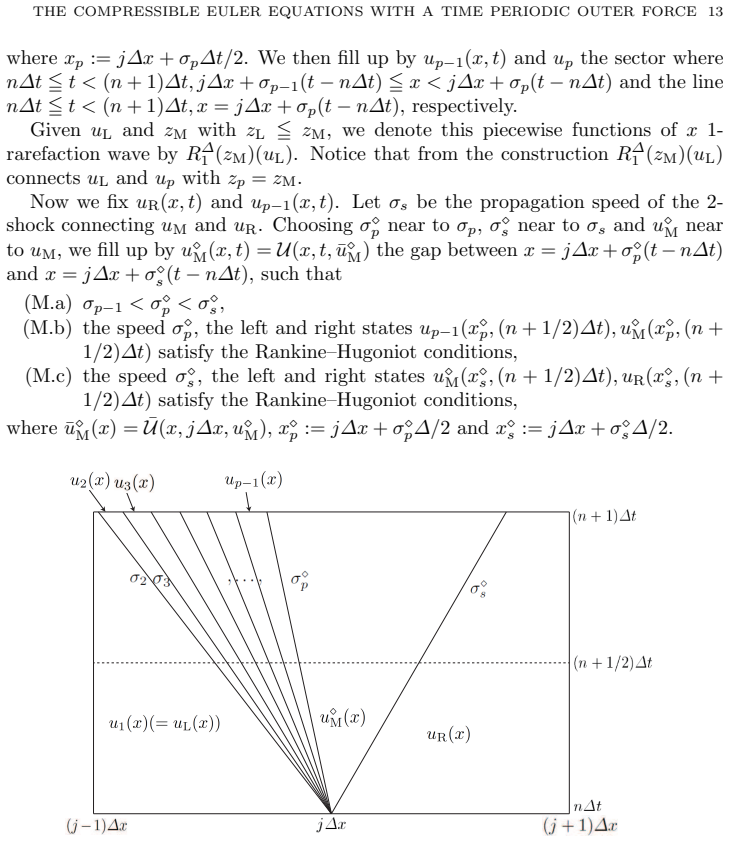
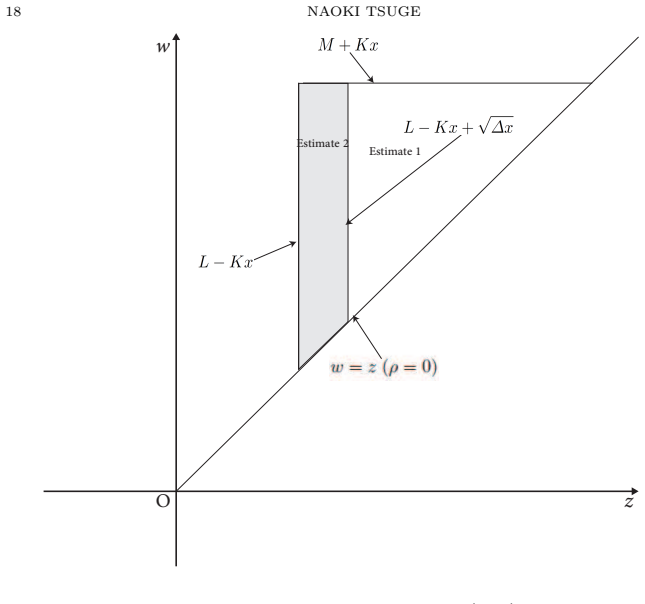
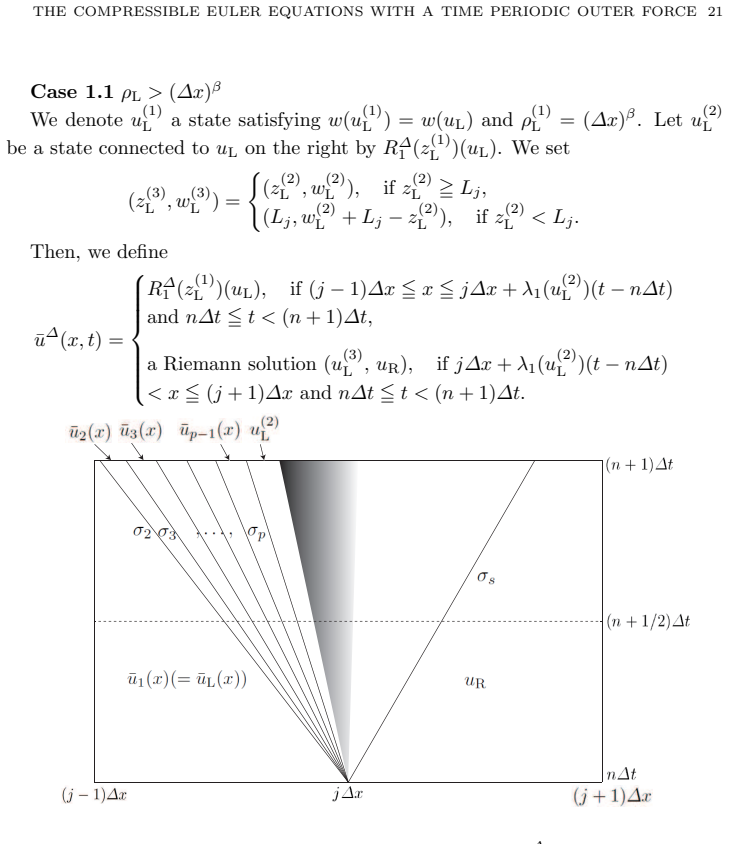
The central object is the generalized invariant region $\Delta_x = \{\rho \ge 0,\ L - Kx \le z \le w \le M + Kx\}$, expressed in the Riemann invariants $w = v + \rho^\theta/\theta$, $z = v - \rho^\theta/\theta$, where $\theta = (\gamma - 1)/2$, with bounds that shift linearly in $x$. The main mechanism is the modified Lax-Friedrichs scheme: approximate solutions are built cell-by-cell from steady-state profiles and Riemann solutions, and the cell averages obey the explicit recurrence (5.1). These averages define a continuous map from the vector of initial Riemann invariants to the vector after one period; the invariant region keeps the map inside a bounded convex set, and Brouwer's fixed point theorem gives initial data whose time-1 state coincides with itself. A compensated compactness step then extracts an almost-everywhere convergent subsequence whose limit is the periodic entropy weak solution.
What would settle it
Take $F(x,t) = K\cos(2\pi t)$ with $K>0$ and any $M \ge L \ge 1+K$, discretize the modified Lax-Friedrichs recurrence (5.1)-(5.3), and compute the period map on the invariant region; if for some mesh size the image leaves $\{L - Kx - \delta \le z,\ w \le M + Kx + \delta\}$ by more than $o(\Delta x)$, or the Brouwer fixed point fails to appear, then estimate (4.1) is false.
Extended reading notes
Core claim
The central claim is Theorem 1.1: for a $C^1$ outer force $F(x,t)$ with period 1, if $F$ is bounded by $K$ and the constants satisfy $M \ge L \ge 1 + K$, and if the initial data satisfy $0 \le \rho_0$, $L - Kx \le z(u_0)$, $w(u_0) \le M + Kx$ while the left boundary data satisfy the analogous inequalities, then the initial-boundary value problem has a time-periodic entropy weak solution. Moreover, the solution obeys $L - Kx \le z(u(x,t))$ and $w(u(x,t)) \le M + Kx$ for $(x,t) \in (0,1) \times (0,1)$, which implies that both characteristic speeds are positive. In the smooth case the Riemann invariants obey $z_t + \lambda_1 z_x = F$ and $w_t + \lambda_2 w_x = F$; the space-dependent change of variables $\tilde z = z + Kx$, $\tilde w = w - Kx$ makes the source terms push the solution back into the invariant region on the two sides of the triangle. The paper makes this formal argument rigorous for weak solutions by an approximate scheme.
Load-bearing premise
The theorem rests on the claim that the $L^\infty$ estimates for the near-vacuum case and the compensated compactness and periodicity arguments, which are omitted and referred to earlier work, carry over unchanged when the source term is time-periodic and the interval is bounded.
Editorial extensions
If this is right
- If Theorem 1.1 is correct, supersonic isentropic gas flow through a bounded interval with a time-periodic body force can be exactly periodic in time with the same period as the force.
- The invariant-region bounds give uniform $L^\infty$ control: density and velocity remain bounded in terms of $L$, $M$, and $K$ throughout the period.
- The proof constructs the periodic solution as a fixed point of a finite-dimensional period map, so the solution is obtained as a limit of explicitly computable approximate solutions.
- The method is restricted to monotone space-dependent bounds, so periodic boundary conditions and reflecting boundary conditions on a bounded interval are explicitly left open in Section 6.
Reading between the lines
- The proof as written relies on stated carry-over claims: the near-vacuum $L^\infty$ estimates and the compensated compactness and periodicity-of-limit arguments are omitted and referred to earlier work, so a self-contained verification in the present periodic-source, bounded-interval setting would remove the main open technical point.
- A natural numerical test is to solve the recurrence (5.1)-(5.3) for a concrete periodic force such as $F(x,t) = K\sin(2\pi t)$ and check whether the discrete period map has a fixed point inside the invariant region as the mesh size tends to zero.
- The success of the space-dependent invariant region suggests that similar existence results could hold for any hyperbolic system whose Riemann invariants satisfy diagonal equations with a common forcing term controlled by the same slope $K$.
- The paper's open problems indicate that genuinely periodic boundary conditions require non-monotone invariant bounds; constructing such bounds would be a natural next step beyond this paper.
Signed reviews
Editorial analysis
A structured set of objections, weighed in public.
Referee Report
Summary. The paper claims the existence of a time-periodic entropy weak solution to the one-dimensional isentropic compressible Euler equations with a time-periodic outer force on the bounded interval (0,1), under the assumption that both characteristic speeds are nonnegative so that no boundary condition is needed at x=1. The proof strategy combines an x-dependent generalized invariant region of the form L - Kx <= z(u) and w(u) <= M + Kx with a modified Lax-Friedrichs scheme whose recurrence formula defines a continuous time-one map on admissible discrete initial data; a Brouwer fixed point then yields a periodic discrete trajectory, and compensated compactness is invoked to pass to the limit and obtain a periodic entropy weak solution. The main theorem is stated for every initial datum u0 satisfying the invariant-region inequalities (1.8).
Significance. If the proof were complete, the paper would be a valuable contribution: time-periodic solutions for systems of conservation laws with a periodic source on a bounded interval have not been treated before, and the use of an x-dependent invariant region combined with a fixed-point argument is a natural and promising approach. The approximate scheme is carefully designed so that the source terms point inward on the sides of the invariant region, and the recurrence formula is explicit enough that continuity of the discrete time-one map is plausible. The paper also correctly identifies the two main difficulties, namely proving that the solution set maps into itself over one period and constructing a continuous finite-dimensional map. However, as written, the proof establishes less than the theorem states, and several load-bearing technical steps are deferred to previous papers by the author; these gaps must be addressed before the result can be considered proved.
major comments (3)
- [Section 5, Eq. (5.6), and Theorem 1.1] Theorem 1.1 is stated for every initial datum u0 satisfying (1.8), and Definition 1.2 incorporates u0 into the weak formulation through the terms involving phi(x,0)-phi(x,1). However, the proof defines the map F on admissible discrete initial data and then applies Brouwer's fixed point theorem, obtaining a fixed point (tilde u^0_j)^* which is then supplied as the initial data u^0_j for the approximate scheme. This establishes only that there exists some admissible discrete initial datum whose time-one image is within o(1) of itself; it does not show that an arbitrary prescribed u0 satisfying (1.8) is the initial trace of a time-periodic solution. This is not a cosmetic discrepancy, because the fixed-point method cannot deliver the universal reading. The theorem should be weakened to an existential statement over u0, or the authors need an additional argument, such as uniqueness or a strong stability property, to pass from the fixed point to arbitrary admissible initial data.
- [Section 3, Appendix A, Proposition 5.1, and Theorem 5.2] The L-infinity estimates for the near-vacuum case are explicitly omitted: the text says 'we omit the L-infinity estimates for the case in this paper. The detail can be found in [11].' In addition, Proposition 5.1 and Theorem 5.2, which are the results that justify the compensated compactness convergence and the periodicity of the limit, are only asserted to follow 'in the same manner to [11]-[13].' These are not routine localizations: the present problem has a time-periodic source and a bounded interval, so the interaction of the source with the x-dependent invariant region, the boundary Riemann problems, and the periodicity of the limit must be checked explicitly. Without these estimates and proofs, the fixed point obtained in Section 5 is not shown to converge to a time-periodic entropy weak solution. Please include the missing near-vacuum estimates and either prove Proposition 5.1 and Theorem 5.2 in detail or provide a careful verification that the arguments of [11]-[13] apply unchanged to the periodic-source bounded-interval setting.
- [Section 4, Eq. (4.2), and final paragraph of Section 5] The proof of Theorem 4.1 is carried out under the strict margin M >= (1+K)+epsilon in (4.2), and the paper concludes by saying that since epsilon is arbitrary, Theorem 4.1 holds under (1.7). For M = 1+K, which is allowed by (1.7), no positive epsilon exists, and the argument in Estimate 2 uses the epsilon-margin to absorb the O(sqrt(Delta x)) error in (4.21). The passage from the strict-inequality case to the equality case needs an explicit limiting argument, for example by applying the result with M+epsilon and L-epsilon and then letting epsilon tend to zero with uniform bounds. As written, the equality case M = 1+K is not proved.
minor comments (4)
- [Section 2] The numbering of Lemma 2.1 and the subsequent Lemma 2.3 is inconsistent: after Lemma 2.1 the text says 'Lemma 2.3 can be found in [2, Lemma 3.3]', and a second statement labeled Lemma 2.3 appears after Theorem 2.2. Please correct the numbering and cross-references.
- [Section 4] In the sentence 'As a result, from (4.20), we drive (4.1)1', the word 'drive' should read 'derive'.
- [Section 3] The notation u^Delta(x,-0) is used without explanation; since the approximate solution is piecewise constant in time and may jump at each time level, the notation should be defined explicitly as the appropriate one-sided limit.
- [Section 5, Eq. (5.5)] The choice of delta(Delta x) in (5.5) is asserted to exist from (5.1)-(5.3), but it should be clarified that the o(Delta x) remainder in (5.1) is absorbed uniformly over all admissible discrete initial data, since the fixed-point argument requires a single compact convex set that is mapped into itself.
Circularity Check
No circularity: the periodic solution is produced by a fixed-point argument, and the same-author citations supply independent technical estimates rather than restating the conclusion.
full rationale
The derivation chain does not reduce any conclusion to its own input. The invariant-region bound (1.10) is obtained from the maximum-principle-type estimates in Section 4; the projection step (3.1) truncates cell values into the candidate triangle, but the text tracks the truncation as o(∆x) and shows that it disappears in the limit, so the bound is not simply assumed. The periodic solution is found as a Brouwer fixed point of the discrete time-one map (5.6), not by fitting parameters to the solution; the constructed initial grid data are part of the existence argument. The same-author citations are load-bearing for technical estimates: Section 3 defers near-vacuum L∞ estimates to [11], Section 4.1 cites [11, Appendix A] for the quasi-steady-state properties, and Section 5 states that Proposition 5.1 and Theorem 5.2 'can be proved in the same manner to [11]–[13]'. These are prior external results for related problems rather than restatements of the present theorem, so they do not make the argument circular; at worst they leave proof gaps if the carry-over fails. The prescribed-u0 reading of Theorem 1.1 versus the fixed-point-constructed initial data is a logical quantifier issue, not a self-referential reduction. Therefore no circularity step can be exhibited.
Assumptions & free parameters
assumptions (3)
- standard math Unique Riemann solutions and invariant regions for the homogeneous isentropic Euler system, cited to Chen [2].
- domain assumption The modified Lax-Friedrichs scheme estimates, including the omitted near-vacuum L-infinity bound, hold as in [11, Appendix A] and [12]-[17].
- ad hoc to paper The compactness theorem (Proposition 5.1) and convergence to a time-periodic entropy weak solution (Theorem 5.2) follow by the same argument as [11]-[13].
Cite this review
Pith. "Pith review of Existence of a time periodic solution for the compressible Euler equation with a time periodic outer force." pith.science (2026). https://pith.science/paper/JERPIQCY
@misc{pith2026190803120,
  author       = {Pith},
  title        = {Pith review of: Existence of a time periodic solution for the compressible Euler equation with a time periodic outer force},
  year         = {2026},
  howpublished = {\url{https://pith.science/paper/JERPIQCY}},
  note         = {Machine review of arXiv:1908.03120}
}
read the original abstract
We are concerned with a time periodic supersonic flow through a bounded interval. This motion is described by the compressible Euler equation with a time periodic outer force. Our goal in this paper is to prove the existence of a time periodic solution. Although this is a fundamental problem for other equations, it has not been received much attention for the system of conservation laws until now.
Figures

Figures from the paper (2 more)
Reference graph
Works this paper leans on
-
[11]
Tsuge, N.: Global L∞ solutions of the compressible Euler equations with spheric al symmetry. J. Math. Kyoto Univ. 46, 457–524 (2006)
work page 2006
-
[13]
Tsuge, N.: Isentropic gas flow for the compressible Eule r equation in a nozzle. Arch. Ration. Mech. Anal. 209, 365400 (2013)
work page 2013
-
[1]
Acta Mathematica Scientia 6, 75–120 (1986)
Chen, G.-Q.: Convergence of the Lax–Friedrichs scheme f or isentropic gas dynamics (III). Acta Mathematica Scientia 6, 75–120 (1986)
work page 1986
-
[2]
MSRI preprint 00527-91, Berkeley, 1990
Chen, G.-Q.: The compensated compactness method and the system of isentropic gas dy- namics. MSRI preprint 00527-91, Berkeley, 1990
work page 1990
-
[3]
DiPerna, R.J.: Convergence of the viscosity method for i sentropic gas dynamics. Commun. Math. Phys. 91, 1–30 (1983)
work page 1983
-
[4]
Acta Mathematica Scientia 5, 415–432, 433–472 (1985)
Ding, X., Chen, G.-Q., Luo, P.: Convergence of the Lax–Fr iedrichs scheme for isentropic gas dynamics (I)–(II). Acta Mathematica Scientia 5, 415–432, 433–472 (1985)
work page 1985
-
[5]
Ding, X., Chen, G.-Q., Luo, P.: Convergence of the fracti onal step Lax–Friedrichs scheme and Godunov scheme for the isentropic system of gas dynamics . Commun. Math. Phys. 121, 63—84 (1989)
work page 1989
-
[6]
Murat, F.: Compacit´ e per compensation. Ann. Scuola Norm. Sup. Pisa Sci. Math. 5, 489– 507 (1978); II, In: De Giorgi, E., Magenes, E., and Mosco, U. ( eds.) Proc. Int. Meeting on Recent Methods on Nonlinear Analysis. Pitagora, Bologna, 1 979; III, Ann. Scuola. Norm. Sup. Pisa Sci. Math. 8, 69–102 (1981) THE COMPRESSIBLE EULER EQUATIONS WITH A TIME PERIOD...
work page 1978
Show all 18 references
-
[7]
Lecture Notes in Num
Matsumura A., Nishida T: Periodic solutions of a viscous gas equation. Lecture Notes in Num. Appl. Anal. 10, 49–82 (1998)
1998
-
[8]
Nonlinear Anal
Takeno, S.: Time-periodic solutions for a scalar conser vation law. Nonlinear Anal. 45, 1039– 1060 (2001)
2001
-
[9]
In: Knopps, R.J
Tartar, L.: Compensated compactness and applications to partial differ ential equations. In: Knopps, R.J. (ed.) Nonlinear Analysis and Mechanics, Herio tt-W att Symposium, vol. 4. ed. Research Notes in Mathematics, Vol. 39. Pittman Press, Lond on, 136–211, 1979
1979
-
[10]
Systems of Nonlinear PDEs, NATO Advanced Science Institute s Series, vol
Tartar, L.: The compensated compactness method applied to systems of co nservation laws . Systems of Nonlinear PDEs, NATO Advanced Science Institute s Series, vol. III, pp. 263–285. Oxford, 1983
1983
-
[12]
Tsuge, N.: Existence of global solutions for unsteady i sentropic gas flow in a Laval nozzle. Arch. Ration. Mech. Anal. 205, 151–193 (2012)
2012
-
[14]
Tsuge, N.: Existence of a global solution to a scalar con servation law with a source term for large data. J. Math. Anal. Appl. 432, 862–867 (2015)
2015
-
[15]
Nonlinear Anal
Tsuge, N.: Existence and Stability of Solutions to the C ompressible Euler Equations with an Outer Force. Nonlinear Anal. Real World Appl. 27, 203–220 (2016)
2016
-
[16]
Acta Appl
Tsuge, N.: Existence of a Global Solution for a Scalar Co nservation Law with a Source Term. Acta Appl. Math. 147, 177–186 (2016)
2016
-
[17]
Nonlinear Anal
Tsuge, N.: Global entropy solutions to the compressibl e Euler equations in the isentropic nozzle flow for large data: Application of the generalized in variant regions and the modified Godunov scheme. Nonlinear Anal. Real World Appl. 37, 217–238 (2017)
2017
-
[18]
and Tsuge, N.: Global existence and stabil ity to the polytropic gas dynamics with an outer force
Hu, Y., Lu, Y. and Tsuge, N.: Global existence and stabil ity to the polytropic gas dynamics with an outer force. Appl. Math. Lett. 95, 36–40 (2019) Department of Mathematics Education, F aculty of Education , Gifu University, 1-1 Yanagido, Gifu Gifu 501-1193 Japan. E-mail add...
2019
Reviewed August 14, 2026 · model on record in the stance chip above.
Discussion (0). Continue with ORCID to comment.