REVIEW 3 major objections 4 minor 151 references
Interpreting Language Model Hidden States at Scale
T0 review · 3 major / 4 minor · reviewed 2026-08-14 · deepseek-v4-flash
Pith's one-line read OmniLens claims that one low-rank, identity-residual lens family can attach to any model-width hookpoint, making dense trained-lens coverage practical on models as large as LLaMA-3-70B.
desk verdict A solid scaling contribution whose headline interpretability claim needs better statistics before it is treated as established. read the letter →
The pith
A machine-rendered reading of the paper's core claim, the machinery that carries it, and where it could break.
The reading
What carries the argument
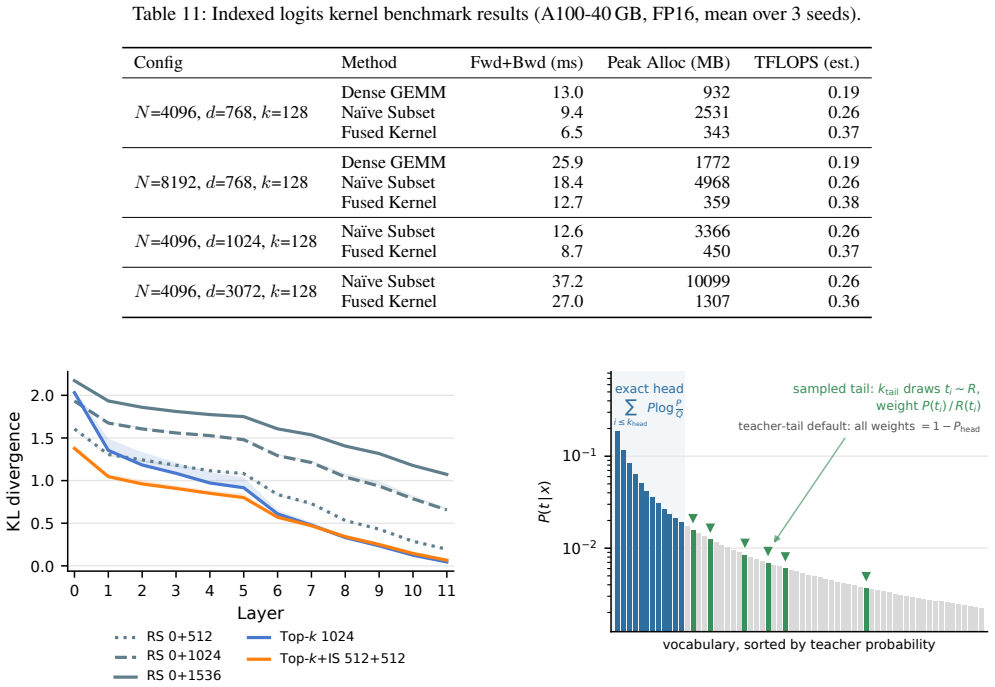
The load-bearing mechanism is the identity-residual low-rank translator $L_{\ell,u}=I+\frac{\alpha}{r}B_{\ell,u}A_{\ell,u}$, which turns each hookpoint's activation into residual-stream space before the frozen final normalization and unembedding; because it starts as the identity and only needs to agree on activations the model actually produces, rank $r=64$ captures most of a full-rank lens's fidelity at a fraction of the parameters. The second mechanism is Subset-KL training: Top-$k$ truncation renormalizes both distributions over the teacher's $k$ most probable tokens, while Top-$k$+IS computes the head exactly and importance-samples the tail with a lens-independent proposal, so the estimated objective and its gradients are unbiased for the full KL (Theorem 1). A fused CUDA kernel computes only the selected logits without materializing the gathered unembedding rows, removing the memory blow-up that subset objectives would otherwise reintroduce. Together these two mechanisms make per-hookpoint parameter growth linear in width and keep vocabulary-side memory under control, which is what allows 482 lenses on a 70B model.
What would settle it
At 8B, train full-rank full-KL lenses on all six hookpoint types and rerun the toxicity audit; if MLP outputs no longer give the largest toxicity reduction or the negative Spearman correlation between detection and intervention disappears, the visibility-action decoupling is an artifact of the low-rank or subset-KL approximation.
Extended reading notes
Core claim
OmniLens establishes that a single low-rank lens family can decode any model-width activation—residual, attention, or MLP—and that with this universal family dense coverage is tractable at 70B scale. The translator is an identity-residual low-rank map $L_{\ell,u}=I+\frac{\alpha}{r}BA$, trained against the model's frozen final readout, with parameters growing linearly rather than quadratically in width. Two Subset-KL objectives supply the memory lever: Top-$k$ truncation renormalizes over the teacher's most probable tokens, and Top-$k$+IS keeps those head tokens exact while importance-sampling the tail, giving unbiased stochastic gradients for the full KL. On a 482-lens LLaMA-3-70B ensemble the paper reproduces published prompt-injection detection, multi-hop memory injection, and toxicity localization results at lower cost. The new finding that model-wide coverage exposes is that visibility and causal actionability decouple: the components where toxic language is most detectable are negatively correlated (Spearman $-0.43$ at 8B) with the components where intervention reduces toxicity, and the most effective intervention targets lie outside the attention heads studied previously.
Load-bearing premise
The paper's central new finding—that visible hookpoints differ from effective intervention sites—rests on the assumption that its rank-64 and subset-vocabulary approximations preserve the relative ordering of hookpoints; the paper's own appendix shows the approximations resolve predictions several hidden states later than the full-KL reference, so if the approximations shift rankings, the decoupling could be an artifact.
Editorial extensions
If this is right
- Trained-lens interpretability scales to near-frontier models: a 482-hookpoint ensemble trains on LLaMA-3-70B within A100-40GB budgets, and eight optimizer steps execute on LLaMA-3-405B.
- Component-agnostic coverage makes cross-component comparison routine: the same lens family reads residual, attention, and MLP activations, so rankings of visibility and intervention efficacy can be compared without retraining separate lens families.
- Visibility and actionability can diverge: at 8B, the components with the strongest detected toxicity signal and the components whose modification most reduces toxicity are negatively correlated (Spearman $-0.43$), so localization studies that rely on readout visibility alone may pick the wrong intervention site.
- Established lens applications survive the approximations: prompt-injection detection reaches mean AUROC 0.997 on the five classification tasks at every scale, memory injection captures 61–82% of achievable gain at $\tau=4$, and toxicity localization reproduces the published head concentration.
- Full-rank references are not needed for task-level utility: at 70B, where no full-rank reference is trainable, the Subset-KL lenses detect knowledge-task injections the logit lens misses.
Reading between the lines
- Beyond the paper, a user of the released framework can test the decoupling directly on any 8B model: select intervention sites by measured causal effect rather than by lens visibility and compare; if visibility-selected sites continue to underperform, the paper's constraint becomes a general design rule for interpretability tools.
- Beyond the paper, the rank-64 default makes early-layer analyses the fragile case; the paper's own ablations show layer-0 top-1 agreement of only 56.7%, so component or layer rankings in the first few layers should be read with wider error bars than late-layer rankings.
- Beyond the paper, the identity-residual translator plus a learned input map could extend the same family to individual attention heads, which the paper lists as future work; if that holds, per-head interpretability at 70B becomes a matter of engineering rather than method design.
Signed reviews
Editorial analysis
A structured set of objections, weighed in public.
Referee Report
Summary. The paper introduces OmniLens, a trained-lens framework that attaches one low-rank, identity-residual translator family to residual-stream, attention, and MLP hookpoints, and trains it with two Subset-KL objectives: a biased Top-k truncation and an unbiased Top-k+IS importance-sampled estimator. The authors report large reductions in trainable parameters and peak memory, train a 482-lens ensemble on LLaMA-3-70B, run eight optimization steps on LLaMA-3.1-405B as a feasibility demonstration, and reproduce three lens applications: prompt-injection detection, multi-hop memory injection, and toxicity localization. The paper's central scientific claim beyond scaling is that model-wide lens coverage reveals a decoupling between where a behavior is most visible in lens readouts and where intervention is most causally effective, with a reported Spearman correlation of -0.43 between detected toxicity and intervention reduction across six component types at 8B.
Significance. If the scaling results hold, OmniLens is a substantial systems contribution: it combines two independent cost reductions (low-rank translators and subset-KL training), ships reproducible code, gives a correct unbiasedness proof for the Top-k+IS estimator in Appendix E, and validates its memory model against measured GPT-2 and 70B runs. Enabling dense trained-lens coverage at 70B and a training path at 405B is genuinely valuable for the interpretability community. The decoupling claim, if confirmed with proper statistical support, would be an important empirical constraint on how lens readouts are used, because it would show that visibility rankings do not generally imply intervention rankings. However, as detailed below, the evidence for that claim is currently not sufficient: it rests on six component-type aggregates with no uncertainty quantification and on approximation choices whose effect on the relevant rankings is not verified against a full-rank componentwise reference.
major comments (3)
- [§5, Fig. 6d] The headline decoupling result, Spearman -0.43 between detected toxicity and intervention effectiveness at 8B, is computed from six component-type aggregates with no confidence interval, no permutation test, and no cross-seed spread on the intervention axis. The paper itself notes in Appendix J that the selector comparison in Table 22 is a single-run evaluation and that differences of a few points are within run-to-run noise. As presented, the correlation cannot be distinguished from sampling noise. Please report bootstrap confidence intervals over lens seeds and prompts, and a permutation test over component labels, or explicitly demote the claim to a qualitative observation.
- [Appendix K, Table 7] The decoupling claim requires that the low-rank/Subset-KL approximation preserve the relative ordering of hookpoints by visibility and by intervention efficacy. The paper's own fidelity statistics do not establish this. Table 7 reports early-layer Kendall tau@100 of only 0.243 for the recommended Top-k+IS lens against the full-rank reference (and -0.077 for Top-k), and Appendix K states that Subset-KL lenses resolve predictions 4-5 hidden states later than the full-KL reference. Since toxicity detection is a fine-grained, partly early-layer signal, this is a real risk that the component rankings in Fig. 6d are artifacts of the approximation. A concrete remedy is to compute the same detection-vs-intervention Spearman at GPT-2 with the full-rank full-KL reference, which is trainable at that scale, and show that the low-rank and full-rank component orderings agree; at 8B no full-rank componentwise reference exists, so that check is essential rather than optional.
- [Abstract, §5, Appendix J] The abstract states that 'the most effective interventions lie outside the attention heads examined by prior lens studies' without qualification, but the supporting evidence is limited to GPT-2 and 8B. At 70B, Appendix J reports that ablating the flagged heads is no more effective than ablating random heads (Fig. 30), so the outside-attention conclusion has no 70B support; the 8B selector comparison in Table 22 is single-run. Please qualify the abstract and Section 6 claims to 'at GPT-2 and 8B', or provide an intervention result at 70B that identifies an effective non-attention site.
minor comments (4)
- [Fig. 6d] The six component-type points in the main-text figure are not directly labeled in the rendered figure; please add explicit labels or a legend so the reader can map each point to attn_in, attn_out, resid_mid, mlp_in, mlp_out, and resid_post without cross-referencing the text.
- [Appendix L] Appendix L states that the detection captures of Table 16 and the whole-model audit predate the 250-step cosine-annealed schedule and use earlier-schedule checkpoints. Please make this schedule mismatch visible in the main text, since the three case studies are presented as a single coherent evaluation and the inconsistency is currently easy to miss.
- [Fig. 6d caption] The caption's statement 'No full-rank reference is trainable at 70B (Section 4)' is ambiguous: Appendix G shows that LoRA+Full-KL fits at 35.5GB, so the missing reference is a full-rank translator, not a full-KL objective. Please rephrase to 'no full-rank translator reference is trainable at 70B'.
- [Appendix E] In the proof of Theorem 1, the display for the tail expectation omits the explicit average over the k_tail draws; the surrounding text explains it, but the equation would be clearer if the 1/k_tail sum appeared explicitly before taking the expectation.
Circularity Check
No circular derivation; the scaling and estimator results are self-contained, and the self-citations in the case studies are replication baselines with external outcomes.
full rationale
The paper's central derivations are not circular. The low-rank translator in Eq. (3) is an explicit parameterization with O(rd) parameters, so the parameter-count scaling is arithmetic rather than a fitted prediction. The Subset-KL estimator's unbiasedness (Theorem 1) is a standard importance-sampling identity, proved in Appendix E and numerically verified against full-KL autograd gradients; it does not assume the conclusion. Fidelity claims for low-rank and Subset-KL lenses are checked against full-rank full-KL baselines on GPT-2 and 8B, and against teacher KL, so the approximations are evaluated against independent references rather than being defined in terms of their own outputs. The three case studies use external task outcomes (detection AUROC on held-out attacks, 2WMH causal lift in the model's own final P(answer), and Toxic-BERT scores on generations) that were not used to fit any lens constant; consequently, no fitted parameter is recycled as a 'prediction.' The visibility-vs-intervention decoupling is a new empirical claim whose robustness is limited by low-rank/Subset-KL fidelity at early layers (Appendix K, Table 7: early-layer Kendall tau 0.243 for Top-k+IS vs. the full-rank reference; 4-5 hidden-state later prediction depth), but this is an approximation-validity concern, not circularity: the intervention measurements are external and the lens was not optimized to produce the decoupling. Self-citations to Pettyjohn (2025) and Sakarvadia et al. (2023, 2024) appear as described prior work and replication baselines; they are not load-bearing because the current paper re-measures those effects on external benchmarks (2WMH, Toxic-BERT, prompt-injection AUROC) rather than relying on the citations for support. These non-load-bearing self-citations justify a score of 2, not 0, but no circular step is present.
Assumptions & free parameters
free parameters (4)
- lens rank r =
r = 64
- Subset-KL budget (k_head, k_tail) =
Top-k+IS: (512, 1024); Top-k: k = 512
- translator scale alpha =
alpha = r (unit scaling)
- memory-model coefficient beta =
7.0 bytes per token times vocabulary slot
assumptions (5)
- domain assumption The teacher distribution P(·|x) is the correct self-supervised target for lenses.
- domain assumption The frozen final normalization and unembedding provide a sufficient readout for every hookpoint type.
- domain assumption The Pile corpus is a sufficient training distribution for lenses.
- standard math Importance-sampling support condition R(v|x) > 0 wherever P(v|x) > 0 on the tail.
- domain assumption The student's full-vocabulary log-partition can be computed exactly in chunks without materializing all student logits.
Cite this review
Pith. "Pith review of Interpreting Language Model Hidden States at Scale." pith.science (2026). https://pith.science/paper/JEXUFH6M
@misc{pith2026260810260,
  author       = {Pith},
  title        = {Pith review of: Interpreting Language Model Hidden States at Scale},
  year         = {2026},
  howpublished = {\url{https://pith.science/paper/JEXUFH6M}},
  note         = {Machine review of arXiv:2608.10260}
}
read the original abstract
Lens methods interpret large language models (LLMs) by mapping intermediate activations to the output vocabulary, revealing how next-token predictions develop through the network. Trained lenses remain expensive: affine-translator parameters grow quadratically with model width, while exact, full-vocabulary Kullback--Leibler (KL) training dominates memory. Consequently, prior trained lenses have been applied to models of at most 20B parameters and remain tied to particular component types. We present OmniLens, which applies a single lens family to any model-width activation, whether residual stream, attention, or MLP, and combines two independent scaling techniques. First, low-rank translators make per-lens parameter growth linear in model width and reduce trainable parameters by up to 98.4%. Second, Subset-KL materializes only selected vocabulary logits: its Top-k mode cuts peak training memory by up to 70%, while its importance-sampled variant retains unbiased stochastic gradients for the full KL. These savings enable a dense ensemble of 482 lenses for LLaMA-3.3-70B, providing 6x the coverage of a residual-stream design at the same depth. Model-wide coverage then reveals what single-component lenses cannot: the components where a behavior is most visible need not be those where intervention is most effective, and the most effective interventions lie outside the attention heads examined by prior lens studies. Across three case studies (prompt-injection detection, multi-hop memory injection, and toxicity localization), OmniLens reproduces key published results at substantially lower cost.
Figures


Figures from the paper (25 more)







Reference graph
Works this paper leans on
-
[1]
Advances in Neural Information Processing Systems , volume=
Attention is all you need , author=. Advances in Neural Information Processing Systems , volume=
-
[2]
On Pixel-Wise Explanations for Non-Linear Classifier Decisions by Layer-Wise Relevance Propagation , year =. PLOS ONE , publisher =. doi:10.1371/journal.pone.0130140 , author =
-
[3]
Ian Tenney and Dipanjan Das and Ellie Pavlick , year=. 1905.05950 , archivePrefix=
arXiv 1905
-
[4]
2021 , eprint=
Transformer Interpretability Beyond Attention Visualization , author=. 2021 , eprint=
2021
-
[5]
Interpreting
Nostalgebraist , howpublished=. Interpreting. 2020 , note=
2020
-
[6]
2023 , eprint=
Eliciting Latent Predictions from Transformers with the Tuned Lens , author=. 2023 , eprint=
2023
-
[7]
2023 , eprint=
Attention Lens: A Tool for Mechanistically Interpreting the Attention Head Information Retrieval Mechanism , author=. 2023 , eprint=
2023
-
[8]
2023 , eprint=
Towards Automated Circuit Discovery for Mechanistic Interpretability , author=. 2023 , eprint=
2023
Show all 151 references
-
[9]
and Ducharme, R and Vincent, Pascal and Mathematiques, Centre , year =
Bengio, Y. and Ducharme, R and Vincent, Pascal and Mathematiques, Centre , year =
-
[10]
2013 , eprint=
Efficient Estimation of Word Representations in Vector Space , author=. 2013 , eprint=
2013
-
[11]
G lo V e: Global Vectors for Word Representation
Pennington, Jeffrey and Socher, Richard and Manning, Christopher. G lo V e: Global Vectors for Word Representation. Conference on Empirical Methods in Natural Language Processing. 2014. doi:10.3115/v1/D14-1162
2014 doi
-
[12]
2018 , eprint=
Deep contextualized word representations , author=. 2018 , eprint=
2018
-
[13]
C Users J
Gage, Philip , title =. C Users J. , month = feb, pages =. 1994 , issue_date =
1994
-
[14]
2021 , eprint=
An Image is Worth 16x16 Words: Transformers for Image Recognition at Scale , author=. 2021 , eprint=
2021
-
[15]
2018 , eprint=
Self-Attention with Relative Position Representations , author=. 2018 , eprint=
2018
-
[16]
Jianlin Su and Yu Lu and Shengfeng Pan and Ahmed Murtadha and Bo Wen and Yunfeng Liu , year=. Ro. 2104.09864 , archivePrefix=
-
[17]
Fu and Stefano Ermon and Atri Rudra and Christopher Ré , year=
Tri Dao and Daniel Y. Fu and Stefano Ermon and Atri Rudra and Christopher Ré , year=. Flash. 2205.14135 , archivePrefix=
-
[18]
1810.04805 , archivePrefix=
Jacob Devlin and Ming-Wei Chang and Kenton Lee and Kristina Toutanova , year=. 1810.04805 , archivePrefix=
-
[19]
and Zipser, David , journal=
Williams, Ronald J. and Zipser, David , journal=. A Learning Algorithm for Continually Running Fully Recurrent Neural Networks , year=
-
[20]
2001 , eprint=
A Bit of Progress in Language Modeling , author=. 2001 , eprint=
2001
-
[21]
OpenAI Blog , year =
Improving Language Understanding by Generative Pre-Training , author =. OpenAI Blog , year =
-
[22]
2017 , eprint=
Adam: A Method for Stochastic Optimization , author=. 2017 , eprint=
2017
-
[23]
1954 , url=
Distributional Structure , author=. 1954 , url=
1954
-
[24]
2017 , eprint=
The Mythos of Model Interpretability , author=. 2017 , eprint=
2017
-
[25]
2017 , eprint=
Towards A Rigorous Science of Interpretable Machine Learning , author=. 2017 , eprint=
2017
-
[26]
Why Should I Trust You?
"Why Should I Trust You?": Explaining the Predictions of Any Classifier , author=. 2016 , eprint=
2016
-
[27]
Hu and Yelong Shen and Phillip Wallis and Zeyuan Allen-Zhu and Yuanzhi Li and Shean Wang and Lu Wang and Weizhu Chen , year=
Edward J. Hu and Yelong Shen and Phillip Wallis and Zeyuan Allen-Zhu and Yuanzhi Li and Shean Wang and Lu Wang and Weizhu Chen , year=. 2106.09685 , archivePrefix=
-
[28]
R eal T oxicity P rompts: Evaluating Neural Toxic Degeneration in Language Models
Gehman, Samuel and Gururangan, Suchin and Sap, Maarten and Choi, Yejin and Smith, Noah A. R eal T oxicity P rompts: Evaluating Neural Toxic Degeneration in Language Models. Findings of the Association for Computational Linguistics: EMNLP 2020. 2020. doi:10.18653/v1/2020.findin...
2020 doi
-
[29]
2021 , eprint=
Ethical and social risks of harm from Language Models , author=. 2021 , eprint=
2021
-
[30]
2022 , eprint=
Characteristics of Harmful Text: Towards Rigorous Benchmarking of Language Models , author=. 2022 , eprint=
2022
-
[31]
and Gebru, Timnit and McMillan-Major, Angelina and Shmitchell, Shmargaret , title =
Bender, Emily M. and Gebru, Timnit and McMillan-Major, Angelina and Shmitchell, Shmargaret , title =. 2021 , isbn =. doi:10.1145/3442188.3445922 , booktitle =
2021
-
[32]
2024 , eprint=
Memory Injections: Correcting Multi-Hop Reasoning Failures during Inference in Transformer-Based Language Models , author=. 2024 , eprint=
2024
-
[33]
IEEE/CVF Conference on Computer Vision and Pattern Recognition , pages =
Transformer Interpretability Beyond Attention Visualization , author =. IEEE/CVF Conference on Computer Vision and Pattern Recognition , pages =. 2021 , doi =
2021
-
[34]
2402.05602 , archivePrefix=
Reduan Achtibat and Sayed Mohammad Vakilzadeh Hatefi and Maximilian Dreyer and Aakriti Jain and Thomas Wiegand and Sebastian Lapuschkin and Wojciech Samek , year=. 2402.05602 , archivePrefix=
-
[35]
2018 , eprint=
Understanding intermediate layers using linear classifier probes , author=. 2018 , eprint=
2018
-
[36]
2018 , eprint=
What you can cram into a single vector: Probing sentence embeddings for linguistic properties , author=. 2018 , eprint=
2018
-
[37]
2024 , url =
Monte MacDiarmid and Timothy Maxwell and Nicholas Schiefer and Jesse Mu and Jared Kaplan and David Duvenaud and Sam Bowman and Alex Tamkin and Ethan Perez and Mrinank Sharma and Carson Denison and Evan Hubinger , title =. 2024 , url =
2024
-
[38]
2021 , journal=
A Mathematical Framework for Transformer Circuits , author=. 2021 , journal=
2021
-
[39]
How does
Michael Hanna and Ollie Liu and Alexandre Variengien , year=. How does. 2305.00586 , archivePrefix=
-
[40]
Interpretability in the Wild: A Circuit for Indirect Object Identification in
Kevin Wang and Alexandre Variengien and Arthur Conmy and Buck Shlegeris and Jacob Steinhardt , year=. Interpretability in the Wild: A Circuit for Indirect Object Identification in. 2211.00593 , archivePrefix=
-
[41]
2023 , eprint=
Progress measures for grokking via mechanistic interpretability , author=. 2023 , eprint=
2023
-
[42]
GitHub repository , howpublished =
Nova Patch and Emmanuel Rosa and others , title =. GitHub repository , howpublished =. 2020 , publisher =
2020
-
[43]
Orthrus Toxic Dictionary implementation , howpublished =
Dawid Grad, Orthrus-Lexicon , year =. Orthrus Toxic Dictionary implementation , howpublished =
-
[44]
The IEEE International Conference on Computer Vision (ICCV) , month =
Aligning Books and Movies: Towards Story-Like Visual Explanations by Watching Movies and Reading Books , author =. The IEEE International Conference on Computer Vision (ICCV) , month =
-
[45]
2017 , howpublished =
cjadams and Jeffrey Sorensen and Julia Elliott and Lucas Dixon and Mark McDonald and nithum and Will Cukierski , title =. 2017 , howpublished =
2017
-
[46]
2016 , eprint=
Pointer Sentinel Mixture Models , author=. 2016 , eprint=
2016
-
[47]
Aaron Grattafiori and Abhimanyu Dubey and Abhinav Jauhri and Abhinav Pandey and Abhishek Kadian and Ahmad Al-Dahle and et al. , year=. The. 2407.21783 , archivePrefix=
-
[48]
Gao, Leo and Biderman, Stella and Black, Sid and Golding, Laurence and Hoppe, Travis and Foster, Charles and Phang, Jason and He, Horace and Thite, Anish and Nabeshima, Noa and Presser, Shawn and Leahy, Connor , journal=. The
-
[49]
AAAI Conference on Artificial Intelligence , year=
On Scalar Embedding of Relative Positions in Attention Models , author=. AAAI Conference on Artificial Intelligence , year=
-
[50]
2023 , eprint=
Exploring the Limits of Transfer Learning with a Unified Text-to-Text Transformer , author=. 2023 , eprint=
2023
-
[51]
Le and Ruslan Salakhutdinov , year=
Zihang Dai and Zhilin Yang and Yiming Yang and Jaime Carbonell and Quoc V. Le and Ruslan Salakhutdinov , year=. Transformer-. 1901.02860 , archivePrefix=
1901 arXiv
-
[52]
2021 , eprint=
Challenges in Detoxifying Language Models , author=. 2021 , eprint=
2021
-
[53]
2024 , eprint=
Full Parameter Fine-tuning for Large Language Models with Limited Resources , author=. 2024 , eprint=
2024
-
[54]
2021 , eprint=
Overcoming Catastrophic Forgetting by Generative Regularization , author=. 2021 , eprint=
2021
-
[55]
What's in a Name?
Alejandro Salinas and Amit Haim and Julian Nyarko , year=. What's in a Name?. 2402.14875 , archivePrefix=
-
[56]
2020 , isbn =
Rasley, Jeff and Rajbhandari, Samyam and Ruwase, Olatunji and He, Yuxiong , title =. 2020 , isbn =. doi:10.1145/3394486.3406703 , booktitle =
2020
-
[57]
arXiv preprint arXiv:2311.04897 , year=
Future lens: Anticipating subsequent tokens from a single hidden state , author=. arXiv preprint arXiv:2311.04897 , year=
-
[58]
arXiv preprint arXiv:2403.05846 , year=
Diffusion lens: Interpreting text encoders in text-to-image pipelines , author=. arXiv preprint arXiv:2403.05846 , year=
-
[59]
arXiv preprint arXiv:2502.16570 , year=
Entropy-lens: The information signature of transformer computations , author=. arXiv preprint arXiv:2502.16570 , year=
-
[60]
Joint International Conference on Computational Linguistics, Language Resources and Evaluation , pages=
Jump to Conclusions: Short-Cutting Transformers with Linear Transformations , author=. Joint International Conference on Computational Linguistics, Language Resources and Evaluation , pages=
-
[61]
59th Annual Meeting of the Association for Computational Linguistics and the 11th International Joint Conference on Natural Language Processing , pages=
Intrinsic Dimensionality Explains the Effectiveness of Language Model Fine-Tuning , author=. 59th Annual Meeting of the Association for Computational Linguistics and the 11th International Joint Conference on Natural Language Processing , pages=
-
[62]
Dettmers, Tim and Pagnoni, Artidoro and Holtzman, Ari and Zettlemoyer, Luke , journal=
-
[63]
Zhao, Jiawei and Zhang, Zhenyu and Chen, Beidi and Wang, Zhangyang and Anandkumar, Anima and Tian, Yuandong , booktitle=. Ga
-
[64]
D. G. Horvitz and D. J. Thompson , journal =. A Generalization of Sampling Without Replacement From a Finite Universe , urldate =
-
[65]
Empirical
Andreas Maurer and Massimiliano Pontil , year=. Empirical. 0907.3740 , archivePrefix=
-
[66]
Constructing A Multi-hop
Xanh Ho and Anh-Khoa Duong Nguyen and Saku Sugawara and Akiko Aizawa , year=. Constructing A Multi-hop. 2011.01060 , archivePrefix=
2011 arXiv
-
[67]
2020 , howpublished =
Schulman, John , title =. 2020 , howpublished =
2020
-
[68]
Shao, Zhihong and Wang, Peiyi and Zhu, Qihao and Xu, Runxin and Song, Junxiao and Bi, Xiao and Zhang, Haowei and Zhang, Mingchuan and Li, YK and Wu, Yang and others , journal=
-
[69]
Zhang, Lunjun and Ba, Jimmy , journal=
-
[70]
Better Estimation of the
Amini, Afra and Vieira, Tim and Cotterell, Ryan , booktitle=. Better Estimation of the
-
[71]
A Comedy of Estimators: On
Shah, Vedant and Obando-Ceron, Johan and Jain, Vineet and Bartoldson, Brian and Kailkhura, Bhavya and Mittal, Sarthak and Berseth, Glen and Castro, Pablo Samuel and Bengio, Yoshua and Malkin, Nikolay and others , journal=. A Comedy of Estimators: On
-
[72]
arXiv preprint arXiv:2408.01416 , year=
The quest for the right mediator: Surveying mechanistic interpretability through the lens of causal mediation analysis , author=. arXiv preprint arXiv:2408.01416 , year=
-
[73]
Interpretability Can Be Actionable , author=
-
[74]
2026 , eprint=
Agents of Chaos , author=. 2026 , eprint=
2026
-
[75]
Feature Visualization , volume =
Olah, Chris and Mordvintsev, Alexander and Schubert, Ludwig , year =. Feature Visualization , volume =. Distill , doi =
-
[76]
Distill , year =
Cammarata, Nick and Goh, Gabriel and Carter, Shan and Voss, Chelsea and Schubert, Ludwig and Olah, Chris , title =. Distill , year =
-
[77]
What Does BERT Look at? A n Analysis of BERT ' s Attention
Clark, Kevin and Khandelwal, Urvashi and Levy, Omer and Manning, Christopher D. What Does BERT Look at? A n Analysis of BERT ' s Attention. ACL Workshop BlackboxNLP: Analyzing and Interpreting Neural Networks for NLP. 2019. doi:10.18653/v1/W19-4828
2019 doi
-
[78]
Analyzing Multi-Head Self-Attention: Specialized Heads Do the Heavy Lifting, the Rest Can Be Pruned
Voita, Elena and Talbot, David and Moiseev, Fedor and Sennrich, Rico and Titov, Ivan. Analyzing Multi-Head Self-Attention: Specialized Heads Do the Heavy Lifting, the Rest Can Be Pruned. 57th Annual Meeting of the Association for Computational Linguistics. 2019. doi:10.18653/v...
2019 doi
-
[79]
Analyzing the Structure of Attention in a Transformer Language Model
Vig, Jesse and Belinkov, Yonatan. Analyzing the Structure of Attention in a Transformer Language Model. ACL Workshop BlackboxNLP: Analyzing and Interpreting Neural Networks for NLP. 2019. doi:10.18653/v1/W19-4808
2019 doi
-
[80]
36th International Conference on Neural Information Processing Systems , articleno =
Meng, Kevin and Bau, David and Andonian, Alex and Belinkov, Yonatan , title =. 36th International Conference on Neural Information Processing Systems , articleno =. 2022 , isbn =
2022
-
[81]
What do Neural Machine Translation Models Learn about Morphology?
Belinkov, Yonatan and Durrani, Nadir and Dalvi, Fahim and Sajjad, Hassan and Glass, James. What do Neural Machine Translation Models Learn about Morphology?. 55th Annual Meeting of the Association for Computational Linguistics. 2017. doi:10.18653/v1/P17-1080
2017 doi
-
[82]
A Structural Probe for Finding Syntax in Word Representations
Hewitt, John and Manning, Christopher D. A Structural Probe for Finding Syntax in Word Representations. 2019 Conference of the North A merican Chapter of the Association for Computational Linguistics: Human Language Technologies. 2019. doi:10.18653/v1/N19-1419
2019 doi
-
[83]
2024 , eprint=
The Linear Representation Hypothesis and the Geometry of Large Language Models , author=. 2024 , eprint=
2024
-
[84]
Emergent Linear Representations in World Models of Self-Supervised Sequence Models
Nanda, Neel and Lee, Andrew and Wattenberg, Martin. Emergent Linear Representations in World Models of Self-Supervised Sequence Models. 6th BlackboxNLP Workshop: Analyzing and Interpreting Neural Networks for NLP. 2023. doi:10.18653/v1/2023.blackboxnlp-1.2
2023 doi
-
[85]
2023 , eprint=
Sparse Autoencoders Find Highly Interpretable Features in Language Models , author=. 2023 , eprint=
2023
-
[86]
Daniel and Sumers, Theodore R
Templeton, Adly and Conerly, Tom and Marcus, Jonathan and Lindsey, Jack and Bricken, Trenton and Chen, Brian and Pearce, Adam and Citro, Craig and Ameisen, Emmanuel and Jones, Andy and Cunningham, Hoagy and Turner, Nicholas L and McDougall, Callum and MacDiarmid, Monte and Fre...
-
[87]
AI Alignment Forum , volume=
Taking features out of superposition with sparse autoencoders , author=. AI Alignment Forum , volume=
-
[88]
2024 , eprint=
Scaling Down to Scale Up: A Guide to Parameter-Efficient Fine-Tuning , author=. 2024 , eprint=
2024
-
[89]
Adaptive learning rate optimization algorithms with dynamic bound based on
Zhi-Jun Wang and He-Bei Gao and Xiang-Hong Wang and Shuai-Ye Zhao and Hong Li and Xiao-Qin Zhang , keywords =. Adaptive learning rate optimization algorithms with dynamic bound based on. Information Sciences , volume =. 2023 , issn =. doi:https://doi.org/10.1016/j.ins.2023.03....
2023 doi
-
[90]
2015 , eprint=
Distilling the Knowledge in a Neural Network , author=. 2015 , eprint=
2015
-
[91]
Victor Sanh and Lysandre Debut and Julien Chaumond and Thomas Wolf , year=. Distil. 1910.01108 , archivePrefix=
1910 arXiv
-
[92]
2019 , eprint=
Not All Samples Are Created Equal: Deep Learning with Importance Sampling , author=. 2019 , eprint=
2019
-
[93]
35th International Conference on Machine Learning , pages =
Adaptive Sampled Softmax with Kernel Based Sampling , author =. 35th International Conference on Machine Learning , pages =. 2018 , editor =
2018
-
[94]
2022 , eprint=
Training a Helpful and Harmless Assistant with Reinforcement Learning from Human Feedback , author=. 2022 , eprint=
2022
-
[95]
2022 , eprint=
Red Teaming Language Models to Reduce Harms: Methods, Scaling Behaviors, and Lessons Learned , author=. 2022 , eprint=
2022
-
[96]
2020 , eprint=
Scaling Laws for Neural Language Models , author=. 2020 , eprint=
2020
-
[97]
International Conference for High Performance Computing, Networking, Storage and Analysis , articleno =
Rajbhandari, Samyam and Rasley, Jeff and Ruwase, Olatunji and He, Yuxiong , title =. International Conference for High Performance Computing, Networking, Storage and Analysis , articleno =. 2020 , isbn =
2020
-
[98]
2101.06840 , archivePrefix=
Jie Ren and Samyam Rajbhandari and Reza Yazdani Aminabadi and Olatunji Ruwase and Shuangyan Yang and Minjia Zhang and Dong Li and Yuxiong He , year=. 2101.06840 , archivePrefix=
-
[99]
2024 , eprint=
Steering Language Models With Activation Engineering , author=. 2024 , eprint=
2024
-
[100]
Building Production-Ready Probes For
Kram. Building Production-Ready Probes For. arXiv preprint arXiv:2601.11516 , year=
-
[101]
UniReps: 1st Workshop on Unifying Representations in Neural Models , pages=
Linearly structured world representations in maze-solving transformers , author=. UniReps: 1st Workshop on Unifying Representations in Neural Models , pages=. 2024 , organization_x=
2024
-
[102]
arXiv preprint arXiv:2506.20790 , year=
Stochastic parameter decomposition , author=. arXiv preprint arXiv:2506.20790 , year=
-
[103]
Claas Beger and Ryan Yi and Shuhao Fu and Arsenii Kirillovich Moskvichev and Sarah Tsai and Sivasankaran Rajamanickam and Melanie Mitchell , year=. Do
-
[104]
Correlations without causation do not support claims of human--
Vankov, Ivan I and Adolfi, Federico and Heaton, Rachel F and Puebla, Guillermo and Bowers, Jeffrey S , journal=. Correlations without causation do not support claims of human--. 2026 , publisher=
2026
-
[105]
33rd ACM International Conference on Information and Knowledge Management , pages =
Amirizaniani, Maryam and Martin, Elias and Sivachenko, Maryna and Mashhadi, Afra and Shah, Chirag , title =. 33rd ACM International Conference on Information and Knowledge Management , pages =. 2024 , isbn =. doi:10.1145/3627673.3679832 , abstract =
2024
-
[106]
On a few pitfalls in
Tang, Yunhao and Munos, R. On a few pitfalls in. arXiv preprint arXiv:2506.09477 , year=
-
[107]
2025 , howpublished =
Pettyjohn, Jordan , title =. 2025 , howpublished =
2025
-
[108]
13th International Conference on Artificial Intelligence and Statistics , pages=
Understanding the difficulty of training deep feedforward neural networks , author=. 13th International Conference on Artificial Intelligence and Statistics , pages=. 2010 , organization=
2010
-
[109]
Probing for semantic evidence of composition by means of simple classification tasks
Ettinger, Allyson and Elgohary, Ahmed and Resnik, Philip. Probing for semantic evidence of composition by means of simple classification tasks. 1st Workshop on Evaluating Vector-Space Representations for NLP. 2016. doi:10.18653/v1/W16-2524
2016 doi
-
[110]
arXiv preprint arXiv:2101.00027 , year=
The pile: An 800gb dataset of diverse text for language modeling , author=. arXiv preprint arXiv:2101.00027 , year=
-
[111]
Advances in Neural Information Processing Systems , volume=
Deep reinforcement learning from human preferences , author=. Advances in Neural Information Processing Systems , volume=
-
[112]
Advances in Neural Information Processing Systems , volume=
Learning to summarize with human feedback , author=. Advances in Neural Information Processing Systems , volume=
-
[113]
Sparse Logit Sampling: Accelerating Knowledge Distillation in LLM s
Anshumann and Zaidi, Mohd Abbas and Kedia, Akhil and Ahn, Jinwoo and Kwon, Taehwak and Lee, Kangwook and Lee, Haejun and Lee, Joohyung. Sparse Logit Sampling: Accelerating Knowledge Distillation in LLM s. 63rd Annual Meeting of the Association for Computational Linguistics. 20...
2025 doi
-
[114]
The Eleventh International Conference on Learning Representations , year =
Adaptive Budget Allocation for Parameter-Efficient Fine-Tuning , author=. The Eleventh International Conference on Learning Representations , year =
-
[115]
34th European Symposium on Artificial Neural Networks, Computational Intelligence and Machine Learning , pages =
Trimigno, Giuseppe and Lombardo, Gianfranco and Cagnoni, Stefano , title =. 34th European Symposium on Artificial Neural Networks, Computational Intelligence and Machine Learning , pages =. 2026 , address =
2026
-
[116]
arXiv preprint arXiv:2607.15495 , year=
Verbalizable representations form a global workspace in language models , author=. arXiv preprint arXiv:2607.15495 , year=
-
[117]
2026 , eprint=
Verbalizable Representations Form a Global Workspace in Language Models , author=. 2026 , eprint=
2026
-
[118]
Conference on Empirical Methods in Natural Language Processing , pages=
Backward lens: Projecting language model gradients into the vocabulary space , author=. Conference on Empirical Methods in Natural Language Processing , pages=
-
[119]
arXiv preprint arXiv:2401.06102 , year=
Patchscopes: A unifying framework for inspecting hidden representations of language models , author=. arXiv preprint arXiv:2401.06102 , year=
-
[120]
Anthropic Research , year=
Circuit Tracing: Revealing Computational Graphs in Language Models , author=. Anthropic Research , year=
-
[121]
Lieberum, Tom and Conerly, Tom and Sonnerat, Nicolas and others , journal=. Gemma
-
[122]
Ko, Jongwoo and Kim, SungnyuSe-Young , booktitle=. Distil
-
[123]
Gu, Yuxian and Dong, Li and Wei, Furu and Huang, Minlie , booktitle=. Mini
-
[124]
International Conference on Learning Representations , volume=
On-policy distillation of language models: Learning from self-generated mistakes , author=. International Conference on Learning Representations , volume=
-
[125]
2025 , url=
Adam Karvonen and Can Rager and Johnny Lin and Curt Tigges and Joseph Isaac Bloom and David Chanin and Yeu-Tong Lau and Eoin Farrell and Callum Stuart McDougall and Kola Ayonrinde and Demian Till and Matthew Wearden and Arthur Conmy and Samuel Marks and Neel Nanda , booktitle=...
2025
-
[126]
Transcoders Find Interpretable
Dunefsky, Jacob and Chlenski, Philippe and Nanda, Neel , journal=. Transcoders Find Interpretable
-
[127]
Wang, Ziqian , journal=. Logit
-
[128]
2023 , eprint=
Mass-Editing Memory in a Transformer , author=. 2023 , eprint=
2023
-
[129]
2024 , eprint=
Inference-Time Intervention: Eliciting Truthful Answers from a Language Model , author=. 2024 , eprint=
2024
-
[130]
2024 , eprint=
A Mechanistic Understanding of Alignment Algorithms: A Case Study on DPO and Toxicity , author=. 2024 , eprint=
2024
-
[131]
2024 , eprint=
Refusal in Language Models Is Mediated by a Single Direction , author=. 2024 , eprint=
2024
-
[132]
2025 , eprint=
Representation Engineering: A Top-Down Approach to AI Transparency , author=. 2025 , eprint=
2025
-
[133]
2018 , eprint=
Think you have Solved Question Answering? Try ARC, the AI2 Reasoning Challenge , author=. 2018 , eprint=
2018
-
[134]
2019 , eprint=
BoolQ: Exploring the Surprising Difficulty of Natural Yes/No Questions , author=. 2019 , eprint=
2019
-
[135]
``Going on a vacation'' takes longer than ``Going for a walk'': A Study of Temporal Commonsense Understanding
Zhou, Ben and Khashabi, Daniel and Ning, Qiang and Roth, Dan. ``Going on a vacation'' takes longer than ``Going for a walk'': A Study of Temporal Commonsense Understanding. Proceedings of the 2019 Conference on Empirical Methods in Natural Language Processing and the 9th Inter...
2019 doi
-
[136]
A Broad-Coverage Challenge Corpus for Sentence Understanding through Inference
Williams, Adina and Nangia, Nikita and Bowman, Samuel R. A Broad-Coverage Challenge Corpus for Sentence Understanding through Inference. Proceedings of the 2018 Conference of the North A merican Chapter of the Association for Computational Linguistics: Human Language Technolog...
2018 doi
-
[137]
GLUE : A Multi-Task Benchmark and Analysis Platform for Natural Language Understanding
Wang, Alex and Singh, Amanpreet and Michael, Julian and Hill, Felix and Levy, Omer and Bowman, Samuel R. GLUE : A Multi-Task Benchmark and Analysis Platform for Natural Language Understanding. Proceedings of the 2018 EMNLP Workshop B lackbox NLP : Analyzing and Interpreting Ne...
2018 doi
-
[138]
and Gardner, Matt
Welbl, Johannes and Liu, Nelson F. and Gardner, Matt. Crowdsourcing Multiple Choice Science Questions. Proceedings of the 3rd Workshop on Noisy User-generated Text. 2017. doi:10.18653/v1/W17-4413
2017 doi
-
[139]
and Ng, Andrew and Potts, Christopher
Socher, Richard and Perelygin, Alex and Wu, Jean and Chuang, Jason and Manning, Christopher D. and Ng, Andrew and Potts, Christopher. Recursive Deep Models for Semantic Compositionality Over a Sentiment Treebank. Proceedings of the 2013 Conference on Empirical Methods in Natur...
2013
-
[140]
2020 , eprint=
LogiQA: A Challenge Dataset for Machine Reading Comprehension with Logical Reasoning , author=. 2020 , eprint=
2020
-
[141]
Communication, Simulation, and Intelligent Agents: Implications of Personal Intelligent Machines for Medical Education
Clancey, William J. Communication, Simulation, and Intelligent Agents: Implications of Personal Intelligent Machines for Medical Education. Proceedings of the Eighth International Joint Conference on Artificial Intelligence (IJCAI-83)
-
[142]
Classification Problem Solving
Clancey, William J. Classification Problem Solving. Proceedings of the Fourth National Conference on Artificial Intelligence
-
[143]
, title =
Robinson, Arthur L. , title =. 1980 , doi =. https://science.sciencemag.org/content/208/4447/1019.full.pdf , journal =
1980
-
[144]
New Ways to Make Microcircuits Smaller---Duplicate Entry
Robinson, Arthur L. New Ways to Make Microcircuits Smaller---Duplicate Entry. Science
-
[145]
Clancey and Glenn Rennels , abstract =
Diane Warner Hasling and William J. Clancey and Glenn Rennels , abstract =. Strategic explanations for a diagnostic consultation system , journal =. 1984 , issn =. doi:https://doi.org/10.1016/S0020-7373(84)80003-6 , url =
1984 doi
-
[146]
and Rennels, Glenn R
Hasling, Diane Warner and Clancey, William J. and Rennels, Glenn R. and Test, Thomas. Strategic Explanations in Consultation---Duplicate. The International Journal of Man-Machine Studies
-
[147]
Poligon: A System for Parallel Problem Solving
Rice, James. Poligon: A System for Parallel Problem Solving
-
[148]
Transfer of Rule-Based Expertise through a Tutorial Dialogue
Clancey, William J. Transfer of Rule-Based Expertise through a Tutorial Dialogue
-
[149]
The Engineering of Qualitative Models
Clancey, William J. The Engineering of Qualitative Models
-
[150]
2023 , eprint=
Attention Is All You Need , author=. 2023 , eprint=
2023
-
[151]
Pluto: The 'Other' Red Planet
NASA. Pluto: The 'Other' Red Planet
Reviewed August 14, 2026 · model on record in the stance chip above.
Discussion (0). Continue with ORCID to comment.