REVIEW 4 major objections 6 minor 17 references
LRA-GNN: Latent Relation-Aware Graph Neural Network with Initial and Dynamic Residual for Facial Age Estimation
T0 review · 4 major / 6 minor · reviewed 2026-08-08 · deepseek-v4-flash
Pith's one-line read The paper claims that a graph neural network which captures latent key-point relations and co-optimizes age estimation with reinforcement learning surpasses state-of-the-art baselines on four facial age benchmarks.
desk verdict A real but incremental GNN architecture for age estimation whose 'surpasses SOTA' claim is directly contradicted by its own Table 1. read the letter →
The pith
A machine-rendered reading of the paper's core claim, the machinery that carries it, and where it could break.
The reading
What carries the argument
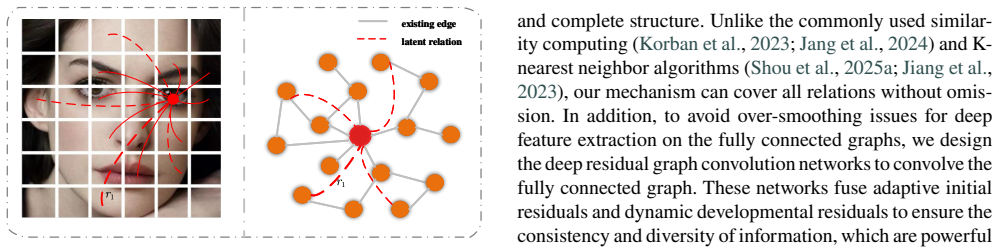
The load-bearing object is the latent relation-aware fully connected graph. Starting from a key-point-initialized graph, a random walk updates the adjacency matrix with global structural evidence; multi-head self-attention then re-weights all pairwise connections, producing a set of fully connected graphs in which no potential relation is thresholded away. Deep feature extraction runs through residual GCN layers that fuse an adaptive initial residual term with a dynamic developmental residual term, both designed to counteract over-smoothing. Age estimation is framed as a Markov decision process on a grid whose rows are age groups and columns are within-group ages, solved with Double DQN; the reward function includes an imbalance ratio and label-distance terms.
What would settle it
Run LRA-GNN and the three baselines it trails on MORPH II Setting I under identical pretraining data, split, and preprocessing; if the MAE gap reverses or disappears, the paper's superiority claim fails. If public code reproduces the reported MAEs under the stated protocols, the claim stands.
Extended reading notes
Core claim
The central claim is that modeling faces as graphs with complete, attention-generated connections and residual-equipped deep convolution yields a compact age estimator that outperforms established CNN and Transformer baselines. Concretely, LRA-GNN reports MAE 1.79 on MORPH II Setting I and 1.94 on Setting II with external pre-training, 2.14 on FG-NET, 3.11 on ChaLearn LAP 2016, and 4.22 on UTK-Face, using about 13M parameters. The authors attribute the gains to three interacting mechanisms: random-walk guidance followed by multi-head attention that captures latent key-point relations, deep residual GCNs that preserve node individuality, and reinforcement learning that treats age estimation as a walk-to-the-end grid problem and jointly optimizes classification and regression with an imbalance-aware reward.
Load-bearing premise
The comparisons in Tables 1 to 4 assume the benchmark protocols are comparable, even though methods differ in external pretraining, backbone, and train/test splits; if those differences are not controlled, the reported state-of-the-art advantage could be an artifact of the evaluation setup rather than the architecture.
Editorial extensions
If this is right
- If correct, a graph-based face representation can reach top-tier age-estimation accuracy at a fraction of the parameter count of VGG-16 or ViT-based systems.
- Capturing latent relations beyond similarity-thresholded edges is a measurable source of accuracy: the ablation shows Latent Relation Capturing contributes the largest single gain, e.g., 0.28 MAE on ChaLearn LAP 2016.
- Co-optimizing age-group classification and regression through reinforcement learning beats decoupled training; adding the imbalance ratio and label distance improves all four benchmarks, with the largest gain of 0.25 MAE under MORPH II Setting II.
- Fusing adaptive initial and dynamic developmental residuals lets GCNs go deeper on fully connected graphs without over-smoothing; depth 12 is chosen as the balance between performance and parameter overhead.
- The efficiency analysis indicates competitive runtime (141.96 ms on UTK-Face) with fewer parameters than the CNN and Transformer baselines, suggesting the architecture is practical to deploy.
Reading between the lines
- Beyond the paper's chosen splits, the latent-relation mechanism should transfer to other facial attribute tasks, such as expression recognition or action-unit detection, where key-point relations are similarly informative and the graph construction is not age-specific.
- A direct protocol-matched comparison against the three baselines it trails on MORPH II Setting I, under identical pretraining data, split, and preprocessing, would clarify whether the residual MAE differences reflect the architecture or the evaluation setup.
- The random-walk-plus-attention pipeline can be seen as a cheap way to approximate global relational structure; a natural testable extension is replacing the hand-set thresholds (0.936, 0.824) with a learned edge predictor.
- The reinforcement-learning grid formulation is a general template for any ordinal regression task with natural grouping, so applying it to other ordinal labels, such as health scores or quality ratings, is a plausible extension not explored in the paper.
Editorial analysis
A structured set of objections, weighed in public.
Referee Report
Summary. The manuscript proposes LRA-GNN, a graph neural network for facial age estimation. The method constructs an initial graph from facial key points, uses a random walk to capture global structure, applies multi-head attention to generate fully connected graphs that capture latent relations, and uses deep residual graph convolution with adaptive initial and dynamic developmental residuals to avoid over-smoothing. Age estimation is framed as a progressive reinforcement learning problem on a grid, optimized with a combined focal and MAE loss. The paper reports MAE values on MORPH II, FG-NET, ChaLearn LAP 2016, and UTK-Face, with ablations on the main components. The stated central claim is that the proposed model surpasses state-of-the-art baselines on several age estimation benchmarks.
Significance. If fully substantiated, the paper would show that a compact 13M-parameter GNN can match or exceed much larger CNN and Transformer models on facial age estimation. The architecture is plausible, the component-level ablations show internally consistent improvements, and the code is publicly available. However, the central claim is not supported as written: on MORPH II Setting I, the paper's own Table 1 shows that several existing methods achieve lower MAE than LRA-GNN, both with and without pre-training. In addition, the comparisons across datasets mix pre-trained and non-pre-trained baselines without protocol matching, and no uncertainty estimates are provided. The significance of the contribution therefore remains contingent on a corrected and protocol-matched empirical evaluation.
major comments (4)
- [Abstract, Section 4.4.1, Section 5, Table 1] The abstract and conclusion claim LRA-GNN 'surpasses the state-of-the-art baselines' on 'several age estimation benchmarks,' but Table 1 directly contradicts this for MORPH II Setting I. With pre-training, LRA-GNN achieves MAE 1.79, while HR reports 1.13*, GLAE reports 1.14*, and TAA-GCN reports 1.69; without pre-training, LRA-GNN achieves 2.02, which is worse than MetaAge's 1.81 and the same three methods. The text acknowledges underperforming HR, GLAE, and TAA-GCN in Section 4.4.1 but retains the global 'surpasses SOTA' phrasing in the abstract and conclusion. This is an internal inconsistency in a load-bearing claim and should be corrected by restricting the claim to the settings and datasets where LRA-GNN actually ranks first.
- [Section 4.1 and Tables 1-4] The comparison protocol is not matched across methods. The tables mix models with and without external pre-training, different backbones, and different preprocessing choices, with only an asterisk to indicate pre-training. For MORPH II Setting I, the train/test split is described as a random 80/20 partition with no fixed split or seed, so the reported differences of 0.02-0.1 MAE may reflect split variance rather than model quality. No confidence intervals, standard deviations, or significance tests are reported for any of the benchmark results. Consequently, even the results where LRA-GNN ranks first (e.g., Setting II, FG-NET, ChaLearn, UTK-Face) are not established as reliable state-of-the-art comparisons.
- [Section 4.3, Figure 6, Table 8] Several hyperparameters are selected using the same benchmarks on which the final results are reported. Section 4.3 fixes L=12, M=8, eta=0.5, initial-graph threshold 0.936, random-walk threshold 0.824, and Section 3.5.6 sets tau=1.3; Figure 6 tunes M on FG-NET and Table 8 tunes eta on MORPH II and FG-NET. The paper does not describe a validation split or nested tuning procedure. This selection on the test benchmarks makes the reported MAE values optimistic and weakens the generalization claim. The authors should either report results on a held-out validation split or quantify the sensitivity of the final numbers to these choices.
- [Section 3.5 and Algorithm 2] The progressive RL component is not specified precisely enough to assess its contribution. The MDP is defined by a five-tuple, but the transition function is not given: Algorithm 2 updates the state only as 'obtain next state s_{t+1}', and the episode termination condition is only described as 'reach the maximum cumulative reward.' It is also unclear how the DDQN loss interacts with the focal and MAE loss in Eq. (12). Since Table 7 attributes a substantial gain to the RL design, a precise formulation of the MDP transitions and an ablation separating the RL machinery from the combined loss would be needed to support that claim.
minor comments (6)
- [Section 3.2.2, Eq. (1)] The text says 'm, n are the adjustable parameters' but the equation uses p and q; the notation should be made consistent.
- [Section 4.4] The text says 'comprehensive experiments across three facial image datasets,' but the paper evaluates on four datasets (MORPH II, FG-NET, ChaLearn LAP 2016, and UTK-Face).
- [Table 3 caption] The caption reads 'ChaLearn LAP 2016 dataset' but the table title is 'CLAP2016'; use the consistent dataset name.
- [Section 4.5] The phrase 'without loading the eternal dataset pre-trained weights' should read 'external dataset pre-trained weights.'
- [Section 3.3, Eq. (3)] The symbol M is used both for the feature dimension in Eq. (3) and for the number of attention heads in Section 4.3; this should be disambiguated.
- [Section 5] The conclusion says the method outperforms SOTA on 'Morph II, FG-NET, and CLAP 2016' but omits UTK-Face, even though Table 4 reports results on that dataset; the list should be consistent with the experiments.
Circularity Check
No significant circularity: the reported MAEs are empirical test-set results of a learned architecture, not derivations that reduce to their inputs; the paper's central 'surpasses SOTA' claim is undermined by its own Table 1, but that is a correctness/consistency failure, not circularity.
full rationale
The paper does not claim a derivation from first principles to its numerical results; LRA-GNN is an architecture plus training procedure, and Tables 1-4 report empirical MAE on held-out test splits. I checked for self-definitional reductions. The 'latent relations' in Eq. (3) are defined as the softmax-attention-weighted fully connected graphs produced from node features; this defines the module, and the ablation in Table 5 measures its empirical contribution rather than algebraically forcing the reported gains. Eq. (2) does use a cosine-similarity threshold for random-walk guidance, and thresholds (0.936, 0.824), layer count L=12, heads M=8, and loss weight eta are selected with reference to benchmark performance; this is tuning-induced optimism or selection bias, not circularity by construction, because those hyperparameters do not determine the test labels or the MAE formula. Self-citations to GroupFace (Zhang et al. 2024a) and MCGRL (Shou et al. 2025a) appear as baselines and related work, not as load-bearing justifications; no uniqueness theorem or cited prior result is invoked to force the architecture or the empirical outcomes. The strongest issue is that the abstract/conclusion claim 'surpasses the state-of-the-art baselines' is contradicted by the paper's own Table 1, where HR (1.13), GLAE (1.14), and TAA-GCN (1.69) achieve lower MAE than LRA-GNN's 1.79 on MORPH II Setting I with pre-training; the paper even concedes 'Under Setting I, we only underperform HR, GLAE and TAA-GCN.' This is an internal-consistency and benchmarking-protocol problem for the correctness of the headline, not a circular derivation. No equation-level or citation-level circular step can be exhibited, so the circularity score is 0.
Assumptions & free parameters
free parameters (7)
- initial graph similarity threshold =
0.936
- random walk updating threshold =
0.824
- number of GCN layers L =
12
- number of multi-head attention heads M =
8
- loss weight eta =
0.5 (MORPH II), 0.4 (FG-NET)
- focal loss focusing parameter tau =
1.3
- random walk p and q parameters =
not specified
assumptions (6)
- domain assumption Facial keypoints and local patches carry most age-discriminative information.
- domain assumption The landmark detector from Korban et al. (2023) provides sufficiently accurate keypoints for patch construction.
- domain assumption Random walk with cosine-similarity thresholding reveals global graph structure useful for age estimation.
- domain assumption Multi-head attention scores approximate latent semantic relations between facial regions.
- domain assumption Deep residual graph convolutions with adaptive initial and dynamic residuals prevent over-smoothing.
- domain assumption Benchmark splits, preprocessing, and pretraining are comparable across methods listed in Tables 1 to 4.
Cite this review
Pith. "Pith review of LRA-GNN: Latent Relation-Aware Graph Neural Network with Initial and Dynamic Residual for Facial Age Estimation." pith.science (2026). https://pith.science/paper/JF7CEM2Q
@misc{pith2026250205423,
  author       = {Pith},
  title        = {Pith review of: LRA-GNN: Latent Relation-Aware Graph Neural Network with Initial and Dynamic Residual for Facial Age Estimation},
  year         = {2026},
  howpublished = {\url{https://pith.science/paper/JF7CEM2Q}},
  note         = {Machine review of arXiv:2502.05423}
}
read the original abstract
Face information is mainly concentrated among facial key points, and frontier research has begun to use graph neural networks to segment faces into patches as nodes to model complex face representations. However, these methods construct node-to-node relations based on similarity thresholds, so there is a problem that some latent relations are missing. These latent relations are crucial for deep semantic representation of face aging. In this novel, we propose a new Latent Relation-Aware Graph Neural Network with Initial and Dynamic Residual (LRA-GNN) to achieve robust and comprehensive facial representation. Specifically, we first construct an initial graph utilizing facial key points as prior knowledge, and then a random walk strategy is employed to the initial graph for obtaining the global structure, both of which together guide the subsequent effective exploration and comprehensive representation. Then LRA-GNN leverages the multi-attention mechanism to capture the latent relations and generates a set of fully connected graphs containing rich facial information and complete structure based on the aforementioned guidance. To avoid over-smoothing issues for deep feature extraction on the fully connected graphs, the deep residual graph convolutional networks are carefully designed, which fuse adaptive initial residuals and dynamic developmental residuals to ensure the consistency and diversity of information. Finally, to improve the estimation accuracy and generalization ability, progressive reinforcement learning is proposed to optimize the ensemble classification regressor. Our proposed framework surpasses the state-of-the-art baselines on several age estimation benchmarks, demonstrating its strength and effectiveness.
Figures


Figures from the paper (7 more)


Reference graph
Works this paper leans on
-
[8]
arXiv preprint arXiv:1609.02907
Semi-supervised classification with graph convolutional networks. arXiv preprint arXiv:1609.02907 . Korban, M., Youngs, P., Acton, S.T.,
-
[12]
Moving window regression: A novel approach to ordinal regression, in: Proceedings of the IEEE/CVF conference on computer vision and pattern recognition, pp. 18760– 18769. Shou, Y., Ai, W., Du, J., Meng, T., Liu, H., 2024a. Efficient long-distance latent relation-aware graph neural network for multi-modal emotion recognition in conversations. arXiv preprin...
arXiv 2023
-
[13]
Tan,Z.,Wan,J.,Lei,Z.,Zhi,R.,Guo,G.,Li,S.Z.,2017
Deep conditional distribution learningforageestimation.IEEETransactionsonInformationForensics and Security 16, 4679–4690. Tan,Z.,Wan,J.,Lei,Z.,Zhi,R.,Guo,G.,Li,S.Z.,2017. Efficientgroup-n encoding and decoding for facial age estimation. IEEE transactions on pattern analysis and machine intelligence 40, 2610–2623. Van Hasselt, H., Guez, A., Silver, D.,
work page 2017
-
[14]
arXiv preprint arXiv:1710.10903
Graph attention networks. arXiv preprint arXiv:1710.10903 . Wang, C., Li, Z., Mo, X., Tang, X., Liu, H.,
-
[15]
IEEE Transac- tions on Information Forensics and Security
Exploiting unfairness with meta-set learning for chronological age estimation. IEEE Transac- tions on Information Forensics and Security . Wen,G.,Wu,K.,2021. Buildingdecisiontreeforimbalancedclassification via deep reinforcement learning, in: Asian Conference on Machine Learning, PMLR. pp. 1645–1659. Yang, J., El-Bouri, R., O’Donoghue, O., Lachapelle, A.S...
work page 2021
-
[16]
Prediction model of dow jones index based on lstm-adaboost, in: 2021 International Conference on Com- munications, Information System and Computer Engineering (CISCE), IEEE. pp. 808–812. Zhang, C., Liu, S., Xu, X., Zhu, C., 2019a. C3ae: Exploring the limits of compact model for age estimation, in: Proceedings of the IEEE/CVF conference on computer vision ...
work page 2021
-
[17]
IEEE signal processing letters 23, 1499–1503
Joint face detection and alignment using multitask cascaded convolutional networks. IEEE signal processing letters 23, 1499–1503. Zhang,L.,Yan,X.,He,J.,Li,R.,Chu,W.,2023. Drgcn:Dynamicevolving initial residual for deep graph convolutional networks, in: Proceedings of the AAAI Conference on Artificial Intelligence, pp. 11254–11261. Zhang, Y., Shou, Y., Ai,...
work page 2023
-
[2014]
arXiv preprint arXiv:1412.6980
Adam: A method for stochastic optimization. arXiv preprint arXiv:1412.6980 . Kipf, T.N., Welling, M.,
Show all 17 references
-
[2015]
arXiv preprint arXiv:1506.05163
Deep convolutional networks on graph-structured data. arXiv preprint arXiv:1506.05163 . Hiba, S., Keller, Y.,
-
[2016]
Chalearn looking at people and faces of the world: Face analysis workshop and challenge 2016, in: Proceedings of the IEEE Conference on Computer Vision and Pattern Recognition Workshops, pp. 1–8. Gao, B.B., Zhou, H.Y., Wu, J., Geng, X.,
2016
-
[2017]
2980–2988
Focal loss for dense object detection, in: Proceedings of the IEEE international conference on computer vision, pp. 2980–2988. Meng,T.,Shou,Y.,Ai,W.,Du,J.,Liu,H.,Li,K.,2024a. Amulti-message passing framework based on heterogeneous graphs in conversational emotion recognition. ...
2016 arXiv
-
[2018]
2304–2313
Deep regression forests for age estimation, in: Proceedings of the IEEE conference on computer vision and pattern recognition, pp. 2304–2313. Shen,W.,Zhao,K.,Guo,Y.,Yuille,A.L.,2017. Labeldistributionlearning forests. Advances in neural information processing systems
2017
-
[2020]
arXiv preprint arXiv:2010.11929
An image is worth 16x16 words: Transformers for image recognition at scale. arXiv preprint arXiv:2010.11929 . Duan, M., Li, K., Li, K.,
2010 arXiv
-
[2021]
Artificial Intelligence Review 54, 179–213
Deep learning approach for facial age classification: a survey of the state-of-the-art. Artificial Intelligence Review 54, 179–213. Ai, W., Deng, W., Chen, H., Du, J., Meng, T., Shou, Y., 2024a. Mcsff: Multi-modal consistency and specificity fusion framework for entity alignme...
-
[2022]
IEEE Transactions on Image Processing 31, 4761–4775
Metaage: meta- learning personalized age estimators. IEEE Transactions on Image Processing 31, 4761–4775. Lin,E.,Chen,Q.,Qi,X.,2020.Deepreinforcementlearningforimbalanced classification. Applied Intelligence 50, 2488–2502. Lin, T.Y., Goyal, P., Girshick, R., He, K., Dollár, P.,
2020
-
[2023]
long- tailedageestimation:Anapproachtokilltwobirdswithonestone
General vs. long- tailedageestimation:Anapproachtokilltwobirdswithonestone. IEEE Transactions on Image Processing 32, 6155–6167. Bao,Z.,Tan,Z.,Wan,J.,Ma,X.,Guo,G.,Lei,Z.,2022. Divergence-driven consistency training for semi-supervised facial age estimation. IEEE Transactions o...
2022
-
[2024]
Expert Systems with Applications 248, 123403
Rakcr: Reviews sentiment-aware based knowledge graph convolutional networks for personalized recommendation. Expert Systems with Applications 248, 123403. Deng,Z.,Liu,H.,Wang,Y.,Wang,C.,Yu,Z.,Sun,X.,2021. Pml:Progres- sivemarginlossforlong-tailedageclassification,in:Proceeding...
2021
Reviewed August 8, 2026 · model on record in the stance chip above.
Discussion (0). Continue with ORCID to comment.