REVIEW 3 major objections 6 minor 44 references
InfoCons: Identifying Interpretable Critical Concepts in Point Clouds via Information Theory
T0 review · 3 major / 6 minor · reviewed 2026-08-07 · deepseek-v4-flash
Pith's one-line read InfoCons finds the points that drive a point-cloud prediction.
desk verdict A practical and broad empirical study of VIB-style attribution for point clouds, but the central information-theoretic derivation does not hold up, so treat the theory as a heuristic and the experiments as the contribution. read the letter →
The pith
A machine-rendered reading of the paper's core claim, the machinery that carries it, and where it could break.
The reading
What carries the argument
The explanatory object is the attention bottleneck $f(\hat m \mid z(x); \theta)$: a channel-wise attention block that reads the frozen encoder's intermediate feature $z\in\mathbb{R}^{D\times N'}$, projects it through linear layers with ELU, applies a scaled softmax attention, and outputs a mask $\hat m\in(0,1)^{D\times N'}$ via an MLP with sigmoid. The mask is optimized under Eq. 6, whose first term is the cross-entropy lower bound on $I(C,y)$ and whose second term, the KL divergence between $\hat z$ and a Gaussian prior $q(\hat z)=\mathcal{N}(\mu_z,\sigma_z^2)$ parameterized by the feature's own mean and variance, is the variational proxy for the information-bottleneck penalty $I(x,C)$. The stop-gradient noise substitution $\hat z=\hat m\odot z+\operatorname{sg}(1-\hat m)\odot\epsilon$ is the piece that lets the mask point to the anchor point's unique information instead of the entangled neighbor context.
What would settle it
For a small model and a single point cloud, randomly sample many subsets of the same size as the InfoCons subset and record how much prediction changes when each is dropped; if random subsets routinely change predictions far more than the InfoCons subset, the claim that Eq. 6 identifies the most faithful minimal subset is falsified.
Extended reading notes
Core claim
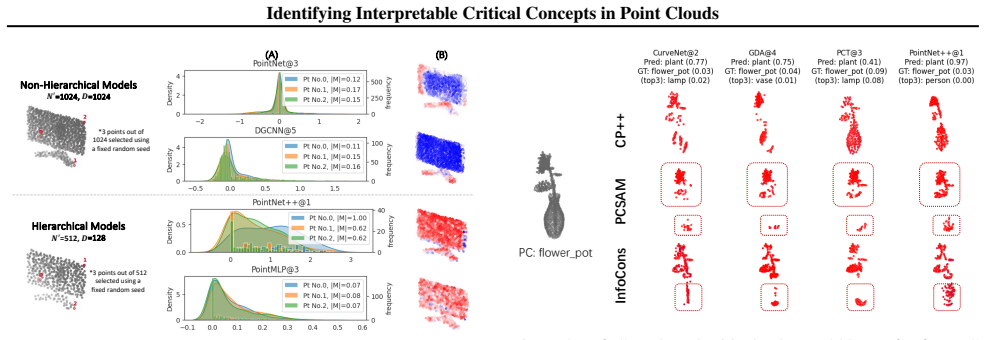
InfoCons proposes that an interpretable critical subset of a point cloud is one that maximizes $I(C, y)$ — the mutual information between the selected points $C$ and the model's prediction $y$ — while minimizing $I(x, C)$, the information the selection still carries about the full input $x$. The paper rewrites this information-bottleneck objective for a pretrained point cloud model as $$\max_\$\theta$ \mathbb{E}_{x\sim p(x)}\left[\mathbb{E}_{y\sim p(y)}\log q(y|\hat z) - \$\beta$ D_{KL}(\hat z \| q(\hat z))\right], \quad \hat z = \hat m \odot z(x) + \operatorname{sg}(1-\hat m)\odot \epsilon,$$ where $\hat m = f(\hat m \mid z(x); \theta)$ is a learned soft mask produced by an attention bottleneck, $z(x)$ is the intermediate feature of the frozen encoder, and $\epsilon_i \sim \mathcal{N}(\mu_z, \sigma_z^2)$ is Gaussian noise matched to the feature statistics. The stop-gradient term is the paper's mechanism for disentangling each point's own information from the information it shares with its neighbors: when a point is deemed unimportant, its feature is replaced by neighbor-typical noise rather than by zero, so the model is only penalized for removing the point's unique contribution. Once trained, averaging the soft mask over the reduced dimension gives a per-point critical score $s(x)$, and the critical subset is the set of highest-scoring points.
Load-bearing premise
The load-bearing premise is that the KL divergence computed on intermediate features, $D_{KL}(\hat z \| q(\hat z))$, is a valid proxy for the input-level bottleneck $I(x,C)$, so that minimizing it really enforces that the selected subset is minimal.
Editorial extensions
If this is right
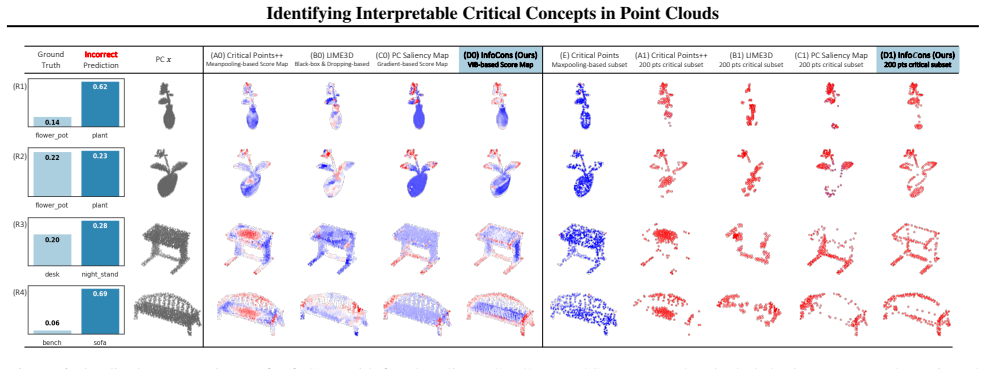
- If Eq. 6 does what the paper claims, explaining a point cloud model reduces to a one-pass forward computation, yielding 200-point critical subsets that drop DGCNN test accuracy to 63.70% after 20 iterations, second only to a 1,000-query black-box baseline.
- The same score map is reusable as a saliency signal: replacing SageMix's gradient saliency with InfoCons raises DGCNN mixup test accuracy from 92.79% to 93.19%, and rescaling SI-Adv's gradient with InfoCons increases attack success rate while lowering Chamfer and Hausdorff distances.
- Because the mask is trained on the frozen model's features rather than on logits alone, the method transfers across non-hierarchical, hierarchical, and self-attention architectures, with evaluation on eight models, and extends to object detection by substituting a detection-score objective for classification cross-entropy.
- K-means clustering of the InfoCons score map produces a critical-subset hierarchy, letting a user decompose a point cloud into levels such as 'contour' versus 'seat' for a sofa misclassified as a bench.
Reading between the lines
- A natural test the paper does not run: measure how well InfoCons's top-scoring points agree with human part annotations such as PartNet labels; high agreement would show conceptual coherence is an emergent property of the objective rather than a visualization artifact.
- The stop-gradient Gaussian substitution is a general recipe for attribution under feature entanglement; porting it to 2D image or video attributions, where neighboring pixels share features, could remove the same i.i.d. failure that motivated Eq. 6.
- The paper's manual choice of intermediate layer $l$ and $\beta$ invites a data-driven criterion: select layer and $\beta$ that maximize the MCD-LCD accuracy gap on a validation set, rather than score-map variance.
- If the KL proxy ever fails to track $I(x,C)$, InfoCons would still be a useful saliency heuristic; the paper's own observation that features are entangled, with nearly all points highlighted for hierarchical models, is the evidence to watch.
Editorial analysis
A structured set of objections, weighed in public.
Referee Report
Summary. The paper introduces InfoCons, a post-hoc explanation method for point cloud classifiers. InfoCons trains a small attention-based bottleneck module on a frozen model's intermediate features; the module outputs a soft mask that is applied to the features, optionally replacing non-critical feature entries with Gaussian noise. The training objective (Eq. 6) combines the cross-entropy of the masked features with the model's prediction and an information-loss term D_KL(z_hat||q(z_hat)), presented as a variational approximation of the Information Bottleneck objective I(C,y)-beta*I(x,C). The resulting scores are used to extract critical subsets, which are evaluated with point-drop attacks on eight architectures and three datasets, and are plugged into SageMix data augmentation and SI-Adv adversarial attack. The paper also provides qualitative comparisons with CP, CP++, PCSAM, and LIME3D.
Significance. If the IB derivation were valid, InfoCons would be a useful contribution: it is a single-forward-pass explainer that scales across a wide range of point cloud architectures, and the downstream applications (mixup and adversarial attack) show measurable gains. The empirical study is extensive (8 architectures, 3 datasets, 4 baselines) and the code is released. However, the central theoretical claim is currently unsupported: Eq. (6) does not follow from the variational bound in Eq. (9), and the information-loss term as written is not the KL divergence claimed. The method may still work as a heuristic feature-replacement regularizer, and the empirical evidence is promising, but the paper needs to either supply a correct bound/derivation or explicitly reframe the contribution as heuristic. The qualitative concept-coherence evidence is compelling but only anecdotal.
major comments (3)
- [§3.2, Eq. (6)] The information-loss term D_KL(z_hat||q(z_hat)) in Eq. (6) is not a well-defined KL for the distribution induced by the construction. With z_hat = m_hat * z + sg(1 - m_hat) * epsilon and epsilon_i ~ N(mu_z, sigma_z^2), the conditional distribution of each dimension is p(z_hat_i | x) = N(m_hat_i z_i + (1 - m_hat_i) mu_i, (1 - m_hat_i)^2 sigma_i^2). The exact KL against q = N(mu_z, sigma_z^2) contains -log(1 - m_hat_i), which diverges as m_hat_i -> 1. The paper does not state which finite approximation is used in the implementation; without this, the objective in Eq. (6) is not the variational penalty claimed, and the reported training numbers cannot be checked against the formula.
- [§A.2, Eqs. (15)-(17)] The step E_x[D_KL(p(z_hat|x)||q(z_hat))] = E_x[D_KL(z_hat||q(z_hat))] is a notational substitution and does not establish an inequality. Moreover, the variational upper bound in Eq. (9) applies to I(x,z_hat), the mutual information between the input and the feature-replaced representation, not to I(x,C) for the selected input subset C = m * x. Equation (17) similarly asserts I(C,x) <= E_x[D_KL(m_hat||q(m_hat))] without proof. Consequently the central claim that Eq. (6) optimizes the IB objective in Eq. (2) for critical concepts is not supported by the derivation; the method is at present a heuristic feature-replacement regularizer for which the information-theoretic grounding remains to be supplied.
- [§4, evaluation protocol] Conceptual coherence, one of the two central desiderata in the paper's title and introduction, is supported only qualitatively (Fig. 6, Fig. 11, Fig. 15). The only quantitative evaluation is the point-drop attack, which is a faithfulness proxy and is itself acknowledged in §4.4 to have limitations (removing points in specific spatial locations can push the point cloud off the data manifold). No quantitative measure of concept coherence is provided, so the claim that InfoCons produces critical subsets that are both faithful and conceptually coherent is not fully evidenced.
minor comments (6)
- [§3.2, Eq. (6)] q(z_hat) is called a 'Gaussian prior' but is parameterized with the same feature statistics (mu_z, sigma_z^2) used in the noise insertion, making it a data-dependent prior; the term 'learnable unbiased prior' in the abstract is not defined.
- [§3.2, Eq. (7)] The softmax axis of Att(q_z,z,v_z) is not specified; q_z^T z has shape (N,N) and the result is not obviously a per-point attention weight. Please clarify the normalization and the output shape.
- [§4.2] The abbreviation 'PCSM' is used after introducing 'PCSAM' (and the baseline is called PCSAM elsewhere); please make the notation consistent.
- [§C.3, Eq. (18)] The expectation E_k is not defined; use an explicit expectation over the Gumbel noise variables and specify the noise distribution clearly.
- [§4.3, Table 2] The abbreviations CD and HD (Chamfer distance and Hausdorff distance, presumably) should be defined at first use.
- [Table 4] The header 'Sparsity/% P I(z=0)/(D' x N')' is hard to parse; define P and the sparsity statistic explicitly.
Circularity Check
No construction-level circularity: point-drop, baseline, and application evaluations are external and self-contained, and there are no self-citations. The theoretical IB-grounding of Eq. 6 is definitional, since Appendix A.2 (Eq. 16) equates the required bound on I(x,C) with the implemented loss by notation.
-
self definitional
[Appendix A.2, Eq. 16; Section 3.2, Definition 3.2 (Eq. 6)]
"Ex[DKL(p(ẑ|x)||q(ẑ))] = Ex[DKL(ẑ||q(ẑ))] considering ẑ=f(ẑ|x;θ). Moreover, since z(x) is determined by the trained encoder F, we consider the upper bound based on m̂ in Eq. 5 as follows: I(C,x) ≤ Ex[DKL(m̂||q(m̂))]."
The paper claims (Def. 3.2, Eq. 6) that Eq. 6 is the IB objective for Eq. 2 (max I(C,y) − βI(x,C)). In App. A.2 the variational upper bound on I(x,C) is written as Ex[DKL(p(ẑ|x)||q(ẑ))] and then equated to the per-sample loss Ex[DKL(ẑ||q(ẑ))] by the phrase 'considering ẑ=f(ẑ|x;θ)'. This equality is a notational substitution, not a derived bound: with the induced p(ẑ|x)=N(m̂⊙z,(1−m̂)²σ²) and q=N(µ_z,σ²_z), the exact KL contains −log(1−m̂) and diverges as m̂→1, so no finite KL of the stated distributions equals the implemented loss. The claim that Eq. 6 minimizes I(x,C) thus holds by definition of the loss, not by the IB derivation; the empirical drop-attack evaluation is external and unaffected.
full rationale
Walking the claimed derivation chain (Eq. 2 → Eq. 5 → Eq. 6 and Appendix A.2): the paper contains no self-citations, so the self-citation patterns do not apply. The explainer θ is trained with cross-entropy on masked features plus a KL regularizer; its score maps are evaluated on a held-out test split by point-drop attack (MCD/LCD) and against four external baselines (CP, CP++, PCSAM, LIME3D), with additional downstream metrics (mixup test OA, ASR, CD/HD) that do not appear in the training loss. No fitted constant is renamed as a prediction: the score map is a genuine function of learned parameters, and the faithfulness results are not forced by the optimization. One step in the theoretical narrative is definitional: Appendix A.2 (Eq. 16) equates the required variational upper bound on I(x,C) with the implemented loss DKL(ẑ||q(ẑ)) by the phrase 'considering ẑ=f(ẑ|x;θ)', so the claim that Eq. 6 is the IB objective for Eq. 2 is true by notation rather than by derivation; this is the same gap the skeptic identifies (the exact KL of the induced Gaussian would diverge as m̂→1). This weakens the information-theoretic grounding but does not collapse any empirical prediction. Minor caveats: Section 4.4 selects β 'together with the test set accuracy' on the same test split used for the reported drop-attack numbers, a mild evaluation-integrity concern rather than construction-level circularity; and conceptual coherence is supported by qualitative evidence plus the KL regularization, not by the unestablished I(x,C) bound. On balance, the paper's empirical contribution is self-contained against external benchmarks, and the circularity score is accordingly low.
Assumptions & free parameters
free parameters (4)
- beta =
10^k, varied per model (e.g., 10^-3 to 10^3)
- reduction dimension D_r =
64 (default)
- intermediate layer l =
manually selected per model (Table 4)
- Gumbel softmax temperature tau =
0.7
assumptions (4)
- standard math Variational bounds on I(z,y) and I(z,x) (Eqs. 8-9) hold.
- domain assumption A soft mask on point features is equivalent to a critical subset of input points.
- domain assumption Point features are i.i.d. for Monte Carlo KL estimation.
- domain assumption The model's output Y is the correct target signal for training the explainer.
Cite this review
Pith. "Pith review of InfoCons: Identifying Interpretable Critical Concepts in Point Clouds via Information Theory." pith.science (2026). https://pith.science/paper/JGJTQR2N
@misc{pith2026250519820,
  author       = {Pith},
  title        = {Pith review of: InfoCons: Identifying Interpretable Critical Concepts in Point Clouds via Information Theory},
  year         = {2026},
  howpublished = {\url{https://pith.science/paper/JGJTQR2N}},
  note         = {Machine review of arXiv:2505.19820}
}
read the original abstract
Interpretability of point cloud (PC) models becomes imperative given their deployment in safety-critical scenarios such as autonomous vehicles. We focus on attributing PC model outputs to interpretable critical concepts, defined as meaningful subsets of the input point cloud. To enable human-understandable diagnostics of model failures, an ideal critical subset should be *faithful* (preserving points that causally influence predictions) and *conceptually coherent* (forming semantically meaningful structures that align with human perception). We propose InfoCons, an explanation framework that applies information-theoretic principles to decompose the point cloud into 3D concepts, enabling the examination of their causal effect on model predictions with learnable priors. We evaluate InfoCons on synthetic datasets for classification, comparing it qualitatively and quantitatively with four baselines. We further demonstrate its scalability and flexibility on two real-world datasets and in two applications that utilize critical scores of PC.
Figures


Figures from the paper (15 more)



Reference graph
Works this paper leans on
-
[1]
write newline
" write newline "" before.all 'output.state := FUNCTION n.dashify 't := "" t empty not t #1 #1 substring "-" = t #1 #2 substring "--" = not "--" * t #2 global.max substring 't := t #1 #1 substring "-" = "-" * t #2 global.max substring 't := while if t #1 #1 substring * t #2 global.max substring 't := if while FUNCTION format.date year duplicate empty "emp...
-
[2]
Alemi, A. A., Fischer, I., Dillon, J. V., and Murphy, K. Deep variational information bottleneck. arXiv preprint arXiv:1612.00410, 2016
arXiv 2016
-
[3]
R., Jiang, H., Brilakis, I., Fischer, M., and Savarese, S
Armeni, I., Sener, O., Zamir, A. R., Jiang, H., Brilakis, I., Fischer, M., and Savarese, S. 3d semantic parsing of large-scale indoor spaces. In Proceedings of the IEEE conference on computer vision and pattern recognition, pp.\ 1534--1543, 2016
work page 2016
-
[4]
Explaining a black-box by using a deep variational information bottleneck approach
Bang, S., Xie, P., Lee, H., Wu, W., and Xing, E. Explaining a black-box by using a deep variational information bottleneck approach. In Proceedings of the AAAI conference on artificial intelligence, volume 35, pp.\ 11396--11404, 2021
work page 2021
-
[5]
Brendel, W. and Bethge, M. Approximating cnns with bag-of-local-features models works surprisingly well on imagenet. In International Conference on Learning Representations, 2019
work page 2019
-
[6]
Chang, A. X., Funkhouser, T., Guibas, L., Hanrahan, P., Huang, Q., Li, Z., Savarese, S., Savva, M., Song, S., Su, H., et al. Shapenet: An information-rich 3d model repository. arXiv preprint arXiv:1512.03012, 2015
arXiv 2015
-
[7]
Learning to explain: An information-theoretic perspective on model interpretation
Chen, J., Song, L., Wainwright, M., and Jordan, M. Learning to explain: An information-theoretic perspective on model interpretation. In International conference on machine learning, pp.\ 883--892. PMLR, 2018
work page 2018
-
[8]
Unifying fourteen post-hoc attribution methods with taylor interactions
Deng, H., Zou, N., Du, M., Chen, W., Feng, G., Yang, Z., Li, Z., and Zhang, Q. Unifying fourteen post-hoc attribution methods with taylor interactions. IEEE Transactions on Pattern Analysis and Machine Intelligence, 2024
work page 2024
Show all 44 references
-
[9]
Interpretable3d: An ad-hoc interpretable classifier for 3d point clouds
Feng, T., Quan, R., Wang, X., Wang, W., and Yang, Y. Interpretable3d: An ad-hoc interpretable classifier for 3d point clouds. In Proceedings of the AAAI Conference on Artificial Intelligence, volume 38, pp.\ 1761--1769, 2024
2024
-
[10]
Are we ready for autonomous driving? the kitti vision benchmark suite
Geiger, A., Lenz, P., and Urtasun, R. Are we ready for autonomous driving? the kitti vision benchmark suite. In 2012 IEEE conference on computer vision and pattern recognition, pp.\ 3354--3361. IEEE, 2012
2012
-
[11]
R., and Hu, S.-M
Guo, M.-H., Cai, J.-X., Liu, Z.-N., Mu, T.-J., Martin, R. R., and Hu, S.-M. Pct: Point cloud transformer. Computational Visual Media, 7: 0 187--199, 2021
2021
-
[12]
Towards better visualizing the decision basis of networks via unfold and conquer attribution guidance
Hong, J.-H., Nam, W.-J., Jeon, K.-S., and Lee, S.-W. Towards better visualizing the decision basis of networks via unfold and conquer attribution guidance. In Proceedings of the AAAI Conference on Artificial Intelligence, volume 37, pp.\ 7884--7892, 2023
2023
-
[13]
Shape-invariant 3d adversarial point clouds
Huang, Q., Dong, X., Chen, D., Zhou, H., Zhang, W., and Yu, N. Shape-invariant 3d adversarial point clouds. In Proceedings of the IEEE/CVF Conference on Computer Vision and Pattern Recognition, pp.\ 15335--15344, 2022
2022
-
[14]
Minimal adversarial examples for deep learning on 3d point clouds
Kim, J., Hua, B.-S., Nguyen, T., and Yeung, S.-K. Minimal adversarial examples for deep learning on 3d point clouds. In Proceedings of the IEEE/CVF International Conference on Computer Vision, pp.\ 7797--7806, 2021
2021
-
[15]
W., Nguyen, T., Tang, Y
Koh, P. W., Nguyen, T., Tang, Y. S., Mussmann, S., Pierson, E., Kim, B., and Liang, P. Concept bottleneck models. In International conference on machine learning, pp.\ 5338--5348. PMLR, 2020
2020
-
[16]
H., Vora, S., Caesar, H., Zhou, L., Yang, J., and Beijbom, O
Lang, A. H., Vora, S., Caesar, H., Zhou, L., Yang, J., and Beijbom, O. Pointpillars: Fast encoders for object detection from point clouds. In Proceedings of the IEEE/CVF conference on computer vision and pattern recognition, pp.\ 12697--12705, 2019
2019
-
[17]
Lee, S., Jeon, M., Kim, I., Xiong, Y., and Kim, H. J. Sagemix: Saliency-guided mixup for point clouds. Advances in Neural Information Processing Systems, 35: 0 23580--23592, 2022
2022
-
[18]
Levi, M. Y. and Gilboa, G. Critical points++: An agile point cloud importance measure for robust classification, adversarial defense and explainable ai. arXiv preprint arXiv:2308.05525, 2023
2023 arXiv
-
[19]
B., and Saligrama, V
Lin, F., Yue, Y., Zhang, Z., Hou, S., Yamada, K., Kolachalama, V. B., and Saligrama, V. Infocd: A contrastive chamfer distance loss for point cloud completion. In Thirty-seventh Conference on Neural Information Processing Systems, 2023
2023
-
[20]
Liu, H., Cai, M., and Lee, Y. J. Masked discrimination for self-supervised learning on point clouds. In European Conference on Computer Vision, pp.\ 657--675. Springer, 2022
2022
-
[21]
Ffam: Feature factorization activation map for explanation of 3d detectors
Liu, S., Li, B., Fang, Z., Cui, M., and Huang, K. Ffam: Feature factorization activation map for explanation of 3d detectors. In The Thirty-eighth Annual Conference on Neural Information Processing Systems, 2024 a
2024
-
[22]
Point-voxel cnn for efficient 3d deep learning
Liu, Z., Tang, H., Lin, Y., and Han, S. Point-voxel cnn for efficient 3d deep learning. Advances in Neural Information Processing Systems, 32, 2019
2019
-
[23]
Timex++: Learning time-series explanations with information bottleneck
Liu, Z., Wang, T., Shi, J., Zheng, X., Chen, Z., Song, L., Dong, W., Obeysekera, J., Shirani, F., and Luo, D. Timex++: Learning time-series explanations with information bottleneck. In Forty-first International Conference on Machine Learning, 2024 b
2024
-
[24]
Rethinking network design and local geometry in point cloud: A simple residual mlp framework
Ma, X., Qin, C., You, H., Ran, H., and Fu, Y. Rethinking network design and local geometry in point cloud: A simple residual mlp framework. arXiv preprint arXiv:2202.07123, 2022
2022 arXiv
-
[25]
Curvenet: Curvature-based multitask learning deep networks for 3d object recognition
Muzahid, A., Wan, W., Sohel, F., Wu, L., and Hou, L. Curvenet: Curvature-based multitask learning deep networks for 3d object recognition. IEEE/CAA Journal of Automatica Sinica, 8 0 (6): 0 1177--1187, 2020
2020
-
[26]
R., Su, H., Mo, K., and Guibas, L
Qi, C. R., Su, H., Mo, K., and Guibas, L. J. Pointnet: Deep learning on point sets for 3d classification and segmentation. In Proceedings of the IEEE conference on computer vision and pattern recognition, pp.\ 652--660, 2017 a
2017
-
[27]
R., Yi, L., Su, H., and Guibas, L
Qi, C. R., Yi, L., Su, H., and Guibas, L. J. Pointnet++: Deep hierarchical feature learning on point sets in a metric space. Advances in neural information processing systems, 30, 2017 b
2017
-
[28]
A practical review of mechanistic interpretability for transformer-based language models
Rai, D., Zhou, Y., Feng, S., Saparov, A., and Yao, Z. A practical review of mechanistic interpretability for transformer-based language models. arXiv preprint arXiv:2407.02646, 2024
2024
-
[29]
why should i trust you?
Ribeiro, M. T., Singh, S., and Guestrin, C. " why should i trust you?" explaining the predictions of any classifier. In Proceedings of the 22nd ACM SIGKDD international conference on knowledge discovery and data mining, pp.\ 1135--1144, 2016
2016
-
[30]
M., and Bischof, H
Schinagl, D., Krispel, G., Possegger, H., Roth, P. M., and Bischof, H. Occam's laser: Occlusion-based attribution maps for 3d object detectors on lidar data. In Proceedings of the IEEE/CVF Conference on Computer Vision and Pattern Recognition, pp.\ 1141--1150, 2022
2022
-
[31]
Restricting the flow: Information bottlenecks for attribution
Schulz, K., Sixt, L., Tombari, F., and Landgraf, T. Restricting the flow: Information bottlenecks for attribution. arXiv preprint arXiv:2001.00396, 2020
2001 arXiv
-
[32]
R., Cogswell, M., Das, A., Vedantam, R., Parikh, D., and Batra, D
Selvaraju, R. R., Cogswell, M., Das, A., Vedantam, R., Parikh, D., and Batra, D. Grad-cam: Visual explanations from deep networks via gradient-based localization. In Proceedings of the IEEE international conference on computer vision, pp.\ 618--626, 2017
2017
-
[33]
Visualizing global explanations of point cloud dnns
Tan, H. Visualizing global explanations of point cloud dnns. In Proceedings of the IEEE/CVF Winter Conference on Applications of Computer Vision, pp.\ 4741--4750, 2023
2023
-
[34]
and Kotthaus, H
Tan, H. and Kotthaus, H. Surrogate model-based explainability methods for point cloud nns. In Proceedings of the IEEE/CVF Winter Conference on Applications of Computer Vision, pp.\ 2239--2248, 2022
2022
-
[35]
C., and Bialek, W
Tishby, N., Pereira, F. C., and Bialek, W. The information bottleneck method. arXiv preprint physics/0004057, 2000
2000 arXiv
-
[36]
A., Pham, Q.-H., Hua, B.-S., Nguyen, T., and Yeung, S.-K
Uy, M. A., Pham, Q.-H., Hua, B.-S., Nguyen, T., and Yeung, S.-K. Revisiting point cloud classification: A new benchmark dataset and classification model on real-world data. In Proceedings of the IEEE/CVF international conference on computer vision, pp.\ 1588--1597, 2019
2019
-
[37]
E., Bronstein, M
Wang, Y., Sun, Y., Liu, Z., Sarma, S. E., Bronstein, M. M., and Solomon, J. M. Dynamic graph cnn for learning on point clouds. ACM Transactions on Graphics (tog), 38 0 (5): 0 1--12, 2019
2019
-
[38]
Point transformer v3: Simpler faster stronger
Wu, X., Jiang, L., Wang, P.-S., Liu, Z., Liu, X., Qiao, Y., Ouyang, W., He, T., and Zhao, H. Point transformer v3: Simpler faster stronger. In Proceedings of the IEEE/CVF Conference on Computer Vision and Pattern Recognition, pp.\ 4840--4851, 2024
2024
-
[39]
3d shapenets: A deep representation for volumetric shapes
Wu, Z., Song, S., Khosla, A., Yu, F., Zhang, L., Tang, X., and Xiao, J. 3d shapenets: A deep representation for volumetric shapes. In Proceedings of the IEEE conference on computer vision and pattern recognition, pp.\ 1912--1920, 2015
1912
-
[40]
R., and Li, B
Xiang, C., Qi, C. R., and Li, B. Generating 3d adversarial point clouds. In Proceedings of the IEEE/CVF Conference on Computer Vision and Pattern Recognition, pp.\ 9136--9144, 2019
2019
-
[41]
R., Guibas, L., and Litany, O
Xie, S., Gu, J., Guo, D., Qi, C. R., Guibas, L., and Litany, O. Pointcontrast: Unsupervised pre-training for 3d point cloud understanding. In Computer Vision--ECCV 2020: 16th European Conference, Glasgow, UK, August 23--28, 2020, Proceedings, Part III 16, pp.\ 574--591. Springer, 2020
2020
-
[42]
Learning geometry-disentangled representation for complementary understanding of 3d object point cloud
Xu, M., Zhang, J., Zhou, Z., Xu, M., Qi, X., and Qiao, Y. Learning geometry-disentangled representation for complementary understanding of 3d object point cloud. In AAAI, 2021
2021
-
[43]
Pointcloud saliency maps
Zheng, T., Chen, C., Yuan, J., Li, B., and Ren, K. Pointcloud saliency maps. In Proceedings of the IEEE/CVF International Conference on Computer Vision, pp.\ 1598--1606, 2019
2019
-
[44]
Explaining generalization power of a dnn using interactive concepts
Zhou, H., Zhang, H., Deng, H., Liu, D., Shen, W., Chan, S.-H., and Zhang, Q. Explaining generalization power of a dnn using interactive concepts. In Proceedings of the AAAI Conference on Artificial Intelligence, volume 38, pp.\ 17105--17113, 2024
2024
Reviewed August 7, 2026 · model on record in the stance chip above.
Discussion (0). Sign in to comment.