Matrix phase-space representations for quantum symmetries
Pith reviewed 2026-06-27 07:03 UTC · model grok-4.3
The pith
Matrix phase-space representations incorporate global quantum symmetries by projecting bases onto reduced Hilbert spaces, which unifies prior methods and cuts sampling errors in many-body simulations.
A machine-rendered reading of the paper's core claim, the machinery that carries it, and where it could break.
Core claim
The central claim is that a matrix phase-space representation includes global quantum symmetries in the basis expansion by projecting onto a reduced Hilbert space. This construction unifies several previous phase-space methods, supplies proofs of the required theorems and operator identities for multiple symmetry types, and yields greatly reduced sampling errors in many-body quantum simulations. When applied to verification of Gaussian boson sampling outputs with photon number resolving detectors, the use of parity symmetry reduces sampling errors by very large factors.
What carries the argument
The matrix phase-space representation, which projects the basis onto a reduced Hilbert space that incorporates global quantum symmetries.
If this is right
- Sampling errors in many-body quantum simulations are greatly reduced.
- Several previous phase-space methods become special cases of a single unified framework.
- Detailed proofs establish the basic theorems and operator identities needed for the representation.
- Parity symmetry applied to GBS verification with photon number resolving detectors reduces sampling errors by very large factors.
Where Pith is reading between the lines
- The projection technique may allow verification protocols to handle larger numbers of modes or photons before sampling variance becomes prohibitive.
- Similar symmetry reductions could be tested on other boson-sampling variants or on continuous-variable quantum information tasks.
- The unification of methods suggests that existing simulation codes could be adapted with modest changes to gain the error-reduction benefit.
Load-bearing premise
Projecting the basis onto a reduced Hilbert space while incorporating global quantum symmetries preserves the correctness and utility of the phase-space representation for the targeted quantum systems and symmetries.
What would settle it
A side-by-side computation on a small GBS instance showing that the sampling error when using parity symmetry in the matrix phase-space method is not substantially smaller than the error obtained with earlier phase-space methods.
Figures
read the original abstract
We introduce a general phase-space representation that includes global quantum symmetries in the basis expansion. This method, called matrix phase-space, projects the basis onto a reduced Hilbert space, which can greatly reduce sampling errors of many-body quantum simulations and unifies several previous phase-space methods. The purpose of this paper is to provide detailed proofs of basic theorems and operator identities. We also treat several different types of symmetries. To illustrate the benefits of matrix phase-space methods, we give a detailed derivation of a recent application to the topical problem of verifying the outputs of Gaussian boson sampling (GBS) quantum computers with photon number resolving detectors. This has exponential complexity, and using parity symmetry reduces sampling errors by very large factors relative to earlier methods.
Editorial analysis
A structured set of objections, weighed in public.
Referee Report
Summary. The paper introduces a matrix phase-space representation for quantum systems that incorporates global symmetries by projecting the basis onto a reduced, symmetry-adapted Hilbert space. It supplies proofs of core operator identities and projection theorems, shows that the construction is exact on the invariant sector, unifies several prior phase-space methods, and derives an application to parity-symmetric verification of Gaussian boson sampling (GBS) outputs, claiming substantial reductions in sampling error relative to earlier approaches.
Significance. If the proofs and exactness claims hold, the work provides a systematic, symmetry-aware extension of phase-space methods that can lower sampling costs in many-body simulations without additional approximations on the invariant subspace. The explicit treatment of multiple symmetry types and the GBS derivation add concrete utility for quantum optics and verification tasks.
minor comments (2)
- §3 (or equivalent section on operator identities): the notation for the projected basis operators could be clarified with an explicit example of the reduced-space inner product to aid readers unfamiliar with symmetry-adapted bases.
- The GBS application section would benefit from a short table comparing sampling-error scaling with and without the parity projection, even if only schematic.
Simulated Author's Rebuttal
We thank the referee for their careful reading, positive assessment of the work, and recommendation to accept the manuscript.
Circularity Check
No significant circularity identified
full rationale
The manuscript supplies explicit proofs of the core operator identities and projection theorems for the matrix phase-space construction under global symmetries. The reduction to the symmetry-adapted subspace is shown to be exact on the invariant sector, and the GBS parity application follows directly from the same identities without additional approximations or fitted parameters. No load-bearing step reduces by construction to a self-citation, ansatz, or input quantity; the central argument is self-contained against external benchmarks.
Axiom & Free-Parameter Ledger
axioms (2)
- domain assumption Standard phase-space representations of quantum mechanics exist and can be extended.
- domain assumption Global quantum symmetries such as parity can be incorporated through basis projection without loss of essential features.
Reference graph
Works this paper leans on
-
[1]
t0 0 1/t # ,(4.18) whileT 0 = ¯t≡tanh |α|2 andT ′ 0 = ¯t′ ≡ tanh |β|2 for the simple weight, such that T =
The identities are the coherent state identities of Eq.(4.7). •M= 2: Theσ k matrix is a Pauli matrix,σk = σT k =σ x. In this case the identities Eq.(4.8) change by±1for any mode. However, due to par- ity conservation, the quadratic identities reduce to the standard coherent state case, since(σx)2 =I : ˆa2 j ∥α⟩ =α 2 j ∥α⟩ ˆa† i ˆaj∥α⟩ =α j∂i∥α⟩ ˆa†2 j ∥α⟩...
-
[2]
While this is outside our present scope, we note that phase-space methods can provide a route to these approximate algorithms [82, 84]
are not scalable. While this is outside our present scope, we note that phase-space methods can provide a route to these approximate algorithms [82, 84]. A. Photon-counting probabilities If a setSof photo-detectors has disjoint subsetsS j, the projection operator for the photon number vector c= [c 1, . . . , cM]of measurements inS j is ˆG(c) = O i∈Sj 1 ci...
-
[3]
1 1 1−1 # .(6.24) In this caseh=diag[0,1], and the symmetry gener- ator matrixgis: g= 1 2
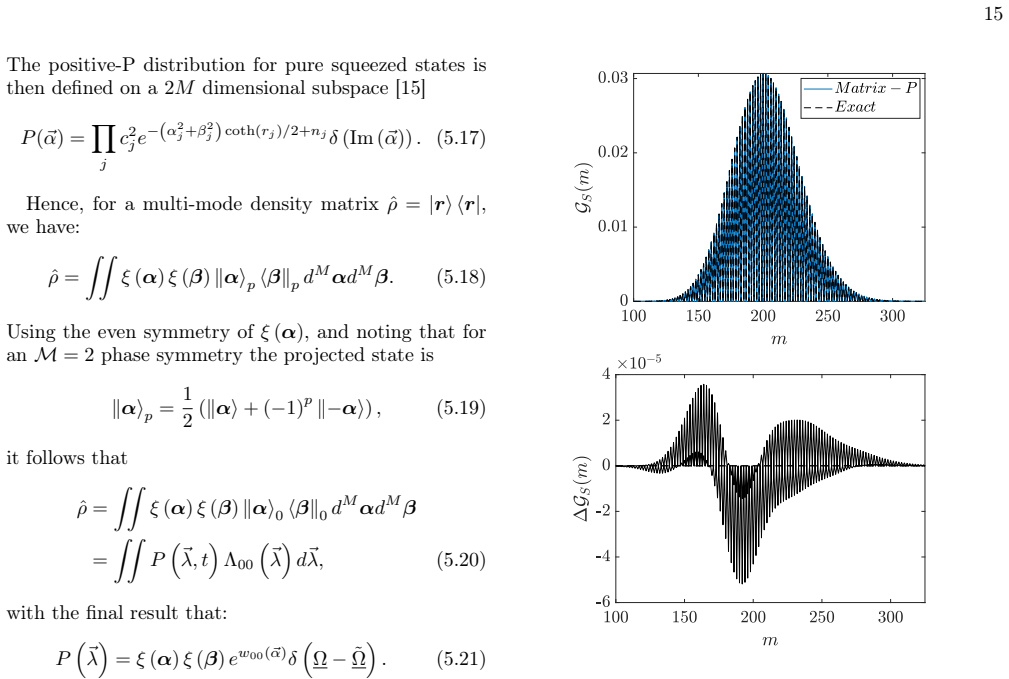
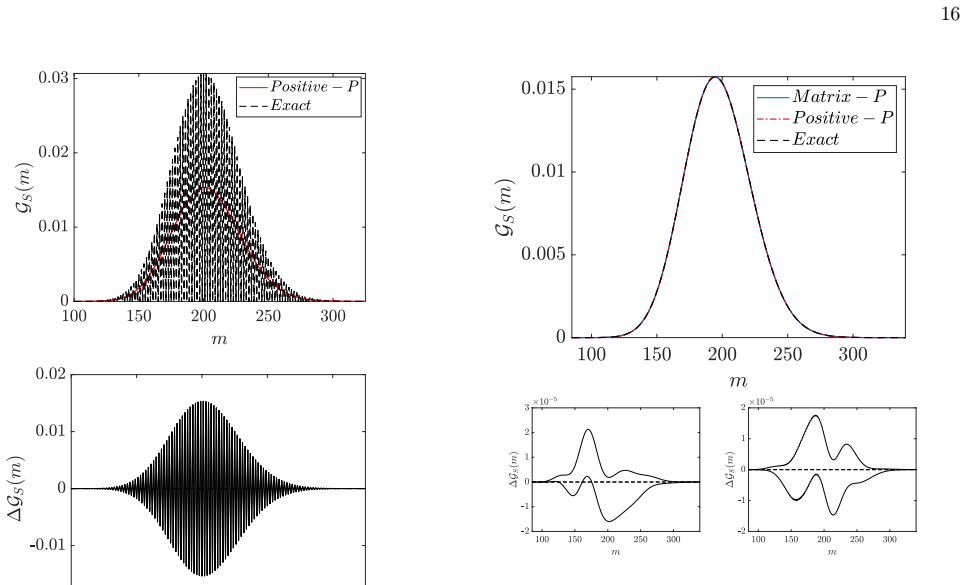
Lower plot: Difference errors of the exact and matrix-P simulated distributions, which are so small that they are not visible. many orders of magnitude. This can be seen in fig- ures (1) and (2), where matrix-P converges to the exact distribution while the +P simulation is far from exact. The lack of convergence of +P in the lossless case is due to the di...
-
[4]
Aaronson, Proceedings of the Royal Society of Lon- don A: Mathematical, Physical and Engineering Sci- ences467, 3393 (2011)
S. Aaronson, Proceedings of the Royal Society of Lon- don A: Mathematical, Physical and Engineering Sci- ences467, 3393 (2011)
2011
-
[5]
C. S. Hamilton, R. Kruse, L. Sansoni, S. Barkhofen, C. Silberhorn, and I. Jex, Phys. Rev. Lett.119, 170501 (2017)
2017
-
[6]
V.A.Yurovsky, B.A.Malomed, R.G.Hulet,andM.Ol- shanii, Physical review letters119, 220401 (2017)
2017
-
[7]
Husimi, Proc
K. Husimi, Proc. Phys. Math. Soc. Jpn.22, 264 (1940)
1940
-
[8]
Altland and F
A. Altland and F. Haake, Phys. Rev. Lett.108, 073601 (2012)
2012
-
[9]
P. D. Drummond and M. D. Reid, Physical review re- search2, 033266 (2020)
2020
-
[10]
Wigner, Phys
E. Wigner, Phys. Rev.40, 749 (1932)
1932
-
[11]
R. J. Glauber, Phys. Rev.131, 2766 (1963)
1963
-
[12]
P. D. Drummond and C. W. Gardiner, Journal of Physics A: Mathematical and General13, 2353 (1980)
1980
-
[13]
P. D. Drummond and S. Chaturvedi, Physica Scripta 91, 073007 (2016)
2016
-
[14]
S. J. Carter, P. D. Drummond, M. D. Reid, and R. M. Shelby, Phys. Rev. Lett.58, 1841 (1987)
1987
-
[15]
S. J. Carter and P. D. Drummond, Phys. Rev. Lett.67, 3757 (1991)
1991
-
[16]
M. G. Raymer, P. D. Drummond, and S. J. Carter, Op- tics letters16, 1189 (1991)
1991
-
[17]
Deuar and P
P. Deuar and P. D. Drummond, Phys. Rev. Lett.98, 120402 (2007)
2007
-
[18]
P. D. Drummond, B. Opanchuk, A. Dellios, and M. D. Reid, Phys. Rev. A105, 012427 (2022)
2022
-
[19]
Gilchrist, C
A. Gilchrist, C. W. Gardiner, and P. D. Drummond, Phys. Rev. A55, 3014 (1997)
1997
-
[20]
F. F. Assaad, P. Werner, P. Corboz, E. Gull, and M. Troyer, Phys. Rev. B72, 224518 (2005)
2005
-
[21]
Deuar and P
P. Deuar and P. D. Drummond, J. Phys. A39, 1163 (2006)
2006
-
[22]
P. D. Drummond, A. S. Dellios, and M. D. Reid, Phys- ical Review Letters136, 013601 (2026)
2026
-
[23]
Carusotto, Y
I. Carusotto, Y. Castin, and J. Dalibard, Phys. Rev. A 63, 023606 (2001)
2001
-
[24]
Corboz, M
P. Corboz, M. Troyer, A. Kleine, I. P. McCulloch, U. Schollwöck, and F. F. Assaad, Physical Review B— Condensed Matter and Materials Physics77, 085108 (2008)
2008
-
[25]
Deuar and P
P. Deuar and P. D. Drummond, Phys. Rev. A66, 033812 (2002)
2002
-
[26]
Haake, H
F. Haake, H. King, G. Schröder, J. Haus, and R. Glauber, Phys. Rev. A20, 2047 (1979)
2047
-
[27]
P. D. Drummond and J. H. Eberly, Phys. Rev. A25, 3446 (1982)
1982
-
[28]
D. W. Barry and P. D. Drummond, Phys. Rev. A78, 052108 (2008)
2008
-
[29]
L. K. Antonopoulos, D. G. Lewis, J. Davis, N. Funai, and N. C. Menicucci, Phys. Rev. A112, 052219 (2025)
2025
-
[30]
Brif and A
C. Brif and A. Mann, Journal of Physics A: Mathemat- ical and General31, L9 (1998)
1998
-
[31]
Brif and A
C. Brif and A. Mann, Phys. Rev. A59, 971 (1999)
1999
-
[32]
Zhong, Y.-H
H.-S. Zhong, Y.-H. Deng, J. Qin, H. Wang, M.-C. Chen, L.-C. Peng, Y.-H. Luo, D. Wu, S.-Q. Gong, H. Su, Y. Hu, P. Hu, X.-Y. Yang, W.-J. Zhang, H. Li, Y. Li, X. Jiang, L. Gan, G. Yang, L. You, Z. Wang, L. Li, N.- L. Liu, J. J. Renema, C.-Y. Lu, and J.-W. Pan, Phys. Rev. Lett.127, 180502 (2021)
2021
-
[33]
L. S. Madsen, F. Laudenbach, M. F. Askarani, F. Ror- tais, T. Vincent, J. F. F. Bulmer, F. M. Miatto, L.Neuhaus, L.G.Helt, M.J.Collins, A.E.Lita, T.Ger- rits, S. W. Nam, V. D. Vaidya, M. Menotti, I. Dhand, Z. Vernon, N. Quesada, and J. Lavoie, Nature606, 75 (2022)
2022
-
[34]
Deng, Y.-C
Y.-H. Deng, Y.-C. Gu, H.-L. Liu, S.-Q. Gong, H. Su, Z.- J. Zhang, H.-Y. Tang, M.-H. Jia, J.-M. Xu, M.-C. Chen, J. Qin, L.-C. Peng, J. Yan, Y. Hu, J. Huang, H. Li, Y. Li, Y. Chen, X. Jiang, L. Gan, G. Yang, L. You, L. Li, H.-S. Zhong, H. Wang, N.-L. Liu, J. J. Renema, C.-Y. Lu, and J.-W. Pan, Phys. Rev. Lett.131, 150601 (2023)
2023
- [35]
-
[36]
Zlokapa, B
A. Zlokapa, B. Villalonga, S. Boixo, and D. A. Lidar, npj Quantum Information9, 36 (2023)
2023
-
[37]
G. Q. AI and Collaborators, Nature638, 920 (2025)
2025
-
[38]
G. C. Ghirardi, A. Rimini, and T. Weber, Phys. Rev. D 34, 470 (1986)
1986
-
[39]
G. C. Ghirardi, P. Pearle, and A. Rimini, Physical Re- view A42, 78 (1990)
1990
-
[40]
Diosi, Physics Letters A120, 377 (1987)
L. Diosi, Physics Letters A120, 377 (1987)
1987
-
[41]
Penrose, General relativity and gravitation28, 581 (1996)
R. Penrose, General relativity and gravitation28, 581 (1996)
1996
-
[42]
Marshall, C
W. Marshall, C. Simon, R. Penrose, and D. Bouwmeester, Physical Review Letters91, 130401 (2003)
2003
-
[43]
Diósi, Physical Review A40, 1165 (1989)
L. Diósi, Physical Review A40, 1165 (1989)
1989
-
[44]
Dellios, P
A. Dellios, P. D. Drummond, B. Opanchuk, R. Y. Teh, and M. D. Reid, Physics Letters A429, 127911 (2022). 24
2022
-
[45]
A. S. Dellios, B. Opanchuk, N. Goodman, M. D. Reid, and P. D. Drummond, Physics Letters A549, 130529 (2025)
2025
-
[46]
A. S. Dellios, M. D. Reid, and P. D. Drummond, Quan- tum Science and Technology10, 045030 (2025)
2025
-
[47]
Noether, Nachrichten von der Gesellschaft der Wis- senschaften zu Göttingen, Mathematisch-Physikalische Klasse1918, 235 (1918)
E. Noether, Nachrichten von der Gesellschaft der Wis- senschaften zu Göttingen, Mathematisch-Physikalische Klasse1918, 235 (1918)
1918
-
[48]
Ishimori, T
H. Ishimori, T. Kobayashi, H. Ohki, Y. Shimizu, H. Okada, and M. Tanimoto, Progress of Theoretical Physics Supplement183, 1 (2010)
2010
-
[49]
Bargmann, Commun
V. Bargmann, Commun. Pure Appl. Math.14, 187 (1961)
1961
-
[50]
F. T. Arecchi, E. Courtens, R. Gilmore, and H. Thomas, Phys. Rev. A6, 2211 (1972)
1972
-
[51]
J. F. Corney and P. D. Drummond, Phys. Rev. Lett. 93, 260401 (2004)
2004
-
[52]
Deuar and P
P. Deuar and P. D. Drummond, Physical Review A66, 033812 (2002)
2002
-
[53]
Deuar and P
P. Deuar and P. D. Drummond, J. Phys. A39, 2723 (2006)
2006
-
[54]
Deuar and P
P. Deuar and P. Drummond, Comput. Phys. Commun. 142, 442 (2001)
2001
-
[55]
Carusotto and Y
I. Carusotto and Y. Castin, Journal of Physics B: Atomic, Molecular and Optical Physics34, 4589 (2001)
2001
-
[56]
Carusotto and Y
I. Carusotto and Y. Castin, Phys. Rev. Lett.90, 030401 (2003)
2003
-
[57]
E. A. Polyakov and P. N. Vorontsov-Velyaminov, Phys- ical Review A91, 042107 (2015)
2015
-
[58]
Zin, Phys
P. Zin, Phys. Rev. A98, 043608 (2018)
2018
-
[59]
Carusotto and Y
I. Carusotto and Y. Castin, inAnnales Henri Poincaré, Vol. 4 (Springer, 2003) pp. 783–792
2003
-
[60]
E. C. G. Sudarshan, Phys. Rev. Lett.10, 277 (1963)
1963
-
[61]
Schrödinger, Naturwissenschaften14, 664 (1926)
E. Schrödinger, Naturwissenschaften14, 664 (1926)
1926
-
[62]
P. D. Drummond and M. D. Reid, Phys. Rev. A94, 063851 (2016)
2016
-
[63]
Montina, Phys
A. Montina, Phys. Rev. A68, 043616 (2003)
2003
-
[64]
L. I. Plimak, M. K. Olsen, and M. J. Collett, Phys. Rev. A64, 025801 (2001)
2001
-
[65]
P. D. Drummond, P. Deuar, and K. V. Kheruntsyan, Phys. Rev. Lett.92, 040405 (2004)
2004
-
[66]
P. Deuar,First-principles quantum simulations of many-mode open interacting Bose gases using stochastic gauge methods, Ph.D. thesis, The University of Queens- land (2005), cond-mat/0507023
work page internal anchor Pith review Pith/arXiv arXiv 2005
-
[67]
Hillery, R
M. Hillery, R. O’Connell, M. Scully, and E. Wigner, Physics Reports106, 121 (1984)
1984
-
[68]
J. F. Corney and P. D. Drummond, Physical Review A 68, 063822 (2003)
2003
-
[69]
Assaad, P
F. Assaad, P. Werner, P. Corboz, E. Gull, and M. Troyer, Physical Review B—Condensed Matter and Materials Physics72, 224518 (2005)
2005
-
[70]
P. A. M. Dirac, Rev. Mod. Phys.17, 195 (1945)
1945
-
[71]
Aimi and M
T. Aimi and M. Imada, J. Phys. Soc. Jpn.76, 084709 (2007)
2007
-
[72]
Tung,Group theory in physics, Vol
W.-K. Tung,Group theory in physics, Vol. 1 (World Scientific, 1985)
1985
-
[73]
Schwichtenberg,Physics from symmetry(Springer, 2018)
J. Schwichtenberg,Physics from symmetry(Springer, 2018)
2018
-
[74]
Schur, Sitzungsberichte der Königlich Preußischen Akademie der Wissenschaften zu Berlin , 406 (1905)
I. Schur, Sitzungsberichte der Königlich Preußischen Akademie der Wissenschaften zu Berlin , 406 (1905)
1905
-
[75]
Deuar, A
P. Deuar, A. G. Sykes, D. M. Gangardt, M. J. Davis, P. D. Drummond, and K. V. Kheruntsyan, Phys. Rev. A79, 043619 (2009)
2009
-
[76]
C. W. Gardiner,Stochastic Methods, 1st ed. (Springer, Berlin, 1985)
1985
-
[77]
Drummond and D
P. Drummond and D. Walls, Journal of Physics A: Mathematical and General13, 725 (1980)
1980
-
[78]
Drummond, K
P. Drummond, K. McNeil, and D. Walls, J. Mod. Opt. 28, 211 (1981)
1981
-
[79]
R. J. Glauber, Phys. Rev.130, 2529 (1963)
1963
-
[80]
R. J. Glauber, Phys. Rev. Lett.10, 84 (1963)
1963
discussion (0)
Sign in with ORCID, Apple, or X to comment. Anyone can read and Pith papers without signing in.