Strain and thickness effects on magnetocrystalline anisotropy of CoFe(011) films
Pith reviewed 2026-05-25 18:36 UTC · model grok-4.3
The pith
Compressed xy-plane lattice strengthens perpendicular magnetocrystalline anisotropy in CoFe(011) films while tensile strain favors in-plane easy axis.
A machine-rendered reading of the paper's core claim, the machinery that carries it, and where it could break.
Core claim
Perpendicular magnetocrystalline anisotropy energy in CoFe(011) films increases with a compressed xy-plane lattice constant, while tensile strain on the xy-plane turns the in-plane direction into the easy axis; these behaviors arise from specific features of the electronic structures.
What carries the argument
Strain-modified xy-plane lattice constant that alters electronic band features to change the sign and magnitude of magnetocrystalline anisotropy energy.
If this is right
- Tuning epitaxial strain during growth can switch the magnetic easy axis from perpendicular to in-plane.
- Thinner films will exhibit stronger strain effects on anisotropy because thickness modulates the lattice constraint.
- Electronic-structure calculations become a predictive tool for anisotropy values at different strain levels.
- Device designs can exploit compressive strain to stabilize perpendicular magnetization without additional layers.
Where Pith is reading between the lines
- The same strain-electronic link may appear in related alloys such as FeCo with different compositions.
- Strain control could reduce the energy barrier for magnetization reversal in storage applications.
- Extending the study to multilayer stacks would test whether the bulk electronic explanation survives interface perturbations.
Load-bearing premise
The anisotropy changes come from electronic structure features instead of shape anisotropy, interface effects, or defects.
What would settle it
Grow films at fixed strain but with added defects or interface layers that alter shape or interface contributions; if the anisotropy versus strain trend disappears, the electronic-structure explanation fails.
Figures

read the original abstract
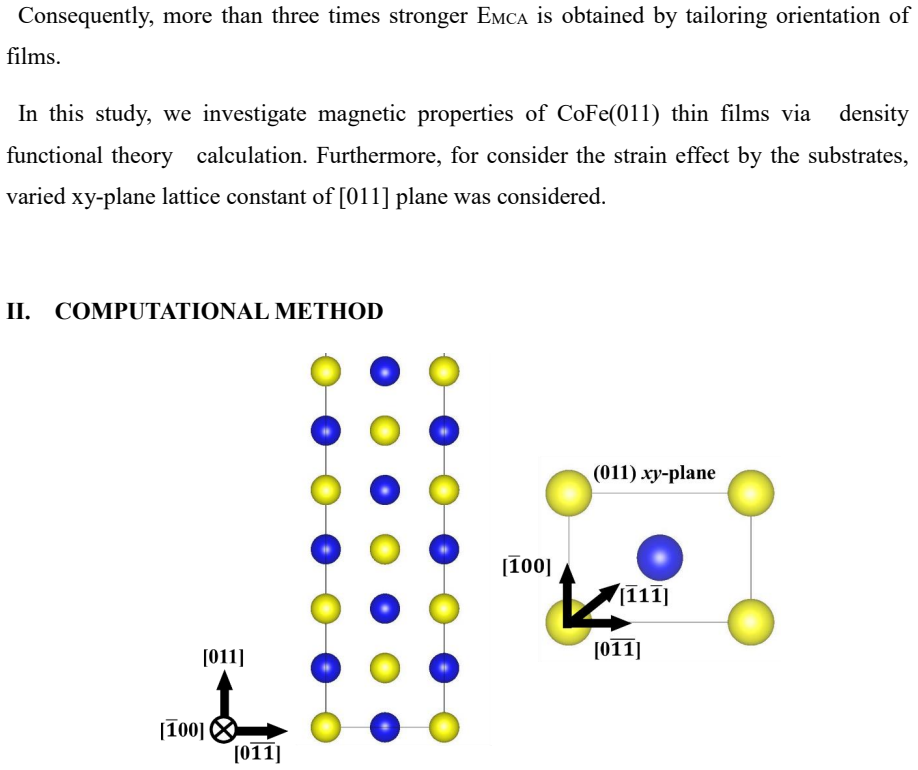
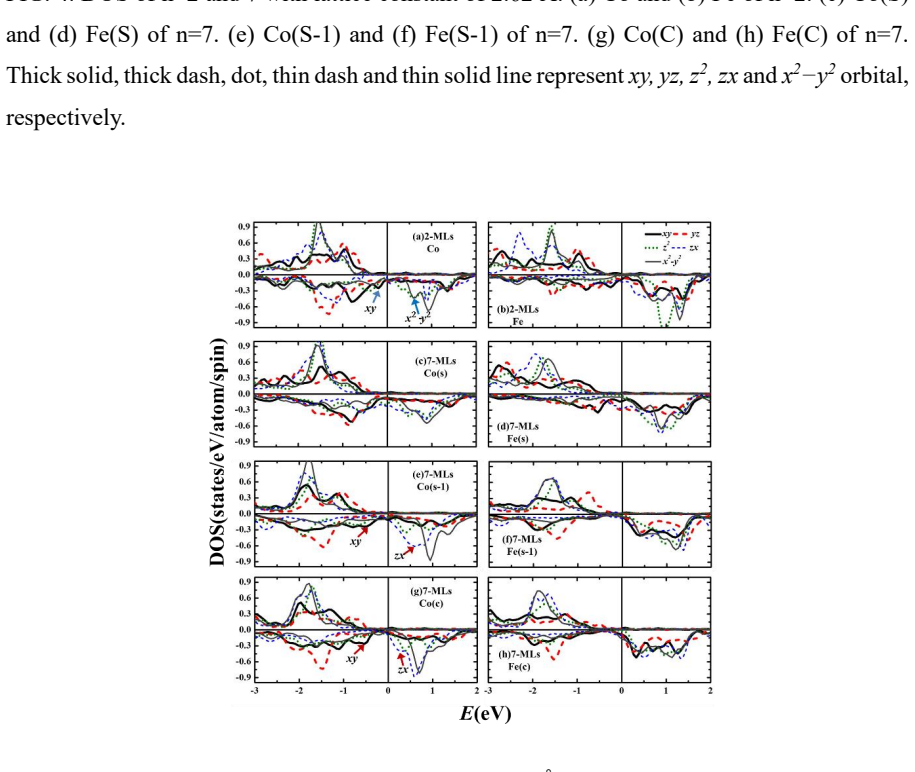
We investigate MCA of CoFe(011) thin films as a function of strength of strain and film thickness has been studied. It is elucidated that perpendicular magnetocystalline anisotropy (MCA) energy (EMCA) is getting stronger with compressed xy-plane lattice constant while in-plane MCA is become an easy-axis by tensile strain on xy-plane. The reason of the EMCA behaviors can be explained by features of electronic structures.
Editorial analysis
A structured set of objections, weighed in public.
Referee Report
Summary. The manuscript investigates strain and thickness dependence of magnetocrystalline anisotropy (MCA) in CoFe(011) thin films. It reports that perpendicular MCA energy strengthens under compression of the xy-plane lattice constant while tensile strain renders the in-plane direction the magnetic easy axis; these trends are attributed to features of the electronic band structure.
Significance. If the reported DFT trends hold, the work supplies concrete strain-engineering guidelines for CoFe-based films and links the anisotropy changes to specific electronic-structure signatures, which could aid materials design for spintronic devices. The computational isolation of MCA via total-energy differences (with/without spin-orbit coupling) removes the usual confounding contributions from shape anisotropy or interfaces, strengthening the internal consistency of the central claim.
minor comments (2)
- The provided abstract contains no numerical values, error estimates, slab thicknesses, k-point meshes, or exchange-correlation functional details, preventing quantitative assessment of the claimed trends.
- No figures, tables, or section references are supplied in the available text, so it is impossible to verify the electronic-structure explanation or the thickness dependence.
Simulated Author's Rebuttal
We thank the referee for their review. The provided summary accurately reflects the central findings of our work on strain and thickness effects on magnetocrystalline anisotropy in CoFe(011) films. We note that the referee report lists no specific major comments following the 'MAJOR COMMENTS:' heading, and the recommendation is marked 'uncertain' without further elaboration. Accordingly, we have no individual points to address point-by-point.
Circularity Check
No significant circularity identified
full rationale
The provided abstract and context describe a computational DFT study computing MCA via total-energy differences with/without SOC on strained CoFe(011) slabs as a function of strain and thickness. No equations, fitted parameters, or derivations are shown that reduce by construction to inputs. The attribution of trends to electronic-structure features is an interpretive statement following the calculations, not a self-definitional or fitted-input step. No self-citations appear as load-bearing uniqueness theorems or ansatz sources. The central claims rest on standard, externally verifiable DFT procedures for isolating MCA, making the derivation self-contained.
Axiom & Free-Parameter Ledger
Reference graph
Works this paper leans on
-
[1]
A. Stupakiewicz, K. Szerenos, D. Afanasiev, A. Kirilyuk, and A. V . Kimel, Nature, 542, 71 (2017)
work page 2017
-
[2]
C. V ogler, C. Abert, F. Bruckner, D. Suess, and D. Praetorius, Appl. Phys. Let. 108, 102406 (2016)
work page 2016
-
[3]
Y . K. Takahashi, R. Medapalli, S. Kasai, J. Wang, K. Ishioka, S. H. Wee, and E. E. Fullerton, Phys. Rev. Appl. 6, 054004 (2016)
work page 2016
- [4]
- [5]
- [6]
- [7]
-
[8]
R. G. Parr, (1980). Density func tional theory of atoms and molecules. In Horizons of Quantum Chemistry (pp. 5-15). Springer, Dordrecht
work page 1980
-
[9]
Hafner, Journal of computational chemistry, 29, 2044 (2008)
J. Hafner, Journal of computational chemistry, 29, 2044 (2008)
work page 2044
-
[10]
H. J. Monkhorst and J. D Pack, Phys Rev B, 13, 5188 (1076)
-
[11]
E. G. Kim, S. Y . Jekal, O. Kwon, S. C. Hong, J. Kor. Magn. Soc. 24, 35 (2014)
work page 2014
-
[12]
K. Andersson, P. A. Malmqvist, and R. O. Roos, The Journal of chemical physics, 96, 1218 (1992)
work page 1992
discussion (0)
Sign in with ORCID, Apple, or X to comment. Anyone can read and Pith papers without signing in.