REVIEW 5 major objections 4 minor 39 references
Hyper-Path-Based Representation Learning for Hyper-Networks
T0 review · 5 major / 4 minor · reviewed 2026-08-14 · deepseek-v4-flash
Pith's one-line read Hyper-path random walks plus a tuplewise deep model beat pairwise baselines on indecomposable hyper-networks.
desk verdict A solid, incremental hyper-network embedding paper whose central metric—the indecomposable factor—is under-analyzed and possibly confounded with hyperedge overlap, so the claimed advantage of the hyper-path random walk is not fully pinned down. read the letter →
The pith
A machine-rendered reading of the paper's core claim, the machinery that carries it, and where it could break.
The reading
What carries the argument
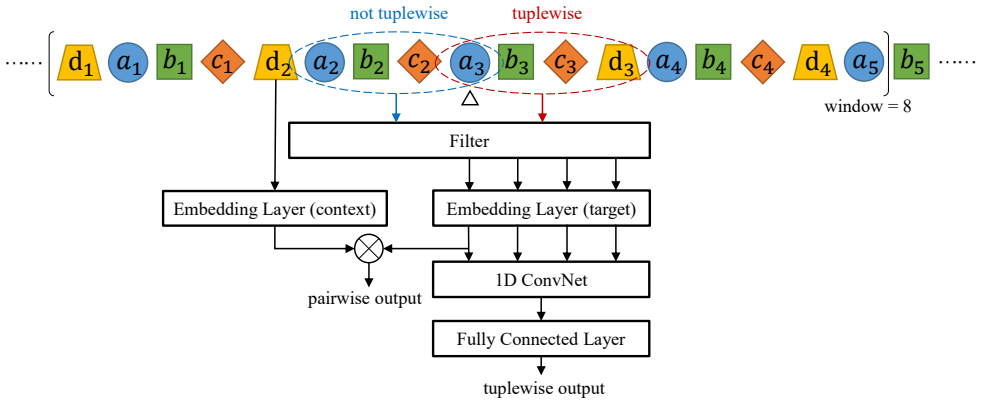
The load-bearing object is the indecomposable factor $\xi_t = p(B_t)/p(B_t|A)$, a per-type ratio estimated by Eq. (2) as the frequency of 'subset reappears in another hyperedge' events in a random edge set divided by the same frequency in the real edge set. It sets the bias in the hyper-path random walk transition probability $\pi_2(v|P) = \pi_1(v|P[-1])\exp(\alpha\,\xi_{\phi(v)}(\mathrm{PO}(v|P)-1))$, where path order $\mathrm{PO}(v|P)$ counts how many of the last distinct nodes of the current path share a hyperedge with $v$. The second machinery piece is Hyper-gram, whose objective $J = J_{\mathrm{pair}} + \lambda J_{\mathrm{tuple}}$ trains a Skip-gram pairwise term and a convolutional tuplewise scorer in parallel, so the final representation and the tuplewise similarity function are produced together. The path-order preference is what distinguishes these walks from ordinary pairwise random-walk models and from meta-path walks: it keeps the random walker inside the hyperedge that the current suffix belongs to, rather than hopping across flattened pairwise edges.
What would settle it
Build two synthetic 3-uniform hyper-networks with identical node-type counts and identical hyperedge-overlap statistics, only one of which has a planted semantic rule tying the tuple $(a,b,c)$ together; if the indecomposable factor of Eq. (2) and the link-prediction advantage of HPHG over $\alpha=0$ walks do not separate the two graphs, the factor is not measuring semantic indecomposability.
Extended reading notes
Core claim
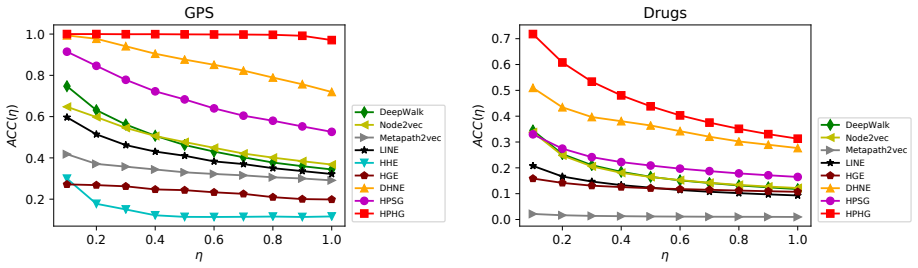
On a hyper-network, each hyperedge is a tuplewise relationship among an arbitrary set of nodes, and the paper's starting point is that the strength of that relationship cannot be inferred from pairwise subsets alone. The authors define the indecomposable factor $\xi_t = p(B_t)/p(B_t | A)$ for each node type $t$, estimated from how often a hyperedge minus one node is contained in another hyperedge, divided by the same frequency in a random edge set; values near 1 indicate decomposable or random structure, and values away from 1 indicate that the missing node type is load-bearing. They then define path order $\mathrm{PO}(v|P)$ as the length of the longest suffix of a path that can sit inside one hyperedge together with $v$, and define a hyper-path as a walk that prefers nodes of largest path order. The random-walk transition probability multiplies a first-order neighbor choice by $\exp(\alpha\,\xi_{\phi(v)}\,(\mathrm{PO}(v|P)-1))$, so strongly indecomposable node types pull the walk back into completed hyperedges. The Hyper-gram model combines a Skip-gram-style pairwise loss with a tuplewise loss over candidate tuples scored by a 1-D convolutional network plus a nonlinear output, jointly training node embeddings and a tuplewise similarity function $s_{\mathrm{tuple}}$; the full objective is $J = J_{\mathrm{pair}} + \lambda J_{\mathrm{tuple}}$. The paper reports that HPHG reaches the best AUC on the GPS, Drugs, and Wordnet hyper-networks, beats DHNE where both use a tuplewise metric, and reconstructs GPS hyperedges with accuracy 0.9708 at full reconstruction.
Load-bearing premise
The load-bearing premise is that the indecomposable factor, the ratio in Eq. (2), actually measures semantic indecomposability of hyperedges rather than just how often subsets reappear by overlap; if that premise fails, the hyper-path bias is not explained and the method's advantage would be a tuning artifact.
Editorial extensions
If this is right
- On hyper-networks with relatively high indecomposable factors, such as GPS, Drugs, and Wordnet, methods that model tuplewise relationships directly beat pairwise-only methods on link prediction, and HPHG is the best of these.
- On near-decomposable hyper-networks such as MovieLens, pairwise methods remain competitive, so computing the indecomposable factor first can tell a practitioner whether a hyperedge-aware model is needed.
- Hyper-path-based random walks alone, without the tuplewise loss, already beat the pairwise baselines on most datasets, so the walk generator itself preserves hyper-network structure better than clique-expanded walks.
- The ablation on GPS shows that removing any component, the tuplewise loss, the pairwise window, or the hyper-path bias, lowers AUC, so all three components contribute to HPHG's result.
- The learned tuplewise similarity function can be used directly to rank candidate hyperedges, which is how HPHG reaches reconstruction accuracy 0.9708 on GPS.
Reading between the lines
- A practical extension the paper leaves implicit is using the indecomposable factor as a model-selection diagnostic: compute it before training, and only switch to a hyper-path and Hyper-gram pipeline when the factors deviate clearly from 1.
- Because the factor is type-level, it cannot distinguish which subsets of a hyperedge are the meaningful ones; a per-subset analogue of the factor could sharpen the random-walk bias and is a natural next step.
- The exponential dependence on $\alpha\,\xi_{\phi(v)}$ means the effective bias depends on the scale of $\xi$; normalizing $\xi$ across types or learning $\alpha$ per dataset might make the method easier to tune on new hyper-networks.
- The GPS reconstruction accuracy suggests the tuplewise scorer is capturing near-deterministic structure in that data; testing on sparser, larger hyper-networks would show whether the advantage persists when the number of candidate hyperedges explodes combinatorially.
Signed reviews
Editorial analysis
A structured set of objections, weighed in public.
Referee Report
Summary. The paper proposes a representation learning method for hyper-networks. It defines an 'indecomposable factor' ξ_t per node type, estimated by Eq. (2), and uses it to bias a new 'hyper-path' random walk (Eq. (5)). The resulting sequences are fed into two models: HPSG (hyper-path walks plus Skip-gram) and HPHG (hyper-path walks plus a new Hyper-gram model that jointly optimizes a pairwise Skip-gram-style loss and a tuplewise ConvNet-based similarity loss). Experiments on four hyper-networks (GPS, MovieLens, Drugs, Wordnet) evaluate link prediction (Table 3) and hyper-network reconstruction (Fig. 3), with an ablation study on GPS (Table 5). The paper claims state-of-the-art performance on hyper-networks with relatively high indecomposability, and in particular reports an accuracy of 0.9708 for reconstructing the GPS hyper-network.
Significance. If the claims are substantiated, the paper makes a useful contribution: it is one of the few methods that explicitly target the indecomposability of hyperedges, it ships code and data, and the idea of coupling a type-level indecomposability statistic with a biased random walk is simple and potentially transferable. The reported link-prediction gains on GPS, Drugs, and Wordnet, and the strong reconstruction result on GPS, are encouraging. However, the core explanatory link between ξ_t and the method's advantage is not validated, the ablations do not isolate the contribution of ξ_t, and the experimental reporting omits error bars and sensitivity analyses. The contribution is therefore defensible but not yet fully established.
major comments (5)
- [Section 3.2, Definition 1 and Eq. (2)] The paper asserts without proof that 'the larger the factor, the stronger the indecomposability' and then uses ξ_t directly to weight transitions in Eq. (5). As defined, δ1(e) is an overlap statistic: for a 3-uniform hyperedge, δ1(e)=1 exactly when e minus one type-t node is contained in another hyperedge. This conflates semantic indecomposability with hyperedge overlap density and node-type frequency. The random-edge baseline (ξ≈1) only shows that structured and random hypergraphs differ; it does not validate the metric as a measure of indecomposability. Please provide a derivation or controlled synthetic experiments (e.g., hypergraphs generated from known pairwise relations versus genuinely tuplewise relations) and, at minimum, an ablation that varies ξ_t while holding the path-order bias fixed.
- [Section 4.5, Table 5] The ablation HPHG(α=0) removes both the hyper-path selection rule and the ξ_t weighting, while HPSG removes the tuplewise loss entirely. Consequently, the experiments cannot separate the contribution of the indecomposable factor from the generic benefit of biasing walks toward nodes with high path order. A version with ξ_t replaced by a constant (or by an alternative overlap statistic) is needed to support the causal role of ξ_t in the reported improvements.
- [Section 4.2.2 and Table 3] The parameter α is tuned separately per dataset (α=100 for GPS, MovieLens, Drugs and α=20 for Wordnet) on the same data used for evaluation, and no sensitivity analysis is provided. Since α is the main control on the random-walk bias, the reported improvements may reflect per-dataset tuning rather than a property of the method. Report sensitivity of HPSG/HPHG to α (and to λ), or set these values on a validation split and state the chosen values.
- [Section 4.3, Table 3, Abstract and Conclusion] The broad claim of 'state-of-the-art' performance is not supported by the paper's own table. On MovieLens, the pairwise baselines DeepWalk (L1 0.9629, L2 0.9643, COS 0.9520) and Node2vec (L1 0.9632, L2 0.9645, COS 0.9524) all exceed HPHG (0.9012). The abstract and conclusion should be restricted to hyper-networks with relatively high indecomposable factor, as the paper itself acknowledges in the discussion of Table 3.
- [Section 4.3 and Fig. 3] Although the text says 'Each algorithm runs five times,' Table 3 and Fig. 3 report only point estimates with no standard deviations, confidence intervals, or significance tests. Several differences are small (for example, HPSG 0.9649 versus Node2vec 0.9645 on MovieLens L2), so the claim that the proposed models 'significantly' outperform baselines is not supported by the reported evidence.
minor comments (4)
- [Section 3.3, Definition 3 vs Eq. (5)] Definition 3 states that a hyper-path selects a node with the largest path order, while Eq. (5) defines a soft, stochastic weighting that only approaches this behavior as α·ξ_t·(PO−1) becomes large. Please clarify that Definition 3 is the deterministic limit of Eq. (5) and that the implemented walks are the soft version.
- [Section 3.2, text after Eq. (2)] The sentence describing E_random appears garbled: 'generated randomly from the node set and the distribution of edge degree according to the distribution of edge degree in E' should specify whether random edges are also drawn to match the node-type distribution and how the number of random edges is chosen beyond the example '10×|E|'.
- [Section 4.3] The procedure for generating negative test samples is described only for HPHG/DHNE; it is unclear whether the same hidden/negative split is used for all baselines. Please state explicitly that the evaluation protocol is identical across methods.
- [Section 2] Hyper2vec and HHNE are discussed in the related work but are not compared in the experiments. A sentence explaining why they are excluded would help the reader calibrate the 'state-of-the-art' comparison.
Circularity Check
No circularity identified: the paper's method is empirical, and its reported predictions are evaluated on held-out hyperedges rather than being forced by fitted inputs or self-citations.
full rationale
The derivation chain is empirical and self-contained against external benchmarks. The indecomposable factor ξ_t is computed from hyperedge statistics via Eq. (2) and used as a bias in the transition probability Eq. (5); it is not fitted to the link-prediction or reconstruction targets, and no equation in the paper equates a predicted score to a fitted parameter or to the definition of ξ_t. The learned representations are evaluated on 20% held-out hyperedges in Section 4.3 and on reconstruction accuracy in Section 4.4, so the reported gains are not forced by construction. Hyperparameter tuning of α and λ on each dataset is standard model selection, not fitting the test labels. The only self-citation, Hyper2vec [13], appears in the related-work discussion and is not load-bearing for any claim in the paper. The concern that ξ_t may partly reflect hyperedge overlap rather than semantic indecomposability is a validity and interpretability issue, not a circularity, because the paper's main empirical conclusions do not reduce to the definition of ξ_t. No circular step satisfying the quoted-equivalence standard was found.
Assumptions & free parameters
free parameters (2)
- alpha (alpha) =
100 for GPS, MovieLens, Drugs; 20 for Wordnet
- lambda (lambda) =
1
assumptions (4)
- ad hoc to paper The indecomposable factor xi_t in Eq. (2) measures the degree of indecomposability of a hyper-network.
- domain assumption Hyper-path-based random walks preserve both pairwise and tuplewise structure better than uniform walks.
- domain assumption Each hyperedge contains exactly one node of each type, making the delta_2 filter in Eq. (13) valid.
- standard math Co-occurrence in random walks reflects meaningful node proximity (DeepWalk/Skip-gram assumption).
Cite this review
Pith. "Pith review of Hyper-Path-Based Representation Learning for Hyper-Networks." pith.science (2026). https://pith.science/paper/JGMFWTXF
@misc{pith2026190809152,
  author       = {Pith},
  title        = {Pith review of: Hyper-Path-Based Representation Learning for Hyper-Networks},
  year         = {2026},
  howpublished = {\url{https://pith.science/paper/JGMFWTXF}},
  note         = {Machine review of arXiv:1908.09152}
}
read the original abstract
Network representation learning has aroused widespread interests in recent years. While most of the existing methods deal with edges as pairwise relationships, only a few studies have been proposed for hyper-networks to capture more complicated tuplewise relationships among multiple nodes. A hyper-network is a network where each edge, called hyperedge, connects an arbitrary number of nodes. Different from conventional networks, hyper-networks have certain degrees of indecomposability such that the nodes in a subset of a hyperedge may not possess a strong relationship. That is the main reason why traditional algorithms fail in learning representations in hyper-networks by simply decomposing hyperedges into pairwise relationships. In this paper, we firstly define a metric to depict the degrees of indecomposability for hyper-networks. Then we propose a new concept called hyper-path and design hyper-path-based random walks to preserve the structural information of hyper-networks according to the analysis of the indecomposability. Then a carefully designed algorithm, Hyper-gram, utilizes these random walks to capture both pairwise relationships and tuplewise relationships in the whole hyper-networks. Finally, we conduct extensive experiments on several real-world datasets covering the tasks of link prediction and hyper-network reconstruction, and results demonstrate the rationality, validity, and effectiveness of our methods compared with those existing state-of-the-art models designed for conventional networks or hyper-networks.
Figures

Reference graph
Works this paper leans on
-
[1]
Sameer Agarwal, Kristin Branson, and Serge Belongie. 2006. Higher order learn- ing with graphs. In ICML. ACM, 17–24
work page 2006
-
[2]
Inci M Baytas, Cao Xiao, Fei Wang, Anil K Jain, and Jiayu Zhou. 2018. Heteroge- neous Hyper-Network Embedding. In ICDM. IEEE, 875–880
work page 2018
-
[3]
Mikhail Belkin and Partha Niyogi. 2002. Laplacian eigenmaps and spectral techniques for embedding and clustering. In NIPS. 585–591
work page 2002
-
[4]
Antoine Bordes, Nicolas Usunier, Alberto Garcia-Duran, Jason Weston, and Ok- sana Yakhnenko. 2013. Translating embeddings for modeling multi-relational data. In NIPS. 2787–2795
work page 2013
-
[5]
Hongyun Cai, Vincent W Zheng, and Kevin Chen-Chuan Chang. 2018. A com- prehensive survey of graph embedding: Problems, techniques, and applications. IEEE Transactions on Knowledge and Data Engineering 30, 9 (2018), 1616–1637
2018
-
[6]
Shaosheng Cao, Wei Lu, and Qiongkai Xu. 2016. Deep Neural Networks for Learning Graph Representations. In AAAI. 1145–1152
2016
-
[7]
Shiyu Chang, Wei Han, Jiliang Tang, Guo-Jun Qi, Charu C Aggarwal, and Thomas S Huang. 2015. Heterogeneous network embedding via deep archi- tectures. In SIGKDD. ACM, 119–128
work page 2015
-
[8]
Peng Cui, Xiao Wang, Jian Pei, and Wenwu Zhu. 2018. A survey on network embedding. IEEE Transactions on Knowledge and Data Engineering (2018)
work page 2018
Show all 39 references
-
[9]
Yuxiao Dong, Nitesh V Chawla, and Ananthram Swami. 2017. metapath2vec: Scalable representation learning for heterogeneous networks. In SIGKDD. ACM, 135–144
2017
-
[10]
Ming Gao, Leihui Chen, Xiangnan He, and Aoying Zhou. 2018. BiNE: Bipartite Network Embedding. In SIGIR. 715–724
2018
-
[11]
Aditya Grover and Jure Leskovec. 2016. node2vec: Scalable feature learning for networks. In SIGKDD. ACM, 855–864
2016
-
[12]
F Maxwell Harper and Joseph A Konstan. 2016. The movielens datasets: History and context. ACM Transactions on Interactive Intelligent Systems 5, 4 (2016), 19
2016
-
[13]
Jie Huang, Chuan Chen, Fanghua Ye, Jiajing Wu, Zibin Zheng, and Guohui Ling. 2019. Hyper2vec: Biased Random Walk for Hyper-network Embedding. In DASFAA. Springer, 273–277
2019
-
[14]
Glen Jeh and Jennifer Widom. 2003. Scaling personalized web search. In WWW. ACM, 271–279
2003
-
[15]
David Liben-Nowell and Jon Kleinberg. 2007. The link-prediction problem for social networks. Journal of the Association for Information Science and Technology 58, 7 (2007), 1019–1031
2007
-
[16]
Tomas Mikolov, Ilya Sutskever, Kai Chen, Greg S Corrado, and Jeff Dean. 2013. Distributed representations of words and phrases and their compositionality. In NIPS. 3111–3119
2013
-
[17]
George A Miller. 1995. WordNet: a lexical database for English. Commun. ACM 38, 11 (1995), 39–41
1995
-
[18]
Andrew Y Ng, Michael I Jordan, and Yair Weiss. 2002. On spectral clustering: Analysis and an algorithm. In NIPS. 849–856
2002
-
[19]
Bryan Perozzi, Rami Al-Rfou, and Steven Skiena. 2014. Deepwalk: Online learning of social representations. In SIGKDD. ACM, 701–710
2014
-
[20]
Sam T Roweis and Lawrence K Saul. 2000. Nonlinear dimensionality reduction by locally linear embedding. science 290, 5500 (2000), 2323–2326
2000
-
[21]
Liang Sun, Shuiwang Ji, and Jieping Ye. 2008. Hypergraph spectral learning for multi-label classification. In SIGKDD. ACM, 668–676
2008
-
[22]
Yizhou Sun, Jiawei Han, Xifeng Yan, Philip S Yu, and Tianyi Wu. 2011. Pathsim: Meta path-based top-k similarity search in heterogeneous information networks. Proceedings of the VLDB Endowment 4, 11 (2011), 992–1003
2011
-
[23]
Jian Tang, Meng Qu, Mingzhe Wang, Ming Zhang, Jun Yan, and Qiaozhu Mei
-
[24]
Lei Tang and Huan Liu. 2011. Leveraging social media networks for classification. Data Mining and Knowledge Discovery 23, 3 (2011), 447–478
2011
-
[25]
Joshua B Tenenbaum, Vin De Silva, and John C Langford. 2000. A global geometric framework for nonlinear dimensionality reduction.science 290, 5500 (2000), 2319– 2323
2000
-
[26]
Ke Tu, Peng Cui, Xiao Wang, Fei Wang, and Wenwu Zhu. 2018. Structural deep embedding for hyper-networks. In AAAI
2018
-
[27]
Daixin Wang, Peng Cui, and Wenwu Zhu. 2016. Structural deep network embed- ding. In SIGKDD. ACM, 1225–1234
2016
-
[28]
Meng Wang, Weijie Fu, Shijie Hao, Hengchang Liu, and Xindong Wu. 2017. Learning on big graph: Label inference and regularization with anchor hierarchy. IEEE Transactions on Knowledge and Data Engineering 29, 5 (2017), 1101–1114
2017
-
[29]
Meng Wang, Weijie Fu, Shijie Hao, Dacheng Tao, and Xindong Wu. 2016. Scal- able semi-supervised learning by efficient anchor graph regularization. IEEE Transactions on Knowledge and Data Engineering 28, 7 (2016), 1864–1877
2016
-
[30]
Suhang Wang, Jiliang Tang, Charu Aggarwal, Yi Chang, and Huan Liu. 2017. Signed network embedding in social media. In SDM. SIAM, 327–335
2017
-
[31]
Fei Wu, Ya-Hong Han, and Yue-Ting Zhuang. 2010. Multiple hypergraph clus- tering of web images by miningword2image correlations. Journal of Computer Science and Technology 25, 4 (2010), 750–760
2010
-
[32]
Linchuan Xu, Xiaokai Wei, Jiannong Cao, and Philip S Yu. 2017. Embedding of embedding (eoe): Joint embedding for coupled heterogeneous networks. In WSDM. ACM, 741–749
2017
-
[33]
Chia-An Yu, Ching-Lun Tai, Tak-Shing Chan, and Yi-Hsuan Yang. 2018. Modeling Multi-way Relations with Hypergraph Embedding. In CIKM. ACM, 1707–1710
2018
-
[34]
Ziwei Zhang, Peng Cui, Xiao Wang, Jian Pei, Xuanrong Yao, and Wenwu Zhu
-
[35]
Vincent W Zheng, Bin Cao, Yu Zheng, Xing Xie, and Qiang Yang. 2010. Collab- orative filtering meets mobile recommendation: A user-centered approach. In AAAI
2010
-
[36]
Denny Zhou, Jiayuan Huang, and Bernhard Schölkopf. 2007. Learning with hypergraphs: Clustering, classification, and embedding. In NIPS. 1601–1608
2007
-
[37]
Yu Zhu, Ziyu Guan, Shulong Tan, Haifeng Liu, Deng Cai, and Xiaofei He. 2016. Heterogeneous hypergraph embedding for document recommendation. Neuro- computing 216 (2016), 150–162
2016
-
[2015]
Line: Large-scale information network embedding. In WWW. WWW, 1067–1077
-
[2018]
In SIGKDD
Arbitrary-Order Proximity Preserved Network Embedding. In SIGKDD. ACM, 2778–2786
Reviewed August 14, 2026 · model on record in the stance chip above.
Discussion (0). Continue with ORCID to comment.