Hyperedge approximation for stochastic processes on higher-order networks
Pith reviewed 2026-05-25 02:52 UTC · model grok-4.3
The pith
The ℓ-hyperedge approximation extends pairwise results to stochastic processes on regular hypergraphs with group interactions.
A machine-rendered reading of the paper's core claim, the machinery that carries it, and where it could break.
Core claim
The central claim is that the ℓ-hyperedge approximation on regular hypergraphs yields analytical expressions for evolutionary dynamics, including generalized thresholds for the spread of cooperation in ℓ-player games and exact fixation probabilities for complex contagions governed by a complexity parameter, thereby extending pair approximation techniques to interaction structures with no pairwise analog.
What carries the argument
The ℓ-hyperedge approximation, a closure method that averages states over hyperedges of size ℓ in a regular hypergraph to obtain reduced dynamical equations for both payoff calculation and state updating.
If this is right
- Cooperation is favored when the benefit-to-cost ratio exceeds a threshold that depends explicitly on group size ℓ and group number k.
- Nonlinear ℓ-player public goods games receive distinct critical benefit-to-cost ratios that cannot be recovered from pairwise reductions.
- The fixation probability of a rare type in complex contagion takes a closed form controlled by a single complexity parameter.
- Payoff-biased complex contagion becomes a single unified stochastic process on the hypergraph structure.
Where Pith is reading between the lines
- The same closure could be tested on empirical contact data that record group memberships rather than only pairwise contacts.
- The method suggests that increasing group size ℓ systematically shifts the threshold for cooperation or contagion spread in structured populations.
- Similar reductions might apply to other multi-agent processes such as threshold-based opinion updates within cliques.
Load-bearing premise
The hypergraphs must be regular, with each individual belonging to exactly k groups of size ℓ, and the approximation closure must remain valid for payoff and updating steps without extra higher-order correlations.
What would settle it
Direct Monte Carlo simulations on a small regular hypergraph that produce fixation probabilities or cooperation thresholds measurably different from the closed-form predictions would show the approximation fails to capture the true dynamics.
Figures


read the original abstract
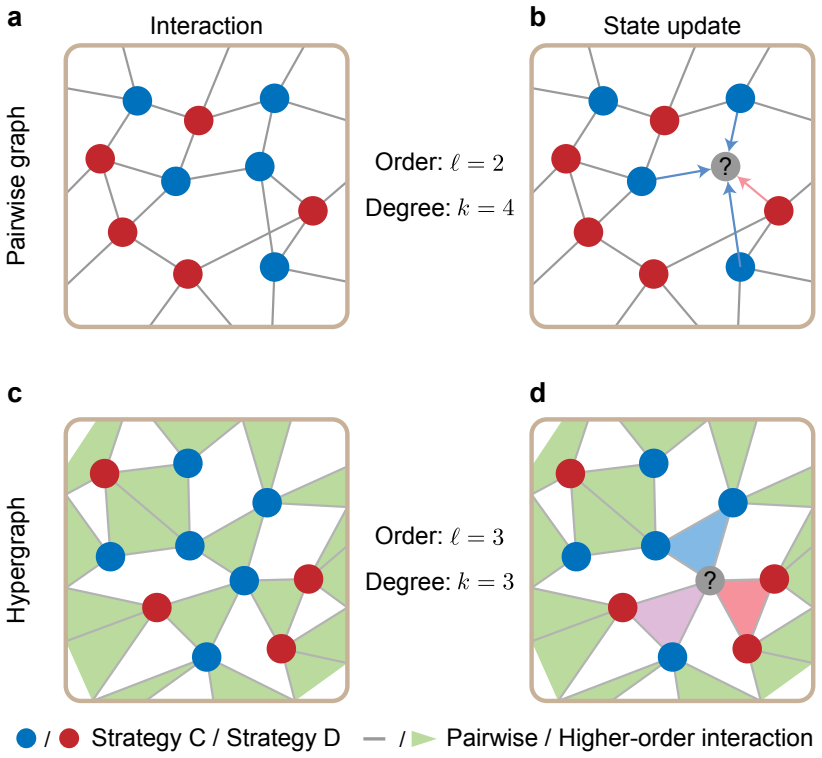
Graphs are a standard framework for describing dynamical processes shaped by pairwise interactions among agents. But many systems involve interactions in groups of three or more agents. Here, we develop a method of "$\ell$-hyperedge approximation", a framework to analyze stochastic population processes on regular hypergraphs, in which each individual belongs to $k$ groups of size $\ell$. The framework accommodates both higher-order interactions that determine payoffs and higher-order processes for updating states in response to payoffs. Applied to evolutionary game dynamics, the framework generalizes the classical pairwise result on benefits and costs, $b/c>k$, that favors the spread of cooperation; and it provides critical benefit-to-cost ratios for nonlinear $\ell$-player public goods games that cannot be reduced to pairwise interactions. Applied to complex contagions, where inheritance of states occurs within hyperedges rather than along parent-offspring edges, the framework gives a closed-form result for the fixation probability, which shows how a complexity parameter governs the spread of rare types. Coupling the two processes produces a single stochastic model of payoff-biased complex contagion in structured populations. These results extend pair approximation from graphs to hypergraphs, accommodating multi-way interactions and inheritance structures with no pairwise analog.
Editorial analysis
A structured set of objections, weighed in public.
Referee Report
Summary. The manuscript develops an ℓ-hyperedge approximation framework for stochastic processes on regular hypergraphs (each node in exactly k hyperedges of size ℓ). It extends pair approximation to accommodate both higher-order payoff interactions and hyperedge-based state updating. The framework generalizes the pairwise b/c > k threshold for cooperation to ℓ-player public-goods games (including nonlinear cases with no pairwise reduction) and supplies closed-form fixation probabilities for complex contagions controlled by a complexity parameter; the two processes are also coupled into a single payoff-biased contagion model.
Significance. If the closure is valid, the work supplies a useful analytic extension of mean-field and pair approximations to hypergraphs, yielding concrete, parameter-free predictions (generalized critical ratios and fixation expressions) for multi-way interactions that lack pairwise analogs. This could enable new analyses of group-structured dynamics in evolutionary games and contagion processes on higher-order networks.
major comments (2)
- [Abstract and §2] Abstract and §2 (framework): the claim of closed-form critical b/c ratios and fixation probabilities for nonlinear ℓ-player games and hyperedge inheritance rests on the ℓ-hyperedge closure exactly truncating all higher-order correlations; no error bound, regime of validity, or comparison to exact master equations for small hypergraphs is supplied to confirm that residual three-or-higher correlations induced by nonlinear payoffs or hyperedge updating do not invalidate the reduction.
- [§4 and §5] §4 (evolutionary games) and §5 (complex contagions): the reported thresholds and fixation formulas assume the same moment closure suffices for both payoff calculation and state-transition probabilities; any additional correlations arising specifically from the nonlinear public-goods payoff or from the hyperedge inheritance rule would break the claimed pairwise-like ODEs or master equations, yet no diagnostic or simulation test of this assumption is presented.
minor comments (2)
- [Introduction] Notation for the regularity parameters (k, ℓ) and the complexity parameter should be introduced with explicit definitions in the introduction rather than deferred to the methods.
- [Figures] Figure captions for the hypergraph schematics would benefit from explicit indication of which panels illustrate payoff versus updating steps.
Simulated Author's Rebuttal
We thank the referee for their thoughtful review and for highlighting important aspects of the closure assumptions in our ℓ-hyperedge approximation. We respond to each major comment below.
read point-by-point responses
-
Referee: [Abstract and §2] Abstract and §2 (framework): the claim of closed-form critical b/c ratios and fixation probabilities for nonlinear ℓ-player games and hyperedge inheritance rests on the ℓ-hyperedge closure exactly truncating all higher-order correlations; no error bound, regime of validity, or comparison to exact master equations for small hypergraphs is supplied to confirm that residual three-or-higher correlations induced by nonlinear payoffs or hyperedge updating do not invalidate the reduction.
Authors: The ℓ-hyperedge approximation is a moment-closure technique that reduces the master equation by expressing higher-order hyperedge correlations in terms of lower-order ones, exactly as pair approximation does on ordinary graphs. The closed-form expressions for critical ratios and fixation probabilities are derived exactly under this closure; they are not claimed to be exact for the full stochastic process. We do not supply rigorous a-priori error bounds because such bounds are not generally available for moment closures of this type and would require a separate analytic development. The manuscript does compare the resulting ODEs and fixation formulas against Monte-Carlo simulations on finite regular hypergraphs (see §§4–5 and the associated figures), which serves as a practical check on the truncation. We will add an explicit paragraph in §2 stating the closure assumption and the expected regime of validity (large population, moderate hyperedge size, and decaying spatial correlations). revision: partial
-
Referee: [§4 and §5] §4 (evolutionary games) and §5 (complex contagions): the reported thresholds and fixation formulas assume the same moment closure suffices for both payoff calculation and state-transition probabilities; any additional correlations arising specifically from the nonlinear public-goods payoff or from the hyperedge inheritance rule would break the claimed pairwise-like ODEs or master equations, yet no diagnostic or simulation test of this assumption is presented.
Authors: Because both the payoff function and the state-update rule are defined on the same hyperedge configurations, the identical closure is applied uniformly; this is the defining feature of the framework. The nonlinear public-goods payoffs enter directly through the hyperedge payoff vector and do not require an additional reduction step. The hyperedge-inheritance rule is likewise expressed in terms of the same hyperedge states. The assumption is tested by direct comparison of the closed-form predictions with individual-based stochastic simulations on finite hypergraphs, which are reported throughout §§4 and 5. These simulations incorporate the full nonlinear payoffs and hyperedge updating, so any systematic deviation caused by unclosed correlations would appear as a mismatch. We will insert a short diagnostic subsection that explicitly overlays the approximated transition rates against those measured from the simulations to make this check more transparent. revision: partial
Circularity Check
No circularity: derivation is a modeling approximation with independent content
full rationale
The provided abstract and description introduce an ℓ-hyperedge approximation as a new closure method that extends pair approximation to regular hypergraphs, yielding closed-form expressions for critical b/c ratios and fixation probabilities under stated assumptions. No equations or steps are quoted that reduce outputs to inputs by definition, rename fitted parameters as predictions, or rely on load-bearing self-citations whose prior results themselves depend on the target claim. The closure is presented as an explicit modeling choice whose accuracy is an external question, not a self-referential identity. This is the normal case of a self-contained approximation framework.
Axiom & Free-Parameter Ledger
axioms (1)
- domain assumption The population is embedded on a regular hypergraph in which every individual belongs to exactly k hyperedges each of size ℓ.
Reference graph
Works this paper leans on
-
[1]
R. Albert and A.-L. Barab \'a si. Statistical mechanics of complex networks. Reviews of modern physics, 74 0 (1): 0 47, 2002
work page 2002
-
[2]
M. E. J. Newman. The structure and function of complex networks. SIAM Review, 45 0 (2): 0 167--256, 2003
work page 2003
- [3]
-
[4]
F. Radicchi and A. Arenas. Abrupt transition in the structural formation of interconnected networks. Nature Physics, 9 0 (11): 0 717--720, 2013
work page 2013
-
[5]
S. N. Dorogovtsev, A. V. Goltsev, and J. F. F. Mendes. Ising model on networks with an arbitrary distribution of connections. Physical Review E, 66 0 (1): 0 016104, 2002
work page 2002
-
[6]
H. Ohtsuki, C. Hauert, E. Lieberman, and M. A. Nowak. A simple rule for the evolution of cooperation on graphs and social networks. Nature, 441 0 (7092): 0 502--505, 2006
work page 2006
-
[7]
Q. Su, B. Allen, and J. B. Plotkin. Evolution of cooperation with asymmetric social interactions. Proceedings of the National Academy of Sciences, 119 0 (1): 0 e2113468118, 2022 a
work page 2022
-
[8]
R. Durrett and S. Levin. The importance of being discrete (and spatial). Theoretical Population Biology, 46 0 (3): 0 363--394, 1994
work page 1994
-
[9]
R. Lambiotte, M. Rosvall, and I. Scholtes. From networks to optimal higher-order models of complex systems. Nature Physics, 15 0 (4): 0 313--320, 2019
work page 2019
-
[10]
F. Battiston, E. Amico, A. Barrat, G. Bianconi, G. Ferraz de Arruda, et al. The physics of higher-order interactions in complex systems. Nature Physics, 17 0 (10): 0 1093--1098, 2021
work page 2021
- [11]
-
[12]
J. M. Levine, J. Bascompte, P. B. Adler, and S. Allesina. Beyond pairwise mechanisms of species coexistence in complex communities. Nature, 546 0 (7656): 0 56--64, 2017
work page 2017
-
[13]
A. Fontan and S. Zhang. Collective decision-making dynamics in hypernetworks. In 2025 IEEE 64th Conference on Decision and Control (CDC), pages 6222--6227. IEEE, 2025
work page 2025
-
[14]
F. Battiston, G. Cencetti, I. Iacopini, V. Latora, M. Lucas, et al. Networks beyond pairwise interactions: Structure and dynamics. Physics Reports, 874: 0 1--92, 2020
work page 2020
-
[15]
F. C. Santos, M. D. Santos, and J. M. Pacheco. Social diversity promotes the emergence of cooperation in public goods games. Nature, 454 0 (7201): 0 213--216, 2008
work page 2008
-
[16]
A. Li, M. Broom, J. Du, and L. Wang. Evolutionary dynamics of general group interactions in structured populations. Physical Review E, 93 0 (2): 0 022407, 2016
work page 2016
-
[17]
U. Alvarez-Rodriguez, F. Battiston, G. F. de Arruda, Y. Moreno, M. Perc, and V. Latora. Evolutionary dynamics of higher-order interactions in social networks. Nature Human Behaviour, 5 0 (5): 0 586--595, 2021
work page 2021
-
[18]
D. G. Rand, M. A. Nowak, J. H. Fowler, and N. A. Christakis. Static network structure can stabilize human cooperation. Proceedings of the National Academy of Sciences, 111 0 (48): 0 17093--17098, 2014
work page 2014
- [19]
- [20]
-
[21]
M. Mobilia. Does a single zealot affect an infinite group of voters? Physical Review Letters, 91 0 (2): 0 028701, 2003
work page 2003
-
[22]
R. Durrett and S. A. Levin. Can stable social groups be maintained by homophilous imitation alone? Journal of Economic Behavior & Organization, 57 0 (3): 0 267--286, 2005
work page 2005
-
[23]
F. C. Santos and J. M. Pacheco. Scale-free networks provide a unifying framework for the emergence of cooperation. Physical Review Letters, 95 0 (9): 0 098104, 2005
work page 2005
-
[24]
C. Castellano, S. Fortunato, and V. Loreto. Statistical physics of social dynamics. Reviews of Modern Physics, 81 0 (2): 0 591--646, 2009
work page 2009
-
[25]
A. Traulsen, D. Semmann, R. D. Sommerfeld, H.-J. Krambeck, and M. Milinski. Human strategy updating in evolutionary games. Proceedings of the National Academy of Sciences, 107 0 (7): 0 2962--2966, 2010
work page 2010
- [26]
-
[27]
F. L. Pinheiro, M. D. Santos, F. C. Santos, and J. M. Pacheco. Origin of peer influence in social networks. Physical Review Letters, 112 0 (9): 0 098702, 2014
work page 2014
-
[28]
I. Iacopini, S. Milojevi \'c , and V. Latora. Network dynamics of innovation processes. Physical Review Letters, 120 0 (4): 0 048301, 2018
work page 2018
-
[29]
D. Centola and M. Macy. Complex contagions and the weakness of long ties. American Journal of Sociology, 113 0 (3): 0 702--734, 2007
work page 2007
-
[30]
D. Centola. The spread of behavior in an online social network experiment. Science, 329 0 (5996): 0 1194--1197, 2010
work page 2010
-
[31]
E. Campbell and M. Salath \'e . Complex social contagion makes networks more vulnerable to disease outbreaks. Scientific Reports, 3 0 (1): 0 1905, 2013
work page 1905
- [32]
-
[33]
D. Centola. How behavior spreads: The science of complex contagions, volume 3. Princeton University Press, 2018
work page 2018
-
[34]
V. V. Vasconcelos, S. A. Levin, and F. L. Pinheiro. Consensus and polarization in competing complex contagion processes. Journal of the Royal Society Interface, 16 0 (155): 0 20190196, 2019
work page 2019
-
[35]
H. Chiba-Okabe and J. B. Plotkin. Social learning with complex contagion. Proceedings of the National Academy of Sciences, 121 0 (49): 0 e2414291121, 2024
work page 2024
- [36]
-
[37]
A. McAvoy and B. Allen. Fixation probabilities in evolutionary dynamics under weak selection. Journal of Mathematical Biology, 82 0 (3): 0 14, 2021
work page 2021
-
[38]
Q. Su, A. McAvoy, and J. B. Plotkin. Strategy evolution on dynamic networks. Nature Computational Science, 3 0 (9): 0 763--776, 2023
work page 2023
- [39]
-
[40]
M. A. Nowak, A. Sasaki, C. Taylor, and D. Fudenberg. Emergence of cooperation and evolutionary stability in finite populations. Nature, 428 0 (6983): 0 646--650, 2004
work page 2004
-
[41]
T. Ohta. Near-neutrality in evolution of genes and gene regulation. Proceedings of the National Academy of Sciences, 99 0 (25): 0 16134--16137, 2002
work page 2002
-
[42]
B. Wu, P. M. Altrock, L. Wang, and A. Traulsen. Universality of weak selection. Physical Review E, 82 0 (4): 0 046106, 2010
work page 2010
-
[43]
H. Akashi. Inferring weak selection from patterns of polymorphism and divergence at "silent" sites in Drosophila DNA . Genetics, 139 0 (2): 0 1067--1076, 1995
work page 1995
-
[44]
A. Traulsen, J. C. Claussen, and C. Hauert. Coevolutionary dynamics: from finite to infinite populations. Physical Review Letters, 95 0 (23): 0 238701, 2005
work page 2005
-
[45]
G. Szab \'o and G. Fath. Evolutionary games on graphs. Physics Reports, 446 0 (4-6): 0 97--216, 2007
work page 2007
- [46]
-
[47]
B. Allen and A. McAvoy. A mathematical formalism for natural selection with arbitrary spatial and genetic structure. Journal of Mathematical Biology, 78 0 (4): 0 1147--1210, 2019
work page 2019
-
[48]
B. Allen and C. E. Tarnita. Measures of success in a class of evolutionary models with fixed population size and structure. Journal of Mathematical Biology, 68 0 (1): 0 109--143, 2014
work page 2014
-
[49]
G. R. Price. Selection and covariance. Nature, 227: 0 520--521, 1970
work page 1970
-
[50]
D. ben Avraham and J. K \"o hler. Mean-field (n, m)-cluster approximation for lattice models. Physical Review A, 45 0 (12): 0 8358, 1992
work page 1992
-
[51]
H.-N. Dai, B. Yang, A. Reingruber, et al. Four-body ring-exchange interactions and anyonic statistics within a minimal toric-code hamiltonian. Nature Physics, 13 0 (12): 0 1195--1200, 2017
work page 2017
-
[52]
I. Iacopini, G. Petri, A. Barrat, and V. Latora. Simplicial models of social contagion. Nature Communications, 10 0 (1): 0 2485, 2019
work page 2019
-
[53]
C. E. Tarnita, T. Antal, H. Ohtsuki, and M. A. Nowak. Evolutionary dynamics in set structured populations. Proceedings of the National Academy of Sciences, 106 0 (21): 0 8601--8604, 2009
work page 2009
-
[54]
Q. Su, A. McAvoy, Y. Mori, and J. B. Plotkin. Evolution of prosocial behaviours in multilayer populations. Nature Human Behaviour, 6 0 (3): 0 338--348, 2022 b
work page 2022
-
[55]
A. McAvoy and J. Wakeley. Evaluating the structure-coefficient theorem of evolutionary game theory. Proceedings of the National Academy of Sciences, 119 0 (28): 0 e2119656119, 2022
work page 2022
-
[56]
B. Allen and A. McAvoy. The coalescent in finite populations with arbitrary, fixed structure. Theoretical Population Biology, 158: 0 150--169, 2024
work page 2024
-
[57]
J. A. DiMasi, R. W. Hansen, and H. G. Grabowski. The price of innovation: new estimates of drug development costs. Journal of Health Economics, 22 0 (2): 0 151--185, 2003
work page 2003
-
[58]
M. Cuijpers, H. Guenter, and K. Hussinger. Costs and benefits of inter-departmental innovation collaboration. Research Policy, 40 0 (4): 0 565--575, 2011
work page 2011
- [59]
discussion (0)
Sign in with ORCID, Apple, or X to comment. Anyone can read and Pith papers without signing in.