REVIEW 4 major objections 5 minor 29 references
Gradient Pursuit-Based Channel Estimation for MmWave Massive MIMO Systems with One-Bit ADCs
T0 review · 4 major / 5 minor · reviewed 2026-08-14 · deepseek-v4-flash
Pith's one-line read Replacing naive best-L-term gradient thresholding with a band-maximum-selecting thresholder lets gradient pursuit algorithms estimate sparse mmWave massive MIMO channels from one-bit ADC measurements even when the virtual-channel…
desk verdict New BMS thresholder gives a plausible fix for gradient pursuit with one-bit ADCs, but the unproved coherence conjecture and asymmetric simulations keep it at conditional-accept level. read the letter →
The pith
A machine-rendered reading of the paper's core claim, the machinery that carries it, and where it could break.
The reading
What carries the argument
The band maximum selecting (BMS) hard thresholder $T_{\mathrm{BMS},L}(\cdot)$ from Algorithm 1. It iteratively examines gradient entries in descending magnitude and keeps an index $i$ only if its gradient magnitude is strictly larger than the magnitude at every other index in the $\eta$-coherence band $\mathcal{B}_\eta(i) = \{j : \mu(i,j) \geq \eta\}$, where $\mu(i,j) = |\mathbf{a}_i^H \mathbf{a}_j|/(\|\mathbf{a}_i\|\|\mathbf{a}_j\|)$ is the dictionary column coherence and the compared entries require the current estimate's coefficients to be equal ($\hat{x}_i = \hat{x}_j$). This replaces the naive $\nabla h(\hat{x})|_L$ operation in GraSP and GraHTP. Its justification rests on Conjecture 1, that for sufficiently large $\eta$, $\nabla h(x_i) \approx \nabla h(x_j)$ whenever $x_i = x_j$ and $j$ lies in the coherence band; then non-maximal gradient entries in a band are likely by-products of leakage rather than true support. Algorithm 1 is used in support identification, which doubles as joint AoA/AoD estimation, and path gains are then obtained by maximizing the concave objective $h(x) = f(x) + g(x)$ over the selected support.
What would settle it
Simulate one-bit mmWave measurements with a known $L$-sparse virtual channel and an oversampled DFT dictionary (e.g., $M=N=64$, $B_{\mathrm{RX}}=B_{\mathrm{TX}}=256$), compute the gradient of $h$ at the true $x^*$, and check Conjecture 1 directly: for each support index $i$ and each $j$ in its $\eta$-coherence band with $x_i = x_j$, measure $|\nabla h(x_i) - \nabla h(x_j)|$. If the deviations are not small relative to the gap between gradient magnitudes at true support and off-support indices, BMS can reject true support, and the claimed gains would not generalize; a simpler test is whether BMSGraSP recovers the known support when $\eta$ is chosen by (28).
Extended reading notes
Core claim
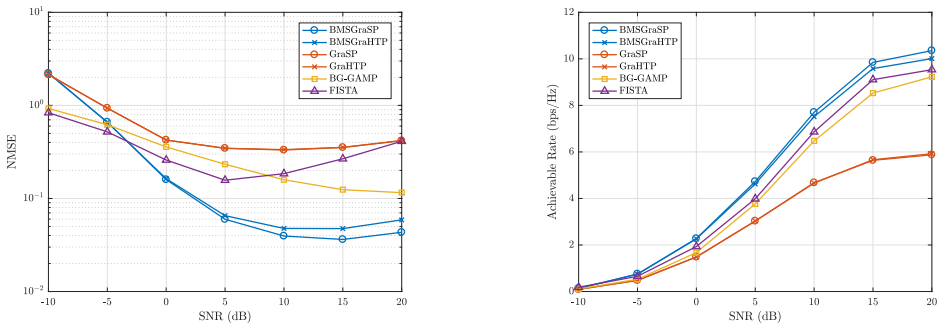
The central claim, on the paper's own terms, is that coherence-aware hard thresholding repairs gradient pursuit algorithms under ill-conditioned objective functions. Specifically, when the dictionary columns are highly coherent, the standard best-L-term approximation of the gradient selects many spurious support indices that are not true channel path locations because their gradient values approximately match those of a true band maximum. The BMS technique selects only indices whose gradient magnitude exceeds every other index in their η-coherence band, calling the discarded ones by-products. Applied to GraSP and GraHTP, this yields BMSGraSP and BMSGraHTP, which recover sparse virtual channels with dictionaries oversampled to reduce leakage, and the paper reports that they outperform GAMP and other baselines in normalized MSE and achievable-rate lower bound.
Load-bearing premise
The method rests on the unproved Conjecture 1 that gradient values at highly coherent dictionary indices are nearly equal whenever the current coefficient estimates are equal; if that approximate equality fails on real dictionaries, the band-maximum criterion may discard true support indices.
Editorial extensions
If this is right
- BMSGraSP and BMSGraHTP can use much finer angular grids ($B_{\mathrm{RX}} = B_{\mathrm{TX}} = 256$ for 64-element arrays) without diverging, reducing leakage and improving NMSE relative to GraSP, GraHTP, and BG-GAMP, which are forced to coarser grids.
- The BMS thresholder turns support identification into a band-maximum selection problem, so joint AoA/AoD estimation is more robust to dictionary coherence than best-L-term thresholding.
- All the compared estimators degrade in high SNR because one-bit quantization discards magnitude information ($x^*$ and $cx^*$ are indistinguishable), and the paper notes dithering as a possible remedy but does not implement it.
- Per-iteration complexity is dominated by computing $\nabla h$, which can be implemented with FFTs when the training matrix has an FFT-friendly structure such as circularly shifted Zadoff-Chu sequences.
Reading between the lines
- If Conjecture 1 holds generally, the BMS idea extends beyond DFT dictionaries: any highly coherent frame with a meaningful coherence-band structure could stabilize gradient pursuit with band-maximum thresholding, though the choice of $\eta$ would need adaptation.
- The paper leaves open a rigorous guarantee; a natural testable extension is to prove support recovery under a coherence-band condition, replacing the conjecture with a theorem.
- The high-SNR scale ambiguity suggests combining BMS with dithering or adaptive one-bit thresholds could recover magnitude information and extend the reported gains into the high-SNR regime.
- The heuristic choice of $\eta$ via $\min_i |\mathcal{B}_\eta(i)| > 1$ could be replaced by a data-driven or gradient-statistics-based rule, which might improve robustness across array sizes and SNRs.
Signed reviews
Editorial analysis
A structured set of objections, weighed in public.
Referee Report
Summary. This paper considers channel estimation for mmWave massive MIMO systems with one-bit ADCs. The authors formulate the MAP estimation problem as a sparsity-constrained optimization, adopt the gradient pursuit algorithms GraSP and GraHTP, and propose replacing the conventional best-L-term hard thresholding with a 'band maximum selecting' (BMS) thresholder. The BMS thresholder uses coherence bands B_η(i) and keeps only indices whose gradient magnitude is maximal within their band, based on Conjecture 1 that gradient entries are approximately equal for coherent indices with equal current estimates. The resulting BMSGraSP and BMSGraHTP algorithms are evaluated by simulation for M=N=64, T=80, L=4, showing NMSE and achievable-rate gains over GraSP, GraHTP, BG-GAMP, and FISTA. The proposal is motivated by the breakdown of standard gradient pursuit methods when the sensing matrix is ill-conditioned due to oversampled DFT dictionaries.
Significance. If the empirical claims hold, the paper contributes a practical algorithmic modification that allows gradient pursuit methods to operate with highly oversampled DFT dictionaries in one-bit massive MIMO, and the FFT-based complexity discussion in Remark 2 is useful. The authors are explicit about the central assumption: Conjecture 1 is the load-bearing step, and the η selection rule is stated. The paper does not include code, machine-checked proofs, or statistical error bars; its contribution rests on the credibility of the unproved conjecture and on the fairness of the comparison. Strengths include a clear problem formulation, concrete algorithmic descriptions, and an implementation-oriented complexity discussion. The paper is likely of interest to the signal-processing community, but the central claim requires stronger support before publication.
major comments (4)
- [Section III, Conjecture 1] Conjecture 1 states that ∇h(x_i) ≈ ∇h(x_j) whenever j ∈ B_η(i) and x_i = x_j, but no error bound, no dependence on ρ, T, L, dictionary oversampling, or the one-bit likelihood is provided. Algorithm 1 uses exactly this approximation to discard non-maximal gradient entries. The authors should provide a quantitative bound or, at minimum, a numerical validation that the approximation holds for the dictionaries and η values used in Section IV; without this, there is no guarantee that true support indices are not discarded by the BMS criterion.
- [Section IV, Figs. 1 and 2] The comparison is asymmetric: BMSGraSP and BMSGraHTP use B_RX = B_TX = 256, while GraSP, GraHTP, and BG-GAMP are restricted to B_RX = B_TX = 64 because of an asserted divergence when the sensing matrix is ill-conditioned. The reported gains could therefore be due to reduced leakage at higher dictionary resolution rather than to the BMS technique itself. The authors should include same-dictionary control experiments (e.g., BMS at 64×64, and baselines at 256×256 wherever they do not diverge), report the divergence point explicitly, or otherwise separate the effects of dictionary resolution and the BMS thresholder.
- [Section IV, Eq. (28)] The choice of η via min_i |B_η(i)| > 1 only ensures that every coherence band is nonempty; it does not ensure that the approximation in Conjecture 1 holds with any controlled error. The authors should specify the actual η values used in the simulations and show the sensitivity of the results to η. As written, the configuration of a key hyperparameter is ad hoc and may not realize the condition on which the BMS criterion relies.
- [Section IV and Algorithm 1] Only a single simulation configuration (M=N=64, T=80, L=4) is reported, with no number of Monte Carlo trials or error bars. The manuscript should report the number of random channel realizations and include confidence intervals or standard deviations, and should demonstrate performance over at least a few dictionary oversampling factors and path numbers. In addition, Algorithm 1 can terminate with |S| < L if fewer than L indices satisfy the band-maximum criterion; the consequences for the support size in Algorithms 2 and 3 and for the resulting estimator are not discussed.
minor comments (5)
- [Throughout] There are several typographical and spacing artifacts (e.g., 'In this paper ,', 'estimat e') that should be corrected in a copyedit pass.
- [Algorithm 1] The while loop may exhaust the index set before reaching L selected indices; the behavior of the thresholder in this case should be stated explicitly, along with its effect on the support size used by Algorithms 2 and 3.
- [Figure captions 1 and 2] The captions say 'BRX and BTX vary from algorithm to algorithm' but do not give the exact values; a table listing B_RX, B_TX, and η for each algorithm would make the comparison transparent.
- [Equation (19)] The notation λ(·) is defined both as a scalar function and as an element-wise function; the distinction should be made clearer when first introducing the element-wise operation.
- [Section IV, high-SNR discussion] The side note about the high-SNR degradation in Eq. (30) is helpful, but it should be connected explicitly to the observed trends in Fig. 1, since the authors claim all algorithms degrade at high SNR while the figure shows the proposed methods still outperform baselines.
Circularity Check
No significant circularity: the BMS thresholder is an unproved heuristic, but no target quantity is fitted and then reported as a prediction.
full rationale
The derivation chain is self-contained against the paper's own claims. The MAP objective (13) uses the standard one-bit log-likelihood (12) cited from [17]; that formula is an input model, not a consequence of the proposed BMS thresholder, and it does not contain the claimed outcome that BMSGraSP/BMSGraHTP outperform other estimators. The parameter eta is selected in (28) purely from dictionary coherence geometry via min_i |B_eta(i)| > 1, not by fitting to NMSE curves or to the reported gains. The central novelty is Algorithm 1, whose band-maximum criterion is justified by Conjecture 1; even though the conjecture is unquantified and the eta rule is ad hoc, asserting an approximate-equality heuristic is not equivalent to assuming the empirical performance advantage. The simulated NMSE (Fig. 1) and achievable rate lower bound (Fig. 2) are direct evaluations against ground-truth channels, with comparison algorithms using their own standard settings and hyperparameters, so no equation reduces by construction to its inputs. The self-citations [17] and [12] supply the likelihood function and the rate lower bound respectively; both are externally published ingredients with independent content, not self-fulfilling outputs of the present paper.
Assumptions & free parameters
free parameters (2)
- Sparsity level L =
4
- Coherence threshold η =
largest value satisfying min_i |B_η(i)| > 1
assumptions (4)
- domain assumption The virtual channel x* is L-sparse with i.i.d. CN(0,1) entries whose support is uniform over {1,...,B}.
- ad hoc to paper For sufficiently large η, ∇h(x_i) ≈ ∇h(x_j) whenever j ∈ B_η(i) and x_i = x_j (Conjecture 1).
- standard math The objective h(x) is concave, so support-restricted maximization and line search are tractable.
- domain assumption Increasing BRX and BTX reduces leakage but also increases column coherence, and BMS prevents the resulting breakdown.
Cite this review
Pith. "Pith review of Gradient Pursuit-Based Channel Estimation for MmWave Massive MIMO Systems with One-Bit ADCs." pith.science (2026). https://pith.science/paper/JH7LKR7N
@misc{pith2026190800508,
  author       = {Pith},
  title        = {Pith review of: Gradient Pursuit-Based Channel Estimation for MmWave Massive MIMO Systems with One-Bit ADCs},
  year         = {2026},
  howpublished = {\url{https://pith.science/paper/JH7LKR7N}},
  note         = {Machine review of arXiv:1908.00508}
}
read the original abstract
In this paper, channel estimation for millimeter wave (mmWave) massive multiple-input multiple-output (MIMO) systems with one-bit analog-to-digital converters (ADCs) is considered. In the mmWave band, the number of propagation paths is small, which results in sparse virtual channels. To estimate sparse virtual channels based on the maximum a posteriori (MAP) criterion, sparsity-constrained optimization comes into play. In general, optimizing objective functions with sparsity constraints is NP-hard because of their combinatorial complexity. Furthermore, the coarse quantization of one-bit ADCs makes channel estimation a challenging task. In the field of compressed sensing (CS), the gradient support pursuit (GraSP) and gradient hard thresholding pursuit (GraHTP) algorithms were proposed to approximately solve sparsity-constrained optimization problems iteratively by pursuing the gradient of the objective function via hard thresholding. The accuracy guarantee of these algorithms, however, breaks down when the objective function is ill-conditioned, which frequently occurs in the mmWave band. To prevent the breakdown of gradient pursuit-based algorithms, the band maximum selecting (BMS) technique, which is a hard thresholder selecting only the "band maxima," is applied to GraSP and GraHTP to propose the BMSGraSP and BMSGraHTP algorithms in this paper.
Figures
Reference graph
Works this paper leans on
-
[1]
Millimeter-wave massive MIMO: the next wireless revoluti on?
A. L. Swindlehurst, E. Ayanoglu, P . Heydari, and F. Capol ino, “Millimeter-wave massive MIMO: the next wireless revoluti on?” IEEE Communications Magazine , vol. 52, no. 9, pp. 56–62, Sept. 2014
work page 2014
-
[2]
Millimeter wave mobile communications for 5G cellular: it will work!
T. S. Rappaport, S. Sun, R. Mayzus, H. Zhao, Y . Azar, K. Wan g, G. N. Wong, J. K. Schulz, M. Samimi, and F. Gutierrez, “Millimeter wave mobile communications for 5G cellular: it will work!” IEEE Access , vol. 1, pp. 335–349, 2013
work page 2013
-
[3]
Five disruptive technology directions for 5G,
F. Boccardi, R. W. Heath, A. Lozano, T. L. Marzetta, and P . Popovski, “Five disruptive technology directions for 5G,” IEEE Communications Magazine, vol. 52, no. 2, pp. 74–80, Feb. 2014
work page 2014
-
[4]
Millimeter-wa ve cellular wireless networks: potentials and challenges,
S. Rangan, T. S. Rappaport, and E. Erkip, “Millimeter-wa ve cellular wireless networks: potentials and challenges,” Proceedings of the IEEE , vol. 102, no. 3, pp. 366–385, Mar. 2014
work page 2014
-
[5]
Analog -to-digital converters,
B. Le, T. W. Rondeau, J. H. Reed, and C. W. Bostian, “Analog -to-digital converters,” IEEE Signal Processing Magazine , vol. 22, no. 6, pp. 69–77, Nov. 2005
work page 2005
-
[6]
Uplin k performance of wideband massive MIMO with one-bit ADCs,
C. Moll´ en, J. Choi, E. G. Larsson, and R. W. Heath, “Uplin k performance of wideband massive MIMO with one-bit ADCs,” IEEE Transactions on Wireless Communications, vol. 16, no. 1, pp. 87–100, Jan. 2017
work page 2017
-
[7]
Uplink achievable ra te for mas- sive MIMO systems with low-resolution ADC,
L. Fan, S. Jin, C. Wen, and H. Zhang, “Uplink achievable ra te for mas- sive MIMO systems with low-resolution ADC,” IEEE Communications Letters, vol. 19, no. 12, pp. 2186–2189, Dec. 2015
work page 2015
-
[8]
On the spectral effic iency of massive MIMO systems with low-resolution ADCs,
J. Zhang, L. Dai, S. Sun, and Z. Wang, “On the spectral effic iency of massive MIMO systems with low-resolution ADCs,” IEEE Communica- tions Letters , vol. 20, no. 5, pp. 842–845, May 2016
work page 2016
Show all 29 references
-
[9]
Throughput analysis of massive MIMO uplink with low-resol ution ADCs,
S. Jacobsson, G. Durisi, M. Coldrey, U. Gustavsson, and C . Studer, “Throughput analysis of massive MIMO uplink with low-resol ution ADCs,” IEEE Transactions on Wireless Communications , vol. 16, no. 6, pp. 4038–4051, Jun. 2017
2017
-
[10]
Bayesian channel estima tion algo- rithms for massive MIMO systems with hybrid analog-digital processing and low-resolution ADCs,
Y . Ding, S. Chiu, and B. D. Rao, “Bayesian channel estima tion algo- rithms for massive MIMO systems with hybrid analog-digital processing and low-resolution ADCs,” IEEE Journal of Selected Topics in Signal Processing, vol. 12, no. 3, pp. 499–513, Jun. 2018
2018
-
[11]
Bayesian optimal data detecto r for hybrid mmWave MIMO-OFDM systems with low-resolution ADCs,
H. He, C. Wen, and S. Jin, “Bayesian optimal data detecto r for hybrid mmWave MIMO-OFDM systems with low-resolution ADCs,” IEEE Journal of Selected Topics in Signal Processing , vol. 12, no. 3, pp. 469– 483, Jun. 2018
2018
-
[12]
Channel estimation in broadband millimeter wave MIMO systems with few-bit ADCs,
J. Mo, P . Schniter, and R. W. Heath, “Channel estimation in broadband millimeter wave MIMO systems with few-bit ADCs,” IEEE Transactions on Signal Processing , vol. 66, no. 5, pp. 1141–1154, Mar. 2018
2018
-
[13]
Greedy sparsit y-constrained optimization,
S. Bahmani, B. Raj, and P . T. Boufounos, “Greedy sparsit y-constrained optimization,” Journal of Machine Learning Research , vol. 14, no. Mar, pp. 807–841, 2013
2013
-
[14]
Gradient hard threshol ding pursuit
X.-T. Y uan, P . Li, and T. Zhang, “Gradient hard threshol ding pursuit.” Journal of Machine Learning Research , vol. 18, pp. 166–1, 2017
2017
-
[15]
3D mmWave channel model proposal,
T. A. Thomas, H. C. Nguyen, G. R. MacCartney, and T. S. Rap paport, “3D mmWave channel model proposal,” in 2014 IEEE 80th V ehicular Technology Conference (VTC2014-Fall), Sept. 2014, pp. 1–6
2014
-
[16]
Deconstructing multiantenna fading cha nnels,
A. M. Sayeed, “Deconstructing multiantenna fading cha nnels,” IEEE Transactions on Signal Processing , vol. 50, no. 10, pp. 2563–2579, Oct. 2002
2002
-
[17]
Near maximum-likelihoo d detector and channel estimator for uplink multiuser massive MIMO sys tems with one-bit ADCs,
J. Choi, J. Mo, and R. W. Heath, “Near maximum-likelihoo d detector and channel estimator for uplink multiuser massive MIMO sys tems with one-bit ADCs,” IEEE Transactions on Communications , vol. 64, no. 5, pp. 2005–2018, May 2016
2005
-
[18]
Chann el estimation in millimeter wave MIMO systems with one-bit quantization,
J. Mo, P . Schniter, N. G. Prelcic, and R. W. Heath, “Chann el estimation in millimeter wave MIMO systems with one-bit quantization,” i n 2014 48th Asilomar Conference on Signals, Systems and Computers , Nov. 2014, pp. 957–961
2014
-
[19]
CoSaMP: iterative signal re covery from in- complete and inaccurate samples,
D. Needell and J. A. Tropp, “CoSaMP: iterative signal re covery from in- complete and inaccurate samples,” Applied and computational harmonic analysis, vol. 26, no. 3, pp. 301–321, 2009
2009
-
[20]
Hard thresholding pursuit: an algorithm f or compressive sensing,
S. Foucart, “Hard thresholding pursuit: an algorithm f or compressive sensing,” SIAM Journal on Numerical Analysis , vol. 49, no. 6, pp. 2543– 2563, 2011
2011
-
[21]
Boyd and L
S. Boyd and L. V andenberghe, Convex optimization . Cambridge university press, 2004
2004
-
[22]
Coherence pattern–guided co mpressive sensing with unresolved grids,
A. Fannjiang and W. Liao, “Coherence pattern–guided co mpressive sensing with unresolved grids,” SIAM Journal on Imaging Sciences , vol. 5, no. 1, pp. 179–202, 2012
2012
-
[23]
MIMO broadcast channels with finite rate fee dback,
N. Jindal, “MIMO broadcast channels with finite rate fee dback,” in GLOBECOM ’05. IEEE Global Telecommunications Conference, 2005., vol. 3, Nov. 2005, pp. 5 pp.–
2005
-
[24]
Asymmetric LSH (ALSH) for sub linear time maximum inner product search (MIPS),
A. Shrivastava and P . Li, “Asymmetric LSH (ALSH) for sub linear time maximum inner product search (MIPS),” in Advances in Neural Information Processing Systems , 2014, pp. 2321–2329
2014
-
[25]
Polyphase codes with good periodic correlatio n properties (Corresp.),
D. Chu, “Polyphase codes with good periodic correlatio n properties (Corresp.),” IEEE Transactions on Information Theory , vol. 18, no. 4, pp. 531–532, Jul. 1972
1972
-
[26]
A fast iterative shrinkage-th resholding algo- rithm for linear inverse problems,
A. Beck and M. Teboulle, “A fast iterative shrinkage-th resholding algo- rithm for linear inverse problems,” SIAM journal on imaging sciences , vol. 2, no. 1, pp. 183–202, 2009
2009
-
[27]
Regression shrinkage and selection vi a the lasso,
R. Tibshirani, “Regression shrinkage and selection vi a the lasso,” Journal of the Royal Statistical Society. Series B (Methodological ), pp. 267–288, 1996
1996
-
[28]
Mixed-ADC massive MIMO,
N. Liang and W. Zhang, “Mixed-ADC massive MIMO,” IEEE Journal on Selected Areas in Communications , vol. 34, no. 4, pp. 983–997, Apr. 2016
2016
-
[29]
Crosscorrelation functions of amplit ude-distorted Gaus- sian signals,
J. J. Bussgang, “Crosscorrelation functions of amplit ude-distorted Gaus- sian signals,” 1952
1952
Reviewed August 14, 2026 · model on record in the stance chip above.
Discussion (0). Continue with ORCID to comment.