REVIEW 4 major objections 6 minor 36 references
SubstationAI: Multimodal Large Model-Based Approaches for Analyzing Substation Equipment Faults
T0 review · 4 major / 6 minor · reviewed 2026-08-11 · deepseek-v4-flash
Pith's one-line read SubstationAI, a LoRA-fine-tuned 7B multimodal model with a substation fault-knowledge base, outscores GPT-4 and every other tested baseline on expert ratings of fault analysis reports.
desk verdict A reasonable engineering pipeline for substation fault report generation, but the headline superiority claim over GPT-4 is uninterpretable because the benchmark is drawn from the same dataset used for training, with no stated hold-out split. read the letter →
The pith
A machine-rendered reading of the paper's core claim, the machinery that carries it, and where it could break.
The reading
What carries the argument
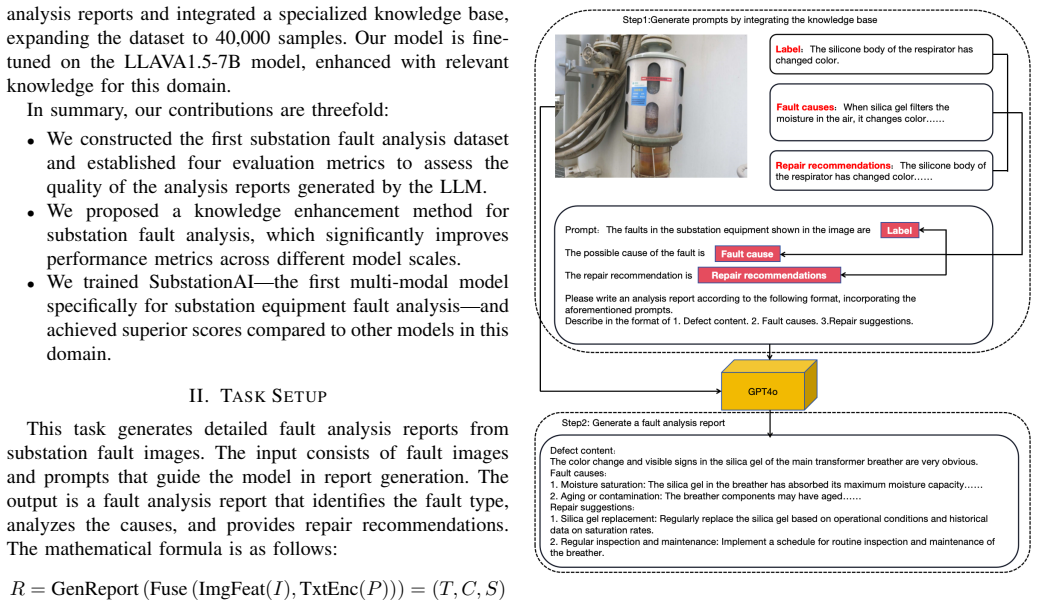
The load-bearing mechanism is the knowledge-enhanced report generator. Formally, the task is $R = \mathrm{GenReport}(\mathrm{Fuse}(\mathrm{ImgFeat}(I), \mathrm{TxtEnc}(P))) = (T, C, S)$, where $T$ is fault type, $C$ is cause analysis, and $S$ is repair suggestions. In practice, the mechanism is a two-stage pipeline: a BERT-based keyword extractor identifies salient terms from the model's initial description, then a retrieval step ranks knowledge-base entries by relevance and injects the top-scoring points into the prompt before final generation. The knowledge base itself is derived from the equipment-condition assessment guidelines, so the model is not left to improvise repair advice. Data augmentation via an image-to-video generator with screenshots expands the raw 10,330 images to 40,000 samples, and LoRA fine-tuning of the base model adapts visual and language features to that dataset. The four-metric scoring protocol, accuracy, clarity, completeness, and practicality, is what makes the improvement measurable.
What would settle it
A concrete test: verify by image-hash matching that none of the 1,000 benchmark images appears in the fine-tuning set, then have five engineers, blind to model identity, re-rate SubstationAI and GPT-4 on those images; if SubstationAI no longer leads on all four metrics, the claimed superiority is an artifact of training-set overlap.
Extended reading notes
Core claim
The paper's central claim is that domain-specific data and knowledge retrieval, not model scale, drive report quality in this setting. Starting from LLaVA1.5-7B, the authors apply LoRA fine-tuning on 40,000 image-report pairs and couple it with a knowledge-enhancement module: the model drafts an initial description, a BERT-based extractor pulls key terms, a search over a substation fault-diagnosis knowledge base returns the highest-scoring points, and those points are folded into the final generation. The resulting reports decompose into fault type, cause analysis, and repair suggestions. In the paper's evaluation, SubstationAI receives mean expert scores of 4.32, 4.11, 4.41, and 4.27 for accuracy, clarity, completeness, and practicality, with an average of 4.28, while GPT-4 averages 3.35 and Claude-3 averages 3.38; the ablation shows that supervised fine-tuning plus knowledge enhancement beats supervised fine-tuning alone.
Load-bearing premise
The 1,000 benchmark samples were selected from the same 40,000-image dataset used to fine-tune SubstationAI, and the paper does not say they were held out of training, so the reported advantage over GPT-4 could reflect memorization rather than generalization.
Editorial extensions
If this is right
- A utility engineer could photograph a damaged transformer breather and receive a structured report stating the fault type, the likely cause, and concrete repair steps rather than a generic alert.
- The four-metric expert-rating scheme gives maintenance organizations a domain-specific way to evaluate AI-generated fault reports, replacing text metrics such as BLEU and ROUGE that the paper argues do not capture electrical-engineering quality.
- Because the winning model is built on an open 7B base and trained with LoRA on three consumer GPUs, the approach is replicable by utilities that cannot send substation images to a closed API.
- The ablation result implies the knowledge base is doing real work: adding it to supervised fine-tuning raises the average score from 3.58 to 4.28, while replacing it with zero-shot chain-of-thought yields only 3.68.
Reading between the lines
- The decisive caveat: the 1,000 benchmark samples were randomly drawn from the same 40,000-image pool used for fine-tuning, and the paper never states that they were excluded from training. If they were not, the 4.28-versus-3.35 gap is an upper bound and the true generalization gap is unknown.
- A fair re-test should use a held-out set from a different substation or a different season of images, with raters blind to which model produced each report; this would separate memorization of training images from genuine visual reasoning.
- The same recipe of LoRA fine-tuning plus retrieval over an equipment-guideline knowledge base should transfer to adjacent inspection tasks such as transmission-line or cable-joint faults, since those domains also have guideline texts and image-labeled defect data.
- The image-to-video augmentation creates new camera angles, not new fault types; a stress test with genuinely novel fault classes would show whether the advantage is about recognizing known defects or about reasoning from visual evidence.
Editorial analysis
A structured set of objections, weighed in public.
Referee Report
Summary. The paper introduces SubstationAI, a multimodal large language model for substation equipment fault analysis. The authors construct a 40,000-entry dataset by expanding 10,330 substation defect images with EasyAnimate video frames, use GPT-4 (with expert correction) to generate fault-analysis reports, fine-tune LLaVA-1.5-7B with LoRA, and add a knowledge-enhancement retrieval step. They define four qualitative report-quality metrics (accuracy, clarity, completeness, practicality) and compare SubstationAI against six baselines including GPT-4 and Claude-3, reporting that SubstationAI achieves the highest scores on all metrics. Ablation experiments attribute most of the gain to supervised fine-tuning (SFT) with further improvement from knowledge enhancement.
Significance. If substantiated, the paper would provide a useful domain-specific resource: a substation fault analysis dataset, a dedicated knowledge base, and a fine-tuned open-source MLLM with a practical application. The authors also introduce a four-dimensional report evaluation scheme and an ablation study, which are constructive methodological elements. However, the central superiority claim is currently unsupported because the evaluation does not establish a held-out split, the human rating protocol lacks essential controls, and the training targets are GPT-4-derived, making the comparison against GPT-4 partly a measure of imitation. The contribution is potentially valuable, but the experimental evidence must be reworked before the claims can be accepted.
major comments (4)
- [§V.A–§V.B, Table I] The benchmark is contaminated by the training set. Section V.A states that LoRA fine-tuning was performed "on the constructed dataset," and Section V.B states that "a total of 1,000 samples were randomly selected from the dataset as benchmark data," but the paper never states that these 1,000 samples were excluded from training. Because the 40,000 images were produced by expanding 10,330 source images with EasyAnimate frames (Section III.B), random selection from the 40,000 images very likely includes frames derived from the same source images as training frames, so exact or near-duplicate overlap is probable. Under these conditions, the large margins in Table I (e.g., 4.28 vs. 3.35 average) can be explained by memorization rather than generalization. The authors must specify the train/benchmark split, verify that no benchmark sample overlaps the training set, and if overlap exists, rerun the experiments on a truly held-out set.
- [§V.B, Table I] The human evaluation protocol is not described with enough rigor to support the claim that SubstationAI "significantly outperforms" other models. The paper does not state whether the five engineers were blinded to model identity, whether they rated reports independently, whether each engineer rated every model on every image, or how disagreements were resolved. No inter-rater reliability measure (e.g., Cohen's kappa, Krippendorff's alpha, or intraclass correlation) is reported, and the scores in Table I are given to two decimals without variances, confidence intervals, or significance tests. The authors should report the full rating protocol and quantitative agreement statistics.
- [§III.B, §V.C] There is a partial circularity in comparing SubstationAI against GPT-4. The training reports were generated by GPT-4 and then corrected by five electrical experts (Section III.B), so SubstationAI is optimized to produce GPT-4-like report text. The comparison in Table I therefore partly measures how well SubstationAI imitates its own training target's style rather than independent domain competence. The authors should quantify how much of the final report text was altered by expert correction, or provide an evaluation on independently authored expert reports, or at minimum discuss this limitation explicitly when interpreting the comparison.
- [§V.B, Table I] The claim of "significant" superiority lacks statistical support. With five raters and 1,000 samples, the ~0.9-point average difference in Table I could reflect systematic rater effects, model order, or noise; no significance tests, effect-size intervals, or adjustment for multiple comparisons are provided. The ablation results in Table II face the same issue. The authors should report standard errors or confidence intervals and perform appropriate significance tests (e.g., paired comparisons per sample, mixed-effects models treating raters as random effects).
minor comments (6)
- [§II] The sentence following the formula reads "In this formula,Here, R represents..." which is a typographical error and should be corrected.
- [§V.D, Table II] The table title says "BLATION EXPERIMENT" instead of "ABLATION EXPERIMENT," and the sentence "The resultsII, as shown in Table 2" is garbled; also "COT" and "SFT-COT" in Table II are not clearly linked to the "Zero-shot-CoT" described in the text.
- [§III.B] The paper says the dataset contains "40,000 entries, including images, defect labels, and analysis reports" (abstract) but later says "This process increased the dataset to 40,000 images" (Section III.B); the authors should clarify whether the 40,000 images correspond one-to-one with 40,000 reports and labels.
- [§I] The Index Terms line contains the placeholder text "component, formatting, style, styling, insert" and should be replaced with actual keywords.
- [References] Some references are incomplete or informal: [21] and [22] give only a title and year without venue or institutional identifier, [32] lists "Q. team" as an author, and several entries lack page numbers or DOIs; these should be formatted consistently.
- [§IV.A] The knowledge-enhancement method uses "BERT-based keyword extraction" but does not specify which BERT variant or tokenizer is used, whether it is fine-tuned, or how the retrieval score is computed; adding these details would improve reproducibility.
Circularity Check
The headline superiority claim is evaluated on a benchmark sampled from the model's own training set, so the reported margin over GPT-4 reduces to in-distribution memorization unless a hold-out split is documented.
-
fitted input called prediction
[Section V.A and V.B (Experimental Setups; Baselines)]
"For this model, we conducted LoRA parameter fine-tuning on the constructed dataset over a period of 60 hours. ... A total of 1,000 samples were randomly selected from the dataset as benchmark data, covering 14 common types of substation faults."
SubstationAI's LoRA parameters are fit to the constructed dataset (the 40,000-image database, Section III.B), and the benchmark is then randomly selected from that same dataset. The paper never states that the 1,000 benchmark samples were excluded from training, and because the dataset was expanded by taking EasyAnimate video frames of the same source images, even non-identical benchmark samples can be near-duplicates of training frames. The reported 'prediction' that SubstationAI significantly outperforms GPT-4 (4.28 vs. 3.35 average) is therefore not an out-of-sample claim; it is an evaluation on the training distribution, so the performance gap can be produced by memorization rather than by the model's domain analysis ability.
full rationale
The central empirical claim is Section V.C: SubstationAI scores 4.32/4.11/4.41/4.27 and significantly outperforms GPT-4 and Claude-3. The derivation chain for that claim is: construct a 40,000-image dataset with GPT-4-generated, expert-corrected reports; fine-tune LLaVA1.5-7B on it; then randomly select 1,000 samples 'from the dataset' as benchmark data. Because V.A says fine-tuning was performed on 'the constructed dataset' and V.B draws the benchmark from the same dataset without any stated hold-out split, the benchmark and training set are not shown to be disjoint. Given that the 40,000 images are generated from 10,330 source images by EasyAnimate frame extraction, exact or near-duplicate overlap is likely. Under overlap, the comparison against zero-shot GPT-4 is not a test of generalization: the model has seen the benchmark distribution during training, so the reported superiority is explainable by memorization. The additional fact that the training reports themselves were generated by GPT-4 (then expert-corrected) reinforces the concern: SubstationAI is optimized toward the same report style used to seed the training target, so beating zero-shot GPT-4 on the same distribution is an expected consequence of fine-tuning. This is a partial circularity of the evaluation, not a definitional identity, and it is not resolved by any limitation section or hold-out statement. The rest of the paper (knowledge base construction, augmentation, and the evaluation metric design) has independent content and is not self-citation-dependent.
Assumptions & free parameters
free parameters (6)
- LoRA rank =
64
- LoRA alpha =
16
- LoRA dropout =
0.05
- Learning rate =
1e-4
- Training epochs =
20
- Batch size =
10
assumptions (6)
- domain assumption The source dataset's 10,330 images and 14 fault-type annotations are accurate and representative.
- domain assumption The State Grid guidelines provide authoritative fault cause and repair information.
- domain assumption GPT-4-generated reports, after expert review, are valid ground truth for fault analysis.
- ad hoc to paper EasyAnimate-generated videos and screenshots preserve fault-relevant visual features.
- domain assumption The 1,000 benchmark samples are representative and independent of the training set.
- domain assumption Human expert ratings are reliable and unbiased.
Cite this review
Pith. "Pith review of SubstationAI: Multimodal Large Model-Based Approaches for Analyzing Substation Equipment Faults." pith.science (2026). https://pith.science/paper/JH7RY7MD
@misc{pith2026241217077,
  author       = {Pith},
  title        = {Pith review of: SubstationAI: Multimodal Large Model-Based Approaches for Analyzing Substation Equipment Faults},
  year         = {2026},
  howpublished = {\url{https://pith.science/paper/JH7RY7MD}},
  note         = {Machine review of arXiv:2412.17077}
}
read the original abstract
The reliability of substation equipment is crucial to the stability of power systems, but traditional fault analysis methods heavily rely on manual expertise, limiting their effectiveness in handling complex and large-scale data. This paper proposes a substation equipment fault analysis method based on a multimodal large language model (MLLM). We developed a database containing 40,000 entries, including images, defect labels, and analysis reports, and used an image-to-video generation model for data augmentation. Detailed fault analysis reports were generated using GPT-4. Based on this database, we developed SubstationAI, the first model dedicated to substation fault analysis, and designed a fault diagnosis knowledge base along with knowledge enhancement methods. Experimental results show that SubstationAI significantly outperforms existing models, such as GPT-4, across various evaluation metrics, demonstrating higher accuracy and practicality in fault cause analysis, repair suggestions, and preventive measures, providing a more advanced solution for substation equipment fault analysis.
Figures


Reference graph
Works this paper leans on
-
[1]
Intelligent detection method for substation insulator defects based on centermask,
B. Ye, F. Li, M. Li, P. Yan, H. Yang, and L. Wang, “Intelligent detection method for substation insulator defects based on centermask,” Frontiers in Energy Research, vol. 10, Aug. 2022. [Online]. Available: http://dx.doi.org/10.3389/fenrg.2022.985600
-
[2]
Dynamic Fault Analysis in Substations Based on Knowledge Graphs
W. Li, X. Liu, W. Wang, L. Chen, S. Li, and H. Fan, “Dynamic fault analysis in substations based on knowledge graphs,” 2024. [Online]. Available: https://arxiv.org/abs/2311.13708
work page Pith review arXiv 2024
-
[3]
Artificial intelligence approaches to fault diagnosis in power grids: A review,
E. Chai, P. Zeng, S. Ma, H. Xing, and B. Zhao, “Artificial intelligence approaches to fault diagnosis in power grids: A review,” in 2019 Chinese Control Conference (CCC). IEEE, 2019, pp. 7346–7353
work page 2019
-
[4]
OpenAI, J. Achiam, S. Adler, S. Agarwal, L. Ahmad, and I. A. al., “Gpt-4 technical report,” 2024
work page 2024
-
[5]
Coca: Contrastive captioners are image-text foundation models,
J. Yu, Z. Wang, V . Vasudevan, L. Yeung, M. Seyedhosseini, and Y . Wu, “Coca: Contrastive captioners are image-text foundation models,” 2022. [Online]. Available: https://arxiv.org/abs/2205.01917
arXiv 2022
-
[6]
Vatt: Transformers for multimodal self-supervised learning from raw video, audio and text,
H. Akbari, L. Yuan, R. Qian, W.-H. Chuang, S.-F. Chang, Y . Cui, and B. Gong, “Vatt: Transformers for multimodal self-supervised learning from raw video, audio and text,” 2021. [Online]. Available: https://arxiv.org/abs/2104.11178
arXiv 2021
-
[7]
Learning transferable visual models from natural language supervi- sion,
A. Radford, J. W. Kim, C. Hallacy, A. Ramesh, G. Goh, S. Agarwal, G. Sastry, A. Askell, P. Mishkin, J. Clark, G. Krueger, and I. Sutskever, “Learning transferable visual models from natural language supervi- sion,” 2021. [Online]. Available: https://arxiv.org/abs/2103.00020
arXiv 2021
-
[8]
Zero-shot text-to-image generation,
A. Ramesh, M. Pavlov, G. Goh, S. Gray, C. V oss, A. Radford, M. Chen, and I. Sutskever, “Zero-shot text-to-image generation,” 2021. [Online]. Available: https://arxiv.org/abs/2102.12092
arXiv 2021
Show all 36 references
-
[9]
Transformers in time series: A survey,
Q. Wen, T. Zhou, C. Zhang, W. Chen, Z. Ma, J. Yan, and L. Sun, “Transformers in time series: A survey,” 2023. [Online]. Available: https://arxiv.org/abs/2202.07125
2023 arXiv
-
[10]
High- resolution image synthesis with latent diffusion models,
R. Rombach, A. Blattmann, D. Lorenz, P. Esser, and B. Ommer, “High- resolution image synthesis with latent diffusion models,” 2022. [Online]. Available: https://arxiv.org/abs/2112.10752
2022 arXiv
-
[11]
Glide: Towards photorealistic image gen- eration and editing with text-guided diffusion models,
A. Nichol, P. Dhariwal, A. Ramesh, P. Shyam, P. Mishkin, B. McGrew, I. Sutskever, and M. Chen, “Glide: Towards photorealistic image gen- eration and editing with text-guided diffusion models,” 2022. [Online]. Available: https://arxiv.org/abs/2112.10741
2022 arXiv
-
[12]
Lxmert: Learning cross-modality en- coder representations from transformers,
H. Tan and M. Bansal, “Lxmert: Learning cross-modality en- coder representations from transformers,” 2019. [Online]. Available: https://arxiv.org/abs/1908.07490
2019 arXiv
-
[13]
Blip: Bootstrapping language-image pre-training for unified vision-language understanding and generation,
J. Li, D. Li, C. Xiong, and S. Hoi, “Blip: Bootstrapping language-image pre-training for unified vision-language understanding and generation,”
-
[14]
Merlot: Multimodal neural script knowledge models,
R. Zellers, X. Lu, J. Hessel, Y . Yu, J. S. Park, J. Cao, A. Farhadi, and Y . Choi, “Merlot: Multimodal neural script knowledge models,” 2021. [Online]. Available: https://arxiv.org/abs/2106.02636
2021 arXiv
-
[15]
Ernie- vil: Knowledge enhanced vision-language representations through scene graph,
F. Yu, J. Tang, W. Yin, Y . Sun, H. Tian, H. Wu, and H. Wang, “Ernie- vil: Knowledge enhanced vision-language representations through scene graph,” 2021. [Online]. Available: https://arxiv.org/abs/2006.16934
2021 arXiv
-
[16]
On the opportunities and risks of foundation models,
R. Bommasani, D. A. Hudson, E. Adeli, R. Altman, S. Arora, S. von Arx, M. S. Bernstein, J. Bohg, A. Bosselut, E. Brunskill, E. Brynjolfsson, S. Buch, D. Card, R. Castellon, N. Chatterji, A. Chen, K. Creel, J. Q. Davis, D. Demszky, C. Donahue, M. Doumbouya, E. Durmus, S. Ermon,...
2022 arXiv
-
[17]
Huatuogpt, towards taming language model to be a doctor,
H. Zhang, J. Chen, F. Jiang, F. Yu, Z. Chen, J. Li, G. Chen, X. Wu, Z. Zhang, Q. Xiao, X. Wan, B. Wang, and H. Li, “Huatuogpt, towards taming language model to be a doctor,” 2023. [Online]. Available: https://arxiv.org/abs/2305.15075
2023 arXiv
-
[18]
Evaluating professional- ism in medical undergraduates using selected response questions: find- ings from an item response modelling study,
P. A. Tiffin, G. M. Finn, and J. C. McLachlan, “Evaluating professional- ism in medical undergraduates using selected response questions: find- ings from an item response modelling study,” BMC medical education, vol. 11, pp. 1–9, 2011
2011
-
[19]
Readability measures as predictors of understandability and engagement in searching to learn,
Y . Ghafourian, A. Hanbury, and P. Knoth, “Readability measures as predictors of understandability and engagement in searching to learn,” in International Conference on Theory and Practice of Digital Libraries. Springer, 2023, pp. 173–181
2023
-
[20]
A review of comprehensiveness, user-friendliness, and contribution for sustainable design of whole build- ing environmental life cycle assessment software tools,
S. Karunaratne and D. Dharmarathna, “A review of comprehensiveness, user-friendliness, and contribution for sustainable design of whole build- ing environmental life cycle assessment software tools,” Building and Environment, vol. 212, p. 108784, 2022
2022
-
[21]
Substation fault diagnosis dataset,
China Electric Power Research Institute, “Substation fault diagnosis dataset,” China Electric Power Research Institute, Beijing, 2022, publicly Released
2022
-
[22]
State Grid Corporation of China, Evaluation Guidelines for Major Power Transmission and Transformation Equipment, State Grid Corporation of China, Beijing, 2022, publicly Released
2022
-
[23]
Easyanimate: A high-performance long video generation method based on transformer architecture,
J. Xu, X. Zou, K. Huang, Y . Chen, B. Liu, M. Cheng, X. Shi, and J. Huang, “Easyanimate: A high-performance long video generation method based on transformer architecture,” 2024. [Online]. Available: https://arxiv.org/abs/2405.18991
2024
-
[24]
Training a helpful and harmless assistant with reinforcement learning from human feedback,
Y . Bai, A. Jones, K. Ndousse, A. Askell, A. Chen, N. DasSarma, D. Drain, S. Fort, D. Ganguli, T. Henighan, N. Joseph, S. Kadavath, J. Kernion, T. Conerly, S. El-Showk, N. Elhage, Z. Hatfield-Dodds, D. Hernandez, T. Hume, S. Johnston, S. Kravec, L. Lovitt, N. Nanda, C. Olsson,...
2022 arXiv
-
[25]
Fine-tuning language models from human preferences,
D. M. Ziegler, N. Stiennon, J. Wu, T. B. Brown, A. Radford, D. Amodei, P. Christiano, and G. Irving, “Fine-tuning language models from human preferences,” arXiv preprint arXiv:1909.08593, 2019
1909 arXiv
-
[26]
A general language assistant as a laboratory for alignment,
A. Askell, Y . Bai, A. Chen, D. Drain, D. Ganguli, T. Henighan, A. Jones, N. Joseph, B. Mann, N. DasSarma et al., “A general language assistant as a laboratory for alignment,” arXiv preprint arXiv:2112.00861, 2021
2021 arXiv
-
[27]
Visual instruction tuning,
H. Liu, C. Li, Q. Wu, and Y . J. Lee, “Visual instruction tuning,” 2023. [Online]. Available: https://arxiv.org/abs/2304.08485
2023 arXiv
-
[28]
Improved baselines with visual instruction tuning,
H. Liu, C. Li, Y . Li, and Y . J. Lee, “Improved baselines with visual instruction tuning,” 2024. [Online]. Available: https://arxiv.org/abs/2310.03744
2024 arXiv
-
[29]
Glm: General language model pretraining with autoregressive blank infilling,
Z. Du, Y . Qian, X. Liu, M. Ding, J. Qiu, Z. Yang, and J. Tang, “Glm: General language model pretraining with autoregressive blank infilling,” in Proceedings of the 60th Annual Meeting of the Association for Computational Linguistics (V olume 1: Long Papers), 2022, pp. 320– 335
2022
-
[30]
Cogview: Mastering text-to-image generation via transformers,
M. Ding, Z. Yang, W. Hong, W. Zheng, C. Zhou, D. Yin, J. Lin, X. Zou, Z. Shao, H. Yang et al., “Cogview: Mastering text-to-image generation via transformers,” Advances in Neural Information Processing Systems, vol. 34, pp. 19 822–19 835, 2021
2021
-
[31]
Qwen-vl: A versatile vision-language model for un- derstanding, localization, text reading, and beyond,
J. Bai, S. Bai, S. Yang, S. Wang, S. Tan, P. Wang, J. Lin, C. Zhou, and J. Zhou, “Qwen-vl: A versatile vision-language model for un- derstanding, localization, text reading, and beyond,” arXiv preprint arXiv:2308.12966, 2023
2023 arXiv
-
[32]
Qwen2-vl,
Q. team, “Qwen2-vl,” 2024
2024
-
[33]
Minigpt-v2: large language model as a unified interface for vision-language multi-task learning,
J. Chen, D. Zhu, X. Shen, X. Li, Z. Liu, P. Zhang, R. Krishnamoorthi, V . Chandra, Y . Xiong, and M. Elhoseiny, “Minigpt-v2: large language model as a unified interface for vision-language multi-task learning,” arXiv preprint arXiv:2310.09478, 2023
-
[34]
Minigpt-4: Enhancing vision-language understanding with advanced large language models,
D. Zhu, J. Chen, X. Shen, X. Li, and M. Elhoseiny, “Minigpt-4: Enhancing vision-language understanding with advanced large language models,” arXiv preprint arXiv:2304.10592, 2023
2023 arXiv
-
[35]
Zero-shot visual reasoning by vision-language models: Benchmarking and analysis,
A. Nagar, S. Jaiswal, and C. Tan, “Zero-shot visual reasoning by vision-language models: Benchmarking and analysis,” 2024. [Online]. Available: https://arxiv.org/abs/2409.00106
2024 arXiv
-
[2022]
Available: https://arxiv.org/abs/2201.12086
[Online]. Available: https://arxiv.org/abs/2201.12086
Reviewed August 11, 2026 · model on record in the stance chip above.
Discussion (0). Continue with ORCID to comment.