REVIEW 2 major objections 5 minor 70 references
PaMO: Parallel Mesh Optimization for Intersection-Free Low-Poly Modeling on the GPU
T0 review · 2 major / 5 minor · reviewed 2026-08-15 · deepseek-v4-flash
Pith's one-line read A three-stage GPU pipeline converts any input 3D mesh — including non-manifold, self-intersecting triangle soups — into a watertight, manifold, intersection-free low-poly mesh in seconds.
desk verdict PaMO is a strong GPU mesh-optimization pipeline with real speed wins, but the 'intersection-free guarantee' is not actually established because Algorithm 3 deliberately suppresses short intersection segments for shared-vertex pairs. read the letter →
The pith
A machine-rendered reading of the paper's core claim, the machinery that carries it, and where it could break.
The reading
What carries the argument
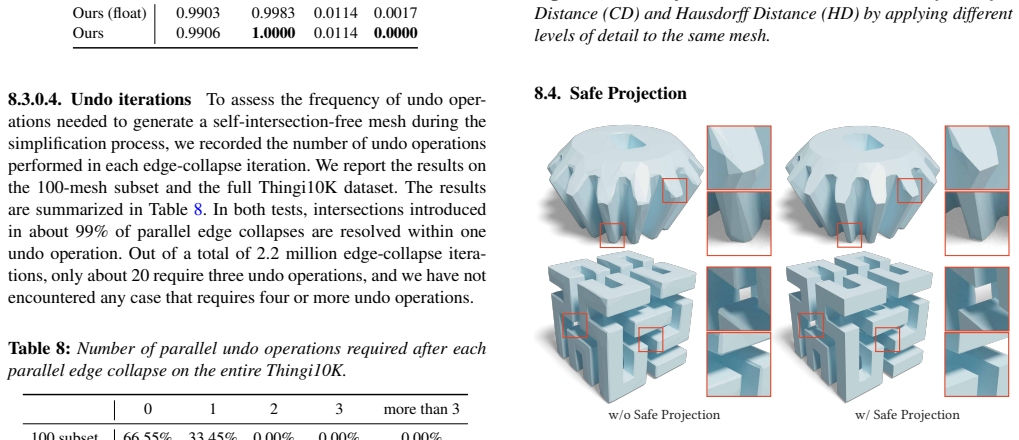
The load-bearing object is the GPU self-intersection detector used in the simplification stage and inherited by the other stages' guarantees. It pairs a parallel LBVH acceleration structure with a triangle-pair test that splits intersections into genuinely three-dimensional cases, handled by a determinant-based sign test, and coplanar cases, subdivided by how many vertices the two triangles share: no shared vertex, one shared vertex (an angle-overlap test), and two shared vertices (a same-side-of-the-edge test). Because coplanar vertex- or edge-sharing between neighboring triangles is legitimate and must not be flagged, this case analysis is what lets the algorithm promise intersection-free output while still collapsing aggressively. The same guarantee thread runs through the other two stages: Dual Marching Cubes patched with an envelope-based quad-division rule and smoothed interpolation to avoid isosurface self-intersections, and a Newton-type optimizer with a barrier energy plus additive continuous collision detection that certifies every projection step is intersection-free.
What would settle it
Run the simplification stage on meshes seeded with adversarial coplanar configurations that the curated set does not obviously cover — near-degenerate shared-vertex overlaps and edge-sharing pairs a few machine-epsilons from the separating case — then verify the entire output mesh with an independent exact-arithmetic triangle-intersection library; also sweep the mixed-precision detector against a double-precision reference on all Thingi10K outputs and count discrepancies. A single false negative that survives the undo loop contradicts the stated guarantee.
Extended reading notes
Core claim
On its own terms, the paper's discovery is that the three properties users want from low-poly meshing — manifoldness, freedom from self-intersection, and fidelity to the input — can each be enforced by a GPU-parallel stage that complements the others. The remeshing stage converts arbitrary inputs into a manifold, intersection-free surface with well-shaped triangles, which removes the need for the simplification stage to repair topology and makes its intersection check cheap and reliable. The simplification stage collapses edges in cost-propagated independent regions and then, after every iteration, detects every triangle pair that intersects using a case-based test that distinguishes genuine self-intersections from legitimate vertex- and edge-sharing; colliding collapses are undone until the mesh is clean. The final projection stage solves a constrained optimization, borrowing the barrier-function and continuous-collision machinery of deformable-body simulation, to move vertices back toward the input and recover sharp features without ever crossing into intersection. The paper's headline evidence is the speed — 2.75 seconds to decimate a two-million-face mesh to 2,000 triangles on an RTX 4090 — plus 100% manifold, intersection-free, and success rates across 100 difficult Thingi10K meshes.
Load-bearing premise
The paper's promised intersection-free property rests entirely on the GPU self-intersection detector never missing a real intersection, and that completeness is demonstrated empirically — on 10,100 curated triangle pairs and three meshes — rather than proven, so a single undetected configuration during any collapse iteration would silently break the guarantee.
Editorial extensions
If this is right
- Mesh decimation that used to take tens of minutes and require a separate CPU remeshing pass now runs in seconds on a single GPU, so intersection-free low-poly generation can sit inside real-time content pipelines.
- Applications that reject self-intersecting geometry — 3D printing validation, boolean operations, soft-body and cloth simulation — can accept the output of this pipeline directly without a repair stage.
- The pipeline handles meshes in the wild (non-manifold, self-intersecting, triangle soups) without a preprocessing repair step, since the remeshing stage normalizes topology before simplification.
- Larger decimation ratios (10–20% of faces) keep the intersection-free and manifold guarantees while matching baseline geometry-accuracy numbers, so the method covers both aggressive low-poly and moderate level-of-detail settings.
- Sharp-feature recovery comes from the projection stage rather than from feature-aware decimation, so features survive aggressive simplification as long as the projection can see them in the input.
Reading between the lines
- The paper's intersection-free guarantee is only as strong as its detector's completeness: the coplanar case analysis is validated empirically (10,100 curated triangle pairs and three meshes, 0% false negatives) rather than proven, and a formal argument or adversarial randomized generator would convert the guarantee from statistical to certified.
- The authors' stated limitation — that simplification cannot see the input mesh and projection cannot change connectivity — suggests an immediate extension: interleaving collapse and projection so feature recovery and decimation inform each other, an integration the paper itself floats as future work.
- The remeshing stage is topology-agnostic and processes meshes of 100k vertices in about three milliseconds, which makes the same UDF-plus-DualMC kernel a candidate for per-interaction watertight repair of scanned or generative-model outputs, not just a preprocessing step for simplification.
- The 64-bit integer encoding that lets edge costs be compared exactly under GPU atomic operations is a transferable pattern for other parallel priority-based geometry algorithms beyond mesh decimation.
Signed reviews
Editorial analysis
A structured set of objections, weighed in public.
Referee Report
Summary. The paper proposes PaMO, a GPU-based pipeline for converting arbitrary triangle meshes into low-poly, watertight, manifold, intersection-free meshes. Stage 1 computes a narrow-band unsigned distance field with a voxel-grid hierarchy and extracts a surface with dual marching cubes, with corrections for self-intersections and numerical instability. Stage 2 performs parallel QEM-based edge collapses in independent regions, then detects self-intersections with a BVH and a custom triangle-pair test and undoes collapses that introduce intersections. Stage 3 projects simplified vertices toward the input while minimizing a Chamfer-distance-inspired energy plus elastic and bending energies, using an IPC-style barrier and continuous collision detection to keep the trajectory intersection-free. The paper claims this is the first fully GPU-based mesh optimization method with intersection-free guarantees, and reports strong speed and geometric-quality results on a 100-mesh subset of Thingi10K and on the full dataset.
Significance. The engineering contribution is substantial: the method is reportedly one to two orders of magnitude faster than prior intersection-aware simplification (e.g., RoLoPM) while achieving competitive or better Chamfer/Hausdorff distances, and the ablations for edge costs, energy terms, and undo iterations are careful and informative. If the intersection-free guarantee is made rigorous, the paper would be a strong contribution to practical low-poly modeling. The evaluation is extensive and the presentation is generally clear. However, the central guarantee is currently not established because of the detector's deliberately suppressed small-intersection cases and the absence of a correctness proof; the empirical FNR=0 result is not a substitute. With the guarantee downgraded to a practical/empirical claim, the contribution remains valuable but would be weaker than advertised.
major comments (2)
- [§5.2, Algorithm 3, line 20] The 'intersection-free guarantee' stated in the Abstract and Contribution (b) is not established. For a non-coplanar triangle pair sharing exactly one vertex (s=1), Algorithm 3 reports an intersection only when ||l||>0 AND NOT(||l||≤ε AND s=1); consequently every positive-length intersection segment of length at most ε is classified as non-intersecting, even when that segment is a genuine crossing and not merely the shared vertex. An edge collapse can plausibly create such a configuration by folding a vertex slightly through a nearby triangle, and the paper gives no argument that this configuration class is empty. The value of ε is never defined, and the 0% FNR in Table 7 cannot cover this boundary class because randomly generated shared-vertex pairs rarely fall in the band 0<||l||≤ε. Since the safe-projection stage (Section 6) starts from the stage-2 mesh and its barrier/ACCD machinery assumes a non-intersecting input, a missed intersection here propagates to the final output. Please either prove that the suppressed case cannot be a genuine intersection, remove the ε suppression with exact predicates for the s=1 branch, or revise the guarantee to an empirical claim and add the restriction to Section 9.
- [§5.2 and Table 7] Even setting aside the ε branch, the guarantee depends on the completeness and numerical robustness of the GPU self-intersection detector. Algorithm 3's case analysis (s=0,1,2 and coplanar vs non-coplanar) is validated empirically on 10,100 curated triangle pairs and three meshes, but no proof shows that every self-intersecting configuration falls into one of the enumerated cases or that the mixed-precision floating-point checks never miss an intersection. Table 7's FNR=0 is strong evidence but not a guarantee, especially because the dataset is curated and may not cover degenerate configurations such as exactly coplanar partial overlaps with zero-area intersection or very small dihedral angles. If the word 'guarantee' is retained, the paper should either provide a formal correctness argument (e.g., exact predicates and exhaustive case analysis) or replace 'guarantee' with 'empirically robust' throughout the claims.
minor comments (5)
- [Abstract, §1, Figure 1] The reported timings for the large-mesh example are inconsistent: the abstract says a 2-million-face mesh is reduced to 20k triangles in 3 seconds, the introduction says 2k triangles in 2.75 seconds, and Figure 1 says 2M faces to 0.1% in 2.29 seconds; please unify these numbers.
- [§4.2] The text contains a stray '𝜀𝜀' and the sentence 'We first turn the UDF generated by the mesh-to-volume algorithm it into SDF' is grammatically broken; please fix this passage.
- [§7] The metric name 'Hausdroff' should be 'Hausdorff'.
- [Algorithm 1, lines 6–8] It is not stated how the triangle cost C_t is initialized before the min-propagation loop; please specify the initialization explicitly.
- [Figure 16 caption] The caption contains unresolved equation markup in the manuscript text; please check the rendered version.
Circularity Check
No significant circularity: PaMO's derivation is self-contained, with no fitted parameter or definitional step that reduces a prediction to its input.
full rationale
I traced the claimed derivation chain through all three stages. The remeshing stage converts the input to a UDF/SDF and extracts a mesh via DualMC; its manifold/watertight/intersection-free properties are inherited from the isosurface-extraction construction, and no parameter is fitted to the evaluation metrics. The simplification stage uses QEM costs plus edge-length and skinny-triangle costs, then reverts collapses flagged by an external intersection test (Devillers/DG02, with BVH acceleration); the target face count is a user input and the 'intersection-free' property is enforced by detecting and undoing intersections, not defined into existence. The safe projection stage minimizes a Chamfer-distance-to-input energy with hyperelastic and bending regularizers plus an IPC-style barrier; although the distance energy resembles the downstream CD metric, it is an optimization objective evaluated against the external input surface, not a predicted quantity that was fitted from the metric, so there is no reduction of the paper's out-of-sample fidelity claim to its inputs. The one substantive weakness is a soundness gap, not circularity: Algorithm 3 line 20 suppresses 3D shared-vertex intersections with intersection-segment length at most epsilon, so the stated intersection-free guarantee is not fully established for that boundary class, and the Limitations section does not disclose this. That is an unsupported guarantee/correctness concern, not a circular derivation. Self-citations (e.g., WXB*23, LSC*23) appear only as related-work background and are not load-bearing for the central pipeline. I found no equation-level reduction, no fitted parameter renamed as a prediction, and no definitional dependence of the claimed output properties on the pipeline's own detector: score 0.
Assumptions & free parameters
free parameters (8)
- SDF band epsilon =
0.9 / R_DMC
- Sigmoid smoothing beta =
5
- Edge cost weights w_e, w_s =
0.001, 0.005
- Safe projection energy weights =
k_dis=1000, k_elas=0.1, k_bend=0.01
- Barrier parameters =
k_bar=100, d_hat=1e-3
- M2S sample count m =
16384
- Newton iterations T =
50
- DualMC grid resolution R =
256 (128 for <1k target faces, 64 for <50)
assumptions (6)
- standard math Devillers' triangle-triangle intersection test is correct for non-coplanar triangles
- domain assumption Envelope-based quad division from [JU06, Wan09] eliminates DualMC quad-division self-intersections
- domain assumption The angle-overlap and same-side tests correctly classify coplanar vertex/edge-sharing configurations
- standard math Link condition guarantees the mesh remains manifold after edge collapses
- domain assumption The IPC barrier method keeps the trajectory intersection-free when combined with ACCD line search
- domain assumption Input meshes are normalized into [0,1]^3 and all distances are computed in this space
Cite this review
Pith. "Pith review of PaMO: Parallel Mesh Optimization for Intersection-Free Low-Poly Modeling on the GPU." pith.science (2026). https://pith.science/paper/JHB5ZAU4
@misc{pith2026250905595,
  author       = {Pith},
  title        = {Pith review of: PaMO: Parallel Mesh Optimization for Intersection-Free Low-Poly Modeling on the GPU},
  year         = {2026},
  howpublished = {\url{https://pith.science/paper/JHB5ZAU4}},
  note         = {Machine review of arXiv:2509.05595}
}
read the original abstract
Reducing the triangle count in complex 3D models is a basic geometry preprocessing step in graphics pipelines such as efficient rendering and interactive editing. However, most existing mesh simplification methods exhibit a few issues. Firstly, they often lead to self-intersections during decimation, a major issue for applications such as 3D printing and soft-body simulation. Second, to perform simplification on a mesh in the wild, one would first need to perform re-meshing, which often suffers from surface shifts and losses of sharp features. Finally, existing re-meshing and simplification methods can take minutes when processing large-scale meshes, limiting their applications in practice. To address the challenges, we introduce a novel GPU-based mesh optimization approach containing three key components: (1) a parallel re-meshing algorithm to turn meshes in the wild into watertight, manifold, and intersection-free ones, and reduce the prevalence of poorly shaped triangles; (2) a robust parallel simplification algorithm with intersection-free guarantees; (3) an optimization-based safe projection algorithm to realign the simplified mesh with the input, eliminating the surface shift introduced by re-meshing and recovering the original sharp features. The algorithm demonstrates remarkable efficiency, simplifying a 2-million-face mesh to 20k triangles in 3 seconds on RTX4090. We evaluated the approach on the Thingi10K dataset and showcased its exceptional performance in geometry preservation and speed.
Figures


Figures from the paper (17 more)




Reference graph
Works this paper leans on
-
[1]
write newline
" write newline "" before.all 'output.state := FUNCTION fin.entry add.period write newline FUNCTION new.block output.state before.all = 'skip after.block 'output.state := if FUNCTION new.sentence output.state after.block = 'skip output.state before.all = 'skip after.sentence 'output.state := if if FUNCTION not #0 #1 if FUNCTION and 'skip pop #0 if FUNCTIO...
-
[2]
write newline
" write newline "" before.all 'output.state := FUNCTION fin.entry.original add.period write newline FUNCTION new.block output.state before.all = 'skip after.block 'output.state := if FUNCTION new.sentence output.state after.block = 'skip output.state before.all = 'skip after.sentence 'output.state := if if FUNCTION not #0 #1 if FUNCTION and 'skip pop #0 i...
-
[3]
: A lightweight approach to repairing digitized polygon meshes
Attene M. : A lightweight approach to repairing digitized polygon meshes. The visual computer 26 (2010), 1393--1406
work page 2010
-
[4]
: Direct repair of self-intersecting meshes
Attene M. : Direct repair of self-intersecting meshes. Graph. Models 76, 6 (nov 2014), 658–668. URL: https://doi.org/10.1016/j.gmod.2014.09.002, https://doi.org/10.1016/j.gmod.2014.09.002 doi:10.1016/j.gmod.2014.09.002
-
[5]
Borouchaki H., Frey P. J. : Simplification of surface mesh using hausdorff envelope. Computer Methods in Applied Mechanics and Engineering 194, 48-49 (2005), 4864--4884. https://doi.org/10.1016/j.cma.2004.11.016 doi:10.1016/j.cma.2004.11.016
-
[6]
: Structure preserving cad model repair
Bischoff S., Kobbelt L. : Structure preserving cad model repair. Computer Graphics Forum 24 (2005). URL: https://api.semanticscholar.org/CorpusID:7341662
work page 2005
-
[7]
Stichting Blender Foundation, Amsterdam, 2018
Blender Foundation : Blender - a 3D modelling and rendering package. Stichting Blender Foundation, Amsterdam, 2018. URL: http://www.blender.org
work page 2018
-
[8]
: Robust low-poly meshing for general 3d models
Chen Z., Pan Z., Wu K., Vouga E., Gao X. : Robust low-poly meshing for general 3d models. ACM Transactions on Graphics (TOG) 42, 4 (2023), 1--20
work page 2023
Show all 70 references
-
[10]
Calli B., Walsman A., Singh A., Srinivasa S., Abbeel P., Dollar A. M. : Benchmarking in manipulation research: The ycb object and model set and benchmarking protocols. IEEE Robotics & Automation Magazine, 22 (2015) 36 - 52 22, 3 (Sept. 2015), 36--52. http://arxiv.org/abs/1502....
2015 arXiv
-
[11]
: Neural marching cubes
Chen Z., Zhang H. : Neural marching cubes. ACM Trans. Graph. 40, 6, Article 251 (December 2021), 15 pages 40, 6 (Dec. 2021), 1--15. http://arxiv.org/abs/2106.11272 arXiv:2106.11272 , https://doi.org/10.1145/3478513.3480518 doi:10.1145/3478513.3480518
2021 arXiv
-
[12]
: trimesh, 2019
Dawson-Haggerty et al. : trimesh, 2019. URL: https://trimesh.org/
2019
-
[13]
: Topology preserving edge contraction
Dey T., Edelsbrunner H., Guha S., Nekhayev D. : Topology preserving edge contraction. Publications de l'Institut Math \'e matique 66 (1999)
1999
-
[14]
B., Vanhoucke V
Downs L., Francis A., Koenig N., Kinman B., Hickman R., Reymann K., McHugh T. B., Vanhoucke V. : Google scanned objects: A high-quality dataset of 3d scanned household items. http://arxiv.org/abs/2204.11918 arXiv:2204.11918 , https://doi.org/10.48550/ARXIV.2204.11918 doi:10.48...
-
[15]
: Faster triangle-triangle intersection tests
Devillers O., Guigue P. : Faster triangle-triangle intersection tests. PhD thesis, INRIA, 2002
2002
-
[16]
: An efficient method of triangulating equi-valued surfaces by using tetrahedral cells
Doi A., Koide A. : An efficient method of triangulating equi-valued surfaces by using tetrahedral cells. IEICE TRANSACTIONS on Information and Systems 74, 1 (1991), 214--224
1991
-
[17]
: Real-time mesh simplification using the gpu
DeCoro C., Tatarchuk N. : Real-time mesh simplification using the gpu. In Proceedings of the 2007 symposium on Interactive 3D graphics and games (2007), pp. 161--166
2007
-
[18]
: Cgal: The computational geometry algorithms library
Fabri A., Pion S. : Cgal: The computational geometry algorithms library. In Proceedings of the 17th ACM SIGSPATIAL international conference on advances in geographic information systems (2009), pp. 538--539
2009
-
[19]
: Intersection free simplification
Gumhold S., Borodin P., Klein R. : Intersection free simplification. Int. J. Shape Model. 9 (2003), 155--176. URL: https://api.semanticscholar.org/CorpusID:3080587
2003
-
[20]
Garland M., Heckbert P. S. : Surface simplification using quadric error metrics. In Proceedings of the 24th annual conference on Computer graphics and interactive techniques (1997), pp. 209--216
1997
-
[21]
N., Desbrun M., Schr\" o der P
Grinspun E., Hirani A. N., Desbrun M., Schr\" o der P. : Discrete shells. In Proceedings of the 2003 ACM SIGGRAPH/Eurographics Symposium on Computer Animation (Goslar, DEU, 2003), SCA '03, Eurographics Association, p. 62–67
2003
-
[22]
: Interactive gpu-based decimation of large meshes
Gautron P., Kubisch C. : Interactive gpu-based decimation of large meshes. In ACM SIGGRAPH 2023 Talks. 2023, pp. 1--2
2023
-
[23]
: Progressive meshes, 1996
Hoppe H. : Progressive meshes, 1996. https://doi.org/10.1145/237170.237216 doi:10.1145/237170.237216
1996
-
[24]
: Robust watertight manifold surface generation method for shapenet models
Huang J., Su H., Guibas L. : Robust watertight manifold surface generation method for shapenet models. arXiv preprint arXiv:1802.01698 (2018)
2018 arXiv
-
[25]
: Fast tetrahedral meshing in the wild
Hu Y., Schneider T., Wang B., Zorin D., Panozzo D. : Fast tetrahedral meshing in the wild. ACM Trans. Graph. 39, 4 (July 2020). URL: https://doi.org/10.1145/3386569.3392385, https://doi.org/10.1145/3386569.3392385 doi:10.1145/3386569.3392385
2020
-
[26]
: Tetrahedral meshing in the wild
Hu Y., Zhou Q., Gao X., Jacobson A., Zorin D., Panozzo D. : Tetrahedral meshing in the wild. ACM Trans. Graph. 37, 4 (July 2018), 60:1--60:14. URL: http://doi.acm.org/10.1145/3197517.3201353, https://doi.org/10.1145/3197517.3201353 doi:10.1145/3197517.3201353
2018
-
[27]
: Manifoldplus: A robust and scalable watertight manifold surface generation method for triangle soups
Huang J., Zhou Y., Guibas L. : Manifoldplus: A robust and scalable watertight manifold surface generation method for triangle soups. arXiv preprint arXiv:2005.11621 (2020)
2020 arXiv
-
[28]
S., Zorin D., Panozzo D., Schneider T
Jiang Z., Dai J., Hu Y., Zhou Y., Dumas J., Zhou Q., Bajwa G. S., Zorin D., Panozzo D., Schneider T. : Declarative specification for unstructured mesh editing algorithms. ACM Transactions on Graphics (TOG) 41, 6 (2022), 1--14
2022
-
[29]
: Dual contouring of hermite data, 2002
Ju T., Losasso F., Schaefer S., Warren J. : Dual contouring of hermite data, 2002. https://doi.org/10.1145/566570.566586 doi:10.1145/566570.566586
2002
-
[30]
: libigl: A simple c++ geometry processing library
Jacobson A., Panozzo D., Sch \"u ller C., Diamanti O., Zhou Q., Pietroni N., et al. : libigl: A simple c++ geometry processing library. Google Scholar (2013)
2013
-
[31]
: Intersection-free contouring on an octree grid
Ju T., Udeshi T. : Intersection-free contouring on an octree grid. In Proceedings of Pacific graphics (2006), vol. 2006, Citeseer
2006
-
[32]
: Maximizing parallelism in the construction of bvhs, octrees, and k-d trees
Karras T. : Maximizing parallelism in the construction of bvhs, octrees, and k-d trees. In Proceedings of the Fourth ACM SIGGRAPH/Eurographics conference on High-Performance Graphics (2012), pp. 33--37
2012
-
[33]
P., Botsch M., Schwanecke U., Seidel H.-P
Kobbelt L. P., Botsch M., Schwanecke U., Seidel H.-P. : Feature sensitive surface extraction from volume data, 2001. https://doi.org/10.1145/383259.383265 doi:10.1145/383259.383265
2001
-
[34]
: Gpu-based multiple-choice scheme for mesh simplification
Koh N., Zhang W., Zheng J., Cai Y. : Gpu-based multiple-choice scheme for mesh simplification. In Proceedings of Computer Graphics International 2018. 2018, pp. 195--200
2018
-
[35]
: Morton integrals for high speed geometry simplification
Legrand H., Boubekeur T. : Morton integrals for high speed geometry simplification. In Proceedings of the 7th Conference on High-Performance Graphics (2015), pp. 105--112
2015
-
[36]
E., Cline H
Lorensen W. E., Cline H. E. : Marching cubes: A high resolution 3d surface construction algorithm. ACM SIGGRAPH Computer Graphics 21, 4 (1987), 163--169. https://doi.org/10.1145/37402.37422 doi:10.1145/37402.37422
1987
-
[37]
: Deep marching cubes: Learning explicit surface representations, 2018
Liao Y., Donne S., Geiger A. : Deep marching cubes: Learning explicit surface representations, 2018. https://doi.org/10.1109/cvpr.2018.00308 doi:10.1109/cvpr.2018.00308
2018
-
[38]
Li M., Ferguson Z., Schneider T., Langlois T., Zorin D., Panozzo D., Jiang C., Kaufman D. M. : Incremental potential contact: Intersection- and inversion-free large deformation dynamics. ACM Trans. Graph. (SIGGRAPH) 39, 4 (2020)
2020
-
[39]
: Magic3d: High-resolution text-to-3d content creation
Lin C.-H., Gao J., Tang L., Takikawa T., Zeng X., Huang X., Kreis K., Fidler S., Liu M.-Y., Lin T.-Y. : Magic3d: High-resolution text-to-3d content creation. In Proceedings of the IEEE/CVF Conference on Computer Vision and Pattern Recognition (2023), pp. 300--309
2023
-
[40]
: Parallel mesh simplification using embedded tree collapsing
Lee H., Kyung M.-H. : Parallel mesh simplification using embedded tree collapsing. The Visual Computer 32 (2016), 967--976
2016
-
[41]
D., Kim V
Liu H.-T. D., Kim V. G., Chaudhuri S., Aigerman N., Jacobson A. : Neural subdivision. arXiv preprint arXiv:2005.01819 (2020)
2020 arXiv
-
[42]
M., Jiang C
Li M., Kaufman D. M., Jiang C. : Codimensional incremental potential contact. ACM Trans. Graph. (SIGGRAPH) 40, 4 (2021)
2021
-
[43]
D., Thiery J.-M., Jacobson A., Boubekeur T., Ovsjanikov M
Lescoat T., Liu H.-T. D., Thiery J.-M., Jacobson A., Boubekeur T., Ovsjanikov M. : Spectral mesh simplification. Computer Graphics Forum 39 (2020). URL: https://api.semanticscholar.org/CorpusID:219161648
2020
-
[44]
: One-2-3-45++: Fast single image to 3d objects with consistent multi-view generation and 3d diffusion
Liu M., Shi R., Chen L., Zhang Z., Xu C., Wei X., Chen H., Zeng C., Gu J., Su H. : One-2-3-45++: Fast single image to 3d objects with consistent multi-view generation and 3d diffusion. arXiv preprint arXiv:2311.07885 (2023)
2023 arXiv
-
[45]
: Model simplification using vertex-clustering, 1997
Low K.-L., Tan T.-S. : Model simplification using vertex-clustering, 1997. https://doi.org/10.1145/253284.253310 doi:10.1145/253284.253310
1997
-
[46]
: Image-driven simplification
Lindstrom P., Turk G. : Image-driven simplification. ACM Trans. Graph. 19, 3 (jul 2000), 204–241. URL: https://doi.org/10.1145/353981.353995, https://doi.org/10.1145/353981.353995 doi:10.1145/353981.353995
2000
-
[47]
H., Hussein M
Mousa M. H., Hussein M. K. : High-performance simplification of triangular surfaces using a gpu. PloS one 16, 8 (2021), e0255832
2021
-
[48]
: Openvdb: an open-source data structure and toolkit for high-resolution volumes
Museth K., Lait J., Johanson J., Budsberg J., Henderson R., Alden M., Cucka P., Hill D., Pearce A. : Openvdb: an open-source data structure and toolkit for high-resolution volumes. In Acm siggraph 2013 courses. 2013, pp. 1--1
2013
-
[49]
: A fast triangle-triangle intersection test
M \"o ller T. : A fast triangle-triangle intersection test. Journal of graphics tools 2, 2 (1997), 25--30
1997
-
[50]
Natarajan B. K. : On generating topologically consistent isosurfaces from uniform samples. Vis. Comput. 11, 1 (jan 1994), 52–62. URL: https://doi.org/10.1007/BF01900699, https://doi.org/10.1007/BF01900699 doi:10.1007/BF01900699
1994 doi
-
[51]
Nielson G. M. : Dual marching cubes. In IEEE visualization 2004 (2004), IEEE, pp. 489--496
2004
-
[52]
Nocedal J., Wright S. J. : Numerical optimization, 2nd ed ed. Springer series in operations research. Springer, New York, 2006
2006
-
[53]
: Gpu-accelerated triangle mesh simplification using parallel vertex removal
Odaker T., Kranzlmueller D., Volkert J. : Gpu-accelerated triangle mesh simplification using parallel vertex removal. International Journal of Computer and Information Engineering 10, 1 (2016), 160--166
2016
-
[54]
: Triangular mesh simplification on the gpu
Papageorgiou A., Platis N. : Triangular mesh simplification on the gpu. The Visual Computer 31 (2015), 235--244
2015
-
[55]
: Atomic volumes for mesh completion
Podolak J., Rusinkiewicz S. : Atomic volumes for mesh completion. In Symposium on Geometry Processing (2005), vol. 33, p. 41
2005
-
[56]
: Alpha wrapping with an offset
Portaneri C., Rouxel-Labb\' e M., Hemmer M., Cohen-Steiner D., Alliez P. : Alpha wrapping with an offset. ACM Trans. Graph. 41, 4 (jul 2022). URL: https://doi.org/10.1145/3528223.3530152, https://doi.org/10.1145/3528223.3530152 doi:10.1145/3528223.3530152
2022
-
[57]
: Multi-resolution 3d approximations for rendering complex scenes, 1993
Rossignac J., Borrel P. : Multi-resolution 3d approximations for rendering complex scenes, 1993. https://doi.org/10.1007/978-3-642-78114-8_29 doi:10.1007/978-3-642-78114-8_29
1993 doi
-
[58]
: Fem simulation of 3d deformable solids: a practitioner's guide to theory, discretization and model reduction
Sifakis E., Barbic J. : Fem simulation of 3d deformable solids: a practitioner's guide to theory, discretization and model reduction. In ACM SIGGRAPH 2012 Courses (New York, NY, USA, 2012), SIGGRAPH '12, Association for Computing Machinery. URL: https://doi.org/10.1145/2343483...
2012
-
[59]
: Deep marching tetrahedra: a hybrid representation for high-resolution 3d shape synthesis
Shen T., Gao J., Yin K., Liu M.-Y., Fidler S. : Deep marching tetrahedra: a hybrid representation for high-resolution 3d shape synthesis. http://arxiv.org/abs/2111.04276 arXiv:2111.04276 , https://doi.org/10.48550/ARXIV.2111.04276 doi:10.48550/ARXIV.2111.04276
-
[60]
: Flexible isosurface extraction for gradient-based mesh optimization
Shen T., Munkberg J., Hasselgren J., Yin K., Wang Z., Chen W., Gojcic Z., Fidler S., Sharp N., Gao J. : Flexible isosurface extraction for gradient-based mesh optimization. ACM Transactions on Graphics 42, 4 (2023), 1--16. https://doi.org/10.1145/3592430 doi:10.1145/3592430
2023 doi
-
[61]
: Dual marching cubes: Primal contouring of dual grids
Schaefer S., Warren J. : Dual marching cubes: Primal contouring of dual grids. Computer Graphics Forum 24, 2 (2005), 195--201. https://doi.org/10.1111/j.1467-8659.2005.00843.x doi:10.1111/j.1467-8659.2005.00843.x
2005
-
[62]
: Marching cubes 33: Construction of topologically correct isosurfaces
Tcherniaev E. : Marching cubes 33: Construction of topologically correct isosurfaces
-
[63]
: Discrete bending forces and their Jacobians
Tamstorf R., Grinspun E. : Discrete bending forces and their Jacobians . Graphical Models 75, 6 (Nov. 2013), 362--370. URL: https://linkinghub.elsevier.com/retrieve/pii/S1524070313000209, https://doi.org/10.1016/j.gmod.2013.07.001 doi:10.1016/j.gmod.2013.07.001
2013 doi
-
[64]
: Delicate textured mesh recovery from nerf via adaptive surface refinement
Tang J., Zhou H., Chen X., Hu T., Ding E., Wang J., Zeng G. : Delicate textured mesh recovery from nerf via adaptive surface refinement. arXiv preprint arXiv:2303.02091 (2022)
2022 arXiv
-
[65]
Wang C. C. : Intersection-free dual contouring on uniform grids: an approach based on convex/concave analysis. Tech. rep., Technical Report, 2009, http://www2. mae. cuhk. edu. hk/\ cwang/pubs …, 2009
2009
-
[66]
: Isosurfaces: geometry, topology, and algorithms
Wenger R. : Isosurfaces: geometry, topology, and algorithms. CRC Press, 2013
2013
-
[67]
: Feature preserving mesh simplification using feature sensitive metric
Wei J., Lou Y. : Feature preserving mesh simplification using feature sensitive metric. Journal of Computer Science and Technology 25, 3 (2010), 595--605. https://doi.org/10.1007/s11390-010-9348-7 doi:10.1007/s11390-010-9348-7
2010 doi
-
[68]
S., Ernst M
Wald I., Woop S., Benthin C., Johnson G. S., Ernst M. : Embree: a kernel framework for efficient cpu ray tracing. ACM Transactions on Graphics (TOG) 33, 4 (2014), 1--8
2014
-
[69]
: Neumanifold: Neural watertight manifold reconstruction with efficient and high-quality rendering support
Wei X., Xiang F., Bi S., Chen A., Sunkavalli K., Xu Z., Su H. : Neumanifold: Neural watertight manifold reconstruction with efficient and high-quality rendering support. http://arxiv.org/abs/2305.17134 arXiv:2305.17134 , https://doi.org/10.48550/ARXIV.2305.17134 doi:10.48550/A...
-
[70]
: Thingi10k: A dataset of 10,000 3d-printing models
Zhou Q., Jacobson A. : Thingi10k: A dataset of 10,000 3d-printing models. arXiv preprint arXiv:1605.04797 (2016)
2016 arXiv
-
[71]
: Open3d: A modern library for 3d data processing
Zhou Q.-Y., Park J., Koltun V. : Open3d: A modern library for 3d data processing. arXiv preprint arXiv:1801.09847 (2018)
2018 arXiv
Reviewed August 15, 2026 · model on record in the stance chip above.
Discussion (0). Continue with ORCID to comment.