A-Live: Passive Liveness Detection via Neuromuscular Micro-Motion Signatures on Commodity Sensors
Pith reviewed 2026-06-28 05:22 UTC · model grok-4.3
The pith
Neuromuscular micro-motions captured in standard IMU sensors enable passive liveness detection at over 99.5 percent accuracy on commodity devices.
A machine-rendered reading of the paper's core claim, the machinery that carries it, and where it could break.
Core claim
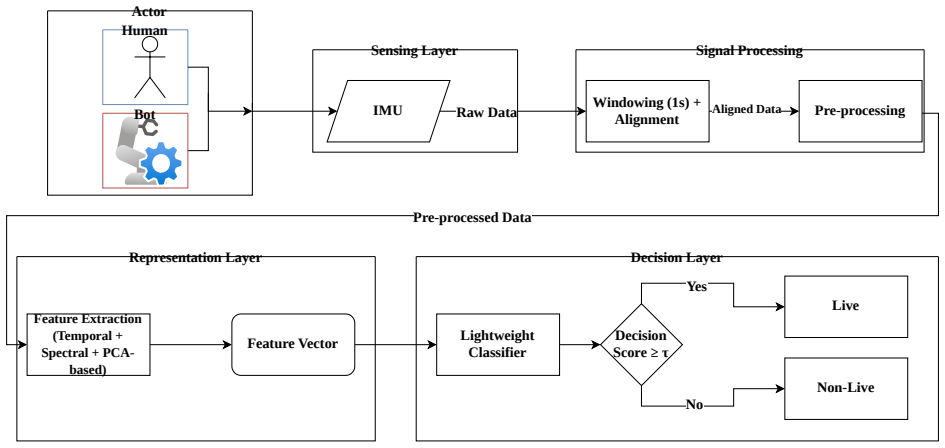
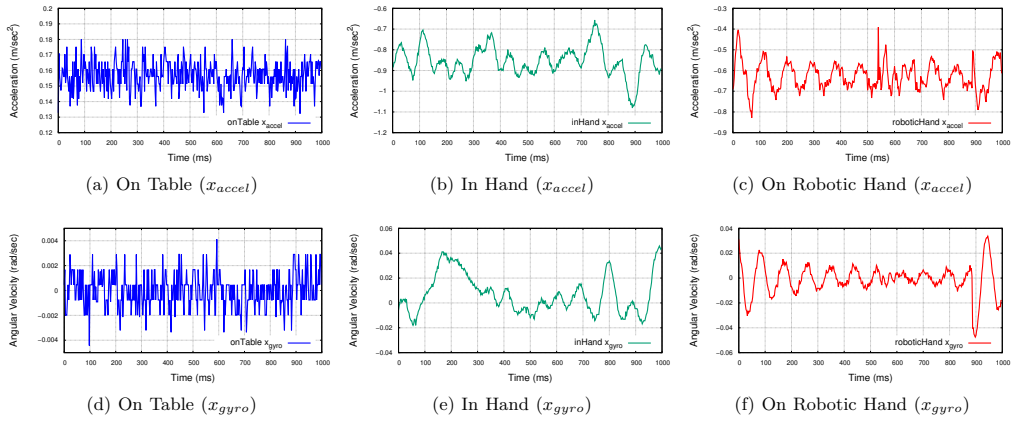
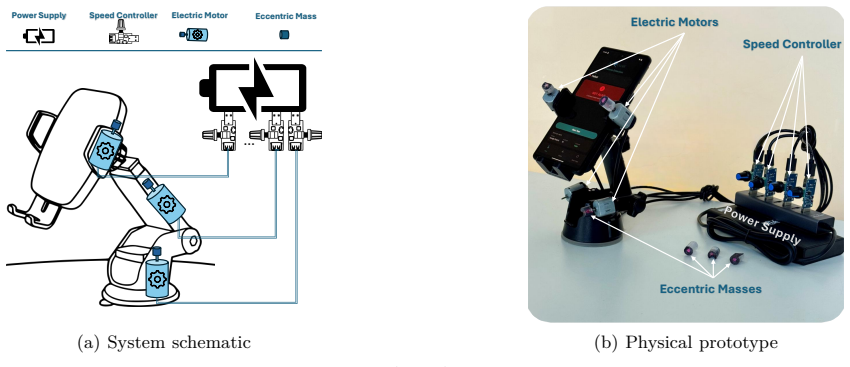
A-Live is a passive liveness detection framework that operates solely on inertial measurement unit signals available in commodity devices. It rests on the observation that neuromuscular micro-motions inherent to human motor control produce subtle but measurable signatures in inertial data. A lightweight feature extraction pipeline and compact classifier, together with a controllable physical micro-motion platform for robustness testing, deliver over 99.5 percent accuracy with low false acceptance and rejection rates across multiple device platforms and real-user settings.
What carries the argument
The lightweight feature extraction pipeline and compact classifier that isolate neuromuscular micro-motion signatures from IMU signals.
If this is right
- Liveness detection requires no explicit user interaction or additional hardware beyond standard mobile sensors.
- The system supports real-time on-device execution across Android and iOS platforms.
- Accuracy holds against both automated replay and physically engineered non-human motions.
- Evaluation includes both laboratory and real-user scenarios.
- The method scales without per-user enrollment or specialized calibration.
Where Pith is reading between the lines
- The same signatures could be layered with existing authentication flows to counter agentic AI without changing user experience.
- The micro-motion platform offers a reusable testbed for other sensor-based liveness proposals.
- If the signatures remain stable across sessions, they might extend to continuous presence monitoring rather than one-time checks.
Load-bearing premise
Neuromuscular micro-motions produce unique, measurable signatures in IMU data that cannot be replicated by engineered non-human motion or AI-generated signals.
What would settle it
An experiment in which an engineered mechanical device or AI-generated signal produces IMU traces that the classifier accepts as live at rates comparable to human users.
Figures

read the original abstract
Liveness detection has evolved from a safeguard against presentation and replay attacks in biometric authentication to a broader requirement for distinguishing human users from non-human agents in modern digital systems. The emergence of generative and agentic AI further amplifies this need, positioning liveness as a fundamental security primitive. Existing approaches face key limitations, including reliance on explicit user interaction, specialized hardware, vulnerability to increasingly realistic spoofing, and limited scalability in real-world deployments. We present A-Live, a passive liveness detection framework that operates solely on inertial measurement unit (IMU) signals available in commodity devices. A-Live is based on the observation that neuromuscular micro-motions inherent to human motor control produce subtle but measurable signatures in inertial data, which are often treated as noise in prior work. We design a lightweight feature extraction pipeline and a compact classifier suitable for real-time on-device deployment, and introduce a controllable physical micro-motion platform to evaluate robustness against engineered non-human motion. Extensive evaluation across Android and iOS devices, including both automated and real-user settings, shows that A-Live achieves over 99.5\% accuracy with low false acceptance and rejection rates. Our results demonstrate that neuromuscular micro-motion signatures provide a scalable and passive foundation for liveness detection under emerging AI-driven threat models.
Editorial analysis
A structured set of objections, weighed in public.
Referee Report
Summary. The manuscript presents A-Live, a passive liveness detection framework that extracts neuromuscular micro-motion signatures from IMU signals on commodity Android and iOS devices. It includes a lightweight feature extraction pipeline and compact classifier for on-device use, plus a controllable physical micro-motion platform to test against engineered non-human motion. The central claim is that this yields over 99.5% accuracy with low false acceptance/rejection rates in both automated and real-user settings, addressing AI-driven threats where prior work treated such signals as noise.
Significance. If the results hold under broader threat models, the work offers a scalable, interaction-free approach to liveness detection using only existing sensors, reframing micro-motions as a biometric signal rather than noise. This could support defenses against generative AI agents in biometric and access-control systems without specialized hardware.
major comments (2)
- [Evaluation] Evaluation section: robustness is assessed only via the physical micro-motion platform for engineered non-human motion; no experiments are reported against synthetic or AI-generated IMU traces that could replicate the extracted micro-motion features without biological origin. This directly undercuts the claim of security under the AI-driven threat model stated in the abstract and introduction.
- [Methods] Methods/Feature extraction: the pipeline is described as lightweight and suitable for real-time deployment, but no explicit equations, parameter values, or feature definitions are provided to allow reproduction or independent verification of how the 99.5% accuracy is obtained from raw IMU data.
minor comments (1)
- [Abstract] Abstract: the claim of 'extensive evaluation across Android and iOS devices' would benefit from a one-sentence summary of participant count, device models, and trial numbers to contextualize the accuracy figure.
Simulated Author's Rebuttal
We thank the referee for the constructive comments. Below we respond point-by-point to the major comments and indicate planned revisions.
read point-by-point responses
-
Referee: [Evaluation] Evaluation section: robustness is assessed only via the physical micro-motion platform for engineered non-human motion; no experiments are reported against synthetic or AI-generated IMU traces that could replicate the extracted micro-motion features without biological origin. This directly undercuts the claim of security under the AI-driven threat model stated in the abstract and introduction.
Authors: We thank the referee for this observation. Our evaluation employs a controllable physical micro-motion platform to generate reproducible non-biological motion that attempts to replicate the target signatures, providing a direct and controllable test of the core hypothesis. While we did not conduct experiments using AI-generated synthetic IMU traces, producing such traces that faithfully reproduce the subtle, biologically grounded neuromuscular micro-motions remains a significant open challenge. In the revision we will add a dedicated discussion subsection addressing the limitations of current generative approaches for this signal type and clarifying how the physical platform serves as a practical proxy for the stated AI-driven threat model. revision: partial
-
Referee: [Methods] Methods/Feature extraction: the pipeline is described as lightweight and suitable for real-time deployment, but no explicit equations, parameter values, or feature definitions are provided to allow reproduction or independent verification of how the 99.5% accuracy is obtained from raw IMU data.
Authors: We agree that explicit mathematical details are required for independent verification. The revised manuscript will include the full set of equations defining the feature extraction pipeline, precise definitions and formulas for each extracted feature from the raw IMU time series, and all numerical parameter values, window sizes, and classifier hyperparameters used to obtain the reported accuracy figures. revision: yes
Circularity Check
No significant circularity; empirical evaluation is self-contained
full rationale
The provided abstract and context describe an empirical system that extracts features from IMU signals, trains a compact classifier, and reports accuracy on real-user and automated test settings using a physical micro-motion platform. No equations, derivations, or self-citations are visible that reduce any claim to a fitted parameter renamed as a prediction or to a self-definitional loop. The uniqueness of neuromuscular signatures is presented as an observation motivating the work rather than a theorem imported from prior author work, and the accuracy metric is tied to explicit experimental evaluation rather than construction from inputs. This is the normal case of a non-circular empirical paper.
Axiom & Free-Parameter Ledger
Reference graph
Works this paper leans on
-
[1]
Virtual u: Defeating face liveness detection by building virtual models from your public photos,
Y. Xu, T. Price, J.-M. Frahm, and F. Monrose, “Virtual u: Defeating face liveness detection by building virtual models from your public photos,” in 25th USENIX Security Symposium (USENIX Security 16). Austin, TX: USENIX Association, Aug. 2016, pp. 497–512. [Online]. A vailable: https://www.usenix.org/conference/usenixsecurity16/technical- sessions/presentation/xu
2016
-
[2]
Spoofing real-world face authentication systems through optical synthesis,
Y. Yan and Z. Yang, “Spoofing real-world face authentication systems through optical synthesis,” in 2023 IEEE Symposium on Security and Privacy (SP), 2023, pp. 882–898
2023
-
[3]
Functional connectome fingerprinting: identifying individuals using patterns of brain connectivity,
E. S. Finn, X. Shen, D. Scheinost, M. D. Rosenberg, J. Huang, M. M. Chun, X. Papademetris, and R. T. Constable, “Functional connectome fingerprinting: identifying individuals using patterns of brain connectivity,” Nature Neuroscience, vol. 18, no. 11, pp. 1664–1671, 2015. [Online]. A vailable: https://doi.org/10.1038/nn.4135
-
[4]
Cortico-muscular coherence parallels coherence of postural tremor and meg during static muscle contraction,
K. Airaksinen, T. Lehti, J. Nurminen, J. Luoma, L. Helle, S. Taulu, E. Pekkonen, and J. P. Mäkelä, “Cortico-muscular coherence parallels coherence of postural tremor and meg during static muscle contraction,” Neuroscience Letters, vol. 602, pp. 22–26, 2015
2015
-
[5]
Seeing your face is not enough: An inertial sensor-based liveness detection for face authentication,
Y. Li, Y. Li, Q. Yan, H. Kong, and R. H. Deng, “Seeing your face is not enough: An inertial sensor-based liveness detection for face authentication,” in Proceedings of the 22nd ACM SIGSAC Conference on Computer and Communications Security, ser. CCS ’15. New York, NY, USA: Association for Computing Machinery, 2015, p. 1558–1569. [Online]. A vailable: https...
-
[6]
Spoofing and countermeasures for speaker verification: A survey,
Z. Wu, N. Evans, T. Kinnunen, J. Yamagishi, F. Alegre, and H. Li, “Spoofing and countermeasures for speaker verification: A survey,” Speech Communication, vol. 66, pp. 130–153, 2015
2015
-
[7]
Void: A fast and light voice liveness detection system,
M. E. Ahmed, I.-Y. Kwak, J. H. Huh, I. Kim, T. Oh, and H. Kim, “Void: A fast and light voice liveness detection system,” in 29th USENIX Security Symposium (USENIX Security 20). USENIX Association, Aug. 2020, pp. 2685– 2702
2020
-
[8]
Captcha: Using hard ai problems for security,
L. von Ahn, M. Blum, N. J. Hopper, and J. Langford, “Captcha: Using hard ai problems for security,” in Advances in Cryptology — EUROCRYPT 2003, E. Biham, Ed. Berlin, Heidelberg: Springer Berlin Heidelberg, 2003, pp. 294–311
2003
-
[9]
Face spoofing detection from single images using micro-texture analysis,
J. Määttä, A. Hadid, and M. Pietikäinen, “Face spoofing detection from single images using micro-texture analysis,” in 2011 International Joint Conference on Biometrics (IJCB), 2011, pp. 1–7
2011
-
[10]
Learning deep models for face anti-spoofing: Binary or auxiliary supervision,
Y. Liu, A. Jourabloo, and X. Liu, “Learning deep models for face anti-spoofing: Binary or auxiliary supervision,” in 2018 IEEE/CVF Conference on Computer Vision and Pattern Recognition, 2018, pp. 389–398
2018
-
[11]
A survey on face anti- spoofing algorithms,
M. Zhang, K. Zeng, and J. Wang, “A survey on face anti- spoofing algorithms,” Journal of Information Hiding and Privacy Protection, vol. 2, no. 1, pp. 21–34, 2020
2020
-
[12]
Face liveness detection from a single image with sparse low rank bilinear discrimina- tive model,
X. Tan, Y. Li, J. Liu, and L. Jiang, “Face liveness detection from a single image with sparse low rank bilinear discrimina- tive model,” in Computer Vision – ECCV 2010, K. Daniilidis, P. Maragos, and N. Paragios, Eds. Berlin, Heidelberg: Springer Berlin Heidelberg, 2010, pp. 504–517
2010
-
[13]
Face anti- spoofing using patch and depth-based cnns,
Y. Atoum, Y. Liu, A. Jourabloo, and X. Liu, “Face anti- spoofing using patch and depth-based cnns,” in 2017 IEEE International Joint Conference on Biometrics (IJCB), 2017, pp. 319–328
2017
-
[14]
Remote plethysmographic imaging using ambient light
W. Verkruysse, L. O. Svaasand, and J. S. Nelson, “Remote plethysmographic imaging using ambient light. ” Opt. Express, vol. 16, no. 26, pp. 21 434–21 445, Dec 2008. [Online]. A vailable: https://opg.optica.org/oe/abstract.cfm?URI=oe- 16-26-21434
2008
-
[15]
Non- contact, automated cardiac pulse measurements using video imaging and blind source separation
M.-Z. Poh, D. J. McDuff, and R. W. Picard, “Non- contact, automated cardiac pulse measurements using video imaging and blind source separation. ” Opt. Express, vol. 18, no. 10, pp. 10 762–10 774, May 2010. [Online]. A vailable: https://opg.optica.org/oe/abstract.cfm?URI=oe- 18-10-10762
2010
-
[16]
Imu: Physical impersonating attack for face recognition system with natural style changes,
S. An, Y. Yao, Q. Xu, S. Ma, G. Tao, S. Cheng, K. Zhang, Y. Liu, G. Shen, I. Kelk, and X. Zhang, “Imu: Physical impersonating attack for face recognition system with natural style changes,” in 2023 IEEE Symposium on Security and Privacy (SP), 2023, pp. 899–916
2023
-
[17]
Ecg biometric recognition: A comparative analysis,
I. Odinaka, P.-H. Lai, A. D. Kaplan, J. A. O’Sullivan, E. J. Sirevaag, and J. W. Rohrbaugh, “Ecg biometric recognition: A comparative analysis,” IEEE Transactions on Information Forensics and Security, vol. 7, no. 6, pp. 1812–1824, 2012
2012
-
[18]
Cancelable hd-semg-based biomet- rics for cross-application discrepant personal identification,
X. Jiang, K. Xu, X. Liu, C. Dai, D. A. Clifton, E. A. Clancy, M. Akay, and W. Chen, “Cancelable hd-semg-based biomet- rics for cross-application discrepant personal identification,” IEEE Journal of Biomedical and Health Informatics, vol. 25, no. 4, pp. 1070–1079, 2021
2021
-
[19]
New optical methods for liveness detection on fingers,
M. Drahansky, M. Dolezel, J. Vana, E. Brezinova, J. Yim, and K. Shim, “New optical methods for liveness detection on fingers,” BioMed Research International, vol. 2013, p. 197925, 2013
2013
-
[20]
Building a real human network,
Worldcoin, “Building a real human network,” https://whitepaper.worldcoin.org/, 2023
2023
-
[21]
Detecting pulse from head motions in video,
G. Balakrishnan, F. Durand, and J. Guttag, “Detecting pulse from head motions in video,” in 2013 IEEE Conference on Computer Vision and Pattern Recognition, 2013, pp. 3430– 3437
2013
-
[22]
Iris liveness detection based on quality related features,
J. Galbally, J. Ortiz-Lopez, J. Fierrez, and J. Ortega-Garcia, “Iris liveness detection based on quality related features,” in 2012 5th IAPR International Conference on Biometrics (ICB), 2012, pp. 271–276
2012
-
[23]
Electronic device related to user identification, authentication, liveness, encryption using biometrics technology and methods for operation thereof,
M. Zizi, N. Sullivan, L. Stork, D. Drusinsky, and K. Lee, “Electronic device related to user identification, authentication, liveness, encryption using biometrics technology and methods for operation thereof,” Patent US11 947 648B2, Apr. 2, 2024. [Online]. A vailable: https://patents.google.com/patent/US11947648B2
2024
-
[24]
Glitch in time: Exploiting temporal misalignment of imu for eaves- dropping,
A. Najeeb, A. Rafay, M. H. Alizai, and N. A. Bhatti, “Glitch in time: Exploiting temporal misalignment of imu for eaves- dropping,” in Proceedings of the 20th ACM Asia Conference on Computer and Communications Security, ser. ASIA CCS ’25. New York, NY, USA: Association for Computing Machinery, 2025, p. 530–541
2025
-
[25]
A-live: Aerendir liveness detection system (public demo),
“A-live: Aerendir liveness detection system (public demo),” https://alive.aerendir.info/try-alive, 2026, accessed: 2026-05- 15
2026
-
[26]
A review of wearable sensors and systems with application in rehabilitation,
S. Patel, H. Park, P. Bonato, L. Chan, and M. Rodgers, “A review of wearable sensors and systems with application in rehabilitation,” Journal of NeuroEngineering and Rehabilitation, vol. 9, no. 1, p. 21, 2012. [Online]. A vailable: https://doi.org/10.1186/1743-0003-9-21
-
[27]
Eyeblink-based anti- spoofing in face recognition from a generic webcamera,
G. Pan, L. Sun, Z. Wu, and S. Lao, “Eyeblink-based anti- spoofing in face recognition from a generic webcamera,” in 2007 IEEE 11th International Conference on Computer Vision, 2007, pp. 1–8
2007
-
[28]
Interactive face liveness detection based on openvino and near infrared camera,
N. Zhang, J. Huang, and H. Zhang, “Interactive face liveness detection based on openvino and near infrared camera,” in Digital TV and Wireless Multimedia Communication, G. Zhai, J. Zhou, H. Yang, P. An, and X. Yang, Eds. Singapore: Springer Singapore, 2020, pp. 79–90
2020
-
[29]
Evaluation of different passive methods for liveness detection,
M. Butz and M. Wölfel, “Evaluation of different passive methods for liveness detection,” in 2024 12th International Symposium on Digital Forensics and Security (ISDFS), 2024, pp. 01–06
2024
-
[30]
The imaging issue in an auto- matic face/disguise detection system,
I. Pavlidis and P. Symosek, “The imaging issue in an auto- matic face/disguise detection system,” in Proceedings IEEE Workshop on Computer Vision Beyond the Visible Spectrum: Methods and Applications (Cat. No.PR00640), 2000, pp. 15– 24
2000
-
[31]
“liveness
G. Chetty and M. Wagner, ““liveness” verification in audio- video authentication,” in Proceedings 8th International Con- ference on Spoken Language Processing, INTERSPEECH 2004– ICSLP ICC Jeju, Jeju Island, Korea, 2004, pp. 4–8
2004
-
[32]
A face antispoofing database with diverse attacks,
Z. Zhang, J. Yan, S. Liu, Z. Lei, D. Yi, and S. Z. Li, “A face antispoofing database with diverse attacks,” in 2012 5th IAPR International Conference on Biometrics (ICB), 2012, pp. 26–31
2012
discussion (0)
Sign in with ORCID, Apple, or X to comment. Anyone can read and Pith papers without signing in.