REVIEW 4 major objections 5 minor 70 references
Preserve More Details: Mitigating Content Drift in Real-World Image Super-Resolution
T0 review · 4 major / 5 minor · reviewed 2026-08-11 · deepseek-v4-flash
Pith's one-line read A dual-pathway one-step diffusion model preserves fine structures and corrects semantic drift in real-world super-resolution.
desk verdict Solid incremental one-step SR paper with a good idea; the ablation doesn't match the final model configuration and the abstract overclaims, but it's worth refereeing. read the letter →
The pith
A machine-rendered reading of the paper's core claim, the machinery that carries it, and where it could break.
The reading
What carries the argument
The load-bearing mechanism is the dual-pathway architecture built on a pre-trained Stable Diffusion backbone: (1) the Detail-Conditioned Pathway extracts a structured-detail feature map $X_S$ from the first block of a frozen ViT encoder, compresses it to a small token set $X_H$ with a learnable Detail-Aware Token Compression (DATC) transformer, and injects it into the UNet through Structured Detail Conditioned Attention (SDCA), in which the diffusion latents query the detail tokens; (2) the Detail-Modulated Semantic Pathway passes the text embeddings and $X_S$ through a Semantic-Detail Modulator (SDM), whose scaled dot-product attention produces a detail-aware text conditioning $C_T$. DATC keeps the attention cost tractable, SDCA feeds fine structure directly into generation, and SDM lets the details correct semantic misalignment in the caption.
What would settle it
A controlled experiment that replaces the ViT feature map with random noise of the same shape, while keeping DATC and SDCA intact, would settle the claim: if the noise-injected model still matches FSP-Diff's PSNR and LPIPS scores on any of the three benchmarks, then the structured details themselves are not the cause of the improvement.
Extended reading notes
Core claim
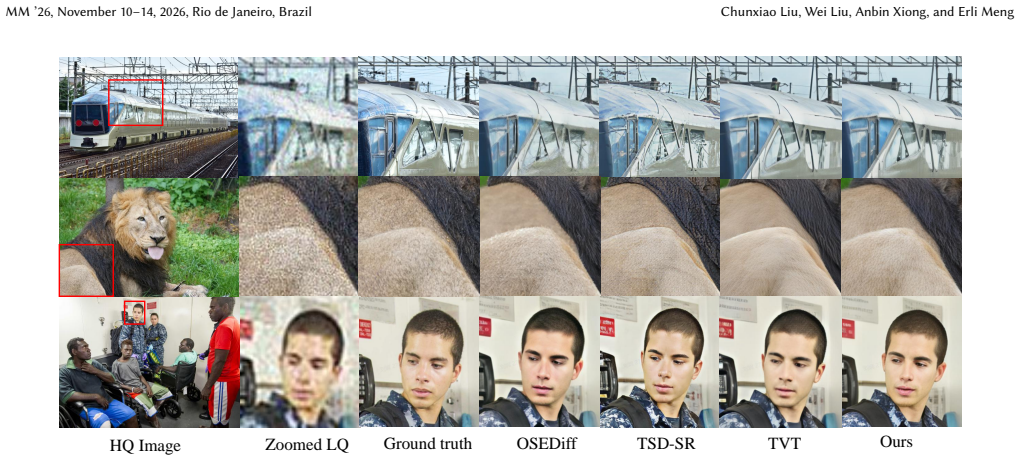
The central discovery claimed is that content drift in one-step diffusion-based real-world super-resolution arises from the loss of structured details in the VAE-compressed latent and from the unreliability of text captions derived from low-quality images, and that both can be mitigated by explicitly extracting fine structures from the input and using them in two complementary ways. FSP-Diff's Detail-Conditioned Pathway uses a frozen first-block ViT feature map at one-eighth resolution as structured detail, compresses it through a Detail-Aware Token Compression module, and injects the resulting tokens into each UNet block through Structured Detail Conditioned Attention placed after the text cross-attention. The Detail-Modulated Semantic Pathway computes attention between text embeddings and the structured detail map, producing a refined text conditioning that replaces the original caption embedding. Trained with L1 and LPIPS reconstruction losses plus variational score distillation regularization and a shifted timestep distribution, the model attains the best or second-best results on most benchmark metrics and, in the paper's qualitative comparisons, avoids both the stochastic artifacts of the baseline and the polygonal artifacts of a fine-structure-preserving competitor.
Load-bearing premise
The whole scheme rests on the assumption that the first block of a frozen ViT, applied to the low-quality image, retains the fine structures that the VAE latent has discarded, and that the DATC and SDCA modules can feed those structures into the generator without introducing their own artifacts.
Editorial extensions
If this is right
- One-step real-world super-resolution can preserve fine structures without retraining a less-compressed VAE, avoiding the multi-stage pipeline used by methods that transfer the VAE to a lower compression ratio.
- Adding the two pathways to an existing one-step diffusion baseline raises fidelity and perceptual metrics together, suggesting that detail injection and semantic modulation do not force the usual fidelity-perception trade-off.
- Because the structured-detail extractor is frozen and the token set is small, the dual-pathway design adds only modest inference cost, about 0.15 seconds versus 0.12 seconds for the baseline on the reported hardware.
- The semantic pathway uses the same detail features as the detail pathway, so semantic mis-reconstructions such as rendering a house as a snow pile are corrected without introducing an extra captioning model beyond the existing prompt extractor.
- The design is compatible with the one-step latent diffusion formulation and can be trained in a single stage on the same training data as the baseline.
Reading between the lines
- The dual-pathway principle may transfer to other diffusion-based restoration tasks, such as deblurring or deraining, where the input carries high-frequency structure that the latent drops and where text prompts from degraded images are unreliable.
- The success of the frozen first-block ViT features suggests a general recipe: bypass the VAE's lossy compression with an off-the-shelf high-resolution feature extractor, then compress adaptively before injection.
- A testable extension is to generate the semantic conditioning directly from the structured-detail tokens, which could remove the dependency on the captioning module entirely.
- The ViT-depth ablation implies that only the earliest layer of the encoder matters for this purpose, so a lightweight edge-and-boundary extractor might achieve similar gains at lower computational cost.
Signed reviews
Editorial analysis
A structured set of objections, weighed in public.
Referee Report
Summary. The manuscript proposes FSP-Diff, a one-step diffusion model for real-world image super-resolution (Real-ISR). It augments an OSEDiff-style Stable Diffusion 2.1 backbone with two pathways: a Detail-Conditioned Pathway that extracts structured details from frozen early ViT features, compresses them with a Detail-Aware Token Compression module, and injects them via Structured Detail Conditioned Attention; and a Detail-Modulated Semantic Pathway that refines text embeddings with a Semantic-Detail Modulator. Training uses L1+LPIPS reconstruction together with variational score distillation and a shifted timestep-sampling distribution. The model is evaluated on DIV2K-val, RealSR, and DRealSR against one-step diffusion baselines, and the paper reports ablations of components and hyperparameters as well as inference complexity.
Significance. If the claimed gains are reproducible, the core idea—using early-layer ViT features as a structured-detail complement to the lossy VAE latent and conditioning both detail injection and semantic modulation on those features—is a plausible and useful direction for one-step Real-ISR. The paper has strengths: it uses standard benchmarks and baselines, reports parameter/FLOP/latency comparisons, and makes an effort to match OSEDiff's training setup. However, the experimental validation as reported does not fully support the central claims: the headline model and the component ablations use different feature extractors, several hyperparameters are selected directly on the test benchmarks, and the abstract overstates the quantitative comparison.
major comments (4)
- [Section 4.3, Tables 2 and 4] The component ablation is run with the VAE+ extractor, while the headline FSP-Diff model in Tables 1–3 uses the ViT+ first-block extractor. The paper acknowledges this but asserts it 'does not affect the conclusions' without support. Table 2 shows the two extractors produce measurably different results: ViT+DATC_D4 gives DISTS 0.2014, MANIQA 0.6092, FID 127.19, and CLIPIQA 0.6868, whereas VAE+DATC_D4 gives DISTS 0.2048, MANIQA 0.6053, FID 125.34, and CLIPIQA 0.6725. Table 4's 'Full' row (PSNR 28.93, DISTS 0.2048, NIQE 6.21, MANIQA 0.6053, FID 125.34) matches the VAE-based configuration, not the ViT-based model whose results are advertised. The incremental gains attributed to SDCA, DATC, and SDM in Table 4 are of the same order as the differences caused by the extractor choice, so the component-wise attribution for the final model is not established. The ablations should be rerun with the ViT+ extractor, or the authors should provide direct evidence that the extractor choice does not change the conclusions.
- [Section 4.3, Tables 3, 5, and 6] Several key hyperparameters are selected using the same benchmark test sets that are later reported as the main results. Table 3 selects ViT depth on DRealSR, Table 5 selects L_q (presumably on DRealSR, though the table is not labeled), and Table 6 selects the shift parameter on DIV2K according to the caption but on DRealSR according to the main text. Since the final configuration is chosen by comparing directly on these benchmarks, the numbers in Table 1 are not held-out evaluations, and the reported improvements are inflated by test-set optimizer's curse. The authors should use a separate validation split or nested evaluation procedure for hyperparameter selection and then report unbiased test-set numbers.
- [Abstract and Table 1] The abstract claims that FSP-Diff 'surpasses existing one-step diffusion methods in both quantitative and qualitative metrics,' but Table 1 contradicts this on several no-reference metrics. TSD-SR outperforms FSP-Diff on CLIPIQA on all three benchmarks (0.7344 vs 0.6868 on DRealSR, 0.7160 vs 0.6687 on RealSR, 0.7416 vs 0.6583 on DIV2K-Val) and on MUSIQ on all three (66.62 vs 65.17, 71.19 vs 68.60, 71.69 vs 67.78). TSD-SR also has better NIQE on RealSR and DIV2K-Val, and PiSA-SR has better MANIQA on RealSR and DIV2K-Val. The text in Section 4.2 partially acknowledges this, but the abstract and contribution statements should be revised to claim competitiveness or superiority only on the specific metrics and benchmarks where it holds.
- [Table 4 and Section 4.3] The table shows that 'Full' (with shift s=0.9) has worse PSNR than 'Add SDM' (s=1.0) by 0.13 dB and worse FID by 0.79, while improving only NIQE and MANIQA by small margins. The manuscript states that 'Full' is the best configuration, but it is not supported by the fidelity metrics reported in the same table. This is a specific internal inconsistency in the ablation story for the shift parameter. The authors should report the trade-off explicitly and justify why the perceptual gains outweigh the fidelity loss, or adjust the claimed best configuration.
minor comments (5)
- [Section 4.1] The text says the DIV2K-val dataset contains 3,000 LR–HR image pairs, but the standard DIV2K validation set contains only 100 images; please clarify whether this is a different synthesized validation set of crops.
- [Section 4.3 and Table 6] The caption of Table 6 says 'DIV2K Benchmark,' while the main text says the shift hyperparameter is evaluated on the 'DRealSR test set.' These need to be reconciled.
- [Table 5] The table does not state which benchmark is used for the L_q ablation; it should be labeled for reproducibility.
- [Section 3.3] The 'vit_b' feature extractor is not precisely specified; please state which pretrained ViT checkpoint (e.g., CLIP ViT-B/32, DINOv2, or another model) is used, how the input is preprocessed, and at which spatial resolution the features are taken.
- [Section 4.3] There are minor typos: 'we adopt adopt this value' and 'experimemts'; also Table 2's VAE row is missing spaces between numeric entries.
Circularity Check
No significant circularity: the dual-pathway result is benchmarked against external baselines, while the ablation-extractor mismatch and test-set hyperparameter selection are validity concerns rather than circular reductions.
full rationale
FSP-Diff's central claim—that a dual-pathway detail-conditioned architecture improves one-step Real-ISR—is not derived from its own inputs by construction. The architecture is an empirical proposal (Eqs. 1–11 define the flow, losses, and timestep shift), and its success is evaluated against external benchmarks and public baselines (Table 1), so the reported scores are not logically forced. The VSD regularizer is adopted from OSEDiff [49] and the DAPE prompt extractor from SeeSR [50]; these are prior works with no author overlap with the present paper, and they do not contain the dual-pathway claim, so there is no load-bearing self-citation chain. The main validity concerns are non-circular: Table 6, Table 5, and Table 3 select the shift s, query length Lq, and ViT depth on the evaluation sets themselves, which weakens the 'surpasses' claim as an unbiased prediction; and Section 4.3 explicitly says the component ablation uses the VAE+ extractor while the final model uses ViT+ ('This choice does not affect the conclusions'), even though Table 2's VAE+DATC_D4 row (FID 125.34) is numerically the 'Full' row of Table 4 rather than the headline Table 1 model (FID 127.19). These are experimental-support and selection-bias problems, not reductions of the claimed result to its inputs by equation or by self-citation. No Eq. X = Eq. Y by construction and no fitted parameter renamed as a prediction was found; therefore the circularity score is 0.
Assumptions & free parameters
free parameters (6)
- lambda (reconstruction/VSD balance) =
1
- lambda1 (LPIPS weight) =
2
- shift parameter s =
0.9
- L_q (DATC query count) =
400
- M (DATC depth) =
4
- ViT feature depth =
first block
assumptions (5)
- domain assumption Pre-trained Stable Diffusion 2.1-base provides a valid generative prior for LQ-to-HQ mapping.
- domain assumption Real-ESRGAN degradation pipeline produces LQ images representative of real-world degradations.
- domain assumption DAPE-generated captions from LQ images provide useful semantic guidance.
- domain assumption VSD regularization from OSEDiff improves generalization of the one-step generator.
- ad hoc to paper Early ViT features retain the structured details lost by VAE compression.
Cite this review
Pith. "Pith review of Preserve More Details: Mitigating Content Drift in Real-World Image Super-Resolution." pith.science (2026). https://pith.science/paper/JHOKLS5W
@misc{pith2026260809373,
  author       = {Pith},
  title        = {Pith review of: Preserve More Details: Mitigating Content Drift in Real-World Image Super-Resolution},
  year         = {2026},
  howpublished = {\url{https://pith.science/paper/JHOKLS5W}},
  note         = {Machine review of arXiv:2608.09373}
}
read the original abstract
Real-world image super-resolution (Real-ISR) aims to reconstruct high-quality (HQ) images from low-quality (LQ) inputs subject to diverse real-world degradations. Recent advances have leveraged the LQ inputs and natural image priors learned by Stable Diffusion models to achieve impressive results. However, existing methods often overlook insufficient clarity of LQ inputs inevitably induce content drift in the generated HQ images. This manifests primarily as visual detail degradation and textual semantic shift, severely compromising both fidelity and perceptual quality. To address this challenge, we propose FSP-Diff, a novel one-step diffusion model featuring a dual-pathway architecture. This architecture comprises a Detail-Conditioned Pathway for injecting structured details to recover fine structures, and a Detail-Modulated Semantic Pathway that refines semantic guidance using structured details to mitigate semantic deviations. Extensive experiments on standard Real-ISR benchmarks demonstrate that FSP-Diff surpasses existing one-step diffusion methods in both quantitative and qualitative metrics.
Figures


Figures from the paper (2 more)


Reference graph
Works this paper leans on
-
[1]
Eirikur Agustsson and Radu Timofte. 2017. Ntire 2017 challenge on single image super-resolution: Dataset and study. InProceedings of the IEEE conference on computer vision and pattern recognition workshops. 126–135
2017
-
[2]
Jianrui Cai, Hui Zeng, Hongwei Yong, Zisheng Cao, and Lei Zhang. 2019. Toward real-world single image super-resolution: A new benchmark and a new model. InProceedings of the IEEE/CVF international conference on computer vision. 3086– 3095
work page 2019
-
[3]
Chaofeng Chen, Xinyu Shi, Yipeng Qin, Xiaoming Li, Xiaoguang Han, Tao Yang, and Shihui Guo. 2022. Real-world blind super-resolution via feature matching with implicit high-resolution priors. InProceedings of the 30th ACM International Conference on Multimedia. 1329–1338
work page 2022
-
[4]
Hanting Chen, Yunhe Wang, Tianyu Guo, Chang Xu, Yiping Deng, Zhenhua Liu, Siwei Ma, Chunjing Xu, Chao Xu, and Wen Gao. 2021. Pre-trained image processing transformer. InProceedings of the IEEE/CVF conference on computer vision and pattern recognition. 12299–12310
work page 2021
-
[5]
Junyang Chen, Jinshan Pan, and Jiangxin Dong. 2025. Faithdiff: Unleashing diffusion priors for faithful image super-resolution. InProceedings of the Computer Vision and Pattern Recognition Conference. 28188–28197
work page 2025
-
[6]
Junsong Chen, Jincheng Yu, Chongjian Ge, Lewei Yao, Enze Xie, Yue Wu, Zhong- dao Wang, James Kwok, Ping Luo, Huchuan Lu, et al. 2023. Pixart-𝛼: Fast training of diffusion transformer for photorealistic text-to-image synthesis.arXiv preprint arXiv:2310.00426(2023)
arXiv 2023
-
[7]
Tao Dai, Jianrui Cai, Yongbing Zhang, Shu-Tao Xia, and Lei Zhang. 2019. Second- order attention network for single image super-resolution. InProceedings of the IEEE/CVF conference on computer vision and pattern recognition. 11065–11074
work page 2019
-
[8]
Trung Dao, Thuan Hoang Nguyen, Thanh Le, Duc Vu, Khoi Nguyen, Cuong Pham, and Anh Tran. 2024. Swiftbrush v2: Make your one-step diffusion model better than its teacher. InEuropean Conference on Computer Vision. Springer, 176–192
work page 2024
Show all 70 references
-
[9]
Prafulla Dhariwal and Alexander Nichol. 2021. Diffusion models beat gans on image synthesis.Advances in neural information processing systems34 (2021), 8780–8794
2021
-
[10]
Keyan Ding, Kede Ma, Shiqi Wang, and Eero P Simoncelli. 2020. Image quality assessment: Unifying structure and texture similarity.IEEE transactions on pattern analysis and machine intelligence44, 5 (2020), 2567–2581
2020
-
[11]
Linwei Dong, Qingnan Fan, Yihong Guo, Zhonghao Wang, Qi Zhang, Jinwei Chen, Yawei Luo, and Changqing Zou. 2025. Tsd-sr: One-step diffusion with target score distillation for real-world image super-resolution. InProceedings of the Computer Vision and Pattern Recognition Confere...
2025
-
[12]
Alexey Dosovitskiy, Lucas Beyer, Alexander Kolesnikov, Dirk Weissenborn, Xi- aohua Zhai, Thomas Unterthiner, Mostafa Dehghani, Matthias Minderer, Georg Heigold, Sylvain Gelly, et al. 2020. An image is worth 16x16 words: Transformers for image recognition at scale.arXiv preprin...
2020 arXiv
-
[13]
Patrick Esser, Sumith Kulal, Andreas Blattmann, Rahim Entezari, Jonas Müller, Harry Saini, Yam Levi, Dominik Lorenz, Axel Sauer, Frederic Boesel, et al. 2024. Scaling rectified flow transformers for high-resolution image synthesis. InForty- first international conference on ma...
2024
-
[14]
Ian J Goodfellow, Jean Pouget-Abadie, Mehdi Mirza, Bing Xu, David Warde-Farley, Sherjil Ozair, Aaron Courville, and Yoshua Bengio. 2014. Generative adversarial nets.Advances in neural information processing systems27 (2014)
2014
-
[15]
Martin Heusel, Hubert Ramsauer, Thomas Unterthiner, Bernhard Nessler, and Sepp Hochreiter. 2017. Gans trained by a two time-scale update rule converge to a local nash equilibrium.Advances in neural information processing systems30 (2017)
2017
-
[16]
Jonathan Ho, Ajay Jain, and Pieter Abbeel. 2020. Denoising diffusion probabilistic models.Advances in neural information processing systems33 (2020), 6840–6851
2020
-
[17]
Edward J Hu, Yelong Shen, Phillip Wallis, Zeyuan Allen-Zhu, Yuanzhi Li, Shean Wang, Lu Wang, Weizhu Chen, et al. 2022. Lora: Low-rank adaptation of large language models.ICLR1, 2 (2022), 3
2022
-
[18]
Tero Karras, Samuli Laine, and Timo Aila. 2019. A style-based generator ar- chitecture for generative adversarial networks. InProceedings of the IEEE/CVF conference on computer vision and pattern recognition. 4401–4410
2019
-
[19]
Bahjat Kawar, Michael Elad, Stefano Ermon, and Jiaming Song. 2022. Denoising diffusion restoration models.Advances in neural information processing systems 35 (2022), 23593–23606
2022
-
[20]
Junjie Ke, Qifei Wang, Yilin Wang, Peyman Milanfar, and Feng Yang. 2021. Musiq: Multi-scale image quality transformer. InProceedings of the IEEE/CVF international conference on computer vision. 5148–5157
2021
-
[21]
Alina Kuznetsova, Hassan Rom, Neil Alldrin, Jasper Uijlings, Ivan Krasin, Jordi Pont-Tuset, Shahab Kamali, Stefan Popov, Matteo Malloci, Alexander Kolesnikov, et al. 2020. The open images dataset v4: Unified image classification, object detection, and visual relationship detec...
2020
-
[22]
Yawei Li, Kai Zhang, Jingyun Liang, Jiezhang Cao, Ce Liu, Rui Gong, Yulun Zhang, Hao Tang, Yun Liu, Denis Demandolx, et al. 2023. Lsdir: A large scale dataset for image restoration. InProceedings of the IEEE/CVF Conference on Computer Vision and Pattern Recognition. 1775–1787
2023
-
[23]
Jingyun Liang, Jiezhang Cao, Guolei Sun, Kai Zhang, Luc Van Gool, and Radu Timofte. 2021. Swinir: Image restoration using swin transformer. InProceedings of the IEEE/CVF international conference on computer vision. 1833–1844
2021
-
[24]
Jie Liang, Hui Zeng, and Lei Zhang. 2022. Details or artifacts: A locally discrimi- native learning approach to realistic image super-resolution. InProceedings of the IEEE/CVF conference on computer vision and pattern recognition. 5657–5666
2022
-
[25]
Jie Liang, Hui Zeng, and Lei Zhang. 2022. Efficient and degradation-adaptive net- work for real-world image super-resolution. InEuropean Conference on Computer Vision. Springer, 574–591
2022
-
[26]
Bee Lim, Sanghyun Son, Heewon Kim, Seungjun Nah, and Kyoung Mu Lee
-
[27]
Shanchuan Lin, Xin Xia, Yuxi Ren, Ceyuan Yang, Xuefeng Xiao, and Lu Jiang
-
[28]
Xinqi Lin, Jingwen He, Ziyan Chen, Zhaoyang Lyu, Bo Dai, Fanghua Yu, Yu Qiao, Wanli Ouyang, and Chao Dong. 2024. Diffbir: Toward blind image restora- tion with generative diffusion prior. InEuropean conference on computer vision. Springer, 430–448
2024
-
[29]
Haotian Liu, Chunyuan Li, Qingyang Wu, and Yong Jae Lee. 2023. Visual in- struction tuning.Advances in neural information processing systems36 (2023), 34892–34916
2023
-
[30]
Simian Luo, Yiqin Tan, Longbo Huang, Jian Li, and Hang Zhao. 2023. Latent consistency models: Synthesizing high-resolution images with few-step inference. arXiv preprint arXiv:2310.04378(2023)
2023 arXiv
-
[31]
Jianqi Ma, Zhetong Liang, Wangmeng Xiang, Xi Yang, and Lei Zhang. 2023. A benchmark for chinese-english scene text image super-resolution. InProceedings of the IEEE/CVF International Conference on Computer Vision. 19452–19461
2023
-
[32]
Dustin Podell, Zion English, Kyle Lacey, Andreas Blattmann, Tim Dockhorn, Jonas Müller, Joe Penna, and Robin Rombach. 2023. Sdxl: Improving latent diffusion models for high-resolution image synthesis.arXiv preprint arXiv:2307.01952 (2023)
2023 arXiv
-
[33]
Yunpeng Qu, Kun Yuan, Kai Zhao, Qizhi Xie, Jinhua Hao, Ming Sun, and Chao Zhou. 2024. Xpsr: Cross-modal priors for diffusion-based image super-resolution. InEuropean Conference on Computer Vision. Springer, 285–303
2024
-
[34]
Robin Rombach, Andreas Blattmann, Dominik Lorenz, Patrick Esser, and Björn Ommer. 2022. High-resolution image synthesis with latent diffusion models. In Proceedings of the IEEE/CVF conference on computer vision and pattern recognition. 10684–10695
2022
-
[35]
Chitwan Saharia, William Chan, Saurabh Saxena, Lala Li, Jay Whang, Emily L Denton, Kamyar Ghasemipour, Raphael Gontijo Lopes, Burcu Karagol Ayan, Tim Salimans, et al. 2022. Photorealistic text-to-image diffusion models with deep language understanding.Advances in neural inform...
2022
-
[36]
Jiaming Song, Chenlin Meng, and Stefano Ermon. 2020. Denoising diffusion implicit models.arXiv preprint arXiv:2010.02502(2020)
2020 arXiv
-
[37]
Yang Song, Jascha Sohl-Dickstein, Diederik P Kingma, Abhishek Kumar, Stefano Ermon, and Ben Poole. 2020. Score-based generative modeling through stochastic differential equations.arXiv preprint arXiv:2011.13456(2020)
2020 arXiv
-
[38]
Lingchen Sun, Rongyuan Wu, Zhiyuan Ma, Shuaizheng Liu, Qiaosi Yi, and Lei Zhang. 2025. Pixel-level and semantic-level adjustable super-resolution: A dual- lora approach. InProceedings of the Computer Vision and Pattern Recognition Conference. 2333–2343
2025
-
[39]
Radu Timofte, Eirikur Agustsson, Luc Van Gool, Ming-Hsuan Yang, and Lei Zhang. 2017. Ntire 2017 challenge on single image super-resolution: Methods and results. InProceedings of the IEEE conference on computer vision and pattern recognition workshops. 114–125
2017
-
[40]
Ashish Vaswani, Noam Shazeer, Niki Parmar, Jakob Uszkoreit, Llion Jones, Aidan N Gomez, Łukasz Kaiser, and Illia Polosukhin. 2017. Attention is all you need.Advances in neural information processing systems30 (2017)
2017
-
[41]
Jianyi Wang, Kelvin CK Chan, and Chen Change Loy. 2023. Exploring clip for assessing the look and feel of images. InProceedings of the AAAI conference on artificial intelligence, Vol. 37. 2555–2563
2023
-
[42]
Jingkai Wang, Jue Gong, Lin Zhang, Zheng Chen, Xing Liu, Hong Gu, Yutong Liu, Yulun Zhang, and Xiaokang Yang. 2025. Osdface: One-step diffusion model for face restoration. InProceedings of the Computer Vision and Pattern Recognition Conference. 12626–12636
2025
-
[43]
Jianyi Wang, Zongsheng Yue, Shangchen Zhou, Kelvin CK Chan, and Chen Change Loy. 2024. Exploiting diffusion prior for real-world image super- resolution.International Journal of Computer Vision132, 12 (2024), 5929–5949
2024
-
[44]
Xintao Wang, Liangbin Xie, Chao Dong, and Ying Shan. 2021. Real-esrgan: Train- ing real-world blind super-resolution with pure synthetic data. InProceedings of the IEEE/CVF international conference on computer vision. 1905–1914
2021
-
[45]
Yufei Wang, Wenhan Yang, Xinyuan Chen, Yaohui Wang, Lanqing Guo, Lap-Pui Chau, Ziwei Liu, Yu Qiao, Alex C Kot, and Bihan Wen. 2024. Sinsr: diffusion-based image super-resolution in a single step. InProceedings of the IEEE/CVF conference MM ’26, November 10–14, 2026, Rio de Jan...
2024
-
[46]
Zhou Wang, Alan C Bovik, Hamid R Sheikh, and Eero P Simoncelli. 2004. Image quality assessment: from error visibility to structural similarity.IEEE transactions on image processing13, 4 (2004), 600–612
2004
-
[47]
Zhengyi Wang, Cheng Lu, Yikai Wang, Fan Bao, Chongxuan Li, Hang Su, and Jun Zhu. 2023. Prolificdreamer: High-fidelity and diverse text-to-3d generation with variational score distillation.Advances in neural information processing systems 36 (2023), 8406–8441
2023
-
[48]
Pengxu Wei, Ziwei Xie, Hannan Lu, Zongyuan Zhan, Qixiang Ye, Wangmeng Zuo, and Liang Lin. 2020. Component divide-and-conquer for real-world image super-resolution. InEuropean conference on computer vision. Springer, 101–117
2020
-
[49]
Rongyuan Wu, Lingchen Sun, Zhiyuan Ma, and Lei Zhang. 2024. One-step effective diffusion network for real-world image super-resolution.Advances in Neural Information Processing Systems37 (2024), 92529–92553
2024
-
[50]
Rongyuan Wu, Tao Yang, Lingchen Sun, Zhengqiang Zhang, Shuai Li, and Lei Zhang. 2024. Seesr: Towards semantics-aware real-world image super-resolution. InProceedings of the IEEE/CVF conference on computer vision and pattern recogni- tion. 25456–25467
2024
-
[51]
Liangbin Xie, Xintao Wang, Xiangyu Chen, Gen Li, Ying Shan, Jiantao Zhou, and Chao Dong. 2023. Desra: detect and delete the artifacts of gan-based real-world super-resolution models.arXiv preprint arXiv:2307.02457(2023)
2023 arXiv
-
[52]
Rui Xie, Chen Zhao, Kai Zhang, Zhenyu Zhang, Jun Zhou, Jian Yang, and Ying Tai
-
[53]
Sidi Yang, Tianhe Wu, Shuwei Shi, Shanshan Lao, Yuan Gong, Mingdeng Cao, Jia- hao Wang, and Yujiu Yang. 2022. Maniqa: Multi-dimension attention network for no-reference image quality assessment. InProceedings of the IEEE/CVF conference on computer vision and pattern recognitio...
2022
-
[54]
Tao Yang, Rongyuan Wu, Peiran Ren, Xuansong Xie, and Lei Zhang. 2024. Pixel- aware stable diffusion for realistic image super-resolution and personalized stylization. InEuropean conference on computer vision. Springer, 74–91
2024
-
[55]
Qiaosi Yi, Shuai Li, Rongyuan Wu, Lingchen Sun, Yuhui Wu, and Lei Zhang
-
[56]
Tianwei Yin, Michaël Gharbi, Richard Zhang, Eli Shechtman, Fredo Durand, William T Freeman, and Taesung Park. 2024. One-step diffusion with distribution matching distillation. InProceedings of the IEEE/CVF conference on computer vision and pattern recognition. 6613–6623
2024
-
[57]
Fanghua Yu, Jinjin Gu, Zheyuan Li, Jinfan Hu, Xiangtao Kong, Xintao Wang, Jingwen He, Yu Qiao, and Chao Dong. 2024. Scaling up to excellence: Practicing model scaling for photo-realistic image restoration in the wild. InProceedings of the IEEE/CVF conference on computer vision...
2024
-
[58]
Zongsheng Yue, Jianyi Wang, and Chen Change Loy. 2023. Resshift: Efficient diffusion model for image super-resolution by residual shifting.Advances in Neural Information Processing Systems36 (2023), 13294–13307
2023
-
[59]
InProceedings of the IEEE/CVF international conference on computer vision
Fine-structure preserved real-world image super-resolution via transfer vae training. InProceedings of the IEEE/CVF international conference on computer vision. 12415–12426
-
[60]
Kai Zhang, Jingyun Liang, Luc Van Gool, and Radu Timofte. 2021. Designing a practical degradation model for deep blind image super-resolution. InProceedings of the IEEE/CVF international conference on computer vision. 4791–4800
2021
-
[61]
Lvmin Zhang, Anyi Rao, and Maneesh Agrawala. 2023. Adding conditional con- trol to text-to-image diffusion models. InProceedings of the IEEE/CVF international conference on computer vision. 3836–3847
2023
-
[62]
Lin Zhang, Lei Zhang, and Alan C Bovik. 2015. A feature-enriched completely blind image quality evaluator.IEEE Transactions on Image Processing24, 8 (2015), 2579–2591
2015
-
[63]
Aiping Zhang, Zongsheng Yue, Renjing Pei, Wenqi Ren, and Xiaochun Cao. 2024. Degradation-guided one-step image super-resolution with diffusion priors.arXiv preprint arXiv:2409.17058(2024)
2024 arXiv
-
[64]
Xindong Zhang, Hui Zeng, Shi Guo, and Lei Zhang. 2022. Efficient long-range attention network for image super-resolution. InEuropean conference on computer vision. Springer, 649–667
2022
-
[65]
Yulun Zhang, Kunpeng Li, Kai Li, Lichen Wang, Bineng Zhong, and Yun Fu. 2018. Image super-resolution using very deep residual channel attention networks. In Proceedings of the European conference on computer vision (ECCV). 286–301
2018
-
[67]
Richard Zhang, Phillip Isola, Alexei A Efros, Eli Shechtman, and Oliver Wang
-
[2017]
In Proceedings of the IEEE conference on computer vision and pattern recognition workshops
Enhanced deep residual networks for single image super-resolution. In Proceedings of the IEEE conference on computer vision and pattern recognition workshops. 136–144
-
[2018]
InProceedings of the IEEE conference on computer vision and pattern recognition
The unreasonable effectiveness of deep features as a perceptual metric. InProceedings of the IEEE conference on computer vision and pattern recognition. 586–595
-
[2024]
Addsr: Accelerating diffusion-based blind super-resolution with adversarial diffusion distillation.arXiv preprint arXiv:2404.01717(2024)
2024 arXiv
-
[2025]
Diffusion adversarial post-training for one-step video generation.arXiv preprint arXiv:2501.08316(2025)
2025
Reviewed August 11, 2026 · model on record in the stance chip above.
Discussion (0). Continue with ORCID to comment.