REVIEW 4 major objections 5 minor 18 references
Atomic Reasoning for Scientific Table Claim Verification
T0 review · 4 major / 5 minor · reviewed 2026-08-07 · deepseek-v4-flash
Pith's one-line read Decomposing table verification into atomic reasoning skills beats GPT-4o chain-of-thought with just 350 training examples.
desk verdict Interesting skill-chaining method and new benchmark, but the headline 'beats GPT-4o CoT' only holds on SciTab, which may be contaminated by table overlap with the training set. read the letter →
The pith
A machine-rendered reading of the paper's core claim, the machinery that carries it, and where it could break.
The reading
What carries the argument
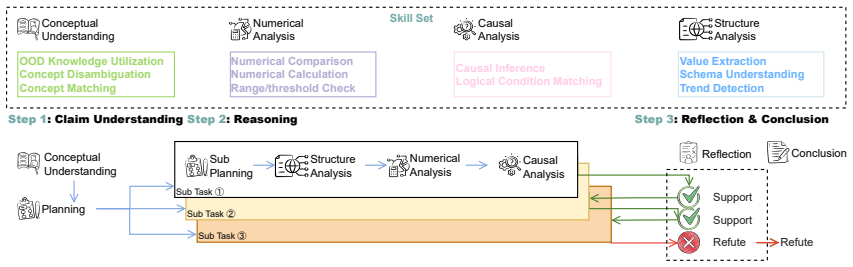
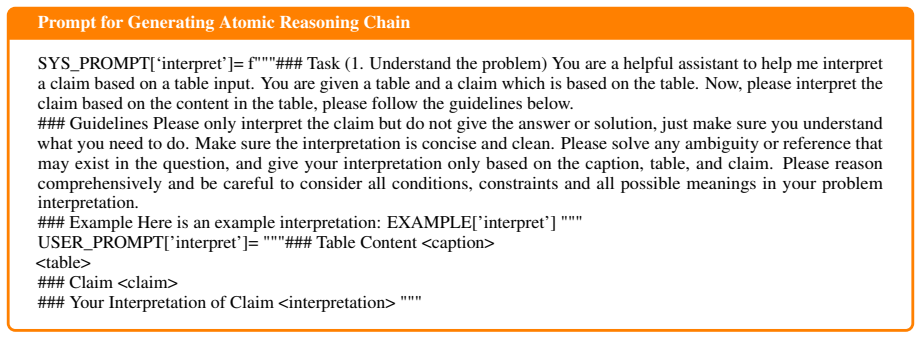
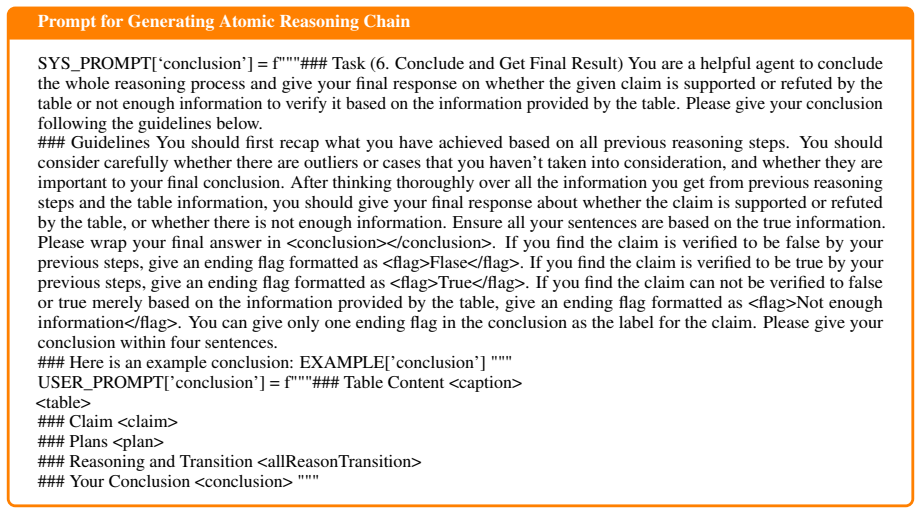
The carrying object is the skill-chaining schema, formalized as interpretation → planning → [subplan → cell grounding → reasoning → recap]^N → conclusion, with a fixed atomic skill set of Conceptual Understanding, Structure Analysis, Numerical Analysis, and Causal Analysis. Each reasoning step invokes only a subset of these skills, and cell grounding explicitly locates rows and columns before any numerical operation, which prevents the model from blurring or skipping intermediate steps. The paper's evidence that this mechanism works is that fine-tuning with atomic chains improves every base model tested, the gains persist across out-of-domain evaluation sets, and error analysis shows fewer snowball and coarse-grained errors than chain-of-thought reasoning.
What would settle it
Take the 868 SciTab claim-table pairs, remove any tables that also appear in the 800 SciAtomic machine-learning pairs sampled from SciGen, and rerun the fine-tuned model against GPT-4o chain-of-thought; if the accuracy gap vanishes or reverses, the claimed out-of-domain generalization does not hold. Alternatively, have two independent expert teams relabel a random sample of SciAtomic claims and check whether the model's errors concentrate on claims where the GPT-4o-generated label was wrong.
Extended reading notes
Core claim
The central claim is that explicit decomposition into atomic skills is what drives accurate table-claim verification, not raw model scale or long reasoning chains. The proposed method uses a skill-chaining schema that forces each verification step—interpretation, planning, per-subgoal cell grounding, reasoning with a selected subset of atomic skills, recap, and conclusion—to operate only on local context, with each step consuming only its predecessor's output. Trained on 350 fine-tuning examples from the machine-learning domain, the fine-tuned DeepSeek-R1-Qwen-7B model reaches 85.70% accuracy on the finance subset, and on the public SciTab benchmark it outperforms GPT-4o with chain-of-thought reasoning and surpasses state-of-the-art baselines. The paper also reports that the model exhibits emergent skill composition on out-of-domain materials tables, combining value extraction, numerical calculation, and schema understanding into compound skills it was not explicitly trained on.
Load-bearing premise
The benchmark's ground-truth labels are correct and unbiased, because if GPT-4o's claim generation embeds the same reasoning shortcuts that atomic reasoning is designed to catch, the measured advantage over GPT-4o is partly an artifact of the test set.
Editorial extensions
If this is right
- A 350-example fine-tune with atomic chains lifts DeepSeek-R1-Qwen-7B from 63.12% to 85.70% on the finance domain and improves every tested base model across all domains.
- On the public SciTab benchmark, atomic fine-tuning beats GPT-4o with chain-of-thought reasoning and outperforms table-specialized baselines trained on much larger datasets.
- Atomic supervision is complementary to reasoning-pretrained models: even the DeepSeek-R1 series improves under it, indicating the skills add inductive bias beyond standard chain-of-thought prompting.
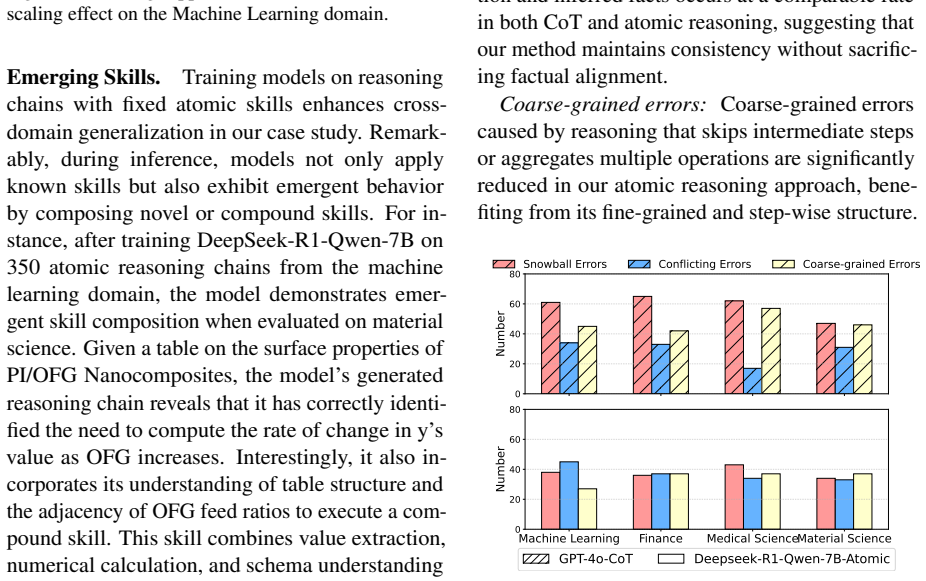
- Fine-grained reasoning chains enable emergent skill composition on out-of-domain materials tables, with the model invoking compound skills it was not explicitly trained on.
- Error analysis shows atomic reasoning reduces snowball errors and coarse-grained errors compared with GPT-4o chain-of-thought, while contextual-conflict errors occur at a comparable rate.
Reading between the lines
- A natural extension would be to check whether the benchmark inherits GPT-4o's own reasoning shortcuts, since the claims were generated by GPT-4o and reviewed by four volunteers; if so, part of the measured advantage may reflect alignment with the generator rather than generalizable reasoning skill.
- Because both SciTab and the SciAtomic machine-learning subset are sampled from SciGen, an overlap check between the two table collections would test whether the claimed out-of-domain SciTab result is genuinely out of domain.
- The schema's prompts allow the model to say 'not enough information' during reasoning, but the final labels are forced to SUPPORT or REFUTE; a three-way label scheme might reveal how often the table genuinely cannot settle a claim.
Editorial analysis
A structured set of objections, weighed in public.
Referee Report
Summary. The paper proposes "atomic reasoning" for scientific table claim verification: a skill-chaining schema that decomposes verification into modular atomic skills (conceptual understanding, structure analysis, numerical analysis, causal analysis). The authors introduce SciAtomicBench, a new cross-domain benchmark covering machine learning, materials, medicine, and finance, and fine-tune several open LLMs on only 350 training examples from the machine-learning subset. They evaluate on SciAtomic and on the external SciTab benchmark, reporting that their fine-tuned models outperform GPT-4o's chain-of-thought prompting and achieve state-of-the-art results. The paper also presents analyses of training/inference scaling, emerging skill composition, and error types.
Significance. If the central claims held, the paper would be a significant contribution to data-efficient table reasoning: it proposes a modular reasoning schema, releases a new benchmark with fine-grained annotations, and demonstrates strong performance with 350 examples compared to models trained on millions. The inclusion of a public external benchmark (SciTab) and multiple base-model ablations are strengths. However, the main performance claim is not supported by the reported numbers, and the one benchmark where the claim does hold (SciTab) suffers from a potentially serious leakage risk. The paper's methodological contribution—atomic skill decomposition—is interesting and worth exploring, but the empirical evidence as presented does not justify the abstract's sweeping superiority claim.
major comments (4)
- [Abstract and §5.3, Table 3] The abstract claims that "with only 350 fine-tuning examples, our model trained by atomic reasoning outperforms GPT-4o's chain-of-thought method, achieving state-of-the-art results," but Table 3 contradicts this on the authors' own SciAtomic benchmark: GPT-4o CoT achieves higher accuracy than every fine-tuned atomic model on SciAtomic ML (0.9025 vs 0.8200), Material (0.8580 vs 0.7653), and Medical (0.8152 vs 0.7654), and ties the best on Finance (0.8570 vs 0.8570). The only benchmark where a fine-tuned atomic model beats GPT-4o CoT is SciTab (0.7009 vs 0.5507). The abstract and introduction should be revised to restrict the claim to SciTab, or the claim should be removed.
- [§3.2, Appendix A, §1] The paper repeatedly describes SciTab as an "out-of-domain" evaluation set, but the ML subset of SciAtomic is constructed by sampling 1,376 table-caption pairs from SciGen (Section 3.2, Appendix A), and SciTab is a scientific table-claim benchmark whose source tables also come from the scientific literature, likely including SciGen. The paper never checks whether any of the 350 training tables, or the 50 validation tables, overlap with tables in SciTab. Without a deduplication analysis, the SciTab result may be inflated by table overlap or near-duplicate claims, and the "out-of-domain" generalization claim is therefore unevidenced.
- [§5.3, Table 3] The best result on SciTab is 0.7009 (Qwen2.5-14b fine-tuned), which is only 0.005 above the strongest baseline, TableGPT2 (0.6959). No significance testing or confidence intervals are reported for any of the Table 3 results. Given that the entire cross-domain superiority claim rests on this single small margin, the paper should provide significance tests (e.g., bootstrap or McNemar) to establish that the difference is not due to noise.
- [§3.3, Appendix C] The SciAtomic benchmark claims are generated by GPT-4o and then validated by four volunteers in roughly 20 person-hours total, with no inter-annotator agreement reported. If the claim-generation process embeds the same reasoning shortcuts that atomic reasoning is designed to expose, the in-domain results on SciAtomic may be favorably biased toward the proposed method. The paper should report inter-annotator agreement or provide an independent audit of label quality, and should discuss this limitation explicitly.
minor comments (5)
- [Table 3] The "Model Size" column lists GPT-4o as "7b"; GPT-4o is a proprietary model and its parameter count is not publicly known to be 7b. This is misleading and should be corrected.
- [§4.3] The formal definition of "Adequate Alignment" compares f_step(T,C,C_i) with f_step(T,C,C_{i-1}), which seems to compare the current step's output directly with the previous step's output rather than checking consistency with accumulated context; this should be clarified.
- [§5.1] The baselines list refers to "TableGPT" while Table 3 reports "TableGPT2"; please use consistent naming and cite the exact model used.
- [Figures 3 and 5] The quality evaluation in Figure 3 and the scaling plots in Figure 5 do not show error bars or variance across runs; since the text says GPT-4o evaluations were averaged over three runs, the variance should be reported.
- [§7] The limitations section mentions that the dataset may not be reproducible due to API changes and randomness, but it does not mention the lack of a deduplication check against existing benchmarks such as SciTab; this should be added to the limitations.
Circularity Check
No circular derivation: the paper's claims are empirical benchmark results, not consequences of its own definitions; external SciTab anchors the main comparison.
full rationale
The paper makes an empirical claim: fine-tuning on 350 atomic-reasoning examples improves table-claim verification accuracy, including on the external SciTab benchmark. No step in the derivation reduces by construction to its own inputs. The proposed skill-chaining schema is a prompting/fine-tuning method, not a theorem derived from a definition of atomic reasoning; the benchmark SciAtomicBench is introduced separately and used for evaluation, not as the source of the claimed gains. The main result against GPT-4o CoT is measured on SciTab, a pre-existing public benchmark, which provides independent grounding. The paper's self-citations (e.g., SCITAB by Lu et al. 2023, which shares an author) are used as prior work and baselines, not as load-bearing justification for the claimed improvement; no uniqueness theorem or equivalent is invoked. The use of GPT-4o to generate claims and to judge reasoning-chain quality is a potential benchmark-design and evaluation-methodology concern, but it is not a circularity: the paper does not define 'atomic reasoning works' in terms of GPT-4o's judgments, and the central SciTab comparison does not depend on the generated benchmark. Similarly, the possibility of table overlap between SciGen-sourced training data and SciTab is a data-leakage/correctness risk, not a definitional identity between a fitted parameter and a predicted quantity. Overall, the claimed results are empirical and falsifiable, so the circularity score is 0.
Assumptions & free parameters
free parameters (3)
- Skill-chain schema structure
- Atomic skill set
- Fine-tuning hyperparameters =
3 epochs, LR 1e-5, temperature 0.8, top-k 0.9
assumptions (4)
- domain assumption SciAtomicBench ground-truth labels are correct and unbiased.
- domain assumption SciTab and SciAtomic ML subsets are disjoint.
- domain assumption Accuracy on a balanced binary benchmark is an adequate measure of verification quality.
- domain assumption GPT-4o can reliably judge reasoning chain quality.
invented entities (1)
-
Atomic skills
Cite this review
Pith. "Pith review of Atomic Reasoning for Scientific Table Claim Verification." pith.science (2026). https://pith.science/paper/JHS6NRWN
@misc{pith2026250606972,
  author       = {Pith},
  title        = {Pith review of: Atomic Reasoning for Scientific Table Claim Verification},
  year         = {2026},
  howpublished = {\url{https://pith.science/paper/JHS6NRWN}},
  note         = {Machine review of arXiv:2506.06972}
}
read the original abstract
Scientific texts often convey authority due to their technical language and complex data. However, this complexity can sometimes lead to the spread of misinformation. Non-experts are particularly susceptible to misleading claims based on scientific tables due to their high information density and perceived credibility. Existing table claim verification models, including state-of-the-art large language models (LLMs), often struggle with precise fine-grained reasoning, resulting in errors and a lack of precision in verifying scientific claims. Inspired by Cognitive Load Theory, we propose that enhancing a model's ability to interpret table-based claims involves reducing cognitive load by developing modular, reusable reasoning components (i.e., atomic skills). We introduce a skill-chaining schema that dynamically composes these skills to facilitate more accurate and generalizable reasoning with a reduced cognitive load. To evaluate this, we create SciAtomicBench, a cross-domain benchmark with fine-grained reasoning annotations. With only 350 fine-tuning examples, our model trained by atomic reasoning outperforms GPT-4o's chain-of-thought method, achieving state-of-the-art results with far less training data.
Figures


Figures from the paper (12 more)






Reference graph
Works this paper leans on
-
[1]
Read the table content carefully and try to understand what information is given in the table
-
[2]
that are meaningful in the domain
Identify more than five key aspects that you can make claims about trend, maximum, average, inf erence, etc. that are meaningful in the domain. When writing the claim, ensure you incorporate specific knowledge from the field related to the table. Naturally incorporate the domain knowledge into the calculation
-
[3]
Make the claims complex in mathematical calculation but clear in expression. The data in the table must clearly support the claim based on physical principles of the domain or experimental facts, not just superficial correlations
-
[4]
In order to verify the claim, commplex calculations like multi-step complex deduction, sum, trend, multiplication and etc. should be needed
-
[5]
Adjust the claim to be more deterministic, precise, diverse, and complex. Delete vague words like "poorly", "smilarly", "substantially", "consistently" and "significantly". Change vague words to comparative metrics like "perform worse than", "same", and "increase" and include specific calculated numbers from the table
-
[6]
Write the scientific claim to make it more natural by integrating the domain knowledge into the numerical trend rather than explicitly stating it. The revision should maintain a formal scientific tone, keep the focus on the numerical relationship, and avoid directly explaining the underlying mechanism. Convey the scientific conclusion implicitly through t...
-
[7]
Pubtables-1m: Towards comprehensive table extraction from unstructured documents. In Proceed- ings of the IEEE/CVF Conference on Computer Vi- sion and Pattern Recognition, pages 4634–4642. Aofeng Su, Aowen Wang, Chao Ye, Chen Zhou, Ga Zhang, Guangcheng Zhu, Haobo Wang, Haokai Xu, Hao Chen, Haoze Li, Haoxuan Lan, Jiaming Tian, Jing Yuan, Junbo Zhao, Junlin...
work page 2024
-
[8]
Generate claims that require calculation between several cells in the table
Do not write claims that need to be verified by locating all the cells in the table. Generate claims that require calculation between several cells in the table. Avoid trivial numerical comparison. Involve complex multi-step implicit computation for the claim
Show all 18 references
-
[9]
sig- nificantly better
Large language models are complex table parsers. In Proceedings of the 2023 Conference on Empirical Methods in Natural Language Process- ing, pages 14786–14802, Singapore. Association for Computational Linguistics. Mingyang Zhou, Yi Fung, Long Chen, Christopher Thomas, Heng Ji...
2023
-
[16]
Naturally incorporate the domain knowledge into the calculation
The claim should involve complex and challenging calculations, requiring a deep understanding of the table as well as partial knowledge of the domain. Naturally incorporate the domain knowledge into the calculation. It goes beyond simple cell-to-cell operations or comparisons....
-
[18]
possibly due to
Check the calculation results to be correct, if it is not correct, calculate it again and ensure the final results shown in the claim is correct. The claim should include the final numerical computational result. Write concrete determinstric claim. Avoid speculative sentences ...
-
[2010]
Team Qwen, Baosong Yang, B Zhang, B Hui, B Zheng, B Yu, Chengpeng Li, D Liu, F Huang, H Wei, et al
Cognitive load theory. Team Qwen, Baosong Yang, B Zhang, B Hui, B Zheng, B Yu, Chengpeng Li, D Liu, F Huang, H Wei, et al
-
[2018]
In Proceed- ings of the 11th International Conference on Natural Language Generation, pages 10–21, Tilburg Univer- sity, The Netherlands
Describing a knowledge base. In Proceed- ings of the 11th International Conference on Natural Language Generation, pages 10–21, Tilburg Univer- sity, The Netherlands. Association for Computational Linguistics. Qingyun Wang, Semih Yavuz, Xi Victoria Lin, Heng Ji, and Nazneen Ra...
2022 arXiv
-
[2020]
In Proceedings of the 58th Annual Meet- ing of the Association for Computational Linguistics, pages 4320–4333, Online
TaPas: Weakly supervised table parsing via pre-training. In Proceedings of the 58th Annual Meet- ing of the Association for Computational Linguistics, pages 4320–4333, Online. Association for Computa- tional Linguistics. Kevin Hu, Snehalkumar ’Neil’ S. Gaikwad, Madelon Hulsebo...
2019
-
[2021]
In IEEE/WIC/ACM International Conference on Web Intelligence and Intelligent Agent Technology, pages 518–523
Do you trust experts on twitter? successful correction of covid-19-related misinformation. In IEEE/WIC/ACM International Conference on Web Intelligence and Intelligent Agent Technology, pages 518–523. Nelson F. Liu, Kevin Lin, John Hewitt, Ashwin Paran- jape, Michele Bevilacqu...
2024 arXiv
-
[2022]
In Find- ings of the Association for Computational Linguistics: NAACL 2022, pages 1–16, Seattle, United States
PubHealthTab: A public health table-based dataset for evidence-based fact checking. In Find- ings of the Association for Computational Linguistics: NAACL 2022, pages 1–16, Seattle, United States. As- sociation for Computational Linguistics. Roberto Bolli, Joshua M Hare, Keith ...
2022 arXiv
-
[2023]
In Proceedings of The 26th International Conference on Artificial In- telligence and Statistics, volume 206 of Proceedings of Machine Learning Research , pages 5549–5581
Tabllm: Few-shot classification of tabular data with large language models. In Proceedings of The 26th International Conference on Artificial In- telligence and Statistics, volume 206 of Proceedings of Machine Learning Research , pages 5549–5581. PMLR. Jonathan Herzig, Pawel K...
-
[2024]
Computation and Language, arXiv:2412.15115
Qwen2 technical report. Computation and Language, arXiv:2412.15115. Mourad Sarrouti, Asma Ben Abacha, Yassine Mrabet, and Dina Demner-Fushman. 2021. Evidence-based fact-checking of health-related claims. In Findings of the Association for Computational Linguistics: EMNLP 2021,...
2021 arXiv
Reviewed August 7, 2026 · model on record in the stance chip above.
Discussion (0). Sign in to comment.