REVIEW 3 major objections 4 minor 17 references
Light charged Higgs boson production at future $ep$ colliders
T0 review · 3 major / 4 minor · reviewed 2026-08-14 · deepseek-v4-flash
Pith's one-line read A light charged Higgs boson could be detectable at the proposed LHeC electron-proton collider, this simulation study argues.
desk verdict A clean conference recap of the authors' PRD study, but it brings no new results and its Table 3 has an internal inconsistency that should be fixed before the numbers are used. read the letter →
The pith
A machine-rendered reading of the paper's core claim, the machinery that carries it, and where it could break.
The reading
What carries the argument
The machinery is the four-zero texture imposed on the Hermitian Yukawa matrices $Y_1$ and $Y_2$, which after electroweak symmetry breaking gives fermion couplings of the form $[\tilde{Y}^f_n]_{ij}=(\sqrt{m_i m_j}/v)[\chi^f_n]_{ij} e^{i\theta}$. This texture keeps flavor-changing neutral currents under control while allowing both Higgs doublets to couple to both up- and down-type quarks. From it come the charged-Higgs couplings $X_{ij}$, $Y_{ij}$, $Z_{ij}$ that determine the production cross section and branching ratios, and a general two-doublet scalar potential supplies the Higgs spectrum. The rest of the argument is a cut flow: selection of three jets with b-tagging, a forward jet, and an invariant-mass window around $m_{H^\pm}$ for the $b\bar{c}$ channel, or one b-jet plus a lepton and a transverse-mass window for the $\tau$ channel.
What would settle it
Compute the four benchmark points of Section 2 against the current measured values of flavor observables such as $B\to X_s\gamma$ and $B_s\to\mu^+\mu^-$ and the measured 125 GeV Higgs signal rates; exclusion of any benchmark, or a null result from an LHeC run at $100~\mathrm{fb}^{-1}$ with $m_{H^\pm}=110$ GeV, would falsify the paper's feasibility claim.
Extended reading notes
Core claim
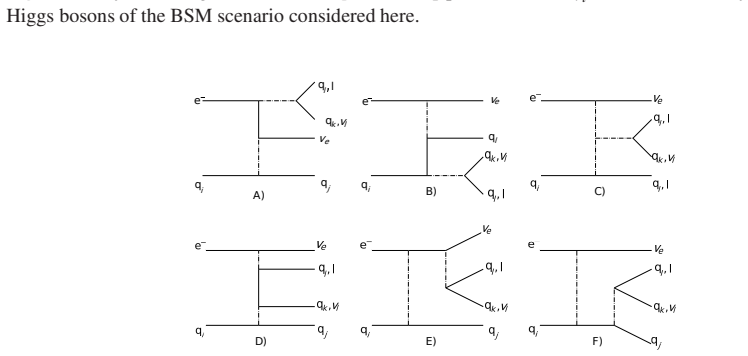
The central claim is that detecting a light charged Higgs boson at the LHeC is feasible in the 2HDM-III. Specifically, the paper shows that for four benchmark points drawn from the same authors' prior study, the process $e^-p\to\nu_e q H^-$ followed by $H^-\to b\bar{c}$ and $H^-\to\tau\bar{\nu}_\tau$ survives a sequence of detector-level cuts, yielding $S/\sqrt{B}=1.43$, $1.40$, $2.41$ and $4.18$ at $100~\mathrm{fb}^{-1}$ for $m_{H^\pm}=110$ GeV in the like-I, -II, -X and -Y incarnations, respectively. The strongest $b\bar{c}$ signal comes from the like-Y benchmark, while the $\tau\bar{\nu}_\tau$ signal is strongest in the like-X case. At integrated luminosities of 1000 and 3000 $\mathrm{fb}^{-1}$, the significances grow to roughly 4.5–13 and 7.8–22.5 for the best channels. The paper concludes that the LHeC's standard energy ($\sqrt{s}\approx1.3$ TeV) and luminosity assumptions are sufficient for these prospects.
Load-bearing premise
The quoted significances rely on benchmark parameter points taken from the authors' previous study without re-testing them against current flavor and collider constraints; if those points are excluded, or if the LHeC does not deliver the assumed $\sqrt{s}\approx1.3$ TeV and $100$ to $3000~\mathrm{fb}^{-1}$, the detection claim does not stand.
Editorial extensions
If this is right
- At the LHeC with $\sqrt{s}\approx1.3$ TeV and $100~\mathrm{fb}^{-1}$, a 110 GeV charged Higgs in the 2HDM-III would be visible with $S/\sqrt{B}$ between 1.4 and 4.2, and the significance grows with integrated luminosity.
- The $H^-\to b\bar{c}$ channel works best in the 2HDM-III like-I, -II and -Y incarnations, while $H^-\to\tau\bar{\nu}_\tau$ is the discovery channel in the like-X incarnation.
- For heavier masses, the prospects degrade sharply: at $m_{H^\pm}=150$ GeV the significances fall below about 0.3 at $100~\mathrm{fb}^{-1}$ in most scenarios, so the LHeC coverage is concentrated on light charged Higgs states.
- A modest set of sequential cuts—jet multiplicity, b-tagging, forward-jet selection, and mass-window reconstruction—is enough to suppress both reducible and irreducible backgrounds.
- The analysis supports the view that an $ep$ collider can act as a charged-Higgs discovery machine in a mass range where hadron-collider searches face large backgrounds.
Reading between the lines
- The quoted reach extends with luminosity: at $3000~\mathrm{fb}^{-1}$, the same cut flow should probe charged Higgs masses beyond 110 GeV, since the 130 GeV benchmarks already give $S/\sqrt{B}$ in the 3.2–7.8 range.
- The conclusion depends on the four chosen benchmark points, not on a scan of the parameter space; mapping the full allowed $\chi$ region would show whether the 110 GeV detectability is generic or confined to those points.
- The same event-selection strategy could be adapted to other charged-Higgs decay modes—for instance $H^-\to c\bar{s}$ or $H^-\to t\bar{b}$—and to other two-Higgs-doublet realizations, potentially widening the LHeC's charged-Higgs reach.
Signed reviews
Editorial analysis
A structured set of objections, weighed in public.
Referee Report
Summary. This paper investigates the observability of a light charged Higgs boson H− at the proposed LHeC e−p collider within the 2HDM type III with a four-zero Yukawa texture. The charged-current process e−p → ν_e q H− is simulated with CalcHEP, PYTHIA6 and PGS, and the H−→b\bar c and H−→τ\bar ν_τ decay channels are analysed after four sequential cuts. Four benchmark points (2HDM-III like-I, II, X, Y) are adopted from the authors' earlier work, with mH±=110–170 GeV. The central result is that at mH±=110 GeV and L=100 fb^-1, the significance S/√B ranges from 1.4 to 4.2 depending on the benchmark, leading to the conclusion that the detection prospects are 'excellent'.
Significance. If the quoted significances are correct, the paper provides a useful demonstration that the LHeC could extend the charged-Higgs search reach to light masses in the 2HDM-III, complementing LHC searches. The strengths are the detailed description of the Monte Carlo chain and cut flow, and the inclusion of a large set of reducible and irreducible backgrounds. The study is, however, only as good as its input benchmark points and its event bookkeeping; both currently raise concerns.
major comments (3)
- [Table 3] The reported event counts after sequential cuts in Table 3 are internally inconsistent. In the Y-110 row the number of signal events rises from 468 after Cut II to 567 after Cut III, although Cut III imposes |η|>0.6 on the forward jet and can only reduce the sample. In addition, the significances in the final column do not match S_after_CutIV / √B with the quoted B=1441: for I-130, 19/37.9=0.50 is reported as 0.58; for I-150, 3/37.9=0.08 is reported as 0.16; similar discrepancies occur for II-130, II-150, Y-130 and Y-150. Since these significances are the central quantitative result, please re-check the event counts, state precisely how the significance is computed (e.g., S after Cut IV divided by √B where B is the sum of background event counts after Cut IV), and correct Table 3 and the corresponding text.
- [Section 2] The four benchmark points are taken verbatim from Ref. [8] and are not derived or validated in this paper. The cross sections and branching ratios in Table 2, and hence all S/√B values, depend directly on the χ parameters. The text says that the points account for 'the most recent constraints from experimental data [8]' but no constraints are listed. Please add a short paragraph stating which flavour, electroweak and direct collider constraints have been applied (e.g., b→sγ, B_s→μμ, B→τν, LHC H± searches) and explicitly confirming that each benchmark point satisfies them. This is necessary for the reader to judge whether the quoted significance estimates apply.
- [Section 3] The analysis uses a single PDF set (CTEQ6L1), one detector emulator setting and one set of cuts, and the quoted significances are point estimates with no systematic uncertainty. Since the significances at 100 fb^-1 are O(1)–4, PDF and scale uncertainties of typically 10–20% could change the conclusions (e.g., a 3σ evidence claim could become 2σ). Please estimate the impact of PDF uncertainties (e.g., by comparing with another PDF set) and of renormalization/factorization scale variation, or state explicitly that the quoted values are statistical only and discuss the sensitivity of the conclusion.
minor comments (4)
- [References] Reference [7] contains a garbled author name 'J. Hernández-S#anchez' due to an encoding error; please fix.
- [Abstract] The phrase 'taking in account' in the abstract should be 'taking into account'.
- [Section 2 and Figure 2] There are several typos, e.g., 'V akum Expectation V alues' in Section 2 and '(pseu do)scalars' in the caption of Figure 2.
- [Table 2] The meaning of the columns 'X Y Z' in Table 2 is not explained in the caption; please clarify that these are the parameters of Eqs. (2.4)–(2.6).
Circularity Check
No equation-level circularity; the only self-referential element is the inherited benchmark-point input from the same authors' earlier paper [8], which conditions but does not force the numerical conclusions.
-
other
[Section 2, benchmark point definitions; Introduction]
"We take four Benchmark points (BPs) where the decay channels H− → b¯c and H− → τν¯τ can offer the most optimistic chances for detection [8]."
The χ parameters, X/Y/Z values and BRs used to generate Tables 2–4 are neither derived nor validated in this paper; they are imported verbatim from the same authors' prior publication [8], and the Introduction further cites [8] as the source of 'the most recent constraints from experimental data.' The feasibility claim is therefore conditional on a self-cited input. This is not a fitted-input/prediction reduction: the cross sections and significances are computed from the stated Lagrangian and cuts rather than fitted to the claimed result, so the self-citation is minor rather than load-bearing.
full rationale
The paper's derivation chain is a standard Monte Carlo feasibility study: given the 2HDM-III Lagrangian (Eqs. 2.1–2.6) and four benchmark points, CalcHEP/PYTHIA/PGS produce event rates, and sequential cuts in Section 3 yield S/√B in Tables 3–4. No quantity predicted as a discovery significance is reused as an input; no fit to the target observable occurs; the benchmark points are openly labeled as prior work [8] chosen for optimistic detection chances. The only self-referential element is that these benchmark points and their flavor constraints come from the same authors' earlier paper, which weakens the claim's independence but does not make the simulation circular. The monotonicity inconsistency in Table 3 (Y-110: 468 events after Cut II vs 567 after Cut III) is an internal numerical reliability issue, not a circularity issue. Overall, the analysis is self-contained apart from the inherited benchmark input.
Assumptions & free parameters
free parameters (4)
- 2HDM-III like-I benchmark parameters =
cos(beta-alpha)=0.5, chi_u22=1, chi_u23=0.1, chi_u33=1.4, chi_d22=1.8, chi_d23=0.1, chi_d33=1.2, chi_l22=-0.4…
- 2HDM-III like-II and like-Y benchmark parameters =
cos(beta-alpha)=0.1, chi_u22=1, chi_u23=-0.53, chi_u33=1.4, chi_d22=1.8, chi_d23=0.2, chi_d33=1.3, chi_l22=-0.4…
- 2HDM-III like-X benchmark parameters =
same chi parameters as like-II, plus X=0.03, Y=1.5, Z=-33.33
- Charged Higgs mass mH+ =
110, 130, 150, and 170 GeV
assumptions (4)
- domain assumption Four-zero texture Yukawa matrices are Hermitian and control FCNCs.
- domain assumption The scalar potential of Eq. (2.1) with real parameters describes the 2HDM-III Higgs sector.
- domain assumption The LHeC runs at sqrt(s) approximately 1.3 TeV with luminosity 100 fb^-1, scaled to 1000 and 3000 fb^-1.
- domain assumption The Monte Carlo chain (CalcHEP 3.7 with CTEQ6L1, PYTHIA6, PGS with a modified LHC card) accurately models the detector response.
Cite this review
Pith. "Pith review of Light charged Higgs boson production at future $ep$ colliders." pith.science (2026). https://pith.science/paper/JIFIG2GL
@misc{pith2026190809405,
  author       = {Pith},
  title        = {Pith review of: Light charged Higgs boson production at future $ep$ colliders},
  year         = {2026},
  howpublished = {\url{https://pith.science/paper/JIFIG2GL}},
  note         = {Machine review of arXiv:1908.09405}
}
abstract
We present a recent study of light charged Higgs boson ($H^-$) production at the Large Hadron electron Collider (LHeC). We study the charged current production process $e^- p \to \nu_e q H^-$, taking in account the decay channels $H^- \to b\bar{c}$ and $H^-\to \tau \bar{\nu}_\tau$. We analyse the process in the framework of the 2-Higgs Doublet Model Type-III (2HDM-III), assuming a four-zero texture in the Yukawa matrices and a general Higgs potential. We consider a variety of both reducible and irreducible backgrounds for the signals of the $H^-$ state. We show that the detection of a light charged Higgs boson is feasible, assuming for the LHeC standard energy and luminosity conditions.
Figures

Reference graph
Works this paper leans on
-
[8]
Light charged Higgs boson production at the Large Hadron electron Collider
O. Flores-Sánchez, J. Hernández-Sánchez, C. G. Honorat o, S. Moretti and S. Rosado-Navarro, Phys. Rev. D 99, no. 9, 095009 (2019) [arXiv:1811.05476 [hep-ph]]
work page Pith review arXiv 2019
-
[1]
S. Chatchyan et. al. [CMS Colllaboration], Phys. Lett. B 716, 30 (2012) [arXiv: 1207.7235[hep-ex]]
arXiv 2012
-
[2]
G. Aad et. al. [A TLAS Collaboration], Phys. Lett. B 716, 1 (2012) [arXiv:1207.7214[hep-ex]]. 5 Light charged Higgs boson production at future ep colliders J. Hernández-Sánchez
arXiv 2012
-
[3]
G. C. Branco, P . M. Ferreira, L. Lavoura, M. N. Rebelo, M. S her and J. P . Silva, Phys. Rept. 516, 1 (2012) [arXiv:1106.0034 [hep-ph]]
arXiv 2012
-
[4]
J. L. Diaz-Cruz, J. Hernández-Sánchez, S. Moretti, R. No riega-Papaqui and A. Rosado, Phys. Rev. D 79, 095025 (2009) [arXiv:0902.4490 [hep-ph]]
work page Pith review arXiv 2009
-
[5]
J. Hernández-Sánchez, S. Moretti, R. Noriega-Papaqui a nd A. Rosado, JHEP 1307, 044 (2013) [arXiv:1212.6818 [hep-ph]]
arXiv 2013
-
[6]
A. G. Akeroyd et al., Eur. Phys. J. C 77, no. 5, 276 (2017) [arXiv:1607.01320 [hep-ph]]
arXiv 2017
-
[7]
A. G. Akeroyd, S. Moretti and J. Hernández-S#anchez, Phy s. Rev. D 85, 115002 (2012) [arXiv:1203.5769 [hep-ph]]
arXiv 2012
Show all 17 references
-
[9]
Hernández-Sánchez, O
J. Hernández-Sánchez, O. Flores-Sánchez, C. G. Honorat o, S. Moretti and S. Rosado, PoS CHARGED 2016, 032 (2017) [arXiv:1612.06316 [hep-ph]]
2017 arXiv
-
[10]
Félix-Beltrán, F
O. Félix-Beltrán, F. González-Canales, J. Hernández- Sánchez, S. Moretti, R. Noriega-Papaqui and A. Rosado, Phys. Lett. B 742, 347 (2015) [arXiv:1311.5210 [hep-ph]]
2015 arXiv
-
[11]
Belyaev, N
A. Belyaev, N. D. Christensen and A. Pukhov, Comput. Phy s. Commun. 184, 1729 (2013) [arXiv:1207.6082 [hep-ph]]
2013 arXiv
-
[12]
Pumplin, D
J. Pumplin, D. R. Stump, J. Huston, H. L. Lai, P . M. Nadols ky and W . K. Tung, JHEP 0207, 012 (2002) [hep-ph/0201195]
2002 arXiv
-
[13]
Sjostrand, S
T. Sjostrand, S. Mrenna and P . Z. Skands, JHEP 0605, 026 (2006) [hep-ph/0603175]
2006 arXiv
-
[14]
Conway, R
J. Conway, R. Culbertson, R. Demina, B. Kilminster, M. K ruse, S. Mrenna, J. Nielsen, M. Roco, A. Pierce, J. Thaler and T. Wizansky, http://conway.physics.ucdavis.edu/research/software/pgs/pgs4-general.htm
-
[15]
J. L. Abelleira Fernandez et al. [LHeC Study Group], J. Phys. G 39, 075001 (2012) [arXiv:1206.2913 [physics.acc-ph]]
2012 arXiv
-
[16]
Bruening and M
O. Bruening and M. Klein, Mod. Phys. Lett. A 28, no. 16, 1330011 (2013) [arXiv:1305.2090 [physics.acc-ph]]
2013 arXiv
-
[17]
Conte, B
E. Conte, B. Fuks and G. Serret, Comput. Phys. Commun. 184, 222 (2013) [arXiv:1206.1599 [hep-ph]]. 6
2013 arXiv
Reviewed August 14, 2026 · model on record in the stance chip above.
Discussion (0). Continue with ORCID to comment.