REVIEW 2 major objections 2 minor 113 references
Deep associative networks can be trained to high MNIST accuracy with local Hebbian rules by sending simultaneous opposing activity waves from input and output layers.
Reviewed by Pith at T0; open to challenge. T0 means a machine referee read the full paper against a public rubric. the ladder, T0–T4 →
T0 review · grok-4.3
2026-06-30 01:45 UTC pith:JIHLPVA3
load-bearing objection This sketches a counterstream wave mechanism for local Hebbian training in deep nets but the MNIST performance claim has no supporting numbers or protocol. the 2 major comments →
Supervised Hebbian learning in Deep Counterstream Associative Networks
The pith
A machine-rendered reading of the paper's core claim, the machinery that carries it, and where it could break.
Core claim
The central claim is that deep associative networks can be trained in a supervised manner by initiating two activity waves simultaneously at the input and output layers that travel in opposite directions to meet in hidden layers, where local Hebbian-type learning rules then link the corresponding activity pattern sequences bidirectionally and thereby decrease error rates over training time, all without requiring symmetric connectivity or a separate processing channel for error signals.
What carries the argument
The counterstream mechanism in which opposing activity waves meet in hidden layers to enable bidirectional Hebbian linking of input and target patterns.
Load-bearing premise
The method assumes that two activity waves can be started at the same time from the input and output layers, travel in opposite directions, and meet in hidden layers so that local Hebbian rules can correctly associate the patterns.
What would settle it
Training runs that disable simultaneous initiation of the opposing waves or prevent their meeting in hidden layers would show whether accuracy on binarized MNIST falls to chance levels or stays comparable to backpropagation.
If this is right
- Training becomes possible using only local Hebbian rules and recognition of output errors without symmetric connectivity.
- The same forward activity channel carries both recognition signals and correcting target activity.
- No separate mathematical operations such as subtractions or inversions are required for learning.
- Deep hierarchies can reduce error rates through repeated bidirectional pattern linking.
- Test accuracy on binarized MNIST reaches levels comparable to more complex architectures despite incomplete hyperparameter search.
Where Pith is reading between the lines
- If biological networks can generate and align such opposing waves, the mechanism offers a candidate explanation for supervised learning in cortex without explicit backpropagation circuitry.
- The same wave-meeting process might be tested on non-image data to determine whether the accuracy result generalizes beyond binarized MNIST.
- Removing the requirement for symmetric weights could simplify hardware implementations of deep networks that use only local updates.
- Extending the method to recurrent or spiking networks would test whether the counterstream idea remains effective when timing of wave arrival becomes variable.
Editorial analysis
A structured set of objections, weighed in public.
Referee Report
Summary. The manuscript proposes supervised counterstream learning for deep associative networks as a biologically plausible alternative to backpropagation. Two activity waves are initiated simultaneously at the input and output layers, propagate in opposite directions through the same channel, and meet in a hidden layer; local Hebbian-type rules then link the patterns bidirectionally to reduce error. The abstract asserts that this achieves high test accuracy on binarized MNIST comparable to more demanding architectures, despite the method's simplicity and an incomplete hyperparameter optimization.
Significance. If the empirical performance is demonstrated with quantitative results and the wave-meeting mechanism is shown to operate without unstated global coordination or pre-wired structure, the approach could provide a simpler local-learning alternative that avoids weight symmetry and separate error channels. The emphasis on purely local Hebbian updates is a potential strength, but the current lack of supporting data prevents assessment of whether the result would meaningfully advance the field.
major comments (2)
- [Abstract] Abstract: the central empirical claim that 'a high test accuracy is achieved on the (binarized) MNIST data set that is comparable to more demanding architectures' is unsupported; no numerical accuracy values, error bars, baseline comparisons, training protocol, or hyperparameter details are supplied, leaving the claim without visible evidence.
- [Abstract] Abstract: the description that 'two activity waves are initiated at the same time in input and output layers and then traveling in opposite directions to meet in one of the hidden layers' supplies no mechanism for simultaneous initiation, layer selection, or synchronization per input-target pair. This coordination assumption is load-bearing for the claim that only local Hebbian rules and 'recognition of errors' suffice without additional global signals or network structure.
minor comments (2)
- [Abstract] Abstract contains the repeated phrase 'high high test accuracy' and the misspelling 'optimzation'.
- [Abstract] The abstract states that hyperparameter optimization is incomplete but provides no information on which parameters were varied or the search method used.
Simulated Author's Rebuttal
We thank the referee for the constructive feedback. We agree that the abstract requires supporting numerical evidence and will revise it to include specific accuracy figures, training details, and comparisons. We will also expand the description of wave initiation to address synchronization concerns while maintaining the focus on local rules. Point-by-point responses follow.
read point-by-point responses
-
Referee: [Abstract] Abstract: the central empirical claim that 'a high test accuracy is achieved on the (binarized) MNIST data set that is comparable to more demanding architectures' is unsupported; no numerical accuracy values, error bars, baseline comparisons, training protocol, or hyperparameter details are supplied, leaving the claim without visible evidence.
Authors: We accept the criticism. The abstract summarizes results without quantitative support for conciseness. The full manuscript contains the experimental outcomes on binarized MNIST. In revision we will update the abstract with the reported test accuracy, error bars if available, baseline comparisons, and a brief note on the training protocol and incomplete hyperparameter search to make the claim directly supported. revision: yes
-
Referee: [Abstract] Abstract: the description that 'two activity waves are initiated at the same time in input and output layers and then traveling in opposite directions to meet in one of the hidden layers' supplies no mechanism for simultaneous initiation, layer selection, or synchronization per input-target pair. This coordination assumption is load-bearing for the claim that only local Hebbian rules and 'recognition of errors' suffice without additional global signals or network structure.
Authors: The referee is correct that the abstract provides no explicit mechanism. The manuscript assumes coordinated presentation of input and target during supervised training to start the opposing waves, with meeting occurring via propagation timing in the associative network. We will revise the methods section to clarify this assumption, discuss whether it can be realized with purely local signals, and note any remaining requirements for global coordination as a limitation rather than claiming it is fully avoided. revision: yes
Circularity Check
No significant circularity detected; derivation is self-contained.
full rationale
The paper proposes a novel supervised counterstream Hebbian mechanism in deep associative networks, with the central claim resting on empirical MNIST results and local learning rules applied to oppositely propagating activity waves. No load-bearing steps reduce by construction to fitted parameters, self-citations, or renamed prior results; the abstract and description present the wave-meeting and bidirectional linking as a new assumption set independent of the target performance metric. This matches the default expectation of non-circularity for a mechanism paper with external benchmark evaluation.
Axiom & Free-Parameter Ledger
invented entities (1)
-
counterstream activity waves
no independent evidence
read the original abstract
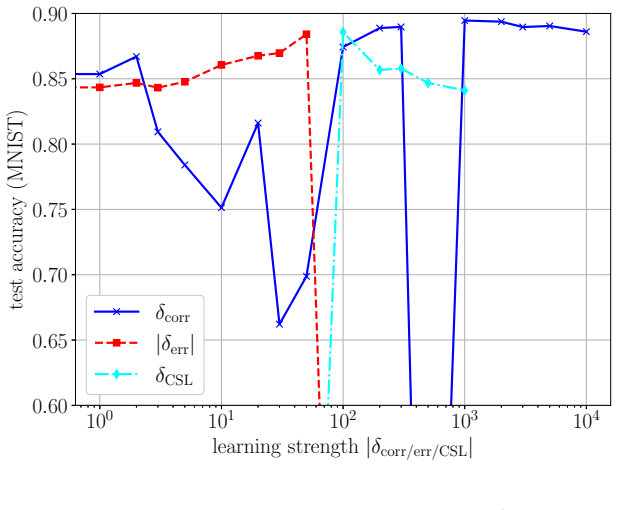
Modern machine learning applications employ deep neural networks training with the error backpropagation algorithm. Although this algorithm is very effective, it lacks biological realism. For example, backpropagation requires symmetric connectivity, and a separate neural processing channel for error signals. Prior works have therefore proposed a number of more realistic alternatives for error backpropagation. However, most of them still suffer from demanding preassumptions that may be not fulfilled in the real brain, for example, they often still require either symmetric connectivity or two separate processing channels, and often require also special mathematical operations like subtractions or function inversions. Here I propose supervised counterstream learning in deep associative networks as a simpler approach that requires only recognition of errors during training, and then backpropagates correcting target activity through the same activity channel as used for forward propagation. For this, two activity waves are initiated at the same time in input and output layers and then traveling in opposite directions to meet in one of the hidden layers. By employing simple local Hebbian-type learning rules, the corresponding activity pattern sequences get linked bidirectionally, thereby decreasing error rates over time. Despite its simplicity and an incomplete hyperparameter optimzation, a high high test accuracy is achieved on the (binarized) MNIST data set that is comparable to more demanding architectures.
Figures




Reference graph
Works this paper leans on
-
[1]
Abel and S
R. Abel and S. Ullman. Biologically inspired learning model for instructed vision. InAdvances in Neural Information Processing Systems, volume 37, 2024
2024
-
[2]
A study of retrieval algorithms of sparse mes- sages in networks of neural cliques
Ala Aboudib, Vincent Gripon, and Xiaoran Jiang. A study of retrieval algorithms of sparse mes- sages in networks of neural cliques. InProceedings of the 6th International Conference on Ad- vanced Cognitive Technologies and Applications (Cognitive 2014), pages 140–146, May 2014
2014
-
[3]
Storing sparse messages in networks of neural cliques.IEEE Transactions on Neural Networks and Learning Systems, 25:980–989, 2014
Behrooz Kamary Aliabadi, Claude Berrou, Vincent Gripon, and Xiaoran Jiang. Storing sparse messages in networks of neural cliques.IEEE Transactions on Neural Networks and Learning Systems, 25:980–989, 2014
2014
-
[4]
Alkam, E
T. Alkam, E. Tarshizi, and A.H. Van Benschoten. Reinforcement learning at the interface of artificial intelligence and cognitive science.Neuroscience, 585:289–312, 2025
2025
-
[5]
Bishop.Pattern recognition and machine learning.Springer, New York, 2006
C.M. Bishop.Pattern recognition and machine learning.Springer, New York, 2006
2006
-
[6]
Braitenberg
V . Braitenberg. Cell assemblies in the cerebral cortex. In R. Heim and G. Palm, editors,Lec- ture notes in biomathematics (21). Theoretical approaches to complex systems., pages 171–188. Springer-Verlag, Berlin Heidelberg New York, 1978
1978
-
[7]
Braitenberg and A
V . Braitenberg and A. Sch ¨uz.Anatomy of the cortex. Statistics and geometry.Springer-Verlag, Berlin, 1991
1991
-
[8]
A. E. Bryson and Y . C. Ho.Applied Optimal Control: Optimization, Estimation, and Control. Blaisdell, New York, 1969
1969
-
[9]
Buckingham and D.J
J.T. Buckingham and D.J. Willshaw. Performance characteristics of the associative net.Network: Computation in Neural Systems, 3:407–414, 1992
1992
-
[10]
Cauwenberghs
G. Cauwenberghs. A fast stochastic error-descent algorithm for supervised learning and optimiza- tion. In S. J. Hanson, J. D. Cowan, and C. L. Giles, editors,Advances in Neural Information Processing Systems 5 (NIPS 1992), pages 244–251, San Mateo, CA, 1993. Morgan Kaufmann
1992
-
[11]
L. Deng. The MNIST database of handwritten digit images for machine learning research.IEEE Signal Processing Magazine, 29(6):141–142, 2012
2012
-
[12]
Felleman and D.C
D.J. Felleman and D.C. Van Essen. Distributed hierarchical processing in the primate cerebral cortex.Cerebral Cortex, 1:1–47, 1991
1991
-
[13]
Nearest neighbour search using binary neural networks
Demetrio Ferro, Vincent Gripon, and Xiaoran Jiang. Nearest neighbour search using binary neural networks. InProceedings of the International Joint Conference on Neural Networks (IJCNN), July 2016
2016
-
[14]
Fiete, M.S
I.R. Fiete, M.S. Fee, and H.S. Seung. Model of birdsong learning based on gradient estimation by dynamic perturbation of neural conductances.Journal of Neurophysiology, 98(4):2038–2057, 2007
2038
-
[15]
Fremaux and W
N. Fremaux and W. Gerstner. Neuromodulated spike-timing-dependent plasticity, and theory of three-factor learning rules.Frontiers in Neural Circuits, 9:85, 2016
2016
-
[16]
Friston, C.D
K.J. Friston, C.D. Frith, and R.S.J. Frackowiak. Principal component analysis learning algorithms: A neurobiological analysis.Proceedings of the Royal Society of London. Series B: Biological Sciences, 254(1339):47–54, 1993
1993
-
[17]
Gripon and C
V . Gripon and C. Berrou. Sparse neural networks with large learning diversity.IEEE Transactions on Neural Networks, 22(7):1087–1096, 2011
2011
-
[18]
Gripon and C
V . Gripon and C. Berrou. Nearly-optimal associative memories based on distributed constant weight codes. InProceedings of the IEEE Information Theory and Applications Workshop (ITA), pages 269–273, 2012. 21
2012
-
[19]
Maximum likelihood associative memories
Vincent Gripon and Michael Rabbat. Maximum likelihood associative memories. InProceedings of the IEEE Information Theory Workshop (ITW), pages 1–5, September 2013
2013
-
[20]
Hebb.The organization of behavior
D.O. Hebb.The organization of behavior. A neuropsychological theory.Wiley, New York, 1949
1949
-
[21]
M.H. Hennig. Theoretical models of synaptic short term plasticity.Frontiers in Computational Neuroscience, 7(45):1–10, 2013
2013
-
[22]
Holtmaat and K
A. Holtmaat and K. Svoboda. Experience-dependent structural synaptic plasticity in the mam- malian brain.Nature Reviews Neuroscience, 10:647–658, 2009
2009
-
[23]
Hopfield
J.J. Hopfield. Neural networks and physical systems with emergent collective computational abil- ities.Proceedings of the National Academy of Science, USA, 79:2554–2558, 1982
1982
- [24]
-
[25]
Jabri and B
M. Jabri and B. Flower. Weight perturbation: An optimal architecture and learning technique for analog vlsi feedforward and recurrent multilayer networks.IEEE Transactions on Neural Networks, 3(1):154–157, 1992
1992
-
[26]
Kanerva.Sparse Distributed Memory.MIT Press, Cambridge, MA, 1988
P. Kanerva.Sparse Distributed Memory.MIT Press, Cambridge, MA, 1988
1988
-
[27]
I. Kanter. Potts-glass models of neural networks.Physical Review A, 37(7):2739—-2742, 1988
1988
-
[28]
Adam: A Method for Stochastic Optimization
D.P. Kingma and J.L. Ba. Adam: A method for stochastic optimization. In Y . Bengio and Y . LeCun, editors,3rd Proceedings of the International Conference on Learning Representations (ICLR), arXiv:1412.6980v9, 2015
work page internal anchor Pith review Pith/arXiv arXiv 2015
-
[29]
Knoblauch
A. Knoblauch. On the computational benefits of inhibitory neural associative networks. HRI-EU Report 07-05, Honda Research Institute Europe GmbH, D-63073 Offenbach/Main, Germany, May 2007
2007
-
[30]
Knoblauch
A. Knoblauch. Neural associative memory and the Willshaw-Palm probability distribution.SIAM Journal on Applied Mathematics, 69(1):169–196, 2008
2008
-
[31]
Knoblauch
A. Knoblauch. Neural associative networks with optimal bayesian learning. HRI-EU Report 09- 02, Honda Research Institute Europe GmbH, D-63073 Offenbach/Main, Germany, May 2009
2009
-
[32]
Knoblauch
A. Knoblauch. The role of structural plasticity and synaptic consolidation for memory and am- nesia in a model of cortico-hippocampal interplay. In J. Mayor, N. Ruh, and K. Plunkett, editors, Connectionist Models of Behavior and Cognition II: Proceedings of the 11th Neural Computation and Psychology Workshop, pages 79–90, Singapore, 2009. World Scientific...
2009
-
[33]
Knoblauch
A. Knoblauch. Optimal synaptic learning in non-linear associative memory. InProceedings of the International Joint Conference on Neural Networks (IJCNN), pages 3205–3211, Barcelona, Spain, 2010. IEEE World Congress on Computational Intelligence (WCCI)
2010
-
[34]
Knoblauch
A. Knoblauch. Neural associative memory with optimal bayesian learning.Neural Computation, 23(6):1393–1451, 2011
2011
-
[35]
Knoblauch
A. Knoblauch. Method and device for realizing an associative memory based on inhibitory neural networks., 2012. European Patent EP 2,012,260, filed June 22, 2007, issued April 11, 2012; U.S. Patent No. 8,335,752, issued December 18, 2012; JP Patent No. 5297451, issued June 21, 2013
2012
-
[36]
Knoblauch
A. Knoblauch. Impact of structural plasticity on memory formation and decline. In A. van Ooyen and M. Butz, editors,Rewiring the Brain: A Computational Approach to Structural Plasticity in the Adult Brain., pages 361–386, London, UK, 2017. Elsevier/Academic Press
2017
- [37]
-
[38]
Knoblauch.Intelligente Lernende Systeme.Springer-Vieweg, Wiesbaden, 2026
A. Knoblauch.Intelligente Lernende Systeme.Springer-Vieweg, Wiesbaden, 2026. 22
2026
-
[39]
Knoblauch, F
A. Knoblauch, F. Hauser, M.-O. Gewaltig, E. K ¨orner, and G. Palm. Does spike-timing-dependent synaptic plasticity couple or decouple neurons firing in synchrony?Frontiers in Computational Neuroscience, 6(55):1–27, 2012
2012
-
[40]
Knoblauch, E
A. Knoblauch, E. K ¨orner, U. K ¨orner, and F.T. Sommer. Structural plasticity has high memory capacity and can explain graded amnesia, catastrophic forgetting, and the spacing effect.PLoS ONE, 9(5):e96485:1–19, 2014
2014
-
[41]
Knoblauch and G
A. Knoblauch and G. Palm. Scene segmentation by spike synchronization in reciprocally con- nected visual areas. I. Local effects of cortical feedback.Biological Cybernetics, 87(3):151–167, 2002
2002
-
[42]
Knoblauch and G
A. Knoblauch and G. Palm. Scene segmentation by spike synchronization in reciprocally con- nected visual areas. II. Global assemblies and synchronization on larger space and time scales. Biological Cybernetics, 87(3):168–184, 2002
2002
-
[43]
Knoblauch and G
A. Knoblauch and G. Palm. Bidirectional associative memory with block coding: A comparison of iterative retrieval methods. In I.V . Tetko, V . Kurkova, P. Karpov, and F. Theis, editors,Artificial Neural Networks and Machine Learning – ICANN 2019: Theoretical Neural Computation, Pro- ceedings of the 28th International Conference on Artificial Neural Networ...
2019
-
[44]
Knoblauch and G
A. Knoblauch and G. Palm. Iterative retrieval and block coding in autoassociative and heteroasso- ciative memory.Neural Computation, 32(1):205–260, 2020
2020
-
[45]
Knoblauch, G
A. Knoblauch, G. Palm, and F.T. Sommer. Memory capacities for synaptic and structural plasticity. Neural Computation, 22(2):289–341, 2010
2010
-
[46]
Knoblauch and F.T
A. Knoblauch and F.T. Sommer. Structural plasticity, effectual connectivity, and memory in cortex. Frontiers in Neuroanatomy, 10(63):1–20, 2016
2016
-
[47]
B. Kosko. Bidirectional associative memories.IEEE Transactions on Systems, Man, and Cyber- netics, 18:49–60, 1988
1988
-
[48]
Krotov and J.J
D. Krotov and J.J. Hopfield. Unsupervised learning by competing hidden units.Proceedings of the National Academy of Science, USA, 116(16):7723–7731, 2019
2019
-
[49]
Kryzhanovsky and V .M
B.V . Kryzhanovsky and V .M. Kryzhanovsky. A binary pattern classification using Potts model. Optical Memory and Neural Networks (Information Optics), 17(4):308–316, 2008
2008
-
[50]
Kryzhanovsky, L.B
B.V . Kryzhanovsky, L.B. Litinskii, and A.L. Mikaelian. Vector-neuron models of associa- tive memory. In2004 IEEE International Joint Conference on Neural Networks (IEEE Cat. No.04CH37541; IJCNN-04), Volume 2, pages 909–914, 2004
2004
-
[51]
Kryzhanovsky, B
V . Kryzhanovsky, B. Kryzhanovsky, and A. Fonarev. Application of potts-model perceptron for binary patterns identification. In V . Kurkova-Pohlova, R. Neruda, and J. Koutnik, editors,Proceed- ings of the 18th International Conference on Artificial Neural Networks (ICANN), Part I, LNCS 5163, pages 553–561, Berlin, Heidelberg, 2008. Springer Verlag
2008
-
[52]
A. Lansner. Associative memory models: from the cell-assembly theory to biophysically detailed cortex simulations.Trends in Neurosciences, 32(3):178–186, 2009
2009
-
[53]
Lansner and ¨O
A. Lansner and ¨O. Ekeberg. A one-layer feedback artificial neural network with a Bayesian learn- ing rule.International Journal of Neural Systems, 1(1):77–87, 1989
1989
-
[54]
A. Lansner, N.B. Ravichandran, A. Knoblauch, and P. Herman. Benchmarking Hebbian learning rules for associative memory.arxiv:2401.00335v2, 2025
-
[55]
LeCun, L
Y . LeCun, L. Bottou, Y . Bengio, and P. Haffner. Gradient-based learning applied to document recognition.Proceedings of the IEEE, 86(11):2278–2324, 1998. 23
1998
-
[56]
D.-H. Lee, S. Zhang, A. Fischer, and Y . Bengio. Difference target propagation. InMachine Learning and Knowledge Discovery in Databases (ECML PKDD), pages 498–515, 2015
2015
-
[57]
Lillicrap, D
T.P. Lillicrap, D. Cownden, D.B. Tweed, and C.J. Akerman. Random synaptic feedback weights support error backpropagation for deep learning.Nature Communications, 7(1):13276, 2016
2016
-
[58]
Lillicrap, A
T.P. Lillicrap, A. Santoro, L. Marris, C.J. Akerman, and G. Hinton. Backpropagation and the brain. Nature Reviews Neuroscience, 21:335–346, 2020
2020
-
[59]
Bistable, irregular firing and population oscillations in a modular attractor memory network.PLoS Computational Biology, 6(6):e1000803, 2010
Mikael Lundqvist, Albert Compte, and Anders Lansner. Bistable, irregular firing and population oscillations in a modular attractor memory network.PLoS Computational Biology, 6(6):e1000803, 2010
2010
-
[60]
Attractor dynamics in a modular network model of neocortex.Network: Computation in Neural Systems, 17(3):253–276, 2006
Mikael Lundqvist, Markus Rehn, Mikael Djurfeldt, and Anders Lansner. Attractor dynamics in a modular network model of neocortex.Network: Computation in Neural Systems, 17(3):253–276, 2006
2006
-
[61]
McClelland, B.L
J.L. McClelland, B.L. McNaughton, and R.C. O’Reilly. Why there are complementary learning systems in the hippocampus and neocortex: Insights from the successes and failures of connec- tionist models of learning and memory.Psychological Review, 102(3):419–457, 1995
1995
-
[62]
A.A. Minai. Covariance learning of correlated patterns in competitive networks.Neural Compu- tation, 9(3):667–681, 1997
1997
-
[63]
Ming and H
G.L. Ming and H. Song. Adult neurogenesis in the mammalian central nervous system.Annu. Rev. Neurosci., 28:223–250, 2005
2005
-
[64]
A. Nokland. Direct feedback alignment provides learning in deep neural networks. InAdvances in Neural Information Processing Systems, volume 29, 2016
2016
-
[65]
E. Oja. Simplified neuron model as a principal component analyzer.Journal of Mathematical Biology, 15(3):267–273, 1982
1982
-
[66]
E. Oja. Principal components, minor components, and linear neural networks.Neural Networks, 5(6):927–935, 1992
1992
-
[67]
Ororbia and A
A.G. Ororbia and A. Mali. Biologically motivated algorithms for propagating local target rep- resentations. InProceedings of the AAAI Conference on Artificial Intelligence, volume 33(01), pages 4651–4658, 2019
2019
-
[68]
G. Palm. On associative memories.Biological Cybernetics, 36:19–31, 1980
1980
-
[69]
Palm.Neural Assemblies
G. Palm.Neural Assemblies. An Alternative Approach to Artificial Intelligence.Springer, Berlin, 1982
1982
-
[70]
G. Palm. Computing with neural networks.Science, 235:1227–1228, 1987
1987
-
[71]
G. Palm. On associative memories. In E. Caianiello, editor,Physics of Cognitive Processes, pages 380–422. World Scientific, 1987
1987
-
[72]
G. Palm. On the information storage capacity of local learning rules.Neural Computation, 4(5):703–711, 1992
1992
-
[73]
G. Palm. Neural associative memories and sparse coding.Neural Networks, 37:165–171, 2013
2013
-
[74]
G. Palm, A. Knoblauch, F. Hauser, and A. Sch¨uz. Cell assemblies in the cerebral cortex.Biological Cybernetics, 108(5):559–572, 2014
2014
-
[75]
G. Palm, F. Schwenker, and F.T. Sommer. Associative memory networks and sparse similarity preserving codes. In V . Cherkassky, J.H. Friedman, and H. Wechsler, editors,From statistics to neural networks: Theory and pattern recognition applications, NATO ASI Series F, pages 283–
-
[76]
Springer Verlag, Berlin, Heidelberg, 1994. 24
1994
-
[77]
Palm and F.T
G. Palm and F.T. Sommer. Information capacity in recurrent McCulloch-Pitts networks with sparsely coded memory states.Network, 3:177–186, 1992
1992
-
[78]
Palm and F.T
G. Palm and F.T. Sommer. Associative data storage and retrieval in neural nets. In E. Domany, J.L. van Hemmen, and K. Schulten, editors,Models of Neural Networks III, pages 79–118. Springer- Verlag, New York, 1996
1996
-
[79]
D.B. Parker. Learning-logic: casting the cortex of the human brain in silicon. Technical Report Tr- 47, Center for Computational Research in Economics and Management Science. MIT Cambridge, MA., 1985
1985
-
[80]
Pulverm ¨uller.The neuroscience of language: on brain circuits of words and serial order.Cam- bridge University Press, Cambridge, UK, 2003
F. Pulverm ¨uller.The neuroscience of language: on brain circuits of words and serial order.Cam- bridge University Press, Cambridge, UK, 2003
2003
discussion (0)
Sign in with ORCID, Apple, or X to comment. Anyone can read and Pith papers without signing in.