Probing Strange-Quark Hadronization via (Multi-)Strange Hadron Multiplicity Distributions in Small Collision Systems with ALICE
Pith reviewed 2026-06-26 14:51 UTC · model grok-4.3
The pith
ALICE measures the probability distributions of strange-hadron multiplicities in proton-proton collisions to test production mechanisms.
A machine-rendered reading of the paper's core claim, the machinery that carries it, and where it could break.
Core claim
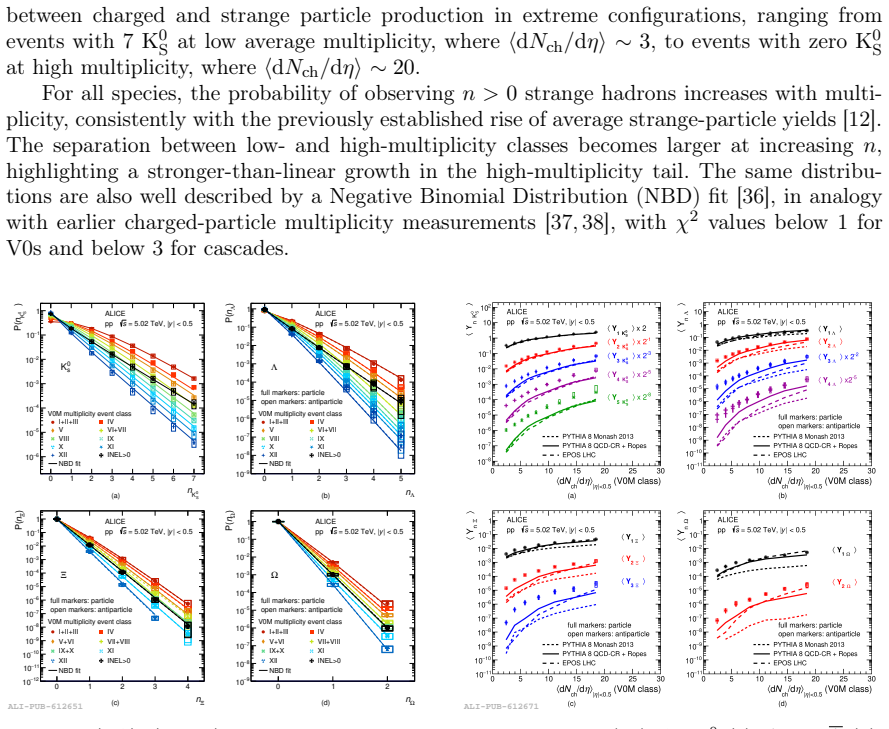
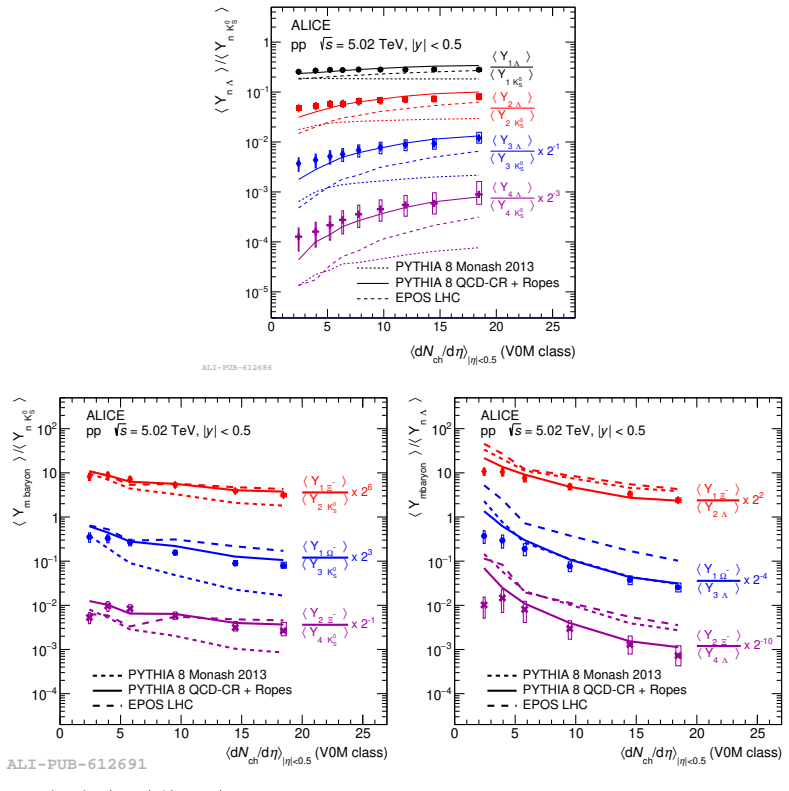
The ALICE collaboration has measured the probability distribution of producing a given number of strange particles (K0S, Λ, Ξ, and Ω) of the same species per event in pp collisions at √s = 5.02 TeV. This measurement extends the study of strangeness production beyond the mean particle yield by employing a technique based on event-by-event particle counting. It provides a new test bench for production mechanisms, probing events with large imbalances between strange and non-strange content. The results are compared with state-of-the-art phenomenological models implemented in commonly used Monte Carlo event generators.
What carries the argument
Event-by-event particle counting to obtain multiplicity distributions of strange hadrons, which probes production mechanisms beyond average yields.
If this is right
- The distributions provide enhanced sensitivity to the underlying dynamics of strangeness production.
- Comparisons with models can identify which aspects of hadronization are correctly modeled.
- The method opens the way to study rare events with extreme strange particle content.
- It can be used to test if strangeness enhancement is driven by changes in the tail of the distributions.
Where Pith is reading between the lines
- If the distributions deviate from model predictions in specific ways, it could point to the need for improved modeling of color reconnection or statistical hadronization in small systems.
- Extending this to different collision energies or systems could reveal whether the observed universality in yield ratios holds for the full distributions.
- This technique might be combined with machine learning methods for particle identification to reduce uncertainties in future measurements.
Load-bearing premise
Detector acceptance, efficiency, and particle identification allow unbiased reconstruction of the true multiplicity distributions without significant distortion from experimental effects.
What would settle it
A clear discrepancy between the measured distributions and those predicted by the models, after full correction for experimental effects, would indicate that the models do not capture the production mechanisms correctly.
Figures
read the original abstract
Strangeness enhancement is defined as the increased relative production of strange hadrons in heavy-ion collisions compared to proton--proton (pp) interactions. It was originally proposed as one of the signatures of quark--gluon plasma (QGP) formation. At the LHC, the ALICE experiment observed that strange-hadron-to-pion yield ratios rise with increasing charged-particle multiplicity at midrapidity, independently of collision energy ($\sqrt{s}$) and system size, from pp to p--Pb and up to Pb--Pb collisions. To gain deeper insight into the mechanisms of strangeness production, the ALICE collaboration has measured the probability distribution of producing a given number of strange particles ($K^{0}_{S}$, $\Lambda$, $\Xi$, and $\Omega$) of the same species per event in pp collisions at $\sqrt{s}~=~5.02$ TeV. This measurement extends the study of strangeness production beyond the mean particle yield by employing, for the first time, a technique based on event-by-event particle counting. It provides a new test bench for production mechanisms, probing events with large imbalances between strange and non-strange content. The results are compared with state-of-the-art phenomenological models implemented in commonly used Monte Carlo event generators, offering enhanced sensitivity to the underlying dynamics of strangeness production.
Editorial analysis
A structured set of objections, weighed in public.
Referee Report
Summary. The manuscript reports measurements by the ALICE experiment of the event-by-event multiplicity probability distributions for K_S^0, Λ, Ξ, and Ω in pp collisions at √s = 5.02 TeV. The central claim is that these distributions extend the study of strangeness enhancement beyond mean yields, providing a new test bench for production mechanisms by accessing events with large strange/non-strange imbalances; results are compared to Monte Carlo event generators.
Significance. If the reported distributions are shown to be free of significant multiplicity-dependent biases, the work supplies a falsifiable, higher-moment observable that can discriminate among hadronization models in small systems. The approach is a direct experimental measurement with no free parameters or circular derivations.
major comments (1)
- [Abstract and analysis description] The provided abstract and text supply no information on multiplicity-dependent efficiency corrections, acceptance, PID, or feed-down subtraction procedures. Because the tails of the distributions are the load-bearing feature for testing model sensitivity to strange/non-strange imbalances, residual p_T- or multiplicity-dependent biases would distort the reported probabilities and render the model comparisons inconclusive.
Simulated Author's Rebuttal
We thank the referee for the careful reading of our manuscript and the constructive comment. We address the major point below and agree that additional methodological details are required to strengthen the presentation of the results.
read point-by-point responses
-
Referee: [Abstract and analysis description] The provided abstract and text supply no information on multiplicity-dependent efficiency corrections, acceptance, PID, or feed-down subtraction procedures. Because the tails of the distributions are the load-bearing feature for testing model sensitivity to strange/non-strange imbalances, residual p_T- or multiplicity-dependent biases would distort the reported probabilities and render the model comparisons inconclusive.
Authors: We agree that the current manuscript version does not provide explicit details on multiplicity-dependent efficiency corrections, acceptance, PID, and feed-down subtraction. These elements are essential for assessing potential biases in the high-multiplicity tails. In the revised version we will add a dedicated subsection (or expanded methods paragraph) describing: (i) how efficiency corrections are derived and applied as a function of charged-particle multiplicity, (ii) the fiducial acceptance and p_T ranges, (iii) the PID selection criteria and associated purity, and (iv) the feed-down subtraction procedure for Λ, Ξ, and Ω. This addition will allow readers to evaluate residual p_T- or multiplicity-dependent biases directly. revision: yes
Circularity Check
No significant circularity: direct experimental measurement of multiplicity distributions
full rationale
The paper presents an experimental measurement of event-by-event multiplicity distributions for K0S, Lambda, Xi, and Omega in pp collisions at 5.02 TeV, extending prior mean-yield studies. No derivation chain exists that reduces predictions or results to fitted parameters, self-definitions, or self-citation load-bearing steps. The abstract and described content focus on data collection, efficiency-corrected counting, and model comparisons without any equations or claims that equate outputs to inputs by construction. This is a standard experimental result whose central claims rest on observed distributions rather than internal redefinitions.
Axiom & Free-Parameter Ledger
axioms (1)
- domain assumption Standard assumptions about ALICE detector response, tracking efficiency, and particle identification for strange hadrons
Reference graph
Works this paper leans on
-
[1]
ALICE Collaboration, arXiv:2511.10413 [nucl-ex]
-
[2]
J.Rafelski and B.Müller, Phys. Rev. Lett.56, no 21 (1986)
1986
-
[3]
WA97 Collaboration, Phys. Lett. B449, 401 (1999)
1999
-
[4]
NA49 Collaboration, Phys. Lett. B538, 275 (2002)
2002
-
[5]
NA57 Collaboration, J. Phys. G37, 045105 (2010)
2010
-
[6]
STAR Collaboration, Phys. Rev. C77, 044908 (2008)
2008
-
[7]
ALICE Collaboration, Phys. Rev. B734, 409-410 (2014)
2014
-
[8]
ALICE Collaboration, arXiv:2511.10360 [nucl-ex]
-
[9]
Phys.13, 535-539 (2017)
ALICE Collaboration, Nat. Phys.13, 535-539 (2017)
2017
-
[10]
ALICE Collaboration, Phys. Rev. B728, 25-38 (2014)
2014
-
[11]
ALICE Collaboration, Phys. Rev. B758, 389-401 (2016)
2016
-
[12]
ALICE Collaboration, arXiv:2511.10306 [nucl-ex]
-
[13]
ALICE Collaboration, Phys. Rev. C99, no 2, 024906 (2019)
2019
-
[14]
Phys.J.C80, no 2, 167 (2020)
ALICE Collaboration, Eur. Phys.J.C80, no 2, 167 (2020)
2020
-
[15]
ALICE Collaboration, JHEP05, 290 (2021)
2021
-
[16]
ALICE Collaboration, Phys. Lett. B719, 29 (2013)
2013
-
[17]
CMS Collaboration, Phys. Rev. Lett.116, 172302 (2016)
2016
-
[18]
CMS Collaboration, Phys. Lett. B765, 193 (2017)
2017
-
[19]
CMS Collaboration, Phys. Rev. Lett.115, 012301 (2015)
2015
-
[20]
ATLAS Collaboration, Phys. Rev. Lett.116, 172301 (2016)
2016
-
[21]
Commun.17, 2585 (2026)
ALICE Collaboration, Nat. Commun.17, 2585 (2026)
2026
-
[22]
Bierlichet al., arXiv:2203.11601 [hep-ph]
C. Bierlichet al., arXiv:2203.11601 [hep-ph]
-
[23]
Bähret al., Eur
M. Bähret al., Eur. Phys. J. C58, 639 (2008)
2008
-
[24]
Christiansen and P.Z
J.R. Christiansen and P.Z. Skands, JHEP08, 003 (2015)
2015
-
[25]
Bierlich, G
C. Bierlich, G. Gustafson, L. Lönnblad, and A. Tarasov, JHEP03, 148 (2015)
2015
-
[26]
Duncan and P
C.B. Duncan and P. Kirchgäesser, Eur. Phys. J. C79, 61 (2019)
2019
-
[27]
ALICE Collaboration, Phys. Lett. B827, 136984 (2022)
2022
-
[28]
ALICE Collaboration, JHEP09, 204 (2024)
2024
-
[29]
ALICE Collaboration, JHEP05, 184 (2024)
2024
-
[30]
ALICE Collaboration, JHEP03, 29 (2025)
2025
-
[31]
ALICE Collaboration, Phys. Rev. Lett.134, 022303 (2025)
2025
-
[32]
ALICE Collaboration, JHEP09, 102 (2024)
2024
-
[33]
Gaiser, Ph.D
J.E. Gaiser, Ph.D. thesis, Stanford University (1982)
1982
-
[34]
G.D’Agostini, arXiv:1010.0632 [physics.data-an]
-
[35]
ALICE Collaboration, Eur. Phys. J. C81, 630 (2021)
2021
-
[36]
UA5 Collaboration, Phys. Lett. B160, 193 (1985)
1985
-
[37]
ALICE Collaboration, Eur. Phys. J. C68, 89 (2010)
2010
-
[38]
ALICE Collaboration, Eur. Phys. J. C77, 852 (2017)
2017
-
[39]
C.Bierlich et al., JHEP 03, no 148 (2015)
2015
-
[40]
C.Bierlich, EPJ Web Conf.171, 14003 (2018)
2018
-
[41]
T.Pieroget al., Phys. Rev. C92, 034906 (2015). 6
2015
discussion (0)
Sign in with ORCID, Apple, or X to comment. Anyone can read and Pith papers without signing in.