REVIEW 3 major objections 7 minor 1 cited by
Particle swarm optimization of divertor targets for heat load control
T0 review · 3 major / 7 minor · reviewed 2026-08-05 · deepseek-v4-flash
Pith's one-line read Divertor targets can be scoped by a fast heat-load proxy wrapped in particle swarm optimization, but the winning shape depends on the assumed background plasma parameters.
desk verdict Useful scoping study showing PSO plus FLARE can map divertor target trade-offs, but the PSO robustness claims are validated only on an interpolated surrogate, not on the actual heat-load model. read the letter →
The pith
A machine-rendered reading of the paper's core claim, the machinery that carries it, and where it could break.
The reading
What carries the argument
The central object is the coupled PSO-plus-proxy loop. The proxy solves Eq. (3), a linearized conduction model q = -kappa_parallel grad_parallel T - chi_perp n grad_perp T with fixed n, T, and chi_perp, by Monte Carlo field-line tracing in FLARE, which reconstructs field lines from an unstructured flux tube mesh; candidates are plates parametrized by (alpha, s), and each is scored by f = q_max^OT + 10(q_max^baffle + q_max^floor), which penalizes loads on the baffle and floor at ten times the weight of the target load. The PSO update, Eq. (1)-(2) with inertia w=0.729 and c1=c2=1.494, moves the swarm toward personal and global bests; the key diagnostic is that the landscape's minimum, and ther
What would settle it
Run the high-fidelity EMC3-EIRENE simulation used for the reference curve in Fig. 1(c) on the three proxy-optimal (alpha, s) configurations from Fig. 7 plus the actual ITER divertor configuration; if a proxy-preferred plate does not reduce peak heat load below the actual configuration at the same PSOL, then the proxy's ranking of geometries, and thus the optimization built on it, fails.
Extended reading notes
Core claim
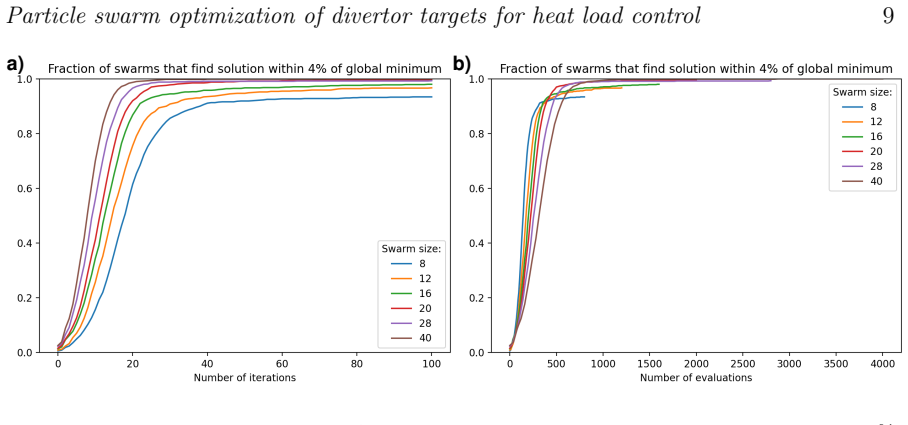
Using a two-parameter toy model of ITER's outer divertor (a flat target plate of fixed length, anchored along the outer divertor leg by a position s and tilted by an angle alpha relative to the separatrix), the paper shows that particle swarm optimization driven by the FLARE heat-load proxy reliably finds the global minimum of an interpolated objective function within a few percent in tens of iterations with swarms of about 12 particles. The global minimum in the noiseless case reflects two physical tendencies: shallower incidence of the separatrix reduces peak heat load, and target positions nearer the X-point benefit from flux expansion, though positions too close to the X-point are penali
Load-bearing premise
The loop's usefulness rests on the assumption that the low-fidelity heat-load proxy with a single fixed set of background values (n=1e20 m^-3, T=160 eV, chi_perp=2 m^2/s, for example) ranks divertor geometries the same way the real, detached plasma would; figure 7 shows the optimal (alpha, s) changes with these values, so this assumption is the load-bearing premise.
Editorial extensions
If this is right
- On the toy problem, 12-particle swarms get within 4 percent of the global minimum after roughly 20 iterations, so dozens to hundreds of target evaluations, not thousands, are enough to scope a design.
- Because Monte Carlo noise in the heat-load proxy is unavoidable, the swarm converges to a cloud spread over the noise level around the minimum rather than to a single point; 4 percent noise already widens the range of 'optimal' target angles to about -60 to -35 degrees.
- The recommended use is not a single optimum: run the optimizer for several defensible (n, T, chi_perp) choices and treat the different winners as candidate designs for high-fidelity benchmarking.
- Configurations with near-normal incidence and positions right at the X-point are excluded by the penalty term, so the procedure respects the engineering constraint that baffle/floor loads stay an order of magnitude below the target limit.
- The procedure does not guarantee a global optimum and a minority of swarms settle in a nearby local minimum, so 'good enough accuracy' rather than exact optimality is the right expectation.
Reading between the lines
- The same loop, applied to a stellarator island divertor where field-line tracing speedup matters most, would likely show even stronger parameter sensitivity because heat loads are toroidally localized; the toy-problem result is a lower bound on the need for multi-candidate design.
- The parameter sensitivity could be formalized as uncertainty quantification: sample (n, T, chi_perp) from plausible operating ranges, run the optimizer over the sampled objectives, and select a geometry that either minimizes expected peak load or minimizes worst-case load over the ensemble.
- A direct calibration experiment would be to score the red-optimum and green-optimum geometries from Fig. 7 in a single high-fidelity detached simulation; whichever wins identifies which proxy parameter set is most predictive, giving future scoping loops a rational parameter choice.
- The objective function could be extended to a multiobjective Pareto front that includes neutral pumping or connection length, which the paper says is in preparation; the current single-scalar objective is a deliberate simplification.
Editorial analysis
A structured set of objections, weighed in public.
Referee Report
Summary. The paper presents a particle swarm optimization (PSO) workflow for designing the outer divertor target in ITER using a fast heat-load proxy model, FLARE, which solves a linearized heat conduction equation on reconstructed field lines. The geometry is reduced to two parameters: plate orientation angle α and poloidal location s. A penalty-based objective function balances peak heat load on the target against heat loads on the baffle and floor. The paper studies PSO convergence on an interpolated surrogate of a gridded simulation, tests robustness to swarm size and to artificial homoscedastic noise, and demonstrates in Fig. 7 that the optimum shifts when background plasma model parameters (n, T, χ_perp) are varied. The central claims are that PSO is 'robust enough to find a solution with good enough accuracy' and that the optimum depends on proxy model assumptions.
Significance. If the methodology is correctly validated, the contribution is useful: it shows that a fast proxy-based optimizer can scope candidate divertor geometries and that parameter sensitivity must be explicitly managed before recommending a design. The paper is honest in its limitations, explicitly stating that high-fidelity validation is needed and that extension to complex geometries is unverified. Its strength is a clean two-parameter demonstration and a clear visualization of how model assumptions move the optimum. The comparison of FLARE proxy profiles to EMC3-EIRENE (Fig. 1c) provides valuable, if limited, external grounding. However, the quantitative PSO performance claims are currently established only on an interpolated surrogate, not on the actual stochastic heat-load simulation, which is a load-bearing gap.
major comments (3)
- [§4, Figs. 4–5 and 7] The quantitative PSO performance claims—especially the statement in Section 5 that the procedure 'appears to be robust enough to find a solution with good enough accuracy'—are established on a RegularGridInterpolator surrogate of the Fig. 3 simulation data. The reference 'global minimum' (white star in Fig. 3b) is the minimum of that same interpolant. No direct FLARE/EMC3-Lite evaluation is reported at any PSO-selected optimum, so interpolation error at off-grid and optimal points is uncharacterized. This is load-bearing because the heat-load peak is sharply localized. Please re-evaluate the reported optima with direct Monte Carlo runs (with multiple seeds to estimate noise), or explicitly reformulate the conclusions as properties of the surrogate rather than of the heat-load model.
- [§4, Fig. 6] The noise-robustness study adds a homoscedastic Gaussian to a smoothed version of the interpolant (σ/f = 4% and 16%). Actual Monte Carlo noise in q_max from FLARE is unlikely to be homoscedastic or independent of (α,s); it may be largest precisely near the sharp heat-load peak that determines the optimum. Without empirical noise estimates from repeated FLARE runs at representative (α,s) points, the conclusion that PSO 'converges to points within the noise range' does not transfer to the real problem. The manuscript should either provide such estimates or explicitly scope the noise analysis as an idealized illustration of PSO behavior under synthetic noise.
- [§3, Eq. (5) and Fig. 7] The paper convincingly shows that the optimal (α,s) depends on the background plasma parameters in the proxy model. However, the objective function also contains an arbitrarily fixed penalty factor f_penalty = 10, whose sensitivity is not examined. Since the penalty factor directly controls the trade-off between target heat load and baffle/floor loads, a change in f_penalty could move the optimum comparably to a change in plasma parameters. A short sensitivity scan over f_penalty (or a justification that it is fixed by material limits) would strengthen the interpretation that the observed shifts in the optimum are caused by the plasma model assumptions rather than by the chosen objective weighting.
minor comments (7)
- [Abstract and §3 title] 'head loads' should be 'heat loads' (also in the Section 3 title and abstract).
- [Introduction] Typo: 'detchment' should be 'detachment'.
- [§3, Fig. 2 area] 'netural' should be 'neutral'; also 'configuratoin' should be 'configuration'.
- [§2, Eq. (1)] 'clampled' should be 'clamped'.
- [§5] 'witin' should be 'within'.
- [Eq. (5)] Use f_penalty (with subscript) consistently rather than fpenalty for readability.
- [Figure 4] The caption labels are confusing: '(a, b) Evolution ... (b) Change of each swarm's best known position' should be '(a) Evolution ... (b) Change ...' or similar.
Circularity Check
No significant circularity: PSO is tested on an explicitly constructed surrogate and self-citations are not load-bearing.
full rationale
The paper's derivation chain is self-contained. The objective function f(α,s) is defined in Eq. (5) from FLARE heat-load calculations, and Sec. 4 explicitly states that a continuous objective is constructed by interpolating the Fig. 3 data before running PSO. Thus all PSO success metrics (fmin, convergence radii, noise study) are properties of that surrogate—this is an openly declared benchmark, not a hidden equivalence. The heat-load proxy Eq. (3) is a stated physical model with fixed input parameters (n, T, χ⊥); the dependence of the optimum on these parameters (Fig. 7) is a sensitivity result, not a fitted parameter renamed as a prediction. Self-citations to the author's FLARE paper [10] and to EMC3-Lite [17] provide code/model provenance, but the governing equation is written out and an external EMC3-EIRENE/SOLPS-ITER comparison is shown in Fig. 1(c), so the central claims do not reduce to the self-citations. The explicit limitations—'candidate solution(s) ... would need to be validated by high-fidelity modeling' and 'if this translates to more complex geometries still needs to be verified'—show the author does not claim an independent first-principles prediction. Any remaining concerns are about validation fidelity and parameter sensitivity, not circularity. Score 2 reflects only the presence of minor, non-load-bearing self-citations.
Assumptions & free parameters
free parameters (4)
- heat load proxy parameters (n, T, chi_perp) =
n=10^20 m^-3, T=160 eV, chi_perp=2.0 m^2/s for the red case; other cases in Fig. 1(c); exact values for green/orange not
- penalty factor f_penalty =
10
- PSO coefficients w, c1, c2 =
w=0.729, c1=c2=1.494
- artificial noise levels sigma/f =
0.04 and 0.16
assumptions (8)
- standard math PSO update equations (1)-(2) and standard convergence properties from Refs. [12-16] are correct.
- standard math RegularGridInterpolator and Gaussian filter from scipy produce a continuous objective function that faithfully represents the simulation data.
- domain assumption The linearized heat conduction model (Eq. 3) with Bohm boundary condition (Eq. 4) is a sufficient proxy for divertor heat loads in scoping studies.
- domain assumption The axisymmetric ITER geometry and the simplified two-parameter plate (alpha, s) capture the essential design space of the outer divertor target.
- domain assumption Background plasma parameters (n, T, chi_perp) are treated as fixed inputs during optimization.
- ad hoc to paper The objective function f(alpha,s) = q_max(OT) + 10*(q_max(baffle)+q_max(floor)) with penalty factor 10 adequately encodes design preferences.
- domain assumption Neglect of the dome structure and neutral particle transport does not materially change the ranking of candidate geometries for heat loads.
- standard math The Monte Carlo field line tracing in FLARE provides statistically converged heat load estimates with M=400,000 particles.
Cite this review
Pith. "Pith review of Particle swarm optimization of divertor targets for heat load control." pith.science (2026). https://pith.science/paper/JIPMHQ42
@misc{pith2026250900206,
  author       = {Pith},
  title        = {Pith review of: Particle swarm optimization of divertor targets for heat load control},
  year         = {2026},
  howpublished = {\url{https://pith.science/paper/JIPMHQ42}},
  note         = {Machine review of arXiv:2509.00206}
}
read the original abstract
Divertor targets in magnetic confinement fusion devices must be designed to handle extreme heat loads. Fast approximation of heat loads with FLARE based on field line reconstruction from an unstructured flux tube mesh is utilized in particle swarm optimization (PSO) of the divertor target geometry. Optimization of the outer divertor target in ITER is evaluated with a constraint for the head loads onto baffles. The optimal configuration is found to depend on assumptions for the background plasma in the heat load proxy simulation.
Figures


Figures from the paper (4 more)



Forward citations
Cited by 1 Pith paper
-
Stellarator island divertor shape optimization for reduced peak heat fluxes
A two-parameter algorithm automatically constructs stellarator island divertors, and Bayesian optimization finds designs with peak heat flux ~3 MW/m² at far lower cost than grid scanning.
Reference graph
Works this paper leans on
-
[1]
Loarte, B
A. Loarte, B. Lipschultz, A. S. Kukushkin, G. F. Matthews, P. C. Stangeby, N. Asakura, G. F. Counsell, G. Federici, A. Kallenbach, K. Krieger, A. Mahdavi, V. Philipps, D. Reiter, J. Roth, J. Strachan, D. Whyte, R. Doerner, T. Eich, W. Fundamenski, A. Herrmann, M. Fenstermacher, P. Ghendrih, M. Groth, A. Kirschner, S. Konoshima, B. LaBombard, P. Lang, A. W...
2007
-
[2]
Krieger, S
K. Krieger, S. Brezinsek, J.W. Coenen, H. Frerichs, A. Kallenbach, A.W. Leonard, T. Loarer, S. Ratynskaia, N. Vianello, N. Asakura, M. Bernert, D. Carralero, R. Ding, D. Douai, T. Eich, Y. Gasparyan, A. Hakola, Y. Hatano, M. Jakubowski, M. Kobayashi, S. Krasheninnikov, S. Masuzaki, T. Nakano, R. Neu, R.A. Pitts, J. Rapp, K. Schmid, O. Schmitz, D. Tskhakay...
2025
-
[3]
Steven J. Zinkle. Advanced materials for fusion technology. Fusion Engineering and Design, 74 (2005) (1-4) 31–40. ISSN 0920-3796. 10.1016/j.fusengdes.2005.08.008
-
[4]
G. F. Matthews. Plasma detachment from divertor targets and limiters. J. Nucl. Mater., 220-222 (1995) 104–116. 10.1016/0022-3115(94)00450-1
-
[5]
S. I. Krasheninnikov and A. S. Kukushkin. Physics of ultimate detachment of a tokamak divertor plasma. J. Plasma Phys., 83 (2017) (5) 155830501. 10.1017/s0022377817000654
-
[6]
P. C. Stangeby. Basic physical processes and reduced models for plasma detachment. Plasma Phys. Control. Fusion, 60 (2018) 044022. 10.1088/1361-6587/aaacf6
-
[7]
R. K¨ onig, P. Grigull, K. McCormick, Y. Feng, J. Kisslinger, A. Komori, S. Masuzaki, K. Matsuoka, T. Obiki, N. Ohyabu, H. Renner, F. Sardei, F. Wagner, and A. Werner. The divertor program in stellarators. Plasma Phys. Control. Fusion, 44 (2002) (11) 2365–2422
work page 2002
-
[8]
Y. Feng, F. Sardei, J. Kisslinger, P. Grigull, K. McCormick, and D. Reiter. 3D Edge Modeling and Island Divertor Physics. Contrib. Plasma Phys. , 44 (2004) (1-3) 57–69. 10.1002/ctpp.200410009
Show all 18 references
-
[9]
Y. Feng, F. Sardei, and J. Kisslinger. A simple highly accurate field-line mapping technique Particle swarm optimization of divertor targets for heat load control 13 for three-dimensional Monte Carlo modeling of plasma edge transport. Phys. Plasmas, 12 (2005) (052505) 1–7. 10....
2005 doi
-
[10]
Magnetic mesh generation and field line reconstruction for scrape-off layer and divertor modeling in stellarators
Heinke Frerichs, Dieter Boeyaert, Yuhe Feng, and Kelly Adriana Garcia. Magnetic mesh generation and field line reconstruction for scrape-off layer and divertor modeling in stellarators. Plasma Physics and Controlled Fusion, (2025). ISSN 1361-6587. 10.1088/1361-6587/adbb8c
2025 doi
-
[11]
Kennedy and R
J. Kennedy and R. Eberhart. Particle swarm optimization. Proceedings of ICNN’95 - International Conference on Neural Networks, 4 (1995) 1942–1948. 10.1109/ICNN.1995.488968
1995
-
[12]
Eberhart and J
R. Eberhart and J. Kennedy. A new optimizer using particle swarm theory. Proceedings of the Sixth International Symposium on Micro Machine and Human Science , (1995) 39–43. 10.1109/MHS.1995.494215
1995
-
[13]
Shi and R
Y. Shi and R. Eberhart. A modified particle swarm optimizer. IEEE International Conference on Evolutionary Computation Proceedings. IEEE World Congress on Computational Intelligence (Cat. No.98TH8360), (1998). 10.1109/ICEC.1998.699146
1998
-
[14]
Eberhart and Y
R.C. Eberhart and Y. Shi. Comparing inertia weights and constriction factors in particle swarm optimization. Proceedings of the 2000 Congress on Evolutionary Computation. CEC00 (Cat. No.00TH8512), 1 (2000) 84–88. 10.1109/CEC.2000.870279
2000
-
[15]
Clerc and J
M. Clerc and J. Kennedy. The particle swarm - explosion, stability, and convergence in a multidimensional complex space. IEEE Transactions on Evolutionary Computation, 6 (2002) (1) 58–73. ISSN 1089-778X. 10.1109/4235.985692
2002
-
[16]
The particle swarm optimization algorithm: convergence analysis and parameter selection
Ioan Cristian Trelea. The particle swarm optimization algorithm: convergence analysis and parameter selection. Information Processing Letters, 85 (2003) (6) 317–325. ISSN 0020-0190. 10.1016/S0020-0190(02)00447-7
2003 doi
-
[17]
Review of magnetic islands from the divertor perspective and a simplified heat transport model for the island divertor
Y Feng and W7-X-team. Review of magnetic islands from the divertor perspective and a simplified heat transport model for the island divertor. Plasma Physics and Controlled Fusion, 64 (2022) (12) 125012. 10.1088/1361-6587/ac9ed9
2022 doi
-
[18]
Pitts, S
R.A. Pitts, S. Bardin, B. Bazylev, M.A. van den Berg, P. Bunting, S. Carpentier-Chouchana, J.W. Coenen, Y. Corre, R. Dejarnac, F. Escourbiac, J. Gaspar, J.P. Gunn, T. Hirai, S-H. Hong, J. Horacek, D. Iglesias, M. Komm, K. Krieger, C. Lasnier, G.F. Matthews, T.W. Morgan, S. Pan...
2017
Reviewed August 5, 2026 · model on record in the stance chip above.
Discussion (0). Continue with ORCID to comment.