REVIEW 4 major objections 6 minor 92 references
Generative Active Learning for Long-tail Trajectory Prediction via Controllable Diffusion Model
T0 review · 4 major / 6 minor · reviewed 2026-08-06 · deepseek-v4-flash
Pith's one-line read By repeatedly generating new versions of the traffic scenes a predictor gets wrong, a training-time diffusion augmentation loop substantially reduces rare-scenario errors and improves overall trajectory prediction without changing the…
desk verdict Plausible training-time fix for long-tail trajectory prediction, but the generative diversity claim is undercut by a near-duplicate generation control that isn't tested. read the letter →
The pith
A machine-rendered reading of the paper's core claim, the machinery that carries it, and where it could break.
The reading
What carries the argument
The load-bearing object is the tail-aware controllable diffusion generator. 'Real guidance' means initializing the reverse diffusion process at an intermediate noise step $K^*=\lambda_{\text{type}}K$ starting from the noised ground-truth future of the tail scene, rather than from pure noise; smaller $\lambda$ keeps generated futures closer to the observed rare maneuver. Agents are split into tail, relevant, and head groups---tail agents are those with high model error, relevant agents are near neighbors with high attention interaction with tail agents, and the rest are head agents---and the $\lambda$ values in Eq. (3) give these groups different similarity-versus-diversity tradeoffs. Gradient guidance (Eq. (4)) perturbs the denoising mean to enforce no-off-road and anti-collision constraints for head agents. A random time-window shift converts part of each generated future into history so that input features change, and sampling-weight decay biases training toward the newly generated tail scenes. It is the combination of these controls that the paper claims turns a generic diffusion simulator into a useful long-tail data source.
What would settle it
Take the same tail scenes but replace the learned diffusion generator with hand-crafted perturbations of the ground-truth futures, such as small Gaussian or structured noise; if long-tail and overall metrics improve just as much as with GALTraj, the specific controllable-diffusion mechanism is not the source of the gain and the central claim is falsified.
Extended reading notes
Core claim
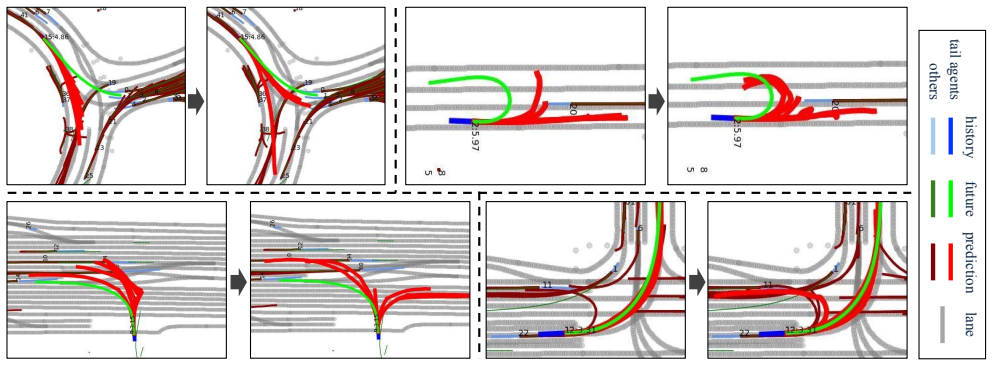
The central claim is that a generative active-learning loop, in which failed tail scenarios are synthesized and added to training, can substantially improve both rare-event and overall trajectory prediction without modifying the backbone model. Tail samples are defined dynamically as scenes in which the current model's per-agent minADE6 exceeds a threshold, so they track actual failures rather than cluster membership. Augmented futures are generated by a pretrained conditional diffusion traffic model using real guidance: reverse diffusion starts not from pure noise but from a noised version of the ground-truth future, with the starting noise level set per agent type ($\lambda_{\text{tail}}=0.25$, $\lambda_{\text{relevant}}=0.6$, $\lambda_{\text{head}}=1$ times the full diffusion length $K$), so tail agents stay close to the original rare behavior while head and relevant agents diversify the scene. Head-agent generation is additionally steered by gradient guidance toward staying on roads and avoiding collisions. The paper reports that on WOMD with QCNet, FPR5 drops from 0.42 to 0.22 and minFDE6 drops from 0.654 to 0.558, that similar or larger relative gains hold on Argoverse2 and with the MTR backbone, and that naive resampling or re-balancing often degrades overall metrics.
Load-bearing premise
The method's gains rest on the assumption that trajectories produced by denoising a lightly noised version of tail agents' ground-truth futures are close enough to the true tail distribution that training on them transfers to unseen tail cases.
Editorial extensions
If this is right
- Any existing trajectory predictor can receive the same tail-boosting treatment at training time, with no architecture change and no added inference cost at deployment.
- Long-tail and head metrics improve together, meaning the method does not trade rare-case accuracy for everyday accuracy the way some resampling baselines do.
- Because false-prediction ratios roughly halve, downstream modules such as motion planning can expect fewer extreme prediction misses for the same backbone.
- The method's gains transfer across backbone designs and datasets, suggesting that the training procedure, not a particular model family, is what limits long-tail performance.
- Training cost is bounded: tail samples are found using errors already computed for the prediction loss, and the reported added generation time is under 36% of an epoch, shrinking as training converges.
Reading between the lines
- Beyond the paper: the real-guidance knob suggests a continuous interpolation spectrum between memorization and novel synthesis, so sweeping the lambda values could measure how much distributional novelty is needed before gains saturate.
- Beyond the paper: the same loop could apply to motion planning or behavior prediction tasks that share trajectory representations, provided a controllable simulator for those outputs is available.
- Beyond the paper: because generated scenes inherit the structure of the simulator, the method's ceiling is tied to how well the diffusion generator covers rare maneuvers; a more diverse simulator should raise the ceiling further.
- Beyond the paper: an alternative explanation of the gains is that noise injection during generation acts as a regularizer, so comparing GALTraj against plain trajectory noise augmentation would separate data-diversity effects from regularization effects.
Editorial analysis
A structured set of objections, weighed in public.
Referee Report
Summary. The paper proposes GALTraj, a training-time augmentation method for long-tail trajectory prediction. After an initial warm-up, the method computes per-agent minADE6 errors on the training set (Eq. (2)), marks scenes whose maximum error exceeds a threshold τ as tail samples (Eq. (1)), and augments those scenes using a pretrained controllable diffusion traffic generator. The generator uses 'real guidance' (Eq. (3)) with different reverse-process starting points for tail, relevant, and head agents (λtail=0.25, λrel=0.6, λhead=1), plus gradient guidance for traffic rules, to produce new future trajectories while retaining the original history. The augmented samples are randomly time-shifted (Eq. (6)) and added to the training set with decaying sampling weights (Sec. 3.5). Experiments on WOMD and Argoverse2 with QCNet and MTR report improved long-tail metrics (Top 1%, VaR999, FPR5) and overall minFDE6 compared with vanilla training, resampling, cRT, contrastive, and a naive generative augmentation baseline.
Significance. If the reported effects hold on held-out data, the paper makes a useful contribution: it shows that changing the training procedure, rather than the architecture, can improve long-tail trajectory prediction, and it provides a concrete recipe for using a pretrained traffic generator as a data-augmentation tool. The work is evaluated on two standard benchmarks and two backbones, includes ablations for all four components of the method, and addresses a genuine gap between average-case and long-tail metrics. These strengths are partly offset by the absence of variance estimates, the train-split 'model capacity' experiment (Table 1), and the lack of diversity statistics for the generated tail set, which leave the central claim that generative simulation, rather than simpler tail upweighting, drives the gains not yet fully established.
major comments (4)
- [5.3, Tables 2 and 3] The central quantitative claims are single-run results with no error bars, confidence intervals, or significance tests. This matters because several reported differences are small (e.g., WOMD minFDE6: Vanilla 0.654 vs. cRT 0.645; Argoverse2: Naive 0.530 vs. GALTraj 0.524), and the long-tail gains could depend on the random seed or protocol. In addition, Table 1 reports the 'model capacity' result on the WOMD training split, i.e., the same split on which the model is fit; an improvement from Top 1% 7.38 to 2.29 on the training split is consistent with overfitting to tail samples and does not by itself support the claim that existing architectures can accommodate tail data. Please report held-out validation results with multiple seeds and standard deviations, and either remove the train-split claim in Section 5.1 or support it with held-out numbers.
- [3.4.1, Eq. (3), Figure 4] For tail agents the reverse process starts from K*=0.25K, i.e., a lightly noised version of the ground-truth future, and Figure 4 states that the generated trajectories 'closely match the ground truth' for tail agents. The paper reports no statistic measuring the diversity or distance of the generated tail set (e.g., average displacement between generated and source futures, number of distinct maneuver modes, or coverage of the tail distribution). Without such a statistic, the reported gains over the resampling baseline could in principle be obtained by duplicating tail samples with the same random time-window shift and sampling-weight decay, without any diffusion generation. I request (i) a duplicate-and-shift control that uses Eq. (6) and the Sec. 3.5 sampling schedule but replaces the diffusion generator with exact copies of the tail futures, and (ii) a table reporting a distributional distance between generated and original tail trajectories for different values of λtail.
- [3.3 and 4.2] Tail samples are mined using minADE6 (Eq. (2)), and the long-tail metrics used for evaluation (Top k%, VaR, FPR5) are all computed from the same per-agent error metric. Selecting training examples by the evaluation metric can inflate apparent gains through selection on the evaluation axis, even when the held-out tail split is disjoint. Please provide a control that mines tail samples with a different error function (e.g., minFDE6, miss rate, or a map-based maneuver difficulty score) and reports the same evaluation suite, or evaluate on a pre-defined held-out tail set whose membership is fixed independently of the trained model.
- [3.4 and 3.5] Several load-bearing hyperparameters are deferred to the supplementary material: the error threshold τ in Eq. (1) that defines tail agents; the decay factor α and the clipping minimum in the sampling-weight schedule; and the distribution of the random shift δt in Eq. (6). Since the method's behavior is controlled by these choices, and the ablation study (Table 4) fixes them at unreported values, please state the exact values used for every experiment and provide a sensitivity analysis for τ and α. Without these details, the reader cannot judge how robust the reported improvements are to the main free parameters.
minor comments (6)
- [Section 1] The contributions section contains the typo 'successfuly'; please correct it to 'successfully'.
- [Table 2] The table header 'A V2' should be 'Argoverse2'; the datasets should be labeled consistently throughout the paper.
- [Table 4] The metric 'FRR5' appears in Table 4, while the text and other tables use 'FPR5'; please unify the notation.
- [Eq. (4)] The covariance Σk in the gradient-guidance update is not defined; please clarify whether it is the learned covariance of the diffusion model or a fixed schedule.
- [Figure 2 caption] The caption states that 'head, relevant, and tail agents move progressively less in the generated scene compared to the original scene', which appears to contradict the text, where tail agents stay close to ground truth and head agents exhibit greater variation; please rephrase the caption.
- [General] The paper repeatedly defers technical details to the supplementary material (gradient-guidance formulas in Sec. 3.4.2, selection of δt in Sec. 3.5, and additional experiments in Sec. 5.3); since the supplement was not part of the submission, these claims cannot currently be verified.
Circularity Check
No significant circularity: GALTraj's gains are measured on held-out validation splits, and its label-anchored generation design does not make the reported predictions equivalent to its inputs.
full rationale
The derivation chain is not circular. Tail samples are selected by the current model's minADE6 error (Eq. 1-2), and the same metric family appears in evaluation (Sec. 4.2); this is standard active-learning metric alignment, not a reduction, because the reported results are on held-out WOMD and Argoverse2 validation scenes disjoint from the samples used for mining and augmentation. Eq. (3) sets K*=0.25K for tail agents, so generated tail futures are deliberately close to the noised ground truth, and Fig. 4 confirms they 'closely match the ground truth.' This makes the augmentation label-anchored, and a skeptic could ask for diversity statistics to rule out a duplicate-and-shift effect; but that is a missing-control or robustness concern, not a circular derivation. The same-split 'model capacity' result in Table 1 is explicitly labeled as testing capacity on the training split and is not offered as a generalization result; cross-split results appear in Table 2. No load-bearing self-citation or imported uniqueness theorem appears: real guidance [22], gradient guidance [88], and LCSim [84] are external. The empirically chosen lambda values and deferred supplementary details (e.g., delta_t selection) are support gaps, not circular steps.
Assumptions & free parameters
free parameters (6)
- tail threshold tau =
not specified
- lambda_tail =
0.25
- lambda_rel =
0.6
- lambda_head =
1.0
- sampling weight decay alpha =
not specified
- random time window shift delta_t =
range not specified
assumptions (3)
- domain assumption The pretrained LCSim diffusion model generates realistic traffic futures that preserve scene semantics when initialized from noised ground truth.
- domain assumption The gradient guidance objective C for no-off-road and repeller constraints is correctly formulated and applied.
- domain assumption The backbone prediction models (QCNet, MTR) are trained with their standard procedures and the training budget is matched across methods.
Cite this review
Pith. "Pith review of Generative Active Learning for Long-tail Trajectory Prediction via Controllable Diffusion Model." pith.science (2026). https://pith.science/paper/JIWTLGX4
@misc{pith2026250722615,
  author       = {Pith},
  title        = {Pith review of: Generative Active Learning for Long-tail Trajectory Prediction via Controllable Diffusion Model},
  year         = {2026},
  howpublished = {\url{https://pith.science/paper/JIWTLGX4}},
  note         = {Machine review of arXiv:2507.22615}
}
read the original abstract
While data-driven trajectory prediction has enhanced the reliability of autonomous driving systems, it still struggles with rarely observed long-tail scenarios. Prior works addressed this by modifying model architectures, such as using hypernetworks. In contrast, we propose refining the training process to unlock each model's potential without altering its structure. We introduce Generative Active Learning for Trajectory prediction (GALTraj), the first method to successfully deploy generative active learning into trajectory prediction. It actively identifies rare tail samples where the model fails and augments these samples with a controllable diffusion model during training. In our framework, generating scenarios that are diverse, realistic, and preserve tail-case characteristics is paramount. Accordingly, we design a tail-aware generation method that applies tailored diffusion guidance to generate trajectories that both capture rare behaviors and respect traffic rules. Unlike prior simulation methods focused solely on scenario diversity, GALTraj is the first to show how simulator-driven augmentation benefits long-tail learning in trajectory prediction. Experiments on multiple trajectory datasets (WOMD, Argoverse2) with popular backbones (QCNet, MTR) confirm that our method significantly boosts performance on tail samples and also enhances accuracy on head samples.
Figures


Figures from the paper (2 more)

Reference graph
Works this paper leans on
-
[1]
So- cial lstm: Human trajectory prediction in crowded spaces
Alexandre Alahi, Kratarth Goel, Vignesh Ramanathan, Alexandre Robicquet, Li Fei-Fei, and Silvio Savarese. So- cial lstm: Human trajectory prediction in crowded spaces. In Proceedings of the IEEE conference on computer vision and pattern recognition, pages 961–971, 2016. 1
2016
-
[2]
Long-tailed recognition via weight balancing
Shaden Alshammari, Yu-Xiong Wang, Deva Ramanan, and Shu Kong. Long-tailed recognition via weight balancing. In Proceedings of the IEEE/CVF conference on computer vi- sion and pattern recognition, pages 6897–6907, 2022. 2
2022
-
[3]
A set of control points con- ditioned pedestrian trajectory prediction
Inhwan Bae and Hae-Gon Jeon. A set of control points con- ditioned pedestrian trajectory prediction. In Proceedings of the AAAI Conference on Artificial Intelligence, pages 6155– 6165, 2023. 1
2023
-
[4]
Learning pedestrian group representations for multi-modal trajectory prediction
Inhwan Bae, Jin-Hwi Park, and Hae-Gon Jeon. Learning pedestrian group representations for multi-modal trajectory prediction. In European Conference on Computer Vision , pages 270–289. Springer, 2022. 2
2022
-
[5]
Eigentrajectory: Low-rank descriptors for multi-modal trajectory forecasting
Inhwan Bae, Jean Oh, and Hae-Gon Jeon. Eigentrajectory: Low-rank descriptors for multi-modal trajectory forecasting. In Proceedings of the IEEE/CVF International Conference on Computer Vision, pages 10017–10029, 2023. 2
2023
-
[6]
Can language beat numerical regression? language-based multimodal tra- jectory prediction
Inhwan Bae, Junoh Lee, and Hae-Gon Jeon. Can language beat numerical regression? language-based multimodal tra- jectory prediction. In Proceedings of the IEEE/CVF Confer- ence on Computer Vision and Pattern Recognition (CVPR) , pages 753–766, 2024. 2
2024
-
[7]
Can language beat numerical regression? language-based multimodal tra- jectory prediction
Inhwan Bae, Junoh Lee, and Hae-Gon Jeon. Can language beat numerical regression? language-based multimodal tra- jectory prediction. In Proceedings of the IEEE/CVF Con- ference on Computer Vision and Pattern Recognition, pages 753–766, 2024. 1
2024
-
[8]
Singu- lartrajectory: Universal trajectory predictor using diffusion model
Inhwan Bae, Young-Jae Park, and Hae-Gon Jeon. Singu- lartrajectory: Universal trajectory predictor using diffusion model. In Proceedings of the IEEE/CVF Conference on Computer Vision and Pattern Recognition (CVPR) , pages 17890–17901, 2024. 2
2024
Show all 92 references
-
[9]
Lang, Sourabh V ora, Venice Erin Liong, Qiang Xu, Anush Krishnan, Yu Pan, Gi- ancarlo Baldan, and Oscar Beijbom
Holger Caesar, Varun Bankiti, Alex H. Lang, Sourabh V ora, Venice Erin Liong, Qiang Xu, Anush Krishnan, Yu Pan, Gi- ancarlo Baldan, and Oscar Beijbom. nuScenes: A Multi- modal Dataset for Autonomous Driving. In 2020 IEEE/CVF Conference on Computer Vision and Pattern Recognitio...
2020
-
[10]
Learning imbalanced datasets with label- distribution-aware margin loss
Kaidi Cao, Colin Wei, Adrien Gaidon, Nikos Arechiga, and Tengyu Ma. Learning imbalanced datasets with label- distribution-aware margin loss. In NeurIPS, 2019. 2
2019
-
[11]
Learning imbalanced datasets with label- distribution-aware margin loss
Kaidi Cao, Colin Wei, Adrien Gaidon, Nikos Arechiga, and Tengyu Ma. Learning imbalanced datasets with label- distribution-aware margin loss. Advances in neural informa- tion processing systems, 32, 2019. 2
2019
-
[12]
Ar- goverse: 3D Tracking and Forecasting With Rich Maps
Ming-Fang Chang, Deva Ramanan, James Hays, John Lam- bert, Patsorn Sangkloy, Jagjeet Singh, Slawomir Bak, An- drew Hartnett, De Wang, Peter Carr, and Simon Lucey. Ar- goverse: 3D Tracking and Forecasting With Rich Maps. In 2019 IEEE/CVF Conference on Computer Vision and Pat- t...
2019
-
[13]
Ppad: Iterative interactions of prediction and planning for end-to-end autonomous driving
Zhili Chen, Maosheng Ye, Shuangjie Xu, Tongyi Cao, and Qifeng Chen. Ppad: Iterative interactions of prediction and planning for end-to-end autonomous driving. In European Conference on Computer Vision , pages 239–256. Springer,
-
[14]
Forecast-mae: Self-supervised pre-training for motion forecasting with masked autoencoders
Jie Cheng, Xiaodong Mei, and Ming Liu. Forecast-mae: Self-supervised pre-training for motion forecasting with masked autoencoders. In Proceedings of the IEEE/CVF In- ternational Conference on Computer Vision , pages 8679– 8689, 2023. 1
2023
-
[15]
Parametric contrastive learning
Jiequan Cui, Zhisheng Zhong, Shu Liu, Bei Yu, and Ji- aya Jia. Parametric contrastive learning. In Proceedings of the IEEE/CVF international conference on computer vision, pages 715–724, 2021. 2
2021
-
[16]
Large scale fine-grained categorization and domain-specific transfer learning
Yin Cui, Yang Song, Chen Sun, Andrew Howard, and Serge Belongie. Large scale fine-grained categorization and domain-specific transfer learning. In Proceedings of the IEEE conference on computer vision and pattern recogni- tion, pages 4109–4118, 2018. 2
2018
-
[17]
Large Scale In- teractive Motion Forecasting for Autonomous Driving : The Waymo Open Motion Dataset
Scott Ettinger, Shuyang Cheng, Benjamin Caine, Chenxi Liu, Hang Zhao, Sabeek Pradhan, Yuning Chai, Ben Sapp, Charles Qi, Yin Zhou, Zoey Yang, Aurelien Chouard, Pei Sun, Jiquan Ngiam, Vijay Vasudevan, Alexander McCauley, Jonathon Shlens, and Dragomir Anguelov. Large Scale In- t...
2021
-
[18]
What neural networks memorize and why: Discovering the long tail via influence estimation
Vitaly Feldman and Chiyuan Zhang. What neural networks memorize and why: Discovering the long tail via influence estimation. In Advances in Neural Information Processing Systems, pages 2881–2891. Curran Associates, Inc., 2020. 1
2020
-
[19]
Unitraj: A unified framework for scalable vehicle trajectory prediction
Lan Feng, Mohammadhossein Bahari, Kaouther Mes- saoud Ben Amor, ´Eloi Zablocki, Matthieu Cord, and Alexan- dre Alahi. Unitraj: A unified framework for scalable vehicle trajectory prediction. In European Conference on Computer Vision, pages 106–123. Springer, 2024. 5
2024
-
[20]
Producing and leveraging on- line map uncertainty in trajectory prediction
Xunjiang Gu, Guanyu Song, Igor Gilitschenski, Marco Pavone, and Boris Ivanovic. Producing and leveraging on- line map uncertainty in trajectory prediction. In Proceedings of the IEEE/CVF Conference on Computer Vision and Pat- tern Recognition, pages 14521–14530, 2024. 2
2024
-
[21]
Social gan: Socially acceptable tra- jectories with generative adversarial networks
Agrim Gupta, Justin Johnson, Li Fei-Fei, Silvio Savarese, and Alexandre Alahi. Social gan: Socially acceptable tra- jectories with generative adversarial networks. In Proceed- ings of the IEEE conference on computer vision and pattern recognition, pages 2255–2264, 2018. 1
2018
-
[22]
IS SYN- THETIC DATA FROM GENERATIVE MODELS READY FOR IMAGE RECOGNITION? In The Eleventh Interna- tional Conference on Learning Representations, 2023
Ruifei He, Shuyang Sun, Xin Yu, Chuhui Xue, Wenqing Zhang, Philip Torr, Song Bai, and XIAOJUAN QI. IS SYN- THETIC DATA FROM GENERATIVE MODELS READY FOR IMAGE RECOGNITION? In The Eleventh Interna- tional Conference on Learning Representations, 2023. 4
2023
-
[23]
Distilling vir- tual examples for long-tailed recognition
Yin-Yin He, Jianxin Wu, and Xiu-Shen Wei. Distilling vir- tual examples for long-tailed recognition. In Proceedings of the IEEE/CVF international conference on computer vision, pages 235–244, 2021. 2
2021
-
[24]
Subclass-balancing contrastive learning for long- tailed recognition
Chengkai Hou, Jieyu Zhang, Haonan Wang, and Tianyi Zhou. Subclass-balancing contrastive learning for long- tailed recognition. In Proceedings of the IEEE/CVF inter- national conference on computer vision , pages 5395–5407,
-
[25]
Planning-oriented autonomous driving
Yihan Hu, Jiazhi Yang, Li Chen, Keyu Li, Chonghao Sima, Xizhou Zhu, Siqi Chai, Senyao Du, Tianwei Lin, Wenhai Wang, et al. Planning-oriented autonomous driving. In Pro- ceedings of the IEEE/CVF Conference on Computer Vision and Pattern Recognition, pages 17853–17862, 2023. 2
2023
-
[26]
Ac- tive generation for image classification
Tao Huang, Jiaqi Liu, Shan You, and Chang Xu. Ac- tive generation for image classification. arXiv preprint arXiv:2403.06517, 2024. 2, 3
2024 arXiv
-
[27]
Gameformer: Game-theoretic modeling and learning of transformer-based interactive prediction and planning for autonomous driving
Zhiyu Huang, Haochen Liu, and Chen Lv. Gameformer: Game-theoretic modeling and learning of transformer-based interactive prediction and planning for autonomous driving. In Proceedings of the IEEE/CVF International Conference on Computer Vision, pages 3903–3913, 2023. 2
2023
-
[28]
Versatile behavior dif- fusion for generalized traffic agent simulation.arXiv preprint arXiv:2404.02524, 2024
Zhiyu Huang, Zixu Zhang, Ameya Vaidya, Yuxiao Chen, Chen Lv, and Jaime Fern´andez Fisac. Versatile behavior dif- fusion for generalized traffic agent simulation.arXiv preprint arXiv:2404.02524, 2024. 2
2024
-
[29]
The trajectron: Proba- bilistic multi-agent trajectory modeling with dynamic spa- tiotemporal graphs
Boris Ivanovic and Marco Pavone. The trajectron: Proba- bilistic multi-agent trajectory modeling with dynamic spa- tiotemporal graphs. In Proceedings of the IEEE/CVF inter- national conference on computer vision , pages 2375–2384,
-
[30]
Rethinking class-balanced methods for long-tailed visual recognition from a domain adaptation perspective
Muhammad Abdullah Jamal, Matthew Brown, Ming-Hsuan Yang, Liqiang Wang, and Boqing Gong. Rethinking class-balanced methods for long-tailed visual recognition from a domain adaptation perspective. In Proceedings of the IEEE/CVF conference on computer vision and pattern recogniti...
2020
-
[31]
Multi-agent long-term 3d human pose forecasting via interaction-aware trajectory conditioning
Jaewoo Jeong, Daehee Park, and Kuk-Jin Yoon. Multi-agent long-term 3d human pose forecasting via interaction-aware trajectory conditioning. In Proceedings of the IEEE/CVF Conference on Computer Vision and Pattern Recognition , pages 1617–1628, 2024. 2
2024
-
[32]
Multi-modal knowledge distillation-based human trajectory forecasting
Jaewoo Jeong, Seohee Lee, Daehee Park, Giwon Lee, and Kuk-Jin Yoon. Multi-modal knowledge distillation-based human trajectory forecasting. In Proceedings of the Com- puter Vision and Pattern Recognition Conference , pages 24222–24233, 2025. 2
2025
-
[33]
Motiondiffuser: Controllable multi-agent motion prediction using diffusion
Chiyu Jiang, Andre Cornman, Cheolho Park, Benjamin Sapp, Yin Zhou, Dragomir Anguelov, et al. Motiondiffuser: Controllable multi-agent motion prediction using diffusion. In Proceedings of the IEEE/CVF Conference on Computer Vision and Pattern Recognition, pages 9644–9653, 2023. 2
2023
-
[34]
Scenediffuser: Efficient and controllable driving simulation initialization and rollout
Max Jiang, Yijing Bai, Andre Cornman, Christopher Davis, Xiukun Huang, Hong Jeon, Sakshum Kulshrestha, John Lambert, Shuangyu Li, Xuanyu Zhou, et al. Scenediffuser: Efficient and controllable driving simulation initialization and rollout. Advances in Neural Information Process...
2024
-
[35]
Decou- pling representation and classifier for long-tailed recogni- tion
Bingyi Kang, Saining Xie, Marcus Rohrbach, Zhicheng Yan, Albert Gordo, Jiashi Feng, and Yannis Kalantidis. Decou- pling representation and classifier for long-tailed recogni- tion. In International Conference on Learning Representa- tions, 2020. 5
2020
-
[36]
M2m: Imbalanced classification via major-to-minor translation
Jaehyung Kim, Jongheon Jeong, and Jinwoo Shin. M2m: Imbalanced classification via major-to-minor translation. In Proceedings of the IEEE/CVF conference on computer vi- sion and pattern recognition, pages 13896–13905, 2020. 2
2020
-
[37]
Higher-order relational reasoning for pedestrian trajectory prediction
Sungjune Kim, Hyung-gun Chi, Hyerin Lim, Karthik Ra- mani, Jinkyu Kim, and Sangpil Kim. Higher-order relational reasoning for pedestrian trajectory prediction. In Proceed- ings of the IEEE/CVF Conference on Computer Vision and Pattern Recognition, pages 15251–15260, 2024. 2
2024
-
[38]
Active generative adversarial network for image classification
Quan Kong, Bin Tong, Martin Klinkigt, Yuki Watanabe, Naoto Akira, and Tomokazu Murakami. Active generative adversarial network for image classification. In Proceed- ings of the AAAI conference on artificial intelligence , pages 4090–4097, 2019. 2, 3
2019
-
[39]
Sept: Towards efficient scene represen- tation learning for motion prediction
Zhiqian Lan, Yuxuan Jiang, Yao Mu, Chen Chen, and Shengbo Eben Li. Sept: Towards efficient scene represen- tation learning for motion prediction. In The Twelfth Inter- national Conference on Learning Representations, 2023. 2
2023
-
[40]
Non-differentiable reward optimization for diffusion- based autonomous motion planning
Giwon Lee, Daehee Park, Jaewoo Jeong, and Kuk-Jin Yoon. Non-differentiable reward optimization for diffusion- based autonomous motion planning. arXiv preprint arXiv:2507.12977, 2025. 2
2025 arXiv
-
[41]
Desire: Distant future prediction in dynamic scenes with interacting agents
Namhoon Lee, Wongun Choi, Paul Vernaza, Christopher B Choy, Philip HS Torr, and Manmohan Chandraker. Desire: Distant future prediction in dynamic scenes with interacting agents. In Proceedings of the IEEE conference on computer vision and pattern recognition, pages 336–345, 2017. 1
2017
-
[42]
Semantic-guided generative image augmentation method with diffusion models for image classification
Bohan Li, Xiao Xu, Xinghao Wang, Yutai Hou, Yunlong Feng, Feng Wang, Xuanliang Zhang, Qingfu Zhu, and Wanx- iang Che. Semantic-guided generative image augmentation method with diffusion models for image classification. In Proceedings of the AAAI Conference on Artificial Intell...
2024
-
[43]
Nested collaborative learning for long-tailed visual recognition
Jun Li, Zichang Tan, Jun Wan, Zhen Lei, and Guodong Guo. Nested collaborative learning for long-tailed visual recognition. In Proceedings of the IEEE/CVF conference on computer vision and pattern recognition, pages 6949–6958,
-
[44]
Metasaug: Meta semantic augmentation for long-tailed visual recognition
Shuang Li, Kaixiong Gong, Chi Harold Liu, Yulin Wang, Feng Qiao, and Xinjing Cheng. Metasaug: Meta semantic augmentation for long-tailed visual recognition. In Proceed- ings of the IEEE/CVF conference on computer vision and pattern recognition, pages 5212–5221, 2021. 2
2021
-
[45]
Targeted su- pervised contrastive learning for long-tailed recognition
Tianhong Li, Peng Cao, Yuan Yuan, Lijie Fan, Yuzhe Yang, Rogerio S Feris, Piotr Indyk, and Dina Katabi. Targeted su- pervised contrastive learning for long-tailed recognition. In Proceedings of the IEEE/CVF conference on computer vi- sion and pattern recognition, pages 6918–69...
2022
-
[46]
Meid: mixture-of-experts with internal distillation for long-tailed video recognition
Xinjie Li and Huijuan Xu. Meid: mixture-of-experts with internal distillation for long-tailed video recognition. In Pro- ceedings of the AAAI Conference on Artificial Intelligence , pages 1451–1459, 2023. 2
2023
-
[47]
Cdkformer: Contextual deviation knowledge-based transformer for long- tail trajectory prediction
Yuansheng Lian, Ke Zhang, and Meng Li. Cdkformer: Contextual deviation knowledge-based transformer for long- tail trajectory prediction. arXiv preprint arXiv:2503.12695,
-
[48]
Deep representation learning on long-tailed data: A learnable embedding augmentation perspective
Jialun Liu, Yifan Sun, Chuchu Han, Zhaopeng Dou, and Wenhui Li. Deep representation learning on long-tailed data: A learnable embedding augmentation perspective. In Pro- ceedings of the IEEE/CVF conference on computer vision and pattern recognition, pages 2970–2979, 2020. 2
2020
-
[49]
Ziwei Liu, Zhongqi Miao, Xiaohang Zhan, Jiayun Wang, Boqing Gong, and Stella X. Yu. Large-scale long-tailed recognition in an open world. In CVPR, 2019. 2
2019
-
[50]
On exposing the challenging long tail in future prediction of traffic actors
Osama Makansi, ¨Ozg¨un Cicek, Yassine Marrakchi, and Thomas Brox. On exposing the challenging long tail in future prediction of traffic actors. In Proceedings of the IEEE/CVF International Conference on Computer Vision , pages 13147–13157, 2021. 1, 3, 5
2021
-
[51]
Long-tail learning via logit adjustment
Aditya Krishna Menon, Sadeep Jayasumana, Ankit Singh Rawat, Himanshu Jain, Andreas Veit, and Sanjiv Kumar. Long-tail learning via logit adjustment. In ICLR, 2021. 2
2021
-
[52]
Long-tail learning via logit adjustment
Aditya Krishna Menon, Sadeep Jayasumana, Ankit Singh Rawat, Himanshu Jain, Andreas Veit, and Sanjiv Kumar. Long-tail learning via logit adjustment. In International Conference on Learning Representations, 2021. 2
2021
-
[53]
Amend: A mixture of experts framework for long-tailed trajectory prediction,
Ray Coden Mercurius, Ehsan Ahmadi, Soheil Mohamad Al- izadeh Shabestary, and Amir Rasouli. Amend: A mixture of experts framework for long-tailed trajectory prediction,
-
[54]
Most: Multi-modality scene to- kenization for motion prediction
Norman Mu, Jingwei Ji, Zhenpei Yang, Nate Harada, Hao- tian Tang, Kan Chen, Charles R Qi, Runzhou Ge, Kratarth Goel, Zoey Yang, et al. Most: Multi-modality scene to- kenization for motion prediction. In Proceedings of the IEEE/CVF Conference on Computer Vision and Pattern Reco...
2024
-
[55]
Factors in finetuning deep model for object detec- tion with long-tail distribution
Wanli Ouyang, Xiaogang Wang, Cong Zhang, and Xiaokang Yang. Factors in finetuning deep model for object detec- tion with long-tail distribution. In Proceedings of the IEEE Conference on Computer Vision and Pattern Recognition (CVPR), 2016. 1
2016
-
[56]
Leveraging future relation- ship reasoning for vehicle trajectory prediction
Daehee Park, Hobin Ryu, Yunseo Yang, Jegyeong Cho, Ji- won Kim, and Kuk-Jin Yoon. Leveraging future relation- ship reasoning for vehicle trajectory prediction. In The Eleventh International Conference on Learning Representa- tions, 2023. 2
2023
-
[57]
Improv- ing transferability for cross-domain trajectory prediction via neural stochastic differential equation
Daehee Park, Jaewoo Jeong, and Kuk-Jin Yoon. Improv- ing transferability for cross-domain trajectory prediction via neural stochastic differential equation. In Proceedings of the AAAI Conference on Artificial Intelligence , pages 10145– 10154, 2024. 2
2024
-
[58]
T4p: Test-time training of tra- jectory prediction via masked autoencoder and actor-specific token memory
Daehee Park, Jaeseok Jeong, Sung-Hoon Yoon, Jaewoo Jeong, and Kuk-Jin Yoon. T4p: Test-time training of tra- jectory prediction via masked autoencoder and actor-specific token memory. In Proceedings of the IEEE/CVF Conference on Computer Vision and Pattern Recognition, pages 15...
2024
-
[59]
What truly matters in trajectory pre- diction for autonomous driving? Advances in Neural Infor- mation Processing Systems, 36, 2024
Tran Phong, Haoran Wu, Cunjun Yu, Panpan Cai, Sifa Zheng, and David Hsu. What truly matters in trajectory pre- diction for autonomous driving? Advances in Neural Infor- mation Processing Systems, 36, 2024. 2
2024
-
[60]
Cadet: a causal disentanglement approach for robust trajec- tory prediction in autonomous driving
Mozhgan Pourkeshavarz, Junrui Zhang, and Amir Rasouli. Cadet: a causal disentanglement approach for robust trajec- tory prediction in autonomous driving. In Proceedings of the IEEE/CVF Conference on Computer Vision and Pattern Recognition, pages 14874–14884, 2024. 1
2024
-
[61]
Scenario diffusion: Controllable driving scenario gen- eration with diffusion
Ethan Pronovost, Meghana Reddy Ganesina, Noureldin Hendy, Zeyu Wang, Andres Morales, Kai Wang, and Nick Roy. Scenario diffusion: Controllable driving scenario gen- eration with diffusion. Advances in Neural Information Pro- cessing Systems, 36:68873–68894, 2023. 3
2023
-
[62]
R2p2: A reparameterized pushforward policy for diverse, precise generative path forecasting
Nicholas Rhinehart, Kris M Kitani, and Paul Vernaza. R2p2: A reparameterized pushforward policy for diverse, precise generative path forecasting. In Proceedings of the European Conference on Computer Vision (ECCV) , pages 772–788,
-
[63]
Fjmp: Factorized joint multi-agent motion prediction over learned directed acyclic interaction graphs
Luke Rowe, Martin Ethier, Eli-Henry Dykhne, and Krzysztof Czarnecki. Fjmp: Factorized joint multi-agent motion prediction over learned directed acyclic interaction graphs. In Proceedings of the IEEE/CVF Conference on Computer Vision and Pattern Recognition , pages 13745– 13755...
2023
-
[64]
Distributional robustness loss for long-tail learning
Dvir Samuel and Gal Chechik. Distributional robustness loss for long-tail learning. In Proceedings of the IEEE/CVF In- ternational Conference on Computer Vision (ICCV) , pages 9495–9504, 2021. 1
2021
-
[65]
Motionlm: Multi-agent motion forecast- ing as language modeling
Ari Seff, Brian Cera, Dian Chen, Mason Ng, Aurick Zhou, Nigamaa Nayakanti, Khaled S Refaat, Rami Al-Rfou, and Benjamin Sapp. Motionlm: Multi-agent motion forecast- ing as language modeling. In Proceedings of the IEEE/CVF International Conference on Computer Vision, pages 8579–...
2023
-
[66]
How re-sampling helps for long-tail learning? Advances in Neural Information Processing Systems, 36, 2023
Jiang-Xin Shi, Tong Wei, Yuke Xiang, and Yu-Feng Li. How re-sampling helps for long-tail learning? Advances in Neural Information Processing Systems, 36, 2023. 5
2023
-
[67]
Motion transformer with global intention localization and lo- cal movement refinement
Shaoshuai Shi, Li Jiang, Dengxin Dai, and Bernt Schiele. Motion transformer with global intention localization and lo- cal movement refinement. Advances in Neural Information Processing Systems, 35:6531–6543, 2022. 5
2022
-
[68]
Language conditioned traffic generation
Shuhan Tan, Boris Ivanovic, Xinshuo Weng, Marco Pavone, and Philipp Kraehenbuehl. Language conditioned traffic generation. In 7th Annual Conference on Robot Learning ,
-
[69]
Hpnet: Dynamic trajectory fore- casting with historical prediction attention
Xiaolong Tang, Meina Kan, Shiguang Shan, Zhilong Ji, Jin- feng Bai, and Xilin Chen. Hpnet: Dynamic trajectory fore- casting with historical prediction attention. InProceedings of the IEEE/CVF Conference on Computer Vision and Pattern Recognition, pages 15261–15270, 2024. 2
2024
-
[70]
Rsg: A simple but effective mod- ule for learning imbalanced datasets
Jianfeng Wang, Thomas Lukasiewicz, Xiaolin Hu, Jianfei Cai, and Zhenghua Xu. Rsg: A simple but effective mod- ule for learning imbalanced datasets. In Proceedings of the IEEE/CVF conference on computer vision and pattern recognition, pages 3784–3793, 2021. 2
2021
-
[71]
Contrastive learning based hybrid networks for long- tailed image classification
Peng Wang, Kai Han, Xiu-Shen Wei, Lei Zhang, and Lei Wang. Contrastive learning based hybrid networks for long- tailed image classification. In Proceedings of the IEEE/CVF conference on computer vision and pattern recognition , pages 943–952, 2021. 2
2021
-
[72]
Fend: A future enhanced distribution-aware contrastive learning framework for long-tail trajectory prediction
Yuning Wang, Pu Zhang, Lei Bai, and Jianru Xue. Fend: A future enhanced distribution-aware contrastive learning framework for long-tail trajectory prediction. In CVPR, pages 1400–1409, 2023. 1, 2, 3, 5, 6
2023
-
[73]
Opti- mizing diffusion models for joint trajectory prediction and controllable generation
Yixiao Wang, Chen Tang, Lingfeng Sun, Simone Rossi, Yichen Xie, Chensheng Peng, Thomas Hannagan, Stefano Sabatini, Nicola Poerio, Masayoshi Tomizuka, et al. Opti- mizing diffusion models for joint trajectory prediction and controllable generation. arXiv preprint arXiv:2408.00766 ,
-
[74]
Density-adaptive model based on motif ma- trix for multi-agent trajectory prediction
Di Wen, Haoran Xu, Zhaocheng He, Zhe Wu, Guang Tan, and Peixi Peng. Density-adaptive model based on motif ma- trix for multi-agent trajectory prediction. In Proceedings of the IEEE/CVF Conference on Computer Vision and Pattern Recognition, pages 14822–14832, 2024. 2
2024
-
[75]
Argoverse 2: Next generation datasets for self-driving perception and fore- casting
Benjamin Wilson, William Qi, Tanmay Agarwal, John Lam- bert, Jagjeet Singh, Siddhesh Khandelwal, Bowen Pan, Rat- nesh Kumar, Andrew Hartnett, Jhony Kaesemodel Pontes, Deva Ramanan, Peter Carr, and James Hays. Argoverse 2: Next generation datasets for self-driving perception an...
2021
-
[76]
Adapting to length shift: Flexilength network for trajectory prediction
Yi Xu and Yun Fu. Adapting to length shift: Flexilength network for trajectory prediction. In Proceedings of the IEEE/CVF Conference on Computer Vision and Pattern Recognition, pages 15226–15237, 2024. 1
2024
-
[77]
Sports-traj: A unified trajectory gen- eration model for multi-agent movement in sports
Yi Xu and Yun Fu. Sports-traj: A unified trajectory gen- eration model for multi-agent movement in sports. In The Thirteenth International Conference on Learning Represen- tations, 2025. 2
2025
-
[78]
Towards cal- ibrated model for long-tailed visual recognition from prior perspective
Zhengzhuo Xu, Zenghao Chai, and Chun Yuan. Towards cal- ibrated model for long-tailed visual recognition from prior perspective. Advances in Neural Information Processing Systems, 34:7139–7152, 2021. 2
2021
-
[79]
Rethinking the value of labels for improving class-imbalanced learning
Yuzhe Yang and Zhi Xu. Rethinking the value of labels for improving class-imbalanced learning. Advances in neural information processing systems, 33:19290–19301, 2020. 2
2020
-
[80]
Delving into deep imbalanced regression
Yuzhe Yang, Kaiwen Zha, Yingcong Chen, Hao Wang, and Dina Katabi. Delving into deep imbalanced regression. In International conference on machine learning, pages 11842– 11851. PMLR, 2021. 1
2021
-
[81]
Feature transfer learning for face recog- nition with under-represented data
Xi Yin, Xiang Yu, Kihyuk Sohn, Xiaoming Liu, and Man- mohan Chandraker. Feature transfer learning for face recog- nition with under-represented data. In Proceedings of the IEEE/CVF conference on computer vision and pattern recognition, pages 5704–5713, 2019. 2
2019
-
[82]
Fasa: Feature augmentation and sampling adaptation for long- tailed instance segmentation
Yuhang Zang, Chen Huang, and Chen Change Loy. Fasa: Feature augmentation and sampling adaptation for long- tailed instance segmentation. In Proceedings of the IEEE/CVF international conference on computer vision , pages 3457–3466, 2021. 2
2021
-
[83]
Deep long-tailed learning: A survey
Yifan Zhang, Bingyi Kang, Bryan Hooi, Shuicheng Yan, and Jiashi Feng. Deep long-tailed learning: A survey. IEEE Transactions on Pattern Analysis and Machine Intelligence, 45(9):10795–10816, 2023. 2
2023
-
[84]
Lcsim: A large-scale controllable traffic simulator, 2024
Yuheng Zhang, Tianjian Ouyang, Fudan Yu, Cong Ma, Lei Qiao, Wei Wu, Jian Yuan, and Yong Li. Lcsim: A large-scale controllable traffic simulator, 2024. 5
2024
-
[85]
Expanding small-scale datasets with guided imag- ination
Yifan Zhang, Daquan Zhou, Bryan Hooi, Kai Wang, and Ji- ashi Feng. Expanding small-scale datasets with guided imag- ination. Advances in Neural Information Processing Sys- tems, 36, 2024. 2
2024
-
[86]
Real-time motion prediction via het- erogeneous polyline transformer with relative pose encod- ing
Zhejun Zhang, Alexander Liniger, Christos Sakaridis, Fisher Yu, and Luc V Gool. Real-time motion prediction via het- erogeneous polyline transformer with relative pose encod- ing. Advances in Neural Information Processing Systems , 36, 2024. 2
2024
-
[87]
Im- proving calibration for long-tailed recognition
Zhisheng Zhong, Jiequan Cui, Shu Liu, and Jiaya Jia. Im- proving calibration for long-tailed recognition. In Proceed- ings of the IEEE/CVF conference on computer vision and pattern recognition, pages 16489–16498, 2021. 2
2021
-
[88]
Guided conditional diffusion for controllable traffic simula- tion
Ziyuan Zhong, Davis Rempe, Danfei Xu, Yuxiao Chen, Sushant Veer, Tong Che, Baishakhi Ray, and Marco Pavone. Guided conditional diffusion for controllable traffic simula- tion. In 2023 IEEE International Conference on Robotics and Automation (ICRA), pages 3560–3566. IEEE, 2023. 4
2023
-
[89]
Bbn: Bilateral-branch network with cumulative learning for long-tailed visual recognition
Boyan Zhou, Quan Cui, Xiu-Shen Wei, and Zhao-Min Chen. Bbn: Bilateral-branch network with cumulative learning for long-tailed visual recognition. In CVPR, 2020. 2
2020
-
[90]
Imb- sam: A closer look at sharpness-aware minimization in class- imbalanced recognition
Yixuan Zhou, Yi Qu, Xing Xu, and Hengtao Shen. Imb- sam: A closer look at sharpness-aware minimization in class- imbalanced recognition. In Proceedings of the IEEE/CVF International Conference on Computer Vision, pages 11345– 11355, 2023. 2
2023
-
[91]
Smartrefine: A scenario-adaptive refinement framework for efficient motion prediction
Yang Zhou, Hao Shao, Letian Wang, Steven L Waslander, Hongsheng Li, and Yu Liu. Smartrefine: A scenario-adaptive refinement framework for efficient motion prediction. In Proceedings of the IEEE/CVF Conference on Computer Vi- sion and Pattern Recognition, pages 15281–15290, 2024. 2
2024
-
[92]
Query-centric trajectory prediction
Zikang Zhou, Jianping Wang, Yung-Hui Li, and Yu-Kai Huang. Query-centric trajectory prediction. In Proceedings of the IEEE/CVF Conference on Computer Vision and Pat- tern Recognition, pages 17863–17873, 2023. 5
2023
Reviewed August 6, 2026 · model on record in the stance chip above.
Discussion (0). Sign in to comment.