REVIEW 2 major objections 2 minor 16 references
GARL: Game-Theoretic Reinforcement Learning for Multi-Agent Strategic Prioritisation
T0 review · 2 major / 2 minor · reviewed 2026-06-28 · grok-4.3
Pith's one-line read A two-stage allocation-arbiter game converts interaction utilities into role-specific reinforcement signals for multi-agent LLM prioritisation.
desk verdict GARL gives a two-stage game structure for turning interaction utilities into RL rewards in multi-agent LLM prioritization, but the abstract supplies almost no evidence to back the reported gains. read the letter →
The pith
A machine-rendered reading of the paper's core claim, the machinery that carries it, and where it could break.
The reading
What carries the argument
The two-stage allocation-plus-arbiter game, which generates utilities that are converted into role-specific reinforcement signals to guide policy optimisation.
What would settle it
An experiment on the same issues-in-dispute ranking task that applies standard task-specific rewards to the agents and finds equal or better performance than the game-derived signals.
Extended reading notes
Core claim
GARL formalises strategic prioritisation as a two-stage game: competing agents first allocate strategic resources over a shared candidate set, and a higher-level arbiter then produces the final ranking. The resulting game-theoretic utilities are converted into role-specific reinforcement signals, allowing policy optimisation to be guided by structured interaction rather than ad-hoc task rewards.
Load-bearing premise
The utilities produced by the two-stage allocation-plus-arbiter game can be directly converted into role-specific reinforcement signals that guide policy optimisation more effectively than conventional task-specific reward design.
Editorial extensions
If this is right
- Ranking performance improves on issues-in-dispute ranking tasks.
- Small open-source LLMs become competitive with strong closed-source LLMs under the same candidate-ranking setting.
- Gains appear in legal-domain competence.
- Performance also improves in broader strategic decision-making tasks.
Reading between the lines
- The same game structure could supply reward signals for other multi-agent LLM tasks that involve prioritisation or selection.
- Interaction-derived signals might reduce reliance on human-crafted rewards across a wider range of agent training problems.
- The framework suggests a route to close performance gaps between model sizes by improving the reward channel instead of scaling parameters.
Editorial analysis
A structured set of objections, weighed in public.
Referee Report
Summary. The paper proposes GARL, a framework that formalizes multi-agent strategic prioritisation as a two-stage game in which agents first allocate resources over candidates and a higher-level arbiter produces a ranking; game-theoretic utilities from this interaction are then converted into role-specific reinforcement signals to guide policy optimisation. The approach is instantiated on legal issue-in-dispute ranking, with the abstract claiming that the resulting policies improve ranking performance, allow small open-source LLMs to compete with strong closed-source models, and yield gains in legal-domain competence and strategic decision-making.
Significance. If the empirical results hold under proper controls, the work supplies a concrete mechanism for deriving RL objectives from explicit multi-agent interaction structure rather than task-specific heuristics, which could reduce reward-design arbitrariness in LLM-based strategic systems. No machine-checked proofs, reproducible code releases, or parameter-free derivations are described.
major comments (2)
- [Abstract] Abstract: the central empirical claim—that GARL improves ranking performance and enables small LLMs to compete with closed-source models—asserts gains without any reported baselines, metrics, statistical tests, ablation controls, or implementation details, so the data-to-claim link cannot be evaluated.
- [Method] Method (two-stage game and utility conversion): the manuscript must demonstrate that the utilities produced by the allocation-plus-arbiter game are computed independently of the downstream ranking objective; otherwise the conversion into RL signals risks circular grounding, as the utilities could be defined in terms of quantities already fitted to the target task.
minor comments (2)
- Notation for the two-stage game and role-specific signals should be introduced with explicit equations rather than prose descriptions alone.
- The abstract refers to 'broader strategic decision-making' gains; the experimental section should clarify whether these are measured on held-out tasks or are post-hoc interpretations of the ranking results.
Simulated Author's Rebuttal
We thank the referee for the detailed review. We address the concerns about the abstract's empirical claims and the independence of game-theoretic utilities. Revisions will include expanded abstract details and a new subsection on utility computation.
read point-by-point responses
-
Referee: [Abstract] Abstract: the central empirical claim—that GARL improves ranking performance and enables small LLMs to compete with closed-source models—asserts gains without any reported baselines, metrics, statistical tests, ablation controls, or implementation details, so the data-to-claim link cannot be evaluated.
Authors: The abstract is intentionally high-level per conference norms, but the full manuscript reports experiments with baselines (e.g., standard RLHF, direct LLM ranking), metrics (NDCG@K, MAP), statistical tests (paired t-tests), and ablations on the two-stage game. We agree the abstract should better link to these and will revise it to include brief references to the evaluation setup and key quantitative gains. revision: yes
-
Referee: [Method] Method (two-stage game and utility conversion): the manuscript must demonstrate that the utilities produced by the allocation-plus-arbiter game are computed independently of the downstream ranking objective; otherwise the conversion into RL signals risks circular grounding, as the utilities could be defined in terms of quantities already fitted to the target task.
Authors: The utilities are defined solely from the two-stage game payoffs: agents' resource allocations determine a Nash-derived value independent of any ground-truth legal rankings, and the arbiter's output is a function of allocations alone. The downstream ranking objective appears only in the RL policy update, not in utility calculation. We will add an explicit subsection with formal notation showing this separation to eliminate any ambiguity. revision: yes
Circularity Check
No significant circularity detected
full rationale
The provided abstract and description formalize GARL as a two-stage game whose utilities are converted into RL signals, with performance gains reported empirically. No equations, parameter-fitting steps, or self-citations are shown that would reduce any claimed prediction or utility to a fitted input or self-referential definition by construction. The central move is presented as an empirical outcome of applying game-theoretic structure to reward design rather than a closed mathematical loop. The derivation chain therefore remains self-contained against external benchmarks and does not trigger any of the enumerated circularity patterns.
Assumptions & free parameters
Cite this review
Pith. "Pith review of GARL: Game-Theoretic Reinforcement Learning for Multi-Agent Strategic Prioritisation." pith.science (2026). https://pith.science/paper/JJ4QLU5Y
@misc{pith2026260605002,
  author       = {Pith},
  title        = {Pith review of: GARL: Game-Theoretic Reinforcement Learning for Multi-Agent Strategic Prioritisation},
  year         = {2026},
  howpublished = {\url{https://pith.science/paper/JJ4QLU5Y}},
  note         = {Machine review of arXiv:2606.05002}
}
read the original abstract
LLM-based multi-agent systems are increasingly used for strategic decision-making tasks. In such settings, performance depends not only on individual model capabilities, but also on the policies by which agents interact and adapt. Multi-agent reinforcement learning can optimise these interaction policies, but its reward design often remains task-specific and weakly grounded in interaction structure. To address this gap, we propose GARL, a GAme-theoretic Reinforcement Learning framework for multi-agent strategic prioritisation. GARL formalises strategic prioritisation as a two-stage game: competing agents first allocate strategic resources over a shared candidate set, and a higher-level arbiter then produces the final ranking. The resulting game-theoretic utilities are converted into role-specific reinforcement signals, allowing policy optimisation to be guided by structured interaction. We instantiate GARL on issues-in-dispute ranking, where the goal is to prioritise core issues in legal proceedings. Experiments show that GARL improves ranking performance, enables small open-source LLMs to become competitive with a strong closed-source LLM under the same candidate-ranking setting, and yields gains in legal-domain competence and broader strategic decision-making. Overall, GARL demonstrates how game-theoretic interaction structure can be turned into reinforcement-learning objectives, providing a principled approach to policy optimisation in multi-agent strategic prioritisation.
Figures


Figures from the paper (5 more)


Reference graph
Works this paper leans on
-
[1]
Resource allocation in dynamic multiagent systems.arXiv preprint arXiv:2102.08317. Jiaxi Cui, Munan Ning, Zongjian Li, Hao Li, Yang Ya, Bohua Chen, Bin Ling, Yonghong Tian, and Li Yuan. 2026. Chatlaw: A multi-agent legal as- sistant based on a role-aligned mixture-of-experts architecture.Fundamental Research. DeepSeek-AI. 2025. Deepseek-r1: Incentivizing ...
-
[2]
Zhiwei Fei, Xiaoyu Shen, Dawei Zhu, Fengzhe Zhou, Zhuo Han, Alan Huang, Songyang Zhang, Kai Chen, Zhixin Yin, Zongwen Shen, and 1 others
Introduction to game theory.Game theory and machine learning for cyber security, pages 21–46. Zhiwei Fei, Xiaoyu Shen, Dawei Zhu, Fengzhe Zhou, Zhuo Han, Alan Huang, Songyang Zhang, Kai Chen, Zhixin Yin, Zongwen Shen, and 1 others. 2024. Law- bench: Benchmarking legal knowledge of large lan- guage models. InProceedings of the 2024 conference on empirical ...
2024
-
[3]
Sirui Hong, Mingchen Zhuge, Jonathan Chen, Xiawu Zheng, Yuheng Cheng, Jinlin Wang, Ceyao Zhang, Steven Yau, Zijuan Lin, Liyang Zhou, and 1 oth- ers
Generative ai for game theory-based mo- bile networking.IEEE Wireless Communications, 32(1):122–130. Sirui Hong, Mingchen Zhuge, Jonathan Chen, Xiawu Zheng, Yuheng Cheng, Jinlin Wang, Ceyao Zhang, Steven Yau, Zijuan Lin, Liyang Zhou, and 1 oth- ers. 2024. Metagpt: Meta programming for a multi- agent collaborative framework. InInternational Con- ference on...
2024
-
[4]
REINFORCE++: Stabilizing Critic-Free Policy Optimization with Global Advantage Normalization
Reinforce++: Stabilizing critic-free policy optimization with global advantage normalization. arXiv preprint arXiv:2501.03262. Wenyue Hua, Ollie Liu, Lingyao Li, Alfonso Amayue- las, Julie Chen, Lucas Jiang, Mingyu Jin, Lizhou Fan, Fei Sun, William Wang, and 1 others. 2024. Game- theoretic llm: Agent workflow for negotiation games. arXiv preprint arXiv:24...
work page Pith review arXiv 2024
-
[5]
Relevance: whether f_i has a direct legal connection to the claims or to facts that materially affect the judgment
-
[6]
Definiteness: whether f_i is logically clear and determinate, i.e., whether it can be formulated as a verifiable yes/no or existence/non-existence statement
-
[7]
Provability: whether f_i can be established or refuted through admissible evidence or legal interpretation
-
[8]
Materiality: whether resolving f_i has a decisive impact on the final judgment or substantially changes the allocation of liability
Show all 16 references
-
[9]
When evaluating the judge model, consider all five criteria and analyse whether each identified issue satisfies them
Legality: whether f_i complies with procedural and substantive legal norms. When evaluating the judge model, consider all five criteria and analyse whether each identified issue satisfies them. Then provide an overall score. If the judge model's output is completely unrelated ...
-
[10]
They must not be identical to, equivalent to, or subsumed by any existing issue
-
[11]
# Output Format
They must be less disputable than the existing issues, i.e., less necessary to be argued as core issues during the hearing. # Output Format
-
[12]
[New Issue in Dispute 1]
-
[13]
Figure 6: Prompt used for distractor issue generation
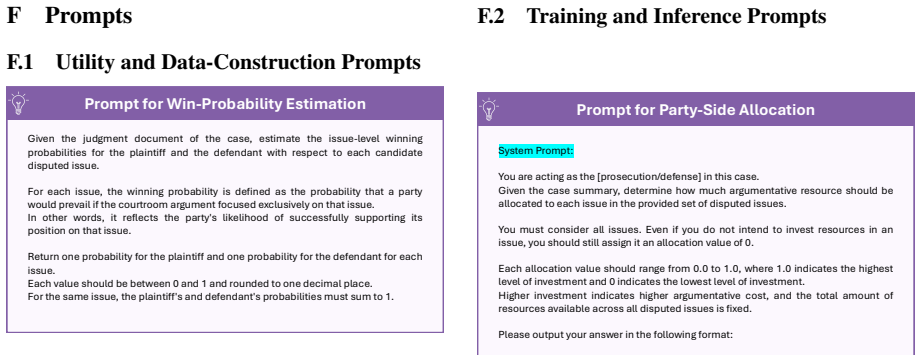
[New Issue in Dispute 2] ... Figure 6: Prompt used for distractor issue generation. F.2 Training and Inference Prompts Prompt for Party-Side Allocation System Prompt: You are acting as the [prosecution/defense] in this case. Given the case summary, determine how much argumenta...
-
[14]
Rank all candidate issues from highest to lowest priority. The issue placed first should receive the highest priority and the greatest argumentative investment, while the issue placed last should receive the lowest priority and the least argumentative investment
-
[15]
Do not omit or repeat any issue
All candidate issues must be included in the ranking. Do not omit or repeat any issue
-
[16]
Strictly follow the output format below: [Reasoning Process] Decision Order Array (list the issue IDs from highest to lowest priority): [ ] Figure 9: Prompt used for candidate issue ranking
Reviewed June 28, 2026 · model on record in the stance chip above.
Discussion (0). Continue with ORCID to comment.