REVIEW 2 major objections 2 minor 1 cited by
Finding the right path: statistical mechanics of connected solutions in constraint satisfaction problems
T0 review · 2 major / 2 minor · reviewed 2026-05-19 · grok-4.3
Pith's one-line read A new statistical mechanics ensemble reveals a stable cluster of connected solutions in the symmetric binary perceptron that persists up to a critical threshold.
desk verdict The paper builds a local-entropy ensemble to track delocalized connected clusters in the SBP and reports a stability threshold that its custom sampler reaches. read the letter →
The pith
A machine-rendered reading of the paper's core claim, the machinery that carries it, and where it could break.
The reading
What carries the argument
The local entropy bias ensemble, which reweights the measure on solutions to favor those with high local entropy and thereby exposes the manifold of connected solutions.
What would settle it
If a Monte Carlo simulation designed to target connected solutions stops finding them at a threshold noticeably different from the predicted κ^{no-mem}_{loc. stab.}, the claimed stability of the delocalized cluster would be falsified.
Extended reading notes
Core claim
The authors introduce an ensemble that uses local entropy bias to measure the manifold of connected solutions in CSPs. In the symmetric binary perceptron this ensemble detects a cluster of delocalized connected solutions whose local stability holds up to a threshold κ^{no-mem}_{loc. stab.} that depends on the constraint density α. Past this point the paths connecting solutions break apart, a phenomenon missed by standard statistical mechanics treatments of the model. The same threshold marks the point where local search algorithms cease to find solutions, and this prediction is confirmed by a custom Monte Carlo procedure that preferentially samples the connected manifold.
Load-bearing premise
The local entropy bias is assumed to correctly identify the manifold of connected solutions whose stability governs algorithmic success in the symmetric binary perceptron.
Editorial extensions
If this is right
- Local algorithms locate solutions in the symmetric binary perceptron for all thresholds below the stability limit.
- Solution paths shatter exactly at the critical threshold, marking a transition in landscape connectivity.
- Conventional statistical mechanics ensembles overlook the connected cluster because they do not bias toward local entropy.
- The ensemble supplies a concrete diagnostic for hardness transitions in other CSPs dominated by isolated solutions.
Reading between the lines
- The same bias construction may identify usable connected components in other models where isolated minima dominate the typical landscape.
- Algorithmic success ranges could be predicted by computing the local stability threshold rather than by exhaustive search.
- The approach suggests that memoryless local search succeeds precisely while the connected manifold remains locally stable.
Editorial analysis
A structured set of objections, weighed in public.
Referee Report
Summary. The paper introduces a statistical mechanics ensemble based on a local entropy bias to characterize the manifold of connected (delocalized) solutions in constraint satisfaction problems. Applied to the symmetric binary perceptron (SBP), where typical solutions are isolated, the ensemble reveals a cluster of connected solutions whose local stability persists up to a critical threshold κ^{no-mem}_{loc. stab.}(α). This transition, at which paths of solutions shatter, is not captured by standard approaches; the prediction is compared to the success of a custom Monte-Carlo sampler designed to target high-local-entropy regions.
Significance. If the local-entropy bias correctly identifies the relevant connected manifold, the work supplies a new device for locating algorithmic thresholds in glassy CSP landscapes dominated by isolated solutions. The explicit matching between the derived stability threshold and the performance limit of the modified sampler is a concrete strength that supports the claim and could generalize to other problems where conventional replica analyses miss connectivity.
major comments (2)
- [§4] §4 (ensemble definition and stability calculation): the local entropy bias is introduced to weight connected solutions, yet the derivation of κ^{no-mem}_{loc. stab.} does not demonstrate that this bias is measure-theoretically independent of the algorithmic dynamics; if the bias over-selects atypical high-entropy regions, the reported stability threshold may not bound unmodified local search or message-passing success in the SBP.
- [§5.2] §5.2 (Monte-Carlo validation): the custom sampler is constructed to target the same delocalized solutions that define the ensemble; without an ablation against an unmodified local Monte-Carlo or message-passing dynamics, and without reported finite-size scaling or error analysis on the observed success threshold, the numerical agreement cannot be taken as independent confirmation that the theoretical transition controls algorithmic reachability.
minor comments (2)
- [Abstract] The abstract introduces the symbol κ^{no-mem}_{loc. stab.} without a brief parenthetical gloss, which may hinder readers who have not yet reached the main text.
- [Figures] Figure captions (e.g., Fig. 2) omit the number of disorder realizations and the precise definition of the plotted order parameter; adding these details would improve reproducibility.
Simulated Author's Rebuttal
We thank the referee for their thorough review and valuable feedback on our manuscript. We appreciate the recognition of the potential significance of our approach for identifying algorithmic thresholds in glassy landscapes. Below, we provide detailed responses to the major comments, outlining how we plan to address them in the revised version.
read point-by-point responses
-
Referee: [§4] §4 (ensemble definition and stability calculation): the local entropy bias is introduced to weight connected solutions, yet the derivation of κ^{no-mem}_{loc. stab.} does not demonstrate that this bias is measure-theoretically independent of the algorithmic dynamics; if the bias over-selects atypical high-entropy regions, the reported stability threshold may not bound unmodified local search or message-passing success in the SBP.
Authors: We thank the referee for highlighting this important aspect. The local entropy bias is a static reweighting of the solution space based on the local density of solutions, which is a geometric property independent of any particular search dynamics. The ensemble is constructed to select for configurations with high local entropy, thereby focusing on the delocalized connected component. The stability analysis is performed by examining the fluctuations within this biased measure, revealing the point at which the connected cluster becomes unstable. We acknowledge that this threshold characterizes the stability under the biased ensemble and may not directly apply to unmodified dynamics that do not preferentially select high-entropy regions. However, it provides a theoretical characterization of the connected manifold that conventional approaches miss. In the revised manuscript, we will expand the discussion in §4 to clarify the measure-theoretic definition and explicitly state the scope regarding algorithmic implications for biased versus unbiased search. revision: partial
-
Referee: [§5.2] §5.2 (Monte-Carlo validation): the custom sampler is constructed to target the same delocalized solutions that define the ensemble; without an ablation against an unmodified local Monte-Carlo or message-passing dynamics, and without reported finite-size scaling or error analysis on the observed success threshold, the numerical agreement cannot be taken as independent confirmation that the theoretical transition controls algorithmic reachability.
Authors: We agree with the referee that the Monte-Carlo sampler is tailored to the high-local-entropy regions identified by our ensemble, making the numerical results a consistency check rather than fully independent validation. To address this, we will include an ablation study comparing the performance of the custom sampler to a standard local Monte-Carlo algorithm without the entropy bias. Additionally, we will report finite-size scaling of the success probability across different system sizes and include error analysis on the estimated success thresholds. These additions will strengthen the evidence that the theoretical transition marks the limit of algorithmic reachability for methods that target the connected manifold. revision: yes
Circularity Check
Tailored Monte-Carlo sampler targeting the local-entropy ensemble renders stability threshold validation self-confirming
-
fitted input called prediction
[Abstract (simulation comparison paragraph)]
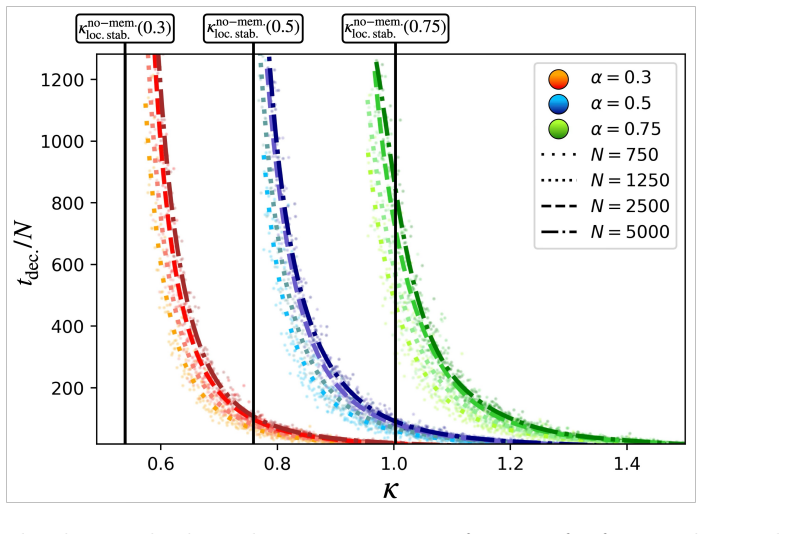
"we used a modified Monte-Carlo algorithm, designed specifically to target these delocalized solutions. We obtained, as predicted, that the algorithm finds solutions until κ≈κ^{no-mem}_{loc. stab.}."
The ensemble is built around the local entropy bias precisely to select the delocalized connected solutions. The Monte-Carlo is then altered to target the identical manifold, and its success up to the derived threshold is offered as confirmation. The agreement is therefore enforced by the shared targeting criterion rather than constituting an independent test of whether the threshold governs standard local algorithms.
full rationale
The derivation defines an ensemble via local entropy bias to isolate the manifold of connected/delocalized solutions in the SBP, derives a stability threshold κ^{no-mem}_{loc. stab.}, and then validates it by running a Monte-Carlo algorithm that is explicitly modified to target precisely those same solutions. Because the sampler is constructed to align with the ensemble definition rather than being an unmodified local search or message-passing dynamics, the reported agreement up to the threshold reduces to a consistency check within the biased measure. This constitutes a fitted-input-called-prediction pattern for the central algorithmic claim. No self-citation chains or definitional loops appear in the abstract or described construction; the circularity is localized to the simulation comparison that bears the load for claiming relevance to algorithmic success.
Assumptions & free parameters
free parameters (2)
- constraint density α
- threshold κ
assumptions (1)
- domain assumption Local entropy bias characterizes the manifold of connected solutions
Cite this review
Pith. "Pith review of Finding the right path: statistical mechanics of connected solutions in constraint satisfaction problems." pith.science (2026). https://pith.science/paper/JK7WNMMZ
@misc{pith2026250520954,
  author       = {Pith},
  title        = {Pith review of: Finding the right path: statistical mechanics of connected solutions in constraint satisfaction problems},
  year         = {2026},
  howpublished = {\url{https://pith.science/paper/JK7WNMMZ}},
  note         = {Machine review of arXiv:2505.20954}
}
abstract
We define and study a statistical mechanics ensemble that characterizes connected solutions in constraint satisfaction problems (CSPs). Built around a well-known local entropy bias, it allows us to better identify hardness transitions in problems where the energy landscape is dominated by isolated solutions. We apply this new device to the symmetric binary perceptron model (SBP), and study how its manifold of connected solutions behaves. We choose this particular problem because, while its typical solutions are isolated, it can be solved using local algorithms for a certain range of constraint density $\alpha$ and threshold $\kappa$. With this new ensemble, we unveil the presence of a cluster composed of delocalized connected solutions. In particular, we demonstrate its stability until a critical threshold $\kappa^{\rm no-mem}_{\rm loc.\, stab.}$ (dependent on $\alpha$). This transition appears as paths of solutions shatter, a phenomenon that more conventional statistical mechanics approaches fail to grasp. Finally, we compared our predictions to simulations. For this, we used a modified Monte-Carlo algorithm, designed specifically to target these delocalized solutions. We obtained, as predicted, that the algorithm finds solutions until $\kappa\approx\kappa^{\rm no-mem}_{\rm loc.\, stab.}$.
Figures


Figures from the paper (13 more)




Forward citations
Cited by 1 Pith paper
-
On the robustness of noisy solutions in non-convex neural networks
Finite training error extends the overlap-gap threshold in binary perceptrons so wide, algorithmically reachable basins persist and still generalize where zero-error solutions are hard.
Reviewed May 19, 2026 · model on record in the stance chip above.
Discussion (0). Sign in to comment.