REVIEW 3 major objections 5 minor 20 references
Sequential Modality Dropout for Robust Multi-Modal Sequential Recommendation
T0 review · 3 major / 5 minor · reviewed 2026-08-14 · deepseek-v4-flash
Pith's one-line read Multi-modal sequential recommenders can be made robust to missing images or text by a per-sample Bernoulli mask that zeroes an entire modality stream for each user's history during training, lifting text retention from 40–73% to 79–97% on…
desk verdict Useful four-line fix for missing modalities in multi-modal sequential recommenders, but the paper never tests the per-item masking alternative that would actually justify the per-sample design. read the letter →
The pith
A machine-rendered reading of the paper's core claim, the machinery that carries it, and where it could break.
The reading
What carries the argument
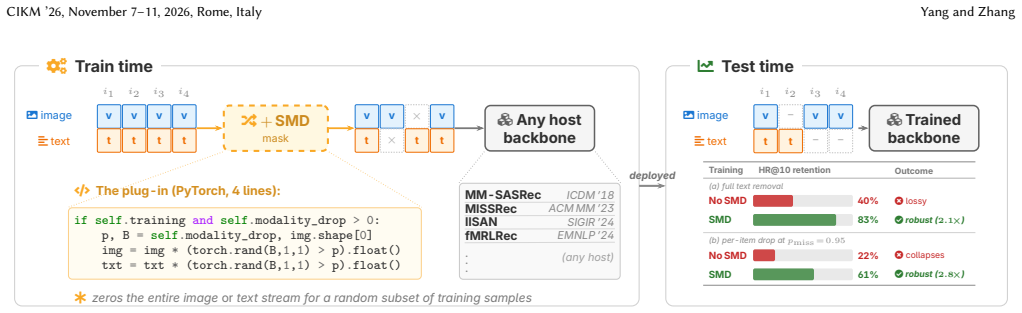
The mechanism is a per-sample Bernoulli modality mask: a random binary draw per user-history sample and per modality (image and text), multiplied onto the modality embeddings before fusion, so zeroing one mask zeroes that entire modality stream across all items in the user's sequence. It is applied only during training and is not rescaled, unlike standard dropout, because its goal is invariance to a genuinely absent modality rather than variance reduction; the full-modality test input is simply the p=0 case already seen in training. The optional cross-modal reconstruction loss trains the two modality projections to predict each other through two-layer side projections, giving the model a fallback for recovering a missing modality when fusion is simple additive. The mask's per-sample design is the load-bearing choice: the paper argues that real catalog missingness clusters by category or source, so an entire modality tends to be missing for a user's history at once, which is a pattern per-item masking would not train for.
What would settle it
Train the same backbones with a per-item rather than per-sample modality mask under identical protocols and compare retention under the per-item missing-rate sweep (Protocol 2); if per-item masking matches or exceeds SMD's retention, then the whole-history masking pattern is not what drives the gains. A second concrete check: measure the spatial distribution of missing images and text in a real logged catalog—if missingness within a user's history is item-independent, SMD's training distribution does not match deployment.
Extended reading notes
Core claim
The central discovery is that a per-sample Bernoulli modality mask—not a per-item mask—applied at the fusion point of any multi-modal sequential recommender during training is enough to make it robust to missing modalities at serving time. For each training sample, the image stream and the text stream are each independently zeroed with probability p, and the same mask applies to every item in the user's chronological sequence; at test time no mask is applied. Across four backbones (MM-SASRec, IISAN, MISSRec, fMRLRec) on the MISSRec Amazon benchmarks, SMD lifts HR@10 text retention from 18–94% to 56–99% on Scientific, and from 40–73% to 79–97% for MM-SASRec across four domains, with a mean full-modality HR@10 change of +0.8% over the 16 backbone-dataset cells tested (11 improve). Under a per-item missing-rate sweep, retention stays approximately flat (slope ≈ -0.027 per unit of missing rate) versus a steep drop without SMD (slope ≈ -0.051), leaving SMD at 61% retention versus 22% at a 95% per-item missing rate. An optional cross-modal reconstruction loss further raises text retention from 90% to 98% on a simple additive backbone in a severely text-missing catalog, at a small full-modality accuracy cost.
Load-bearing premise
The method's success depends on real catalog missingness clustering by whole modality streams across a user's history (for example, an entire category lacking text or an image feed going down) rather than being scattered independently per item; the paper argues for this pattern from category-level missing rates but never runs the direct comparison of per-item masking during training.
Editorial extensions
If this is right
- SMD plugs into any multi-modal sequential backbone at the fusion point in four lines, with no hyperparameter changes to the host model; even fMRLRec, already at 94% text retention, rises to 99%.
- With SMD, MM-SASRec keeps 61% of HR@10 when 95% of items independently lose a modality, versus 22% without SMD, and the gap widens monotonically with the missing rate.
- Across all 16 backbone-dataset cells, 11 improve with a mean peak HR@10 change of +0.8%, and the two largest full-modality drops (IISAN, -4.4% and -4.1%) coincide with the largest retention gains (3.2x and 1.4x).
- Per-user paired tests over 121k users on three datasets find SMD significantly better in 22 of 24 condition-dataset cells by McNemar (HR@10) or Wilcoxon (NDCG@10) tests.
- The optional cross-modal reconstruction loss is worthwhile only on simple additive fusion under severe missingness (90% to 98% text retention on a 48% text-missing catalog); on dynamic fusion it costs 2.3% of full-modality HR@10 for only 3 points of retention.
Reading between the lines
- The per-sample mask may also function as a regularizer that discourages the model from relying on modality-specific shortcuts; the paper measures only retention and HR@10, leaving representation-level effects an open test.
- SMD could be combined with feature-propagation or missing-modality-completion methods, since masking makes the backbone tolerant of absence while completion methods reconstruct the missing features; the paper mentions but does not test this combination.
- A direct per-item-mask training variant is the natural next experiment: it would separate the benefit of masking itself from the benefit of matching whole-stream missingness, and would indicate how sensitive SMD is to a mismatch between assumed and actual missingness structure.
- The same whole-stream masking could extend beyond images and text to audio, video, or structured attributes, and to corruption (noisy) rather than absence; the paper lists these as open directions.
Editorial analysis
A structured set of objections, weighed in public.
Referee Report
Summary. This paper proposes Sequential Modality Dropout (SMD), a training-time per-sample Bernoulli mask that zeroes an entire image or text stream across all items in a user's history at the fusion point of a multi-modal sequential recommender. The authors evaluate SMD on MM-SASRec, IISAN, MISSRec, and fMRLRec on Amazon domains from the MISSRec benchmark, measuring retention (HR@10 under modality removal divided by full-modality HR@10) and robustness gain relative to the same backbone trained without SMD. They report text-retention gains of 1.0 to 3.2x across 11 evaluated backbone-domain cells, a 2.8x improvement at 95% per-item missingness in Figure 2, statistically significant per-user paired tests, and an optional cross-modal reconstruction loss that further improves retention on a simple additive backbone under severe text missingness.
Significance. The method is simple, architecture-agnostic, and potentially useful in practice: the four-line plug-in is clearly described, the authors release source code and JSON outputs backing every number, full-catalog ranking and chronological splits are used, and two complementary robustness protocols plus per-user paired significance tests strengthen the empirical support. If the reported results are reproducible, SMD is a valuable addition to the multi-modal sequential recommendation toolbox. The central claim is supported for the cells that were actually run; the main weaknesses are that the defining design choice (per-sample whole-history mask vs per-item mask) is never tested against the obvious alternative, and the coverage claims in the abstract and Section 3.2 are broader than the evaluated matrix.
major comments (3)
- [Section 2.2 'Why Per-Sample' vs Section 3.1 'Evaluation Protocols'] Section 2.2 justifies the per-sample (whole-history) mask by asserting that real missingness is whole-modality and category-structured, and that a per-item mask would train for a pattern 'rarely seen in deployment.' Section 3.1, however, defines Protocol 2 as per-item independent missingness and explicitly calls it 'matching item-level missingness in real catalogs [2,11].' The paper never compares SMD against per-item training masks at the same dropout probability. If per-item masking performs comparably under Protocol 2 and acceptably under Protocol 1, then the paper's central novelty, the sequential per-sample mask, has no demonstrated benefit over standard per-sample modality dropout applied to sequences. This ablation is load-bearing for the paper's title and for the RQ1/RQ2 claims, and it should be run across at least the MM-SASRec domains, and ideally all backbones, before the per-sample design can be accepted.
- [Section 3.2 and Appendix B / Table 3] The main text says 'we ran all 16 (backbone, dataset) combinations' and states '11 of the 16 improve,' but Appendix B reports that Arts runs are omitted for IISAN, MISSRec, and fMRLRec, and Office runs are omitted for MISSRec and fMRLRec. Table 3 actually contains 10 cells, plus the MM-SASRec/Arts cell in Table 1b, for 11 evaluated cells. The abstract's 'across four backbones ... on four Amazon domains' therefore overstates the empirical coverage, and the claim that 11 of 16 improve is internally inconsistent with the appendix. The authors should either complete the missing cells or revise all coverage claims to refer explicitly to the 11 evaluated cells.
- [Section 3.2, Section 3.1] The universal-claim wording in Section 3.2 ('SMD helps on every recommender we tested') and the conclusion ('it lifts HR@10 text retention by 1.0 to 3.2x over 11 of 16 combinations') should be reconciled with the actual number of evaluated cells. With 11 cells evaluated and all 11 improving, the manuscript should state 'all 11 evaluated cells improve by 1.0 to 3.2x' rather than using the ambiguous '11 of 16.' This is not merely a wording issue: the paper's stated coverage and its reproducibility artifact are in conflict, and the claim as written is not supported by the appendix tables.
minor comments (5)
- [Table 1c / Abstract RQ3 bullet] The abstract and the RQ3 contribution bullet present the reconstruction loss as lifting retention from 90% to 98% on Beauty, but Table 1c shows that full-modality HR@10 drops from 0.63 (SMD only) to 0.52 (SMD+recon), a 17% relative loss, and that the no-SMD full-modality baseline is 0.72. Section 3.4 does acknowledge the trade-off, but the abstract and contribution bullet should state the accuracy cost explicitly, since the paper otherwise emphasizes that SMD preserves full-modality accuracy.
- [Figure 2 / Table 4] The reported slopes (-0.027 and -0.051 per unit p_miss) describe HR@10 in percentage points per percentage point of p_miss; please clarify these units in the text so the reader does not confuse them with raw metric values.
- [Section 3.3 / Table 7] The 121k-user paired significance tests are reported only for MM-SASRec; Section 3.3 should state explicitly that the per-user paired-claims apply to that backbone, not to all four backbones.
- [Table 3 caption and Appendix B] The sentence 'Arts runs are omitted for IISAN, MISSRec, and fMRLRec for the same compute-budget reason' refers to a compute-budget reason that is not stated earlier for Arts; please specify the omitted cells in one transparent table and give the concrete reason for each omission.
- [Table 1b caption] The caption says the better No-SMD/SMD value per cell is bold, but in the Instruments full column the No-SMD value is 7.14 and the SMD value is 7.13; please qualify the claim 'matching or exceeding peak HR@10 on every dataset' so readers know that one cell is a statistical tie rather than an improvement.
Circularity Check
No circularity: SMD's retention gains are measured on held-out test sets under matched hyperparameters; no equation or fitted value reduces the reported robustness to the method's inputs.
full rationale
The paper makes an empirical claim: a four-line per-sample modality mask improves robustness to missing modalities. There is no derivation chain that folds the target result into the assumptions. The mask is fully specified in Section 2.2 (Equation 2) with a fixed p=0.3; the retention metric R and robustness gain G in Equation (4) are defined independently of SMD and computed on held-out test sets under two complementarity test-time protocols. The comparison checkpoints are trained with identical hyperparameters, optimizers, and seeds, with SMD as the only difference, so the improvement cannot be a renamed fit. The hyperparameters p=0.3 and lambda=0.01 are tuned in preliminary runs, but the reported retention values are not fitted values; they come from held-out evaluation. The citation to prior modality-dropout work [1, 12] is external and non-self-referential, and no uniqueness theorem or self-citation is invoked to force the design. The reader-flagged concern that the per-sample mask is never ablated against a per-item mask is a genuine experimental gap and an internal tension with Protocol 2's wording, but it is a missing comparison, not a case where the paper's prediction is equivalent to its inputs by construction. Consequently, there is no circular step to exhibit, and the honest finding is a score of 0.
Assumptions & free parameters
free parameters (2)
- modality dropout probability p =
0.3
- reconstruction loss weight lambda =
0.01
assumptions (3)
- domain assumption Per-sample (whole-history) masking matches real catalog missingness patterns better than per-item masking.
- domain assumption The retention ratio R = HR@10(missing)/HR@10(full) is a valid primary robustness metric even when the denominator (full-modality accuracy) changes across models.
- domain assumption The four Amazon domains and four backbones span the design space of multi-modal sequential recommenders.
Cite this review
Pith. "Pith review of Sequential Modality Dropout for Robust Multi-Modal Sequential Recommendation." pith.science (2026). https://pith.science/paper/JK7ZZERL
@misc{pith2026260810240,
  author       = {Pith},
  title        = {Pith review of: Sequential Modality Dropout for Robust Multi-Modal Sequential Recommendation},
  year         = {2026},
  howpublished = {\url{https://pith.science/paper/JK7ZZERL}},
  note         = {Machine review of arXiv:2608.10240}
}
read the original abstract
Multi-modal sequential recommenders assume every item carries every modality, but real product catalogs often miss images or text, and a model trained on complete data loses much of its recommendation accuracy when a modality is unavailable at serving time. We propose Sequential Modality Dropout (SMD): during training, each modality stream (image and text) is independently erased with probability p for an entire user interaction history, so the model learns to predict the next item without relying on any single modality. We measure robustness by retention, the fraction of a model's full-modality accuracy (HR@10) that survives when a modality is removed at test time. Across four backbones (MM-SASRec, IISAN, MISSRec, and fMRLRec) on four Amazon domains, SMD raises text retention by 1.0 to 3.2x at essentially no cost to full-modality accuracy; under an extreme 95% per-item missing rate, it retains 61% of HR@10 versus 22% without (a 2.8x improvement). An optional cross-modal reconstruction loss further lifts retention from 90% to 98% on a simple additive backbone under severe text missingness. SMD is a four-line, architecture-agnostic change that makes multi-modal sequential recommenders robust to the missing modalities they actually encounter in deployment.
Figures

Reference graph
Works this paper leans on
-
[1]
Ahmed Hussen Abdelaziz, Barry-John Theobald, Paul Dixon, Reinhard Knothe, Nicholas Apostoloff, and Sachin Kajareker. 2020. Modality Dropout for Improved Performance-driven Talking Faces. arXiv:2005.13616 [eess] doi:10.48550/arXiv. 2005.13616
-
[2]
Junchen Fu, Wenhao Deng, Kaiwen Zheng, Ioannis Arapakis, Yu Ye, Yongxin Ni, Joemon M. Jose, and Xuri Ge. 2026. Benchmarking Multimodal Large Language Models for Missing Modality Completion in Product Catalogues. arXiv:2601.19750 [cs] doi:10.48550/arXiv.2601.19750
-
[3]
Junchen Fu, Xuri Ge, Xin Xin, Alexandros Karatzoglou, Ioannis Arapakis, Jie Wang, and Joemon M. Jose. 2024. IISAN: Efficiently Adapting Multimodal Repre- sentation for Sequential Recommendation with Decoupled PEFT. InProceedings of the 47th International ACM SIGIR Conference on Research and Development in In- formation Retrieval. 687–697. arXiv:2404.02059...
work page Pith review arXiv 2024
-
[4]
Jose, Ioannis Arapakis, Kaiwen Zheng, Youhua Li, and Xuri Ge
Junchen Fu, Yongxin Ni, Joemon M. Jose, Ioannis Arapakis, Kaiwen Zheng, Youhua Li, and Xuri Ge. 2025. CROSSAN: Towards Efficient and Effective Adapta- tion of Multiple Multimodal Foundation Models for Sequential Recommendation. arXiv:2504.10307 [cs] doi:10.48550/arXiv.2504.10307
-
[5]
Yongrui Fu, Jian Liu, Tao Li, Zonggang Wu, Shouke Qin, and Hanmeng Liu
-
[6]
Christian Ganhör, Marta Moscati, Anna Hausberger, Shah Nawaz, and Markus Schedl. 2024. A Multimodal Single-Branch Embedding Network for Recommen- dation in Cold-Start and Missing Modality Scenarios. In18th ACM Conference on Recommender Systems. 1290–1295. arXiv:2409.17864 [cs] doi:10.1145/3640457. 3688009
work page Pith review arXiv 2024
-
[7]
Ming-Yi Hong, Yen-Jung Hsu, Miao-Chen Chiang, and Che Lin. 2025. MTSTRec: Multimodal Time-Aligned Shared Token Recommender. InProceedings of the 42nd International Conference on Machine Learning. PMLR, 23640–23661
work page 2025
-
[8]
Jiaxi Hu, Jingtong Gao, Xiangyu Zhao, Yuehong Hu, Yuxuan Liang, Yiqi Wang, Ming He, Zitao Liu, and Hongzhi Yin. 2024. BiVRec: Bidirectional View-based Multimodal Sequential Recommendation. arXiv:2402.17334 [cs] doi:10.48550/ arXiv.2402.17334
work page Pith review arXiv doi:10.48550/arxiv.2402.17334 2024
Show all 20 references
- [9]
- [10]
-
[11]
Malliaros, and Tommaso Di Noia
Daniele Malitesta, Emanuele Rossi, Claudio Pomo, Fragkiskos D. Malliaros, and Tommaso Di Noia. 2024. Dealing with Missing Modalities in Multimodal Rec- ommendation: A Feature Propagation-based Approach. arXiv:2403.19841 [cs] doi:10.48550/arXiv.2403.19841
- [12]
- [13]
-
[14]
Nitish Srivastava, Geoffrey Hinton, Alex Krizhevsky, Ilya Sutskever, and Ruslan Salakhutdinov. [n. d.]. Dropout: A Simple Way to Prevent Neural Networks from Overfitting. ([n. d.])
- [15]
-
[16]
Jinpeng Wang, Ziyun Zeng, Yunxiao Wang, Yuting Wang, Xingyu Lu, Tianxiang Li, Jun Yuan, Rui Zhang, Hai-Tao Zheng, and Shu-Tao Xia. 2023. MISSRec: Pre- training and Transferring Multi-modal Interest-aware Sequence Representation for Recommendation. InProceedings of the 31st ACM...
2023 arXiv
- [17]
-
[18]
Image-miss
Renjie Wu, Hu Wang, Hsiang-Ting Chen, and Gustavo Carneiro. 2026. Deep Multimodal Learning with Missing Modality: A Survey. arXiv:2409.07825 [cs] Table 2: MISSRec benchmark datasets. “Image-miss. ” is the fraction of catalog items whose image is unavailable in our re-download ...
-
[19]
Wenqian Zhao, Kai Yang, Peijin Ding, Ce Na, and Wen Li. 2025. Graph Attention Contrastive Learning with Missing Modality for Multimodal Recommendation. Knowledge-Based Systems311 (Feb. 2025), 113035. doi:10.1016/j.knosys.2025. 113035 A Dataset Statistics Table 2 reports the pe...
2025 doi
- [2025]
Reviewed August 14, 2026 · model on record in the stance chip above.
Discussion (0). Continue with ORCID to comment.