Coexistence of Donor and Acceptor Hydrogen States in n-Type InN
Pith reviewed 2026-06-27 00:26 UTC · model grok-4.3
The pith
Hydrogen in n-type InN acts as both donor and acceptor, explaining compensation via coexisting charge states.
A machine-rendered reading of the paper's core claim, the machinery that carries it, and where it could break.
Core claim
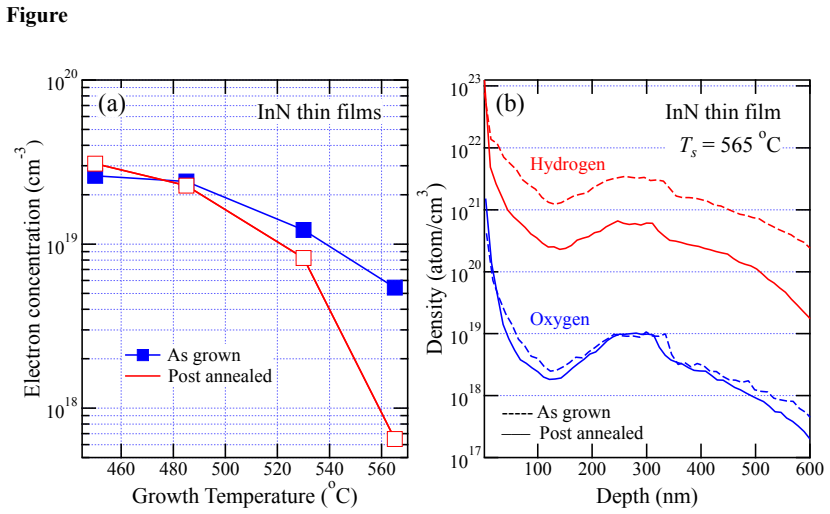
Post-annealing, which reduces the concentration of hydrogen impurities in the films, shifts the core-level spectra toward lower binding energy, consistent with a chemical-potential shift associated with the passivation of electron carriers. In the valence-band spectra, an acceptor-like in-gap feature near the valence-band maximum is suppressed after annealing. Together with the established donor-like behavior of hydrogen in InN, these results suggest that acceptor H- states coexist with donor H+ states in InN.
What carries the argument
The acceptor-like in-gap feature near the valence-band maximum, observed in valence-band HAXPES spectra and suppressed when hydrogen concentration drops after annealing.
If this is right
- Hydrogen compensation in InN arises from the simultaneous presence of opposite charge states rather than from a single dominant state.
- The amphoteric character of hydrogen survives even when the Fermi level lies far above the conduction-band minimum.
- Carrier density in InN films can be tuned by controlling the relative populations of the two hydrogen charge states.
Where Pith is reading between the lines
- Similar spectroscopic signatures may appear in other narrow-gap group-III nitrides where hydrogen is also abundant.
- Device processing steps that alter hydrogen content could be used to shift the balance between donor and acceptor hydrogen populations.
- The same HAXPES approach might detect amphoteric hydrogen behavior in additional n-type semiconductors where only donor activity has been reported so far.
Load-bearing premise
The in-gap feature is produced by hydrogen in an acceptor configuration and its suppression after annealing results from lower hydrogen content rather than other structural or chemical effects of the heat treatment.
What would settle it
Observation that the in-gap feature remains unchanged when hydrogen concentration is independently varied while holding all other variables fixed, or that the core-level shift occurs without any change in hydrogen content.
Figures
read the original abstract
Hydrogen often exhibits amphoteric behavior in semiconductors, but its role is in n-type InN remains unresolved. Wurtzite InN is a narrow-gap semiconductor with high electron mobility and is therefore attractive for high-speed electronics and optoelectronic applications. Here we use hard x-ray photoemission spectroscopy (HAXPES) to probe hydrogen-related electronic structure in as-grown and post-annealed InN thin films prepared at different grown temperatures. Post annealing, which reduces the concentration of hydrogen impurities in the films, shifts the core-level spectra toward lower binding energy, consistent with a chemical-potential shift associated with the passivation of electron carriers. In the valence-band spectra, an acceptor-like in-gap feature near the valence-band maximum is suppressed after annealing. Together with the established donor-like behavior of hydrogen in InN, these results suggest that acceptor H- states coexist with donor H+ states in InN. The coexistence of these opposite hydrogen charge states provides a microscopic picture of hydrogen-driven compensation in InN and highlights the amphoteric nature of hydrogen even in a highly n-type semiconductor.
Editorial analysis
A structured set of objections, weighed in public.
Referee Report
Summary. The manuscript uses hard x-ray photoemission spectroscopy (HAXPES) on as-grown and post-annealed wurtzite InN thin films to examine hydrogen-related electronic structure. Core-level spectra shift to lower binding energy after annealing (which reduces hydrogen concentration), interpreted as a chemical-potential shift from passivation of electron carriers. Valence-band spectra show suppression of an in-gap feature near the valence-band maximum, assigned as an acceptor-like H- state. Combined with the established donor-like behavior of hydrogen, the authors conclude that H+ donor and H- acceptor states coexist in n-type InN, providing a microscopic picture of hydrogen-driven compensation and highlighting hydrogen's amphoteric nature.
Significance. If the spectral assignments and causal attribution to hydrogen hold, the result would supply spectroscopic support for amphoteric hydrogen behavior in a highly n-type narrow-gap semiconductor, offering a defect-level explanation for compensation that is relevant to InN device physics. The HAXPES approach is suitable for bulk-sensitive probing, and the topic addresses an unresolved aspect of hydrogen in nitrides.
major comments (3)
- [Abstract] Abstract (valence-band spectra paragraph): the assignment of the in-gap feature near the VBM as an acceptor-like H- state and the link between its suppression and reduced [H] after annealing rest on qualitative spectral description alone, with no reported quantitative intensities, error bars, or statistical analysis across multiple samples; this attribution is load-bearing for the coexistence claim but lacks independent verification such as SIMS/NRA quantification of hydrogen concentration before/after annealing.
- [Abstract] Abstract: no controls or discussion are described to rule out alternative causes for the observed core-level shift and feature suppression, such as annealing-induced stoichiometry changes, other defect annealing, or Fermi-level movement unrelated to hydrogen reduction; without these, the specific attribution to H- states cannot be isolated.
- [Abstract] Abstract: the central claim of coexistence relies on combining the new acceptor assignment with 'established donor-like behavior,' yet the manuscript provides no new quantitative data (e.g., shift magnitudes or carrier density correlations) to strengthen the link between the spectral changes and hydrogen-driven compensation.
minor comments (2)
- The abstract mentions films 'prepared at different grown temperatures' but does not indicate whether or how growth-temperature dependence is analyzed or presented in the results.
- Notation for charge states (H+, H-) is used without explicit definition in the provided summary; ensure consistency with standard defect notation in the full text.
Simulated Author's Rebuttal
We thank the referee for the constructive comments on our manuscript. Below we respond point-by-point to the major comments, indicating where revisions will be made to address concerns while defending the core claims based on the presented HAXPES data.
read point-by-point responses
-
Referee: [Abstract] Abstract (valence-band spectra paragraph): the assignment of the in-gap feature near the VBM as an acceptor-like H- state and the link between its suppression and reduced [H] after annealing rest on qualitative spectral description alone, with no reported quantitative intensities, error bars, or statistical analysis across multiple samples; this attribution is load-bearing for the coexistence claim but lacks independent verification such as SIMS/NRA quantification of hydrogen concentration before/after annealing.
Authors: We agree that quantitative support would strengthen the spectral assignment. The revised manuscript will add integrated intensities of the in-gap feature (with fitting uncertainties) from the valence-band spectra and note consistency across the measured samples. The link to reduced [H] follows from the established annealing protocol cited in the text; however, this study is HAXPES-focused and does not include new SIMS/NRA measurements. revision: partial
-
Referee: [Abstract] Abstract: no controls or discussion are described to rule out alternative causes for the observed core-level shift and feature suppression, such as annealing-induced stoichiometry changes, other defect annealing, or Fermi-level movement unrelated to hydrogen reduction; without these, the specific attribution to H- states cannot be isolated.
Authors: We will add an explicit discussion paragraph in the revised manuscript addressing alternative explanations. This will note that the direction and magnitude of the core-level shifts match carrier passivation rather than stoichiometry changes (which would produce different chemical shifts), and that prior annealing studies on InN support hydrogen out-diffusion as the dominant effect under the conditions used. revision: yes
-
Referee: [Abstract] Abstract: the central claim of coexistence relies on combining the new acceptor assignment with 'established donor-like behavior,' yet the manuscript provides no new quantitative data (e.g., shift magnitudes or carrier density correlations) to strengthen the link between the spectral changes and hydrogen-driven compensation.
Authors: The manuscript already reports specific core-level binding-energy shifts (detailed in the results) that correlate directly with the annealing step known to reduce hydrogen. These constitute new quantitative spectroscopic evidence for the compensation mechanism. The donor character is drawn from the cited literature, but the new acceptor-state observation completes the amphoteric picture; we do not claim new carrier-density measurements here. revision: no
- Independent SIMS or NRA quantification of hydrogen concentration before and after annealing, which was outside the scope of this HAXPES study and cannot be supplied without additional experiments.
Circularity Check
No circularity: purely experimental observations with interpretive claims
full rationale
The manuscript reports HAXPES measurements on as-grown and annealed InN films, documenting core-level shifts and suppression of an in-gap valence-band feature. The coexistence conclusion is presented as a suggestion combining these observations with externally established donor behavior of H in InN. No equations, fitted parameters, predictions, ansatzes, or uniqueness theorems appear. No self-citation chain is invoked to justify any load-bearing step. The interpretive attribution of the in-gap feature is not a derivation that reduces to its own inputs by construction.
Axiom & Free-Parameter Ledger
axioms (2)
- domain assumption Core-level binding-energy shifts reflect chemical-potential changes due to carrier passivation by hydrogen removal
- ad hoc to paper The in-gap feature near the valence-band maximum is hydrogen-related and acceptor-like
Reference graph
Works this paper leans on
-
[1]
Nakamura, T
S. Nakamura, T. Mukai, M. Senoh, and N. Iwasa, Jpn. J. Appl. Phys. 31, L139 (1992). [5] J. Neugebauer and C. G. Van der Walle, Phys. Rev. Lett. 75, 4452 (1995). [6] O. Gelhausen, M. R. Phillips, E. M. Goldys, T. Paskova, B. Monemar, M. Strassburg, and A. Hoffmann, Phys. Rev. B 69, 125210 (2004). [7] W. E. Spear, and P. G. Le Comber, Solid State Commun. 17...
1992
-
[2]
C. Stampfl, C. G. Van de Walle, D. V ogel, P. Krüger, and J. Pollmann, Phys. Rev. B 61, R7846(R) (2000). [22] X. M. Duan and C. Stampfl, Phys. Rev. B 77, 115207 (2008). [23] X. M. Duan and C. Stampfl, Phys. Rev. B 79, 035207 (2009). [24] D. C. Look, H. Lu, W. J. Schaff, J. Jasinski, Z. Liliental-Weber, Appl. Phys. Lett. 80, 258 (2002). [25] E. A. Davis, D...
arXiv 2000
discussion (0)
Sign in with ORCID, Apple, or X to comment. Anyone can read and Pith papers without signing in.