REVIEW 5 major objections 5 minor 2 cited by
Secular evolution of quasi-periodic eruptions
T0 review · 5 major / 5 minor · reviewed 2026-08-12 · deepseek-v4-flash
Pith's one-line read Quasi-periodic eruptions carry a measurable orbital-decay signal that turns X-ray burst timing into a probe of low-mass black hole masses and accretion disks.
desk verdict Strong timing analysis for GSN069 and eRO-QPE2; the T~M^0.8 population claim needs real error treatment before it carries weight. read the letter →
The pith
A machine-rendered reading of the paper's core claim, the machinery that carries it, and where it could break.
The reading
What carries the argument
The load-bearing object is the osculating trajectory method for forced Kerr geodesics. Instead of integrating the equations of motion orbit by orbit, it uses the analytic Mino-time solution of the Kerr geodesic, with orbital elements $p$, $e$, $\theta_{\min}$ updated on the long timescale $T_{\rm obt}/|\dot{T}_{\rm obt}|$ over which disk collisions dissipate energy; this is why the calculation is orders of magnitude faster. The disk is modeled as a flat slab of constant height $H=1.5M_\bullet$ that precesses rigidly at period $\tau_p$ and either does not align or aligns immediately, and the computed disk-crossing time, with light-travel and Shapiro corrections, is identified as the flare start time.
What would settle it
Continue X-ray monitoring of eRO-QPE2 through 2024-2025: the fast-alignment hypothesis predicts a constant orbital decay rate after alignment, while the precessing-disk hypothesis predicts $\dot{T}_{\rm obt}$ oscillating with a period near $\tau_p\sim10$ d, so a measured oscillation or constancy rules one of them out. For GSN 069, search the residual timing after subtracting the best-fit forced-EMRI model for a third period: the model predicts only the orbital period and apsidal precession, so detection of a coherent modulation near 19 d with a consistent phase would favor the rival external-source interpretation.
Extended reading notes
Core claim
On the paper's own terms, the central discovery is that QPE flare timings encode secular orbital evolution, not just a fixed geodesic. Modeling the stellar-mass object (SMO) as a forced EMRI that loses energy each time it crosses a disk, with the disk treated as a flat rigidly precessing slab of height $H=1.5M_\bullet$, yields decisive evidence for a nonzero orbital decay rate $\dot{T}_{\rm obt}\simeq -6.5\times10^{-5}$ in GSN 069 (log Bayes factor 4.4 against a free geodesic) and nearly equally strong evidence for eRO-QPE2 under two hypotheses: uniform decay with fast disk alignment (log Bayes factor 15.0) or nonuniform decay modulated by disk precession (log Bayes factor 14.4). The fit gives $\log_{10}(M_\bullet/M_\odot)=5.6\pm0.1$ from the main orbital-size peak of GSN 069 ($6.1\pm0.1$ from the minor peak) and about 4.7-4.8 for eRO-QPE2, both much tighter than host-galaxy scaling relations. Combining all available sources, the paper reports a likely correlation $T_{\rm obt}\propto M_\bullet^{0.8}$ among six low-eccentricity QPE EMRIs, with RX J1301 and eRO-QPE4 standing apart as high-eccentricity systems.
Load-bearing premise
The timing model treats the accretion disk as a flat, rigidly precessing slab with a fixed height of $1.5M_\bullet$ and assumes the disk either stays misaligned or snaps to the equator immediately; if the real disk is warped, changes height, or aligns continuously, the inferred decay rate, precession period, and black hole mass would shift.
Editorial extensions
If this is right
- QPE timing becomes an independent precision probe of low-mass SMBH masses: GSN 069 is constrained to $\log_{10}(M_\bullet/M_\odot)=5.6\pm0.1$ (or $6.1\pm0.1$ for the minor peak), far tighter than the roughly 1 dex $M_\bullet$-$\sigma_\star$ relation.
- The measured energy loss per collision, combined with flare energies, gives a QPE radiation efficiency of about $10\%\,(M_\odot/m)$ for GSN 069 and about $24\%\,(M_\odot/m)$ for eRO-QPE2, which is hard to reconcile with a stellar-mass black hole heavier than about $30M_\odot$.
- The near-circular orbits ($e\sim10^{-2}$, semi-major axis $\sim10^2M_\bullet$) favor the wet EMRI formation channel over the dry or Hills channels, and the $T_{\rm obt}\propto M_\bullet^{0.8}$ correlation among low-eccentricity sources points to two distinct QPE populations.
- The osculating method cuts the cost of full Bayesian timing fits by orders of magnitude (for example roughly a factor 52 for GSN 069) and allows joint fits of eRO-QPE2 observations spanning about $10^4$ orbital periods, making long-term QPE monitoring tractable.
Reading between the lines
- If the $T_{\rm obt}\propto M_\bullet^{0.8}$ relation survives more QPE discoveries, recurrence times alone could become a rough SMBH mass estimator for low-mass galactic nuclei, independent of host-galaxy scaling relations; this is an extension beyond the paper's claim.
- The eRO-QPE2 degeneracy between disk alignment and disk precession might be broken by flare morphology: if alignment is real, the collision geometry changes systematically over the alignment timescale, which should leave a correlated trend in flare durations or spectral temperatures.
- The same osculating-trajectory machinery could be carried over to other long-lived EMRI observables, where environmental torques from a disk are usually ignored, potentially changing predicted inspiral rates and phases.
Signed reviews
Editorial analysis
A structured set of objections, weighed in public.
Referee Report
Summary. The paper presents an osculating-trajectory method for evolving EMRI orbits under disk collision losses, and applies it to QPE timing data for GSN 069 and eRO-QPE2, claiming evidence for orbital decay in GSN 069 and evidence for orbital decay or disk alignment in eRO-QPE2. It then collects eight QPE sources and argues for a low-eccentricity population with T_obt proportional to M_bullet^0.8, which it interprets as evidence for two EMRI formation channels. The central technical contribution is a large speed-up in trajectory computation via analytic Kerr geodesic elements with slowly varying constants of motion. The paper is clearly written and the Bayesian framework is appropriate, but the population scaling relation and the conditional nature of the eRO-QPE2 disk constraints need substantial strengthening before the broad claims can be accepted.
Significance. If the GSN 069 timing evidence and the population scaling relation both hold, QPE timing would become a genuinely new probe of low-mass SMBH masses, accretion-disk physics, and EMRI formation channels. The osculating method is a practical contribution: it reduces the cost of long-baseline QPE timing analyses by orders of magnitude and is already used to obtain multi-epoch fits that were previously impractical. The GSN 069 orbital-decay measurement, once carefully calibrated against the stated Jeffreys scale, is a strong result. The eRO-QPE2 analysis is valuable but presently underdetermined: two physically different models are nearly equally favored, so the disk surface density and viscosity constraints derived from one of the two models are conditional. The population relation is interesting but not yet statistically established; the paper should be credited for explicitly acknowledging the external mass prior and the proxy recurrence times, but the scaling claim needs quantitative error treatment.
major comments (5)
- [Section 3.1, Eq. (16)] The paper reports log B_1^0 = 4.4 +/- 0.2 and calls this 'decisive evidence' for a nonzero orbital decay rate. However, the Jeffreys scale defined in Section 2 states that logB in (3.5, 4.6) is 'very strong' and only logB > 4.6 is 'decisive.' The point estimate is therefore one category below the claimed level, and the 2-sigma lower bound is even lower. Please correct the wording throughout (abstract, Section 3.1, and Section 4.1) and, if 'decisive' is needed, justify it by a different evidence criterion or by additional data.
- [Section 3.2, Eqs. (31)-(36)] For eRO-QPE2, the two alternatives H1 (forced orbit plus fast disk alignment) and H2 (forced orbit plus precessing disk) are nearly equally favored, with log B_1^0 = 15.0 and log B_2^0 = 14.4; the posterior quantities such as p, e, and M_bullet are consistent, but the inferred decay rates differ between the models. Equations (35) and (36) then use H1 alone to derive E_col, the QPE radiation efficiency, and by extension the disk surface density and viscosity. These derived quantities should be explicitly labeled as conditional on H1, and ideally the same calculations should be repeated under H2 so that the reader can see the model-dependent range. As written, the paper gives the impression that the disk constraints from eRO-QPE2 are model-independent.
- [Section 4.1, Fig. 3] The claimed T_obt proportional to M_bullet^0.8 relation is the main population-level conclusion, but it is not supported by a quantitative statistical analysis. The slope is quoted without an uncertainty; the fit uses six sources with heterogeneous mass estimators, several of which carry 0.3-0.5 dex errors; two of the six masses come from the same timing model with an external M-sigma prior; and the two excluded sources are rejected on the basis of high eccentricity, which is itself measured with the same timing model. Multiple correlated mass estimates are plotted for AT2019qiz and Swift J0230, and Swift J0230 is marked as an uncertain identification. Please report a proper regression with uncertainties on both axes, a slope and scatter with error bars, and a robustness check that excludes the two timing-derived masses and that varies the inclusion/exclusion of the high-eccentricity sources. Without such a test, the two-population and multiple-formation-channel conclusion is not yet load-bearing.
- [Section 2.1.2, Eq. (8)] In the forced-trajectory system, the equation for dq_t/dlambda is written as Upsilon_z(E,L,C), while the corresponding geodesic equation (7) has dq_t/dlambda = Upsilon_t(E,L,C). If this is a typographical error, it should be corrected because it appears in the methodological core of the paper. If the implementation actually uses Upsilon_z for the time phase, the computed flare arrival times would be wrong, and the timing results would need to be rechecked.
- [Section 2.2 and Section 3.2] The disk model is a rigidly precessing slab with a fixed height H = 1.5 M_bullet, and the alignment process is restricted to two extreme cases: immediate alignment after the first observation, or no alignment at all. The eRO-QPE2 degeneracy between H1 and H2 shows how sensitive the interpretation is to these choices. The paper should at least discuss how a warped disk, a continuously varying disk height, or a finite alignment timescale would alter the inferred decay rate and SMBH mass, and why the two extreme cases bracket the likely behavior rather than merely representing convenient limits.
minor comments (5)
- [Section 2.1.2, Eq. (8)] Aside from the dq_t/dlambda typo noted above, the notation Hdf/Hds for the fast and slow alignment hypotheses is confusing: in Section 3.2, H1 is 'fast alignment' and H2 is 'precessing disk,' but the subscripts df/ds are not defined explicitly in Section 2.2. Please spell out the correspondence in one place.
- [Section 3.1 and Eq. (19)] The statement that QPE timing gives a much tighter SMBH mass constraint than the external M-sigma prior is reasonable, but the paper should clarify in Fig. 3 and in the text that the plotted masses for GSN 069 and eRO-QPE2 are posterior values obtained with the M-sigma prior included, rather than independent measurements.
- [Fig. 3 and Section 4.1] The proxy T_obt = 2 <T_rec> is used for several sources, but the uncertainty in this proxy is not shown or discussed, especially for AT2019vcb where the text says the recurrence time is most uncertain. Please either add error bars for T_obt or state explicitly why the proxy is reliable for the sources included in the fit.
- [Section 4.2] The comparison with Miniutti et al. (2024) is informative, but the sentence about the 19-day period coincidence would benefit from a brief statement of whether the current model was tested against a model with an additional sinusoidal component, rather than only comparing residuals by eye.
- [Abstract and Section 1] The abstract says 'informative constraints on ... the QPE radiation efficiency' for eRO-QPE2, but the efficiency estimate in Eq. (36) has a very wide 95% interval (roughly 9%-45% times (m/M_sun)^-1) and is conditional on H1. Please soften the abstract language accordingly.
Circularity Check
No significant circularity found; central timing and mass constraints are self-contained, with disclosed priors and non-load-bearing self-citations.
full rationale
The paper's central derivation chain is the timing model: flare-start times are fit with a simple light-curve model (paper II), then a Kerr-geodesic/forced-EMRI model is compared via Bayes factors. The orbital decay rate \dot T_obt is a fitted parameter, and the energy loss E_col is obtained from it through the Keplerian relation E_col = E_obt \dot T_obt/3 [Eq. (21)]; this is a standard conversion, not a circular identity. The SMBH masses for GSN069 and eRO-QPE2 are Bayesian posteriors that include the external M-sigma likelihood (Eq. 13); the paper explicitly states 'the constraint ... is not entirely independent' (Sec. 3.1), and the timing data do move the posterior (GSN high-p logM=5.6 vs prior 6.0), so the constraint is not the prior relabeled. The disk surface density and viscosity estimates use the collision-energy formula from the authors' paper I (Eq. 23); this is an input physical model, not the result being derived, and the self-citation is not load-bearing in a circular sense. The T_obt-M correlation (Sec. 4.1, Fig. 3) is an empirical fit to heterogeneous data; concerns about slope uncertainty, post-hoc eccentricity cuts, and mass-estimator inhomogeneity are robustness/statistical issues, not reductions of the relation to its inputs by construction. The disk height H=1.5M from paper II is a modeling ansatz, but it does not define the predicted quantities. No equation in the paper equals its input by construction; the Bayes evidence for orbital decay is corroborated by the independent O-C analysis of Miniutti et al. (2024). Score 1: minor self-citations and disclosed prior dependence exist, but no significant circularity.
Assumptions & free parameters
free parameters (6)
- orbital decay rate dot_T_obt for GSN 069 =
-6.5e-5 (95% CL)
- orbital decay rate dot_T_obt,max for eRO-QPE2 =
-1.6e-5 (95% CL, H2)
- systematic timing noise sigma_sys =
about 290 s for GSN 069 H1, about 185 s for eRO-QPE2 H1
- disk precession period tau_p for eRO-QPE2 =
7+24-2 days (H1), 10+28-6 days (H2)
- initial disk orientation alpha_ini, beta_ini for eRO-QPE2 =
posterior values in Figs. 8 and 9
- population scaling slope n =
about 0.8, no uncertainty reported
assumptions (6)
- domain assumption The EMRI plus disk interpretation of QPEs is correct
- standard math Analytic Kerr geodesic solution of Fujita and Hikida 2009 and van de Meent 2020
- ad hoc to paper The disk is a flat rigid precessing slab with H = 1.5 M_bullet
- ad hoc to paper Eccentricity e and minimum polar angle theta_min remain constant during orbital decay
- domain assumption The M-sigma relation is an appropriate external mass prior
- domain assumption Flare starting time t0 equals the disk crossing time and is extracted from a simple light-curve model
Cite this review
Pith. "Pith review of Secular evolution of quasi-periodic eruptions." pith.science (2026). https://pith.science/paper/JKIQPKZR
@misc{pith2026241118046,
  author       = {Pith},
  title        = {Pith review of: Secular evolution of quasi-periodic eruptions},
  year         = {2026},
  howpublished = {\url{https://pith.science/paper/JKIQPKZR}},
  note         = {Machine review of arXiv:2411.18046}
}
abstract
Quasi-periodic eruptions (QPEs) are intense repeating soft X-ray bursts with recurrence times about a few hours to a few weeks from galactic nuclei. More and more analyses show that QPEs are the result of collisions between a stellar mass object (SMO, a stellar mass black hole or a main sequence star) and an accretion disk around a supermassive black hole (SMBH) in galactic nuclei. In this work, we propose an osculating trajectory method for efficiently calculating secular evolution of extreme mass ratio inspirals (EMRIs) that are perturbed by an accretion disk. This method accelerates the calculation of EMRI orbital evolution by orders of magnitude and lays the foundation for analyzing long-term QPE observations. Applying this method to orbital analyses of GSN 069 and eRO-QPE2, the two most stable QPE sources, we find informative constraints on the SMBH mass, the radiation efficiency of QPEs, the SMO nature, the accretion disk surface density and the accretion disk viscosity. Combining all the QPE sources available, we find the QPE EMRIs can be divided into two populations according to their orbital eccentricities, where the orbital periods and the SMBH masses in the low-eccentricity population follow a scaling relation $T_{\rm obt}\propto M_{\bullet}^n$ with $n\approx 0.8$.
Figures


Figures from the paper (6 more)




Forward citations
Cited by 2 Pith papers
-
Secondary spins of extreme mass ratio inspirals: A probe to the formation channels
For eccentric and inclined extreme mass-ratio inspirals, the secondary black hole spin may be measurable to about 0.1 at SNR 20, and high spins would point to the Hills formation channel.
-
SRG/eROSITA No. 5: Discovery of quasi-periodic eruptions every ~3.7 days from a galaxy at z>0.1
A new quasi-periodic X-ray eruption source, eRO-QPE5, repeats every 3.7 days at z=0.1155, making it the most distant QPE discovered.
Reference graph
Works this paper leans on
-
[1]
Amaro-Seoane, P. 2018, Living Reviews in Relativity, 21, 4, doi: 10.1007/s41114-018-0013-8 Arcodia, R., Merloni, A., Nandra, K., et al. 2021, Nature, 592, 704, doi: 10.1038/s41586-021-03394-6 13 0 20 40 60 80 100 120 140 160 Time[d] 1000 500 0 500 1000 Residual[s] Figure
-
[4]
t(k) obs− t(k) 0 , where error bars represent 1-σ uncertainties
Residuals of the best-fit QPE timing model withH1 for GSN 069, i.e. t(k) obs− t(k) 0 , where error bars represent 1-σ uncertainties. Arcodia, R., Miniutti, G., Ponti, G., et al. 2022, Astronomy&Astrophysics, 662, A49, doi: 10.1051/0004-6361/202243259 Arcodia, R., Liu, Z., Merloni, A., et al. 2024, arXiv e-prints, arXiv:2401.17275, doi: 10.48550/arXiv.2401...
-
[5]
https: //arxiv.org/abs/2409.10486 Giustini, M., Miniutti, G., & Saxton, R. D. 2020, Astronomy&Astrophysics, 636, L2, doi: 10.1051/0004-6361/202037610 Giustini, M., et al
arXiv 2020
-
[6]
https: //arxiv.org/abs/2409.01938 G¨ultekin, K., Richstone, D. O., Gebhardt, K., et al. 2009, ApJ, 698, 198, doi: 10.1088/0004-637X/698/1/198 Guolo, M., Pasham, D. R., Zajaˇcek, M., et al. 2024, Nature Astronomy, doi: 10.1038/s41550-023-02178-4 Hopman, C., & Alexander, T. 2005, ApJ, 629, 362, doi: 10.1086/431475 Isi, M., Chatziioannou, K., & Farr, W. M. 2...
arXiv 2009
-
[7]
Semi-Analytical Fokker Planck Models for Nuclear Star Clusters
https://arxiv.org/abs/2406.07627 Kocsis, B., Yunes, N., & Loeb, A. 2011, Phys. Rev. D, 84, 024032, doi: 10.1103/PhysRevD.84.024032 Levin, Y . 2007, MNRAS, 374, 515, doi: 10.1111/j.1365-2966.2006.11155.x Linial, I., & Metzger, B. D. 2023, arXiv e-prints, arXiv:2303.16231, doi: 10.48550/arXiv.2303.16231 Linial, I., & Metzger, B. D
work page Pith review arXiv 2011
-
[8]
https: //arxiv.org/abs/2404.12421 Miller, M. C., Freitag, M., Hamilton, D. P., & Lauburg, V . M. 2005, Astroph.J.Lett., 631, L117, doi: 10.1086/497335 Miniutti, G., Giustini, M., Arcodia, R., et al. 2023a, Astronomy&Astrophysics, 674, L1, doi: 10.1051/0004-6361/202346653 —. 2023b, Astronomy&Astrophysics, 670, A93, doi: 10.1051/0004-6361/202244512 Miniutti...
arXiv 2005
-
[9]
https: //arxiv.org/abs/2411.13460 Mino, Y . 2003, Phys. Rev. D, 67, 084027, doi: 10.1103/PhysRevD.67.084027 14 p=289.18+137.73 189.17 0.06 0.12 e e=0.04+0.05 0.04 0.4 0.8 cos( min) cos( min)=0.57+0.40 0.45 2.5 5.0 qr, ini qr, ini=3.54+1.99 2.34 3.0 4.5 qz, ini qz, ini=5.40+0.18 3.21 2.5 5.0 q , ini q , ini=3.01+3.08 2.83 63600 64000 64400 Tobt Tobt=63695....
arXiv 2003
-
[10]
Nicholl, M., Wevers, T., Oates, S
The posterior corner plot of model parameters for GSN 069 with the vanilla hypothesis ( H0) : p[M•], e, cosθmin, qr,ini, qz,ini, qϕ,ini, Tobt[sec], a,θ obs,σ sys[sec], where each pair of vertical lines denotes the 2-σ confidence level. Nicholl, M., Wevers, T., Oates, S. R., et al. 2020, Monthly Notices of the Royal Astronomical Society, 499, 482, doi: 10....
arXiv 2020
Show all 13 references
-
[11]
R., Coughlin, E
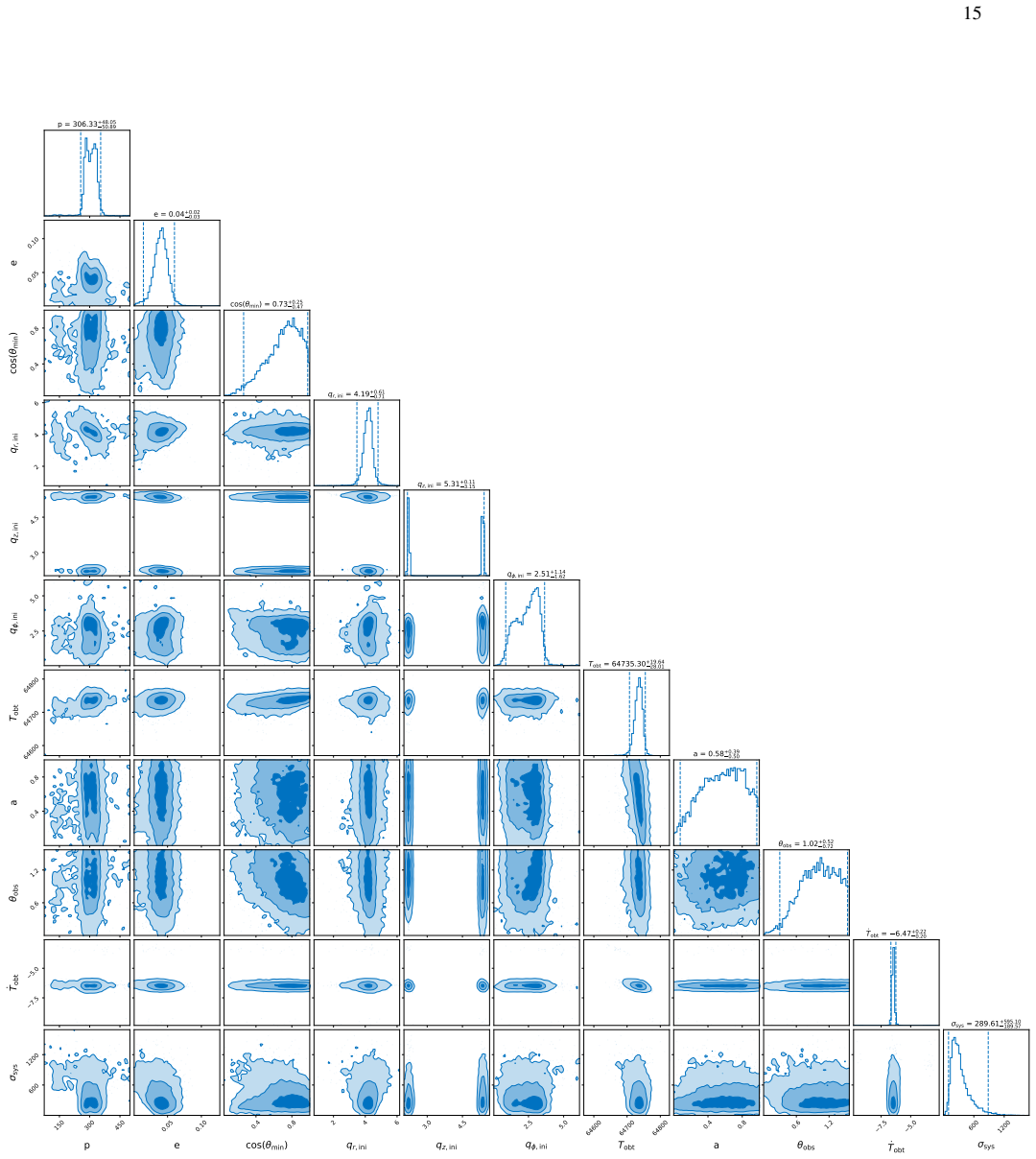
https://arxiv.org/abs/2411.00289 Pasham, D. R., Coughlin, E. R., Zajacek, M., et al. 2024, arXiv e-prints, arXiv:2402.09690. https: //arxiv.org/abs/2402.09690 15 p = 306.33+48.05 50.89 0.05 0.10 e e = 0.04+0.02 0.03 0.4 0.8 cos( min) cos( min) = 0.73+0.25 0.47 2 4 6 qr, ini qr...
2024 arXiv
-
[12]
19 Preto, M., & Amaro-Seoane, P
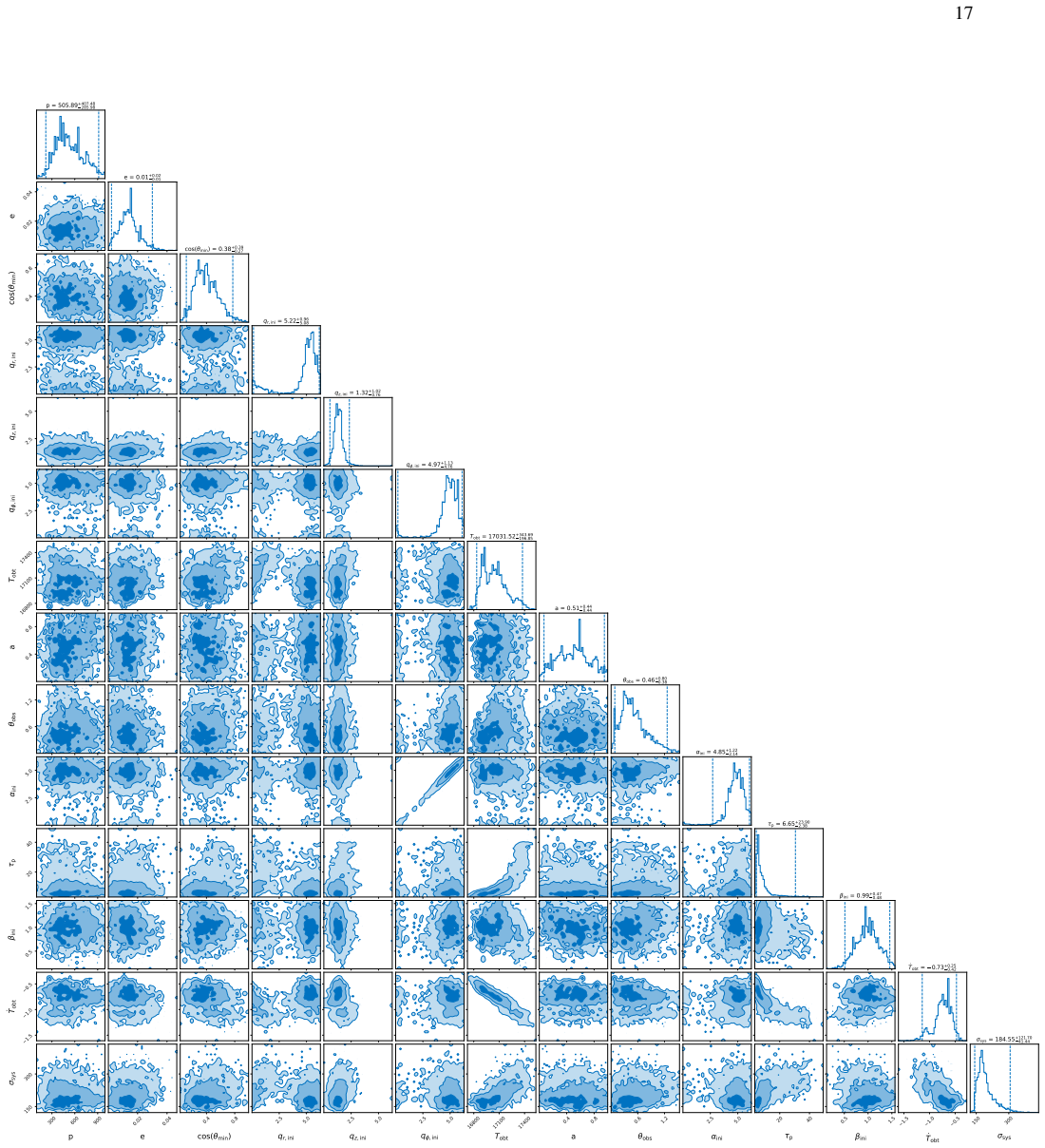
The posterior corner plot of model parameters for eRO-QPE2 with the hypothesis of an nonuniform orbital decay and a precess- ing disk (H2 =He1 +Hds): p[M•], e, cosθmin, qr,ini, qz,ini, qϕ,ini, Tobt[sec], a,θ obs,α ini,τ p[days],β ini, ˙Tobt,max[×10−5],σ sys[sec], where each pa...
2010 doi
-
[13]
https://arxiv.org/abs/2410.05166 Wang, Y ., Lin, D. N. C., Zhang, B., & Zhu, Z. 2023a, arXiv e-prints, arXiv:2310.00038, doi: 10.48550/arXiv.2310.00038 Wang, Y ., Zhu, Z., & Lin, D. N. C. 2023b, arXiv e-prints, arXiv:2308.09129, doi: 10.48550/arXiv.2308.09129 Wevers, T., & Fre...
-
[14]
2023, The Astrophysical Journal Letters, 955, L6, doi: 10.3847/2041-8213/acf216 Zhou, C., Huang, L., Guo, K., Li, Y .-P., & Pan, Z
https://arxiv.org/abs/2407.14578 Yao, Y ., Ravi, V ., Gezari, S., et al. 2023, The Astrophysical Journal Letters, 955, L6, doi: 10.3847/2041-8213/acf216 Zhou, C., Huang, L., Guo, K., Li, Y .-P., & Pan, Z. 2024, PhRvD, 109, 103031, doi: 10.1103/PhysRevD.109.103031 Zhou, C., Zho...
2023 arXiv
-
[2024]
1968, Physical Review, 174, 1559, doi: 10.1103/PhysRev.174.1559 Chakraborty, J., Kara, E., Masterson, M., et al
https://arxiv.org/abs/2409.16908 Carter, B. 1968, Physical Review, 174, 1559, doi: 10.1103/PhysRev.174.1559 Chakraborty, J., Kara, E., Masterson, M., et al. 2021, Astroph.J.Lett., 921, L40, doi: 10.3847/2041-8213/ac313b Chakraborty, J., Arcodia, R., Kara, E., et al. 2024, arXi...
1968 arXiv
Reviewed August 12, 2026 · model on record in the stance chip above.
Discussion (0). Continue with ORCID to comment.