REVIEW 2 major objections 1 minor 22 references
Bridging Identification and Second-Order Acceleration: A Fast Alternating Minimization Framework for Composite Optimization
T0 review · 2 major / 1 minor · reviewed 2026-06-25 · grok-4.3
Pith's one-line read An alternating minimization framework for composite optimization achieves finite subspace identification and O(ε^{-3/2}) complexity to approximate second-order stationarity under the KL property.
desk verdict The paper's main move is an alternating proximal-gradient plus subspace cubic-Newton scheme that gets finite identification and O(ε^{-3/2}) local second-order complexity under KL, but only when the KL exponent is known in advance to set the adaptive threshold. read the letter →
The pith
A machine-rendered reading of the paper's core claim, the machinery that carries it, and where it could break.
The reading
What carries the argument
Adaptive thresholding strategy guided by the KL exponent, which drives finite identification of the active subspace so that cubic-regularized Newton steps can be restricted to it.
What would settle it
A composite optimization instance obeying the KL property for which the adaptive threshold either fails to produce finite subspace identification or requires more than O(ε^{-3/2}) iterations to reach approximate second-order stationarity.
Extended reading notes
Core claim
The central claim is that the proposed alternating minimization framework, which integrates proximal-gradient steps with cubic-regularized Newton updates on a dynamically identified low-dimensional subspace, converges globally to a stationary point under the KL property. By incorporating an adaptive thresholding strategy guided by the KL exponent, the method establishes a finite identification property without nondegeneracy assumptions and attains a worst-case iteration complexity of O(ε^{-3/2}) for approximate second-order stationarity.
Load-bearing premise
The problem satisfies the Kurdyka-Łojasiewicz property with a known exponent that can be used to set the adaptive threshold.
Editorial extensions
If this is right
- Global convergence to a stationary point holds under the KL property.
- Finite identification of the active subspace occurs without nondegeneracy assumptions.
- Worst-case iteration complexity is O(ε^{-3/2}) for approximate second-order stationarity.
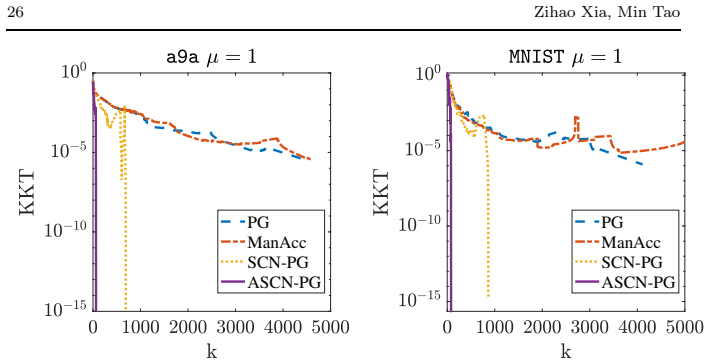
- The framework shows efficiency on both synthetic and real datasets in numerical tests.
Reading between the lines
- The method could be tested on problems where the KL exponent is estimated from data rather than assumed known.
- The subspace-identification step might combine with stochastic or variance-reduced variants of proximal methods.
- Absence of nondegeneracy assumptions suggests applicability to degenerate cases that arise in sparse or structured machine-learning models.
Editorial analysis
A structured set of objections, weighed in public.
Referee Report
Summary. The paper proposes an alternating minimization framework for composite optimization (smooth term plus proper lsc regularizer, possibly nonconvex/nonsmooth) that alternates proximal-gradient steps with cubic-regularized Newton steps restricted to a dynamically identified low-dimensional subspace. Under the KL property it claims global convergence to a stationary point; by using an adaptive thresholding strategy guided by the KL exponent it claims finite identification of the active set without nondegeneracy assumptions; and it claims a local worst-case iteration complexity of O(ε^{-3/2}) to approximate second-order stationarity. Numerical experiments on synthetic and real data are included to illustrate performance.
Significance. If the central claims hold, the work would provide a concrete bridge between active-set identification and second-order acceleration for composite problems, achieving finite identification without the usual nondegeneracy conditions by leveraging the KL exponent for thresholding and delivering a competitive local complexity bound. The explicit use of the KL property for both global convergence and local rate is a methodological strength.
major comments (2)
- [Abstract] Abstract: the finite identification property and the O(ε^{-3/2}) local complexity are obtained via an adaptive thresholding strategy 'guided by the KL exponent.' This makes the exponent a load-bearing input that must be known a priori to set the threshold; the manuscript supplies no discussion of how the exponent is obtained when it is unknown or must be estimated, nor what guarantees remain if the KL property holds but the exponent is unavailable.
- [Analysis sections] Global and local convergence analysis: the abstract asserts global convergence, finite identification, and the O(ε^{-3/2}) bound, yet supplies no derivation outline, no explicit assumptions on the accuracy or termination criterion of the cubic subproblem solver, and no statement of how inexact solves affect the claimed rates. These omissions are load-bearing for the complexity result.
minor comments (1)
- [Numerical experiments] Numerical experiments: the section reports efficiency on synthetic and real datasets but provides neither error bars nor quantitative baseline comparisons, weakening the empirical support for the claimed practical advantages.
Simulated Author's Rebuttal
We thank the referee for the careful reading and constructive comments. We address the major comments point by point below, indicating where revisions will be made.
read point-by-point responses
-
Referee: [Abstract] Abstract: the finite identification property and the O(ε^{-3/2}) local complexity are obtained via an adaptive thresholding strategy 'guided by the KL exponent.' This makes the exponent a load-bearing input that must be known a priori to set the threshold; the manuscript supplies no discussion of how the exponent is obtained when it is unknown or must be estimated, nor what guarantees remain if the KL property holds but the exponent is unavailable.
Authors: We agree that the KL exponent is a load-bearing parameter for the adaptive thresholding. The manuscript treats the exponent as known (standard in KL analyses, where it is often determined by the semi-algebraic structure or problem class). We will add a remark in the revised introduction and conclusion discussing practical estimation approaches (e.g., via local curvature bounds or conservative overestimation) and note that overestimation preserves finite identification at the possible cost of slower local rates. This addresses the gap without altering the core claims. revision: yes
-
Referee: [Analysis sections] Global and local convergence analysis: the abstract asserts global convergence, finite identification, and the O(ε^{-3/2}) bound, yet supplies no derivation outline, no explicit assumptions on the accuracy or termination criterion of the cubic subproblem solver, and no statement of how inexact solves affect the claimed rates. These omissions are load-bearing for the complexity result.
Authors: The full analysis in Sections 3–4 contains the detailed proofs, including the global convergence under KL, finite identification via adaptive thresholding, and the local O(ε^{-3/2}) bound derived from cubic regularization restricted to the identified subspace. We will add a concise derivation outline to the abstract/introduction and explicitly state the cubic subproblem termination criterion (gradient norm ≤ δ_k with δ_k chosen to preserve the rate) together with a short paragraph on how inexactness affects the bound, following standard arguments from the cubic regularization literature. These clarifications will be incorporated. revision: yes
Circularity Check
No circularity; KL exponent treated as external input property
full rationale
The derivation establishes global convergence, finite identification, and O(ε^{-3/2}) local complexity under the KL property with a known exponent that guides the adaptive threshold. This exponent is an a priori problem property, not a fitted output or self-derived quantity. No equations reduce a claimed prediction to a fitted parameter by construction, no self-citation chains bear the central load, and no ansatz or renaming is smuggled in. The analysis is conditional on the stated assumption but does not collapse to it tautologically.
Assumptions & free parameters
assumptions (1)
- domain assumption The objective satisfies the Kurdyka-Łojasiewicz property with an exponent that can be used to guide adaptive thresholding.
Cite this review
Pith. "Pith review of Bridging Identification and Second-Order Acceleration: A Fast Alternating Minimization Framework for Composite Optimization." pith.science (2026). https://pith.science/paper/JKONUNBC
@misc{pith2026260624600,
  author       = {Pith},
  title        = {Pith review of: Bridging Identification and Second-Order Acceleration: A Fast Alternating Minimization Framework for Composite Optimization},
  year         = {2026},
  howpublished = {\url{https://pith.science/paper/JKONUNBC}},
  note         = {Machine review of arXiv:2606.24600}
}
abstract
We consider a class of composite optimization problems involving a smooth function and a proper, lower semicontinuous regularizer, which may be nonconvex and nonsmooth. We propose a novel alternating minimization framework that integrates proximal-gradient steps with cubic-regularized Newton updates restricted to a dynamically identified low-dimensional subspace. Under the Kurdyka--{\L}ojasiewicz (KL) property, we establish global convergence of the proposed method to a stationary point. Moreover, by incorporating an adaptive thresholding strategy guided by the KL exponent, we prove a finite identification property without imposing any nondegeneracy assumptions. We further develop a local convergence analysis and show that the proposed method attains a worst-case iteration complexity of $\mathcal{O}(\varepsilon^{-3/2})$ for achieving approximate second-order stationarity. Numerical experiments on both synthetic and real datasets demonstrate the efficiency and effectiveness of the proposed framework.
Figures


Figures from the paper (2 more)

Reference graph
Works this paper leans on
-
[1]
Attouch and J
H. Attouch and J. Bolte. On the convergence of the proximal algorithm for nonsmooth functions involving analytic features . Mathematical Program- ming, 116.1 (2009), pp. 5–16
2009
-
[2]
Bareilles, F
G. Bareilles, F. Iutzeler, and J. Malick. Newton acceleration on manifolds identified by proximal gradient methods . Mathematical Programming, 200.1 (2023), pp. 37–70
2023
-
[3]
A. Beck. First-order methods in optimization . SIAM, 2017. 28 Zihao Xia, Min Tao
2017
-
[4]
R. I. Bot ¸, G. Y. Li, and M. Tao. Full splitting algorithms for fractional programs with structured numerators and denominators . SIAM Journal on Optimization, 35.4 (2025), pp. 2623–2653
2025
-
[5]
Cartis, N
C. Cartis, N. I. M. Gould, and P. L. Toint. Adaptive cubic regularisation methods for unconstrained optimization. Part I: motivatio n, convergence and numerical results . Mathematical Programming, 127.2 (2011), pp. 245– 295
2011
-
[6]
Cartis, N
C. Cartis, N. I. M. Gould, and P. L. Toint. Adaptive cubic regularisa- tion methods for unconstrained optimization. Part II: wors t-case function- and derivative-evaluation complexity . Mathematical Programming, 130.2 (2011), pp. 295–319
2011
-
[7]
Cartis, N
C. Cartis, N. I. M. Gould, and P. L. Toint. Evaluation Complexity of Al- gorithms for Nonconvex Optimization: Theory, Computation and Perspec- tives. SIAM, 2022
2022
-
[8]
T. Y. Chen, F. E. Curtis, and D. P. Robinson. A reduced-space algorithm for minimizingℓ1-regularized convex functions. SIAM Journal on Optimization, 27.3 (2017), pp. 1583–1610
2017
Show all 22 references
-
[9]
X. Chen, B. Jiang, T. Y. Lin, and S. Z. Zhang. Accelerating adaptive cubic regularization of Newton’s method via random sampling. Journal of Machine Learning Research, 23.90 (2022), pp. 1–38
2022
-
[10]
R. J. Jiang, Z. S. Zhou, and Z. R. Zhou. Cubic regularization methods with second-order complexity guarantee based on a new subpr oblem refor- mulation. Journal of the Operations Research Society of China, 10.3 (2022 ), pp. 471–506
2022
-
[11]
R. J. Jiang, M.-C. Yue, and Z. S. Zhou. An accelerated first-order method with complexity analysis for solving cubic regularization subproblems. Com- putational Optimization and Applications, 79.2 (2021), pp. 471–506
2021
-
[12]
Koh, S.-J
K. Koh, S.-J. Kim, and S. P. Boyd. An interior-point method for large-scale ℓ1-regularized logistic regression. Journal of Machine Learning Research, 8.8 (2007), pp. 1519–1555
2007
-
[13]
Nesterov and B
Y. Nesterov and B. Polyak. Cubic regularization of Newton method and its global performance. Mathematical Programming, 108.1 (2006), pp. 177–205
2006
-
[14]
Qin and Y
J. Qin and Y. F. Lou. ℓ1− 2 regularized logistic regression. In: Proceedings of the 53rd Asilomar Conference on Signals, Systems, and Computers (2019), pp. 779–783
2019
-
[15]
R. T. Rockafellar and R. J. B. Wets. Variational analysis. Springer, 1998
1998
-
[16]
M. Tao. Minimization of L1 over L2 for sparse signal recovery with con- vergence guarantee. SIAM Journal on Scientific Computing, 44.2 (2022), pp. 770–797
2022
-
[17]
M. Tao, X. P. Zhang, and Z. H. Xia. On partial smoothness, activity iden- tification and faster algorithms of L1 over L2 minimization. IEEE Trans- actions on Signal Processing, 72 (2024), pp. 2874–2889
2024
-
[18]
H. Wang, X. Y. Yang, and Y. C. Zhu. Alternating iteratively reweighted ℓ1 and subspace Newton algorithms for nonconvex sparse optimi zation. arXiv preprint arXiv:2407.17216 (2024). Title Suppressed Due to Excessive Length 29
2024
-
[19]
Z. Wang, Y. Zhou, Y. B. Liang, and G. H. Lan. Cubic regularization with momentum for nonconvex optimization . In: Uncertainty in Artificial Intel- ligence (2020), pp. 313–322
2020
-
[20]
Y. Q. Wu, S. H. Pan, and X. Q. Yang. A Regularized Newton Method for Norm Composite Optimization Problems . SIAM Journal on Optimization, 33.3 (2023), pp. 1676–1706
2023
-
[21]
J. Zhao, A. Lucchi, and N. Doikov. Cubic regularized subspace Newton for non-convex optimization. arXiv preprint arXiv:2406.16666 (2024)
2024
-
[22]
Y. Zhou, Z. Wang, and Y. B. Liang. Convergence of cubic regularization for nonconvex optimization under KL property . In: Advances in Neural In- formation Processing Systems, 31 (2018). 30 Zihao Xia, Min Tao A Estimation of the Locally Hessian Lipschitz Continuous Mo dulus The...
2018
Reviewed June 25, 2026 · model on record in the stance chip above.
Discussion (0). Sign in to comment.