REVIEW 3 major objections 4 minor 61 references
BISTRO: Berkeley Integrated System for Transportation Optimization
T0 review · 3 major / 4 minor · reviewed 2026-08-14 · deepseek-v4-flash
Pith's one-line read BISTRO is a working open-source platform that lets nonexpert analysts optimize city transportation policies through agent-based simulation, provided the scoring function is bounded and refined in dialogue with planners
desk verdict A genuinely useful negative result—the unbounded scoring function—sits inside a systems paper whose positive testbed claims need sharper statistics before they carry weight. read the letter →
The pith
A machine-rendered reading of the paper's core claim, the machinery that carries it, and where it could break.
The reading
What carries the argument
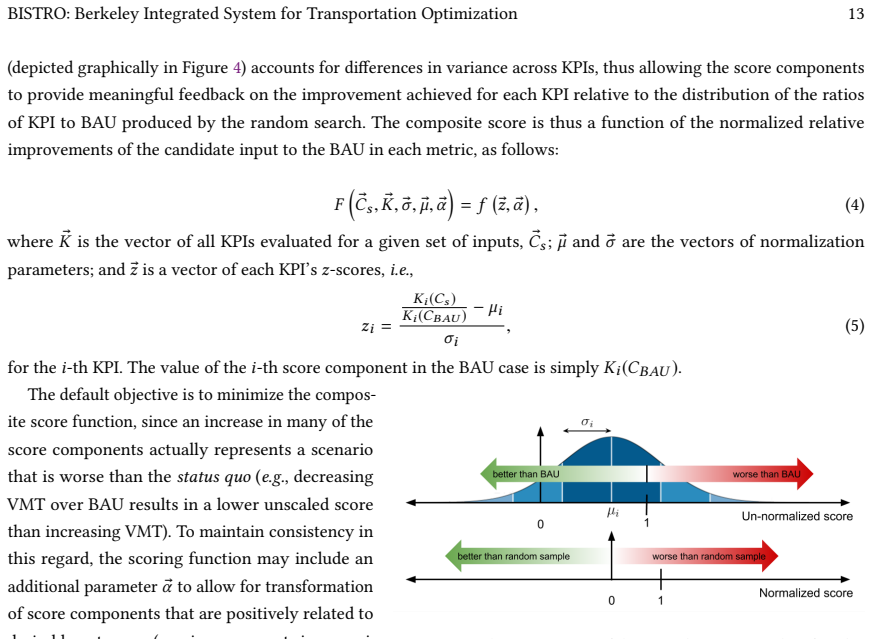
The load-bearing object is the scoring function that turns simulated outcomes into one number to minimize. For each KPI $i$, BISTRO takes the ratio of the candidate run's KPI to the business-as-usual run's KPI, raises that ratio to a parameter $\alpha_i$ that is $-1$ for components where an increase is desirable and $+1$ otherwise, subtracts the mean and divides by the standard deviation of that ratio over an 800-run random sample, and sums the components: $$F(\mathbf{C}_s)=\sum_{i\in K}\frac{(K_i(\mathbf{C}_s)/K_i(\mathbf{C}_{BAU}))^{\alpha_i}-\mu_i}{\sigma_i}.$$ This normalization makes disparate metrics comparable without monetizing them, and it makes the random-search distribution part of the definition of the objective. The rest of the mechanism is the human-in-the-loop loop itself: a planner defines KPIs and business-rule constraints, an analyst runs derivative-free solvers over user-defined policy inputs, post-processing turns millions of agent events into queryable relations, and the resulting visualizations feed back into a revised objective.
What would settle it
Take the top solutions from the genetic algorithm and the tree-based Parzen estimator, run them against random search with a full-size synthetic population and ten independent simulation replicates per trial, and see whether the best scores still sit outside the noise of the best random-search score; if the gap disappears, the pilot's main comparison is not established.
Extended reading notes
Core claim
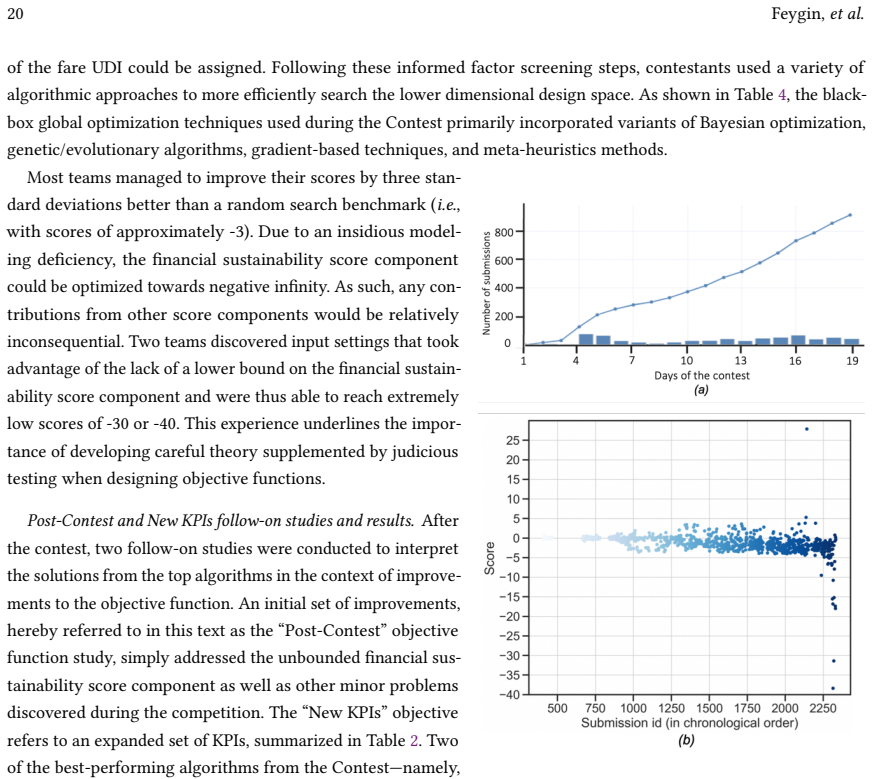
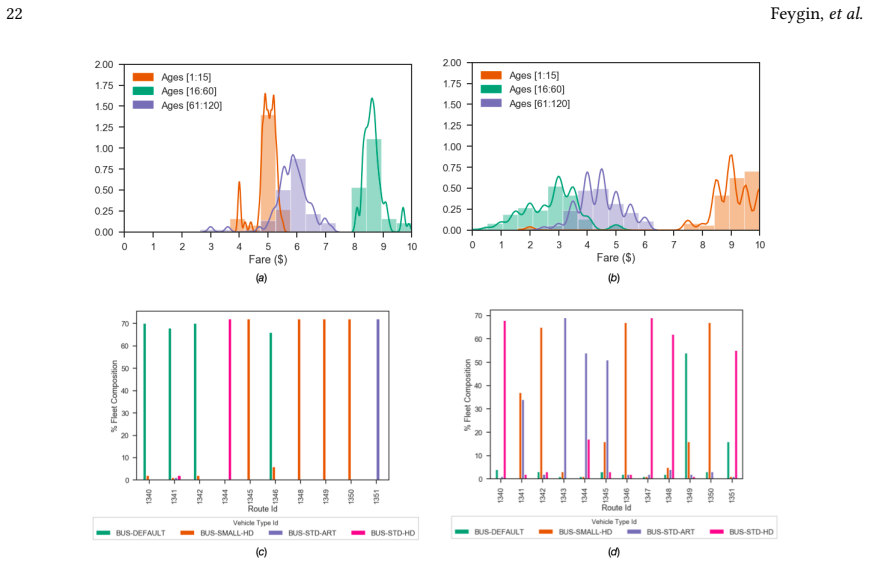
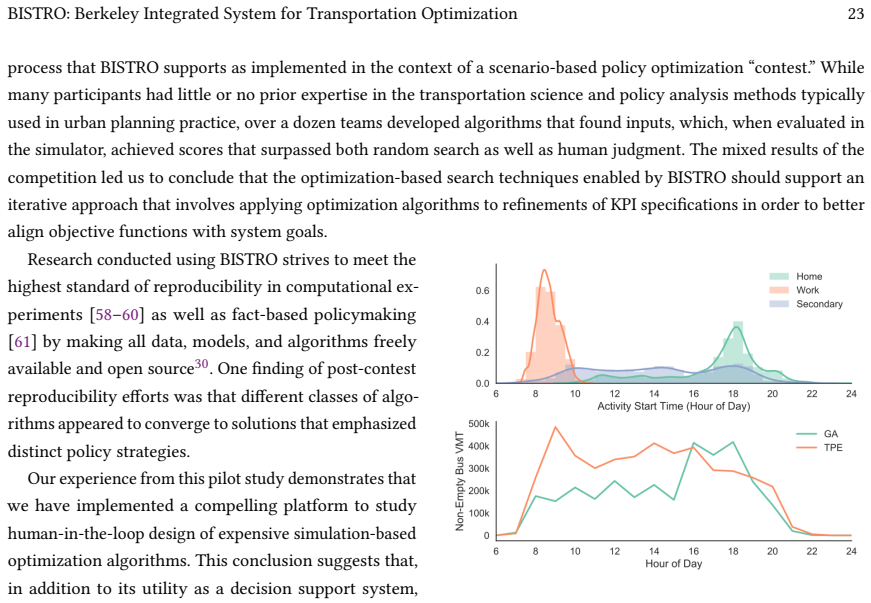
The paper's central claim is that BISTRO is a working, generalizable open-source platform for human-in-the-loop design of expensive simulation-based optimization algorithms. On the paper's own terms, the discovery is the loop itself: optimize a policy bundle in the BEAM simulator against a composite score, inspect the resulting interventions, discover the objective's failure modes, fix the objective, and optimize again. The pilot establishes that non-domain-expert participants could operate the platform and find policies beating random search; that a badly specified score component, the financial-sustainability KPI, was unbounded below and allowed contrived inputs to drive composite scores to -30 or -40 where they were uninterpretable; and that once that component was bounded, both genetic algorithms and tree-based Parzen estimators beat an 800-trial random search, with their top solutions favoring different bus-service patterns. The authors conclude that the platform's value lies partly in exposing such specification errors quickly, so that objective functions can be refined in dialogue with planning goals.
Load-bearing premise
The whole pilot rests on the assumption that a 15% slice of a synthetic population, simulated until the traffic patterns stop changing, produces the same ranking of policy bundles that the full city would; if the simulation's remaining randomness is larger than the score gaps between algorithms, the comparisons could be artifacts.
Editorial extensions
If this is right
- A planning agency adopting BISTRO could hand its policy search to derivative-free optimization algorithms and iterate on the scoring function as failures surface, rather than committing to a single model run.
- The competition result implies that any similar simulation-optimization platform should include explicit boundedness checks on each score component, because an unbounded component can make every other metric irrelevant.
- The follow-on results imply that on this benchmark, genetic algorithms and tree-based Parzen estimators both dominate random search for bus-fleet, frequency, fare, and incentive decisions, so having any principled solver plus a bounded objective matters more than the specific solver family.
- Because the top GA and TPE solutions concentrate on different parts of the bus-service pattern, the platform can present planners with genuinely distinct strategic alternatives rather than a single numeric optimum.
- If BISTRO becomes a shared benchmark, expensive simulation-based optimization research, including freeze-thaw, multi-fidelity, and multi-objective methods, gains a common open testbed grounded in a real transportation planning problem.
Reading between the lines
- The paper leaves implicit that the normalization procedure makes the random-search sample part of the objective's definition; a deliberately biased random sample could shift which solutions look good, so the normalization data should be versioned and published alongside any benchmark.
- The same contest mechanism could be reused as an adversarial testing protocol: before spending on large simulation studies, an agency could invite algorithm teams to attack a proposed objective function, exactly as the two top teams did, to expose unbounded or degenerate components early.
- The disaggregated accessibility and cost-burden KPIs point toward equity-aware optimization; the same loop could constrain or penalize outcomes by income group, turning BISTRO from a single-objective policy search into a distributional planning tool.
- A testable extension is to run the follow-on comparison with a much larger population sample and more replicates per trial; if the GA and TPE advantage over random search vanishes, the pilot's comparison would be an artifact of small-sample noise rather than evidence for the platform.
Signed reviews
Editorial analysis
A structured set of objections, weighed in public.
Referee Report
Summary. The paper describes BISTRO, an open-source decision support system coupling the BEAM agent-based simulator with simulation-based optimization of transportation policy levers. It presents the system architecture, scoring function design, input specification, and output analysis tools. The system is evaluated through an internal Uber-hosted competition on a synthetic Sioux Falls benchmark ("Sioux Faux"), which revealed an unbounded financial-sustainability objective term exploited by the top teams. A follow-on study with two corrected objective functions reports that TPE and GA outperform random search, leading the authors to claim BISTRO is a compelling platform for human-in-the-loop simulation-based optimization.
Significance. If the platform and benchmark are as open and reproducible as claimed, BISTRO and Sioux Faux could provide a valuable shared testbed for the transportation and machine-learning communities. The paper is genuinely useful as a system description and is admirably honest about the unbounded-objective failure discovered during the competition, and it makes code and data publicly available. However, the positive evidence supporting the platform's optimization value rests on a statistically under-specified comparison in Section 4.2; the central claim in Section 5 that BISTRO is a "compelling platform" is therefore only partially supported and needs revision.
major comments (3)
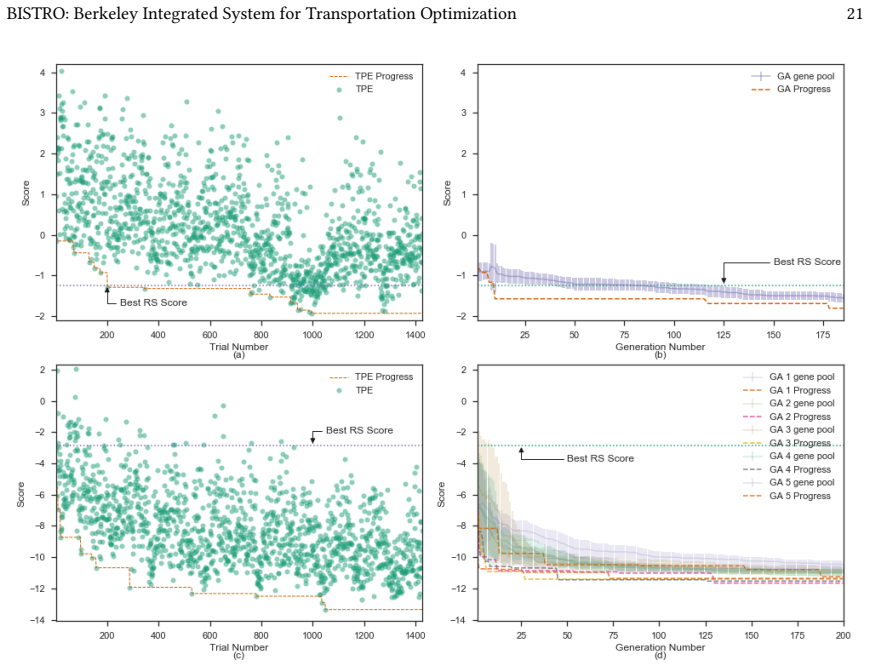
- [Section 4.2, Figure 8] The assertion that "both GA and TPE produce input configurations that are superior to RS" is not statistically established. The comparison uses the best score within a fixed number of trials: 800 for RS versus 1,400 for GA and TPE, with no repeated independent runs of any algorithm, no confidence intervals, and no significance test. Because the objective in Eq. (3) is an expectation and footnote 10 states that optimization usually proceeds with n=1, the reported differences could be within simulation noise. I ask the authors to provide repeated baseline distributions with standard errors, a paired test using the five 100-iteration replicates, or alternatively to weaken the claim to describe a pilot demonstration rather than a definitive superiority result.
- [Section 5] The statement that solutions "surpassed both random search as well as human judgment" introduces an undefined baseline. No human-generated plan or expert-designed solution is described anywhere in Sections 4.1–4.2, so this claim is not falsifiable in its present form. The authors should either define the human baseline explicitly or delete the phrase.
- [Section 4.2, footnote 29 and Figure 8] The paper says initial search used 40 iterations with "partial convergence criteria," while final inputs were simulated for 100 iterations with five replicates per trial. Yet Figure 8 appears to plot best-of-N scores from the 40-iteration search phase. The authors should clarify whether the plotted values come from the 40-iteration runs or the 100-iteration replicates, and should justify that 40 iterations rank alternatives reliably. Without this, the reported faster convergence of GA and TPE could be an artifact of non-stationary simulation output.
minor comments (4)
- [Eq. (5) and Eq. (7)] The definition of z_i in Eq. (5) is ambiguous: the ratio Ki(Cs)/Ki(CBAU) should be enclosed in parentheses before subtracting mu_i, and the same issue appears in Eq. (7). Please add clarifying parentheses so the normalization is unambiguous.
- [Table 2] The asterisk on the Financial Sustainability KPI in the "New KPIs" column is footnoted as "fixed KPI post-contest," but it is not clear whether this KPI is included in the objective as a fixed value or held constant while other components are optimized. Clarify the role of this KPI in the post-contest studies.
- [Figure 8] The caption says the dashed line denotes the best score within the first N trials, but for the GA panel the text also mentions "one standard deviation ranges of current gene pools." Clarify exactly what quantity is plotted for GA so the reader can interpret the comparison.
- [Abstract vs. Section 4.2] The abstract reports that "over 400 engineers and data scientists participated," while Section 4.2 states that 487 people participated. Make these numbers consistent.
Circularity Check
No circular derivation; BISTRO is an empirical system description with a self-contained evaluation.
full rationale
This is a software-systems paper whose central claims are empirical demonstrations rather than mathematical derivations, so the classic circularity failure modes do not arise. Equation (7) is an explicitly constructed scoring function whose normalization statistics are computed from a random sample of UDIs; this is a definitional setup, not a hidden reduction of the later algorithm comparison. The GA/TPE-vs-RS result is an in-sample empirical benchmark report with acknowledged statistical limitations (e.g., 40-iteration partial convergence, n=1 during search, no repeated RS distribution), which is a validity concern, not circularity. BEAM is cited as an external open-source simulator dependency [28], and the paper reports a falsifiable negative finding (the unbounded financial sustainability score component) that contradicts any suggestion the evaluation was forced by construction. The explicit disclaimers that Sioux Faux is not a true replica of Sioux Falls and that stationarity of the iterative simulation is assumed are limitations, not circular steps. No load-bearing claim reduces to its own inputs or to a self-citation chain.
Assumptions & free parameters
free parameters (4)
- Scoring weights alpha_i =
Table 2 values (e.g., -1 for accessibility, 1 for VMT)
- KPI normalization statistics mu_i, sigma_i =
Computed from 800 random search trials
- Population sub-sample size =
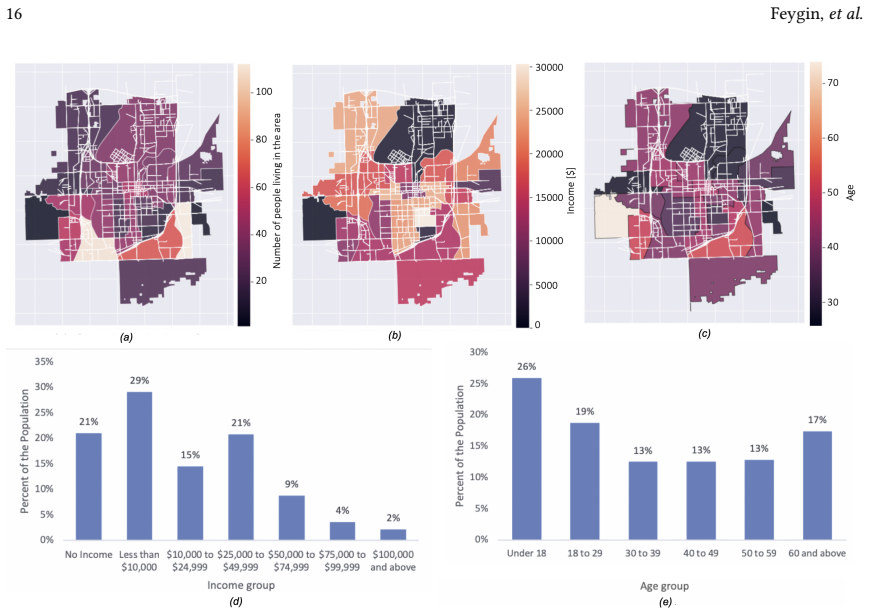
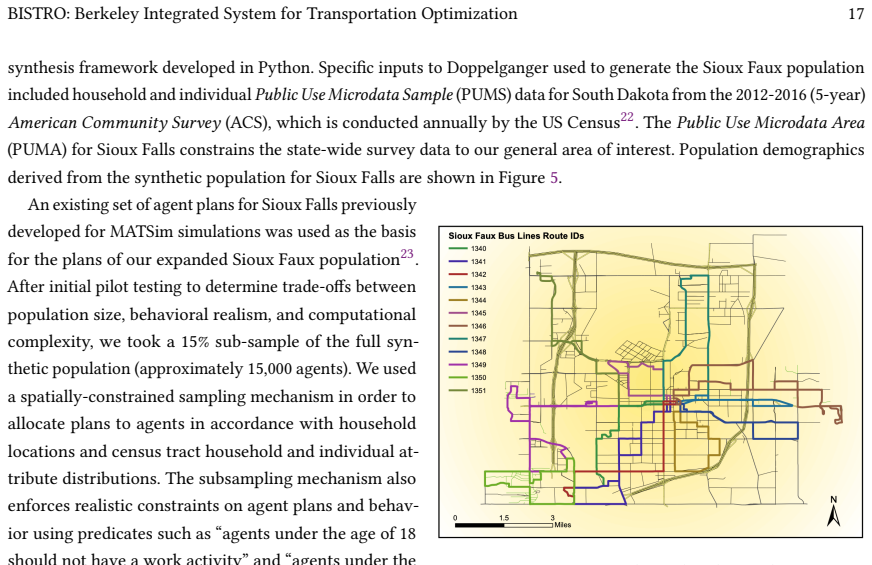
15% of full synthetic population (about 15,000 agents)
- Simulation iteration counts =
40 iterations for search, 100 for final evaluation
assumptions (4)
- domain assumption BEAM simulation reaches stationarity within the chosen iteration count
- domain assumption KPI ratios normalized via z-scores over 800 random samples produce a meaningful objective
- domain assumption The 15% synthetic population sub-sample preserves the behavioral and network effects needed to rank policies
- ad hoc to paper The four business rules define a meaningful feasible region for policy search
Cite this review
Pith. "Pith review of BISTRO: Berkeley Integrated System for Transportation Optimization." pith.science (2026). https://pith.science/paper/JKS4QDAL
@misc{pith2026190803821,
  author       = {Pith},
  title        = {Pith review of: BISTRO: Berkeley Integrated System for Transportation Optimization},
  year         = {2026},
  howpublished = {\url{https://pith.science/paper/JKS4QDAL}},
  note         = {Machine review of arXiv:1908.03821}
}
read the original abstract
This article introduces BISTRO, a new open source transportation planning decision support system that uses an agent-based simulation and optimization approach to anticipate and develop adaptive plans for possible technological disruptions and growth scenarios. The new framework was evaluated in the context of a machine learning competition hosted within Uber Technologies, Inc., in which over 400 engineers and data scientists participated. For the purposes of this competition, a benchmark model, based on the city of Sioux Falls, South Dakota, was adapted to the BISTRO framework. An important finding of this study was that in spite of rigorous analysis and testing done prior to the competition, the two top-scoring teams discovered an unbounded region of the search space, rendering the solutions largely uninterpretable for the purposes of decision-support. On the other hand, a follow-on study aimed to fix the objective function, served to demonstrate BISTRO's utility as a human-in-the-loop cyberphysical system: one that uses scenario-based optimization algorithms as a feedback mechanism to assist urban planners with iteratively refining objective function and constraints specification on intervention strategies such that the portfolio of transportation intervention strategy alternatives eventually chosen achieves high-level regional planning goals developed through participatory stakeholder engagement practices.
Figures
Figures from the paper (7 more)
Reference graph
Works this paper leans on
-
[1]
Activity-based Urban Mobility Modeling from Cellular Data
Mogeng Yin. Activity-based Urban Mobility Modeling from Cellular Data . PhD thesis, UC Berkeley, 2018
work page 2018
-
[2]
A Primer for Agent-Based Simulation and Modeling in Transportation Applications
Hong Zheng. A Primer for Agent-Based Simulation and Modeling in Transportation Applications. Development, page 75, 2013
work page 2013
-
[3]
The multi-agent transport simulation MATSim
Andreas Horni, Kai Nagel, and Kay W Axhausen. The multi-agent transport simulation MATSim . Ubiquity Press London, 2016
work page 2016
-
[4]
Sebastian Hörl. Implementation of an autonomous taxi service in a multi-modal traffic simulation using MATSim Master thesis in Complex Adaptive Systems. (June), 2016
work page 2016
-
[5]
Performance-based planning and programming guidebook
Michael Grant, Janet D’Ignazio, Alexander Bond, Alanna McKeeman, et al. Performance-based planning and programming guidebook. Technical report, United States. Federal Highway Administration, 2013
work page 2013
-
[6]
Trends in Statewide Long-Range Transportation Plans: Core and Emerging Topics, 2012
United States Department of Transportation. Trends in Statewide Long-Range Transportation Plans: Core and Emerging Topics, 2012
work page 2012
-
[7]
Public Engagement: Case Studies and Notable Practices, 2019
Federal Highway Administration/Federal Transit Administration. Public Engagement: Case Studies and Notable Practices, 2019. 30All code and data used and referred in the article is available at http://bistro.its.berkeley.edu Manuscript submitted to ACM 24 Feygin, et al
work page 2019
-
[8]
Metropolitan transportation planning: Lessons from the past, institutions for the future
Gian-Claudia Sciara. Metropolitan transportation planning: Lessons from the past, institutions for the future. Journal of the American Planning Association, 83(3):262–276, 2017
work page 2017
Show all 61 references
-
[9]
The transportation planning process key issues: A briefing book for transportation decisionmakers, officials, and staff
Federal Highway Administration/Federal Transit Administration. The transportation planning process key issues: A briefing book for transportation decisionmakers, officials, and staff. Technical report, Washington, DC, USA, 2016
2016
-
[10]
Report to the ranking member, committee on environment and public works: U.s
United States Government Accountability Office. Report to the ranking member, committee on environment and public works: U.s. senate– metropolitan planning organizations: Options exist to enhance transportation planning capacity and federal oversight. Technical report, Washing...
2009
-
[11]
Polaris: Agent-based modeling framework development and implementation for integrated travel demand and network and operations simulations
Joshua Auld, Michael Hope, Hubert Ley, Vadim Sokolov, Bo Xu, and Kuilin Zhang. Polaris: Agent-based modeling framework development and implementation for integrated travel demand and network and operations simulations. Transportation Research Part C: Emerging Technologies , 64...
2016
-
[12]
Decision Support Systems in Transport Planning
Ebru Vesile Ocalir-Akunal. Decision Support Systems in Transport Planning. Procedia Engineering, 161:1119–1126, 2016
2016
-
[13]
ICT enabled participatory urban planning and policy development: The UrbanAPI project
Zaheer Khan, David Ludlow, Wolfgang Loibl, and Kamran Soomro. ICT enabled participatory urban planning and policy development: The UrbanAPI project. Transforming Government: People, Process and Policy , 8(2):205–229, 2014
2014
-
[14]
Tripod: sustainable travel incentives with prediction, optimization, and personalization
Carlos Lima Azevedo, Ravi Seshadri, Song Gao, Bilge Atasoy, Arun Prakash Akkinepally, Eleni Christofa, Fang Zhao, Jessika Trancik, and Moshe Ben-Akiva. Tripod: sustainable travel incentives with prediction, optimization, and personalization. In Transportation Research Board 97...
2018
-
[15]
Maria Nadia Postorino and Giuseppe M.L. Sarné. Agents meet traffic simulation, control and management: A review of selected recent contributions. CEUR Workshop Proceedings, 1664:112–117, 2016
2016
-
[16]
Activitysim | an open platform for activity-based travel modeling, 2019
Association of Metropolitan Planning Organizations. Activitysim | an open platform for activity-based travel modeling, 2019
2019
-
[17]
Activity-Based Travel Demand Models: A Primer
Joe Castiglione, Mark Bradley, and John Gliebe. Activity-Based Travel Demand Models: A Primer . 2016
2016
-
[18]
Smith, R
L. Smith, R. Beckman, and K. Baggerly. TRANSIMS: Transportation analysis and simulation system. In Fifth National Conference on Transportation Planning Methods Applications-Volume II: A Compendium of Papers Based on a Conference Held in Seattle, Washington in April 1995Transpo...
1995
-
[19]
Sumo–simulation of urban mobility: an overview
Michael Behrisch, Laura Bieker, Jakob Erdmann, and Daniel Krajzewicz. Sumo–simulation of urban mobility: an overview. In Proceedings of SIMUL 2011, The Third International Conference on Advances in System Simulation . ThinkMind, 2011
2011
-
[20]
Tangramob: an agent-based simulation framework for validating urban smart mobility solutions
Carlo Castagnari, Flavio Corradini, Francesco De Angelis, Jacopo de Berardinis, Giorgio Forcina, and Andrea Polini. Tangramob: an agent-based simulation framework for validating urban smart mobility solutions. arXiv preprint arXiv:1805.10906, 2018
2018 arXiv
-
[21]
Exploring the Impact of User Preferences on Shared Autonomous Vehicle Modal Split: A Multi-Agent Simulation Approach
Joseph Kamel, Reza Vosooghi, Jakob Puchinger, Feirouz Ksontini, and Göknur Sirin. Exploring the Impact of User Preferences on Shared Autonomous Vehicle Modal Split: A Multi-Agent Simulation Approach. Transportation Research Procedia, 37(September 2018):115–122, 2019
2018
-
[22]
Ilute: An operational prototype of a comprehensive microsimulation model of urban systems
Paul Salvini and Eric J Miller. Ilute: An operational prototype of a comprehensive microsimulation model of urban systems. Networks and spatial economics, 5(2):217–234, 2005
2005
-
[23]
Urbansim: Modeling urban development for land use, transportation, and environmental planning
Paul Waddell. Urbansim: Modeling urban development for land use, transportation, and environmental planning. Journal of the American planning association, 68(3):297–314, 2002
2002
-
[24]
Coupling transport and land use: Investigating accessibility indicators for feedback from a travel to a land-use model
T Nicolai and K Nagel. Coupling transport and land use: Investigating accessibility indicators for feedback from a travel to a land-use model. In Latsis Symposium, pages 12–16, 2012
2012
-
[25]
Trends in integrated land use/transport modeling: An evaluation of the state of the art
Rolf Moeckel, Carlos Llorca Garcia, Ana Tsui Moreno Chou, and Matthew Bediako Okrah. Trends in integrated land use/transport modeling: An evaluation of the state of the art. Journal of Transport and Land Use , 11(1):463–476, 2018
2018
-
[26]
Coupling matsim and urbansim: Software design issues
Thomas W Nicolai and Kai Nagel. Coupling matsim and urbansim: Software design issues. Technical report, SustainCity Working Paper, 2010
2010
-
[27]
Towards an agent-based, integrated land-use transport modeling system
Dominik Ziemke, Kai Nagel, and Rolf Moeckel. Towards an agent-based, integrated land-use transport modeling system. Procedia computer science, 83:958–963, 2016
2016
-
[28]
Energy Efficient Mobility Systems: 2018 Annual Progress Report
US Department of Energy. Energy Efficient Mobility Systems: 2018 Annual Progress Report. Technical report, US Department of Energy, Office of Energy Efficiency and Renewable Energy, Vehicle Technologies Office, dec 2018
2018
-
[29]
Round-based public transit routing
Daniel Delling, Thomas Pajor, and Renato F Werneck. Round-based public transit routing. Transportation Science, 49(3):591–604, 2014
2014
-
[30]
Evidence-Based Transit and Land Use Sketch Planning Using Interactive Accessibility Methods on Combined Schedule and Headway-Based Networks
Matthew Wigginton Conway, Andrew Byrd, and Marco van der Linden. Evidence-Based Transit and Land Use Sketch Planning Using Interactive Accessibility Methods on Combined Schedule and Headway-Based Networks. Transportation Research Record: Journal of the Transportation Research ...
2017
-
[31]
Actors: a model for reasoning about open distributed systems
Gul A Agha, Prasannaa Thati, Reza Ziaei, H Bowman, and J Derrick. Actors: a model for reasoning about open distributed systems. Formal methods for distributed processing: a survey of object-oriented approaches , pages 155–176, 2001
2001
-
[32]
Discrete choice methods with simulation
Kenneth E Train. Discrete choice methods with simulation . Cambridge university press, 2009
2009
-
[33]
Discrete choice analysis: theory and application to travel demand , volume 9
Moshe E Ben-Akiva, Steven R Lerman, and Steven R Lerman. Discrete choice analysis: theory and application to travel demand , volume 9. MIT press, 1985
1985
-
[34]
A simulation-based optimization framework for urban transportation problems
Carolina Osorio and Michel Bierlaire. A simulation-based optimization framework for urban transportation problems. Operations Research, 61(6):1333–1345, 2013
2013
-
[35]
Introduction to derivative-free optimization , volume 8
Andrew R Conn, Katya Scheinberg, and Luis N Vicente. Introduction to derivative-free optimization , volume 8. Siam, 2009
2009
-
[36]
Barton and Martin Meckesheimer
Russell R. Barton and Martin Meckesheimer. Chapter 18 Metamodel-Based Simulation Optimization. Handbooks in Operations Research and Management Science, 13(C):535–574, 2006. Manuscript submitted to ACM BISTRO: Berkeley Integrated System for Transportation Optimization 25
2006
-
[37]
Gaussian processes in machine learning
Carl Edward Rasmussen. Gaussian processes in machine learning. In Summer School on Machine Learning , pages 63–71. Springer, 2003
2003
-
[38]
Taking the human out of the loop: A review of bayesian optimization
Bobak Shahriari, Kevin Swersky, Ziyu Wang, Ryan P Adams, and Nando De Freitas. Taking the human out of the loop: A review of bayesian optimization. Proceedings of the IEEE , 104(1):148–175, 2015
2015
-
[39]
Bayesian Optimization Primer
Ian Dewancker, Michael McCourt, and Scott Clark. Bayesian Optimization Primer. 2015
2015
-
[40]
A tutorial on bayesian optimization
Peter I Frazier. A tutorial on bayesian optimization. arXiv preprint arXiv:1807.02811, 2018
2018 arXiv
-
[41]
Hoos, and Kevin Leyton-Brown
Frank Hutter, Holger H. Hoos, and Kevin Leyton-Brown. Sequential model-based optimization for general algorithm configuration. Lecture Notes in Computer Science (including subseries Lecture Notes in Artificial Intelligence and Lecture Notes in Bioinformatics) , 6683 LNCS:507–523, 2011
2011
-
[42]
Algorithms for hyper-parameter optimization
James S Bergstra, Rémi Bardenet, Yoshua Bengio, and Balázs Kégl. Algorithms for hyper-parameter optimization. In Advances in neural information processing systems, pages 2546–2554, 2011
2011
-
[43]
Making a science of model search: Hyperparameter optimization in hundreds of dimensions for vision architectures
James Bergstra, Daniel L K Yamins, and D Cox. Making a science of model search: Hyperparameter optimization in hundreds of dimensions for vision architectures. In Proceedings of the 30th International Conference on Machine Learning , pages 115–123, 2013
2013
-
[44]
Efficient global optimization of expensive black-box functions
Donald R Jones, Matthias Schonlau, and William J Welch. Efficient global optimization of expensive black-box functions. Journal of Global optimization, 13(4):455–492, 1998
1998
-
[45]
The knowledge-gradient policy for correlated normal beliefs
Peter Frazier, Warren Powell, and Savas Dayanik. The knowledge-gradient policy for correlated normal beliefs. INFORMS journal on Computing , 21(4):599–613, 2009
2009
-
[46]
Bayesian optimization with gradients
Jian Wu, Matthias Poloczek, Andrew G Wilson, and Peter Frazier. Bayesian optimization with gradients. InAdvances in Neural Information Processing Systems, pages 5267–5278, 2017
2017
-
[47]
Practical Bayesian Optimization of Machine Learning Algorithms
Jasper Snoek, Hugo Larochelle, and Ryan Adams. Practical Bayesian Optimization of Machine Learning Algorithms. In Advances in neural information processing systems, pages 2951—-2959, 2012
2012
-
[48]
Freeze-thaw Bayesian optimization
Kevin Swersky, Jasper Snoek, and Ryan Prescott Adams. Freeze-thaw Bayesian optimization. arXiv preprint arXiv:1406.3896, 2014
2014 arXiv
-
[49]
A Computationally Efficient Simulation-Based Optimization Algorithm for Large-Scale Urban Transportation Problems
Carolina Osorio and Linsen Chong. A Computationally Efficient Simulation-Based Optimization Algorithm for Large-Scale Urban Transportation Problems. Transportation Science, 49(3):623–636, 2015
2015
-
[50]
Urban transportation emissions mitigation: Coupling high-resolution vehicular emissions and traffic models for traffic signal optimization
Carolina Osorio and Kanchana Nanduri. Urban transportation emissions mitigation: Coupling high-resolution vehicular emissions and traffic models for traffic signal optimization. Transportation Research Part B: Methodological , 81:520–538, 2015
2015
-
[51]
A simulation-based optimization algorithm for dynamic large-scale urban transportation problems.Transportation Science, 52(3):637–656, 2017
Linsen Chong and Carolina Osorio. A simulation-based optimization algorithm for dynamic large-scale urban transportation problems.Transportation Science, 52(3):637–656, 2017
2017
-
[52]
A stochastic process approach to the analysis of temporal dynamics in transportation networks
Ennio Cascetta. A stochastic process approach to the analysis of temporal dynamics in transportation networks. Transportation Research Part B, 23(1):1–17, 1989
1989
-
[53]
A search acceleration method for optimization problems with transport simulation constraints
Gunnar Flötteröd. A search acceleration method for optimization problems with transport simulation constraints. Transportation Research Part B: Methodological, 98:1339–1351, 2017
2017
-
[54]
Fhwa research and technology evaluation: Agent-based modeling and simulation
Gregory Bucci, Chris Calley, Michael Green, et al. Fhwa research and technology evaluation: Agent-based modeling and simulation. Technical report, United States. Federal Highway Administration. Office of Corporate Research . . . , 2018
2018
-
[55]
New Features of Population Synthesis
Peter Vovsha, James E Hicks, Binny M Paul, Vladimir Livshits, Petya Maneva, and Kyunghwi Jeon. New Features of Population Synthesis. 94th Annual Meeting of the Transportation Research Board , 250:1–20, 2015
2015
-
[56]
Enriched sioux falls scenario with dynamic and disaggregate demand.Arbeitsberichte Verkehrs-und Raumplanung, 978, 2014
Artem Chakirov and Pieter J Fourie. Enriched sioux falls scenario with dynamic and disaggregate demand.Arbeitsberichte Verkehrs-und Raumplanung, 978, 2014
2014
-
[57]
Genetic algorithms and machine learning
David E Goldberg and John H Holland. Genetic algorithms and machine learning. Machine learning, 3(2):95–99, 1988
1988
-
[58]
Reproducible research in computational science
Roger D Peng. Reproducible research in computational science. Science, 334(6060):1226–1227, 2011
2011
-
[59]
Shining light into black boxes
Andrew Morin, Jennifer Urban, Paul D Adams, Ian Foster, Andrej Sali, David Baker, and Piotr Sliz. Shining light into black boxes. Science, 336(6078):159–160, 2012
2012
-
[60]
Ten simple rules for reproducible computational research.PLOS Computational Biology, 9(10):1–4, 10 2013
Geir Kjetil Sandve, Anton Nekrutenko, James Taylor, and Eivind Hovig. Ten simple rules for reproducible computational research.PLOS Computational Biology, 9(10):1–4, 10 2013
2013
-
[61]
Hastings, Mark Howison, Ted Lawless, John Ucles, and Preston White
Justine S. Hastings, Mark Howison, Ted Lawless, John Ucles, and Preston White. Unlocking data to improve public policy. 03 2019. Manuscript submitted to ACM
2019
Reviewed August 14, 2026 · model on record in the stance chip above.
Discussion (0). Continue with ORCID to comment.