Cocktail effect and robust Berry curvature driven anomalous Hall conductivity in the entropy-stabilized Heusler alloy Co₂(Ti_(0.25)V_(0.25)Cr_(0.25)Fe_(0.25))Al
Pith reviewed 2026-06-27 21:46 UTC · model grok-4.3
The pith
The anomalous Hall conductivity in the entropy-stabilized Heusler alloy remains comparable to parent compounds because Berry curvature persists amid configurational disorder.
A machine-rendered reading of the paper's core claim, the machinery that carries it, and where it could break.
Core claim
Combined experimental observations and first-principles calculations establish that the anomalous Hall effect is predominantly intrinsic in origin and originates from the Berry curvature of the electronic bands. Remarkably, despite the substantial configurational disorder and the dilution of the constituent parent compounds, the anomalous Hall conductivity remains comparable to the largest values reported in the corresponding parent Heusler systems. This behavior reflects the manifestation of the cocktail effect, one of the core characteristics of entropy-stabilized systems.
What carries the argument
Berry curvature of the electronic bands (the geometric phase factor that generates an intrinsic transverse velocity for electrons in a ferromagnet), computed on an averaged structure to produce the anomalous Hall conductivity.
If this is right
- The anomalous Hall conductivity reaches approximately 134.4 Ω^{-1} cm^{-1} and is mostly intrinsic.
- This value stays comparable to the largest reported in the ordered parent Heusler compounds.
- Berry curvature mediated transport persists in the chemically disordered system.
- Entropy engineering provides a route for tuning intrinsic anomalous Hall responses.
Where Pith is reading between the lines
- Varying the relative fractions of Ti, V, Cr and Fe while keeping the entropy high could map how the anomalous Hall conductivity changes under the cocktail effect.
- The same robustness may appear in other Berry-phase phenomena such as the spin Hall or orbital Hall effects in related high-entropy alloys.
- If the averaged-structure approximation works here, similar shortcuts may apply to Berry-curvature estimates in other multi-principal-element ferromagnets.
- The result opens the possibility of using entropy stabilization to design materials with strong intrinsic Hall responses without requiring long-range chemical order.
Load-bearing premise
The Berry curvature computed for an idealized or averaged structure in DFT remains representative of the actual random alloy, and extrinsic scattering contributions to the measured Hall conductivity are negligible compared with the intrinsic term.
What would settle it
A supercell calculation that places the four transition-metal atoms at explicit random sites and yields a net Berry curvature far below the averaged-structure result, or temperature-dependent Hall data that isolate a dominant extrinsic term.
Figures
read the original abstract
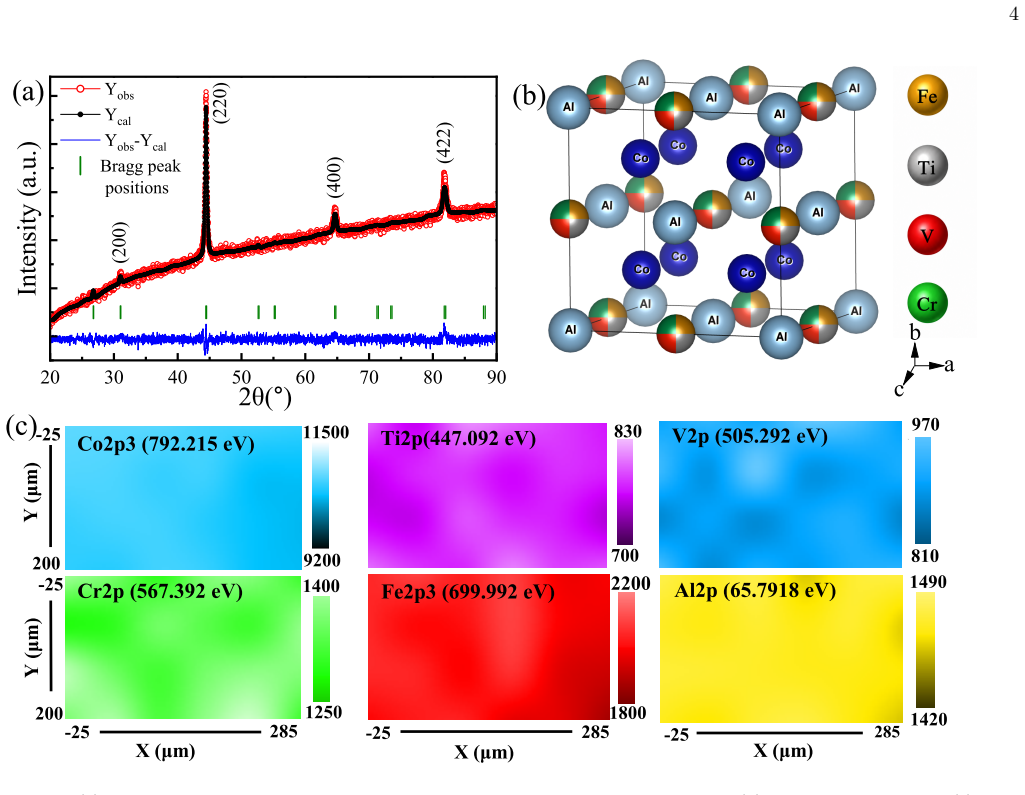
The interplay between chemical disorder and persistence of Berry curvature driven transport phenomena remains an important open question in entropy-stabilized systems. Here, we synthesize an entropy-stabilized Heusler alloy Co$_2$(Ti$_{0.25}$V$_{0.25}$Cr$_{0.25}$Fe$_{0.25}$)Al and systematically investigate its structural, magnetic, and magnetotransport properties using a combination of experimental measurements and density functional theory (DFT) calculations. The system crystallizes in cubic space group $Fm\Bar{3}m$ and exhibits ferromagnetism with saturation magnetization in close agreement with the Slater--Pauling prediction. Transport and magnetotransport measurements reveal metallic behavior and a pronounced anomalous Hall effect with an anomalous Hall conductivity of approximately $134.4~ \Omega^{-1}$.cm$^{-1}$. Combined experimental observations and first-principles calculations establish that the anomalous Hall effect is predominantly intrinsic in origin and originates from the Berry curvature of the electronic bands. Remarkably, despite the substantial configurational disorder and the dilution of the constituent parent compounds, the anomalous Hall conductivity remains comparable to the largest values reported in the corresponding parent Heusler systems. This behavior reflects the manifestation of the cocktail effect, one of the core characteristics of entropy-stabilized systems. Our results also demonstrate that Berry curvature mediated transport persists in this chemically disordered system and indicates that entropy engineering can be a promising route for tuning intrinsic anomalous Hall responses.
Editorial analysis
A structured set of objections, weighed in public.
Referee Report
Summary. The manuscript reports synthesis and characterization of the entropy-stabilized Heusler alloy Co₂(Ti₀.₂₅V₀.₂₅Cr₀.₂₅Fe₀.₂₅)Al. It crystallizes in cubic Fm-3m, exhibits ferromagnetism with saturation magnetization agreeing with the Slater-Pauling rule, shows metallic transport, and measures an anomalous Hall conductivity of 134.4 Ω⁻¹ cm⁻¹. Combined with DFT calculations, the authors conclude that the AHE is predominantly intrinsic and driven by Berry curvature, persisting at values comparable to parent compounds due to the cocktail effect despite configurational disorder.
Significance. If the central claim holds, the work shows that large intrinsic anomalous Hall conductivity can survive substantial chemical disorder in entropy-stabilized alloys, providing evidence that Berry curvature contributions remain robust under dilution. This supports entropy engineering as a strategy for maintaining topological transport responses. The experimental agreement with Slater-Pauling magnetization and direct AHC measurement are clear strengths.
major comments (2)
- [DFT calculations] DFT calculations section: The Berry curvature computation is performed on an idealized or averaged atomic configuration for the Y-site (25% Ti/V/Cr/Fe). No ensemble averaging over multiple SQS configurations or explicit demonstration that local-environment fluctuations do not gap or shift the relevant band crossings is provided. This assumption is load-bearing for the claim that the measured AHC of 134.4 Ω⁻¹ cm⁻¹ is robustly intrinsic and originates from the disordered system's Berry curvature.
- [Transport and magnetotransport results] Transport and magnetotransport results: No scaling analysis, temperature-dependent decomposition, or quantitative bound separating intrinsic versus extrinsic contributions to the anomalous Hall conductivity is reported. The assertion of 'predominantly intrinsic' origin therefore rests solely on the DFT comparison without experimental error analysis or falsification test, weakening the central interpretation in the abstract.
minor comments (2)
- [Abstract] Abstract: The AHC is stated as 'approximately 134.4'; the main text should report the precise measured value with uncertainty and clarify whether it is obtained at a specific temperature or field.
- [Abstract] Notation: Ensure consistent use of Ω⁻¹ cm⁻¹ throughout; the abstract uses Ω^{-1}.cm^{-1} while the text should match exactly.
Simulated Author's Rebuttal
We thank the referee for the constructive feedback. We address each major comment below, indicating planned revisions where appropriate.
read point-by-point responses
-
Referee: [DFT calculations] DFT calculations section: The Berry curvature computation is performed on an idealized or averaged atomic configuration for the Y-site (25% Ti/V/Cr/Fe). No ensemble averaging over multiple SQS configurations or explicit demonstration that local-environment fluctuations do not gap or shift the relevant band crossings is provided. This assumption is load-bearing for the claim that the measured AHC of 134.4 Ω⁻¹ cm⁻¹ is robustly intrinsic and originates from the disordered system's Berry curvature.
Authors: We acknowledge that the Berry curvature was computed on an averaged Y-site configuration rather than an ensemble of SQS supercells. This is a standard approach for high-entropy alloys where explicit disorder averaging is computationally prohibitive, and the resulting AHC matches the experimental value closely. The cocktail effect is invoked precisely because the averaged electronic structure captures the robust band features that survive local fluctuations, as supported by the persistence of AHC comparable to the ordered parent compounds. We will revise the DFT section to explicitly discuss this approximation, its limitations, and supporting literature on averaged structures in similar disordered Heuslers. revision: partial
-
Referee: [Transport and magnetotransport results] Transport and magnetotransport results: No scaling analysis, temperature-dependent decomposition, or quantitative bound separating intrinsic versus extrinsic contributions to the anomalous Hall conductivity is reported. The assertion of 'predominantly intrinsic' origin therefore rests solely on the DFT comparison without experimental error analysis or falsification test, weakening the central interpretation in the abstract.
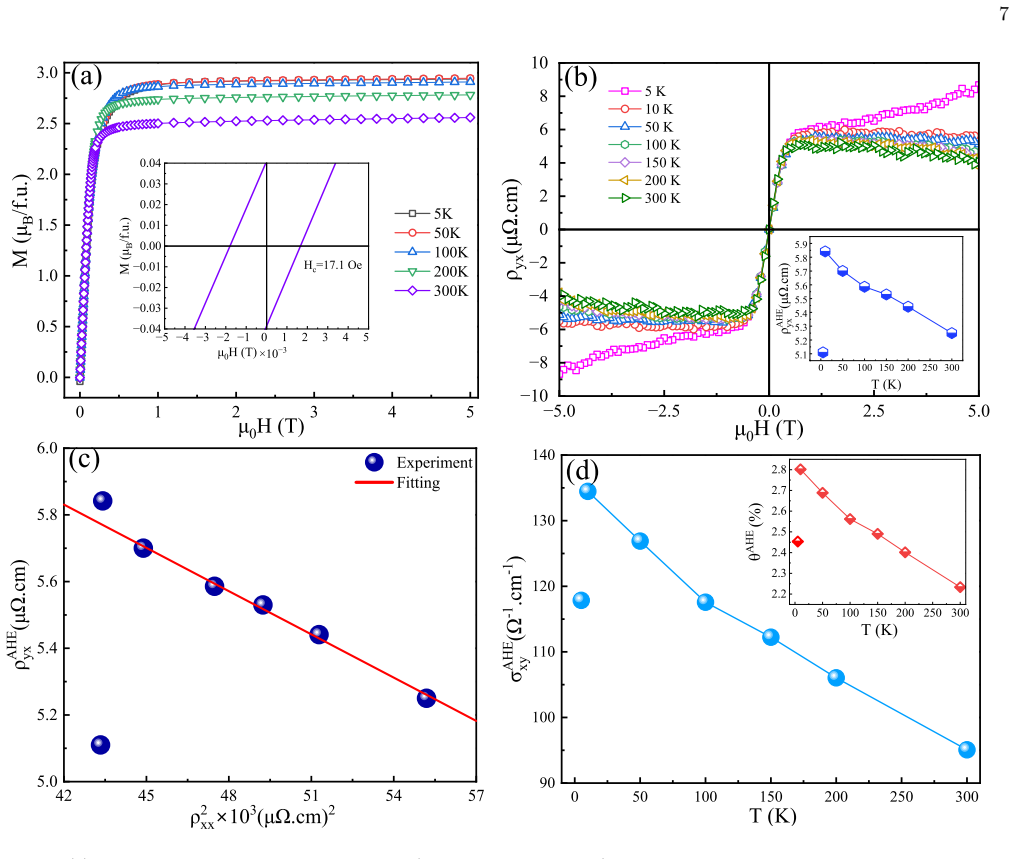
Authors: The temperature dependence of the anomalous Hall conductivity is relatively flat above ~50 K (as shown in the magnetotransport figures), which is a standard experimental signature of dominant intrinsic contribution. Combined with the quantitative match to the DFT Berry curvature value, this supports the interpretation. We agree that an explicit scaling analysis would provide a stronger experimental bound. In the revised manuscript we will add a scaling plot of AHC versus longitudinal conductivity (following established protocols) and a brief error analysis on the extracted AHC to quantify the intrinsic fraction. revision: yes
Circularity Check
No significant circularity; result from direct measurement and independent DFT
full rationale
The paper's central result is the experimentally measured anomalous Hall conductivity (~134.4 Ω^{-1} cm^{-1}) in the disordered alloy, compared directly to literature values for parent Heusler compounds. DFT Berry curvature calculations are performed separately to support the intrinsic origin claim. No step reduces a prediction to a fitted input by construction, no self-citation chain bears the load of the main claim, and no ansatz or uniqueness theorem is invoked in a self-referential manner. The derivation remains self-contained against external benchmarks.
Axiom & Free-Parameter Ledger
axioms (2)
- standard math Standard DFT band-structure calculations yield Berry curvature that can be integrated to obtain intrinsic anomalous Hall conductivity
- domain assumption Slater-Pauling rule applies to the saturation magnetization of the disordered alloy
Reference graph
Works this paper leans on
-
[1]
exchange correlation functional within the gener- alized gradient approximation (GGA). To model the Co2(Ti0.25V0.25Cr0.25Fe0.25)Al, we employed the Virtual Crystal Approximation (VCA)[ 31] as implemented in the V ASP code to describe the mixed transition-metal occupancy at the B-site. The orbital-projected elec- tronic band structures were analyzed and vi...
2000
-
[2]
Felser and A
C. Felser and A. Hirohata, Heusler alloys , Vol. 222 (Springer, 2015)
2015
-
[3]
Hirohata and D
A. Hirohata and D. C. Lloyd, MRS Bulletin 47, 593 (2022)
2022
-
[4]
Al-Douri and M
Y. Al-Douri and M. Ameri, Critical Reviews in Solid State and Materials Sciences 50, 189 (2025)
2025
-
[5]
Tavares, K
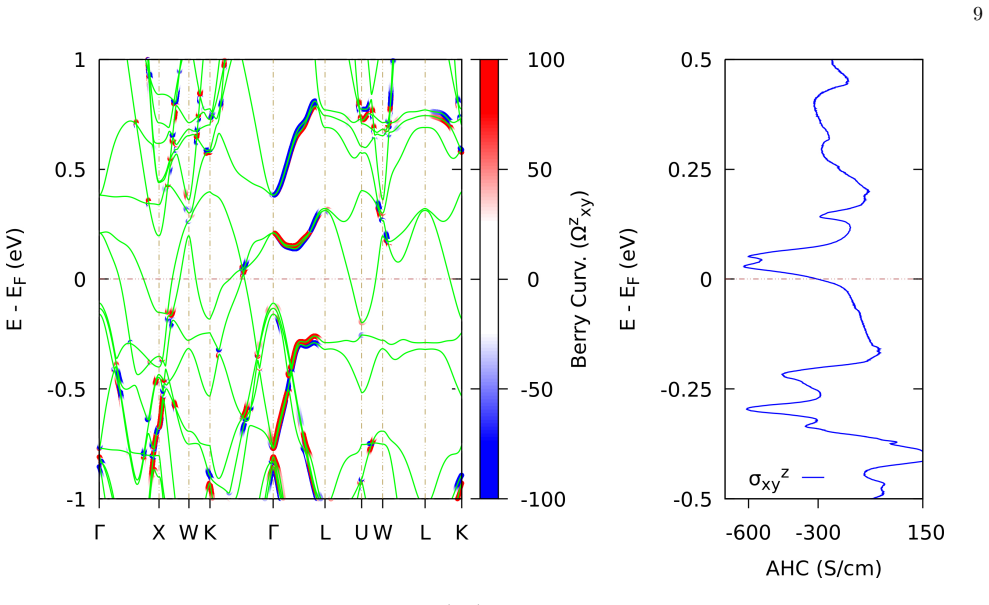
S. Tavares, K. Yang, and M. A. Meyers, Progress in Ma- terials Science 132, 101017 (2023). 9 FIG. 4. Left pannel: Band structure and Berry curvature (BC) contribution along high symmetry line of the cubic BZ in the GGA+SOC for ferro magnetic (FM) state with magnetic moment along the z-axis. Right pannel: Calculated anomalous Hall effect as a function of Fe...
2023
-
[6]
R. Chen, H. Kang, R. Min, Z. Chen, E. Guo, X. Yang, and T. Wang, International Materials Reviews 69, 83 (2024)
2024
-
[7]
R. J. Quinn and J.-W. G. Bos, Materials advances 2, 6246 (2021)
2021
-
[9]
P. Li, J. Koo, W. Ning, J. Li, L. Miao, L. Min, Y. Zhu, Y. Wang, N. Alem, C.-X. Liu, et al. , Nature communi- cations 11, 3476 (2020)
2020
-
[10]
Karplus and J
R. Karplus and J. Luttinger, Physical Review 95, 1154 (1954)
1954
-
[11]
Nagaosa, J
N. Nagaosa, J. Sinova, S. Onoda, A. H. MacDonald, and N. P. Ong, Reviews of modern physics 82, 1539 (2010)
2010
-
[12]
Onoda, N
S. Onoda, N. Sugimoto, and N. Nagaosa, Physical review letters 97, 126602 (2006)
2006
-
[13]
Sakuraba, K
Y. Sakuraba, K. Hyodo, A. Sakuma, and S. Mitani, Phys- ical Review B 101, 134407 (2020)
2020
-
[14]
Manna, L
K. Manna, L. Muechler, T.-H. Kao, R. Stin- shoff, Y. Zhang, J. Gooth, N. Kumar, G. Kreiner, K. Koepernik, R. Car, et al., Physical Review X 8, 041045 (2018)
2018
-
[16]
Yeh, S.-K
J.-W. Yeh, S.-K. Chen, S.-J. Lin, J.-Y. Gan, T.-S. Chin, T.-T. Shun, C.-H. Tsau, and S.-Y. Chang, Advanced en- gineering materials 6, 299 (2004)
2004
-
[17]
E. P. George, D. Raabe, and R. O. Ritchie, Nature re- views materials 4, 515 (2019)
2019
-
[18]
Y. Ye, Q. Wang, J. Lu, C. Liu, and Y. Yang, Materials Today 19, 349 (2016)
2016
-
[19]
Sharma, K
N. Sharma, K. Kargeti, N. Sharma, P. Chourasia, B. Vig- nolle, O. Toulemonde, T. Chakraborty, S. K. Panda, and S. Marik, Phys. Rev. B 112, 224515 (2025)
2025
-
[20]
Y. Tian, L. Ye, and X. Jin, Physical review letters 103, 087206 (2009)
2009
-
[21]
D. Hou, G. Su, Y. Tian, X. Jin, S. A. Yang, and Q. Niu, Physical review letters 114, 217203 (2015)
2015
-
[23]
G. K. Shukla, A. K. Jena, N. Shahi, K. Dubey, I. Rajput, S. Baral, K. Yadav, K. Mukherjee, A. Lakhani, K. Carva, et al. , Physical Review B 105, 035124 (2022)
2022
-
[24]
Vilanova Vidal, H
E. Vilanova Vidal, H. Schneider, and G. Jakob, Physical Review BCondensed Matter and Materials Physics 83, 174410 (2011)
2011
-
[25]
H. Luo, Y. Xin, B. Liu, F. Meng, H. Liu, E. Liu, and G. Wu, Journal of Alloys and Compounds 665, 180 (2016)
2016
-
[26]
Jangid, P
S. Jangid, P. K. Meena, R. K. Kushwaha, S. Srivastava, P. Manna, P. Mishra, S. Sharma, and R. P. Singh, Ap- plied Physics Letters 124 (2024)
2024
-
[27]
Roy Chowdhury, N
R. Roy Chowdhury, N. F. Shkodich, T. Roy, T. Smo- liarova, D. K. Le, E. Kasotakis, M. Shirai, M. Farle, M.- H. Phan, and H. Srikanth, ACS nano 19, 32967 (2025)
2025
-
[28]
Kresse and J
G. Kresse and J. Furthmüller, Physical review B 54, 11169 (1996)
1996
-
[29]
Kresse and D
G. Kresse and D. Joubert, Physical review b 59, 1758 (1999)
1999
-
[30]
P. E. Blöchl, Physical review B 50, 17953 (1994)
1994
-
[31]
J. P. Perdew, K. Burke, and M. Ernzerhof, Physical re- view letters 77, 3865 (1996). 10
1996
-
[32]
Bellaiche and D
L. Bellaiche and D. Vanderbilt, Physical Review B 61, 7877 (2000)
2000
-
[33]
A. M. Ganose, A. J. Jackson, and D. O. Scanlon, Journal of Open Source Software 3, 717 (2018)
2018
-
[34]
X. Wang, J. R. Yates, I. Souza, and D. Vanderbilt, Phys- ical Review BCondensed Matter and Materials Physics 74, 195118 (2006)
2006
-
[35]
Marzari, A
N. Marzari, A. A. Mostofi, J. R. Yates, I. Souza, and D. Vanderbilt, Reviews of Modern Physics 84, 1419 (2012)
2012
-
[36]
Souza, N
I. Souza, N. Marzari, and D. Vanderbilt, Physical Review B 65, 035109 (2001)
2001
-
[37]
A. A. Mostofi, J. R. Yates, G. Pizzi, Y.-S. Lee, I. Souza, D. Vanderbilt, and N. Marzari, Computer Physics Com- munications 185, 2309 (2014)
2014
-
[38]
Y. Yao, L. Kleinman, A. MacDonald, J. Sinova, T. Jung- wirth, D.-s. Wang, E. Wang, and Q. Niu, Physical review letters 92, 037204 (2004)
2004
-
[39]
Sharma, N
N. Sharma, N. Sharma, T. Chakraborty, and S. Marik, Materials Today Communications 44, 111968 (2025)
2025
-
[40]
Wederni, J
A. Wederni, J. Daza, W. Ben Mbarek, J. Saurina, L. Es- coda, and J.-J. Suñol, Metals 14, 688 (2024)
2024
-
[41]
Pathak, S
S. Pathak, S. Khalid, and R. Bindu, Physical Review B 112, 064207 (2025)
2025
-
[42]
Shahi, A
N. Shahi, A. K. Jena, G. K. Shukla, V. Kumar, S. Ras- togi, K. Dubey, I. Rajput, S. Baral, A. Lakhani, S.-C. Lee, et al. , Physical Review B 106, 245137 (2022)
2022
-
[43]
S. Bhowmik, S. Pakhira, A. Kundu, V. R. Reddy, M. Kabir, and C. Mazumdar, arXiv preprint arXiv:2602.00768 (2026)
arXiv 2026
-
[44]
T. Graf, G. H. Fecher, J. Barth, J. Winterlik, and C. Felser, Journal of Physics D: Applied Physics 42, 084003 (2009)
2009
-
[45]
R. P. Jena, D. Kumar, and A. Lakhani, Journal of Physics: Condensed Matter 32, 365703 (2020)
2020
-
[46]
Chatterjee, J
S. Chatterjee, J. Sau, S. Ghosh, S. Samanta, B. Ghosh, M. Kumar, and K. Mandal, Journal of Physics: Con- densed Matter 35, 035601 (2023)
2023
-
[47]
Rastogi, V
S. Rastogi, V. Kumar, A. K. Jena, N. Shahi, G. K. Shukla, S. W. DSouza, S. Bhattacharjee, and S. Singh, Journal of Alloys and Compounds 1010, 177212 (2025)
2025
-
[48]
Husmann and L
A. Husmann and L. Singh, Physical Review BCondensed Matter and Materials Physics 73, 172417 (2006)
2006
-
[49]
Kudrnovsk` y, V
J. Kudrnovsk` y, V. Drchal, and I. Turek, Physical Review BCondensed Matter and Materials Physics 88, 014422 (2013)
2013
-
[50]
Fu et al
Z. Fu et al. , Acta Materialia 107, 59 (2016)
2016
-
[51]
Wu et al
J.-M. Wu et al. , Wear 261, 513 (2006)
2006
-
[52]
Zheng et al
H. Zheng et al. , Materials 12, 3718 (2019)
2019
-
[53]
Kumar and P
A. Kumar and P. Srivastava, Materials Science-Poland 37, 116 (2019)
2019
-
[54]
Yamashita and P
T. Yamashita and P. Hayes, Applied Surface Science 254, 2441 (2008)
2008
-
[55]
M. C. Biesinger, L. W. Lau, A. R. Gerson, and R. S. C. Smart, Applied surface science 257, 887 (2010)
2010
-
[56]
M. C. Biesinger, B. P. Payne, A. P. Grosvenor, L. W. M. Lau, A. R. Gerson, and R. S. C. Smart, Applied Surface Science 257, 2717 (2011)
2011
-
[57]
J. F. Moulder, W. F. Stickle, P. E. Sobol, and K. D. Bomben, Handbook of X-ray Photoelectron Spectroscopy (Perkin-Elmer Corporation, Minnesota, USA, 1992)
1992
-
[58]
J. E. Whitten, Applied Surface Science Advances 13, 100384 (2023)
2023
-
[59]
Hüfner, Photoelectron spectroscopy: principles and ap- plications (Springer Science & Business Media, 2013)
S. Hüfner, Photoelectron spectroscopy: principles and ap- plications (Springer Science & Business Media, 2013)
2013
-
[60]
Egilmez and W
M. Egilmez and W. Abuzaid, Scientific Reports 11, 8048 (2021)
2021
-
[61]
Motla, Arushi, S
K. Motla, Arushi, S. Jangid, P. Meena, R. Kushwaha, and R. Singh, Superconductor Science and Technology 36, 115024 (2023)
2023
-
[62]
Grimvall, Physica Scripta 14, 63 (1976)
G. Grimvall, Physica Scripta 14, 63 (1976)
1976
-
[63]
L. Wu, K. Zhu, D. Yue, Y. Tian, and X. Jin, Physical Review B 93, 214418 (2016)
2016
-
[64]
Nozières and C
P. Nozières and C. Lewiner, Journal de Physique 34, 901 (1973)
1973
discussion (0)
Sign in with ORCID, Apple, or X to comment. Anyone can read and Pith papers without signing in.