VT-DUDA: Visual Token Conditioning for Diffusion-guided Unsupervised Domain Adaptation
Pith reviewed 2026-06-26 14:23 UTC · model grok-4.3
The pith
Concatenating source-image visual tokens with text embeddings in a diffusion model improves target-domain accuracy for unsupervised domain adaptation.
A machine-rendered reading of the paper's core claim, the machinery that carries it, and where it could break.
Core claim
VT-DUDA demonstrates that forming a hybrid conditioning context by concatenating source-derived visual tokens with corresponding text embeddings along the cross-attention context dimension enables instance-dependent guidance for target-style image synthesis in latent diffusion models, resulting in synthetic data that improves downstream target-domain classification accuracy under unsupervised domain adaptation.
What carries the argument
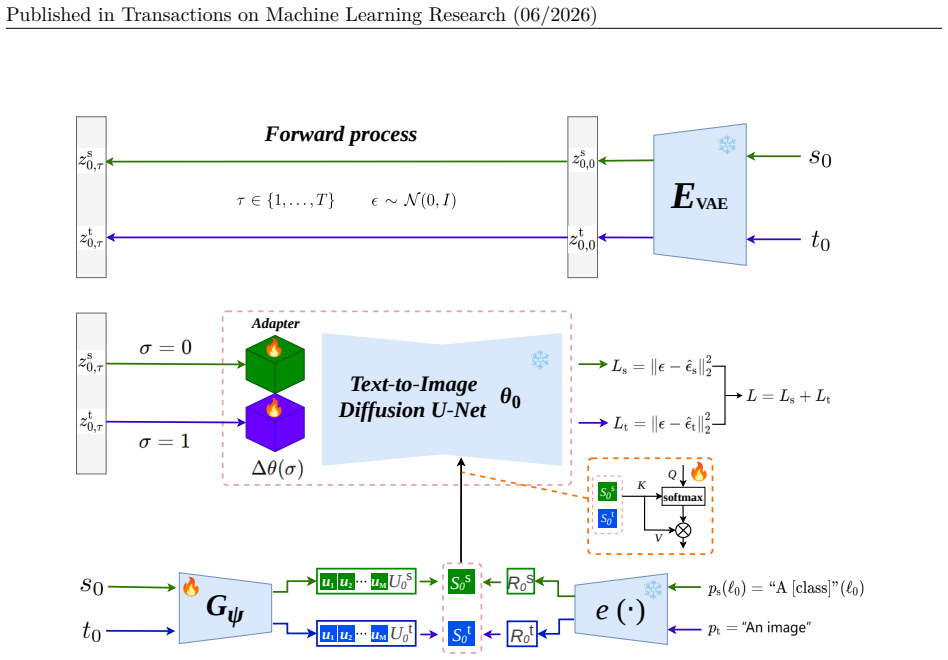
Hybrid conditioning context created by concatenating a compact sequence of visual tokens from source images with text embeddings for cross-attention in a latent diffusion model with target-domain adapter.
If this is right
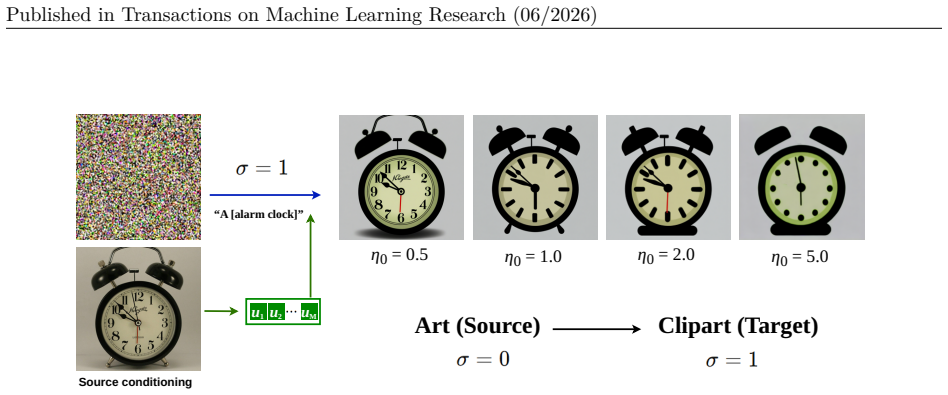
- The same token-sequence interface allows inference-time manipulation through token selection and strength adjustment.
- Synthesis with the target-domain adapter branch produces images that better support classifier training.
- The method can be added to existing adapter-based diffusion frameworks without modifying the backbone.
- Preserving the standard diffusion objective maintains compatibility with pre-trained models.
Where Pith is reading between the lines
- Token-based conditioning might allow similar gains in other conditional generation tasks beyond UDA.
- Explicit token representation could facilitate debugging or analysis of what information drives the generated image style.
- Adjusting token strength at inference could provide a way to balance source instance fidelity against target domain appearance.
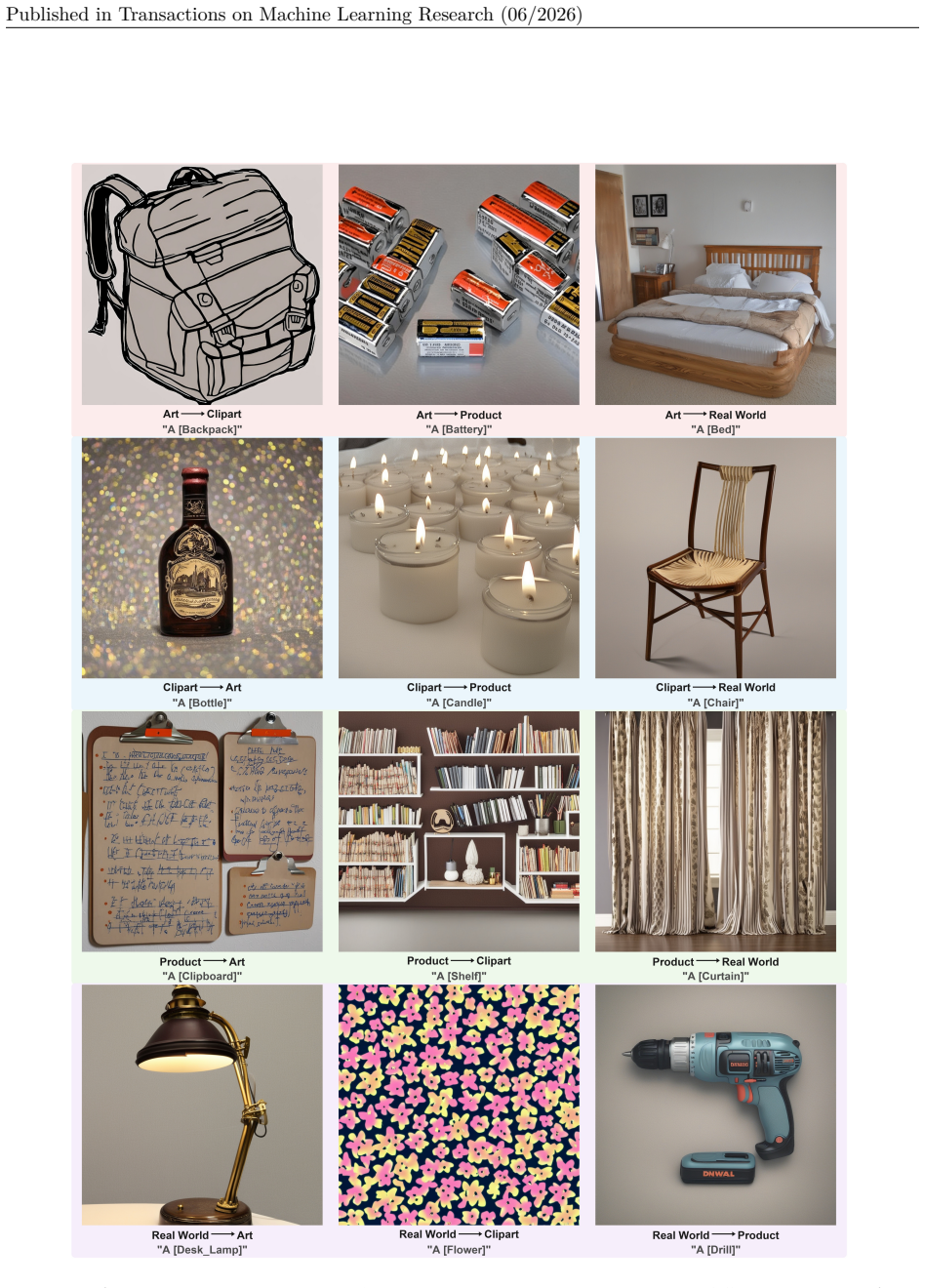
Load-bearing premise
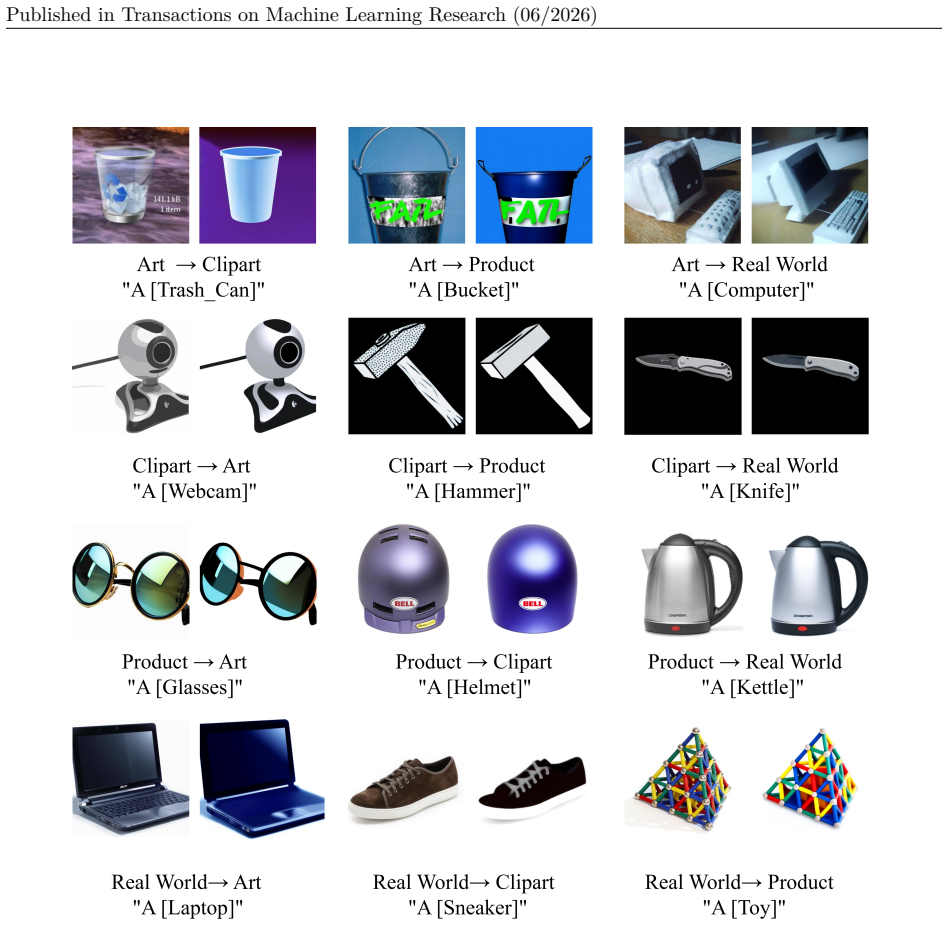
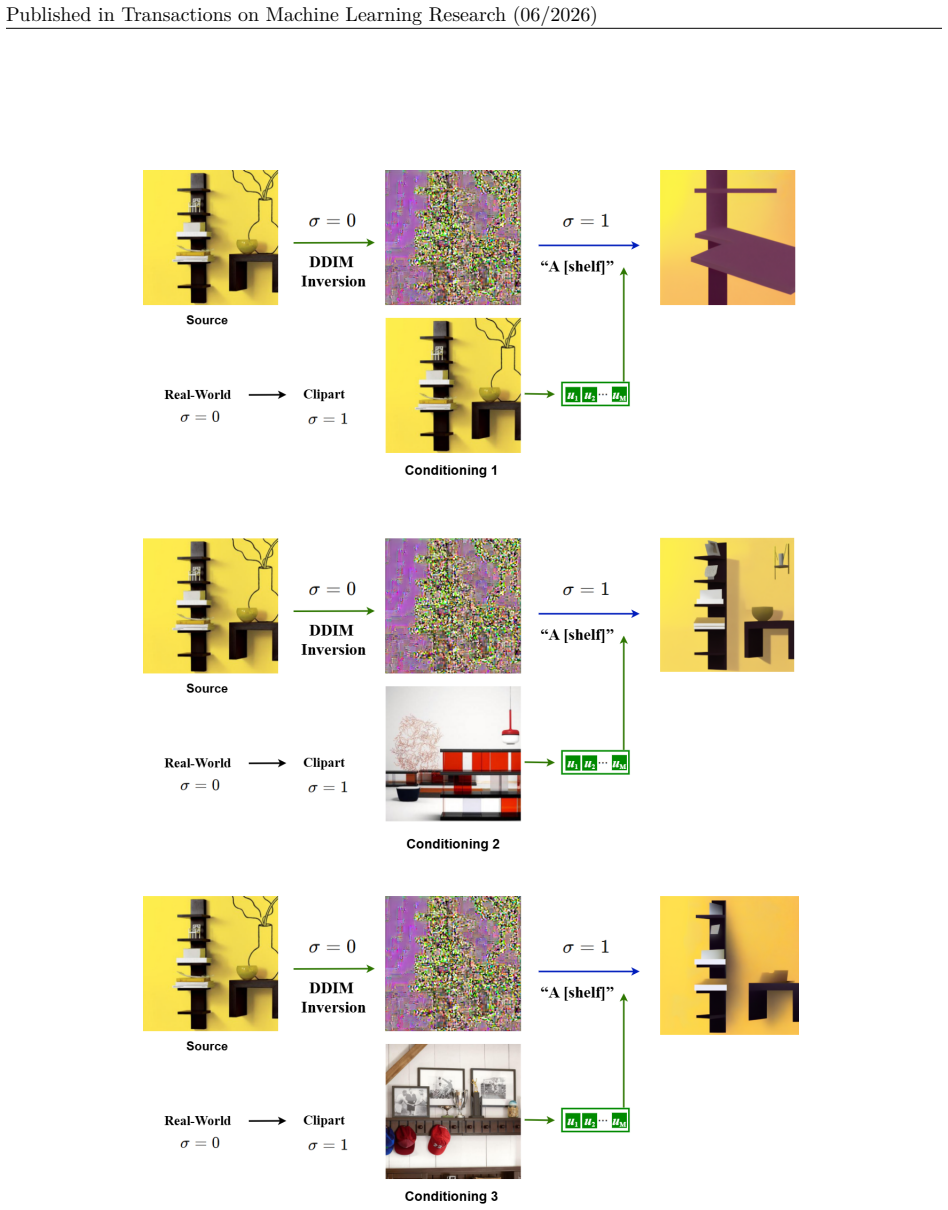
Source-derived visual tokens supply instance-level context that adds to and remains compatible with text embeddings inside the diffusion cross-attention to produce higher-quality target-style images.
What would settle it
A direct comparison showing that target accuracy with visual-token conditioning equals or falls below text-only conditioning on the same benchmarks would falsify the benefit of the hybrid approach.
Figures
read the original abstract
Unsupervised domain adaptation (UDA) aims to learn a target-domain classifier from labeled source data and unlabeled target data under distribution shift. Recent diffusion-based UDA methods approach this problem by synthesizing labeled target-style images and training on the resulting synthetic data. However, their performance depends heavily on the conditioning design: class prompts provide only coarse guidance, while domain adaptation modules mainly control appearance, which may leave target-style synthesis insufficiently specified. We propose VT-DUDA, a visual-token conditioning framework for diffusion-guided UDA. Instead of relying only on text prompts, VT-DUDA uses source images to provide additional instance-level visual context for target-style synthesis. Specifically, VT-DUDA maps each source image to a compact sequence of visual tokens and forms a hybrid conditioning context by concatenating these tokens with the corresponding text embeddings along the cross-attention context dimension of a latent diffusion model. This provides instance-dependent conditioning beyond text alone, while synthesis is performed with the target-domain adapter branch. Because guidance is represented explicitly as a token sequence, the same interface also permits inference-time manipulation of the conditioning signal through token selection and token-strength adjustment. The proposed method preserves the standard diffusion objective and can be integrated into existing adapter-based diffusion frameworks without modifying the backbone. Across Office-31, Office-Home, and VisDA-2017, VT-DUDA improves average target-domain accuracy over strong discriminative and diffusion-based UDA baselines. The results suggest that, in generation-based UDA, a stronger conditioning interface can improve the downstream usefulness of synthetic target-style data.
Editorial analysis
A structured set of objections, weighed in public.
Referee Report
Summary. The manuscript proposes VT-DUDA, a visual-token conditioning method for diffusion-guided unsupervised domain adaptation. Source images are mapped to compact visual token sequences that are concatenated with class text embeddings along the cross-attention context dimension of a latent diffusion model; synthesis proceeds with an existing target-domain adapter branch. The hybrid conditioning is claimed to supply instance-level context beyond text prompts or adapter modules alone, while preserving the standard diffusion objective and permitting inference-time token manipulation. The paper reports that this yields higher average target-domain accuracy than strong discriminative and diffusion-based UDA baselines on Office-31, Office-Home, and VisDA-2017.
Significance. If the reported accuracy gains prove robust and attributable to the visual-token interface, the work would establish that explicit instance-level visual conditioning can improve the downstream utility of synthetic target-style data in generation-based UDA without backbone changes. This would be a concrete, testable advance in conditioning design for diffusion UDA pipelines and could generalize to other adapter-based generative adaptation settings.
major comments (2)
- [Abstract] Abstract: the central claim that VT-DUDA 'improves average target-domain accuracy over strong discriminative and diffusion-based UDA baselines' is asserted without any numerical values, error bars, number of runs, or exclusion criteria. This absence makes it impossible to judge whether the gains are statistically reliable or sensitive to post-hoc choices, directly undermining evaluation of the method's contribution.
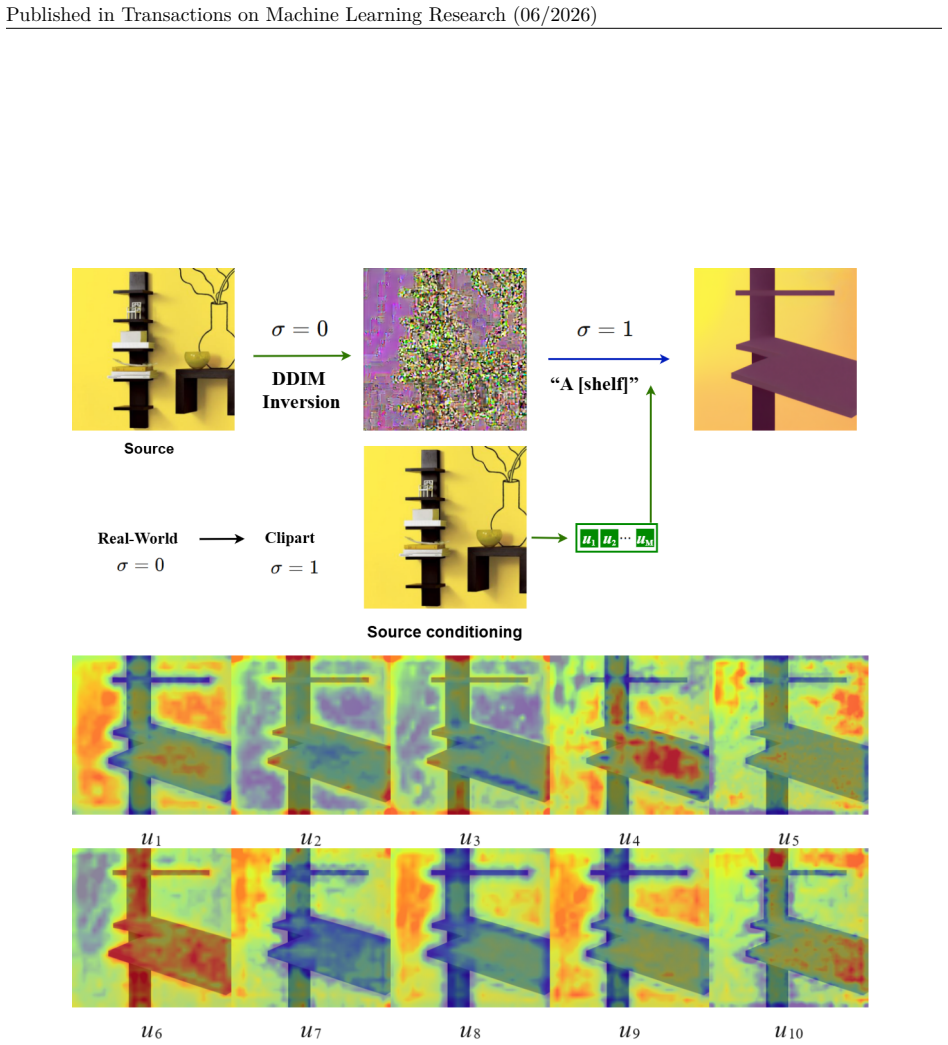
- [Method] Method description (hybrid conditioning paragraph): the claim that source-derived visual tokens supply 'instance-dependent conditioning beyond text alone' that remains additive and compatible with the target adapter under domain shift is presented without any attention-map analysis, ablation isolating the token contribution, or derivation showing why the tokens are not ignored or redundant once the adapter already controls appearance. This is the load-bearing assumption for attributing downstream accuracy gains to the visual-token interface.
Simulated Author's Rebuttal
We thank the referee for the detailed comments. We address each major point below and indicate planned revisions to strengthen the manuscript.
read point-by-point responses
-
Referee: [Abstract] Abstract: the central claim that VT-DUDA 'improves average target-domain accuracy over strong discriminative and diffusion-based UDA baselines' is asserted without any numerical values, error bars, number of runs, or exclusion criteria. This absence makes it impossible to judge whether the gains are statistically reliable or sensitive to post-hoc choices, directly undermining evaluation of the method's contribution.
Authors: We agree that the abstract would benefit from quantitative anchors. The detailed per-dataset accuracies, standard deviations across three random seeds, and run counts are reported in Tables 1–3 and the experimental protocol section. We will revise the abstract to state the average improvement (e.g., “+2.8% on Office-31, +1.9% on Office-Home, +3.1% on VisDA-2017”) while respecting length limits. revision: yes
-
Referee: [Method] Method description (hybrid conditioning paragraph): the claim that source-derived visual tokens supply 'instance-dependent conditioning beyond text alone' that remains additive and compatible with the target adapter under domain shift is presented without any attention-map analysis, ablation isolating the token contribution, or derivation showing why the tokens are not ignored or redundant once the adapter already controls appearance. This is the load-bearing assumption for attributing downstream accuracy gains to the visual-token interface.
Authors: Ablation results isolating the visual-token contribution (text-only vs. hybrid conditioning) appear in Section 4.3 and the supplementary material, showing consistent gains of 1.5–3.2 points when tokens are added. Attention-map visualizations in the supplement confirm that cross-attention heads allocate measurable weight to the visual-token positions. The adapter operates at the domain level while tokens inject instance-specific source content; removing tokens degrades class fidelity under shift, as quantified in the same ablations. We will add a short paragraph in the method section deriving the concatenation along the context dimension and explicitly cross-reference the ablations. revision: yes
Circularity Check
No circularity: empirical method addition with independent benchmark results
full rationale
The paper introduces VT-DUDA as an empirical extension to existing diffusion-based UDA pipelines by concatenating source visual tokens with text embeddings for cross-attention conditioning. No equations, fitted parameters, or self-citations are invoked to derive the reported accuracy gains; the central claim rests on comparative experiments across Office-31, Office-Home, and VisDA-2017 against discriminative and diffusion baselines. The method is presented as preserving the standard diffusion objective and integrating without backbone changes, making the performance improvements falsifiable via external replication rather than forced by definition or prior self-work. This is the standard case of a self-contained empirical contribution.
Axiom & Free-Parameter Ledger
invented entities (1)
-
visual token sequence
no independent evidence
Reference graph
Works this paper leans on
-
[1]
Prompt-to-Prompt Image Editing with Cross Attention Control
Amir Hertz, Ron Mokady, Jay Tenenbaum, Kfir Aberman, Yael Pritch, and Daniel Cohen-Or. Prompt-to- prompt image editing with cross attention control.arXiv preprint arXiv:2208.01626,
work page internal anchor Pith review Pith/arXiv arXiv
-
[2]
Classifier-Free Diffusion Guidance
Jonathan Ho and Tim Salimans. Classifier-free diffusion guidance.arXiv preprint arXiv:2207.12598,
work page internal anchor Pith review Pith/arXiv arXiv
-
[3]
Auto-Encoding Variational Bayes
Diederik P Kingma and Max Welling. Auto-encoding variational bayes.arXiv preprint arXiv:1312.6114,
work page internal anchor Pith review Pith/arXiv arXiv
-
[4]
Kumari, B
14 Published in Transactions on Machine Learning Research (06/2026) N. Kumari, B. Zhang, R. Zhang, E. Shechtman, and J.-Y. Zhu. Multi-concept customization of text-to-image diffusion. InProceedings of the IEEE/CVF Conference on Computer Vision and Pattern Recognition, pp. 1931–1941,
2026
-
[5]
SDEdit: Guided Image Synthesis and Editing with Stochastic Differential Equations
Chenlin Meng, Yutong He, Yang Song, Jiaming Song, Jiajun Wu, Jun-Yan Zhu, and Stefano Ermon. Sdedit: Guidedimagesynthesisandeditingwithstochasticdifferentialequations.arXiv preprint arXiv:2108.01073,
work page internal anchor Pith review Pith/arXiv arXiv
-
[6]
X. Peng, B. Usman, N. Kaushik, J. Hoffman, D. Wang, and K. Saenko. Visda: The visual domain adaptation challenge.arXiv preprint arXiv:1710.06924,
work page internal anchor Pith review Pith/arXiv arXiv
-
[7]
Denoising Diffusion Implicit Models
Jiaming Song, Chenlin Meng, and Stefano Ermon. Denoising diffusion implicit models.arXiv preprint arXiv:2010.02502, 2020a. 15 Published in Transactions on Machine Learning Research (06/2026) Yang Song and Stefano Ermon. Improved techniques for training score-based generative models.Advances in neural information processing systems, 33:12438–12448,
work page internal anchor Pith review Pith/arXiv arXiv 2010
-
[8]
Score-Based Generative Modeling through Stochastic Differential Equations
Yang Song, Jascha Sohl-Dickstein, Diederik P Kingma, Abhishek Kumar, Stefano Ermon, and Ben Poole. Score-based generative modeling through stochastic differential equations.arXiv preprint arXiv:2011.13456, 2020b. V. Vapnik.The nature of statistical learning theory. Springer science & business media,
work page internal anchor Pith review Pith/arXiv arXiv 2011
-
[9]
IP-Adapter: Text Compatible Image Prompt Adapter for Text-to-Image Diffusion Models
Hu Ye, Jun Zhang, Sibo Liu, Xiao Han, and Wei Yang. Ip-adapter: Text compatible image prompt adapter for text-to-image diffusion models.arXiv preprint arXiv:2308.06721,
work page internal anchor Pith review Pith/arXiv arXiv
-
[10]
16 Published in Transactions on Machine Learning Research (06/2026) A Appendix A.1 Implementation Details We instantiate VT-DUDA on top of Stable Diffusion XL (SDXL) Podell et al. (2024). We use the SDXL VAE, keep the VAE frozen throughout training, and use the same VAE encoderEVAE and decoderD VAE as defined in Sec. 3.2. In the implementation, the standa...
2026
-
[11]
equation 5 are implemented as effective low-rank updates Zhuang et al
The branch-dependent updates in Eq. equation 5 are implemented as effective low-rank updates Zhuang et al. (2024) rather than as two independent LoRA modules. Specifically, for an adaptable weight matrixW0∈Rm×n, we use ∆W (σ)=W up ( I+σΩlora )⊤ Wdown, σ∈{0,1},(23) whereW up∈Rm×r,W down∈Rr×n,I∈Rr×r, andΩ lora∈Rr×ris a trainable target-activated modulation ...
2024
-
[12]
Given a promptp, each text encoder outputs a token sequence, and we use the penultimate hidden state from each encoder
Text conditioning is obtained from the two frozen SDXL text encoders. Given a promptp, each text encoder outputs a token sequence, and we use the penultimate hidden state from each encoder. These two token sequences are concatenated along the channel dimension to form the token-wise text embedding R=e(p)∈RMp×dc. Visual tokens are appended only to this cro...
2026
-
[13]
After cropping, each image is converted to a tensor and normalized channel-wise to[−1,1]using mean (0.5,0.5,0.5)and standard deviation(0.5,0.5,0.5)
Data preprocessing.All training images are first corrected with EXIF transpose, converted to RGB if necessary, resized to1024×1024using bilinear interpolation, and then randomly cropped to1024×1024. After cropping, each image is converted to a tensor and normalized channel-wise to[−1,1]using mean (0.5,0.5,0.5)and standard deviation(0.5,0.5,0.5). No horizo...
2026
-
[14]
Inversion-free protocol.The inversion-free protocol uses only the pure-noise route
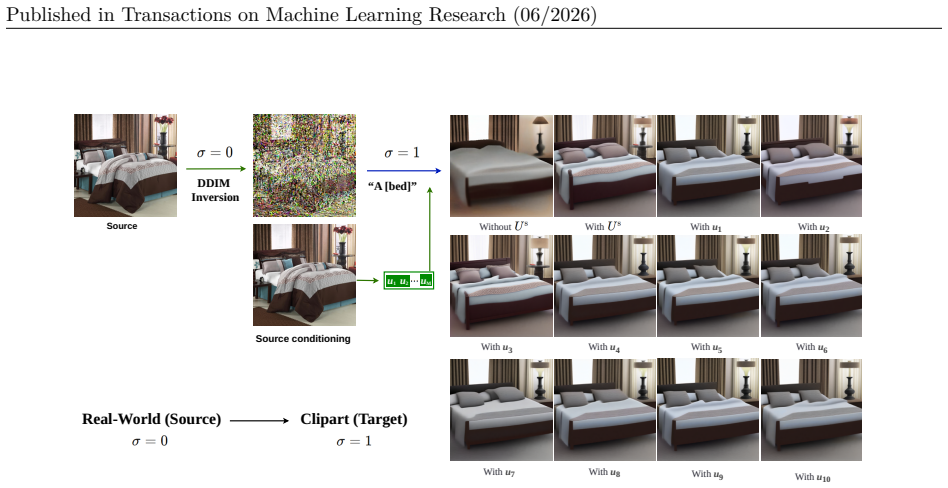
VT-DUDA constructs synthetic target-style training data using two routes: (i) inversion-free pure-noise synthesis and (ii) DDIM-inversion-based target-style translation. Inversion-free protocol.The inversion-free protocol uses only the pure-noise route. Unless otherwise stated, this protocol generates 50 images per class on Office-31 and Office-Home, and ...
2017
-
[15]
and then translated under the target branch(σ= 1)on the same reduced timestep schedule. A.2.3 Downstream training and evaluation After synthetic-data construction, we train a downstream target classifier on the resulting synthetic target- style dataset, optionally together with an unsupervised target regularizer, as described in the main paper. We instant...
2026
-
[16]
The endpointτ0 = 0is introduced as a notational boundary for the clean latent state, and its treatment follows the boundary convention of the chosen DDIM scheduler
The diffusion model is trained with timesteps sampled from{1,...,T}. The endpointτ0 = 0is introduced as a notational boundary for the clean latent state, and its treatment follows the boundary convention of the chosen DDIM scheduler. At inversion step k, given the current latentzinv τk−1, we predict ˆϵs k =ϵθ0+∆θ ( zinv τk−1,τk−1,S s i,σ= 0 ) ,(30) estima...
2026
-
[17]
In particular, DCDM Zhang et al
For transparency, we report standard deviations only for methods for which three-run records were available in our experimental logs. In particular, DCDM Zhang et al. (2025) is not included in this subsection because only the published mean accuracies were available to us. A.4 Additional Ablation Studies To expand the pure-noise results summarized in Tabl...
-
[18]
Figure5summarizesrepresentativepure- noise synthesis results on Office-Home
In this setting, a labeled source image provides both the class prompt and the corresponding visual-token conditioning, and the target-style sample issynthesizedfromGaussiannoiseunderthetargetbranch(σ= 1). Figure5summarizesrepresentativepure- noise synthesis results on Office-Home. The figure contains all twelve transfer tasks, with one representative cla...
-
[19]
Figure 7 shows representative results on Office-Home for all twelve transfer tasks, again using one representative class per transfer direction
In this setting, a labeled source image is first inverted under the source branch(σ= 0), and is then translated to the target style under the target branch(σ= 1)using the same class prompt together with the visual tokens extracted from the source image. Figure 7 shows representative results on Office-Home for all twelve transfer tasks, again using one rep...
2026
-
[20]
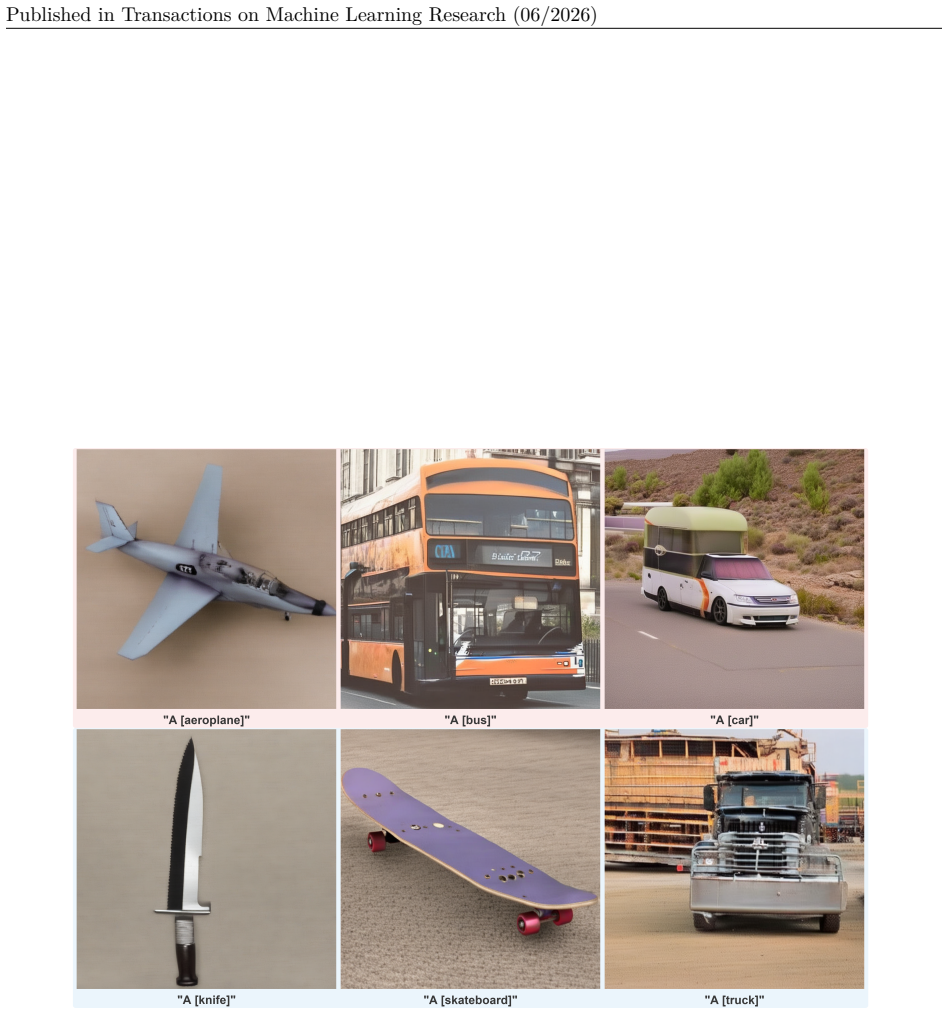
27 Published in Transactions on Machine Learning Research (06/2026) Figure 6: Additional qualitative results for pure-noise target-style synthesis on VisDA-2017 using Algo- rithm
2026
-
[21]
28 Published in Transactions on Machine Learning Research (06/2026) Figure 7: Additional qualitative results for DDIM-inversion-based target-style translation on Office-Home using Algorithm
2026
-
[22]
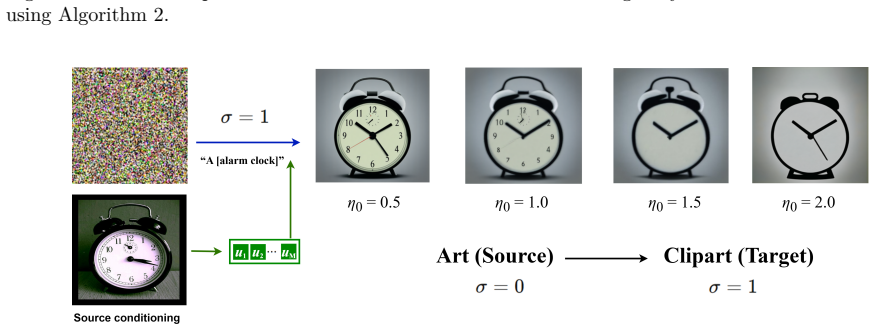
A [CLASS]
Figure 8: Token-strength scaling for synthesis (Art→Clipart). We extract visual tokens from a class-matched source image and generate target-style samples under the target conditionσ=1, while varying the token strengthη0∈{0.5,1.0,1.5,2.0}. 29 Published in Transactions on Machine Learning Research (06/2026) A.6 Comparison with the SDXL Prior To further cla...
2026
-
[23]
As the SDXL-prior baselines become stronger, the average UDA ac- curacy increases from69.92%forSDXL (random)to73.99%forSDXL (selected). Our method achieves 76.74%average accuracy, which is+2.75points higher than the strongest SDXL-prior baseline. In addition, ELS+VT-DUDA obtains the best result on 10 out of 12 transfer tasks. These results show that the p...
discussion (0)
Sign in with ORCID, Apple, or X to comment. Anyone can read and Pith papers without signing in.