Property-Specific Molecular Representations via Feature-Space Transfer Compression
Pith reviewed 2026-06-26 12:57 UTC · model grok-4.3
The pith
Property-specific adaptation compresses molecular representations by a median 72% while retaining accuracy.
A machine-rendered reading of the paper's core claim, the machinery that carries it, and where it could break.
Core claim
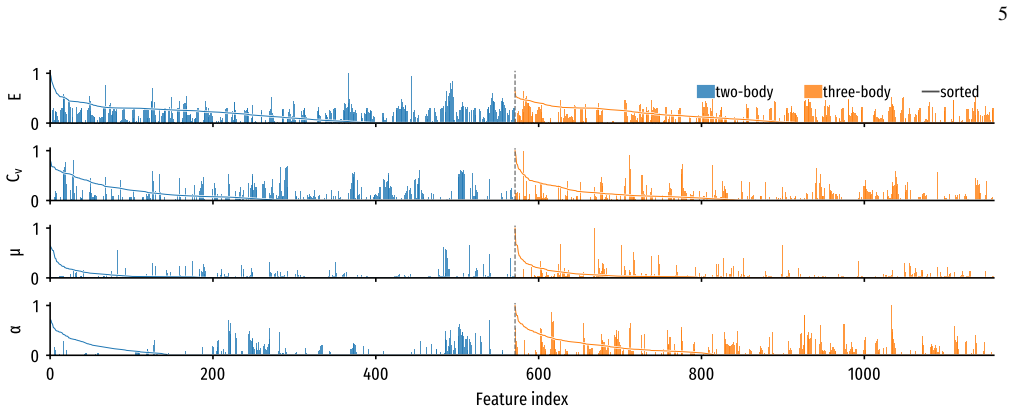
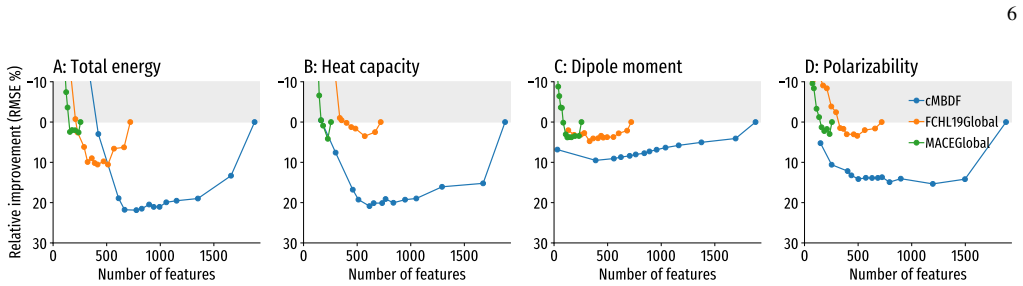
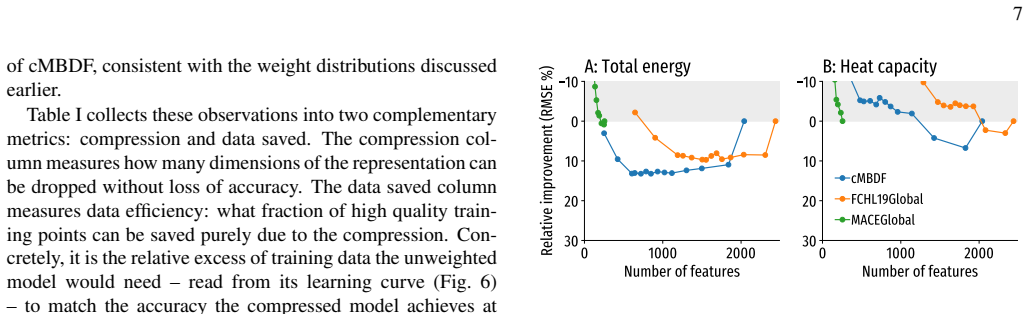
By transferring feature importance rankings derived from semi-empirical data, the authors compress high-dimensional molecular representations into property-specific subsets. This compression reduces the median number of dimensions by 72% across cases while preserving model accuracy on four physical properties. Alternatively, the approach can be tuned to achieve equivalent accuracy with substantially less training data for certain properties like the dipole moment.
What carries the argument
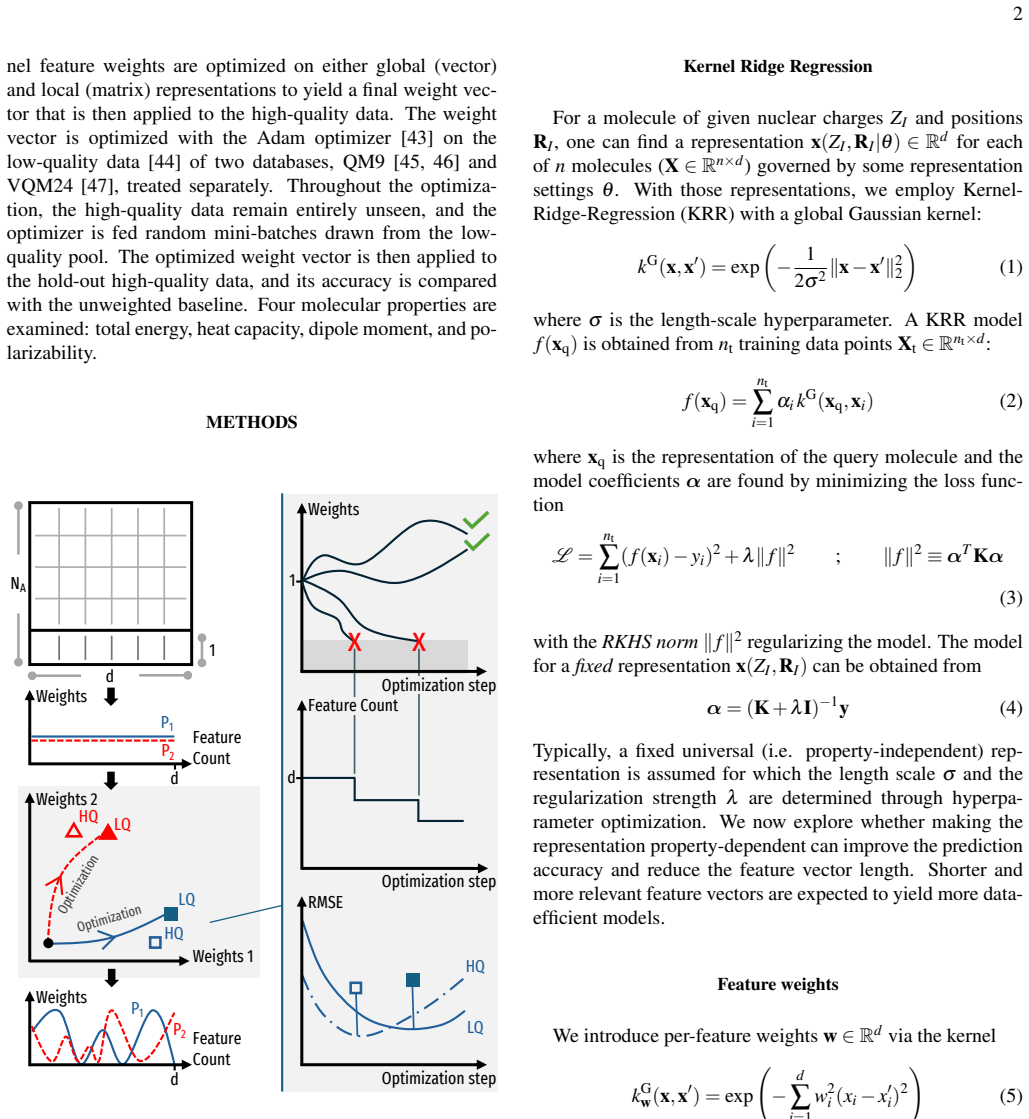
Feature-space transfer compression, which uses feature importance from low-cost surrogate calculations to select and re-weight features in a representation for a specific target property.
Load-bearing premise
The feature importance rankings obtained from semi-empirical calculations transfer effectively to models trained on higher-quality data for the same properties.
What would settle it
A calculation showing that models trained on the selected features lose significant accuracy compared to the full representation when using high-quality reference data would falsify the central claim.
Figures
read the original abstract
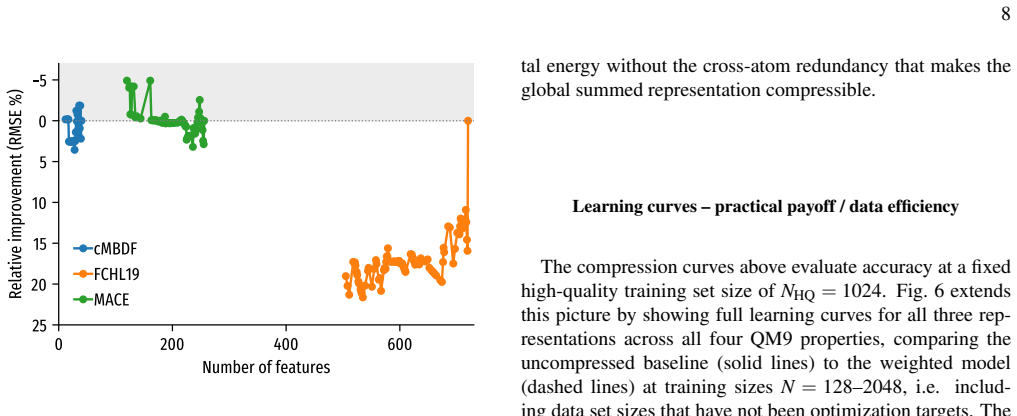
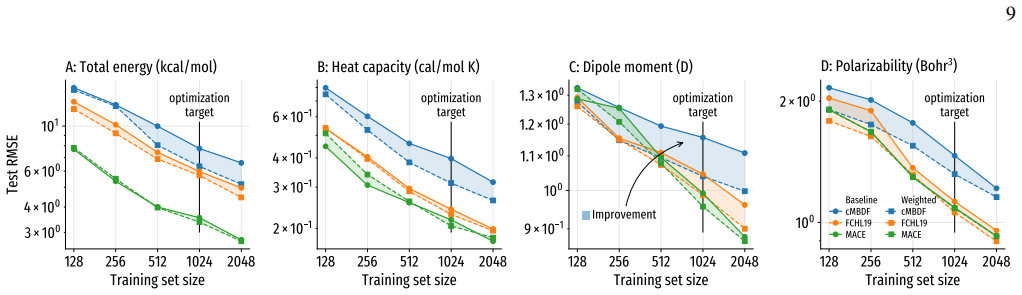
In many machine learning applications, molecules need to be transformed into representations, i.e. mathematical objects. Those representations are typically considered to be property-agnostic and as such are expected to be over-complete: for different physical properties, different parts or the representation may be relevant. In this work, we propose a method to sub-select and re-weight the representation by adapting it to the property in question. We find that in most cases this makes representations shorter and more accurate at the same time. The feature selection itself uses cheap semi-empirical data instead of high-quality labels. We study four properties (total energy, heat capacity, dipole moment, and polarizability) for three representations (cMBDF, FCHL19, and MACE-MP-0 descriptors) on two datasets (QM9 and VQM24). We can reduce the number of dimensions of a representation in the median by 72\,\% (range 36-98\,\%) while retaining the accuracy. Tuning for accuracy instead we can increase the learning efficiency for dipole moments such that the same accuracy can be reached with 19\,\% of the training data. Our approach yields data-driven interpretations of feature importance, lossless compact representations, and increased data efficiency, requiring only expendable surrogate data.
Editorial analysis
A structured set of objections, weighed in public.
Referee Report
Summary. The manuscript proposes a feature-space transfer compression method that derives property-specific feature rankings and re-weightings from models trained on inexpensive semi-empirical labels (e.g., PM6), then applies the resulting reduced and re-weighted representation to train models on higher-quality reference data for four properties (total energy, heat capacity, dipole moment, polarizability) using three representations (cMBDF, FCHL19, MACE-MP-0) on QM9 and VQM24. It reports a median 72% (range 36-98%) dimensionality reduction while retaining accuracy, and, when tuned for accuracy, a data-efficiency gain allowing equivalent dipole accuracy with 19% of the training set.
Significance. If the transfer of feature relevance holds, the approach supplies a practical route to compact, property-adapted representations that improve both model size and sample efficiency while requiring only surrogate data for the selection step; the data-driven feature-importance interpretations are an additional asset.
major comments (3)
- [§3, §4.2] §3 (Method) and §4.2 (Results on transfer): the central claim that semi-empirical-derived feature rankings transfer to high-quality labels without substantial loss is load-bearing yet supported only by end-to-end performance numbers; no direct comparison of feature rankings or selected subsets between semi-empirical and DFT/wavefunction models is presented, leaving the skeptic's concern about systematic differences in charge distribution and response properties unaddressed.
- [Table 2, Figure 4] Table 2 and Figure 4 (dipole learning curves): the reported 19% data-efficiency gain for dipoles is stated without error bars on the learning curves or statistical tests comparing the compressed vs. full representation at matched training-set sizes; it is therefore unclear whether the gain is robust across random seeds or dataset splits.
- [§4.1] §4.1 (Compression results): the median 72% reduction is aggregated across properties and representations, but the per-property/per-representation tables show that for polarizability on VQM24 the retained accuracy sometimes drops below the full-representation baseline; this variability should be quantified with confidence intervals before claiming uniform retention.
minor comments (2)
- [Abstract, §4] The abstract states quantitative outcomes but the main text should explicitly define the accuracy metric (e.g., MAE or RMSE) and the exact protocol for “retaining the accuracy” in the first paragraph of §4.
- [§3.1] Notation for the re-weighting vector w and the selection mask S is introduced without a compact equation; adding a single displayed equation in §3.1 would improve clarity.
Simulated Author's Rebuttal
We thank the referee for the constructive and detailed comments. We agree that additional analyses would strengthen the manuscript and commit to revisions that directly address the concerns about evidence for transfer, statistical robustness, and variability quantification.
read point-by-point responses
-
Referee: [§3, §4.2] the central claim that semi-empirical-derived feature rankings transfer to high-quality labels without substantial loss is load-bearing yet supported only by end-to-end performance numbers; no direct comparison of feature rankings or selected subsets between semi-empirical and DFT/wavefunction models is presented
Authors: We agree this is a valid point and that direct evidence of ranking transfer would address potential concerns about systematic differences in properties like charge distributions. While end-to-end accuracy retention demonstrates practical utility, we will add a supplementary analysis comparing feature rankings (e.g., overlap of top-k features and rank correlations) between PM6 and reference models for representative cases (energy on QM9 with cMBDF, dipole on VQM24 with FCHL19). revision: yes
-
Referee: [Table 2, Figure 4] the reported 19% data-efficiency gain for dipoles is stated without error bars on the learning curves or statistical tests comparing the compressed vs. full representation at matched training-set sizes
Authors: We acknowledge the omission of error bars and statistical validation. In the revised manuscript we will recompute the learning curves with multiple random seeds (reporting mean ± std), add shaded error bands to Figure 4, and include paired statistical tests (e.g., Wilcoxon or t-tests) at matched training-set sizes to establish robustness of the 19% efficiency gain. revision: yes
-
Referee: [§4.1] the median 72% reduction is aggregated across properties and representations, but the per-property/per-representation tables show that for polarizability on VQM24 the retained accuracy sometimes drops below the full-representation baseline; this variability should be quantified with confidence intervals
Authors: We agree that variability exists and that confidence intervals are needed before claiming uniform retention. We will add bootstrap or cross-validation confidence intervals to all accuracy metrics in §4.1 and Table 2, explicitly note the polarizability/VQM24 cases where compressed accuracy is within or slightly below baseline, and revise the abstract/§4.1 wording from 'retaining the accuracy' to 'retaining accuracy within statistical uncertainty in the large majority of cases'. revision: partial
Circularity Check
No circularity: feature selection uses external surrogate data
full rationale
The paper's method selects and re-weights features using semi-empirical calculations as surrogate data, then applies the reduced representation to high-quality reference labels for properties like dipole moment. No equations, procedures, or self-citations in the abstract or described approach reduce the reported compression (median 72%) or data-efficiency gains to quantities defined by the same fitted parameters or by construction. The central transfer step relies on an external assumption about feature importance transferability rather than any self-definitional loop, fitted-input prediction, or load-bearing self-citation chain. The derivation remains self-contained against external benchmarks.
Axiom & Free-Parameter Ledger
Reference graph
Works this paper leans on
-
[1]
O. A. von Lilienfeld, Quantum machine learning in chemi- cal compound space, Angewandte Chemie International Edition 57, 4164 (2018)
2018
-
[2]
O. A. V on Lilienfeld, K.-R. Müller, and A. Tkatchenko, Explor- ing chemical compound space with quantum-based machine 10 learning, Nature Reviews Chemistry4, 347 (2020)
2020
-
[3]
Behler, Four generations of high-dimensional neural network potentials, Chemical Reviews121, 10037 (2021)
J. Behler, Four generations of high-dimensional neural network potentials, Chemical Reviews121, 10037 (2021)
2021
-
[4]
O. T. Unke, S. Chmiela, H. E. Sauceda, M. Gastegger, I. Poltavsky, K. T. Schütt, A. Tkatchenko, and K.-R. Müller, Machine Learning Force Fields, Chemical Reviews121, 10142 (2021)
2021
-
[5]
Montavon, M
G. Montavon, M. Rupp, V . Gobre, A. Vazquez-Mayagoitia, K. Hansen, A. Tkatchenko, K.-R. Müller, and O. A. von Lilien- feld, Machine learning of molecular electronic properties in chemical compound space, New Journal of Physics15, 095003 (2013)
2013
-
[6]
A. Stuke, M. Todorovi´c, M. Rupp, C. Kunkel, K. Ghosh, L. Hi- manen, and P. Rinke, Chemical diversity in molecular orbital energy predictions with kernel ridge regression, The Journal of Chemical Physics150, 10.1063/1.5086105 (2019)
-
[7]
Y . M. Thant, T. Wakamiya, M. Nukunudompanich, K. Kameda, M. Ihara, and S. Manzhos, Kernel regression methods for pre- diction of materials properties: Recent developments, Chemical Physics Reviews6, 011306 (2025)
2025
-
[8]
Musil, A
F. Musil, A. Grisafi, A. P. Bartók, C. Ortner, G. Csányi, and M. Ceriotti, Physics-Inspired Structural Representations for Molecules and Materials, Chemical Reviews121, 9759 (2021)
2021
-
[9]
Drautz, Atomic cluster expansion for accurate and trans- ferable interatomic potentials, Physical Review B99, 014104 (2019)
R. Drautz, Atomic cluster expansion for accurate and trans- ferable interatomic potentials, Physical Review B99, 014104 (2019)
2019
-
[10]
A. P. Bartók, R. Kondor, and G. Csányi, On representing chem- ical environments, Physical Review B87, 184115 (2013)
2013
-
[11]
D. Khan, S. Heinen, and O. A. V on Lilienfeld, Kernel based quantum machine learning at record rate: Many-body distri- bution functionals as compact representations, The Journal of Chemical Physics159, 034106 (2023)
2023
-
[12]
Khan and O
D. Khan and O. A. von Lilienfeld, Generalized convolutional many-body distribution functional representations, Proceed- ings of the National Academy of Sciences122, e2415662122 (2025)
2025
-
[13]
F. A. Faber, A. S. Christensen, B. Huang, and O. A. von Lilien- feld, Alchemical and structural distribution based representa- tion for universal quantum machine learning, The Journal of Chemical Physics148, 241717 (2018)
2018
-
[14]
A. S. Christensen, L. A. Bratholm, F. A. Faber, and O. Ana- tole V on Lilienfeld, FCHL revisited: Faster and more accurate quantum machine learning, The Journal of Chemical Physics 152, 044107 (2020)
2020
-
[15]
Behler and M
J. Behler and M. Parrinello, Generalized Neural-Network Rep- resentation of High-Dimensional Potential-Energy Surfaces, Physical Review Letters98, 146401 (2007)
2007
-
[16]
K. T. Schütt, H. E. Sauceda, P.-J. Kindermans, A. Tkatchenko, and K.-R. Müller, SchNet - a deep learning architecture for molecules and materials, The Journal of Chemical Physics148, 241722 (2018)
2018
-
[17]
Batzner, A
S. Batzner, A. Musaelian, L. Sun, M. Geiger, J. P. Mailoa, M. Kornbluth, N. Molinari, T. E. Smidt, and B. Kozinsky, E(3)- equivariant graph neural networks for data-efficient and accu- rate interatomic potentials, Nature Communications13, 2453 (2022)
2022
-
[18]
I. Batatia, D. P. Kovács, G. N. C. Simm, C. Ortner, and G. Csányi, MACE: Higher Order Equivariant Message Passing Neural Networks for Fast and Accurate Force Fields, NeurIPS 35, arXiv 2206.07697 (2022)
arXiv 2022
-
[19]
Batatia, P
I. Batatia, P. Benner, Y . Chiang, A. M. Elena, D. P. Kovács, J. Riebesell, X. R. Advincula, M. Asta, M. Avaylon, W. J. Bald- win, F. Berger, N. Bernstein, A. Bhowmik, F. Bigi, S. M. Blau, V . C˘arare, M. Ceriotti, S. Chong, J. P. Darby, S. De, F. Della Pia, V . L. Deringer, R. Elijošius, Z. El-Machachi, F. Falcioni, E. Fako, A. C. Ferrari, J. L. A. Gardn...
2024
-
[20]
Batatia, P
I. Batatia, P. Benner, Y . Chiang, A. M. Elena, D. P. Kovács, J. Riebesell, X. R. Advincula, M. Asta, M. Avaylon, W. J. Bald- win, F. Berger, N. Bernstein, A. Bhowmik, F. Bigi, S. M. Blau, V . C˘arare, M. Ceriotti, S. Chong, J. P. Darby, S. De, F. Della Pia, V . L. Deringer, R. Elijošius, Z. El-Machachi, E. Fako, F. Fal- cioni, A. C. Ferrari, J. L. A. Gar...
2025
-
[21]
D. J. C. MacKay, Bayesian Non-Linear Modeling for the Pre- diction Competition, inMaximum Entropy and Bayesian Meth- ods, edited by G. R. Heidbreder (Springer Netherlands, Dor- drecht, 1996) pp. 221–234
1996
-
[22]
M. E. Tipping, Sparse Bayesian Learning and the Relevance Vector Machine, Journal of Machine Learning Research1, 211 (2001)
2001
-
[23]
C. E. Rasmussen and C. K. I. Williams,Gaussian processes for machine learning, 3rd ed., Adaptive computation and machine learning (MIT Press, Cambridge, Mass., 2008)
2008
-
[24]
Huang and O
B. Huang and O. A. von Lilienfeld, Communication: Under- standing molecular representations in machine learning: The role of uniqueness and target similarity, The Journal of Chemi- cal Physics145, 161102 (2016)
2016
-
[25]
S. N. Pozdnyakov, M. J. Willatt, A. P. Bartók, C. Ortner, G. Csányi, and M. Ceriotti, Incompleteness of Atomic Structure Representations, Physical Review Letters125, 166001 (2020)
2020
-
[26]
Uhrin, Through the eyes of a descriptor: Constructing com- plete, invertible descriptions of atomic environments, Physical Review B104, 144110 (2021)
M. Uhrin, Through the eyes of a descriptor: Constructing com- plete, invertible descriptions of atomic environments, Physical Review B104, 144110 (2021)
2021
-
[27]
Y . Cho, K. R. Briling, Y . Calvino Alonso, R. Laplaza, and C. Corminboeuf, Benchmarking physics-inspired machine learning models for transition metal complexes with diverse charge and spin states, Digital Discovery5, 2103 (2026)
2026
-
[28]
Fedik, R
N. Fedik, R. Zubatyuk, M. Kulichenko, N. Lubbers, J. S. Smith, B. Nebgen, R. Messerly, Y . W. Li, A. I. Boldyrev, K. Barros, O. Isayev, and S. Tretiak, Extending machine learning beyond 11 interatomic potentials for predicting molecular properties, Na- ture Reviews Chemistry6, 653 (2022)
2022
-
[29]
Fabregat, P
R. Fabregat, P. Van Gerwen, M. Haeberle, F. Eisenbrand, and C. Corminboeuf, Metric learning for kernel ridge regression: assessment of molecular similarity, Machine Learning: Science and Technology3, 035015 (2022)
2022
-
[30]
Banjafar and G
A. Banjafar and G. F. V on Rudorff, Intrinsic dimensionality of molecular properties, The Journal of Chemical Physics163, 174301 (2025)
2025
-
[31]
Facco, M
E. Facco, M. d’Errico, A. Rodriguez, and A. Laio, Estimating the intrinsic dimension of datasets by a minimal neighborhood information, Scientific Reports7, 12140 (2017)
2017
-
[32]
M. J. Willatt, F. Musil, and M. Ceriotti, Feature optimization for atomistic machine learning yields a data-driven construction of the periodic table of the elements, Physical Chemistry Chemical Physics20, 29661 (2018)
2018
-
[33]
R. Wild, F. Wodaczek, V . Del Tatto, B. Cheng, and A. Laio, Au- tomatic feature selection and weighting in molecular systems using Differentiable Information Imbalance, Nature Communi- cations16, 270 (2025)
2025
-
[34]
L. J. Nelson, G. L. W. Hart, F. Zhou, and V . Ozolin, š, Compres- sive sensing as a paradigm for building physics models, Physi- cal Review B87, 035125 (2013)
2013
-
[35]
J. S. Smith, B. T. Nebgen, R. Zubatyuk, N. Lubbers, C. Dev- ereux, K. Barros, S. Tretiak, O. Isayev, and A. E. Roitberg, Ap- proaching coupled cluster accuracy with a general-purpose neu- ral network potential through transfer learning, Nature Commu- nications10, 10.1038/s41467-019-10827-4 (2019)
-
[36]
Zaspel, B
P. Zaspel, B. Huang, H. Harbrecht, and O. A. von Lilienfeld, Boosting quantum machine learning models with a multilevel combination technique: Pople diagrams revisited, Journal of Chemical Theory and Computation15, 1546 (2018)
2018
-
[37]
Vinod, S
V . Vinod, S. Maity, P. Zaspel, and U. Kleinekathöfer, Multi- fidelity Machine Learning for Molecular Excitation Energies, Journal of Chemical Theory and Computation19, 7658 (2023)
2023
-
[38]
Vinod, D
V . Vinod, D. Lyu, M. Ruth, P. R. Schreiner, U. Kleinekathöfer, and P. Zaspel, Predicting Molecular Energies of Small Organic Molecules With Multi-Fidelity Methods, Journal of Computa- tional Chemistry46, e70056 (2025)
2025
-
[39]
Ramakrishnan, P
R. Ramakrishnan, P. O. Dral, M. Rupp, and O. A. von Lilien- feld, Big data meets quantum chemistry approximations: The ∆-machine learning approach, Journal of Chemical Theory and Computation11, 2087 (2015)
2087
-
[40]
Welborn, L
M. Welborn, L. Cheng, and T. F. Miller, Transferability in ma- chine learning for electronic structure via the molecular orbital basis, Journal of Chemical Theory and Computation14, 4772 (2018)
2018
-
[41]
Karandashev and O
K. Karandashev and O. A. V on Lilienfeld, An orbital-based rep- resentation for accurate quantum machine learning, The Journal of Chemical Physics156, 114101 (2022)
2022
-
[42]
Husch, J
T. Husch, J. Sun, L. Cheng, S. J. R. Lee, and T. F. Miller, Improved accuracy and transferability of molecular-orbital- based machine learning: Organics, transition-metal complexes, non-covalent interactions, and transition states, The Journal of Chemical Physics154, 064108 (2021)
2021
-
[43]
D. P. Kingma and J. Ba, Adam: A Method for Stochastic Opti- mization (2017)
2017
-
[44]
Bannwarth, S
C. Bannwarth, S. Ehlert, and S. Grimme, GFN2-xTB—An Accurate and Broadly Parametrized Self-Consistent Tight- Binding Quantum Chemical Method with Multipole Electro- statics and Density-Dependent Dispersion Contributions, Jour- nal of Chemical Theory and Computation15, 1652 (2019)
2019
-
[45]
R. Ramakrishnan, P. O. Dral, M. Rupp, and O. A. von Lilien- feld, Quantum chemistry structures and properties of 134 kilo molecules, Scientific Data1, 10.1038/sdata.2014.22 (2014)
-
[46]
Ruddigkeit, R
L. Ruddigkeit, R. van Deursen, L. C. Blum, and J.-L. Rey- mond, Enumeration of 166 billion organic small molecules in the chemical universe database GDB-17, Journal of Chemical Information and Modeling52, 2864 (2012)
2012
-
[47]
D. Khan, A. Benali, S. Y . H. Kim, G. F. von Rudorff, and O. A. von Lilienfeld, Towards comprehensive coverage of chemical space: Quantum mechanical properties of 836k constitutional and conformational closed shell neutral isomers consisting of HCNOFSiPSClBr (2024)
2024
-
[48]
Shawe-Taylor, C
J. Shawe-Taylor, C. Williams, N. Cristianini, and J. Kandola, On the Eigenspectrum of the Gram Matrix and the Generaliza- tion Error of Kernel-PCA, IEEE Transactions on Information Theory51, 2510 (2005)
2005
-
[49]
Nandi, T
S. Nandi, T. Vegge, and A. Bhowmik, MultiXC-QM9: Large dataset of molecular and reaction energies from multi-level quantum chemical methods, Scientific Data10, 783 (2023)
2023
-
[50]
Data-driven complete basis set limit estimates from a minimal auxiliary basis
N. Grimblat, G. Klassen, and G. F. von Rudorff, Data-driven complete basis set limit estimates from a minimal auxiliary ba- sis, arXiv 10.48550/ARXIV .2605.15927 (2026)
work page internal anchor Pith review Pith/arXiv arXiv doi:10.48550/arxiv 2026
-
[51]
F. A. Faber, L. Hutchison, B. Huang, J. Gilmer, S. S. Schoen- holz, G. E. Dahl, O. Vinyals, S. Kearnes, P. F. Riley, and O. A. von Lilienfeld, Prediction Errors of Molecular Machine Learn- ing Models Lower than Hybrid DFT Error, Journal of Chemical Theory and Computation13, 5255 (2017)
2017
-
[52]
M. Veit, D. M. Wilkins, Y . Yang, R. A. DiStasio, and M. Ceri- otti, Predicting molecular dipole moments by combining atomic partial charges and atomic dipoles, The Journal of Chemical Physics153, 024113 (2020)
2020
-
[53]
T. W. Ko, J. A. Finkler, S. Goedecker, and J. Behler, A fourth- generation high-dimensional neural network potential with ac- curate electrostatics including non-local charge transfer, Nature Communications12, 10.1038/s41467-020-20427-2 (2021)
-
[54]
O. T. Unke and M. Meuwly, PhysNet: A Neural Network for Predicting Energies, Forces, Dipole Moments, and Partial Charges, Journal of Chemical Theory and Computation15, 3678 (2019)
2019
-
[55]
Cools-Ceuppens, J
M. Cools-Ceuppens, J. Dambre, and T. Verstraelen, Model- ing electronic response properties with an explicit-electron ma- chine learning potential, Journal of Chemical Theory and Com- putation18, 1672 (2022)
2022
-
[56]
A. S. Christensen and O. A. von Lilienfeld, Operator quantum machine learning: Navigating the chemical space of response properties, CHIMIA International Journal for Chemistry73, 1028 (2019)
2019
-
[57]
Weinreich, G
J. Weinreich, G. F. von Rudorff, and O. A. von Lilienfeld, Encrypted machine learning of molecular quantum properties, Machine Learning: Science and Technology4, 025017 (2023)
2023
discussion (0)
Sign in with ORCID, Apple, or X to comment. Anyone can read and Pith papers without signing in.