REVIEW 2 major objections 7 minor 50 references
CuAsmRL: Optimizing GPU SASS Schedules via Deep Reinforcement Learning
T0 review · 2 major / 7 minor · reviewed 2026-08-10 · deepseek-v4-flash
Pith's one-line read An RL agent reorders GPU assembly to speed up LLM kernels by up to 26 percent.
desk verdict First RL-based SASS reorderer with a real artifact and credible measured gains; the headline speedup needs error bars and the 'transparent' claim needs scoping, but this deserves a serious referee. read the letter →
The pith
A machine-rendered reading of the paper's core claim, the machinery that carries it, and where it could break.
The reading
What carries the argument
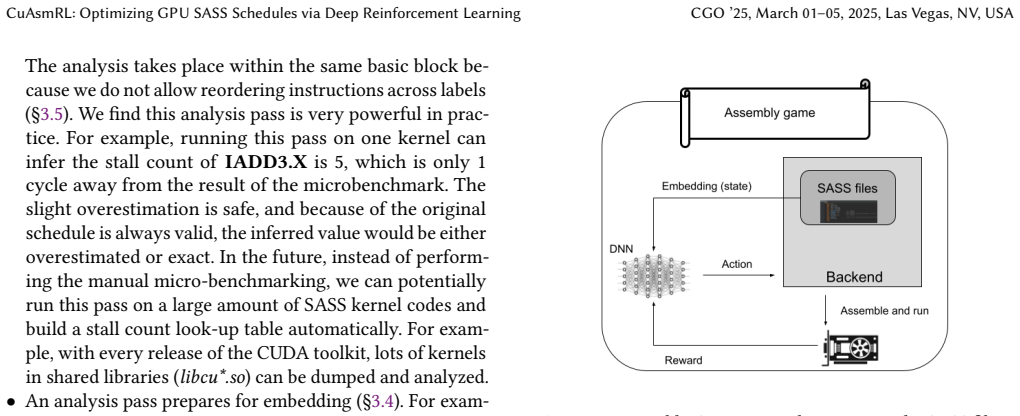
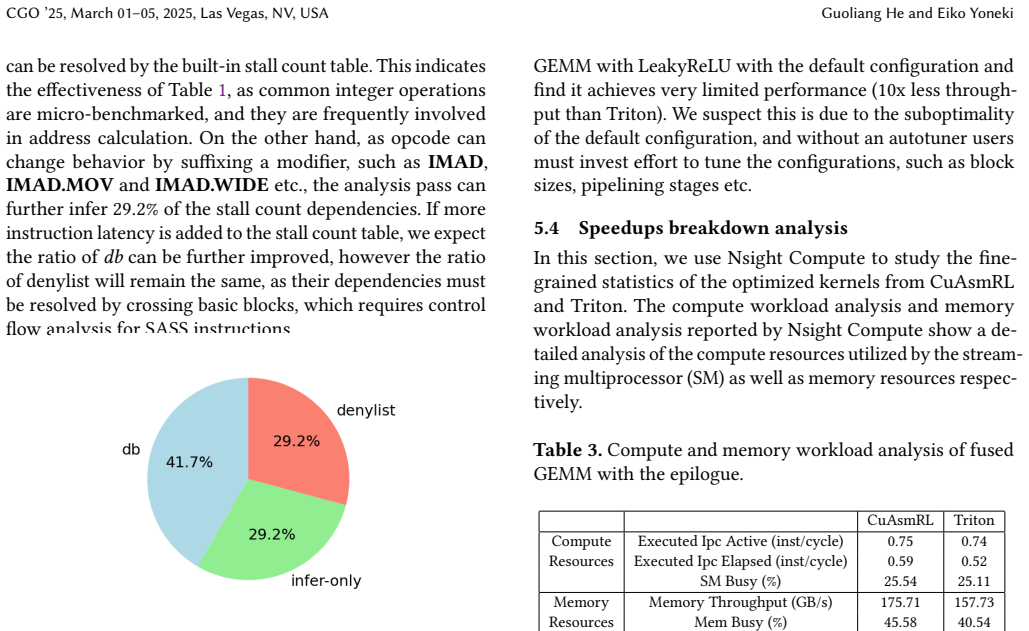
The engine is an assembly game, a Markov decision process whose states are embeddings of SASS instruction streams, whose actions are swaps of a memory instruction with the instruction above or below, and whose reward is the percentage runtime improvement measured against the initial -O3 schedule. Correctness is enforced by action masking: a candidate swap is killed if it violates a register dependency, a barrier dependency, or a stall-count dependency. Stall counts come from a microbenchmarked table for common fixed-latency integer instructions and from a static analysis pass that infers them from the already-valid original schedule; memory instructions whose dependencies cannot be resolved are denylisted and never moved. The policy is a CNN encoder over the embedded instruction matrix followed by an MLP, trained with proximal policy optimization.
What would settle it
Take a kernel from outside the LLM domain, apply the one-line CuAsmRL integration on an A100, and compare its output against the original on randomized inputs; if any optimized cubin returns wrong results, the completeness of the dependency masks is refuted, and if training never yields a faster schedule on such kernels, the claim of general applicability is weakened.
Extended reading notes
Core claim
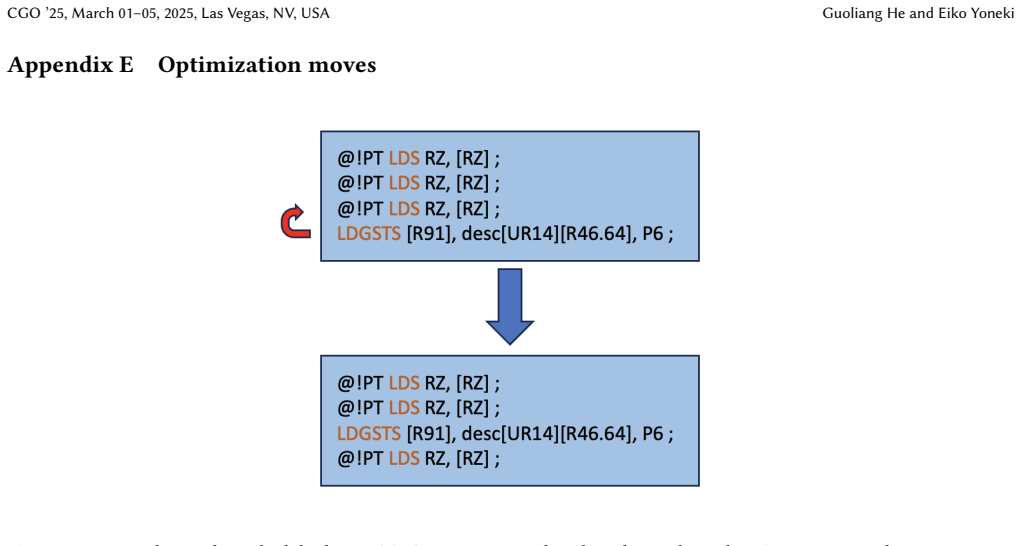
On its own terms, the paper's central claim is that SASS instruction scheduling is a substantial and still-open performance surface for GPU kernels, and that a reinforcement-learning agent can automate the rescheduling human experts currently do by hand. Starting from the best schedule ptxas produces at -O3, CuAsmRL restricts its actions to moving memory load/store instructions such as LDG, LDGSTS, and STG one position up or down inside a basic block, with legal moves filtered by dependency masks for registers, barrier codes, and stall counts. The reward is the measured reduction in kernel runtime, and the agent is trained with PPO to maximize cumulative reward. In evaluation on six kernels used by LLMs, including fused feed-forward, batch matrix multiplication, flash attention, fused GEMM with LeakyReLU, softmax, and RMSNorm, the optimized schedules outperform Triton on every kernel, up to 26 percent and on average 9 percent. The paper also claims the learned moves are interpretable: one reordering of HMMA before LDGSTS in fused GEMM contributes 7 percent and is tied to operand-cache reuse.
Load-bearing premise
The reordering is safe only if the hand-coded dependency rules and the measured stall-count table cover every SASS hazard that exists; if any hazard is missing, an allowed swap can silently change the kernel's results, and the paper's own Section 7 asks users to verify optimized kernels manually.
Editorial extensions
If this is right
- If the measured 9 percent average speedup holds, users of Triton-compiled LLM kernels can gain a transparent speedup on A100 simply by switching to CuAsmRL's decorator, with no source-level changes.
- The discovered moves, such as placing HMMA before LDGSTS and moving LDGSTS ahead of a predicated-off LDS, can be read as concrete scheduling rules for ptxas or other SASS-level passes.
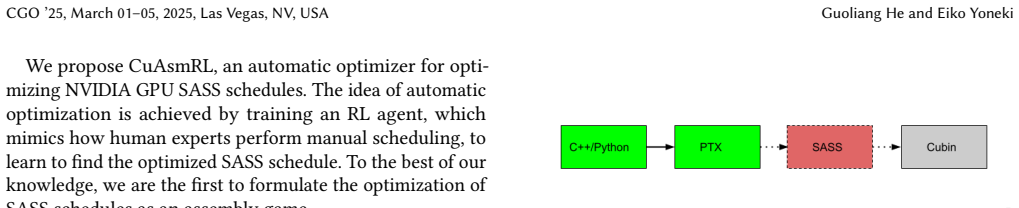
- Because optimization happens after code generation, the approach applies to any cubin that can be disassembled and reassembled, not only to kernels written in Triton.
- The comparison showing CuAsmRL matching or beating CuBLAS and FlashAttention-2 baselines on several kernels implies that schedule-level optimization can close part of the gap between compiler-generated and hand-written GPU code.
Reading between the lines
- The paper does not claim the speedups transfer to other GPU architectures; the stall-count table is A100-specific, so porting would require re-benchmarking before the same gains can be expected on newer hardware.
- The authors leave implicit that the roughly five-hour per-kernel training cost could be amortized by pre-training a policy across many kernels, turning the optimizer into a default compiler pass rather than an offline per-kernel search.
- A practical deployment consequence the paper does not spell out: transparent applies to source code, not to correctness, so an automated equivalence check would be needed before the optimized cubin could ship without human review.
Editorial analysis
A structured set of objections, weighed in public.
Referee Report
Summary. CuAsmRL formulates GPU SASS instruction scheduling as a reinforcement-learning 'assembly game' in which an agent repeatedly swaps memory instructions with adjacent instructions, subject to dependency masks derived from register, barrier, stall-count, and hand-coded 'additional' dependencies. The reward is measured kernel throughput on an A100 GPU. The approach is integrated into OpenAI Triton: it disassembles the compiled cubin, trains an agent to reorder the SASS schedule, and deploys the best schedule found during training. On six LLM-relevant kernels (fused feed-forward, GEMM with LeakyReLU, batch matrix multiply, flash-attention, softmax, and rmsnorm), the paper reports up to 26% and on average 9% throughput improvement over Triton, and it analyzes the discovered reorderings and their effect on memory throughput.
Significance. If the measured speedups hold, CuAsmRL is a practical drop-in SASS-to-SASS optimizer that extends a widely used compiler framework (Triton) with low-level scheduling improvements. The artifact is publicly available on Zenodo/GitHub, the paper reports training statistics, and the method for inferring stall counts from existing schedules is a useful contribution. The paper also provides a concrete case study (HMMA/LDGSTS reordering and the .reuse-flag interaction) that could inform future compiler optimizations. However, the significance is tempered by the absence of statistical validation for the headline speedups and by the manual-verification caveat for correctness, which together make the strength of the central claim uncertain.
major comments (2)
- [Section 5.3, Figure 6, Section 4.2] The central speedup claim lacks statistical validation. The reported numbers come from selecting the 'best optimized cubin found throughout the assembly game' (Section 4.2) using a reward signal that is itself a noisy execution-time measurement (Section 3.6: average of 100 iterations, with standard deviation typically within 1% of two measurements). Selecting an argmax over thousands of noisy evaluations biases the apparent improvement upward. The final benchmark in Section 5.1 uses the same 100-iteration measurement procedure and is not independent of the search. The paper should report per-kernel mean and standard deviation across multiple RL training seeds, include error bars or confidence intervals in Figure 6, and validate the chosen schedule with an independent measurement protocol (e.g., different iteration counts, clock sources, or re-measurement after the fact). For kernels with reported gains near 2%, the effect may be entirely within run-to-run noise; without these numbers the headline 'up to 26%, on average 9%' is not yet established.
- [Section 7, Section 3.5, Section 4.3] The claim that CuAsmRL optimizes kernels 'transparently' (Abstract, Section 1) is contradicted by the paper's own limitation statement that 'users are required to manually verify the optimized kernels as in §5.7.' The correctness of every reordering depends on the completeness of the hand-coded 'additional dependencies' (Section 3.5) and the stall-count table (Section 4.3), and the paper provides no formal verification or exhaustive testing; probabilistic testing with randomized inputs is a sanity check, not a proof. The authors should either (a) weaken the transparency claim to 'source-transparent' with a clear statement that correctness requires per-kernel verification, or (b) provide stronger evidence of correctness, such as systematic output comparison on many random inputs for each of the six kernels, a description of the verification performed in §5.7, and an explicit discussion of which SASS hazard classes are covered by the additional-dependency heuristics.
minor comments (7)
- [Section 5.7.1] There is a missing space in 'we observe7% improvement'; it should read 'we observe 7% improvement'.
- [References] Reference [46] appears corrupted: 'Rico Zhang, Biao an/cudad Sennrich' is not a valid citation; please correct the author and title.
- [Section 3.5, Algorithm 1] The pseudocode for masking stall counts is difficult to evaluate: the semantics of 'is_user(inst_to_check, cur)' are not defined, and the loop breaks at the first encountered user without considering multiple users or producers in the opposite direction. Please clarify why this is sufficient for safe reordering.
- [Section 5.1] The Cutlass baseline is described as using the 'default configuration' and is reported as 10x slower than Triton. This comparison is not informative unless the exact configuration is specified; consider reporting results with a tuned configuration or removing the baseline.
- [Section 5.5] The hyperparameter sensitivity analysis (Figure 8) is shown only for one kernel (fused GEMM with LeakyReLU). Please state whether similar behavior was observed for the other kernels or restrict the robustness claim accordingly.
- [Section 3.6] The statement that the standard deviation of two measurements is typically within 1% would be more useful if the actual per-kernel variances were reported alongside Figure 6.
- [Section 2.3] The example SASS instruction appears to be missing from the rendered text: after 'A typical SASS instruction is shown below' there is a blank line rather than a code listing.
Circularity Check
No significant circularity: the reported speedups are direct GPU timing measurements, and the dependency/stall machinery that constrains reordering is independent calibration, not a fitted predictor of the headline results.
full rationale
CuAsmRL's central claim (up to 26%, mean 9% over Triton, Figure 6) is an empirical optimization result: the RL agent mutates SASS schedules and receives a reward equal to measured kernel throughput (Eq. 3), and the reported numbers are measured execution times of the best cubin found. No equation in the paper defines the target speedup in terms of an input parameter, and no fitted parameter is renamed as a prediction. The stall-count table (Section 4.3) is obtained by dependency-based microbenchmarks on A100, and the static-analysis pass (Section 3.2) infers stall counts conservatively from the original schedule ('because the original schedule is always valid, the inferred value would be either overestimated or exact'); this is a correctness constraint on the search, not a model that generates the speedup. Heuristic dependency rules are manually identified and used only to mask invalid reorderings. The only self-citations ([8], [9]) are artifact and prior-work references that are not load-bearing for the throughput claim. The paper itself flags in Section 7 that users must manually verify optimized kernels and that a cost model is absent; these are correctness and statistical limitations (along with the absence of error bars and selection over the best cubin), but they do not make the derivation circular.
Assumptions & free parameters
assumptions (5)
- domain assumption SASS instruction semantics and control-code behavior as reverse-engineered in prior works are accurate for Ampere.
- domain assumption The microbenchmarked stall counts (Table 1) reflect true fixed-latency instruction latencies on A100.
- ad hoc to paper The hand-coded 'additional dependencies' (e.g., LDGSTS sequences) are the only extra hazards beyond register/barrier/stall dependencies.
- domain assumption The analysis pass's inferred stall counts are always safe (overestimated or exact).
- domain assumption Performance measurement using 100 warmup plus 100 timed iterations with L2 cache clearing is stable and representative.
Cite this review
Pith. "Pith review of CuAsmRL: Optimizing GPU SASS Schedules via Deep Reinforcement Learning." pith.science (2026). https://pith.science/paper/JLOBCHJI
@misc{pith2026250108071,
  author       = {Pith},
  title        = {Pith review of: CuAsmRL: Optimizing GPU SASS Schedules via Deep Reinforcement Learning},
  year         = {2026},
  howpublished = {\url{https://pith.science/paper/JLOBCHJI}},
  note         = {Machine review of arXiv:2501.08071}
}
abstract
Large language models (LLMs) are remarked by their substantial computational requirements. To mitigate the cost, researchers develop specialized CUDA kernels, which often fuse several tensor operations to maximize the utilization of GPUs as much as possible. However, those specialized kernels may still leave performance on the table as CUDA assembly experts show that manual optimization of GPU SASS schedules can lead to better performance, and trial-and-error is largely employed to manually find the best GPU SASS schedules. In this work, we employ an automatic approach to optimize GPU SASS schedules, which thus can be integrated into existing compiler frameworks. The key to automatic optimization is training an RL agent to mimic how human experts perform manual scheduling. To this end, we formulate an assembly game, where RL agents can play to find the best GPU SASS schedules. The assembly game starts from a \textit{-O3} optimized SASS schedule, and the RL agents can iteratively apply actions to mutate the current schedules. Positive rewards are generated if the mutated schedules get higher throughput by executing on GPUs. Experiments show that CuAsmRL can further improve the performance of existing specialized CUDA kernels transparently by up to $26\%$, and on average $9\%$. Moreover, it is used as a tool to reveal potential optimization moves learned automatically.
Figures

Figures from the paper (10 more)




Reference graph
Works this paper leans on
-
[1]
Hamdy Abdelkhalik, Yehia Arafa, Nandakishore Santhi, and Abdel- Hameed Badawy. 2022. Demystifying the Nvidia Ampere Archi- tecture through Microbenchmarking and Instruction-level Analysis. arXiv:2208.11174 [cs.AR] https://arxiv.org/abs/2208.11174
arXiv 2022
-
[2]
Ravichandra Addanki, Shaileshh Bojja Venkatakrishnan, Shreyan Gupta, Hongzi Mao, and Mohammad Alizadeh. 2019. Placeto: Learning Generalizable Device Placement Algorithms for Distributed Machine Learning. In Proceedings of the 33rd International Conference on Neural Information Processing Systems. Curran Associates Inc., Red Hook, NY, USA, Article 358, 11 pages
work page 2019
-
[3]
Greg Brockman, Vicki Cheung, Ludwig Pettersson, Jonas Schneider, John Schulman, Jie Tang, and Wojciech Zaremba. 2016. OpenAI Gym. arXiv:1606.01540 [cs.LG]
arXiv 2016
-
[4]
Cloudcores. 2024. Cuasm. https : / / github. com / cloudcores / CuAssembler
work page 2024
-
[5]
Tri Dao, Dan Fu, Stefano Ermon, Atri Rudra, and Christopher Ré. 2022. FlashAttention: Fast and Memory-Efficient Exact Atten- tion with IO-Awareness. In Advances in Neural Information Pro- cessing Systems , S. Koyejo, S. Mohamed, A. Agarwal, D. Belgrave, K. Cho, and A. Oh (Eds.), Vol. 35. Curran Associates, Inc., 16344– 16359. https://proceedings.neurips.c...
work page 2022
-
[6]
Alhussein Fawzi, Matej Balog, Anderson Huang, Randrianarisoa Ramo- lairisoa, Arthur Guez, Demis Hassabis, Pushmeet Kohli, and Timo- thy P Lillicrap. 2022. Discovering faster matrix multiplication algo- rithms with reinforcement learning. Nature 610, 7930 (2022), 47–53. https://doi.org/10.1038/s41586-022-05172-4
-
[7]
Ameer Haj-Ali, Qijing (Jenny) Huang, John Xiang, William Moses, Krste Asanovic, John Wawrzynek, and Ion Stoica. 2020. AutoPhase: Juggling HLS Phase Orderings in Random Forests with Deep Rein- forcement Learning. In Proceedings of Machine Learning and Sys- tems, I. Dhillon, D. Papailiopoulos, and V. Sze (Eds.), Vol. 2. 70–
work page 2020
-
[8]
Guoliang He. 2025. Reproduction. https://doi.org/10.5281/zenodo. 14058861 CGO ’25 Artifact. CGO ’25, March 01–05, 2025, Las Vegas, NV, USA Guoliang He and Eiko Yoneki
doi:10.5281/zenodo 2025
Show all 50 references
-
[9]
Guoliang He, Sean Parker, and Eiko Yoneki. 2023. X-RLflow: Graph Re- inforcement Learning for Neural Network Subgraphs Transformation. arXiv:2304.14698 [cs.LG] https://arxiv.org/abs/2304.14698
2023 arXiv
-
[10]
Pieter Hijma, Stijn Heldens, Alessio Sclocco, Ben van Werkhoven, and Henri E. Bal. 2023. Optimization Techniques for GPU Programming. ACM Comput. Surv. 55, 11, Article 239 (mar 2023), 81 pages. https: //doi.org/10.1145/3570638
2023 doi
-
[11]
Shengyi Huang, Rousslan Fernand Julien Dossa, Antonin Raffin, Anssi Kanervisto, and Weixun Wang. 2022. The 37 Implementation Details of Proximal Policy Optimization. In ICLR Blog Track. https://iclr-blog- track.github.io/2022/03/25/ppo-implementation-details/ https://iclr- blo...
2022
-
[12]
Intel. 2024. MaxAs. https://github.com/NervanaSystems/maxas
2024
-
[13]
Zhe Jia, Marco Maggioni, Jeffrey Smith, and Daniele Paolo Scarpazza
-
[14]
Scarpazza
Zhe Jia, Marco Maggioni, Benjamin Staiger, and Daniele P. Scarpazza
-
[15]
Albert Q. Jiang, Alexandre Sablayrolles, Antoine Roux, Arthur Mensch, Blanche Savary, Chris Bamford, Devendra Singh Chaplot, Diego de las Casas, Emma Bou Hanna, Florian Bressand, Gianna Lengyel, Guil- laume Bour, Guillaume Lample, Lélio Renard Lavaud, Lucile Saulnier, Marie-An...
2024 arXiv
-
[16]
kernl.ai. 2024. kernl. https://github.com/ELS-RD/kernl
2024
-
[17]
Amy McGovern, Eliot Moss, and Andrew G. Barto. 2002. Basic-block Instruction Scheduling Using Reinforcement Learning and Rollouts. https://api.semanticscholar.org/CorpusID:1231595
2002
-
[18]
Azalia Mirhoseini, Anna Goldie, Hieu Pham, Benoit Steiner, Quoc V Le, and Jeff Dean. 2018. A hierarchical model for device placement. In International Conference on Learning Representations
2018
-
[19]
Rusu, Joel Veness, Marc G
Volodymyr Mnih, Koray Kavukcuoglu, David Silver, Andrei A. Rusu, Joel Veness, Marc G. Bellemare, Alex Graves, Martin A. Riedmiller, Andreas Fidjeland, Georg Ostrovski, Stig Petersen, Charles Beattie, Amir Sadik, Ioannis Antonoglou, Helen King, Dharshan Kumaran, Daan Wierstra, ...
2015 doi
-
[20]
NVIDIA. 2024. CUDA c++ programming guide . https://docs.nvidia. com/cuda/cuda-c-programming-guide/index.html
2024
-
[21]
NVIDIA. 2024. CUDA performance metrics. https://developer.nvidia. com/blog/how-implement-performance-metrics-cuda-cc/
2024
-
[22]
NVIDIA. 2024. CUDA performance metrics. https://docs.nvidia.com/ cuda/cublas/
2024
-
[23]
NVIDIA. 2024. NVIDIA. https://developer.nvidia.com/nsight-compute
2024
-
[24]
NVIDIA. 2024. NVIDIA. https://docs.nvidia.com/nsight-visual- studio- edition/4.6/Content/Analysis/Report/CudaExperiments/ KernelLevel/PerformanceCounters.htm
2024
-
[25]
NVIDIA. 2024. NVIDIA CUDA compiler. https://docs.nvidia.com/cuda/ cuda-compiler-driver-nvcc/index.html
2024
-
[26]
NVIDIA. 2024. NVIDIA kepler GPU . https://www.nvidia.com/content/ dam/en-zz/Solutions/Data-Center/tesla-product-literature/NVIDIA- Kepler-GK110-GK210-Architecture-Whitepaper.pdf
2024
-
[27]
NVIDIA. 2024. NVIDIA ptx. https://docs.nvidia.com/cuda/parallel- thread-execution/index.html
2024
-
[28]
NVIDIA. 2024. NVIDIA sass . https://docs.nvidia.com/cuda/cuda- binary-utilities/index.html
2024
-
[29]
OpenAI. 2024. OpenAI. https://openai.com/research/video-generation- models-as-world-simulators
2024
-
[30]
OpenAI. 2024. OpenAI. https : / / twitter. com / sama / status / 1756089361609981993
2024
-
[31]
OpenAI. 2024. OpenAI. https://openai.com/blog/chatgpt
2024
-
[32]
OpenAI, Ilge Akkaya, Marcin Andrychowicz, Maciek Chociej, Ma- teusz Litwin, Bob McGrew, Arthur Petron, Alex Paino, Matthias Plap- pert, Glenn Powell, Raphael Ribas, Jonas Schneider, Nikolas Tezak, Jerry Tworek, Peter Welinder, Lilian Weng, Qiming Yuan, Wojciech Zaremba, and Le...
2019 arXiv
-
[33]
Pytorch2. 2024. Pytorch2. https://pytorch.org/blog/pytorch-2-paper- tutorial/
2024
-
[34]
Rodrigues, Sam S
Shane Ryoo, Christopher I. Rodrigues, Sam S. Stone, John A. Stratton, Sain-Zee Ueng, Sara S. Baghsorkhi, and Wen mei W. Hwu. 2008. Pro- gram optimization carving for GPU computing. J. Parallel and Distrib. Comput. 68, 10 (2008), 1389–1401. https://doi.org/10.1016/j.jpdc.2008. ...
2008 doi
-
[35]
John Schulman, Filip Wolski, Prafulla Dhariwal, Alec Radford, and Oleg Klimov. 2017. Proximal Policy Optimization Algorithms. arXiv:1707.06347 [cs.LG]
2017 arXiv
-
[36]
Ghassan Shobaki, Austin Kerbow, and Stanislav Mekhanoshin. 2020. Optimizing occupancy and ILP on the GPU using a combinatorial approach. InProceedings of the 18th ACM/IEEE International Symposium on Code Generation and Optimization (San Diego, CA, USA) (CGO ’20). Association f...
2020
-
[37]
Ghassan Shobaki, Pınar Muyan-Özçelik, Josh Hutton, Bruce Linck, Vladislav Malyshenko, Austin Kerbow, Ronaldo Ramirez-Ortega, and Vahl Scott Gordon. 2024. Instruction Scheduling for the GPU on the GPU. In 2024 IEEE/ACM International Symposium on Code Generation and Optimization...
2024
-
[38]
David Silver, Thomas Hubert, Julian Schrittwieser, Ioannis Antonoglou, Matthew Lai, Arthur Guez, Marc Lanctot, Laurent Sifre, Dharshan Kumaran, Thore Graepel, Timothy Lillicrap, Karen Simonyan, and Demis Hassabis. 2018. A general reinforcement learning algorithm that masters c...
2018 doi
-
[39]
Sutton and Andrew G
Richard S. Sutton and Andrew G. Barto. 2018. Reinforcement Learning: An Introduction. A Bradford Book, Cambridge, MA, USA
2018
-
[40]
Philippe Tillet, H. T. Kung, and David Cox. 2019. Triton: an interme- diate language and compiler for tiled neural network computations. In Proceedings of the 3rd ACM SIGPLAN International Workshop on Machine Learning and Programming Languages (Phoenix, AZ, USA) (MAPL 2019). A...
2019
-
[41]
Hugo Touvron, Louis Martin, Kevin Stone, Peter Albert, Amjad Alma- hairi, Yasmine Babaei, Nikolay Bashlykov, Soumya Batra, Prajjwal Bhargava, Shruti Bhosale, Dan Bikel, Lukas Blecher, Cristian Canton Ferrer, Moya Chen, Guillem Cucurull, David Esiobu, Jude Fernandes, Jeremy Fu,...
2023 arXiv
-
[42]
Triton. 2024. Trion-repo. https://github.com/triton-lang/triton CuAsmRL: Optimizing GPU SASS Schedules via Deep Reinforcement Learning CGO ’25, March 01–05, 2025, Las Vegas, NV, USA
2024
-
[43]
Ashish Vaswani, Noam Shazeer, Niki Parmar, Jakob Uszkoreit, Llion Jones, Aidan N Gomez, Lukasz Kaiser, and Illia Polosukhin. 2017. At- tention is All you Need. In Advances in Neural Information Processing Systems, I. Guyon, U. Von Luxburg, S. Bengio, H. Wallach, R. Fergus, S. ...
2017
-
[44]
Da Yan, Wei Wang, and Xiaowen Chu. 2020. Demystifying Tensor Cores to Optimize Half-Precision Matrix Multiply. In2020 IEEE Interna- tional Parallel and Distributed Processing Symposium (IPDPS) . 634–643. https://doi.org/10.1109/IPDPS47924.2020.00071
2020
-
[45]
Da Yan, Wei Wang, and Xiaowen Chu. 2020. Optimizing batched wino- grad convolution on GPUs. In Proceedings of the 25th ACM SIGPLAN Symposium on Principles and Practice of Parallel Programming (San Diego, California) (PPoPP ’20). Association for Computing Machinery, New York, N...
2020
-
[46]
Rico Zhang, Biao an/cudad Sennrich. 2019. Root mean square layer normalization. Curran Associates Inc., Red Hook, NY, USA
2019
-
[47]
Xiuxia Zhang, Guangming Tan, Shuangbai Xue, Jiajia Li, Keren Zhou, and Mingyu Chen. 2017. Understanding the GPU Microar- chitecture to Achieve Bare-Metal Performance Tuning. In Proceed- ings of the 22nd ACM SIGPLAN Symposium on Principles and Prac- tice of Parallel Programming...
2017
-
[81]
https://proceedings.mlsys.org/paper_files/paper/2020/file/ 5b47430e24a5a1f9fe21f0e8eb814131-Paper.pdf
2020
-
[2018]
arXiv:1804.06826 [cs.DC] https://arxiv.org/abs/1804.06826
Dissecting the NVIDIA Volta GPU Architecture via Microbench- marking. arXiv:1804.06826 [cs.DC] https://arxiv.org/abs/1804.06826
-
[2019]
arXiv:1903.07486 [cs.DC]
Dissecting the NVidia Turing T4 GPU via Microbenchmarking. arXiv:1903.07486 [cs.DC]
1903 arXiv
Reviewed August 10, 2026 · model on record in the stance chip above.
Discussion (0). Continue with ORCID to comment.