REVIEW 5 major objections 7 minor 102 references
Workshop data from XSPECT reveal burst, pulse, and state-change science
Reviewed by Pith at T0; open to challenge. T0 means a machine referee read the full paper against a public rubric. the ladder, T0–T4 →
T0 review · deepseek-v4-flash
2026-08-01 07:37 UTC pith:JLSLUPND
load-bearing objection Workshop report that honestly demonstrates XSPECT's basic science utility; mostly confirmatory results with a real calibration caveat, but solid and worth referee time as an instrument-community record. the 5 major comments →
Importance and Science Outcomes from the first XSPECT/XPoSat Workshop
The pith
A machine-rendered reading of the paper's core claim, the machinery that carries it, and where it could break.
Core claim
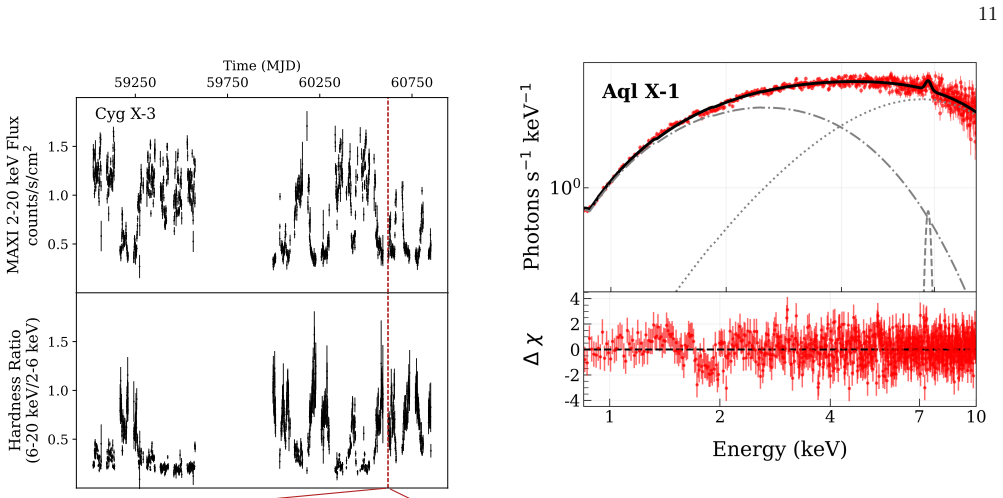
The paper's central claim, on its own terms, is that XSPECT data from the first year of operations can support end-to-end spectral and timing analysis that yields recognizable astrophysical results. Using calibrated responses and background products, workshop teams measured a Type-I X-ray burst in Aql X-1 and inferred a neutron-star radius of 9.94 ± 1.56 km; traced Sco X-1 around its full Z-track with spectral softening from horizontal to normal branch; detected hard-to-soft state transitions in Cir X-1 tied to orbital phase; measured spin periods and phase-dependent absorption in GX 301-2 and Vela X-1; and followed Cyg X-1 toward a softer intermediate state while Cyg X-3 remained intermedia
What carries the argument
The load-bearing object is XSPECT itself: a collimated 0.8–15 keV spectrometer with sixteen swept-charge devices, about 180 eV resolution at 6 keV, 1 ms timing, and both ground and on-board calibration anchored by supernova-remnant and Crab observations. Around it sits the analysis chain the paper describes: Level-1 screening to Level-2 event files, barycentric correction, field-of-view-wise spectra and light curves, instrument response files, blank-sky background products, and the workshop structure that handed these tools to seven trainee teams. That combination of calibrated instrument, software pipeline, and mentored group projects is what carries the argument that the reported results a
Load-bearing premise
The whole set of results rests on the assumption that XSPECT's instrument response and blank-sky background model are accurate enough that fitted parameters like the neutron-star radius and branch-dependent temperatures reflect the sources rather than unmodeled detector systematics.
What would settle it
Compare XSPECT's Aql X-1 burst spectrum and its inferred radius with spectra of the same burst taken by an independent soft X-ray observatory; if the recovered radius differs by much more than the quoted 1.56 km uncertainty, or if the spectral residuals near 1.5 and 1.8 keV vanish when the response is recalibrated, then the science outcomes are contaminated by response or background systematics.
If this is right
- XSPECT can place constraints on neutron-star structure: the Aql X-1 Type-I burst, fitted with a neutron-star atmosphere model, yields a radius consistent with canonical neutron stars, and similar bursts should be usable for radius and mass measurement.
- The full Z-track coverage of Sco X-1 shows that XSPECT's soft band can separate horizontal, normal, and flaring branches and track the accretion-rate-driven spectral changes along them.
- Orbital phase-resolved analysis of Cir X-1 and the pulsars shows the instrument can map accretion geometry changes such as eclipse phases, clumpy wind absorption, and spin-phase modulations in wind-fed systems.
- The Cyg X-1 and Cyg X-3 results demonstrate the ability to follow black-hole state transitions and intermediate states using both Lorentzian timing features and spectral diagnostics.
- The workshop model produces publishable science and direct feedback on the data-analysis software, implying a path for future early-access data events that broaden the user base.
Where Pith is reading between the lines
- Not claimed in the paper: if the calibration and background products hold up under independent scrutiny, the quoted neutron-star radius and Z-track parameter trends become testable physical claims that other teams could re-derive from the same first-year data to check for systematic offsets.
- Not claimed in the paper: the workshop format is a reusable template for future Indian space-mission data releases, where a small mentored cohort gets early access, runs a complete pipeline, and returns software feedback before public release.
- Not claimed in the paper: the absence of detected quasi-periodic oscillations in these short windows does not test XSPECT's timing ceiling; longer continuous exposures or a larger source sample would be needed to see whether the 1 ms resolution can recover kilohertz oscillations in bright Z-sources.
Editorial analysis
A structured set of objections, weighed in public.
Referee Report
Summary. The paper reports on the first XSPECT/XPoSat data-analysis workshop, in which seven trainee teams used a few days of XSPECT observations for three NS-LMXBs (Aql X-1, Sco X-1, Cir X-1), two pulsars (GX 301-2, Vela X-1), and two BH-XRBs (Cyg X-1, Cyg X-3). It summarizes the XSPECT instrument, the data-reduction pipeline, and the spectral/timing results obtained by the teams. The central claim is that the workshop demonstrates XSPECT's scientific promise and the effectiveness of collaborative training for future Indian space-astronomy missions. The paper presents a large set of first-look results: a Type-I burst in Aql X-1 with an nsatmos radius estimate; Z-track spectral evolution in Sco X-1; orbital-phase spectral state changes in Cir X-1; spin-period and pulse-profile measurements in GX 301-2 and Vela X-1; a hard-to-soft-intermediate transition in Cyg X-1; and intermediate-state spectroscopy with multiple emission lines in Cyg X-3. Detailed spectral tables and figures are provided, and the data and software are made available through ISSDC/PRADAN.
Significance. If the results hold, the paper shows that XSPECT can produce scientifically useful spectral and timing measurements of bright X-ray binaries and that the workshop-based training model is effective for community building and for preparing early-career researchers. The paper has value as a compendium of first independent XSPECT results outside the instrument team, and the public availability of the pipeline and data is a credible strength. However, the quantitative astrophysical claims rest on the accuracy of XSPECT's spectral response and background subtraction, which are not independently validated in this manuscript. The paper also contains several internal inconsistencies in the quoted parameter values. The workshop's pedagogical value is not in question, but the scientific-outcome claim needs either stronger calibration cross-checks or clearer caveats.
major comments (5)
- [§6.2, §7.2, §7.6] The spectral models for Sco X-1 and Cyg X-1 include ad hoc edge components at ~1.5 keV and ~1.8 keV attributed to Al/Si detector features. The paper does not demonstrate that these edges are not residual response/background systematics. Because the quoted continuum parameters (Γ, kTin, kTe, normalizations) and the derived quantities (Aql X-1 nsatmos radius in §7.1, Sco X-1 branch spectral evolution in §7.2) depend on these fits, the central science-outcome claim is vulnerable to unrecognized instrument systematics. The authors should either (a) provide a cross-check with a simultaneous observation from an independent instrument (e.g., NICER, MAXI, or Insight-HXMT) for at least one source, or (b) include an explicit estimate of systematic uncertainty from the edge parameters and background. If neither is possible, the paper should be reframed as a demonstration of the data-reduction workf
- [§7.2 vs Table IV] The text states that the Sco X-1 photon index increases from 1.7 in HB to 1.83 in NB, but Table IV lists Γ = 1.90 ± 0.01 for NB. The same paragraph says the disk temperature varies between 0.7 and 0.8 keV, while Table IV gives kTin = 0.76, 0.85, and 0.62 keV for HB, NB, and FB, respectively. These discrepancies undermine the reported spectral evolution along the Z-track and must be reconciled.
- [§6.2, §7.7, Figure 18, §8] The Cyg X-3 emission-line energies are reported inconsistently. Section 6.2 lists Si at 1.89 keV, S XVI at 3.09 and 2.5 keV, and Fe at 6.61 keV; Figure 18's caption lists Si at 1.94 keV, S XVI at 3.15 and 2.51 keV; and Section 8 states Si at 2.74 keV. Additionally, Figure 18's caption shows 'S XVI1' twice. These line energies are part of the scientific results (wind reprocessing in Cyg X-3), so the correct values must be identified and used consistently.
- [§7.5 and Table IV] The text says 'the best-fit value of nH rises from the first day to the last day' for Vela X-1 over orbital phases 0.15–0.48, but Table IV lists Day-1 nH = 1.7, Day-2 nH = 1.5, and Day-3 nH = 3.7 (×10^22 cm^-2), which is not monotonic. The spectral model for Vela X-1 also appears to have a column mismatch in Table IV (no photon index or compST temperature column is visible for the Vela X-1 rows). Please correct the table and the trend statement.
- [§4.1 and §7.1] The distance to Aql X-1 is given as ~6 kpc in Section 4.1, but Section 7.1 states that the nsatmos radius of 9.94 ± 1.56 km is obtained 'assuming a distance of 4.1–5.9 kpc.' The derived radius depends directly on distance, so the adopted value and range need to be specified and made consistent between the source description and the result.
minor comments (7)
- [§6.1] The Cyg X-1 observations are described as being taken on '9th, 10th, 12th, and 13th September 2025,' but Table II and Section 4.3 give 2024. Please correct the year.
- [§5] The sentence 'Since starting operations in January 2024' is ambiguous — the paper earlier states that science operations began on 2024 March 9, with launch on January 1. Please clarify.
- [§7.7] The power-density-spectrum fit for Cyg X-3 is mentioned (power-law index ~1.6–1.7) but no PDS figure or table is shown. Please either display the PDS or note that this result is not shown.
- [§7.6, Table III] The statement that the PDS centroid frequency shifts to higher frequencies toward a softer state is supported by ν2 (1.72 → 2.80 Hz) but not by ν1 (0.16, 0.15, 0.21, 0.17 Hz). Please phrase the claim more precisely.
- [Figure 6 caption] The soft color is defined as (0.8–3.0 keV)/(3–6 keV) and hard color as (3–6 keV)/(6–12 keV). This definition is unconventional; please double-check that the ratios are not inverted.
- [§8] The text contains a typo: 'bolometric luminositNePy' should be 'bolometric luminosity.'
- [Table IV] The column header 'NH(pcfabs)' is not defined in the table caption. Please add a note explaining that it is the column density of the partial-covering absorber.
Circularity Check
No material circularity: the paper reports first-look spectral/timing fits and compares them with external literature; self-citations are standard instrument-calibration practice and do not make the central claim self-defined.
full rationale
The paper's strongest claim is that XSPECT data and the workshop training yield scientifically plausible results (Abstract, Sec. 8). The derivation chain is: raw Level-1 events -> XSPECT screening/response/background tools -> spectral/timing models -> fitted parameters -> comparisons with prior literature. None of these steps defines an output quantity in terms of an input parameter of the same step. For example, the Aql X-1 radius (9.94 +/- 1.56 km, Sec. 7.1) comes from fitting nsatmos to burst spectra and is compared with theoretical/canonical NS radii; it is not the definition of any calibration quantity. The Sco X-1 branch evolution and Cyg X-1 kTin/kTe changes are free spectral-fit parameters, and the paper presents them as observations, not as predictions from a model built to produce them. The cited self-papers ([15], [86], [14], [61]) are instrument calibration and companion-analysis papers; they provide the response/background and detailed analysis support, but the paper does not use them as a 'uniqueness theorem' or as a substitute for its own empirical fits. The only noted weakness is the presence of ad hoc Al/Si edge components in Sco X-1 (Sec. 6.2, 7.2) and Cyg X-1 (Sec. 7.6) fits; these are additional fitted parameters, not quantities defined by construction, and the paper explicitly attributes them to detector edges. Without in-paper cross-checks such as simultaneous NICER/MAXI/Insight-HXMT comparisons, the astrophysical interpretation carries systematic uncertainty, but that is a correctness/robustness concern, not circularity. The paper is self-contained enough for a workshop summary: most quantitative claims are data fits with reported uncertainties, and the central conclusion is an inference from those fits, not an identity.
Axiom & Free-Parameter Ledger
axioms (3)
- domain assumption XSPECT detector calibration (gain, ARF/RMF) and background subtraction are accurate.
- domain assumption Standard X-ray spectral models (diskbb, nthcomp, nsatmos, compST, pcfabs, tbabs) are adequate descriptions of these sources in the 0.8–15 keV band.
- domain assumption Literature distances and masses are correct: Aql X-1 at 4.1–5.9 kpc, Sco X-1 at 2.8 kpc, Cyg X-1 at 21.2 M_sun and 2.22 kpc.
read the original abstract
This paper summarizes the science outcomes of the first Workshop on Data Analysis using observations from the XSPECT payload onboard the XPoSat, which brought together early-career researchers and experts to explore the instrument's scientific capabilities through lectures and hands-on analyses. Participants performed end-to-end data analysis, including calibration, spectral modeling, and timing studies, on seven sources comprising Neutron Star Low-Mass X-ray Binaries, pulsars, and Black Hole X-ray Binaries, demonstrating the instrument's scientific potential. The observations, obtained during the first year of XSPECT operations, together with in-house developed software, were provided to the participants, making them the first users outside the instrument team to analyze XSPECT data. For NS-LMXBs, Aql X-1 exhibited a classical Type-I X-ray burst, enabling constraints on the stellar radius through spectral fitting. Sco X-1, observed across its complete Z-track, revealed systematic spectral evolution driven by accretion-rate fluctuations and disk-corona coupling, while Cir X-1 displayed orbital phase-dependent transitions between hard and soft states, reflecting changes in accretion geometry. Among accretion-powered pulsars, GX 301-2 showed a double-peaked, energy-dependent pulse profile and strong iron fluorescence lines due to stellar wind reprocessing, whereas Vela X-1 exhibited orbital phase-dependent absorption and steady coronal temperatures. Among BH-XRBs, Cyg X-1 transitioned from a hard to soft-intermediate state with increasing disk contribution and spectral softening, while Cyg X-3 remained in the intermediate state with multiple emission lines originating from a clumpy stellar wind. The workshop outcomes highlight the scientific promise of XSPECT and the importance of collaborative training in maximizing the science from XSPECT and future Indian space astronomy missions.
Figures




Reference graph
Works this paper leans on
-
[1]
Agrawal, P. C. (2006). A broad spectral band Indian As- tronomy satellite ‘Astrosat’. Advances in Space Research, 38(12):2989–2994
2006
-
[2]
SCDs have previously been flown on Chandrayaan-1 (C1XS; [30]), Chandrayaan-2 (CLASS; [63]), and Insight-HXMT (LE Telescope; [17])
ABOUT XSPECT XSPECT is a collimated X-ray telescope, using Swept Charge Devices (SCDs; [47], [33]) as its detectors. SCDs have previously been flown on Chandrayaan-1 (C1XS; [30]), Chandrayaan-2 (CLASS; [63]), and Insight-HXMT (LE Telescope; [17]). The instrument is sensitive in the soft X-ray band, and provides moderate energy and tim- ing resolution. XSP...
-
[3]
MOTIV A TION OF THE WORKSHOP This workshop brought together young researchers and experts in the field of Astronomy to discuss the science capabilities of the XSPECT payload. The participants were grouped into seven teams, and each team was guided by the instrument team members through practical steps in analyzing XSPECT data, emphasizing both spectral an...
-
[4]
SOURCES: NS-LMXBS, PULSARS AND BH-XRBS Seven X-ray sources from three categories (NS- LMXBs: Aql X-1, Sco X-1, Cir X-1; X-ray Pulsars: Vela X-1 and GX 301-2; BH-XRBs: Cyg X-1 and Cyg X-
-
[5]
The details of the sources and observation are provided in the following subsections
were considered, for seven projects identified for this workshop. The details of the sources and observation are provided in the following subsections. 4.1. NS-LMXBs •Aql X-1 is classified as an ‘Atoll’ source and consists of a neutron star accreting matter from a K-type low-mass companion star via Roche-lobe overflow ([18]). The system is situated at an ...
1998
-
[6]
OBSER V A TION AND DA T A REDUCTION Since starting operations in January 2024, XSPECT has observed a wide range of X-ray sources, including NS-LMXBs, BH-XRBs, and Pulsars. This workshop uti- lizes XSPECT observations of three NS-LMXBs: Sco X-1 (50 days, 484 ks) Aql X-1 (8 days, 104 ks), and Cir X-1 (17 days, 261 ks); two pulsars: Vela X-1 (28 days, 408 ks...
2024
-
[7]
T emporal Analysis Light curves were extracted with different bin sizes de- pending on the nature of the source
ANAL YSIS AND MODELING 6.1. T emporal Analysis Light curves were extracted with different bin sizes de- pending on the nature of the source. For Aql X-1, 1 s binned light curve was generated as shown in the left panel of Figure 4. The soft (0.8−2.8 keV) and hard (2.8−15.0 keV) band light curves were generated to plot the HID (right panel of Figure 4). Sco...
2025
-
[8]
Aql X-1 XSPECT observed Aql X–1 during the initial decay phase of its 2024 outburst
RESUL TS AND DISCUSSION 7.1. Aql X-1 XSPECT observed Aql X–1 during the initial decay phase of its 2024 outburst. The X-ray lightcurve of Aql X–1 (right panel of Figure 4) indicates a relatively sta- ble persistent flux level during the observation with a single thermonuclear burst superimposed. The HID is plotted in the right panel of Figure 4. The therm...
2024
-
[9]
SUMMAR Y AND CONCLUSION The XSPECT observations of the NS–LMXBs, namely, Aql X-1, Sco X-1, and Cir X-1 provide valuable in- sights into the diverse accretion and emission processes governing these systems. Aql X-1 exhibited persistent emission accompanied by a classical thermonuclear X-ray burst (type-I), confirming active accretion onto the neu- 16 T ABL...
2019
-
[10]
Axelsson, M., Borgonovo, L., and Larsson, S. (2005). Evolution of the 0.01-25 Hz power spectral components in Cygnus X-1. Astronomy & Astrophysics, 438(3):999– 1012
2005
-
[11]
E., Bhuvana, G
Baby, B. E., Bhuvana, G. R., Radhika, D., Katoch, T., Mandal, S., and Nandi, A. (2021). Revealing the na- ture of the transient source MAXI J0637-430 through spectro-temporal analysis. Monthly Notices of the Royal Astronomical Society, 508(2):2447–2457
2021
-
[12]
Bailer-Jones, C. A. L., Rybizki, J., Fouesneau, M., Dem- leitner, M., and Andrae, R. (2021). Estimating Distances from Parallaxes. V. Geometric and Photogeometric Dis- tances to 1.47 Billion Stars in Gaia Early Data Release
2021
-
[13]
The Astrophysical Journal, 161(3):147
-
[14]
Belloni, T., Homan, J., Casella, P., van der Klis, M., Nespoli, E., Lewin, W. H. G., Miller, J. M., and M´ endez, M. (2005). The evolution of the timing properties of the black-hole transient GX 339-4 during its 2002/2003 outburst. Astronomy and Astrophysics, 440(1):207–222
2005
-
[15]
H., Koh, D
Bildsten, L., Chakrabarty, D., Chiu, J., Finger, M. H., Koh, D. T., Nelson, R. W., Prince, T. A., Rubin, B. C., Scott, D. M., Stollberg, M., Vaughan, B. A., Wilson, C. A., and Wilson, R. B. (1997). Observations of Ac- creting Pulsars. The Astrophysical Journal Supplement, 113(2):367–408
1997
-
[16]
Bonnet-Bidaud, J. M. and Chardin, G. (1988). Cygnus x-3, a critical review. Physics Reports, 170(6):325–404
1988
-
[17]
G., and Fender, R
Boutloukos, S., van der Klis, M., Altamirano, D., Klein- Wolt, M., Wijnands, R., Jonker, P. G., and Fender, R. P. (2006). Discovery of Twin kHz QPOs in the Peculiar X-Ray Binary Circinus X-1. The Astrophysical Journal, 653(2):1435–1444
2006
-
[18]
F., Fomalont, E
Bradshaw, C. F., Fomalont, E. B., and Geldzahler, B. J. (1999). High-resolution parallax measurements of scor- pius x-1. The Astrophysical Journal, 512(2):L121
1999
-
[19]
Campana, S., Coti Zelati, F., and D’Avanzo, P. (2013). Mining the Aql X-1 long-term X-ray light curve.Monthly Notices of the Royal Astronomical Society, 432(2):1695– 1700
2013
-
[20]
Casella, P., Altamirano, D., Patruno, A., Wijnands, R., and van der Klis, M. (2008). Discovery of Coher- ent Millisecond X-Ray Pulsations in Aquila X-1. The Astrophysical Journal Letter, 674(1):L41
2008
-
[21]
Casella, P., Belloni, T., and Stella, L. (2006). A continuous flaring- to normal-branch transition in ¡AS- TROBJ¿Scorpius X-1¡/ASTROBJ¿. Astronomy & Astrophysics, 446(2):579–582
2006
-
[22]
and Titarchuk, L
Chakrabarti, S. and Titarchuk, L. G. (1995). Spectral Properties of Accretion Disks around Galactic and Extra- galactic Black Holes. The Astrophysical Journal, 455:623
1995
-
[23]
K., Shyam Prakash, V
Chatterjee, R., Agrawal, V. K., Shyam Prakash, V. P., Vadodariya, K., and Vatedka, R. (2026). Tracing the outburst decay of soft X-ray transients Aql X-1 and 4U 1608-52 with XSPECT. Monthly Notices of the Royal Astronomical Society
2026
-
[24]
K., Tyagi, A., Jayasurya, K
Chatterjee, R., Vadodariya, K., Vatedka, R., Agrawal, V. K., Tyagi, A., Jayasurya, K. M., P., S. P. V., M.C., R., and Sharan, V. (2025). XSPECT on-board XPoSat: calibration and first results. Journal of Astronomical Telescopes, Instruments, and Systems, 11(4):044007
2025
-
[25]
K., Mall, G., Dhaka, R., Misra, R., and Pathak, A
Chaurasia, S. K., Mall, G., Dhaka, R., Misra, R., and Pathak, A. (2025). Spectral Analysis of Cygnus X-3 Us- ing Simultaneous AstroSat and Insight-HXMT Observa- tions. The Astrophysical Journal, 986(1):97
2025
-
[26]
Chen, Y., Cui, W., Li, W., Wang, J., Xu, Y., Lu, F., Wang, Y., Chen, T., Han, D., Hu, W., Zhang, Y., Huo, J., Yang, Y., Li, M., Lu, B., Zhang, Z., Li, T., Zhang, S., Xiong, S., Zhang, S., Xue, R., Zhao, X., Zhu, Y., Zhu, Y., Liu, H., Yang, Y., and Zhang, F. (2020). The Low Energy X-ray telescope (LE) onboard the Insight-HXMT astronomy satellite. Science C...
2020
-
[27]
and Ilovaisky, S
Chevalier, C. and Ilovaisky, S. A. (1991). Discov- ery of a 19-hour period in Aquila X-1. Astronomy & Astrophysics, 251:L11
1991
-
[28]
M., Wright, E
Cutri, R. M., Wright, E. L., Conrow, T., Fowler, J. W., Eisenhardt, P. R. M., Grillmair, C., Kirkpatrick, J. D., Masci, F., McCallon, H. L., Wheelock, S. L., Fajardo- Acosta, S., Yan, L., Benford, D., Harbut, M., Jarrett, T., Lake, S., Leisawitz, D., Ressler, M. E., Stanford, S. A., Tsai, C. W., Liu, F., Helou, G., Mainzer, A., Get- tings, D., Gonzalez, A...
2013
-
[29]
Z., Wang, W., Epili, P
Ding, Y. Z., Wang, W., Epili, P. R., Liu, Q., Ge, M. Y., Lu, F. J., Qu, J. L., Song, L. M., Zhang, S., and Zhang, S. N. (2021). Timing and spectral variability of the high-mass X-ray pulsar GX 301-2 over orbital phases ob- served by Insight-HXMT. Monthly Notices of the Royal Astronomical Society, 506(2):2712–2724
2021
-
[30]
Done, C., Gierli´ nski, M., and Kubota, A. (2007). Mod- elling the behaviour of accretion flows in x-ray binaries: Everything you always wanted to know about accretion but were afraid to ask. The Astronomy and Astrophysics Review, 15(1):1–66
2007
-
[31]
M., Fetisova, Y., and Puls, J
Falanga, M., Bozzo, E., Lutovinov, A., Bonnet-Bidaud, J. M., Fetisova, Y., and Puls, J. (2015). Ephemeris, or- bital decay, and masses of ten eclipsing high-mass X-ray binaries. Astronomy and Astrophysics, 577:A130
2015
-
[32]
P., Belloni, T
Fender, R. P., Belloni, T. M., and Gallo, E. (2004). Towards a unified model for black hole X-ray binary jets. Monthly Notices of the Royal Astronomical Society, 355(4):1105–1118
2004
-
[33]
Frank, J., King, A., and Raine, D. J. (2002). Accretion Power in Astrophysics: Third Edition
2002
-
[34]
R., and Raine, D
Frank, J., King, A. R., and Raine, D. (2002). Accretion power in astrophysics. Cambridge university press
2002
-
[35]
F¨ urst, F., Suchy, S., Kreykenbohm, I., Barrag´ an, L., Wilms, J., Pottschmidt, K., Caballero, I., Kretschmar, P., Ferrigno, C., and Rothschild, R. (2011). Study of the many fluorescent lines and the absorption variability in gx 301- 2 with xmm-newton. Astronomy & Astrophysics, 535:A9
2011
-
[36]
Giacconi, R., Gursky, H., Kellogg, E., Schreier, E., and Tananbaum, H. (1971). Discovery of Periodic X- Ray Pulsations in Centaurus X-3 from UHURU. The Astrophysical Journal Letter, 167:L67
1971
-
[37]
R., and Rossi, B
Giacconi, R., Gursky, H., Paolini, F. R., and Rossi, B. B. (1962). Evidence for x Rays From Sources Outside the Solar System. Physical Review Letters, 9(11):439–443
1962
-
[38]
W., Wright, E
Gottlieb, E. W., Wright, E. L., and Liller, W. (1975). Optical studies of UHURU sources. XI. A probable pe- riod for Scorpius X-1 = V818 Scorpii. The Astrophysical Journal Letter, 195:L33–L35
1975
-
[39]
J., Howe, C
Grande, M., Maddison, B. J., Howe, C. J., Kellett, B. J., Sreekumar, P., Huovelin, J., Crawford, I. A., Duston, C. L., Smith, D., Anand, M., Bhandari, N., Cook, A., Fernandes, V., Foing, B., Gasnaut, O., Goswami, J. N., Holland, A., Joy, K. H., Kochney, D., Lawrence, D., Maurice, S., Okada, T., Narendranath, S., Pieters, C., Rothery, D., Russell, S. S., S...
2009
-
[40]
and van der Klis, M
Hasinger, G. and van der Klis, M. (1989). Two patterns of correlated X-ray timing and spectral behaviour in low- mass X-ray binaries. Astronomy & Astrophysics, 225:79– 96
1989
-
[41]
P., Jonker, P
Heinz, S., Sell, P., Fender, R. P., Jonker, P. G., Brandt, W. N., Calvelo-Santos, D. E., Tzioumis, A. K., Nowak, M. A., Schulz, N. S., Wijnands, R., and van der Klis, M. (2013). The Youngest Known X-Ray Binary: Circinus X- 1 and Its Natal Supernova Remnant. The Astrophysical Journal, 779(2):171
2013
-
[42]
and Pool, P
Holland, A. and Pool, P. (2008). A new family of swept charge devices (SCDs) for x-ray spectroscopy ap- plications. In Dorn, D. A. and Holland, A. D., edi- tors, High Energy, Optical, and Infrared Detectors for Astronomy III, volume 7021 of Society of Photo-Optical Instrumentation Engineers (SPIE) Conference Series, page 702117
2008
-
[43]
S., Gotthelf, E
Holt, S. S., Gotthelf, E. V., Tsunemi, H., and Negoro, H. (1994). ASCA Observations of Cassiopeia A. pasj, 46(4):L151–L155
1994
-
[44]
Homan, J., van der Klis, M., Wijnands, R., Belloni, T., Fender, R., Klein-Wolt, M., Casella, P., M´ endez, M., Gallo, E., Lewin, W. H. G., and Gehrels, N. (2007). Rossi x-ray timing explorer observations of the first tran- sient z source xte j1701–462: Shedding new light on mass accretion in luminous neutron star x-ray binaries. The Astrophysical Journal,...
2007
-
[45]
Homan, J., Wijnands, R., van der Klis, M., Belloni, T., van Paradijs, J., Klein-Wolt, M., Fender, R., and M´ endez, M. (2001). Correlated X-Ray Spectral and Tim- ing Behavior of the Black Hole Candidate XTE J1550- 564: A New Interpretation of Black Hole States. The Astrophysical Journal Supplement, 132(2):377–402
2001
-
[46]
Spectro- temporal
Iyer, N., Nandi, A., and Mandal, S. (2015). Determi- nation of the Mass of IGR J17091-3624 from “Spectro- temporal” Variations during the Onset Phase of the 2011 Outburst. The Astrophysical Journal, 807(1):108
2015
-
[47]
J., Holt, S
Kaluzienski, L. J., Holt, S. S., Boldt, E. A., and Ser- lemitsos, P. J. (1976). Evidence for a 16.6 day period from Circinus X-1. The Astrophysical Journal Letter, 208:L71–L75
1976
-
[48]
T., G¨ uver, T., and Bostancı, Z
Kocabıyık, T., G¨ ung¨ or, C., Sa˘ glam, M. T., G¨ uver, T., and Bostancı, Z. F. (2025). A detailed spectral study of intermittent-accreting millisecond x-ray pulsar aql x-1 during pulse-on and pulse-off stages. Monthly Notices of the Royal Astronomical Society, 537(1):500–506
2025
-
[49]
T., Bildsten, L., Chakrabarty, D., Nelson, R
Koh, D. T., Bildsten, L., Chakrabarty, D., Nelson, R. W., Prince, T. A., Vaughan, B. A., Finger, M. H., Wil- son, R. B., and Rubin, B. C. (1997). Rapid spin-up episodes in the wind-fed accreting pulsar gx 301–2. The Astrophysical Journal, 479(2):933
1997
-
[50]
Kretschmar, P., El Mellah, I., Mart ´ ınez-N´ u˜ nez, S., F¨ urst, F., Grinberg, V., Sander, A. A. C., van den Eijnden, J., Degenaar, N., Ma ´ ız Apell´ aniz, J., Jim´ enez Esteban, F., Ramos-Lerate, M., and Utrilla, E. (2021). Revisiting the archetypical wind accretor Vela X-1 in depth. Case study of a well-known X-ray binary and the limits of our knowle...
2021
-
[51]
K., and Nandi, A
Kushwaha, A., Agrawal, V. K., and Nandi, A. (2021). AstroSat and MAXI view of Cygnus X-1: Signature of an ’extreme’ soft nature. Monthly Notices of the Royal Astronomical Society, 507(2):2602–2613. 20
2021
-
[52]
and Kostka, M
Leahy, D. and Kostka, M. (2008). Stellar wind accretion in gx 301- 2: evidence for a high-density stream. Monthly Notices of the Royal Astronomical Society, 384(2):747– 754
2008
-
[53]
and Livingston, W
Lewin, W. and Livingston, W. (1995). Book review: X- ray binaries/cambridge u press, 1995 & 1997. Journal of the British Astronomical Association, 105(6):284
1995
-
[54]
Lewin, W. H. G. and van der Klis, M. (2006). Compact Stellar X-ray Sources, volume 39. Provided by the SAO/NASA Astrophysics Data System
2006
-
[55]
Lewin, W. H. G., van Paradijs, J., and Taam, R. E. (1993). X-Ray Bursts. Space Science Reviews, 62(3- 4):223–389
1993
-
[56]
G., Holland, A
Lowe, B. G., Holland, A. D., Hutchinson, I. B., Burt, D. J., and Pool, P. J. (2001). The swept charge device, a novel CCD-based EDX detector: first results. Nuclear Instruments and Methods in Physics Research A, 458(1- 2):568–579
2001
-
[57]
V., Remillard, R
Makishima, K., Maejima, Y., Mitsuda, K., Bradt, H. V., Remillard, R. A., Tuohy, I. R., Hoshi, R., and Naka- gawa, M. (1986). Simultaneous X-Ray and Optical Ob- servations of GX 339-4 in an X-Ray High State. The Astrophysical Journal, 308:635
1986
-
[58]
Malacaria, C., Mihara, T., Santangelo, A., Makishima, K., Matsuoka, M., Morii, M., and Sugizaki, M. (2016). Probing the stellar wind environment of Vela X-1 with MAXI. Astronomy and Astrophysics, 588:A100
2016
-
[59]
Mata Sanchez, D., Munoz-Darias, T., Casares, J., Steeghs, D., Ramos Almeida, C., and Acosta Pulido, J. A. (2015). Mass constraints to Sco X-1 from Bowen flu- orescence and deep near-infrared spectroscopy. Monthly Notices of the Royal Astronomical Society, 449:L1–L5
2015
-
[60]
Miller-Jones, J. C. A., Bahramian, A., Orosz, J. A., Man- del, I., Gou, L., Maccarone, T. J., Neijssel, C. J., Zhao, X., Zi´ o lkowski, J., Reid, M. J., Uttley, P., Zheng, X., Byun, D.-Y., Dodson, R., Grinberg, V., Jung, T., Kim, J.-S., Marcote, B., Markoff, S., Rioja, M. J., Rushton, A. P., Russell, D. M., Sivakoff, G. R., Tetarenko, A. J., Tudose, V., a...
2021
-
[61]
Mitsuda, K., Inoue, H., Koyama, K., Makishima, K., Matsuoka, M., Ogawara, Y., Shibazaki, N., Suzuki, K., Tanaka, Y., and Hirano, T. (1984). Energy spec- tra of low-mass binary X-ray sources observed from Tenma. Publications of the Astronomical Society of Japan, 36:741–759
1984
-
[62]
and Tsygankov, S
Mushtukov, A. and Tsygankov, S. (2023). Accreting Strongly Magnetized Neutron Stars: X-ray Pulsars. In Handbook of X-ray and Gamma-ray Astrophysics, page 138
2023
-
[63]
S., Doroshenko, V., Molkov, S
Nabizadeh, A., M¨ onkk¨ onen, J., Tsygankov, S. S., Doroshenko, V., Molkov, S. V., and Poutanen, J. (2019). NuSTAR observations of wind-fed X-ray pulsar GX 301-2 during unusual spin-up event. Astronomy and Astrophysics, 629:A101
2019
-
[64]
Nagase, F. (1989). Accretion-powered x-ray pulsars. Publications of the Astronomical Society of Japan, 41(1):1–79
1989
-
[65]
Nagase, F., Hayakawa, S., Sato, N., Masai, K., and Inoue, H. (1986). Circumstellar matter in the VELA X-1/HD 77581 system. Publications of the Astronomical Society of Japan, 38:547–569
1986
-
[66]
Nandi, A., Debnath, D., Mandal, S., and Chakrabarti, S. K. (2012). Accretion flow dynamics during the evolu- tion of timing and spectral properties of GX 339-4 dur- ing its 2010-11 outburst. Astronomy & Astrophysics, 542:A56
2012
-
[67]
Novikov, I. D. and Thorne, K. S. (1973). Astrophysics of black holes. In Dewitt, C. and Dewitt, B. S., editors, Black Holes (Les Astres Occlus), pages 343–450
1973
-
[68]
Parsignault, D. R. et al. (1972). No x-ray flare seen by uhuru. Nature, 239:123
1972
-
[69]
Paul, B. (2022). The X-ray Polarimetry Satellite XPoSat. In 44th COSPAR Scientific Assembly. Held 16-24 July, volume 44, page 1853
2022
-
[70]
Prakash, V. P. S., Agrawal, V. K., Chatterjee, R., Vatedka, R., Vadodariya, K., and Vinodkumar, A. M. (2025). Spectral nature of Sco X-1 observed using the X-ray SPECtroscopy and Timing (XSPECT) pay- load onboard XPoSat. Monthly Notices of the Royal Astronomical Society, 543(4):3754–3767
2025
-
[71]
J., Ash, T
Quaintrell, H., Norton, A. J., Ash, T. D. C., Roche, P., Willems, B., Bedding, T. R., Baldry, I. K., and Fender, R. P. (2003). The mass of the neutron star in Vela X- 1 and tidally induced non-radial oscillations in GP Vel. Astronomy and Astrophysics, 401:313–323
2003
-
[72]
V., Ku- mar, Balaji, G., Athiray, P
Radhakrishna, V., Narendranath, S., Tyagi, A., Bug, M., Unnikrishnan, U., Kulkarni, R., Sreekantha, C. V., Ku- mar, Balaji, G., Athiray, P. S., Sudhakar, M., Manoj, R., Chetty, C. V., Thyagaraj, M. R., Howe, C., Gow, J., and Sreekumar, P. (2011). The Chandrayaan-2 Large Area Soft X-Ray Spectrometer (CLASS). In42nd Annual Lunar and Planetary Science Confer...
2011
-
[73]
and McClintock, J
Rappaport, S. and McClintock, J. (1975). 3U 0900-40. The International Astronomical Union Circulars, 2833:2
1975
-
[74]
Remillard, R. A. and McClintock, J. E. (2006). X-Ray Properties of Black-Hole Binaries. Annual Review of Astronomy and Astrophysics, 44(1):49–92
2006
-
[75]
Remillard, R. A. and McClintock, J. E. (2006). X- ray properties of black-hole binaries. Annual Review of Astronomy and Astrophysics, 44(1):49–92
2006
-
[76]
V., and Karidhal, R
Saini, H., Madhu, K. V., and Karidhal, R. (2025). Mission analysis, design and operations plan of India’s first polarimetry satellite: X-ray Polarimetry Satellite (XPoSat). Experimental Astronomy, 59(2):17
2025
-
[77]
S., Kallman, T
Schulz, N. S., Kallman, T. E., Heinz, S., Sell, P., Jonker, P., and Brandt, W. N. (2020). Origins of X-Ray Line Emissions in Circinus X-1 at Very Low X-Ray Flux. The Astrophysical Journal, 891(2):150
2020
-
[78]
Shakura, N. I. and Sunyaev, R. A. (1973). Black holes in binary systems. Observational appearance. Astronomy and Astrophysics, 24:337–355
1973
-
[79]
Shapiro, S. L. and Teukolsky, S. A. (1983). The physics of compact objects. John Wiley & Sons, Ltd
1983
-
[80]
Sreehari, H., Nandi, A., Radhika, D., Iyer, N., and Man- dal, S. (2018). Observational aspects of outbursting black hole sources: Evolution of spectro-temporal fea- tures and X-ray variability. Journal of Astrophysics and Astronomy, 39(1):5
2018
discussion (0)
Sign in with ORCID, Apple, or X to comment. Anyone can read and Pith papers without signing in.