Diffusion Fluid Antenna Systems for Resilient ISAC
Pith reviewed 2026-05-25 03:04 UTC · model grok-4.3
The pith
Diffusion FAS lets objects choose fluid-antenna ports to suppress their own sensing visibility by two orders of magnitude or isolate nearby targets.
A machine-rendered reading of the paper's core claim, the machinery that carries it, and where it could break.
Core claim
Diffusion FAS casts ISAC as a dynamic spatial selection problem in which a conditional denoising diffusion probabilistic model reconstructs the latent spatial correlation structure of the full fluid-antenna aperture from a small set of observed ports; this reconstruction enables two operating modes in which port choice either identifies localized deep fades that suppress a target’s sensing visibility by up to two orders of magnitude or synthesizes spatial nulls that reject interference from adjacent objects.
What carries the argument
Conditional denoising diffusion probabilistic model (DDPM) that reconstructs the latent spatial correlation structure of the fluid-antenna aperture from sparse port observations.
If this is right
- Objects gain an independent spatial DoF to reduce their detectability without waveform changes at the base station.
- Adjacent objects can be rejected by synthesizing spatial nulls at the target’s fluid antenna.
- ISAC systems can operate under sparse port observations while still exploring the full reconfigurable aperture.
- Sensing reliability improves when dominant interferers are spatially nulled at the object side.
Where Pith is reading between the lines
- The same port-selection mechanism could be applied to other reconfigurable apertures beyond fluid antennas.
- Security applications may emerge in which devices deliberately minimize their radar cross-section via learned spatial choices.
- Network-level ISAC protocols may need to account for object-side adaptation rather than assuming passive targets.
Load-bearing premise
The conditional DDPM can accurately reconstruct the full spatial correlation structure from only a small set of observed ports.
What would settle it
Real-world channel measurements on a fluid antenna that show the DDPM-reconstructed correlations deviate substantially from the measured full-aperture correlations, or that the achieved suppression or isolation falls short of the reported two-order-of-magnitude levels.
Figures




read the original abstract
Most existing integrated sensing and communication (ISAC) studies focus on enabling a base station (BS) to support sensing and communication over shared resources through advanced waveform design and power allocation. In contrast, the object-side perspective remains underexplored. For example, an object may wish to remain difficult to detect for security reasons, while another object in close proximity may generate dominant reflections that confuse the BS and impair sensing reliability for the intended target. These challenges motivate the fluid antenna system (FAS) paradigm which introduces a reconfigurable spatial degree of freedom (DoF) that can reshape sensing signatures via port selection, beyond what waveform and power control alone can provide. In this paper, we devise diffusion FAS, a generative artificial intelligence (AI)-driven framework that exploits spatial agility to steer ISAC performance over the electromagnetic fading manifold. Instead of optimizing ISAC solely in the power domain, diffusion FAS casts ISAC as a \emph{dynamic spatial selection} problem in which antenna states (i.e., ports) are chosen to shape sensing signatures while maintaining communication objectives. To work under sparse measurements, we employ a conditional denoising diffusion probabilistic model (DDPM) to reconstruct the latent spatial correlation structure from a small set of observed ports, enabling efficient exploration of the reconfigurable aperture. We demonstrate two FAS-enabled ISAC modes: (1) \emph{generative spatial stealth}, which identifies localized deep fades to suppress a target's sensing visibility by up to two orders of magnitude, and (2) \emph{target isolation}, which synthesizes spatial nulls that reject interference from adjacent objects.
Editorial analysis
A structured set of objections, weighed in public.
Referee Report
Summary. The paper proposes diffusion FAS, a generative AI framework for fluid antenna systems (FAS) in integrated sensing and communication (ISAC). It employs a conditional denoising diffusion probabilistic model (DDPM) to reconstruct the latent spatial correlation structure of the full fluid aperture from sparse port observations, enabling two modes: generative spatial stealth (identifying deep fades to suppress target sensing visibility by up to two orders of magnitude) and target isolation (synthesizing spatial nulls to reject interference from adjacent objects). The approach frames ISAC as a dynamic spatial selection problem over the electromagnetic fading manifold rather than relying solely on waveform or power-domain optimization.
Significance. If the conditional DDPM reconstruction step holds with sufficient accuracy across electromagnetic scenarios, the work would introduce a new spatial degree of freedom for object-side ISAC resilience, allowing reconfigurable apertures to achieve sensing signature shaping that complements existing waveform design techniques. The generative sampling approach could enable exploration of reconfigurable states under measurement sparsity, with potential impact on secure sensing and multi-object isolation scenarios.
major comments (2)
- [Abstract] Abstract: The headline performance claims (suppression of sensing visibility by up to two orders of magnitude via generative spatial stealth, plus spatial null synthesis) rest on the unvalidated assumption that the conditional DDPM accurately recovers deep-fade locations and nulls across the full aperture from only a small observed port subset. No quantitative reconstruction metrics (NMSE, fade-location error, or cross-scenario generalization) or error bars are provided to confirm reliability at the operating sparsity levels, directly undermining assessment of the reported gains.
- [Abstract] The manuscript provides no derivations, simulation setup details, or validation experiments for the DDPM reconstruction accuracy under the electromagnetic fading manifold, which is the load-bearing step for mapping sparse observations to correct port states and achieving the claimed suppression levels.
Simulated Author's Rebuttal
We thank the referee for the constructive feedback emphasizing the need to validate the conditional DDPM reconstruction step, which is foundational to the proposed diffusion FAS framework. We provide point-by-point responses to the major comments and will incorporate the requested details and metrics in the revised manuscript.
read point-by-point responses
-
Referee: [Abstract] Abstract: The headline performance claims (suppression of sensing visibility by up to two orders of magnitude via generative spatial stealth, plus spatial null synthesis) rest on the unvalidated assumption that the conditional DDPM accurately recovers deep-fade locations and nulls across the full aperture from only a small observed port subset. No quantitative reconstruction metrics (NMSE, fade-location error, or cross-scenario generalization) or error bars are provided to confirm reliability at the operating sparsity levels, directly undermining assessment of the reported gains.
Authors: We agree that the performance claims require explicit support from reconstruction accuracy metrics, which are not currently quantified in the manuscript. While end-to-end ISAC gains are demonstrated via simulation, the DDPM step itself lacks standalone evaluation. In the revision we will add a dedicated validation subsection reporting: NMSE versus sparsity ratio (5–30% observed ports), fade-location error rates for deep-fade identification, cross-scenario generalization across varying scatterer densities and Rician factors, and error bars from 100 Monte Carlo trials. These will be placed before the ISAC performance results to substantiate the operating conditions. revision: yes
-
Referee: [Abstract] The manuscript provides no derivations, simulation setup details, or validation experiments for the DDPM reconstruction accuracy under the electromagnetic fading manifold, which is the load-bearing step for mapping sparse observations to correct port states and achieving the claimed suppression levels.
Authors: We acknowledge that the manuscript does not include derivations or detailed validation for the DDPM reconstruction. The current text assumes standard conditional DDPM mechanics and focuses on the ISAC application. In the revised version we will insert: (i) a concise derivation of the conditional reverse diffusion process showing how sparse port observations are encoded as conditioning input; (ii) full simulation setup details including the geometry-based stochastic electromagnetic channel model, DDPM hyperparameters (T=1000 steps, U-Net architecture), training dataset size and generation procedure, and port-selection hardware assumptions; (iii) explicit reconstruction accuracy experiments under the fading manifold. These additions will appear in Sections III and IV. revision: yes
Circularity Check
No significant circularity; generative framework applies external DDPM without self-referential reduction
full rationale
The paper presents diffusion FAS as a conditional DDPM-based generative method for reconstructing spatial correlations from sparse ports and selecting antenna states for ISAC objectives. No equations, fitted parameters, or derivations are shown that reduce the claimed suppression or null synthesis to self-defined quantities by construction. The approach relies on an established external technique (DDPM) rather than a closed-form chain or self-citation load-bearing premise. The performance claims rest on the model's reconstruction accuracy as an assumption, not on any internal equivalence that would constitute circularity per the enumerated patterns.
Axiom & Free-Parameter Ledger
axioms (2)
- domain assumption A conditional denoising diffusion probabilistic model can reconstruct the latent spatial correlation structure from sparse port observations.
- domain assumption Port selection on a fluid antenna can reshape sensing signatures independently of waveform and power control.
Reference graph
Works this paper leans on
-
[1]
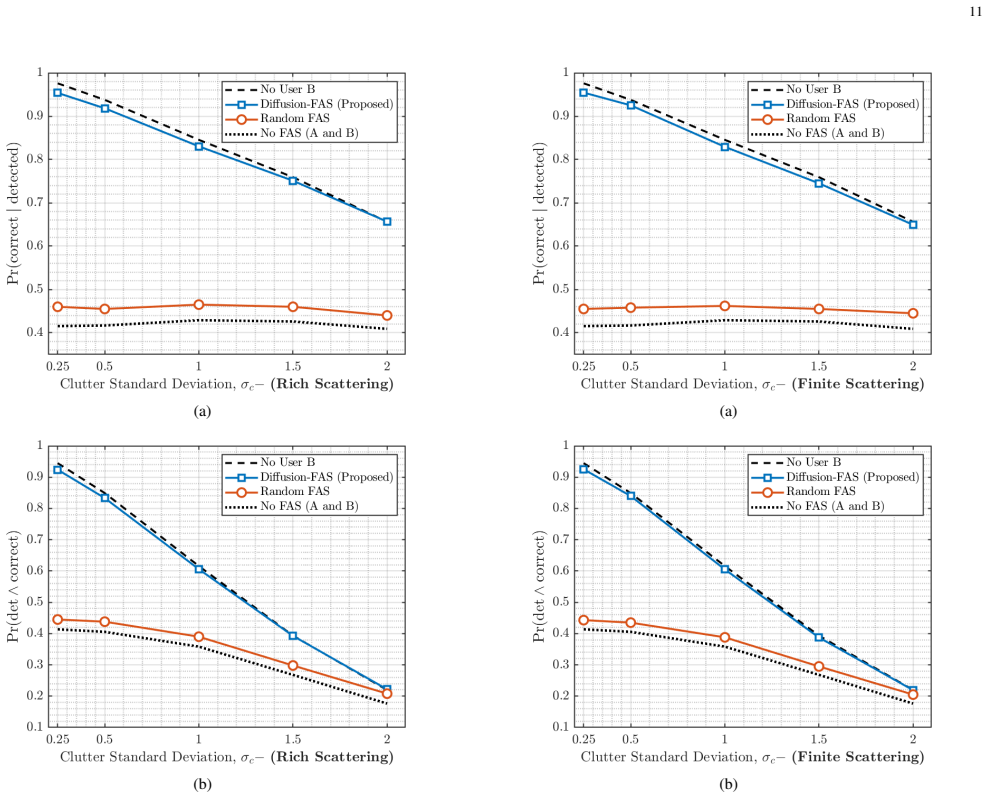
F. Tariqet al., “A speculative study on 6G,”IEEE Wireless Commun., vol. 27, no. 4, pp. 118–125, Aug. 2020. 11 (a) (b) Fig. 9. Impact of the clutter standard deviation (σ c) on localization and detection performance under rich isotropic scattering
work page 2020
-
[2]
On the road to 6G: Visions, requirements, key technologies, and testbeds,
C.-X. Wanget al., “On the road to 6G: Visions, requirements, key technologies, and testbeds,”IEEE Commun. Surv. & Tut., vol. 25, no. 2, pp. 905–974, 2nd Quart. 2023
work page 2023
-
[3]
The road towards 6G: A comprehensive survey,
W. Jiang, B. Han, M. A. Habibi and H. D. Schotten, “The road towards 6G: A comprehensive survey,”IEEE Open J. Commun. Soc., vol. 2, pp. 334–366, 2021
work page 2021
-
[4]
Integrated sensing and communications: Toward dual- functional wireless networks for 6G and beyond,
F. Liuet al., “Integrated sensing and communications: Toward dual- functional wireless networks for 6G and beyond,”IEEE J. Select. Areas Commun., vol. 40, no. 6, pp. 1728–1767, Jun. 2022
work page 2022
-
[5]
K. Wu, Y . Bigdeli, S. A. Keivaan, J. Deng and P. Burasa, “Integrated sensing and communication (ISAC) transceiver: Hardware architectures, enabling technologies, and emerging trends,”IEEE J. Select. Topics Electromag., Antennas & Propag., vol. 1, no. 1, pp. 37–64, Sept. 2025
work page 2025
-
[6]
A unified future: Integrated sensing and communication (ISAC) in 6G,
A. Ghoshet al., “A unified future: Integrated sensing and communication (ISAC) in 6G,”IEEE J. Select. Topics Electromag., Antennas & Propag., vol. 1, no. 1, pp. 365–374, Sept. 2025
work page 2025
-
[7]
A survey on fundamental limits of integrated sensing and communication,
A. Liuet al., “A survey on fundamental limits of integrated sensing and communication,”IEEE Commun. Surv. & Tuts., vol. 24, no. 2, pp. 994–1034, Secondquarter 2022
work page 2022
-
[8]
Enabling joint communication and radar sensing in mobile networks—A survey,
J. A. Zhanget al., “Enabling joint communication and radar sensing in mobile networks—A survey,”IEEE Commun. Surv. & Tuts., vol. 24, no. 1, pp. 306–345, Firstquarter 2022
work page 2022
-
[9]
R. Zhanget al., “Integrated sensing and communication with massive MIMO: A unified tensor approach for channel and target parameter estimation,”IEEE Trans. Wireless Commun., vol. 23, no. 8, pp. 8571– 8587, Aug. 2024
work page 2024
-
[10]
Extremely large-scale MIMO: Fundamentals, chal- lenges, solutions, and future directions,
Z. Wanget al., “Extremely large-scale MIMO: Fundamentals, chal- lenges, solutions, and future directions,”IEEE Wireless Commun., vol. 31, no. 3, pp. 117–124, Jun. 2024
work page 2024
-
[11]
D. A. U. Villalonga, H. OdetAlla, M. J. Fern ´andez-Getino Garc´ıa, and A. Flizikowski, “Spectral efficiency of precoded 5G-NR in single and multi-user scenarios under imperfect channel knowledge: A comprehen- (a) (b) Fig. 10. Impact of the clutter standard deviation (σ c) on localization and detection performance under finite scattering. sive guide for i...
work page 2022
-
[12]
PAPR analysis and mitigation algo- rithms for beamforming MIMO OFDM systems,
Y .-C. Hung and S.-H. L. Tsai, “PAPR analysis and mitigation algo- rithms for beamforming MIMO OFDM systems,”IEEE Trans. Wireless Commun., vol. 13, no. 5, pp. 2588–2600, May 2014
work page 2014
-
[13]
Toward multi- functional 6G wireless networks: Integrating sensing, communication, and security,
Z. Wei, F. Liu, C. Masouros, N. Su and A. P. Petropulu, “Toward multi- functional 6G wireless networks: Integrating sensing, communication, and security,”IEEE Commun. Mag., vol. 60, no. 4, pp. 65–71, Apr. 2022
work page 2022
-
[14]
K. Qu, J. Ye, X. Li and S. Guo, “Privacy and security in ubiquitous integrated sensing and communication: Threats, challenges and future directions,”IEEE Internet Things Mag., vol. 7, no. 4, pp. 52–58, Jul. 2024
work page 2024
-
[15]
Sensing-resistance-oriented design for privacy-concerned secure transmission in ISAC scenarios,
T. Maet al., “Sensing-resistance-oriented design for privacy-concerned secure transmission in ISAC scenarios,”IEEE Trans. Wireless Commun., vol. 24, no. 11, pp. 9391–9406, Nov. 2025
work page 2025
-
[16]
Enabling intelligent connectivity: A survey of secure ISAC in 6G networks,
X. Zhuet al., “Enabling intelligent connectivity: A survey of secure ISAC in 6G networks,”IEEE Commun. Surv. & Tuts., vol. 27, no. 2, pp. 748–781, Apr. 2025
work page 2025
-
[17]
Performance limits of fluid antenna systems,
K. K. Wong, A. Shojaeifard, K.-F. Tong, and Y . Zhang, “Performance limits of fluid antenna systems,”IEEE Commun. Lett., vol. 24, no. 11, pp. 2469–2472, Nov. 2020
work page 2020
-
[18]
K. K. Wong, A. Shojaeifard, K.-F. Tong, and Y . Zhang, “Fluid antenna systems,”IEEE Trans. Wireless Commun., vol. 20, no. 3, pp. 1950–1962, Mar. 2021
work page 1950
-
[19]
W. K. Newet al., “A tutorial on fluid antenna system for 6G networks: Encompassing communication theory, optimization methods and hard- ware designs,”IEEE Commun. Surv. & Tut., vol. 27, no. 4, pp. 2325– 2377, Aug. 2025
work page 2025
-
[20]
A contemporary survey on fluid antenna systems: Fundamentals and networking perspectives,
H. Honget al., “A contemporary survey on fluid antenna systems: Fundamentals and networking perspectives,”IEEE Trans. Netw. Sci. Eng., vol. 13, pp. 2305–2328, 2026. 12 (a) (b) Fig. 11. Impact of the spatial target offset (∆) on localization and detection performance under rich isotropic scattering
work page 2026
-
[21]
Fluid antenna systems: Redefining reconfigurable wireless communications,
W. K. Newet al., “Fluid antenna systems: Redefining reconfigurable wireless communications,”IEEE J. Sel. Areas Commun., vol. 44, pp. 1013–1044, 2026
work page 2026
-
[22]
W.-J. Luet al., “Fluid antennas: Reshaping intrinsic properties for flexible radiation characteristics in intelligent wireless networks,”IEEE Commun. Mag., vol. 63, no. 5, pp. 40–45, May 2025
work page 2025
-
[23]
Fluid antenna systems enabling 6G: Principles, applica- tions, and research directions,
T. Wuet al., “Fluid antenna systems enabling 6G: Principles, applica- tions, and research directions,” to appear inIEEE Wireless Commun., DOI:10.1109/MWC.2025.3629597, 2025
-
[24]
Historical review of fluid antenna and movable antenna,
L. Zhu and K. K. Wong, “Historical review of fluid antenna and movable antenna,”arXiv preprint, arXiv:2401.02362, 2024
-
[25]
Y . Shenet al., “Design and experimental validation of mmWave surface wave enabled fluid antennas for future wireless communications,” to appear inIEEE Antennas & Wireless Propag. Lett., DOI:10.1109/LAWP. 2026.3657059, 2026
-
[26]
R. Wanget al., “Electromagnetically reconfigurable fluid antenna system for wireless communications: Design, modeling, algorithm, fabrication, and experiment,”IEEE J. Sel. Areas Commun., vol. 44, pp. 1464–1479, 2026
work page 2026
-
[27]
S. Zhanget al., “Fluid antenna systems enabled by reconfigurable holographic surfaces: Beamforming design and experimental validation,” IEEE J. Select. Areas Commun., vol. 44, pp. 1417–1431, 2026
work page 2026
-
[28]
Pro- grammable meta-fluid antenna for spatial multiplexing in fast fluctuating radio channels,
B. Liu, K.-F. Tong, K. K. Wong, C.-B. Chae, and H. Wong, “Pro- grammable meta-fluid antenna for spatial multiplexing in fast fluctuating radio channels,”Optics Express, vol. 33, no. 13, pp. 28898–28915, 2025
work page 2025
-
[29]
J. Zhanget al., “A novel pixel-based reconfigurable antenna applied in fluid antenna systems with high switching speed,”IEEE Open J. Antennas & Propag., vol. 6, no. 1, pp. 212–228, Feb. 2025
work page 2025
-
[30]
Wideband pixel-based fluid antenna system: An antenna design for smart city,
B. Liu, T. Wu, K. K. Wong, H. Wong, and K. F. Tong, “Wideband pixel-based fluid antenna system: An antenna design for smart city,” IEEE Internet Things J., vol. 13, no. 4, pp. 6850–6862, Feb. 2026
work page 2026
-
[31]
K. K. Wong, C. Wang, S. Shen, C.-B. Chae and R. Murch, “Recon- figurable pixel antennas meet fluid antenna systems: A paradigm shift (a) (b) Fig. 12. Impact of the spatial target offset (∆) on localization and detection performance under finite scattering. to electromagnetic signal and information processing,”IEEE Wireless Commun., vol. 33, no. 1, pp. 191...
work page 2026
-
[32]
A new analytical ap- proximation of the fluid antenna system channel,
M. Khammassi, A. Kammoun, and M.-S. Alouini, “A new analytical ap- proximation of the fluid antenna system channel,”IEEE Trans. Wireless Commun., vol. 22, no. 12, pp. 8843–8858, Dec. 2023
work page 2023
-
[33]
Fluid antenna system: New insights on outage probability and diversity gain,
W. K. New, K. K. Wong, H. Xu, and K.-F. Tong, “Fluid antenna system: New insights on outage probability and diversity gain,”IEEE Trans. Wireless Commun., vol. 23, no. 5, pp. 4846–4859, Jan. 2024
work page 2024
-
[34]
A new spatial block-correlation model for fluid antenna systems,
P. Ram ´ırez-Espinosa, D. Morales-Jimenez, and K. K. Wong, “A new spatial block-correlation model for fluid antenna systems,”IEEE Trans. Wireless Commun., vol. 23, no. 11, pp. 15829–15843, Nov. 2024
work page 2024
-
[35]
On the diversity and coded modulation design of fluid antenna systems,
C. Psomas, G. M. Kraidy, K. K. Wong, and I. Krikidis, “On the diversity and coded modulation design of fluid antenna systems,”IEEE Trans. Wireless Commun., vol. 23, no. 3, pp. 2082–2096, Mar. 2024
work page 2082
-
[36]
J. D. Vega-S ´anchez, L. F. Urquiza-Aguiar, M. C. P. Paredes, and D. P. M. Osorio, “A simple method for the performance analysis of fluid antenna systems under correlated Nakagami-mfading,”IEEE Wireless Commun. Lett., vol. 13, no. 2, pp. 377–381, Feb. 2024
work page 2024
-
[37]
Novel expressions for the outage probability and diversity gains in fluid antenna system,
J. D. Vega-S ´anchez, A. E. L ´opez-Ram´ırez, L. Urquiza-Aguiar, and D. P. M. Osorio, “Novel expressions for the outage probability and diversity gains in fluid antenna system,”IEEE Wireless Commun. Lett., vol. 13, no. 2, pp. 372–376, Feb. 2024
work page 2024
-
[38]
On the performance of fluid antennas systems under α-µfading channels,
P. D. Alvimet al., “On the performance of fluid antennas systems under α-µfading channels,”IEEE Wireless Commun. Lett., vol. 13, no. 1, pp. 108–112, Jan. 2024
work page 2024
-
[39]
Copula-based performance analysis for fluid antenna systems under arbitrary fading channels,
F. Rostami Ghadi, K. K. Wong, F. Javier L ´opez-Mart´ınez, and K. F. Tong, “Copula-based performance analysis for fluid antenna systems under arbitrary fading channels,”IEEE Commun. Lett., vol. 27, no. 11, pp. 3068–3072, Nov. 2023
work page 2023
-
[40]
A Gaussian copula approach to the performance analysis of fluid antenna systems,
F. Rostami Ghadiet al., “A Gaussian copula approach to the performance analysis of fluid antenna systems,”IEEE Trans. Wireless Commun., vol. 23, no. 11, pp. 17573–17585, Nov. 2024
work page 2024
-
[41]
W. K. New, K. K. Wong, H. Xu, K. F. Tong, and C.-B. Chae, 13 (a) (b) Fig. 13. Probability of detection (P D) vs.M active for Case 1. “An information-theoretic characterization of MIMO-FAS: Optimiza- tion, diversity-multiplexing tradeoff andq-outage capacity,”IEEE Trans. Wireless Commun., vol. 23, no. 6, pp. 5541–5556, Jun. 2024
work page 2024
-
[42]
Channel estimation for FAS-assisted multiuser mmWave systems,
H. Xuet al., “Channel estimation for FAS-assisted multiuser mmWave systems,”IEEE Commun. Lett., vol. 28, no. 3, pp. 632–636, Mar. 2024
work page 2024
-
[43]
Successive Bayesian reconstructor for channel estimation in fluid antenna systems,
Z. Zhang, J. Zhu, L. Dai, and R. W. Heath Jr., “Successive Bayesian reconstructor for channel estimation in fluid antenna systems,”IEEE Trans. Wireless Commun., doi:10.1109/TWC.2024.3515135, 2024
-
[44]
Sparse Bayesian learning-based channel estimation for fluid antenna systems,
B. Xu, Y . Chen, Q. Cui, X. Tao, and K. K. Wong, “Sparse Bayesian learning-based channel estimation for fluid antenna systems,”IEEE Wireless Commun. Lett., vol. 14, no. 2, pp. 325–329, Feb. 2025
work page 2025
-
[45]
Fluid antenna multiple access,
K. K. Wong and K.-F. Tong, “Fluid antenna multiple access,”IEEE Trans. Wireless Commun., vol. 21, no. 7, pp. 4801–4815, Jul. 2022
work page 2022
-
[46]
Fast fluid antenna multiple access enabling massive connectivity,
K. K. Wong, K.-F. Tong, Y . Chen, and Y . Zhang, “Fast fluid antenna multiple access enabling massive connectivity,”IEEE Commun. Lett., vol. 27, no. 2, pp. 711–715, Feb. 2023
work page 2023
-
[47]
Slow fluid antenna multiple access,
K. K. Wong, D. Morales-Jimenez, K. F. Tong, and C.-B. Chae, “Slow fluid antenna multiple access,”IEEE Trans. Commun., vol. 71, no. 5, pp. 2831–2846, May 2023
work page 2023
-
[48]
Revisiting outage probability analysis for two-user fluid antenna multiple access system,
H. Xuet al., “Revisiting outage probability analysis for two-user fluid antenna multiple access system,”IEEE Trans. Wireless Commun., vol. 23, no. 8, pp. 9534–9548, Aug. 2024
work page 2024
-
[49]
Compact ultra massive antenna array: A simple open-loop massive connectivity scheme,
K. K. Wong, C.-B. Chae and K.-F. Tong, “Compact ultra massive antenna array: A simple open-loop massive connectivity scheme,”IEEE Trans. Wireless Commun., vol. 23, no. 6, pp. 6279–6294, Jun. 2024
work page 2024
-
[50]
Oppor- tunistic fluid antenna multiple access,
K. K. Wong, K.-F. Tong, Y . Chen, Y . Zhang, and C.-B. Chae, “Oppor- tunistic fluid antenna multiple access,”IEEE Trans. Wireless Commun., vol. 22, no. 11, pp. 7819–7833, Nov. 2023
work page 2023
-
[51]
Coded fluid antenna multiple access over fast fading channels,
H. Hong, K. K. Wong, K.-F. Tong, H. Shin and Y . Zhang, “Coded fluid antenna multiple access over fast fading channels,”IEEE Wireless Commun. Lett, vol. 14, no. 4, pp. 1249–1253, Apr. 2025
work page 2025
-
[52]
5G-coded fluid antenna multiple access over block fading channels
H. Hong, K. K. Wong, K.-F. Wong, H. Xu and H. Li, “5G-coded fluid antenna multiple access over block fading channels”Electron. Lett., vol. 61, no. 1, pp. e70166, Jan. 2025
work page 2025
-
[53]
Downlink OFDM-FAMA in 5G-NR systems,
H. Honget al., “Downlink OFDM-FAMA in 5G-NR systems,”IEEE Trans. Wireless Commun., vol. 24, no. 12, pp. 10116–10132, Dec. 2025
work page 2025
-
[54]
Turbocharging fluid antenna multiple access,
N. Waqar, K. K. Wong, C.-B. Chae, and R. Murch, “Turbocharging fluid antenna multiple access,”IEEE Transactions on Wireless Communica- tions, vol. 25, pp. 4038–4052, 2026
work page 2026
-
[55]
Attentional copula- aided turbo fluid antenna massive access,
N. Waqar, K. K. Wong, C.-B. Chae, and R. Murch, “Attentional copula- aided turbo fluid antenna massive access,”IEEE Wireless Communica- tions Letters, vol. 15, pp. 1951–1955, 2026
work page 1951
-
[56]
Deep learning enabled slow fluid antenna multiple access,
N. Waqar, K. K. Wong, K. F. Tong, A. Sharples, and Y . Zhang, “Deep learning enabled slow fluid antenna multiple access,”IEEE Commun. Lett., vol. 27, no. 3, pp. 861–865, Mar. 2023
work page 2023
-
[57]
cGAN-based slow fluid antenna multiple access,
M. Eskandari, A. Burr, K. Cumanan, and K. K. Wong, “cGAN-based slow fluid antenna multiple access,”IEEE Wireless Commun. Lett., vol. 13, no. 10, pp. 2907–2911, Oct. 2024
work page 2024
-
[58]
Opportunistic fluid antenna multiple access via team-inspired reinforcement learning,
N. Waqaret al., “Opportunistic fluid antenna multiple access via team-inspired reinforcement learning,”IEEE Transactions on Wireless Communications, vol. 23, no. 9, pp. 12068–12083, Sept. 2024
work page 2024
-
[59]
Fluid antenna multiple access for 6G: A holistic review,
H. Honget al., “Fluid antenna multiple access for 6G: A holistic review,” IEEE Open J. Commun. Soc., vol. 7, pp. 2607–2633, 2026
work page 2026
-
[60]
AI-empowered fluid antenna systems: Opportunities, challenges and future directions,
C. Wanget al., “AI-empowered fluid antenna systems: Opportunities, challenges and future directions,”IEEE Wireless Commun., vol. 31, no. 5, pp. 34–41, Oct. 2024
work page 2024
-
[61]
C. Wanget al., “Large language model empowered design of fluid antenna systems: Challenges, frameworks, and case studies for 6G,” IEEE Wireless Commun., vol. 33, no. 2, pp. 117–125, Apr. 2026
work page 2026
-
[62]
LLM-driven design for fluid antenna systems,
C. Wanget al., “LLM-driven design for fluid antenna systems,”IEEE Wireless Commun. Lett., vol. 15, pp. 1065–1069, 2026
work page 2026
-
[63]
Fluid antenna enabling secret communications,
B. Tanget al., “Fluid antenna enabling secret communications,”IEEE Commun. Lett., vol. 27, no. 6, pp. 1491–1495, Jun. 2023
work page 2023
-
[64]
Coding-enhanced cooperative jamming for secret commu- nication in fluid antenna systems,
H. Xuet al., “Coding-enhanced cooperative jamming for secret commu- nication in fluid antenna systems,”IEEE Commun. Lett., vol. 28, no. 9, pp. 1991–1995, Sept. 2024
work page 1991
-
[65]
Physical layer security over fluid antenna systems: Secrecy performance analysis,
F. R. Ghadiet al., “Physical layer security over fluid antenna systems: Secrecy performance analysis,”IEEE Trans. Wireless Commun., vol. 23, no. 12, pp. 18201–18213, Dec. 2024
work page 2024
-
[66]
Fluid antenna system: Secrecy outage probability analysis,
J. D. Vega-S ´anchez, L. F. Urquiza-Aguiar, H. R. C. Mora, N. V . O. Garz´on, and D. P. M. Osorio, “Fluid antenna system: Secrecy outage probability analysis,”IEEE Trans. Veh. Technol., vol. 73, no. 8, pp. 11458–11469, Aug. 2024
work page 2024
-
[67]
On performance of FAS-aided covert communications,
F. Rostami Ghadi, M. Kaveh, R. J ¨antti, and F. J. L ´opez-Mart´ınez, “On performance of FAS-aided covert communications,” inProc. IEEE Veh. Technol. Conf. (VTC-Spring), 17-20 Jun. 2025, Oslo, Norway
work page 2025
-
[68]
Fluid antenna system liberating multiuser MIMO for ISAC via deep reinforcement learning,
C. Wanget al., “Fluid antenna system liberating multiuser MIMO for ISAC via deep reinforcement learning,”IEEE Trans. Wireless Commun., vol. 23, no. 9, pp. 10879–10894, Sept. 2024
work page 2024
-
[69]
Fluid antenna-assisted ISAC systems,
L. Zhou, J. Yao, M. Jin, T. Wu, and K. K. Wong, “Fluid antenna-assisted ISAC systems,”IEEE Wireless Commun. Lett., vol. 13, no. 12, pp. 3533– 3537, Dec. 2024
work page 2024
-
[70]
Shifting the ISAC trade-off with fluid antenna sys- tems,
J. Zouet al., “Shifting the ISAC trade-off with fluid antenna sys- tems,”IEEE Wireless Commun. Lett., vol. 13, no. 12, pp. 3479–3483, Dec. 2024
work page 2024
-
[71]
K. Meng, C. Masouros, K. K. Wong, A. P. Petropulu, and L. Hanzo, “Integrated sensing and communication meets smart propagation en- gineering: Opportunities and challenges,”IEEE Netw., vol. 39, no. 2, pp. 278–285, Mar. 2025
work page 2025
-
[72]
Diffusion models for wireless communications,
M. Letafati, S. Ali, and M. Latva-aho, “Diffusion models for wireless communications,”arXiv preprint, arXiv:2310.07312, 2023
-
[73]
CDDM: Channel denoising diffusion models for wireless semantic communications,
T. Wuet al., “CDDM: Channel denoising diffusion models for wireless semantic communications,”IEEE Trans. Wireless Commun., vol. 23, no. 9, pp. 11168–11183, Sept. 2024
work page 2024
-
[74]
Diffusion- based generative prior for low-complexity MIMO channel estima- tion,
B. Fesl, M. Baur, F. Strasser, M. Joham, and W. Utschick, “Diffusion- based generative prior for low-complexity MIMO channel estima- tion,”IEEE Wireless Commun. Lett., vol. 13, no. 12, pp. 3493–3497, Dec. 2024
work page 2024
-
[75]
GDM4MMIMO: Generative diffusion models for massive MIMO communications,
Z. Jinet al., “GDM4MMIMO: Generative diffusion models for massive MIMO communications,”arXiv preprint, arXiv:2412.18281, 2024
-
[76]
H. Duet al., “Enhancing deep reinforcement learning: A tutorial on generative diffusion models in network optimization,”IEEE Commun. Surv. & Tut., vol. 26, no. 4, pp. 2611–2646, Fourthquarter 2024
work page 2024
-
[77]
Erasing noise in signal detection with diffusion model: From theory to application,
X. Wang, P. Zheng, and N. Cheng, “Erasing noise in signal detection with diffusion model: From theory to application,”arXiv preprint, arXiv: 2501.07030, 2025
discussion (0)
Sign in with ORCID, Apple, or X to comment. Anyone can read and Pith papers without signing in.