REVIEW 5 major objections 6 minor 44 references
Decision-Focused Learning for Complex System Identification: HVAC Management System Application
T0 review · 5 major / 6 minor · reviewed 2026-08-10 · deepseek-v4-flash
Pith's one-line read This paper claims that system identification and control can be done simultaneously by differentiating through the convex optimization policy, cutting HVAC cost underestimation from sixfold to 3%.
desk verdict A plausible extension of DFL to learning dynamics parameters inside convex policies, but the headline improvement is not fully attributed because the ITO baseline trains on off-policy data. read the letter →
The pith
A machine-rendered reading of the paper's core claim, the machinery that carries it, and where it could break.
The reading
What carries the argument
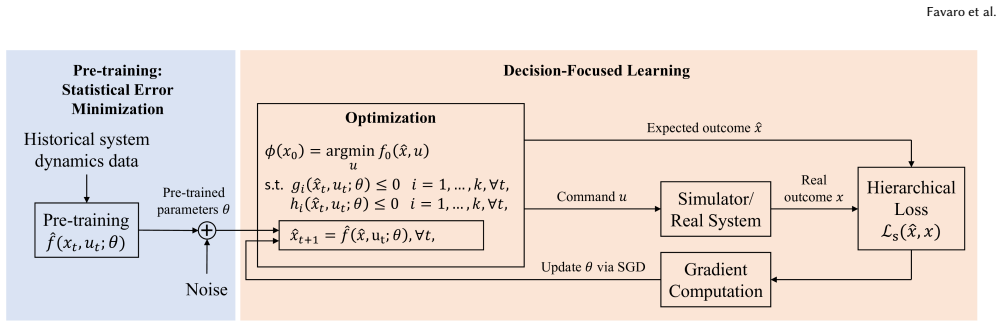
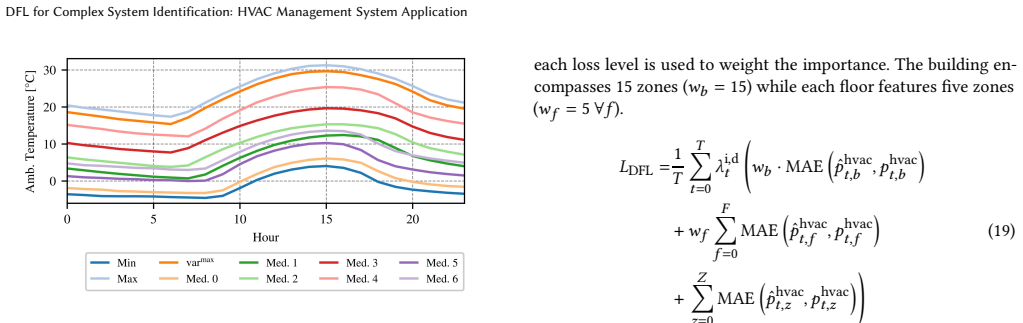
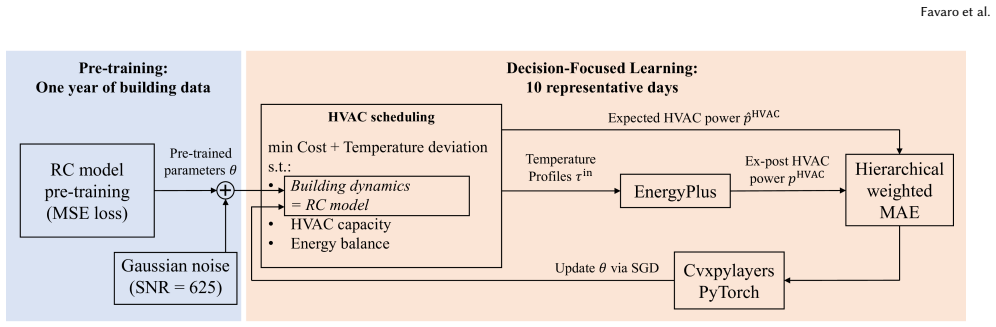
The central mechanism is differentiation through the control policy: the policy is a convex optimization program in conic form (a standard embedding of convex programs), and gradients of its optimal command with respect to the learned model parameters are obtained by implicit differentiation of the self-homogeneous dual embedding of the KKT system. This lets the 265 parameters of the linear RC model (inter-zonal heat transfer, zonal resistances and capacitances, and heating and cooling efficiencies) be updated at each training step. To make learning possible without a differentiable system model, the loss compares the expected HVAC power from the optimization with the observed power from simulating the policy, using a hierarchical price-weighted MAE at building, floor, and zone level. Pre-training on historical data plus a quadratic relaxation of the state-target constraint keeps the evolving optimization problem feasible.
What would settle it
Apply the same DFL pipeline to a second building whose true thermal parameters are known by construction, then hold out a different occupancy or internal-heat-gain schedule: if the learned parameters do not reproduce observed zone temperatures, or if the ex-post cost error grows back toward the supervised baseline under the new schedule, the claim that task-aware training repairs model mismatch is falsified.
Extended reading notes
Core claim
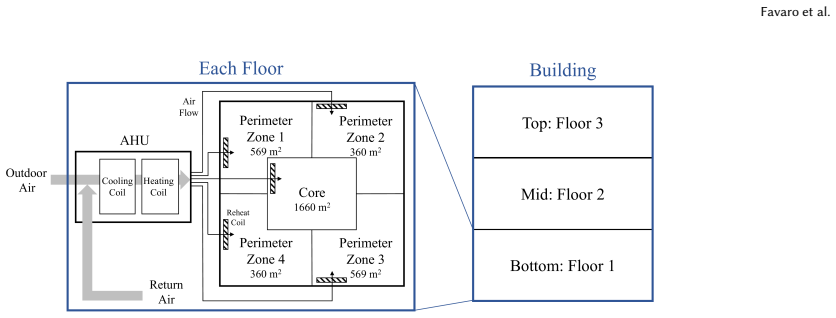
The paper's central claim is that decision-focused learning can be leveraged for system identification: the parameters of the system dynamics, expressed as constraints of a convex optimization control policy, can be learned while the control signal is being optimized. In the Denver 15-zone case study, the conventional RC building model trained by supervised learning on historical data yields expected HVAC costs far below what actually happens, with ex-post cost on average about six times the expected value. The same RC model with parameters obtained by the proposed DFL loss underestimates ex-post cost by only 3%, and its ex-post cost is slightly lower than the supervised baseline's. Under a distribution shift toward a hotter year, the DFL model keeps a small cost error (15 euros) while the supervised baseline's error grows (420 euros). The intended conclusion is that simultaneous identification and control focuses the model's capacity on the operating regions the policy actually uses, making even a simple grey-box model adequate.
Load-bearing premise
The load-bearing premise is that the 265-parameter linear RC model, driven only by ambient temperature, is structurally adequate for day-ahead HVAC scheduling in this building; if that grey-box form is misspecified, DFL can lower the supervised power-mismatch loss on the ten training days while the learned parameters remain non-identifiable or fail to generalize to new weather and occupancy regimes.
Editorial extensions
If this is right
- Day-ahead HVAC schedules built on a simple linear RC model can be made cost-accurate without a white-box model, provided the model parameters are learned with the control objective in view.
- A model that minimizes prediction error on historical data can still be badly wrong for control: the supervised baseline underestimates the actual bill by roughly a factor of six, so task-aware identification is needed when historical data do not cover policy-induced operating conditions.
- Because the loss requires only observable state variables, the approach extends to black-box and non-differentiable systems where repeated experiments under identical conditions are impossible.
- Constraint relaxation and historical pre-training make the end-to-end updates robust to the feasibility domain changing at every gradient step.
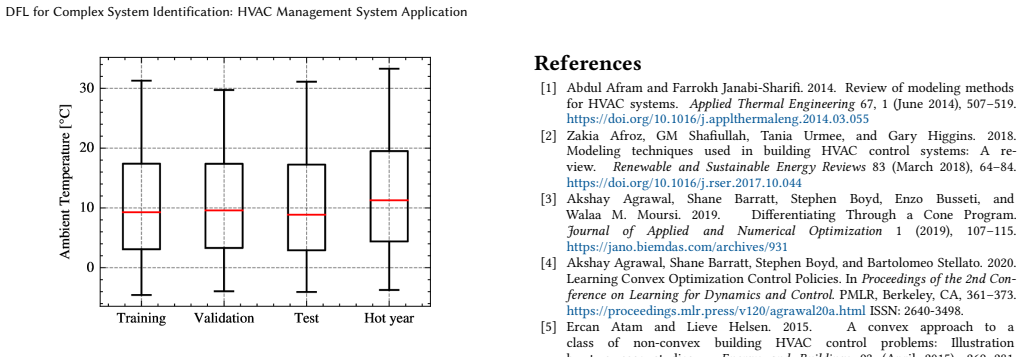
- The advantage carries over to distribution shift: under a hotter-year scenario the DFL model's cost error stays near the test-set level, while the supervised baseline's cost error grows.
Reading between the lines
- A natural generalization is that any convex control policy with observable state variables could be re-identified on-policy after deployment, so model mismatch can be repaired without waiting for a new historical dataset covering the new operating region.
- The single-input structure of the RC model (only ambient temperature) makes it plausible that the learned 265 parameters are not uniquely identifiable; if so, the method's success may lie in finding a parameter set that is cost-equivalent over the training days rather than physically correct.
- A stress-test worth running is to change occupancy or internal heat gains after training; the paper's own discussion attributes remaining inaccuracies to the RC model's limited structure, so the 3% error may deteriorate when the thermal regime leaves the training distribution in a dimension other than ambient temperature.
- An ablation separating the effect of the quadratic discomfort regularization from the DFL loss would clarify how much of the gain comes from task-aware identification and how much from feasibility enforcement.
Editorial analysis
A structured set of objections, weighed in public.
Referee Report
Summary. The manuscript proposes a decision-focused learning (DFL) framework for simultaneous system identification and control. A linear RC network with learnable parameters is embedded as a constraint of a convex day-ahead HVAC scheduling problem, and the parameters are updated by differentiating through the optimization with Cvxpylayers, using a supervised loss on the mismatch between expected and observed system outputs. The method is evaluated on a 15-zone EnergyPlus office building in Denver, comparing DFL-trained RC parameters with an identify-then-optimize (ITO) baseline trained by MSE on historical data. The paper reports that ITO underestimates ex-post electricity cost by 389 EUR on the test set, while DFL underestimates it by only 16 EUR, and that DFL also reduces the ex-post cost from 474 to 468 EUR.
Significance. If the reported effect is causal, the paper makes a useful methodological contribution: it demonstrates that parameters of a linear dynamics model appearing as constraints of a convex optimal control problem can be learned in a task-aware manner without differentiating the true (black-box) system. The realistic EnergyPlus case study and the proposal of a hierarchical price-weighted loss are valuable. However, the empirical evidence is not yet conclusive: the main comparison confounds the decision-focused loss with on-policy data access; the results are from a single run with no seed averaging or code; and the large cost-error improvement is partly a direct consequence of optimizing a price-weighted power-error loss. The paper is nevertheless a worthwhile contribution to the eess.SY community and the central idea is worth pursuing.
major comments (5)
- [§2.2, Eq. (3)] The chain rule in Eq. (3) is incomplete. The loss L in Eq. (7) depends on the expected states and powers, which are functions of θ both through the optimal commands u(θ) and directly through the dynamics constraints in Eq. (2) and Eq. (8). The total derivative should include the dependence of the predicted trajectory on θ at fixed u, e.g., dL/dθ = ∂L/∂ŷ(∂ŷ/∂θ + ∂ŷ/∂u du/dθ). The Cvxpylayers implementation may compute the correct total derivative of the full solution map, but as written Eq. (3) omits the direct dependence of the predicted states on θ. Please correct the derivation or clarify what is meant by the 'command' variable in this chain rule.
- [§3.4, Eq. (19) and §3.5, Table 1] The central quantitative claim, that DFL reduces the cost underestimation from 389 to 16 EUR, is largely a consequence of the loss design. Eq. (19) is a price-weighted MAE on exactly the HVAC power error whose price-weighted sum is the cost error. Thus the improvement in cost prediction is not independent evidence for better system identification. The independent result is the ex-post cost reduction (474 vs 468 EUR), which is not directly optimized. To support the attribution, compare against a baseline trained on the same on-policy data with a task-agnostic loss, such as unweighted power MSE or MAE, and report the cost error of that baseline.
- [§3.5, Table 1 and §1.2] The comparison conflates decision-focused loss with on-policy data access. The ITO baseline is trained on historical data generated without the optimized control policy, whereas DFL is trained on data generated under the policy being evaluated. Since the paper's motivation is that historical data become uninformative under a new policy, the natural control is an iterative on-policy ITO: repeatedly fit the RC model by MSE on data observed under the current model's schedule, re-solve the day-ahead problem, and iterate. Without such a baseline, the improvement cannot be attributed to DFL's task-aware weighting rather than to simply retraining on data from the policy's operating region. This concern is load-bearing for the abstract's attribution claim.
- [§3.3, §3.5, Tables 1 and 2] All reported results come from a single run, with no seed averaging, no confidence intervals, and no code. The claim that the model 'generalizes effectively' rests on two validation days per cluster, which is a thin basis for the strong conclusions drawn. Please report mean and standard deviation over multiple random seeds (or at least over multiple data splits) and specify how the k-medoid clustering and the initial parameter noise are seeded.
- [§3.4, §3.5] Important hyperparameters and experimental details are under-specified: the thermal comfort penalty weights w_{t,z} in Eq. (9), the relaxation weight used in the quadratic regularization, and the exact schedule for the learning rate and early stopping are not reported or justified. These choices affect the optimized schedules and therefore the learned parameters. Please provide a full parameter table or release the code so that the experiments can be reproduced.
minor comments (6)
- [§2.3, Eq. (7)] The loss is defined on the state error, but the case study in §3.4 uses HVAC power. Please clarify whether the 'system state' is meant to include derived power variables or define explicitly how ŵ is computed from the optimization solution.
- [§3.5, Table 1] Please define 'error mean' and 'error std': are they the mean and standard deviation of the per-hour building-level power error (predicted minus actual), and if so, state the unit.
- [§3.3] The description of the k-medoid clustering is incomplete: the number of random restarts or the seeding of the additional seven medoids is not specified, which affects reproducibility.
- [§3.6] The construction of the hot-year dataset is ad hoc: please specify exactly why only the sample associated with the hot test cluster is shifted by 2°C and how that sample is selected.
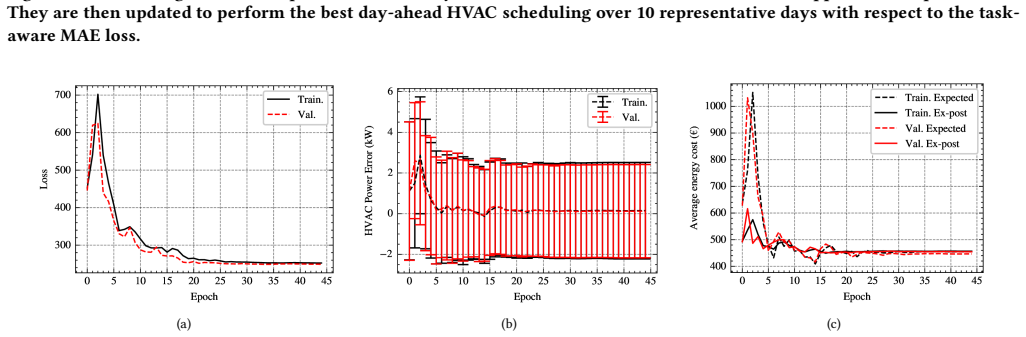
- [§3.5] The sentence 'training converges at the minimum ex-post cost over all epochs' is ambiguous, since the model selection rule is early stopping on validation loss rather than on ex-post cost. Please clarify the selection rule.
- [Eqs. (9) and (19)] The equations contain garbled fragments in the current PDF, such as the braces in Eq. (9) and the definition of floor-level power in Eq. (19). Please ensure the final typeset version renders correctly.
Circularity Check
No circularity: the DFL loss is a supervised surrogate (Eq. 19) and the ex-post cost, test-set metrics come from EnergyPlus on held-out days, so the main comparison is self-contained.
full rationale
The paper's derivation chain is not circular. The RC-model parameters are learned by minimizing the hierarchical price-weighted MAE loss (Eq. 19), which measures mismatch between expected and EnergyPlus-simulated HVAC power. The reported cost error is not equal to this loss: it is a signed, demand-charge-adjusted difference between expected and ex-post costs, evaluated on validation and test days not used for DFL training. Hence the improvement from a 389-euro cost error (ITO) to a 16-euro error (DFL) is an empirical consequence of the learned parameters, not an identity. The paper uses external, independently validated components (EnergyPlus, Cvxpylayers, ECOS, the RC grey-box model) and contains no load-bearing self-citations or imported uniqueness claims. The absence of an on-policy supervised-learning baseline is a potential confound for attributing the improvement to decision-focused weighting rather than to on-policy data, but that is an experimental-design/correctness concern, not circularity. The cost-error metric and the training loss are purposefully aligned, but alignment without equality is not circularity.
Assumptions & free parameters
free parameters (4)
- Thermal comfort penalty weight w_{t,z} =
not reported numerically
- Pre-training noise scale (Gaussian sigma = theta_i / 25) =
SNR = 625
- Hierarchical loss weights w_F = 15 and w_f = 5 =
15 and 5
- Number of medoids k = 10 =
10
assumptions (4)
- domain assumption The building's true thermal dynamics are adequately representable by the linear RC model (Eq. 10) with 265 parameters driven only by ambient temperature.
- domain assumption The state variables used in the loss are observable and measured with negligible noise.
- standard math The convex control policy has a unique solution, so Cvxpylayers can compute a well-defined derivative.
- domain assumption Historical data were generated without optimal scheduling, so historical operating points do not cover the policy's trajectory distribution.
Cite this review
Pith. "Pith review of Decision-Focused Learning for Complex System Identification: HVAC Management System Application." pith.science (2026). https://pith.science/paper/JLYZ6KJL
@misc{pith2026250114708,
  author       = {Pith},
  title        = {Pith review of: Decision-Focused Learning for Complex System Identification: HVAC Management System Application},
  year         = {2026},
  howpublished = {\url{https://pith.science/paper/JLYZ6KJL}},
  note         = {Machine review of arXiv:2501.14708}
}
read the original abstract
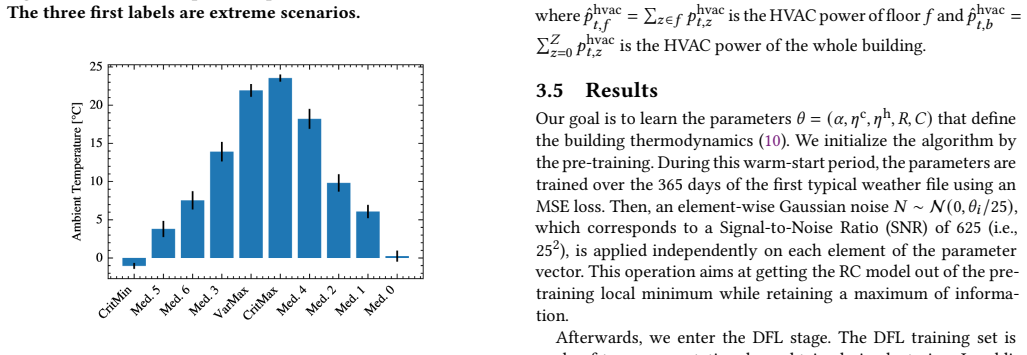
As opposed to conventional training methods tailored to minimize a given statistical metric or task-agnostic loss (e.g., mean squared error), Decision-Focused Learning (DFL) trains machine learning models for optimal performance in downstream decision-making tools. We argue that DFL can be leveraged to learn the parameters of system dynamics, expressed as constraint of the convex optimization control policy, while the system control signal is being optimized, thus creating an end-to-end learning framework. This is particularly relevant for systems in which behavior changes once the control policy is applied, hence rendering historical data less applicable. The proposed approach can perform system identification - i.e., determine appropriate parameters for the system analytical model - and control simultaneously to ensure that the model's accuracy is focused on areas most relevant to control. Furthermore, because black-box systems are non-differentiable, we design a loss function that requires solely to measure the system response. We propose pre-training on historical data and constraint relaxation to stabilize the DFL and deal with potential infeasibilities in learning. We demonstrate the usefulness of the method on a building Heating, Ventilation, and Air Conditioning day-ahead management system for a realistic 15-zone building located in Denver, US. The results show that the conventional RC building model, with the parameters obtained from historical data using supervised learning, underestimates HVAC electrical power consumption. For our case study, the ex-post cost is on average six times higher than the expected one. Meanwhile, the same RC model with parameters obtained via DFL underestimates the ex-post cost only by 3%.
Figures
Figures from the paper (6 more)
Reference graph
Works this paper leans on
-
[4]
Akshay Agrawal, Shane Barratt, Stephen Boyd, and Bartol omeo Stellato. 2020. Learning Convex Optimization Control Policies. In Proceedings of the 2nd Con- ference on Learning for Dynamics and Control . PMLR, Berkeley, CA, 361–373. https://proceedings.mlr.press/v120/agrawal20a.html ISSN: 2640-3498
work page 2020
-
[1]
Abdul Afram and Farrokh Janabi-Sharifi. 2014. Review of m odeling methods for HV AC systems. Applied Thermal Engineering 67, 1 (June 2014), 507–519. https://doi.org/10.1016/j.applthermaleng.2014.03.055
-
[2]
Zakia Afroz, GM Shafiullah, Tania Urmee, and Gary Higgins . 2018. Modeling techniques used in building HV AC control systems: A re- view. Renewable and Sustainable Energy Reviews 83 (March 2018), 64–84. https://doi.org/10.1016/j.rser.2017.10.044
-
[3]
Akshay Agrawal, Shane Barratt, Stephen Boyd, Enzo Busse ti, and Walaa M. Moursi. 2019. Differentiating Through a Cone Progra m. Journal of Applied and Numerical Optimization 1 (2019), 107–115. https://jano.biemdas.com/archives/931
work page 2019
-
[5]
Ercan Atam and Lieve Helsen. 2015. A convex approach to a class of non-convex building HV AC control problems: Illust ration by two case studies. Energy and Buildings 93 (April 2015), 269–281. https://doi.org/10.1016/j.enbuild.2015.02.026
-
[6]
Mokhtar S. Bazaraa, John J. Jarvis, and Hanif D. Sherali. 2009. The Simplex Method . John Wiley & Sons, Ltd, Hoboken, NJ, US, Chapter 3, 91–149. https : / / doi .org / 10 .1002 / 9780471703778 .ch3 arXiv:https://onlinelibrary.wiley.com/doi/pdf/10.1002/9780471703778.ch3
-
[7]
Filip Belić, Željko Hocenski, and Dražen Slišković. 201 6. Thermal modeling of buildings with RC method and parameter estimation. In 2016 International Conference on Smart Systems and Technologies (SST) . IEEE, Osijek, Croatia, 19–
work page 2016
-
[8]
Enzo Busseti, Walaa M. Moursi, and Stephen Boyd. 2019. So lution refinement at regular points of conic problems. Computational Optimization and Applications 74, 3 (Dec. 2019), 627–643. https://doi.org/10.1007/s10589-019-00122-9
Show all 44 references
-
[9]
Marie Chau and Michael C. Fu. 2015. An Overview of Sto- chastic Approximation . Springer, New York, NY. 149–178 pages. https://doi.org/10.1007/978-1-4939-1384-8_6
2015 doi
-
[10]
Drury Crawley, Linda Lawrie, Frederick Winkelmann, W. F. Buhl, Y.Joe Huang, Curtis Pedersen, Richard Strand, Richard Liesen, Daniel Fi sher, Michael Witte, and Jason Glazer. 2001. EnergyPlus: Creating a New-Generat ion Building Energy Simulation Program. Energy and Buildings 3...
2001 doi
-
[11]
Donti, Brandon Amos, and J
Priya L. Donti, Brandon Amos, and J. Zico Kolter. 2017. T ask-based end-to- end model learning in stochastic optimization. In Proceedings of the 31st Inter- national Conference on Neural Information Processing Syste ms (NIPS’17). Curran Associates Inc., Red Hook, NY, USA, 5490–5500
2017
-
[12]
Tuor, Vikas Chandan, and Draguna L
Ján Drgoňa, Aaron R. Tuor, Vikas Chandan, and Draguna L. Vra- bie. 2021. Physics-constrained deep learning of multi-zon e build- ing thermal dynamics. Energy and Buildings 243 (July 2021), 110992. https://doi.org/10.1016/j.enbuild.2021.110992
2021
-
[13]
Diana D’Agostino, Roberto Landolfi, Maurizio Nicolell a, and Francesco Minichiello. 2022. Experimental Study on the Performance D ecay of Thermal Insulation and Related Influence on Heating Energy Consumpt ion in Buildings. Sustainability 14, 5 (Jan. 2022), 2947. https://doi.org...
2022 doi
-
[14]
Predic t, then Optimize
Adam N. Elmachtoub and Paul Grigas. 2022. Smart “Predic t, then Optimize”. Manage. Sci. 68, 1 (Jan. 2022), 9–26. https://doi.org/10.1287/mnsc.2020.3922
2022
-
[15]
González-Torres, L
M. González-Torres, L. Pérez-Lombard, Juan F. Coronel , Ismael R. Maestre, and Da Yan. 2022. A review on buildings energy information: T rends, end-uses, fuels and drivers. Energy Reports 8 (Nov. 2022), 626–637. https://doi.org/10.1016/j.egyr.2021.11.280
2022 doi
-
[16]
Raad Z. Homod. 2013. Review on the HV AC System Modeling T ypes and the Shortcomings of Their Application. Journal of Energy 2013, 1 (2013), 768632. https : / / doi .org / 10.1155 / 2013 / 768632 _eprint: https://onlinelibrary.wiley.com/doi/pdf/10.1155/2013/768632
2013 doi
-
[17]
Hao Huang, Lei Chen, and Eric Hu. 2014. Model predictive control for energy- efficient buildings: An airport terminal building study. In11th IEEE International Conference on Control & Automation (ICCA) . IEEE, Piscataway, NJ, USA, 1025–
2014
-
[18]
Doseok Jang, Larry Yan, Lucas Spangher, and Costas J. Sp anos. 2024. Ac- tive Reinforcement Learning for Robust Building Control. Proceedings of the AAAI Conference on Artificial Intelligence 38, 20 (Mar. 2024), 22150–22158. https://doi.org/10.1609/aaai.v38i20.30219
2024 doi
-
[19]
Scott Jeen, Alessandro Abate, and Jonathan M. Cullen. 2 023. Low emis- sion building control with zero-shot reinforcement learni ng. In Proceed- ings of the Thirty-Seventh AAAI Conference on Artificial Int elligence and Thirty-Fifth Conference on Innovative Applications of Art ...
-
[20]
Yi-hao Kao, Benjamin Roy, and Xiang Yan. 2009. Directed Re- gression. In Advances in Neural Information Processing Systems , Y. Bengio, D. Schuurmans, J. Lafferty, C. Williams, and A. Cul otta (Eds.), Vol. 22. Curran Associates, Inc., Vancouver, B.C., Canada. https://proceeding...
2009
- [21]
-
[22]
Kircher and K
Kevin J. Kircher and K. Max Zhang. 2015. On the lumped cap acitance approxi- mation accuracy in RC network building models. Energy and Buildings 108 (Dec. 2015), 454–462. https://doi.org/10.1016/j.enbuild.2015.09.053
2015 doi
- [23]
-
[24]
Arkadi Nemirovski. 2007. Advances in Convex Optimizat ion: Conic Program- ming. In International Congress of Mathematicians , Vol. 1. EMS Press, Zürich, Switzerland, 413–444
2007
-
[25]
https://doi.org/10.1109/SST.2016.7765626
2016
-
[26]
Brendan O’Donoghue, Eric Chu, Neal Parikh, and Stephen Boyd. 2016. Conic Optimization via Operator Splitting and Homogeneous Self- Dual Embedding. Journal of Optimization Theory and Applications 169, 3 (June 2016), 1042–1068. https://doi.org/10.1007/s10957-016-0892-3
2016 doi
-
[27]
Lukas Ortmann, Fabian Böhm, Florian Klein-Helmkamp, A ndreas Ulbig, Save- rio Bolognani, and Florian Dörfler. 2024. Tuning and Testing an Online Feed- back Optimization Controller to Provide Curative Distribu tion Grid Flexibility. http://arxiv.org/abs/2403.01782 arXiv:2403.017...
2024 arXiv
-
[28]
S. M. Hosseini, R. Carli, and M. Dotoli. 2019. Robust Day -Ahead Energy Scheduling of a Smart Residential User Under Uncerta inty. In 2019 18th European Control Conference (ECC) . IEEE, Naples, Italy, 935–940. https://doi .org/10 .23919/ECC .2019.8796182 Journal Abbreviation: ...
2019
-
[29]
Lolla Phani Raghav, Rangu Seshu Kumar, Dhenuvakonda Ko teswara Raju, and Arvind R. Singh. 2022. Optimal day ahead energy consumption management in grid-connected microgrids. International Journal of Energy Research 46, 2 (Feb. 2022), 1864–1881. https://doi .org/10 .1002/er .73...
2022
-
[30]
Susannah Shoemaker. 2023. NREL Researchers Reveal How Buildings Across United States Do—and Could—Use Energy. https://www.nrel.gov/news/features/2023/nrel-researchers-reveal-how- buildings-across-the-united-states-do-and-could-use -energy.html. Accessed: 2024-05-25
2023
-
[31]
Sanket Shah, Kai Wang, Bryan Wilder, Andrew Perrault, a nd Milind Tambe
-
[32]
Jianwen Sun, Yan Zheng, Jianye Hao, Zhaopeng Meng, and Y ang Liu. 2020. Con- tinuous Multiagent Control Using Collective Behavior Entr opy for Large-Scale Home Energy Management. Proceedings of the AAAI Conference on Artificial In- telligence 34, 01 (April 2020), 922–929. https...
2020 doi
-
[33]
Department of Energy
U.S. Department of Energy. 2019. https://www.energycodes.gov/sites/default/files/2023-10/ASHRAE901_OfficeMedium_STD2019.zip. Accessed: 2024-06-24
2019
-
[34]
Mattia Silvestri, Senne Berden, Jayanta Mandi, Ali Irf an Mahmutogulları, Bran- don Amos, Tias Guns, and Michele Lombardi. 2024. Score Funct ion Gra- dient Estimation to Widen the Applicability of Decision-Fo cused Learning. http://arxiv.org/abs/2307.05213 arXiv:2307.05213 [cs]
2024 arXiv
-
[35]
Zhenbo Wang. 2024. A survey on convex optimization for g uidance and con- trol of vehicular systems. Annual Reviews in Control 57 (Jan. 2024), 100957. https://doi.org/10.1016/j.arcontrol.2024.100957
2024
-
[36]
Bryan Wilder, Bistra Dilkina, and Milind Tambe. 2019. M elding the Data- Decisions Pipeline: Decision-Focused Learning for Combinatorial Optimization. Proceedings of the AAAI Conference on Artificial Intelligenc e 33, 01 (July 2019), 1658–1665. https://doi.org/10.1609/aaai.v33i...
2019 doi
-
[37]
Dariush Wahdany, Carlo Schmitt, and Jochen L. Cremer. 2 023. More than accuracy: end-to-end wind power forecasting that opti mises the en- ergy system. Electric Power Systems Research 221 (Aug. 2023), 109384. https://doi.org/10.1016/j.epsr.2023.109384
2023
-
[38]
Liang Yu, Shuqi Qin, Meng Zhang, Chao Shen, Tao Jiang, an d Xiaohong Guan
-
[39]
Yaohui Zeng, Zijun Zhang, and Andrew Kusiak. 2015. Pred ictive modeling and optimization of a multi-zone HV AC system with d ata mining and firefly algorithms. Energy 86 (June 2015), 393–402. https://doi.org/10.1016/j.energy.2015.04.045
2015 doi
-
[40]
Todd, and Shinji Mizuno
Yinyu Ye, Michael J. Todd, and Shinji Mizuno. 1994. An O s qrt(nL)-Iteration Ho- mogeneous and Self-Dual Linear Programming Algorithm. Mathematics of Op- erations Research 19, 1 (Feb. 1994), 53–67. https://doi.org/10.1287/moor.19.1.53 Publisher: INFORMS
1994 doi
-
[44]
S. L. Zhou, A. A. Shah, P. K. Leung, X. Zhu, and Q. Liao. 202 3. A comprehensive review of the applications of machine learning for HV AC. DeCarbon 2 (Sept. 2023), 100023. https://doi.org/10.1016/j.decarb.2023.100023
2023
-
[1030]
https://doi.org/10.1109/ICCA.2014.6871061 ISSN: 1948-3457
2014
-
[2021]
IEEE Internet of Things Journal 8, 15 (Aug
A Review of Deep Reinforcement Learning for Smart Buil ding Energy Management. IEEE Internet of Things Journal 8, 15 (Aug. 2021), 12046–12063. https://doi.org/10.1109/JIOT.2021.3078462 Conference Name: IEEE Internet of Things Journal
2021
-
[2022]
In Advances in Neural Information Processing Systems, S
Decision-Focused Learning without Decision-Making : Learning Locally Optimized Decision Losses. In Advances in Neural Information Processing Systems, S. Koyejo, S. Mohamed, A. Agarwal, D. Belgrave, K. Cho, and A. Oh (Eds.), Vol. 35. Curran Associates, Inc., New Orleans, LA, 13...
2022
Reviewed August 10, 2026 · model on record in the stance chip above.
Discussion (0). Continue with ORCID to comment.