REVIEW 4 major objections 5 minor 53 references
Local Virtual Nodes for Alleviating Over-Squashing in Graph Neural Networks
T0 review · 4 major / 5 minor · reviewed 2026-08-05 · deepseek-v4-flash
Pith's one-line read Local virtual nodes relieve GNN over-squashing without rewiring
desk verdict Useful new LVN construction with honest empirical work, but the centrality-placement mechanism is unablated and the causal claim remains unsupported. read the letter →
The pith
A machine-rendered reading of the paper's core claim, the machinery that carries it, and where it could break.
The reading
What carries the argument
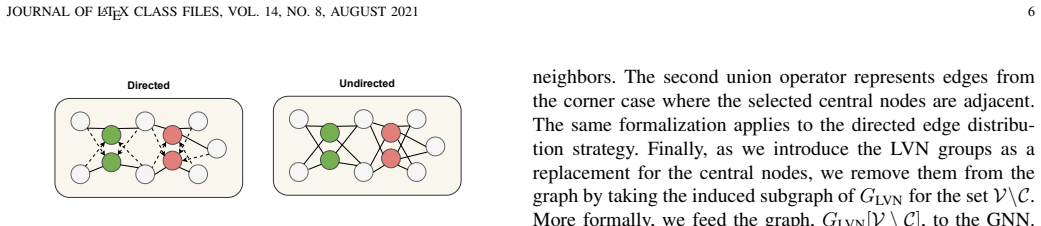
The central object is the LVN group: for each of ns centrality-selected nodes, the original node is replaced by nc virtual nodes, each connected to the original node's neighbors (undirected strategy) or receiving all neighbor messages while sending to only a subset (directed strategy). The graph fed to the GNN is the induced subgraph after removing the central nodes, so no original edges are deleted. Each LVN is initialized with one row of a shared trainable embedding matrix P^{nc × D}; sharing across groups is what enables cross-region communication. The load-bearing formal identity is the augmented edge set, which merges the original edge set with copied central-node edges and, when two ce
What would settle it
Run the same LVN pipeline on graphs where true bottleneck regions are identified by curvature or effective resistance, with three placements: centrality, oracle bottlenecks, and random nodes. If random or oracle placements match or beat centrality, the centrality heuristic is not carrying the reported benefit; if centrality matches oracle, the method's placement assumption is confirmed.
Extended reading notes
Core claim
The central claim is that augmenting a graph with Local Virtual Nodes (LVNs) at central regions, then training GNNs with shared embeddings for those virtual nodes, mitigates over-squashing both structurally and representationally. Structurally, each selected central node is replaced by a group of nc virtual nodes that copy its connections, increasing the number of paths through bottleneck regions and lowering total effective resistance among non-central nodes. Representationally, each LVN starts from one of nc trainable embeddings shared across all central regions; because those embeddings update from feedback in multiple graph regions, they carry long-range information independent of layer
Load-bearing premise
Centrality scores reliably mark the regions where bottlenecks actually form, so placing LVNs at the most central nodes is assumed to be the right placement.
Editorial extensions
If this is right
- Any message-passing GNN can be augmented with LVNs as a preprocessing step plus an embedding table; no changes to the aggregation or update functions are required.
- Graphs with community-like bottlenecks, such as social networks, stand to gain the most; datasets without node features still benefit because the trainable embeddings supply learnable signals.
- The structural benefit is measurable before training: LVNs reduce total effective resistance and increase the number of walks between non-central nodes.
- Because original edges are never removed, the method avoids the edge-level ambiguity that graph rewiring can create, making it safer for tasks where edge semantics matter.
- Long-range information no longer has to travel layer by layer; shared LVN embeddings provide a shortcut that behaves like extra receptive field at constant depth.
Reading between the lines
- The placement heuristic—degree, PageRank, or label-propagation centrality—is doing causal work the paper credits to bottlenecks. Comparing LVN placement against oracle bottleneck locations would separate the heuristic's contribution from the mechanism itself.
- Shared trainable embeddings act as a small distributed memory at selected hubs; this suggests LVNs could be combined with rewiring methods that intervene on different resources, such as adding edges elsewhere.
- The smaller gains on node classification hint that over-smoothing, not over-squashing, dominates those local tasks; a principled LVN variant might need to suppress redundant messages within a group to avoid adding smoothing pressure.
- The 'add' mode is structurally similar to additive positional encodings in transformers; a testable extension is to condition the shared embeddings on node features or graph structure rather than keeping them globally shared.
Signed reviews
Editorial analysis
A structured set of objections, weighed in public.
Referee Report
Summary. This manuscript proposes Local Virtual Nodes (LVNs), an augmentation that replaces a set of high-centrality nodes with groups of virtual nodes. Each LVN inherits the edges of the original central node, and LVNs receive trainable embeddings shared across different groups. The authors argue that this creates local pathways around bottlenecks and enables long-range communication via shared embeddings without global rewiring. They evaluate with a GCN backbone on six graph classification and six node classification datasets, compare against rewiring baselines (DIGL, SDRF, FoSR, BORF, LASER), PANDA, and Last Layer FA, and report total effective resistance and path-count improvements. The central empirical claim is that LVNs improve structural connectivity and downstream accuracy relative to these baselines.
Significance. The idea is simple and attractive: instead of rewiring globally or adding a complete-graph supernode, one can expand capacity at a small number of bottleneck candidate regions and keep the original topology otherwise intact. The paper includes useful structural analyses (effective resistance, path counts), reports 50-split confidence intervals, and releases code. If the mechanism were validated, this would be a practical, architecture-agnostic remedy for over-squashing. However, the two main mechanisms—centrality-based placement and shared trainable embeddings—are not isolated by ablations, so the current evidence does not establish that bottleneck targeting and trainable sharing are what drive the observed gains. The conclusion in Section VI itself identifies the centrality heuristic as crucial and unresolved, which strengthens the need for direct experimental control.
major comments (4)
- [IV.A, V, VI] The paper's central claim is that placing LVNs at high-centrality nodes targets bottlenecks. This is never tested directly. All experiments compare centrality-selected LVNs against non-augmented GCNs or rewiring baselines; there is no control with random node selection or low-centrality selection at the same ns, nc, embedding budget, and training setup. Because LVNs add trainable parameters, the observed gains could arise from added capacity alone rather than from bottleneck targeting. The paper itself states in Section VI that 'determining the set of nodes to replace with virtual node groups is a crucial part of our algorithm' and proposes future learnable selection. I request an ablation with random, low-centrality, and (if feasible) uniform node selection under identical resource budgets, showing that centrality placement outperforms these controls.
- [IV.C, V.G, VI] The second mechanism, shared trainable LVN embeddings, is also not isolated. No comparison is made against fixed random embeddings, per-group non-shared embeddings, or LVNs initialized with copied central-node features. The embedding analyses in Section V.G show only that embeddings change during training and that task-supervised embeddings improve an MLP on the same train/test splits; they do not demonstrate that sharing or trainability per se enables long-range communication. To support the abstract's claim that 'trainable LVN embeddings shared across selected central regions facilitate communication,' please add ablations: (a) fixed random embeddings, (b) non-shared trainable embeddings, and (c) shared trainable embeddings, all with the same ns and nc.
- [V.C, Tables III-IV] The reported hyperparameters are incomplete. The manuscript never states the selected ns, nc, centrality function, replace/add mode, or edge strategy for any dataset, although the captions of Figures 6-7 note that the number of LVNs is tuned. Without these values and the search procedure, the experiments are not reproducible, and it is impossible to judge whether the comparison is fair—for example, whether LVN's good results rely on more extensive tuning than the baselines. Please add a table with per-dataset configurations and the tuning protocol.
- [Tables III-IV] Some headline comparisons are not supported by the reported intervals. For example, on MUTAG, LVN (Directed) is 84.778 ± 2.902 versus PANDA 83.000 ± 1.876; on COLLAB, LVN (Undirected) is 71.520 ± 0.661 versus LASER 71.880 ± 0.567. These error bars overlap substantially. The text states that the method 'outperforms ... by a large margin' and 'significantly improve performance'; please either provide paired statistical tests across the 50 splits or temper the claims to the datasets where the intervals are separated. The current wording overstates the evidence.
minor comments (5)
- [III] The notation [N] is defined as {0, 1, 2, ..., N}, which is non-standard and inconsistent with the later use of [ns] and [nc] as index sets. Please use a consistent convention (e.g., {1, ..., N}).
- [IV.B, Eq. (8)] The second union in Eq. (8) connects all pairs of LVNs between adjacent central nodes, creating a complete bipartite subgraph between the two groups. Please clarify whether this is intended and how the directed edge distribution strategy modifies this formalization.
- [V.G.2] The mutual-similarity analysis concludes that embeddings are distinct 'not due to random initialization.' However, random vectors in high dimension also tend to have near-zero cosine similarity; this analysis does not distinguish learned diversity from initialization. A comparison against the initial embedding distribution would be more informative.
- [V.G.3, Table V] The discriminative-power experiment uses task-supervised LVN embeddings as MLP inputs and trains the MLP on the same labels. This makes the improvement over raw input features difficult to interpret as 'structural information.' Please include a baseline with random pre-trained embeddings and with embeddings from a non-augmented GCN trained under the same protocol.
- [References] Reference [40] has an incomplete author name ('U. B. and'); please correct the citation.
Circularity Check
Main performance and connectivity claims are independent; only the auxiliary LVN-embedding analysis in Section V-G.3 is partly circular.
-
fitted input called prediction
[Section V-G.3 ('Discriminative Power'), around Table V]
"To assess the contribution of virtual node embeddings, we compare MLP performance using input features from the raw graph versus input features from graphs equipped with LVNs and their embeddings. We use pre-trained LVN embeddings as the MLP's input for the second case. ... Thus, we infer that LVN embeddings can capture valuable structural information during training."
The 'pre-trained' embeddings are the LVN embedding matrix P optimized end-to-end on the same graph-classification labels and the same 50 data splits used later to train the MLP. Feeding P (or raw features + P) into an MLP trained on those labels and observing higher accuracy than without P is a direct consequence of fitting P to those labels; it does not isolate structural information from task-label information. The experiment reads a fitted parameter back as evidence of structure, so the inference that LVN embeddings 'capture valuable structural information' is partly self-definitional. This is auxiliary: the main performance comparison is genuine held-out test accuracy, and the structural metrics in Sections V-E and V-F involve deleted central nodes and fixed non-central node sets, so t
full rationale
The paper is primarily an empirical method paper. The central claim that adding LVNs with trainable embeddings improves connectivity and downstream task performance is evaluated by genuine held-out test accuracy against GCN, rewiring baselines, PANDA, and LASER (Tables III and IV); no fitted parameter is renamed as a test-set prediction. The centrality-based placement heuristic is load-bearing but is an external assumption, not a circular step, and the paper itself flags it in Section VI as a future replacement. The structural connectivity analyses (Sections V-E and V-F) are computed on the transformed graph with selected central nodes removed and restricted to a fixed non-central node set, so the reported reductions in effective resistance and increases in walk counts are not tautological edge-count effects. The only partially circular element is the auxiliary embedding analysis in Section V-G.3, where task-fitted LVN embeddings are fed into an MLP for the same task and then interpreted as evidence of 'structural information'; that conclusion is partly guaranteed by the training objective and does not affect the main performance claim. There is also a self-citation [10] in the related-work discussion of over-smoothing, but it is not load-bearing.
Assumptions & free parameters
free parameters (6)
- ns (number of central nodes) =
not reported per dataset
- nc (LVNs per group) =
not reported per dataset
- centrality function =
not reported per dataset
- embedding mode (replace/add) =
not reported per dataset
- edge distribution (standard/directed) =
both reported
- Shared trainable LVN embeddings P (nc x D) =
learned during training
assumptions (5)
- domain assumption High-centrality nodes coincide with bottleneck regions
- domain assumption Adding extra pathways through central regions reduces over-squashing
- ad hoc to paper Replacing central nodes with LVN groups preserves enough of the input graph's structure and domain knowledge
- standard math Standard message-passing GNN framework (Eq. 1-2)
- standard math Effective resistance as a proxy for over-squashing (Eq. 11-12)
invented entities (1)
-
Local Virtual Nodes (LVNs)
independent evidence
Cite this review
Pith. "Pith review of Local Virtual Nodes for Alleviating Over-Squashing in Graph Neural Networks." pith.science (2026). https://pith.science/paper/JMAMC72D
@misc{pith2026250820597,
  author       = {Pith},
  title        = {Pith review of: Local Virtual Nodes for Alleviating Over-Squashing in Graph Neural Networks},
  year         = {2026},
  howpublished = {\url{https://pith.science/paper/JMAMC72D}},
  note         = {Machine review of arXiv:2508.20597}
}
read the original abstract
Over-squashing is a challenge in training graph neural networks for tasks involving long-range dependencies. In such tasks, a GNN's receptive field should be large enough to enable communication between distant nodes. However, gathering information from a wide range of neighborhoods and squashing its content into fixed-size node representations makes message-passing vulnerable to bottlenecks. Graph rewiring and adding virtual nodes are commonly studied remedies that create additional pathways around bottlenecks to mitigate over-squashing. However, these techniques alter the input graph's global topology and disrupt the domain knowledge encoded in the original graph structure, both of which could be essential to specific tasks and domains. This study presents Local Virtual Nodes (LVN) with trainable embeddings to alleviate the effects of over-squashing without significantly corrupting the global structure of the input graph. The position of the LVNs is determined by the node centrality, which indicates the existence of potential bottlenecks. Thus, the proposed approach aims to improve the connectivity in the regions with likely bottlenecks. Furthermore, trainable LVN embeddings shared across selected central regions facilitate communication between distant nodes without adding more layers. Extensive experiments on benchmark datasets demonstrate that LVNs can enhance structural connectivity and significantly improve performance on graph and node classification tasks. The code can be found at https://github.com/ALLab-Boun/LVN/}{https://github.com/ALLab-Boun/LVN/.
Figures


Figures from the paper (4 more)


Reference graph
Works this paper leans on
-
[1]
Lignn: Graph neural networks at linkedin,
F. Borisyuk, S. He, Y . Ouyang, M. Ramezani, P. Du, X. Hou, C. Jiang, N. Pasumarthy, P. Bannur, B. Tiwana, P. Liu, S. Dangi, D. Sun, Z. Pei, X. Shi, S. Zhu, Q. Shen, K.-H. Lee, D. Stein, B. Li, H. Wei, A. Ghoting, and S. Ghosh, “Lignn: Graph neural networks at linkedin,” in Proceedings of the 30th ACM SIGKDD Conference on Knowledge Discovery and Data Mini...
work page 2024
-
[2]
A graph and attentive multi-path convolutional network for traffic prediction,
J. Qi, Z. Zhao, E. Tanin, T. Cui, N. Nassir, and M. Sarvi, “A graph and attentive multi-path convolutional network for traffic prediction,” IEEE Transactions on Knowledge and Data Engineering , vol. 35, no. 7, pp. 6548–6560, 2023
work page 2023
-
[3]
Gnngo3d: Protein function prediction based on 3d structure and functional hierarchy learning,
L. Zhang, Y . Jiang, and Y . Yang, “Gnngo3d: Protein function prediction based on 3d structure and functional hierarchy learning,” IEEE Trans- actions on Knowledge and Data Engineering , vol. 36, no. 8, pp. 3867– 3878, 2024
work page 2024
-
[4]
Neural message passing for quantum chemistry,
J. Gilmer, S. S. Schoenholz, P. F. Riley, O. Vinyals, and G. E. Dahl, “Neural message passing for quantum chemistry,” in Proceedings of the 34th International Conference on Machine Learning , 2017, pp. 1263– 1272
work page 2017
-
[5]
Inductive representation learning on large graphs,
W. L. Hamilton, R. Ying, and J. Leskovec, “Inductive representation learning on large graphs,” in Proceedings of the 31st International Conference on Neural Information Processing Systems , ser. NIPS’17. Red Hook, NY , USA: Curran Associates Inc., 2017, p. 1025–1035
work page 2017
-
[6]
Deeper insights into graph convolu- tional networks for semi-supervised learning,
Q. Li, Z. Han, and X.-M. Wu, “Deeper insights into graph convolu- tional networks for semi-supervised learning,” in Proceedings of the Thirty-Second AAAI Conference on Artificial Intelligence and Thirtieth Innovative Applications of Artificial Intelligence Conference and Eighth AAAI Symposium on Educational Advances in Artificial Intelligence, ser. AAAI’1...
work page 2018
-
[7]
On the bottleneck of graph neural networks and its practical implications,
U. Alon and E. Yahav, “On the bottleneck of graph neural networks and its practical implications,” in International Conference on Learning Representations, 2021
work page 2021
-
[8]
Graph-coupled oscillator networks,
T. K. Rusch, B. Chamberlain, J. Rowbottom, S. Mishra, and M. Bron- stein, “Graph-coupled oscillator networks,” in Proceedings of the 39th International Conference on Machine Learning, ser. Proceedings of Ma- chine Learning Research, K. Chaudhuri, S. Jegelka, L. Song, C. Szepes- vari, G. Niu, and S. Sabato, Eds., vol. 162. PMLR, 17–23 Jul 2022, pp. 18 888–18 909
work page 2022
Show all 53 references
-
[9]
Towards deep attention in graph neural networks: problems and remedies,
S. Y . Lee, F. Bu, J. Yoo, and K. Shin, “Towards deep attention in graph neural networks: problems and remedies,” in Proceedings of the 40th International Conference on Machine Learning , ser. ICML’23. JMLR.org, 2023
2023
-
[10]
Channel-attentive graph neural JOURNAL OF LATEX CLASS FILES, VOL. 14, NO. 8, AUGUST 2021 12 networks,
T. H. Karabulut and ˙I. M. Bayta¸ s, “Channel-attentive graph neural JOURNAL OF LATEX CLASS FILES, VOL. 14, NO. 8, AUGUST 2021 12 networks,” in 2024 IEEE International Conference on Data Mining (ICDM). IEEE, 2024, pp. 729–734
2021
-
[11]
Representation learning on graphs with jumping knowledge networks,
K. Xu, C. Li, Y . Tian, T. Sonobe, K.-i. Kawarabayashi, and S. Jegelka, “Representation learning on graphs with jumping knowledge networks,” in Proceedings of the 35th International Conference on Machine Learning, ser. Proceedings of Machine Learning Research, J. Dy and A. Kra...
2018
-
[12]
Simple and deep graph convolutional networks,
M. Chen, Z. Wei, Z. Huang, B. Ding, and Y . Li, “Simple and deep graph convolutional networks,” in Proceedings of the 37th International Conference on Machine Learning, ser. Proceedings of Machine Learning Research, H. D. III and A. Singh, Eds., vol. 119. PMLR, 13–18 Jul 2020,...
2020
-
[13]
Do transformers really perform bad for graph representation?
C. Ying, T. Cai, S. Luo, S. Zheng, G. Ke, D. He, Y . Shen, and T.-Y . Liu, “Do transformers really perform bad for graph representation?” in Proceedings of the 35th International Conference on Neural Information Processing Systems, 2021, pp. 28 877–28 888
2021
-
[14]
Graph inductive biases in transformers without message passing,
L. Ma, C. Lin, D. Lim, A. Romero-Soriano, P. K. Dokania, M. Coates, P. H. Torr, and S.-N. Lim, “Graph inductive biases in transformers without message passing,” in Proceedings of the 40th International Conference on Machine Learning , 2023, pp. 23 321–23 337
2023
-
[15]
Attending to graph transformers,
L. Müller, M. Galkin, C. Morris, and L. Rampášek, “Attending to graph transformers,” Transactions on Machine Learning Research , 2024
2024
-
[16]
Understanding over-squashing and bottlenecks on graphs via curvature,
J. Topping, F. D. Giovanni, B. P. Chamberlain, X. Dong, and M. M. Bronstein, “Understanding over-squashing and bottlenecks on graphs via curvature,” in International Conference on Learning Representations , 2022
2022
-
[17]
FoSR: First-order spec- tral rewiring for addressing oversquashing in GNNs,
K. Karhadkar, P. K. Banerjee, and G. Montufar, “FoSR: First-order spec- tral rewiring for addressing oversquashing in GNNs,” in The Eleventh International Conference on Learning Representations , 2023
2023
-
[18]
Revisiting over-smoothing and over-squashing using ollivier- ricci curvature,
K. Nguyen, N. M. Hieu, V . D. Nguyen, N. Ho, S. Osher, and T. M. Nguyen, “Revisiting over-smoothing and over-squashing using ollivier- ricci curvature,” in International Conference on Machine Learning . PMLR, 2023, pp. 25 956–25 979
2023
-
[19]
Understanding over- squashing in gnns through the lens of effective resistance,
M. Black, Z. Wan, A. Nayyeri, and Y . Wang, “Understanding over- squashing in gnns through the lens of effective resistance,” in Interna- tional Conference on Machine Learning , 2023, pp. 2528–2547
2023
-
[20]
Dif- fWire: Inductive Graph Rewiring via the Lovász Bound,
A. Arnaiz-Rodríguez, A. Begga, F. Escolano, and N. M. Oliver, “Dif- fWire: Inductive Graph Rewiring via the Lovász Bound,” in Proceedings of the First Learning on Graphs Conference , ser. Proceedings of Machine Learning Research, B. Rieck and R. Pascanu, Eds., vol. 198. PMLR, ...
2022
-
[21]
Rewiring with po- sitional encodings for graph neural networks,
R. B. Gabrielsson, M. Yurochkin, and J. Solomon, “Rewiring with po- sitional encodings for graph neural networks,” Transactions on Machine Learning Research, 2023
2023
-
[22]
Locality-aware graph rewiring in GNNs,
F. Barbero, A. Velingker, A. Saberi, M. M. Bronstein, and F. D. Giovanni, “Locality-aware graph rewiring in GNNs,” in The Twelfth International Conference on Learning Representations , 2024
2024
-
[23]
On over-squashing in message passing neural networks: the impact of width, depth, and topology,
F. Di Giovanni, L. Giusti, F. Barbero, G. Luise, P. Liò, and M. Bronstein, “On over-squashing in message passing neural networks: the impact of width, depth, and topology,” in Proceedings of the 40th International Conference on Machine Learning , 2023, pp. 7865–7885
2023
-
[24]
Panda: expanded width-aware message passing beyond rewiring,
J. Choi, S. Park, H. Wi, S.-B. Cho, and N. Park, “Panda: expanded width-aware message passing beyond rewiring,” in Proceedings of the 41st International Conference on Machine Learning , 2024
2024
-
[25]
How does over-squashing affect the power of GNNs?
F. D. Giovanni, T. K. Rusch, M. Bronstein, A. Deac, M. Lackenby, S. Mishra, and P. Veliˇckovi´c, “How does over-squashing affect the power of GNNs?” Transactions on Machine Learning Research , 2024
2024
-
[26]
Oversquashing in gnns through the lens of information contraction and graph expansion,
P. K. Banerjee, K. Karhadkar, Y . G. Wang, U. Alon, and G. Montúfar, “Oversquashing in gnns through the lens of information contraction and graph expansion,” in 2022 58th Annual Allerton Conference on Communication, Control, and Computing (Allerton) , 2022, p. 1–8
2022
-
[27]
Graph rewiring and preprocessing for graph neural networks based on effective resistance,
X. Shen, P. Liò, L. Yang, R. Yuan, Y . Zhang, and C. Peng, “Graph rewiring and preprocessing for graph neural networks based on effective resistance,” IEEE Transactions on Knowledge and Data Engineering , vol. 36, no. 11, pp. 6330–6343, 2024
2024
-
[28]
Diffusion improves graph learning,
J. Gasteiger, S. Weißenberger, and S. Günnemann, “Diffusion improves graph learning,” Advances in neural information processing systems , vol. 32, 2019
2019
-
[29]
Probabilistically rewired message-passing neural networks,
C. Qian, A. Manolache, K. Ahmed, Z. Zeng, G. V . den Broeck, M. Niepert, and C. Morris, “Probabilistically rewired message-passing neural networks,” in The Twelfth International Conference on Learning Representations, 2024
2024
-
[30]
Expander graph propagation,
A. Deac, M. Lackenby, and P. Veliˇckovi´c, “Expander graph propagation,” in NeurIPS 2022 Workshop on Symmetry and Geometry in Neural Representations, 2022
2022
-
[31]
Cayley graph propagation,
J. Wilson, M. Bechler-Speicher, and P. Veli ˇckovi´c, “Cayley graph propagation,” in The Third Learning on Graphs Conference , 2024
2024
-
[32]
Delaunay graph: Addressing over-squashing and over-smoothing using delaunay triangulation,
H. Attali, D. Buscaldi, and N. Pernelle, “Delaunay graph: Addressing over-squashing and over-smoothing using delaunay triangulation,” in Forty-first International Conference on Machine Learning , 2024
2024
-
[33]
On the connection between mpnn and graph transformer,
C. Cai, T. S. Hy, R. Yu, and Y . Wang, “On the connection between mpnn and graph transformer,” in Proceedings of the 40th International Conference on Machine Learning , 2023, pp. 3408–3430
2023
-
[34]
Un- derstanding virtual nodes: Oversquashing and node heterogeneity,
J. Southern, F. D. Giovanni, M. M. Bronstein, and J. F. Lutzeyer, “Un- derstanding virtual nodes: Oversquashing and node heterogeneity,” in The Thirteenth International Conference on Learning Representations , 2025
2025
-
[35]
An analysis of virtual nodes in graph neural networks for link prediction,
E. Hwang, V . Thost, S. S. Dasgupta, and T. Ma, “An analysis of virtual nodes in graph neural networks for link prediction,” in The First Learning on Graphs Conference , 2022
2022
-
[36]
Vn-egnn: E(3)-equivariant graph neural net- works with virtual nodes enhance protein binding site identification,
F. Sestak, L. Schneckenreiter, J. Brandstetter, S. Hochreiter, A. Mayr, and G. Klambauer, “Vn-egnn: E(3)-equivariant graph neural net- works with virtual nodes enhance protein binding site identification,” arXiv:2404.07194 [cs.LG], 2024
2024 arXiv
-
[37]
Improving equivariant graph neural networks on large geometric graphs via virtual nodes learning,
Y . Zhang, J. Cen, J. Han, Z. Zhang, J. Zhou, and W. Huang, “Improving equivariant graph neural networks on large geometric graphs via virtual nodes learning,” in Proceedings of the 41st International Conference on Machine Learning, 2024, pp. 58 662–58 679
2024
-
[38]
E(n) equivariant graph neural networks,
V . G. Satorras, E. Hoogeboom, and M. Welling, “E(n) equivariant graph neural networks,” in Proceedings of the 38th International Conference on Machine Learning , Virtual, 2021, pp. 9323–9332
2021
-
[39]
Probabilistic graph rewiring via virtual nodes,
C. Qian, A. Manolache, C. Morris, and M. Niepert, “Probabilistic graph rewiring via virtual nodes,” in The Thirty-eighth Annual Conference on Neural Information Processing Systems , 2024
2024
-
[40]
A faster algorithm for betweenness centrality*,
U. B. and, “A faster algorithm for betweenness centrality*,” The Journal of Mathematical Sociology , vol. 25, no. 2, pp. 163–177, 2001
2001
-
[41]
Scientific collaboration networks. ii. shortest paths, weighted networks, and centrality,
M. E. J. Newman, “Scientific collaboration networks. ii. shortest paths, weighted networks, and centrality,” Physical Review E , vol. 64, p. 016132, 2001
2001
-
[42]
Semi-supervised classification with graph convolutional networks,
T. N. Kipf and M. Welling, “Semi-supervised classification with graph convolutional networks,” in International Conference on Learning Rep- resentations, 2017
2017
-
[43]
How powerful are graph neural networks?
K. Xu, W. Hu, J. Leskovec, and S. Jegelka, “How powerful are graph neural networks?” in International Conference on Learning Represen- tations, 2019
2019
-
[44]
Graph attention networks,
P. Velickovic, G. Cucurull, A. Casanova, A. Romero, P. Liò, and Y . Bengio, “Graph attention networks,” in International Conference on Learning Representations, 2018
2018
-
[45]
The pagerank citation ranking: Bringing order to the web
L. Page, S. Brin, R. Motwani, and T. Winograd, “The pagerank citation ranking: Bringing order to the web.” Stanford InfoLab, Technical Report 1999-66, 1999
1999
-
[46]
Near linear time algorithm to detect community structures in large-scale networks,
U. N. Raghavan, R. Albert, and S. Kumara, “Near linear time algorithm to detect community structures in large-scale networks,”Physical Review E, vol. 76, no. 3, 2007
2007
-
[47]
Attention is all you need,
A. Vaswani, N. Shazeer, N. Parmar, J. Uszkoreit, L. Jones, A. N. Gomez, L. u. Kaiser, and I. Polosukhin, “Attention is all you need,” in Advances in Neural Information Processing Systems , I. Guyon, U. V . Luxburg, S. Bengio, H. Wallach, R. Fergus, S. Vishwanathan, and R. Garn...
2017
-
[48]
Tudataset: A collection of benchmark datasets for learning with graphs,
C. Morris, N. M. Kriege, F. Bause, K. Kersting, P. Mutzel, and M. Neu- mann, “Tudataset: A collection of benchmark datasets for learning with graphs,” in ICML Workshop on Graph Representation Learning and Beyond (GRL+ 2020) , 2020
2020
-
[49]
Geom-gcn: Geometric graph convolutional networks,
H. Pei, B. Wei, K. C.-C. Chang, Y . Lei, and B. Yang, “Geom-gcn: Geometric graph convolutional networks,” in International Conference on Learning Representations , 2020
2020
-
[50]
Collective classification in network data,
P. Sen, G. M. Namata, M. Bilgic, L. Getoor, B. Gallagher, and T. Eliassi- Rad, “Collective classification in network data,” AI Magazine, vol. 29, no. 3, pp. 93–106, 2008
2008
-
[51]
Adam: A method for stochastic optimization,
D. P. Kingma and J. Ba, “Adam: A method for stochastic optimization,” in International Conference on Learning Representations , 2015
2015
-
[52]
Batch normalization: accelerating deep net- work training by reducing internal covariate shift,
S. Ioffe and C. Szegedy, “Batch normalization: accelerating deep net- work training by reducing internal covariate shift,” in Proceedings of the 32nd International Conference on International Conference on Machine Learning - Volume 37 , ser. ICML’15, 2015, pp. 448–456
2015
-
[53]
Minimizing effective resistance of a graph,
A. Ghosh, S. Boyd, and A. Saberi, “Minimizing effective resistance of a graph,” SIAM Review, vol. 50, no. 1, pp. 37–66, 2008
2008
Reviewed August 5, 2026 · model on record in the stance chip above.
Discussion (0). Continue with ORCID to comment.