REVIEW 4 major objections 6 minor 32 references
Neural Particle Automata: Learning Self-Organizing Particle Dynamics
T0 review · 4 major / 6 minor · reviewed 2026-08-03 · deepseek-v4-flash
Pith's one-line read Particles learn self-organization from a single shared rule
desk verdict NPA is a real, well-engineered extension of NCA to dynamic particles; the empirical case is thinner than the claims, but the idea holds and deserves serious peer review. read the letter →
The pith
A machine-rendered reading of the paper's core claim, the machinery that carries it, and where it could break.
The reading
What carries the argument
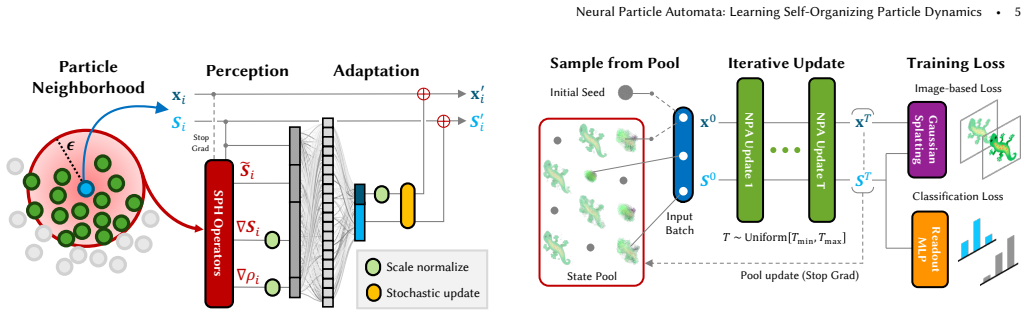
The load-bearing object is the SPH perception vector Z_i = [S_i, S̃_i, ∇S_i, ∇ρ_i]: the particle's own state, a kernel-smoothed neighbor state, a first-order gradient estimate (with moment-matrix bias correction in the forward pass but detached in backprop), and the density gradient. These are computed with fixed Poly6/Spiky kernels over an epsilon-neighborhood, giving permutation- and translation-invariant, local, sampling-robust features. The paper derives analytic backward formulas for every operator so the whole pipeline is differentiable, and implements the sums with hash-grid GPU kernels that avoid explicit adjacency lists.
What would settle it
Train NPA on a reaction-diffusion target that is known to require exact second-order diffusion, such as pattern selection driven by a specific Laplacian eigenvalue. If the learned rule cannot reproduce the pattern even with a large network and long training, while an explicit SPH Laplacian variant can, the operating point is falsified. A lighter check: measure whether test performance on fine textures plateaus at the SPH kernel scale, matching the paper's stated limitation.
Extended reading notes
Core claim
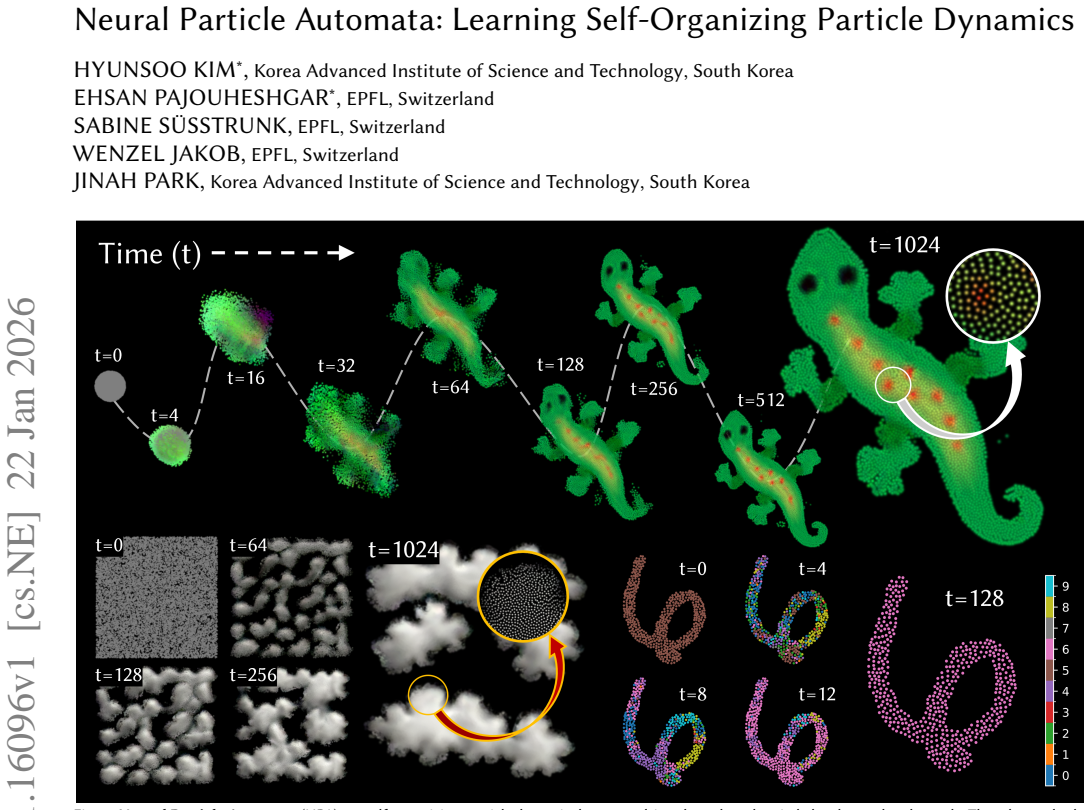
NPA claims that the perception/update separation of NCA transfers to continuous particle systems: replace grid convolutions by differentiable SPH operators, keep a shared learnable MLP, and the same self-organizing phenomena emerge, now on particles that move. The paper argues this is the missing Lagrangian counterpart to lattice-based NCA, and validates it by growing emoji and 3D shapes, synthesizing RGBA textures, and classifying point clouds through iterative local voting. It also demonstrates resilience to perturbation and graceful variation of particle count and support radius.
Load-bearing premise
The whole recipe assumes that the fixed SPH operators—smoothing, first-order gradient, and density gradient—capture all information a task needs; specifically that the difference between a particle's state and its smoothed neighborhood state adequately substitutes for a true Laplacian, an assumption the paper checks on only three task families.
Editorial extensions
If this is right
- Self-organizing particle dynamics can be trained end-to-end with only image-level or task-level losses, without particle-level correspondences.
- Learned rules inherit NCA's ability to recover from state erasure, cuts, and clumping during continued rollout.
- The same trained rule generalizes to different particle counts and support radii, up to predicted rescaling factors.
- Multiple independently trained rules can coexist and interact in one simulation, suggesting a building block for multi-agent particle systems.
- Computation concentrates on occupied regions, making real-time interactive particle graphics feasible on modest hardware.
Reading between the lines
- A natural next test is whether the Laplacian proxy (S_i − S̃_i) ∝ ε² ΔS_i is expressive enough for phenomena requiring fourth-order or anisotropic diffusion; tasks like Turing-pattern selection or thin-plate bending could discriminate.
- If fixed-kernel SPH suffices, NPA becomes a candidate differentiable engine for learned physics-like simulations beyond fluids—agents, crowds, deformable bodies—where the same local rule must infer hidden state from geometry.
- The paper's 'persistent internal flows' hypothesis—that vortices act as distributed memory—is testable: remove or clamp the flow and see whether long-term stability degrades.
- The reported hyperparameter sensitivity suggests a follow-up: derive or learn the perception normalization instead of hand-tuning log-scaling and gradient detachment.
Editorial analysis
A structured set of objections, weighed in public.
Referee Report
Summary. The paper introduces Neural Particle Automata (NPA), a Lagrangian generalization of Neural Cellular Automata in which each cell is a particle with a continuous position and internal state, both updated by a shared, learnable neural rule. Grid-based perception is replaced by differentiable Smoothed Particle Hydrodynamics operators, implemented with custom CUDA kernels and hash-grid acceleration. The authors derive backward formulas for the SPH operators, report experiments on 2D/3D morphogenesis, particle-based texture synthesis, and self-classifying PointMNIST, and provide an interactive browser demo. The single quantitative result is 98.42% test accuracy on PointMNIST; the remaining evidence is largely qualitative, with additional analyses of robustness to discretization, regeneration under perturbations, hidden-state structure, and multi-species composition.
Significance. If the claims hold, NPA is a meaningful step toward trainable self-organizing particle systems, combining the robust, locally-updated rule structure of NCA with the flexibility of Lagrangian representations. The paper's strengths include careful analytic backward derivations in Appendix A, a matrix-free CUDA implementation, and a publicly available interactive demo. However, the empirical support for the central claims is currently thin: the only quantitative result has no baselines or error bars, the regeneration evidence is partly trained rather than emergent, and the asserted equivalence with NCA expressivity is not tested on any task requiring genuine second-order operators. The core idea is promising and the technical machinery is solid, but the load-bearing empirical and modeling assumptions need to be addressed before the paper's strongest claims can be accepted.
major comments (4)
- [§4.3, Table 3] The only quantitative result in the paper is 98.42% test accuracy on PointMNIST. It is reported without error bars, without baselines (grid-based NCA, PointNet, GNNs, or any other point-cloud classifier), and without ablations. Moreover, this benchmark uses static particles, so it does not exercise the Lagrangian position dynamics that are the paper's main contribution. This single number cannot substantiate the abstract's claims of 'scalable end-to-end training' or of matching NCA expressivity. Please add repeated-run statistics, reference models, and a dynamic-particle benchmark with a quantitative metric (e.g., IoU for morphogenesis).
- [§3.2.1, Eq. (4)] The perception vector Z_i omits an explicit SPH Laplacian, justified only by the informal relation (S_i − S̃_i) ∝ ε²ΔS_i. This is a finite-ε approximation whose error contains higher-order derivatives and is biased near boundaries and under irregular sampling. No experiment targets a phenomenon that requires a well-conditioned second-order operator (e.g., reaction–diffusion/Turing patterns, a canonical NCA benchmark), so the claim that NPA is a Lagrangian generalization with NCA-level expressivity is not directly tested. Please run a task whose existence depends on a genuine Laplacian, or compare against a variant with an explicit SPH Laplacian, and report whether the omitted operator changes behavior.
- [§4.4] The regeneration experiments are partially circular. The text states that during training, whenever an element is sampled from the pool, a random particle's ε-neighborhood is zeroed. Thus state-erasure recovery is an in-distribution trained behavior, not an emergent self-correction property. The cut and clumping perturbations are unseen and more convincing, but they are only shown qualitatively. Please provide quantitative regeneration metrics (e.g., density/IoU over time after each perturbation) and an ablation that trains without the local zeroing perturbation, so the reader can see which behaviors actually emerge.
- [§3.2.3] The training pipeline stops gradients with respect to positions in the SPH perception ('we stop gradients with respect to positions in the SPH perception, as shown in Figure 2'). This is a strong inductive bias: the adaptation network never receives gradient signal through the dependence of neighborhood geometry on x_i. Since dynamic particle behavior is central to the contribution, the paper should demonstrate that this detachment does not remove information essential for learning position updates. Please include an ablation (with vs. without detachment) or a gradient-flow analysis.
minor comments (6)
- [§2.2, Table 1] The table assigns SPH operators all checkmarks, but the criteria (U, S, DY, LO, SC, UR) are not formally defined. Please define them or soften the claims; for example, SPH locality depends on compact support and is approximate under kernel truncation.
- [§3.2.3, Eq. (9)] The log-compression constant η is introduced but its value is not reported in Table 3. Please report it.
- [§4.1.1] The '60 emoji targets' are described without a source or preprocessing details. Please provide the dataset source and sample images.
- [Appendix A] Sign conventions for r_ij appear inconsistent between Eqs. (14) and (24). Please verify and standardize the notation throughout the appendix.
- [§4.3, Fig. 8] The term 'Max density over timestep' in Figure 8 is undefined. Please define it in the caption or text.
- [§3.2.2] The term 'equivariance' is used for what appears to be a mix of invariance (permutation, translation) and equivariance (scale, density). Please clarify the terminology.
Circularity Check
No significant circularity: NPA's derivation and experiments are self-contained, with only a disclosed, non-circular training augmentation for regeneration.
full rationale
The paper's core claim is architectural: SPH-based perception replaces grid convolutions in an NCA-style local update rule. The perception vector Z_i = [S_i, S_i_tilde, grad S_i, grad rho_i] is an explicit modeling choice, and the '(S_i − S_i_tilde) ∝ ε² ΔS_i' remark is presented as a heuristic for omitting an explicit SPH Laplacian; it is a stated approximation, not a result derived from the target claim. No fitted parameter is renamed as a prediction: morphogenesis and texture losses are direct rendering losses, and PointMNIST reports a held-out test accuracy (98.42%). The only potentially circular-looking evidence is the state-erasure regeneration test, but the paper explicitly discloses that this perturbation was used during training ('To encourage such regeneration in the 2D morphogenesis and texture settings, we apply a simple training-time disturbance'), and it validates the general regenerative claim on two unseen distortion types (cuts and clumping), which are independent. Self-citations (Pajouheshgar et al. 2024b, 2025; Kim and Park 2025) are contextual and non-load-bearing. The Limitations section concedes expressivity limits ('NPA struggle to capture fine geometric and texture details') and training sensitivity, which affect correctness risk but not circularity.
Assumptions & free parameters
free parameters (6)
- SPH support radius ε =
0.1 (morphology/PointMNIST), 0.2 (textures)
- Total particle mass normalization =
1
- Stochastic update probability p =
0.5
- Log-compression constant η =
small positive (exact value not stated)
- 3D Gaussian decoder constants (A, σ, o) =
A=0.1, σ=0.02, o=0.15
- Gradient-correction det threshold =
1e-3
assumptions (5)
- domain assumption SPH kernel-weighted sums approximate field values and derivatives on particle samples
- domain assumption Local ε-neighborhood interactions are sufficient for the target global behaviors
- ad hoc to paper Detach/stop-gradient heuristics do not remove gradients essential to learning the objective
- domain assumption Rendered image-based losses provide sufficient supervision for self-organization without particle correspondences
- domain assumption SPH feature normalization and gradient rescaling make learned dynamics generalize over spatial scale and sampling density
Cite this review
Pith. "Pith review of Neural Particle Automata: Learning Self-Organizing Particle Dynamics." pith.science (2026). https://pith.science/paper/JNARPOHC
@misc{pith2026260116096,
  author       = {Pith},
  title        = {Pith review of: Neural Particle Automata: Learning Self-Organizing Particle Dynamics},
  year         = {2026},
  howpublished = {\url{https://pith.science/paper/JNARPOHC}},
  note         = {Machine review of arXiv:2601.16096}
}
read the original abstract
We introduce Neural Particle Automata (NPA), a Lagrangian generalization of Neural Cellular Automata (NCA) from static lattices to dynamic particle systems. Unlike classical Eulerian NCA where cells are pinned to pixels or voxels, NPA model each cell as a particle with a continuous position and internal state, both updated by a shared, learnable neural rule. This particle-based formulation yields clear individuation of cells, allows heterogeneous dynamics, and concentrates computation only on regions where activity is present. At the same time, particle systems pose challenges: neighborhoods are dynamic, and a naive implementation of local interactions scale quadratically with the number of particles. We address these challenges by replacing grid-based neighborhood perception with differentiable Smoothed Particle Hydrodynamics (SPH) operators backed by memory-efficient, CUDA-accelerated kernels, enabling scalable end-to-end training. Across tasks including morphogenesis, point-cloud classification, and particle-based texture synthesis, we show that NPA retain key NCA behaviors such as robustness and self-regeneration, while enabling new behaviors specific to particle systems. Together, these results position NPA as a compact neural model for learning self-organizing particle dynamics.
Figures

Figures from the paper (6 more)


Reference graph
Works this paper leans on
-
[8]
Astronomical Journal, vol
A numerical approach to the testing of the fission hypothesis. Astronomical Journal, vol. 82, Dec. 1977, p. 1013-1024.82 (1977), 1013–1024. Arman Maesumi, Tanish Makadia, Thibault Groueix, Vladimir G Kim, Daniel Ritchie, and Noam Aigerman
1977
-
[9]
Leland McInnes, John Healy, Nathaniel Saul, and Lukas Grossberger
PoissonNet: A Local-Global Approach for Learning on Surfaces.arXiv preprint arXiv:2510.14146(2025). Leland McInnes, John Healy, Nathaniel Saul, and Lukas Grossberger
arXiv 2025
-
[10]
UMAP: Uniform Manifold Approximation and Projection.The Journal of Open Source Software3, 29 (2018),
2018
-
[12]
ACM65, 1 (2021), 99–106
Nerf: Representing scenes as neural radiance fields for view synthesis.Commun. ACM65, 1 (2021), 99–106. Davoud Mirzaei, Robert Schaback, and Mehdi Dehghan
2021
-
[14]
NPA remains stable for different stochastic update probabilities 𝑝. 12•Hyunsoo Kim, Ehsan Pajouheshgar, Sabine Süsstrunk, Wenzel Jakob, and Jinah Park A Backward Derivations of SPH Operators Notation.We denote reverse-mode (incoming) gradients by ¯𝑦 := 𝜕L 𝜕𝑦 . Particle positions arex𝑖∈R 𝐷, densities are𝜌𝑖∈R , and states areS𝑖∈R 𝐶. We define pairwise offse...
2014
-
[18]
Ehsan Pajouheshgar, Yitao Xu, Ali Abbasi, Alexander Mordvintsev, Wenzel Jakob, and Sabine Süsstrunk
Self-organising textures.Distill6, 2 (2021), e00027–003. Ehsan Pajouheshgar, Yitao Xu, Ali Abbasi, Alexander Mordvintsev, Wenzel Jakob, and Sabine Süsstrunk
2021
-
[19]
Neural Cellular Automata: From Cells to Pixels.arXiv preprint arXiv:2506.22899(2025). Ehsan Pajouheshgar, Yitao Xu, Alexander Mordvintsev, Eyvind Niklasson, Tong Zhang, and Sabine Süsstrunk. 2024b. Mesh Neural Cellular Automata.ACM Trans. Graph. (2024). doi:10.1145/3658127 Ehsan Pajouheshgar, Yitao Xu, and Sabine Süsstrunk. 2024a. NoiseNCA: Noisy Seed Imp...
arXiv 2025
-
[21]
InProceedings of the IEEE/CVF Conference on Computer Vision and Pattern Recognition
DyNCA: Real- time Dynamic Texture Synthesis Using Neural Cellular Automata. InProceedings of the IEEE/CVF Conference on Computer Vision and Pattern Recognition. 20742–20751. Charles R Qi, Hao Su, Kaichun Mo, and Leonidas J Guibas. 2017a. Pointnet: Deep learning on point sets for 3d classification and segmentation. InProceedings of the IEEE conference on c...
2017
Show all 32 references
-
[22]
Craig W Reynolds
Self-classifying mnist digits.Distill5, 8 (2020), e00027–002. Craig W Reynolds
2020
-
[23]
Karen Simonyan and Andrew Zisserman
Diffusion- net: Discretization agnostic learning on surfaces.ACM Transactions on Graphics (TOG)41, 3 (2022), 1–16. Karen Simonyan and Andrew Zisserman
2022
-
[29]
Rene Winchenbach and Nils Thuerey
Delta- conv: anisotropic operators for geometric deep learning on point clouds.ACM Transactions on Graphics (TOG)41, 4 (2022), 1–10. Rene Winchenbach and Nils Thuerey
2022
-
[30]
Andrew Witkin and Michael Kass
diffSPH: Differentiable Smoothed Particle Hydrodynamics for Adjoint Optimization and Machine Learning.arXiv preprint arXiv:2507.21684(2025). Andrew Witkin and Michael Kass
2025 arXiv
-
[31]
Hengshuang Zhao, Li Jiang, Jiaya Jia, Philip HS Torr, and Vladlen Koltun
gsplat: An open-source library for Gaussian splatting.Journal of Machine Learning Research 26, 34 (2025), 1–17. Hengshuang Zhao, Li Jiang, Jiaya Jia, Philip HS Torr, and Vladlen Koltun
2025
-
[57]
arXiv:https://direct.mit.edu/isal/proceedings- pdf/isal2024/36/57/2461193/isal_a_00785.pdf doi:10.1162/isal_a_00785 Ehsan Pajouheshgar, Yitao Xu, Tong Zhang, and Sabine Süsstrunk
-
[1952]
Ashish Vaswani, Noam Shazeer, Niki Parmar, Jakob Uszkoreit, Llion Jones, Aidan N Gomez, Łukasz Kaiser, and Illia Polosukhin
The Chemical Basis of Morphogenesis.Philosophical Transactions of the Royal Society of London Series B237, 641 (1952), 37–72. Ashish Vaswani, Noam Shazeer, Niki Parmar, Jakob Uszkoreit, Llion Jones, Aidan N Gomez, Łukasz Kaiser, and Illia Polosukhin
1952
-
[1966]
Comp.21 (1966),
Theory of self-reproducing automata.Math. Comp.21 (1966),
1966
-
[1977]
Daniele Grattarola, Lorenzo Livi, and Cesare Alippi
Smoothed particle hydrodynamics: the- ory and application to non-spherical stars.Monthly notices of the royal astronomical society181, 3 (1977), 375–389. Daniele Grattarola, Lorenzo Livi, and Cesare Alippi
1977
-
[1999]
Scott Camazine, Jean-Louis Deneubourg, Nigel R Franks, James Sneyd, Guy Ther- aula, and Eric Bonabeau
Variational and momentum preservation aspects of smooth particle hydrodynamic formulations.Computer Methods in applied mechanics and engineering180, 1-2 (1999), 97–115. Scott Camazine, Jean-Louis Deneubourg, Nigel R Franks, James Sneyd, Guy Ther- aula, and Eric Bonabeau
1999
-
[2003]
InProceedings of the 2003 ACM SIG- GRAPH/Eurographics symposium on Computer animation
Particle-based fluid simulation for interactive applications. InProceedings of the 2003 ACM SIG- GRAPH/Eurographics symposium on Computer animation. Citeseer, 154–159. John von Neumann
2003
-
[2010]
Ben Mildenhall, Pratul P Srinivasan, Matthew Tancik, Jonathan T Barron, Ravi Ra- mamoorthi, and Ren Ng
Model synthesis: A general procedural modeling algorithm.IEEE transactions on visualization and computer graphics17, 6 (2010), 715–728. Ben Mildenhall, Pratul P Srinivasan, Matthew Tancik, Jonathan T Barron, Ravi Ra- mamoorthi, and Ren Ng
2010
-
[2012]
On generalized moving least squares and diffuse derivatives.IMA J. Numer. Anal.32, 3 (2012), 983–1000. Tom Mohr
2012
-
[2015]
In3rd International Conference on Learning Representations, ICLR 2015, San Diego, CA, USA, May 7-9, 2015, Conference Track Proceedings, Yoshua Bengio and Yann LeCun (Eds.)
Very Deep Convolutional Networks for Large-Scale Image Recognition. In3rd International Conference on Learning Representations, ICLR 2015, San Diego, CA, USA, May 7-9, 2015, Conference Track Proceedings, Yoshua Bengio and Yann LeCun (Eds.). http://arxiv.org/abs/1409.1556 Hugue...
2015 arXiv
-
[2016]
https://ventrella.com/Clusters/intro.html
Clusters. https://ventrella.com/Clusters/intro.html. Accessed: 2025-09-08. Ruben Wiersma, Ahmad Nasikun, Elmar Eisemann, and Klaus Hildebrandt
2025
-
[2017]
Jeffrey Ventrella
Attention is all you need.Advances in neural information processing systems30 (2017). Jeffrey Ventrella
2017
-
[2018]
Zhaowei Liu, Dong Yang, Yingjie Wang, Mingjie Lu, and Ranran Li
Pointcnn: Convolution on x-transformed points.Advances in neural information processing systems31 (2018). Zhaowei Liu, Dong Yang, Yingjie Wang, Mingjie Lu, and Ranran Li
2018
-
[2019]
John Kalkhof, Camila González, and Anirban Mukhopadhyay
Meshcnn: a network with an edge.ACM Transactions on Graphics (ToG)38, 4 (2019), 1–12. John Kalkhof, Camila González, and Anirban Mukhopadhyay
2019
-
[2020]
Matthias Müller, David Charypar, and Markus Gross
Growing neural cellular automata.Distill5, 2 (2020), e23. Matthias Müller, David Charypar, and Markus Gross
2020
-
[2021]
Maxim Gumin
Learning graph cellular automata.Advances in Neural Information Processing Systems34 (2021), 20983– 20994. Maxim Gumin
2021
-
[2022]
http://particle-life.com/
Particle Life Simulator. http://particle-life.com/. Open-source Java simulation of emergent particle life, using parallel processing and space partitioning; includes GitHub, YouTube, and Discord components. Alexander Mordvintsev, Eyvind Niklasson, and Ettore Randazzo. 2022a. P...
2025
-
[2023]
Leon B Lucy
EGNN: Graph structure learning based on evolutionary computation helps more in graph neural networks.Applied Soft Computing135 (2023), 110040. Leon B Lucy
2023
-
[2024]
AM Turing
Jax-sph: A differentiable smoothed particle hydrodynamics framework.arXiv preprint arXiv:2403.04750(2024). AM Turing
2024 arXiv
-
[2025]
2025), 18 pages
The Mokume Dataset and Inverse Modeling of Solid Wood Textures.ACM Transactions on Graphics44, 4 (Aug. 2025), 18 pages. doi:10.1145/3730874 Yangyan Li, Rui Bu, Mingchao Sun, Wei Wu, Xinhan Di, and Baoquan Chen
2025 doi
Reviewed August 3, 2026 · model on record in the stance chip above.
Discussion (0). Sign in to comment.