REVIEW 3 major objections 5 minor 2 cited by
The Vortex Phase Diagram of Rotating Superfluid $^3$He-B
T0 review · 3 major / 5 minor · reviewed 2026-08-14 · deepseek-v4-flash
Pith's one-line read This paper reports the first calculation of the pressure–temperature–field phase diagram for vortex phases in rotating superfluid 3He-B, and identifies the observed cooling and warming transitions with a metastability limit and an…
desk verdict First quantitative vortex phase diagram for rotating 3He-B, with a genuine metastability line, but the strong-coupling GL extrapolation is stretched below its validity and the paper admits the supercooling line misses the low-pressure data. read the letter →
The pith
A machine-rendered reading of the paper's core claim, the machinery that carries it, and where it could break.
The reading
What carries the argument
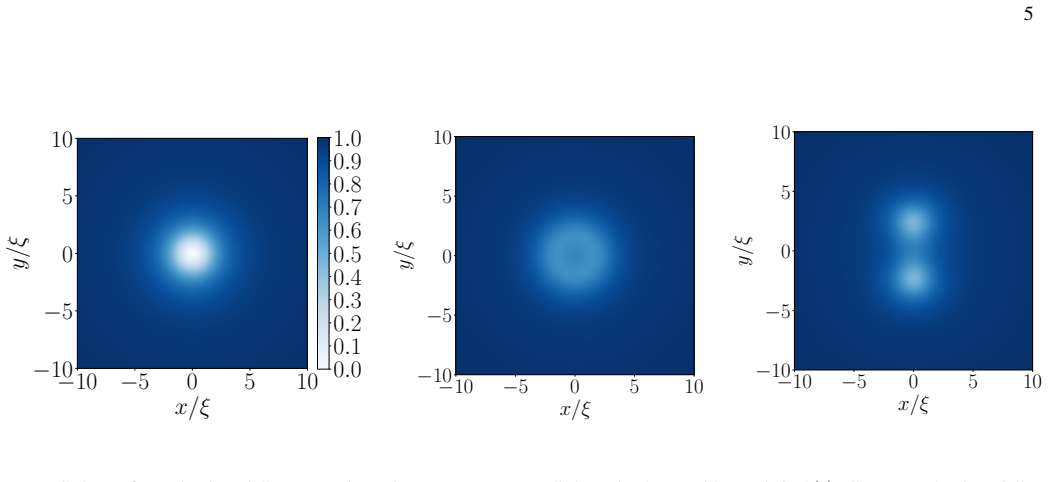
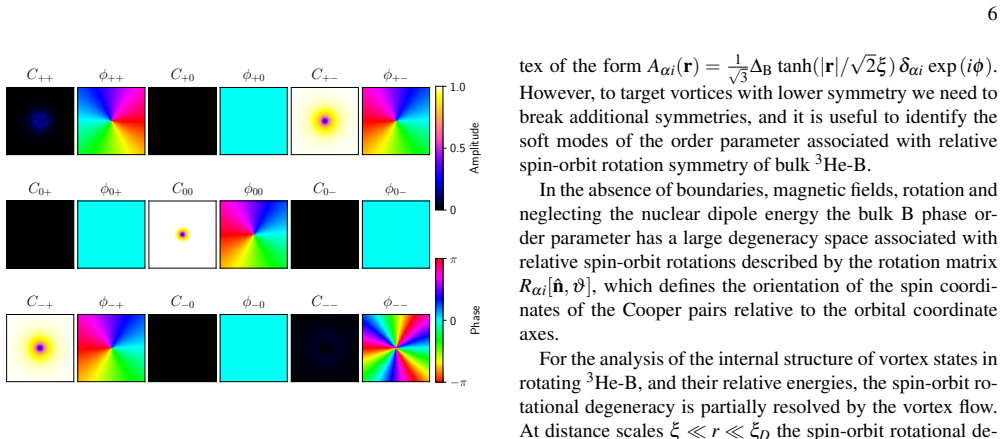
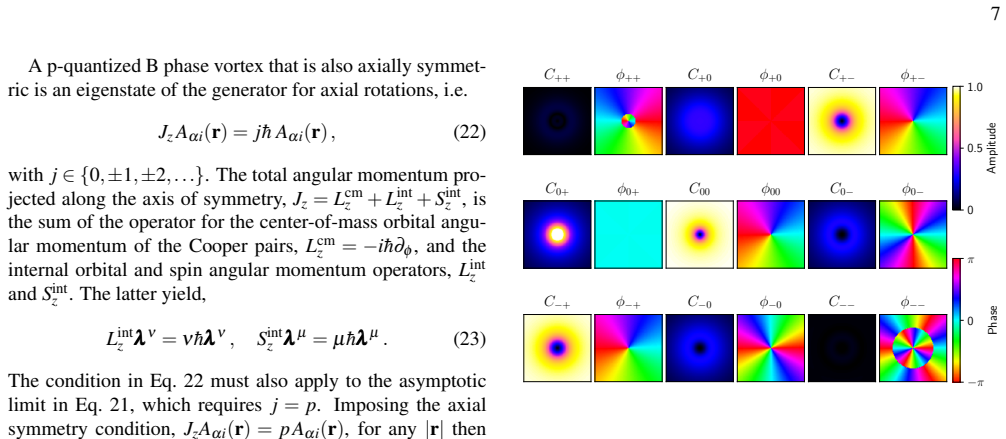
The central object is the strong-coupling Ginzburg-Landau free energy with temperature-dependent fourth-order parameters, Eq. (12), calibrated by bulk thermodynamic data so that the bulk A and B phase boundaries are reproduced over the full pressure range. The vortex order parameter is expanded in the angular-momentum basis, where each component carries an integer phase winding N; the A-core vortex is carried by amplitudes with zero phase winding, C0+ and C+0, which are favored by strong-coupling energies, while the D-core vortex is driven by the dissociation of N=2 winding components C0− and C−0 into pairs of N=1 vortices. The competition between the gain in condensation energy from this dissociation and the loss of strong-coupling core energy is the mechanism that sets the transition temperature T_v(p,H) and the metastability limit T*_v(p,H).
What would settle it
A pressure-sweep measurement of the vortex transition on cooling at H=284 G that reaches pressures below the point where the paper's metastability line terminates would test the theory; the paper's own comparison shows its A-core metastability region ends at higher pressure than the measured cooling transitions, so observing a cooling transition at those lower pressures would indicate a stabilizing mechanism missing from the strong-coupling Ginzburg-Landau functional.
Extended reading notes
Core claim
The central claim is that the vortex phase diagram of rotating 3He-B can be calculated from a strong-coupling Ginzburg-Landau functional whose fourth-order coefficients carry both weak-coupling and strong-coupling contributions, with the strong-coupling part scaled by T/Tc. Using this functional, the paper finds two globally stable vortex phases: the A-core phase, with the chiral A phase and non-unitary β phase filling the vortex core, and the D-core phase, whose core spontaneously breaks axial rotation symmetry and develops a double-core structure. In zero field the first-order boundary T_v(p) between these phases terminates on the bulk transition line at a triple point; the A-core phase is metastable below that line and supercools to a global-instability line T*_v(p,H). For magnetic fields H≳60 G parallel to the rotation axis, the A-core phase is stabilized over an extended region down to low pressure. The authors compare their calculated lines with experimental transitions and find that the cooling transitions track the supercooling line while a warming transition tracks the equilibrium line, thereby giving a unified interpretation of the observed hysteresis.
Load-bearing premise
The calculation assumes that strong-coupling corrections measured near the superfluid transition, scaled linearly with temperature, remain accurate at the much lower temperatures and inside the strongly distorted vortex cores where the D-core phase is stable; if that extrapolation fails, the predicted phase boundaries shift.
Editorial extensions
If this is right
- The observed first-order vortex transition in rotating 3He-B is explained as an equilibrium transition on warming and a supercooling transition on cooling, resolving the hysteresis seen in NMR experiments.
- In zero field, the A-core vortex phase exists only in a window near the bulk transition at high pressure, ending at a triple point on T_c(p), so no A-core phase should be found at lower pressures in zero field.
- An external field H∥Ω with H≳60 G widens the A-core stability region and can open a window of A-core stability at pressures below the zero-field triple point.
- At the first-order transition the vortex magnetization jumps discontinuously, giving a magnetic signature that should be observable in the gyromagnetic NMR shift.
- Below the metastability line the A-core phase is globally unstable, so no amount of supercooling can preserve it; the observed sharp drop in the NMR signal at cooling is the signature of this global instability.
Reading between the lines
- The same competition between zero-winding core amplitudes and dissociation of higher-winding amplitudes might govern vortex core transitions in other spin-triplet or p-wave superfluids, including neutron-star matter, where the strong-coupling parameters would be different.
- The paper's admitted discrepancy—its metastability region ends at higher pressure than the measured cooling transitions—suggests that an additional stabilizing mechanism for the A-core phase exists below p_cv, possibly requiring the full quasiclassical strong-coupling functional rather than the GL extrapolation.
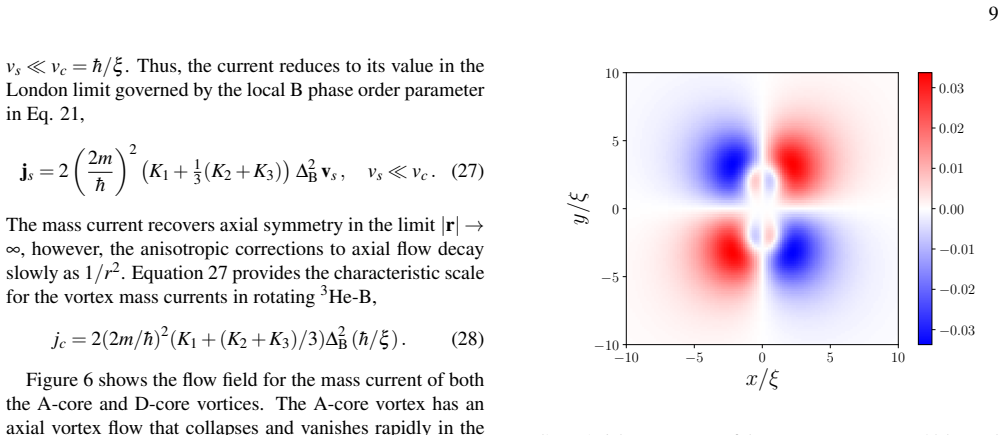
- A quantitative prediction of the axial mass-current anomaly in D-core vortices, for example the transit time of ions carried along the core, would provide a direct experimental test of the double-core structure beyond the phase diagram itself.
Signed reviews
Editorial analysis
A structured set of objections, weighed in public.
Referee Report
Summary. The manuscript develops a strong-coupling Ginzburg-Landau theory for vortex phases in rotating superfluid 3He-B, using temperature-dependent fourth-order coefficients beta_i(p,T) = beta_i^wc(p)+(T/Tc) beta_i^sc(p) (Eq. 12). The authors solve the Euler-Lagrange equations numerically with an L-BFGS solver on a 60xi x 60xi cell for the o-vortex, A-core vortex, and D-core vortex, and compute free energies across pressure and temperature. They report a zero-field first-order transition line T_v(p) between D-core and A-core vortex phases that terminates at a triple point on T_c(p), a field-shifted equilibrium line for H=284 G, and a metastability (supercooling) line T*_v(p,H) below which the A-core vortex is globally unstable. The central interpretive claim is that the experimentally observed cooling transition is T*_v and the warming transition is T_v, with quantitative agreement over most of the measured pressure range and an admitted discrepancy at low pressures.
Significance. The result, if quantitatively reliable, is significant: it is the first calculation of the p-T-H vortex phase diagram for 3He-B, and it is parameter-free in the sense that the strong-coupling beta parameters are fixed by prior fits to bulk properties, not by vortex data. The numerical solver is benchmarked against independent results by Kasamatsu et al., and the bulk A-B transition line is reproduced. The proposed identification of the cooling transition as a global instability of the A-core vortex and the warming transition as the equilibrium transition is physically plausible and gives a natural explanation of the observed hysteresis. The strength of the paper is that it converts a phenomenological picture into concrete, falsifiable predictions for T_v(p,H) and T*_v(p,H); the weakness is the quantitative reliance on an extrapolated strong-coupling ansatz without error estimates.
major comments (3)
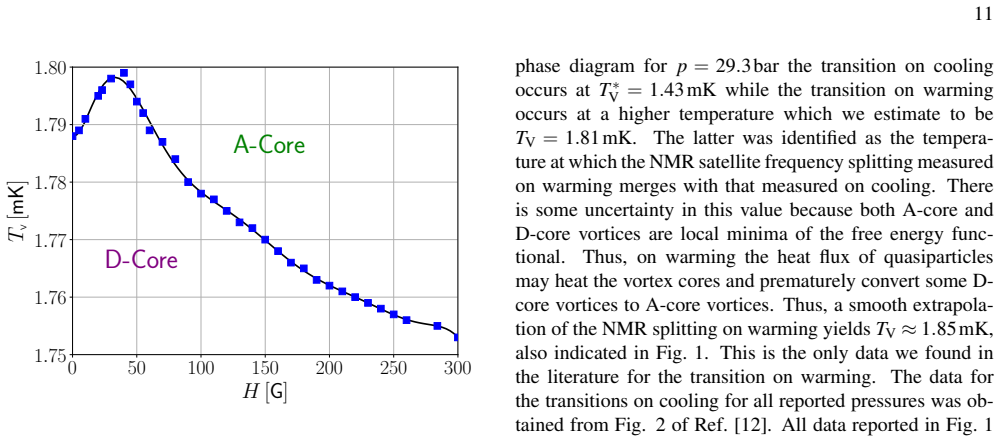
- [Equilibrium & Metastability Transitions] The paper states, 'We are not able to resolve the origin of the discrepancy in the minimum pressure for the metastable A-core phase within the strong-coupling GL theory.' Because the central claim is that the experimentally observed cooling transitions are T*_v(p,H), the fact that the calculated T*_v terminates at higher pressure than the low-pressure cooling data in Fig. 1 means the identification is not established over the full pressure range. The authors should either quantify the pressure mismatch, identify a physical mechanism (e.g., non-axial field components, cell texture, or nucleation effects) that shifts T*_v downward, or narrow the claim to the pressure range where agreement holds.
- [Strong-Coupling Theory, Eq. (12)] The linear temperature scaling beta_i(p,T) = beta_i^wc(p) + (T/Tc) beta_i^sc(p) is motivated by phase-space arguments near T_c, but the stable D-core region and the computed transition lines use solutions at T = 0.25-0.55 T_c, as shown in Figs. 2 and 5. No estimate is provided for the error from truncating the GL expansion at fourth order or from assuming the same linear T/Tc scaling for the strongly distorted order-parameter gradients inside vortex cores. Since T_v and T*_v are determined by small free-energy differences between two vortex phases, this unquantified extrapolation is load-bearing; a sensitivity analysis with respect to variations of beta_i^sc within the uncertainties of Ref. [14] would materially strengthen the paper.
- [Equilibrium & Metastability Transitions] The identification of the warming transition as the equilibrium line T_v rests on a single experimental point at p = 29.3 bar, with the authors noting an uncertainty between T_v = 1.81 mK and 1.85 mK. The case for the hysteresis interpretation would be stronger if additional warming-transition data, or an analysis of the NMR merging criterion, were presented.
minor comments (5)
- [Fig. 1 caption] The legend contains duplicate entries for 'TV (p, H) - Expt., On Warming, H = 284G'; please remove the duplicate.
- [Magnetic Susceptibility] The text 'The increase in TV relative to the zero-field transition for H & 60mK' should read 'H & 60G'; the unit mK is inconsistent with the magnetic field context.
- [Table II] The particle density at p = 22.0 bar (22.96 nm^-3) is not monotonic with the neighboring values and is likely a typographical error; please verify.
- [Throughout] Cross-references to sections appear as placeholders (e.g., 'in Sec. '); please supply the actual section numbers.
- [Equilibrium & Metastability Transitions] The sentence 'This is indicated on the pressure-temperature phase diagram for p = 29.3bar the transition on cooling occurs at T*_V = 1.43mK' is missing punctuation and should be rephrased.
Circularity Check
No significant circularity: the vortex phase diagram is obtained by solving the strong-coupling GL equations with beta-parameters fixed by bulk thermodynamic data, then compared, not fitted, to experiment.
full rationale
The derivation chain starts from the GL functional (Eqs. 1-4) with material parameters fixed by weak-coupling BCS theory and strong-coupling corrections (Eq. 12), whose coefficients are taken from Ref. [14]. Those coefficients are constrained by bulk normal-state and heat-capacity data: the paper states that the strong-coupling corrections 'reproduce the heat capacity jumps for the A and B transitions over the full pressure range.' These inputs do not depend on the vortex transition data. The paper then solves the Euler-Lagrange equations (Eq. 14) for competing vortex ansatze, computes their free energies, and reads off TV and T*V as genuine outputs. The A-core/D-core comparison is not equivalent to the input condition beta_A = beta_B: the vortex free energies involve gradient terms, core structure, and field distortions. The experimental cooling/warming transitions are used only for comparison, not as fitting targets; the paper explicitly reports a low-pressure discrepancy ('We are not able to resolve the origin of the discrepancy in the minimum pressure for the metastable A-core phase'), which is evidence that the comparison is not being forced. The benchmark against Kasamatsu et al. (Fig. 12) is independent code-level support. The self-citations [13,14] do not raise the circularity score because their content is externally constrained by bulk thermodynamic data and the numerical benchmark, and no equation in the paper reduces the predicted vortex transition line to a fit of that line. The linear T/Tc scaling in Eq. 12 is an input assumption with a phase-space motivation, but it is not derived from or fitted to the vortex phase diagram; it is an accuracy risk rather than a circularity.
Assumptions & free parameters
free parameters (1)
- Strong-coupling corrections beta_sc_i(p) =
Set of 19 values (Table II), e.g. at p=0: [-0.0098, -0.0419, -0.0132, -0.0047, -0.0899] in units of |beta_wc_1|; at…
assumptions (4)
- domain assumption Ginzburg-Landau expansion remains quantitatively valid in vortex cores at T/T_c down to 0.25
- ad hoc to paper Linear temperature scaling of strong-coupling corrections, Eq. 12
- domain assumption Single-vortex unit cell (d_c=60xi) with phase-winding boundary conditions represents a vortex in the rotating array
- domain assumption Dipolar energy and large-scale n(r) texture do not affect vortex phase stability
Cite this review
Pith. "Pith review of The Vortex Phase Diagram of Rotating Superfluid $^3$He-B." pith.science (2026). https://pith.science/paper/JNNXJNHX
@misc{pith2026190804190,
  author       = {Pith},
  title        = {Pith review of: The Vortex Phase Diagram of Rotating Superfluid $^3$He-B},
  year         = {2026},
  howpublished = {\url{https://pith.science/paper/JNNXJNHX}},
  note         = {Machine review of arXiv:1908.04190}
}
abstract
We present the first theoretical calculation of the pressure-temperature-field phase diagram for the vortex phases of rotating superfluid $^3$He-B. Based on a strong-coupling extension of the Ginzburg-Landau theory that accounts for the relative stability of the bulk A and B phases of $^3$He at all pressures, we report calculations for the internal structure and free energies of distinct broken-symmetry vortices in rotating superfluid $^3$He-B. Theoretical results for the equilibrium vortex phase diagram in zero field and an external field of $H=284\,\mbox{G}$ parallel to the rotation axis, $\vec{H}\parallel\vec{\Omega}$, are reported, as well as the supercooling transition line, $T^{*}_ {v} (p,H)$. In zero field the vortex phases of $^3$He-B are separated by a first-order phase transition line $T_ {v} (p)$ that terminates on the bulk critical line $T_{c}(p)$ at a triple point. The low-pressure, low-temperature phase is characterized by an array of singly-quantized vortices that spontaneously breaks axial rotation symmetry, exhibits anisotropic vortex currents and an axial current anomaly (D-core phase). The high-pressure, high-temperature phase is characterized by vortices with both bulk A phase and $\beta$ phase in their cores (A-core phase). We show that this phase is metastable and supercools down to a minimum temperature, $T^{*}_ {v} (p,H)$, below which it is globally unstable to an array of D-core vortices. For $H\gtrsim 60\,\mbox{G}$ external magnetic fields aligned along the axis of rotation increase the region of stability of the A-core phase of rotating $^3$He-B, opening a window of stability down to low pressures. These results are compared with the experimentally reported phase transitions in rotating $^3$He-B.
Figures

Figures from the paper (9 more)






Forward citations
Cited by 2 Pith papers
-
Microscopic description of axisymmetric vortices in $^{3}P_{2}$ superfluids
Microscopic calculations show the o vortex is the most stable axisymmetric vortex in 3P2 superfluids under strong magnetic fields and hosts two zero-energy Majorana fermions in its core.
-
Quasiclassical expressions for the free energy of superconducting systems
A lambda-integration-free Eilenberger free energy functional is derived from Luttinger-Ward theory and generalized to spin-triplet correlations and spin-dependent fields.
Reference graph
Works this paper leans on
-
[14]
J. J. Wiman and J. A. Sauls, Superfluid phases of 3He in nanoscale channels, Phys. Rev. B 92, 144515 (2015)
work page 2015
-
[1]
Onsager, Statistical Hydrodynamics, Il Nouvo Cimento 6, 279 (1949)
L. Onsager, Statistical Hydrodynamics, Il Nouvo Cimento 6, 279 (1949)
work page 1949
-
[2]
Figure 7 shows the z-axis current for the D-core vortex for the same pressure and temperature as that for the vortex currents in Fig. 6, also in units of jc. The axial current density spans an area of order A≈ 100 ξ 2≈ 6.25 µm2. An idea for detection of the current anomaly along the z- axis is to inject electrons into rotating 3He-B from the outer, radial...
-
[3]
R. P. Feynman, Chapter 2: The Application of Quantum Me- chanics to Liquid Helium, in Progress in Low Temperature Physics, V ol. I, edited by C. J. Gorter (North Holland Publish- ing Co., Amsterdam, 1955) pp. 17–53
work page 1955
-
[4]
R. J. Zieve, Y . M. Mukharsky, J. D. Close, J. C. Davis, and R. E. Packard, Investigation of quantized circulation in super- fluid 3He-B, J. Low Temp. Phys. 91, 315 (1993)
work page 1993
-
[5]
D. V ollhardt and P. W ¨olfle, The Superfluid Phases of 3He (Taylor & Francis, New York, 1990)
work page 1990
-
[6]
M. M. Salomaa and G. E. V olovik, Quantized Vortices in Su- perfluid 3He, Rev. Mod. Phys. 59, 533 (1987)
work page 1987
-
[7]
O. V . Lounasmaa and E. Thuneberg, Vortices in rotating su- perfluid 3He, Proc. Nat. Acad. Sci. 96, 7760 (1999). 0 50 100 150 200 250 300 H(G) −2.0 −1.5 −1.0 −0.5 0.0 0.5 ˜FV A-Core D-Core FIG. 12. Free energies for the A-core and D-core vortex states versus magnetic field calculated using our GL solver for the set I GL parameters at p = 34bar. The core con...
work page 1999
Show all 51 references
-
[8]
M. M. Salomaa and G. E. V olovik, Vortices with Ferromag- netic Superfluid Core in 3He-B, Phys. Rev. Lett. 51, 2040 (1983)
1983
-
[9]
E. V . Thuneberg, Identification of vortices in superfluid 3He- B, Phys. Rev. Lett. 56, 359 (1986)
1986
-
[10]
Ikkala, G
O. Ikkala, G. V olovik, P. Hakonen, Y . Bunkov, S. Islander, and G. Kharadze, NMR in Rotating Superfluid 3He-B, Sov. Phys. JETP 35, 416 (1982)
1982
-
[11]
P. J. Hakonen, M. Krusius, M. M. Salomaa, J. T. Simola, Y . M. Bunkov, V . P. Mineev, and G. E. V olovik, Magnetic Vortices in Rotating Superfluid 3He-B, Phys. Rev. Lett. 51, 1362 (1983)
1983
-
[12]
P. J. Hakonen, O. T. Ikkala, S. T. Islander, O. V . Lounasmaa, and G. E. V olovik, NMR experiments on rotating superfluid 3He-A and 3He-B and their theoretical interpretation, J. Low Temp. Phys. 53, 425 (1983)
1983
-
[13]
Pekola, J
J. Pekola, J. Simola, P. J. Hakonen, M. Krusius, O. Lounas- maa, K. Nummila, G. Mamniashvili, R. Packard, and G. V olovik,Phase Diagram of the First-Order Vortex Core Transition in Superfluid 3He-B, Phys. Rev. Lett. 53, 584 (1984)
1984
-
[15]
Wiman, Quantitative Superfluid He-Three from Con- finement to Bulk , Ph.D
J. Wiman, Quantitative Superfluid He-Three from Con- finement to Bulk , Ph.D. thesis, Northwestern University, Evanston, Illinois (2019)
2019
-
[16]
T. Ohmi, T. Tsuneto, and T. Fujita, Core Structure of Vortex Line in 3He-B, Prog. Theor. Phys. 70, 647 (1983)
1983
-
[17]
Salomaa and G
M. Salomaa and G. V olovik, Symmetry and Structure of Quantized Vortices in Superfluid3He-B, Phys. Rev. B31, 203 (1985)
1985
-
[18]
Thuneberg, Ginzburg-Landau theory of vortices in super- fluid 3He-B, Phys
E. Thuneberg, Ginzburg-Landau theory of vortices in super- fluid 3He-B, Phys. Rev. B 36, 3583 (1987)
1987
-
[19]
For a detailed analysis of the determination of gD see Ref. [48]
-
[20]
J. W. Serene and D. Rainer, The Quasiclassical Approach to 3He, Phys. Rep. 101, 221 (1983)
1983
-
[21]
There is a very small correction to ∂ α/∂T|Tc from the finite lifetime of quasiparticles which has no role in the relative sta- bility of the vortex phases
-
[22]
Balian and N
R. Balian and N. R. Werthamer, Superconductivity with pairs in a relative p-state, Phys. Rev. 131, 1553 (1963)
1963
-
[23]
P. W. Anderson and P. Morel, Generalized Bardeen-Cooper- Schrieffer States and the Proposed Low-Temperature Phase of 15 3He, Phys. Rev. 123, 1911 (1961)
1961
-
[24]
Layzer and D
A. Layzer and D. Fay, Spin-Fluctuation Exchange Mechanism for P-wave Pairing in Liquid3He, Int. J. Magn. 1, 135 (1971)
1971
-
[25]
Rainer and J
D. Rainer and J. W. Serene, Free Energy of Superfluid 3He, Phys. Rev. B 13, 4745 (1976)
1976
-
[26]
J. A. Sauls and J. W. Serene, Potential Scattering Models for the Quasiparticle Interactions in Liquid3He, Phys. Rev. B24, 183 (1981)
1981
-
[27]
J. A. Sauls and J. W. Serene, Higher-Order Strong Coupling Effects in Superfluid 3He, Physica B+C 108, 1137 (1981)
1981
-
[28]
Nocedal, Updating quasi-Newton matrices with limited storage, Math
J. Nocedal, Updating quasi-Newton matrices with limited storage, Math. Comp. 35, 773 (1980)
1980
-
[29]
Nocedal and S
J. Nocedal and S. J. Wright, Numerical Optimization, V ol. 2nd (Springer, Berlin, 2006)
2006
-
[30]
[49] for implementations of gradient decent al- gorithms for solving the GL equations
See also Ref. [49] for implementations of gradient decent al- gorithms for solving the GL equations
-
[31]
Hasegawa, On Vortex in Superfluid 3He-B, Prog
Y . Hasegawa, On Vortex in Superfluid 3He-B, Prog. Theor. Phys. 73, 1258 (1985)
1985
-
[32]
M. A. Silaev, E. V . Thuneberg, and M. Fogelstr ¨om, Lifshitz Transition in the Double-Core Vortex in 3He-B, Phys. Rev. Lett. 115, 235301 (2015)
2015
-
[33]
S. J. Barnett, Magnetization by Rotation, Phys. Rev. 6, 239 (1915)
1915
-
[34]
A similar axial current anomaly bound to disclination lines in the chiral phase of 3He confined in a cylindrical channel is reported in Ref. [50]
-
[35]
Shevtsov and J
O. Shevtsov and J. A. Sauls, Electron Bubbles and Weyl Fermions in Chiral Superfluid 3He-A, Phys. Rev. B 94, 064511 (2016)
2016
-
[36]
G. A. Williams and R. E. Packard, Photographs of Quan- tized Vortex Lines in Rotating He II, Phys. Rev. Lett. 33, 280 (1974)
1974
-
[37]
Note that in contrast to the imaging of trapped ions in rotating 4He the transport of ions in the D-core phase of rotating 3He- B would be under conditions of zero electric field
-
[38]
L. D. Landau and I. M. Lifshitz, Statistical Physics, 2nd ed., V ol. 5, Course in Theoretical Physics (Pergamon Press, New York, 1969)
1969
-
[39]
J. A. Sauls, Anisotropic Pairing in Neutron Stars and Liq- uid 3He, Ph.D. thesis, State University of New York at Stony Brook (1980)
1980
-
[40]
J. A. Sauls, D. L. Stein, and J. W. Serene, Magnetic Vortices in a Rotating 3P2 Neutron Superfluid, Phys. Rev. D 25, 967 (1982)
1982
-
[41]
In particular, the anisotropy axis defining the B-phase order parameter in Eq. 13 aligns along H||z in the center of the cell, but tilts away from the z-axis at an angle of β (r), with β (r)≃ β1 r, with β1 ≲ π 4 r/R for pressures p & 20bar and rotation speeds Ω ≲ 2rad /s. The t...
-
[42]
T. O. Kenichi Kasamatsu, Ryota Mizuno and M. Nakahara, Effects of a magnetic field on vortex states in superfluid 3He- B, Phys. Rev. B 99, 104513 (2019)
2019
-
[43]
H. Choi, J. P. Davis, J. Pollanen, T. Haard, and W. Halperin, Strong coupling corrections to the Ginzburg-Landau theory of superfluid 3He, Phys. Rev. B 75, 174503 (2007)
2007
-
[44]
D. S. Greywall, 3He Specific Heat and Thermometry at Mil- likelvin Temperatures,Phys. Rev. B 33, 7520 (1986)
1986
-
[45]
J. A. Sauls and T. Mizushima, On the Nambu Fermion-Boson Relations for Superfluid 3He, Phys. Rev. B95, 094515 (2017)
2017
-
[46]
M. D. Nguyen, A. M. Zimmerman, and W. P. Halperin, Cor- rections to Higgs mode masses in superfluid 3He from acous- tic spectroscopy, Phys. Rev. B 99, 054510 (2019)
2019
-
[47]
J. C. Wheatley, Experimental Properties of Superfluid 3He, Rev. Mod. Phys. 47, 415 (1975)
1975
-
[48]
Goudon,Magn´etisme nucl´eaire de l’3He liquide : nouvelle d´etermination du param`etre de Landau Fa 0 , Ph.D
V . Goudon,Magn´etisme nucl´eaire de l’3He liquide : nouvelle d´etermination du param`etre de Landau Fa 0 , Ph.D. thesis, Uni- versit´e Joseph-Fourier - Grenoble I (2006)
2006
-
[49]
E. V . Thuneberg, Hydrostatic Theory of Superfluid 3He-B, J. Low Temp. Phys. 122, 657 (2001)
2001
-
[50]
J. K. Viljas and E. V . Thuneberg, Equilibrium Simulations of 2D Weak Links in p-wave Superfluids, J. Low Temp. Phys. 129, 423 (2002)
2002
-
[51]
J. J. Wiman and J. A. Sauls, Spontaneous Helical Order of a Chiral p-Wave Superfluid Confined in Nano-Scale Channels, Phys. Rev. Lett. 121, 045301 (2018)
2018
Reviewed August 14, 2026 · model on record in the stance chip above.
Discussion (0). Continue with ORCID to comment.