REVIEW 5 major objections 5 minor 63 references
Mitigating Spatial Disparity in Urban Prediction Using Residual-Aware Spatiotemporal Graph Neural Networks: A Chicago Case Study
T0 review · 5 major / 5 minor · reviewed 2026-08-10 · deepseek-v4-flash
Pith's one-line read This paper claims that adding a Residual-Aware Attention block and an equality-enhancing loss to spatiotemporal graph neural networks reduces spatial and demographic disparities in urban predictions, with a 48% fairness improvement at a…
desk verdict The residual-aware attention idea is worth taking seriously, but the current empirical evidence is too under-specified to support the headline fairness claims. read the letter →
The pith
A machine-rendered reading of the paper's core claim, the machinery that carries it, and where it could break.
The reading
What carries the argument
The machinery is the Residual-Aware Attention (RAA) block coupled with a multi-term loss. The RAA block converts the residual vector into Q, K, V through tanh-activated linear layers, forms attention scores S = QK^T/$\sqrt$(|K|), softmax-normalizes them into H, and computes an adapted adjacency matrix A_adapted = A ⊙ H, which is reused in the next training epoch so that message passing downweights neighboring regions with similar residual patterns. The joint loss is L = L_MSE + λ_s D_s + λ_d D_d, where D_s is the sign-aware residual variance of spatially weighted positive and negative residuals and D_d is either Moran's I (shifted to be non-negative) or the Generalized Entropy Index; default regularization weights are 0.05 and tunable. This design is what lets the model reduce spatial disparity without demographic features.
What would settle it
Re-run the same four base models and RAA variants on Chicago ride-hail data using a strict temporal held-out split (for example, train on September through November and evaluate on December), and recompute GEI, SDI, Moran's I, MAE, and SMAPE on that test period; if the fairness gains shrink to near zero or the error increase grows well beyond 9%, the central claim is not supported.
Extended reading notes
Core claim
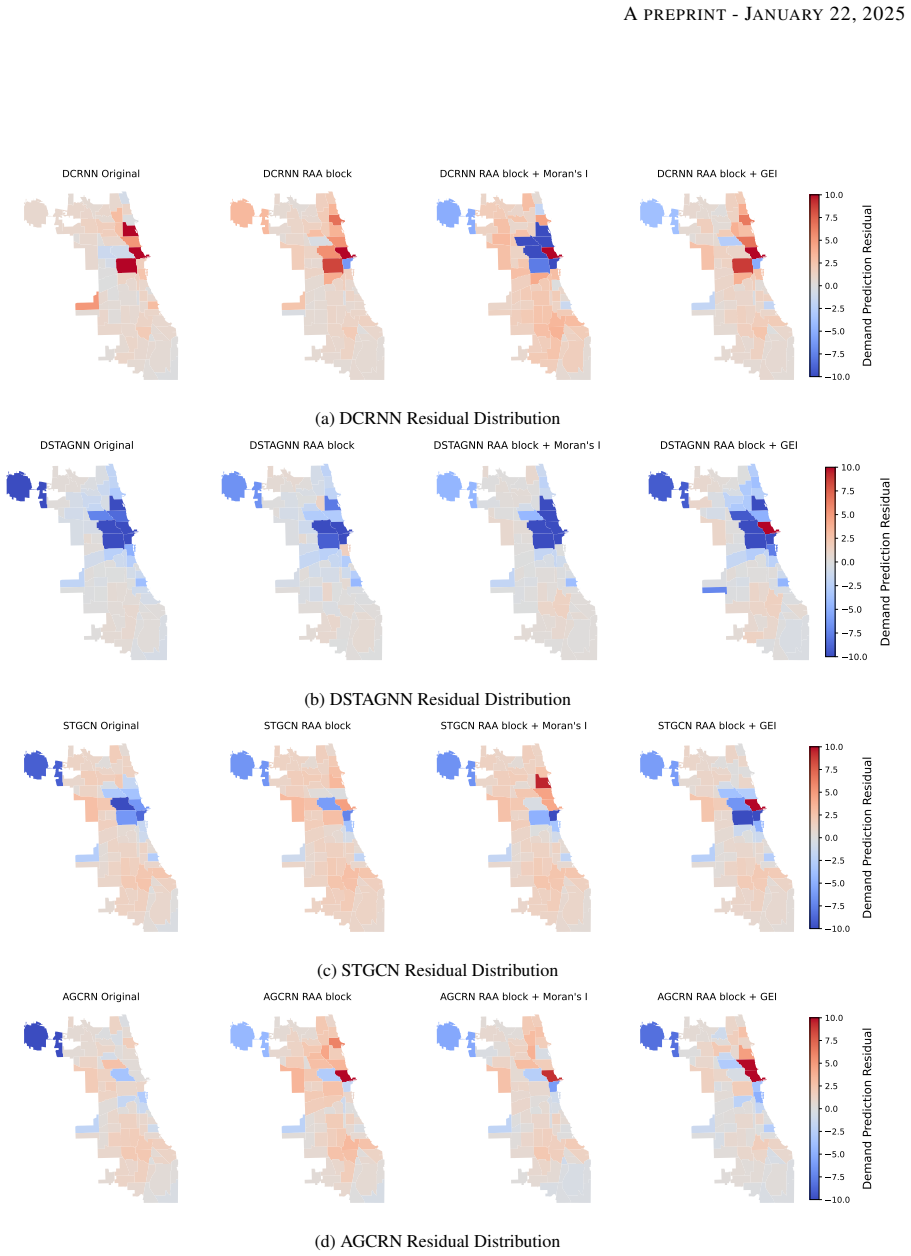
The paper's central claim is that the source of demographic unfairness in ST-GNN predictions is partly spatial: message passing over a fixed geographic adjacency matrix makes residuals locally segregated, and in a city like Chicago, where racial groups are geographically separated, that spatial segregation lines up with demographic groups. The authors therefore propose to attack disparity at the message-passing level. A Residual-Aware Attention block takes the current training residuals, projects them into query, key, and value vectors, and uses softmax attention to form a mask that is multiplied element-wise into the adjacency matrix, so the graph used in the next training epoch de-emphasizes edges along which residuals are similar. An equality-enhancing loss adds to the mean squared error two regularizers: D_s, the sign-aware variance of spatially aggregated positive and negative residuals, and D_d, taken as Moran's I or the Generalized Entropy Index of residuals. On four ST-GNN architectures applied to Chicago ride-hail demand, the authors report that this combination reduces residual clustering and residual-demographic correlation, cuts GEI by an average of 18%, SDI by 47%, and Moran's I by 80%, with a 7% average increase in MAE and 12% in SMAPE.
Load-bearing premise
The load-bearing premise is that the reported fairness and accuracy numbers are measured on data the model did not train on; if they come from the training set instead, the fairness improvements could be partly the model minimizing the very quantities the loss penalizes.
Editorial extensions
If this is right
- Across the four ST-GNN base models, 10 of 12 RAA variants improved GEI, all 12 improved SDI, and the average Moran's I dropped by 80%, so the disparity reduction generalizes across architectures, though its size varies by model.
- The best fairness gains came from the RAA block plus the GEI regularizer, with DCRNN and AGCRN showing the most consistent improvements across all variants.
- Reducing spatial residual clustering also reduced demographic disparity, measured by correlation of residuals with minority and majority population shares, so spatial regularization can substitute for demographic data when protected attributes are unavailable.
- The accuracy-fairness trade-off is mild on average (about 7% MAE and 12% SMAPE increase), and in some configurations both accuracy and fairness improve, which the authors attribute to model multiplicity or underspecification.
Reading between the lines
- Editorial inference: the headline 48% fairness gain should be read as conditional on the evaluation protocol; the paper does not state whether the metrics come from a held-out test set or the training data, and if they come from training data, part of the GEI and Moran's I reductions is the direct effect of minimizing those same terms in the loss.
- Editorial inference: because the method only touches residuals and the adjacency matrix, it should transfer to other urban prediction targets such as crime, pollution, or temperature, but the demographic fairness payoff depends on the extent to which spatial segregation tracks the protected groups of interest.
- Editorial inference: a testable prediction of the mechanism is that the learned attention weights should downweight edges connecting regions whose residuals have the same sign; inspecting the adapted adjacency matrix against residual sign maps would let a reader verify this directly.
Editorial analysis
A structured set of objections, weighed in public.
Referee Report
Summary. The paper proposes a Residual-Aware Attention (RAA) block and an equality-enhancing loss to reduce spatial and demographic disparities in ST-GNN urban prediction, and evaluates the approach on Chicago travel demand with four base ST-GNN models. It reports average fairness-metric decreases of 18% in GEI, 47% in SDI, and 80% in Moran's I at a modest accuracy cost, summarized in the abstract as a 48% significant improvement in fairness metrics with only a 9% increase in error metrics. The central empirical claim is not supported by the reported evidence because the evaluation protocol is unspecified, the fairness metrics reported in Table 1 are partly the same terms minimized in Equation (8), and the same model configurations take contradictory values across Tables 1 and 2.
Significance. If substantiated, the approach would be valuable: it targets prediction disparities without using protected attributes, it adapts the graph adjacency matrix from residuals rather than from demographic labels, and it offers a regularization framework that could transfer to other urban prediction tasks. The paper also provides spatial residual maps and attention visualizations that help interpret the mechanism. However, the significance is contingent on a clean empirical evaluation, which the manuscript does not provide. The missing held-out split, the direct optimization of the reported fairness metrics, the contradictory table entries, and the absence of uncertainty quantification mean the headline claim cannot currently be verified as a generalization result.
major comments (5)
- [§5.5, §5.6.1, Eq. (8)] The paper never states whether the metrics in Table 1 are computed on a held-out test set, a validation set, or the training set. This is load-bearing because Equation (8) includes D_s and D_d as loss terms, and Section 4.2 says D_d is instantiated as Moran's I or GEI, exactly the metrics reported as outcomes in Table 1. If Table 1 is computed on the training residuals used to fit the RAA block and the loss, then the reported GEI and Moran's I decreases are in part a direct consequence of minimizing those same objectives, making the '48% significant improvement' claim circular. The authors must specify the data split and should report metrics on both training and held-out test sets to demonstrate generalization.
- [Tables 1 and 2] The same STGCN configurations have contradictory values across the overall-performance table and the ablation table. For 'RAA block + Ds', Table 1 gives MAE 7.329, SMAPE 0.538, and GEI 1.075, whereas Table 2 (Model 3) gives MAE 7.257, SMAPE 0.474, and GEI 1.854. For 'RAA block + Moran's I', Table 1 gives MAE 7.885 and GEI 1.692, while Table 2 (Model 4) gives MAE 10.465 and GEI 0.842. These discrepancies suggest different evaluation sets, runs, or seeds, and they undermine the reliability of the empirical claims in Sections 5.6.1 and 5.6.3. The authors need to reconcile these numbers and report the exact evaluation setup.
- [§5.6.1, abstract] The claims of 'significant improvement' and the aggregated 48% figure are not supported by any confidence intervals, standard deviations, or significance tests. Additionally, percentage changes are not meaningful for Moran's I when the baseline is near zero or the value changes sign; for example, DCRNN Moran's I from 0.182 to -0.135 is reported as a -174% change. Fairness-metric improvements should be accompanied by error bars and hypothesis tests over multiple seeds.
- [§4.2, Eq. (8) vs §3.2 Eq. (3)] The equality-enhancing loss is ambiguously specified: Equation (3) defines D_d as |Corr(r, Pop_minor)| + |Corr(r, Pop_major)|, which requires demographic data, but Section 4.2 states that D_d 'utilizes fairness metrics like Moran's I or GEI.' Since the paper emphasizes fairness through unawareness, the actual form of D_d used in the experiments must be clarified, and the demographic-correlation version should be reconciled with the Moran's I/GEI version.
- [§5.6.1, Table 1] The description of the results is inaccurate: the text says 'among all 12 RAA experiments, 10 of them have reduced metrics for each fairness metric,' but Table 1 shows DSTAGNN with the Moran's I loss has GEI increase from 1.383 to 2.862 and Moran's I increase from 0.542 to 0.558, and STGCN with Moran's I loss has GEI increase from 1.506 to 1.692. The sentence about error metrics, 'all of them have at least one fairness metric improving while having error metrics decreasing,' also appears to be a typo, since many variants show increased MAE and SMAPE. These statements need correction.
minor comments (5)
- [§5.6.3 heading] The heading 'Abaltion Study' should be corrected to 'Ablation Study.'
- [§5.5] The experiment setup gives no hyperparameters, number of runs, random seeds, or early-stopping criteria; these details are necessary for reproducibility.
- [Table 1] Table 1 lists an AGCRN variant 'RAA block only,' although Section 5.6.1 says only three variants are compared (RAA + Ds, RAA + Moran's I, RAA + GEI); this discrepancy should be explained.
- [§4.1, Eq. (7)] The adapted adjacency matrix A_adapted = A ⊙ H lacks a normalization step, which is important for stable GCN training; the authors should clarify or reference a standard normalization.
- [§5.6.1] The statement that 'the average percentage increase for MAE and SMAPE are 7% and 12%' does not match the abstract's '9% increase' unless the two are averaged; the relationship should be stated explicitly.
Circularity Check
The headline fairness gains may be training-set artifacts: Eq. 8 directly optimizes Moran's I and GEI, and Table 1 reports the same metrics as improvements, without a stated held-out split.
-
fitted input called prediction
[Section 4.2, Eq. 8; Section 5.3; Section 5.6.1, Table 1]
"The overall loss function is: Ljoint = Lprediction + λsDs + λdDd, (8) ... The Dd term utilizes fairness metrics like Moran's I or GEI to measure spatial clustering or information redundancy ... We selected GEI, SDI, and Moran's I to evaluate three aspects of the residual distribution: entropy, correlation to the demographics features, and spatial clusteringness."
Equation 8 trains the model to minimize λdDd, where Dd is defined as Moran's I or GEI. Section 5.3 then defines the evaluation metrics GEI and Moran's I, and Table 1 reports improvements in exactly those metrics (average decreases of 18% in GEI and 80% in Moran's I). If Table 1 is computed on the training residuals used to fit Eq. 8, then these reported fairness improvements are partly the direct effect of optimizing the same quantities; the 'prediction' of lower GEI and Moran's I is the training objective itself, not independent evidence of fairness. The paper never states in Section 5.5 whether the reported numbers come from a held-out test set, so this reduction cannot be excluded.
-
self definitional
[Section 5.6.3, Ablation Study, Table 2]
"Lastly, adding Ds and Dd terms improves the corresponding fairness metrics. Comparing between Model 2 and Model 5, as well as Model 3 and Model 7, we see that introducing GEI in the loss function as a regularization term significantly enhances the GEI performance of model predictions."
This ablation conclusion evaluates the very metric that was added to the loss: Models 5 and 7 include GEI as the Dd regularizer, and the reported GEI is then used as evidence of improvement. On the training residuals, this is true by construction, because the model is trained to minimize GEI. The claim as stated is also internally inconsistent—Model 2 has GEI 0.402 while Model 5 has GEI 0.525, which contradicts the assertion—so it does not provide independent support for the method's effectiveness.
full rationale
The central empirical claim is that the RAA architecture and equality-enhancing loss improve fairness by 48% with only a 9% error increase. The paper's own equations make GEI and Moran's I part of the training objective: Eq. 8 adds λdDd to the MSE loss, and Section 4.2 explicitly says Dd uses Moran's I or GEI. Section 5.3 then defines the evaluation metrics GEI and Moran's I with the same conceptual content, and Table 1 reports decreases in those exact metrics. Optimizing a quantity on training residuals and then reporting a decrease in that quantity is not independent evidence of fairness unless the evaluation is on a held-out set; the paper does not state that split in Section 5.5. The SDI metric is not in the loss, and four base models are compared, which are independent elements, so the circularity is partial rather than total. There is no load-bearing self-citation chain or imported uniqueness theorem. The ambiguity is reinforced by the fact that the same STGCN variant appears with different values in Table 1 and Table 2 (e.g., RAA block + Ds: MAE 7.329 vs 7.257), suggesting the tables may mix different evaluation protocols. Overall, the headline fairness improvement partly reduces to the training objective, giving a partial-circularity score of 6.
Assumptions & free parameters
free parameters (4)
- lambda_s =
0.05 (default, tunable)
- lambda_d =
0.05 (default, tunable)
- GEI alpha =
2
- GEI residual shift m =
not specified (chosen such that residuals non-negative)
assumptions (3)
- domain assumption Prediction residuals are a valid indicator of algorithmic unfairness in urban prediction.
- domain assumption Spatial clustering of residuals is a reliable proxy for demographic disparity.
- ad hoc to paper The residual-driven attention weights from training generalize to the target data.
invented entities (1)
-
Scaled Disparity Index (SDI)
Cite this review
Pith. "Pith review of Mitigating Spatial Disparity in Urban Prediction Using Residual-Aware Spatiotemporal Graph Neural Networks: A Chicago Case Study." pith.science (2026). https://pith.science/paper/JNVOBFDC
@misc{pith2026250111214,
  author       = {Pith},
  title        = {Pith review of: Mitigating Spatial Disparity in Urban Prediction Using Residual-Aware Spatiotemporal Graph Neural Networks: A Chicago Case Study},
  year         = {2026},
  howpublished = {\url{https://pith.science/paper/JNVOBFDC}},
  note         = {Machine review of arXiv:2501.11214}
}
read the original abstract
Urban prediction tasks, such as forecasting traffic flow, temperature, and crime rates, are crucial for efficient urban planning and management. However, existing Spatiotemporal Graph Neural Networks (ST-GNNs) often rely solely on accuracy, overlooking spatial and demographic disparities in their predictions. This oversight can lead to imbalanced resource allocation and exacerbate existing inequities in urban areas. This study introduces a Residual-Aware Attention (RAA) Block and an equality-enhancing loss function to address these disparities. By adapting the adjacency matrix during training and incorporating spatial disparity metrics, our approach aims to reduce local segregation of residuals and errors. We applied our methodology to urban prediction tasks in Chicago, utilizing a travel demand dataset as an example. Our model achieved a 48% significant improvement in fairness metrics with only a 9% increase in error metrics. Spatial analysis of residual distributions revealed that models with RAA Blocks produced more equitable prediction results, particularly by reducing errors clustered in central regions. Attention maps demonstrated the model's ability to dynamically adjust focus, leading to more balanced predictions. Case studies of various community areas in Chicago further illustrated the effectiveness of our approach in addressing spatial and demographic disparities, supporting more balanced and equitable urban planning and policy-making.
Figures


Figures from the paper (1 more)

Reference graph
Works this paper leans on
-
[1]
Adaptive graph convolutional recurrent network for traffic forecasting
Lei Bai, Lina Yao, Can Li, Xianzhi Wang, and Can Wang. Adaptive graph convolutional recurrent network for traffic forecasting. Advances in neural information processing systems, 33: 0 17804--17815, 2020
work page 2020
-
[2]
Model multiplicity: Opportunities, concerns, and solutions
Emily Black, Manish Raghavan, and Solon Barocas. Model multiplicity: Opportunities, concerns, and solutions. In Proceedings of the 2022 ACM Conference on Fairness, Accountability, and Transparency, FAccT ’22, page 850–863, New York, NY, USA, June 2022. Association for Computing Machinery. ISBN 978-1-4503-9352-2. doi:10.1145/3531146.3533149. URL https://dl...
arXiv 2022
-
[3]
Fairness in Machine Learning : A Survey , October 2020
Simon Caton and Christian Haas. Fairness in Machine Learning : A Survey , October 2020. URL http://arxiv.org/abs/2010.04053. arXiv:2010.04053 [cs, stat]
arXiv 2020
-
[4]
Austin Derrow-Pinion, Jennifer She, David Wong, Oliver Lange, Todd Hester, Luis Perez, Marc Nunkesser, Seongjae Lee, Xueying Guo, Brett Wiltshire, Peter W. Battaglia, Vishal Gupta, Ang Li, Zhongwen Xu, Alvaro Sanchez-Gonzalez, Yujia Li, and Petar Velickovic. Eta prediction with graph neural networks in google maps. In Proceedings of the 30th ACM Internati...
arXiv 2021
-
[5]
Edits: Modeling and mitigating data bias for graph neural networks
Yushun Dong, Ninghao Liu, Brian Jalaian, and Jundong Li. Edits: Modeling and mitigating data bias for graph neural networks. In Proceedings of the ACM Web Conference 2022, page 1259–1269, April 2022. doi:10.1145/3485447.3512173. URL http://arxiv.org/abs/2108.05233. arXiv:2108.05233 [cs]
arXiv 2022
-
[6]
Cynthia Dwork, Moritz Hardt, Toniann Pitassi, Omer Reingold, and Richard Zemel. Fairness through awareness. In Proceedings of the 3rd Innovations in Theoretical Computer Science Conference, ITCS ’12, page 214–226, New York, NY, USA, January 2012. Association for Computing Machinery. ISBN 978-1-4503-1115-1. doi:10.1145/2090236.2090255. URL https://doi.org/...
arXiv 2012
-
[7]
Alexander D’Amour, Katherine Heller, Dan Moldovan, Ben Adlam, Babak Alipanahi, Alex Beutel, Christina Chen, Jonathan Deaton, Jacob Eisenstein, Matthew D. Hoffman, Farhad Hormozdiari, Neil Houlsby, Shaobo Hou, Ghassen Jerfel, Alan Karthikesalingam, Mario Lucic, Yian Ma, Cory McLean, Diana Mincu, Akinori Mitani, Andrea Montanari, Zachary Nado, Vivek Nataraj...
work page 2022
-
[9]
Spatial-temporal graph ode networks for traffic flow forecasting
Zheng Fang, Qingqing Long, Guojie Song, and Kunqing Xie. Spatial-temporal graph ode networks for traffic flow forecasting. In Proceedings of the 27th ACM SIGKDD Conference on Knowledge Discovery & Data Mining, pages 364--373, 2021
2021
Show all 63 references
-
[10]
A spatial–temporal graph deep learning model for urban flood nowcasting leveraging heterogeneous community features
Hamed Farahmand, Yuanchang Xu, and Ali Mostafavi. A spatial–temporal graph deep learning model for urban flood nowcasting leveraging heterogeneous community features. Scientific Reports, 13 0 (1): 0 6768, April 2023. ISSN 2045-2322. doi:10.1038/s41598-023-32548-x
2023 doi
-
[11]
The sociodemographic biases in machine learning algorithms: A biomedical informatics perspective
Gillian Franklin, Rachel Stephens, Muhammad Piracha, Shmuel Tiosano, Frank Lehouillier, Ross Koppel, and Peter L Elkin. The sociodemographic biases in machine learning algorithms: A biomedical informatics perspective. Life, 14 0 (6): 0 652, 2024
2024
-
[12]
Compacteta: A fast inference system for travel time prediction
Kun Fu, Fanlin Meng, Jieping Ye, and Zheng Wang. Compacteta: A fast inference system for travel time prediction. In Proceedings of the 26th ACM SIGKDD International Conference on Knowledge Discovery & Data Mining, KDD ’20, page 3337–3345, New York, NY, USA, August 2020. Associ...
2020
-
[13]
Spatiotemporal Multi-Graph Convolution Network for Ride-Hailing Demand Forecasting
Xu Geng, Yaguang Li, Leye Wang, Lingyu Zhang, Qiang Yang, Jieping Ye, and Yan Liu. Spatiotemporal Multi-Graph Convolution Network for Ride-Hailing Demand Forecasting . Proceedings of the AAAI Conference on Artificial Intelligence, 33: 0 3656--3663, 2019. ISSN 2159-5399. doi:10...
2019 doi
-
[14]
The case for process fairness in learning: Feature selection for fair decision making
Nina Grgic-Hlacˇa, Muhammad Bilal Zafar, Krishna P Gummadi, and Adrian Weller. The case for process fairness in learning: Feature selection for fair decision making
-
[15]
Fairness-enhancing vehicle rebalancing in the ride-hailing system
Xiaotong Guo, Hanyong Xu, Dingyi Zhuang, Yunhan Zheng, and Jinhua Zhao. Fairness-enhancing vehicle rebalancing in the ride-hailing system. 0 (arXiv:2401.00093), December 2023. doi:10.48550/arXiv.2401.00093. URL http://arxiv.org/abs/2401.00093. arXiv:2401.00093 [cs]
-
[16]
Predicting station-level short-term passenger flow in a citywide metro network using spatiotemporal graph convolutional neural networks
Yong Han, Shukang Wang, Yibin Ren, Cheng Wang, Peng Gao, and Ge Chen. Predicting station-level short-term passenger flow in a citywide metro network using spatiotemporal graph convolutional neural networks . ISPRS International Journal of Geo-Information, 8 0 (6), 2019. ISSN 2...
2019 doi
-
[17]
Dueta: Traffic congestion propagation pattern modeling via efficient graph learning for eta prediction at baidu maps
Jizhou Huang, Zhengjie Huang, Xiaomin Fang, Shikun Feng, Xuyi Chen, Jiaxiang Liu, Haitao Yuan, and Haifeng Wang. Dueta: Traffic congestion propagation pattern modeling via efficient graph learning for eta prediction at baidu maps. In Proceedings of the 31st ACM International C...
2022
-
[18]
Urban ride-hailing demand prediction with multiple spatio-temporal information fusion network
Guangyin Jin, Yan Cui, Liang Zeng, Hanbo Tang, Yanghe Feng, and Jincai Huang. Urban ride-hailing demand prediction with multiple spatio-temporal information fusion network. Transportation Research Part C: Emerging Technologies, 117: 0 102665, August 2020. ISSN 0968-090X. doi:1...
2020
-
[19]
Deep multi-view graph-based network for citywide ride-hailing demand prediction
Guangyin Jin, Zhexu Xi, Hengyu Sha, Yanghe Feng, and Jincai Huang. Deep multi-view graph-based network for citywide ride-hailing demand prediction. Neurocomputing, 510: 0 79–94, October 2022. ISSN 0925-2312. doi:10.1016/j.neucom.2022.09.010
2022 doi
-
[20]
Spatio-temporal graph neural networks for predictive learning in urban computing: A survey
Guangyin Jin, Yuxuan Liang, Yuchen Fang, Zezhi Shao, Jincai Huang, Junbo Zhang, and Yu Zheng. Spatio-temporal graph neural networks for predictive learning in urban computing: A survey. IEEE Transactions on Knowledge and Data Engineering, page 1–20, 2023 a . ISSN 1558-2191. do...
2023
-
[21]
Spatio-temporal graph neural point process for traffic congestion event prediction
Guangyin Jin, Lingbo Liu, Fuxian Li, and Jincai Huang. Spatio-temporal graph neural point process for traffic congestion event prediction. Proceedings of the AAAI Conference on Artificial Intelligence, 37 0 (1212): 0 14268–14276, June 2023 b . ISSN 2374-3468. doi:10.1609/aaai....
2023 doi
-
[22]
Residual unfairness in fair machine learning from prejudiced data
Nathan Kallus and Angela Zhou. Residual unfairness in fair machine learning from prejudiced data. In International Conference on Machine Learning, pages 2439--2448. PMLR, 2018
2018
-
[23]
Short-term forecasting of passenger demand under on-demand ride services: A spatio-temporal deep learning approach
Jintao Ke, Hongyu Zheng, Hai Yang, and Xiqun (Michael) Chen. Short-term forecasting of passenger demand under on-demand ride services: A spatio-temporal deep learning approach. Transportation Research Part C: Emerging Technologies, 85: 0 591–608, December 2017. ISSN 0968-090X....
2017 doi
-
[24]
STGAT: Spatial-Temporal Graph Attention Networks for Traffic Flow Forecasting
Xiangyuan Kong, Weiwei Xing, Xiang Wei, Peng Bao, Jian Zhang, and Wei Lu. STGAT: Spatial-Temporal Graph Attention Networks for Traffic Flow Forecasting . IEEE Access, 8: 0 134363--134372, 2020. ISSN 21693536. doi:10.1109/ACCESS.2020.3011186
2020
-
[25]
Counterfactual fairness
Matt J Kusner, Joshua Loftus, Chris Russell, and Ricardo Silva. Counterfactual fairness. In Advances in Neural Information Processing Systems, volume 30. Curran Associates, Inc., 2017. URL https://proceedings.neurips.cc/paper_files/paper/2017/hash/a486cd07e4ac3d270571622f4f316...
2017
-
[26]
Dstagnn: Dynamic spatial-temporal aware graph neural network for traffic flow forecasting
Shiyong Lan, Yitong Ma, Weikang Huang, Wenwu Wang, Hongyu Yang, and Pyang Li. Dstagnn: Dynamic spatial-temporal aware graph neural network for traffic flow forecasting. In International conference on machine learning, pages 11906--11917. PMLR, 2022
2022
-
[27]
Diffusion convolutional recurrent neural network: Data-driven traffic forecasting
Yaguang Li, Rose Yu, Cyrus Shahabi, and Yan Liu. Diffusion convolutional recurrent neural network: Data-driven traffic forecasting . 6th International Conference on Learning Representations, ICLR 2018 - Conference Track Proceedings, pages 1--16, 2018
2018
-
[28]
Geoman: Multi-level attention networks for geo-sensory time series prediction
Yuxuan Liang, Songyu Ke, Junbo Zhang, Xiuwen Yi, and Yu Zheng. Geoman: Multi-level attention networks for geo-sensory time series prediction. In Proceedings of the Twenty-Seventh International Joint Conference on Artificial Intelligence, page 3428–3434, Stockholm, Sweden, July...
2018 doi
-
[29]
Evaluating Transportation Equity
Todd Alexander Litman. Evaluating Transportation Equity . March 2023
2023
-
[30]
Largest: A benchmark dataset for large-scale traffic forecasting
Xu Liu, Yutong Xia, Yuxuan Liang, Junfeng Hu, Yiwei Wang, Lei Bai, Chao Huang, Zhenguang Liu, Bryan Hooi, and Roger Zimmermann. Largest: A benchmark dataset for large-scale traffic forecasting. In Advances in Neural Information Processing Systems, 2023
2023
-
[31]
Social graph transformer networks for pedestrian trajectory prediction in complex social scenarios
Yao Liu, Lina Yao, Binghao Li, Xianzhi Wang, and Claude Sammut. Social graph transformer networks for pedestrian trajectory prediction in complex social scenarios. In Proceedings of the 31st ACM International Conference on Information & Knowledge Management, CIKM ’22, page 133...
2022
-
[32]
Make more connections: Urban traffic flow forecasting with spatiotemporal adaptive gated graph convolution network
Bin Lu, Xiaoying Gan, Haiming Jin, Luoyi Fu, Xinbing Wang, and Haisong Zhang. Make more connections: Urban traffic flow forecasting with spatiotemporal adaptive gated graph convolution network. ACM Trans. Intell. Syst. Technol., 13 0 (2): 0 28:1--28:25, January 2022. ISSN 2157...
2022 doi
-
[33]
A Survey on Bias and Fairness in Machine Learning , January 2022
Ninareh Mehrabi, Fred Morstatter, Nripsuta Saxena, Kristina Lerman, and Aram Galstyan. A Survey on Bias and Fairness in Machine Learning , January 2022. URL http://arxiv.org/abs/1908.09635. arXiv:1908.09635 [cs]
2022 arXiv
-
[34]
Social-stgcnn: A social spatio-temporal graph convolutional neural network for human trajectory prediction
Abduallah Mohamed, Kun Qian, Mohamed Elhoseiny, and Christian Claudel. Social-stgcnn: A social spatio-temporal graph convolutional neural network for human trajectory prediction. 0 (arXiv:2002.11927), March 2020. URL http://arxiv.org/abs/2002.11927. arXiv:2002.11927 [cs]
2002 arXiv
-
[35]
Stirnet: A spatial-temporal interaction-aware recursive network for human trajectory prediction
Yusheng Peng, Gaofeng Zhang, Xiangyu Li, and Liping Zheng. Stirnet: A spatial-temporal interaction-aware recursive network for human trajectory prediction. In 2021 IEEE/CVF International Conference on Computer Vision Workshops (ICCVW), page 2285–2293, October 2021. doi:10.1109...
2021
-
[36]
A Review on Fairness in Machine Learning
Dana Pessach and Erez Shmueli. A Review on Fairness in Machine Learning . ACM Computing Surveys, 55 0 (3): 0 51:1--51:44, February 2022. ISSN 0360-0300. doi:10.1145/3494672. URL https://doi.org/10.1145/3494672
2022 doi
-
[37]
D-stgcn: Dynamic pedestrian trajectory prediction using spatio-temporal graph convolutional networks
Bogdan Ilie Sighencea, Ion Rareș Stanciu, and Cătălin Daniel Căleanu. D-stgcn: Dynamic pedestrian trajectory prediction using spatio-temporal graph convolutional networks. Electronics, 12 0 (33): 0 611, January 2023. ISSN 2079-9292. doi:10.3390/electronics12030611
2023 doi
-
[38]
Gummadi, Adish Singla, Adrian Weller, and Muhammad Bilal Zafar
Till Speicher, Hoda Heidari, Nina Grgic-Hlaca, Krishna P. Gummadi, Adish Singla, Adrian Weller, and Muhammad Bilal Zafar. A unified approach to quantifying algorithmic unfairness: Measuring individual &group unfairness via inequality indices. In Proceedings of the 24th ACM SIG...
2018
-
[39]
Spatial-temporal attention network for crime prediction with adaptive graph learning
Mingjie Sun, Pengyuan Zhou, Hui Tian, Yong Liao, and Haiyong Xie. Spatial-temporal attention network for crime prediction with adaptive graph learning. In Elias Pimenidis, Plamen Angelov, Chrisina Jayne, Antonios Papaleonidas, and Mehmet Aydin, editors, Artificial Neural Netwo...
2022 doi
-
[40]
Mfstgn: a multi-scale spatial-temporal fusion graph network for traffic prediction
Ran Tian, Chu Wang, Jia Hu, and Zhongyu Ma. Mfstgn: a multi-scale spatial-temporal fusion graph network for traffic prediction. Applied Intelligence, 53 0 (19): 0 22582–22601, October 2023. ISSN 1573-7497. doi:10.1007/s10489-023-04703-4
2023 doi
-
[41]
Attention is all you need
Ashish Vaswani, Noam Shazeer, Niki Parmar, Jakob Uszkoreit, Llion Jones, Aidan N Gomez, ukasz Kaiser, and Illia Polosukhin. Attention is all you need. Advances in neural information processing systems, 30, 2017
2017
-
[42]
Gsnet: Learning spatial-temporal correlations from geographical and semantic aspects for traffic accident risk forecasting
Beibei Wang, Youfang Lin, Shengnan Guo, and Huaiyu Wan. Gsnet: Learning spatial-temporal correlations from geographical and semantic aspects for traffic accident risk forecasting. Proceedings of the AAAI Conference on Artificial Intelligence, 35 0 (55): 0 4402–4409, May 2021 a...
2021 doi
-
[43]
Hagen: Homophily-aware graph convolutional recurrent network for crime forecasting
Chenyu Wang, Zongyu Lin, Xiaochen Yang, Jiao Sun, Mingxuan Yue, and Cyrus Shahabi. Hagen: Homophily-aware graph convolutional recurrent network for crime forecasting. Proceedings of the AAAI Conference on Artificial Intelligence, 36 0 (4): 0 4193–4200, June 2022. ISSN 2374-346...
2022 doi
-
[44]
Boosting urban prediction tasks with domain-sharing knowledge via meta-learning
Dongkun Wang, Jieyang Peng, Xiaoming Tao, and Yiping Duan. Boosting urban prediction tasks with domain-sharing knowledge via meta-learning. Information Fusion, page 102324, 2024 a
2024
-
[45]
Qingyi Wang, Shenhao Wang, Yunhan Zheng, Hongzhou Lin, Xiaohu Zhang, Jinhua Zhao, and Joan Walker. Deep hybrid model with satellite imagery: How to combine demand modeling and computer vision for travel behavior analysis? Transportation Research Part B: Methodological, 179: 0 ...
2024
-
[46]
Origin-destination matrix prediction via graph convolution: a new perspective of passenger demand modeling
Yuandong Wang, Hongzhi Yin, Hongxu Chen, Tianyu Wo, Jie Xu, and Kai Zheng. Origin-destination matrix prediction via graph convolution: a new perspective of passenger demand modeling. In Proceedings of the 25th ACM SIGKDD International Conference on Knowledge Discovery & Data M...
2019
-
[47]
Gallat: A spatiotemporal graph attention network for passenger demand prediction
Yuandong Wang, Hongzhi Yin, Tong Chen, Chunyang Liu, Ben Wang, Tianyu Wo, and Jie Xu. Gallat: A spatiotemporal graph attention network for passenger demand prediction. In 2021 IEEE 37th International Conference on Data Engineering (ICDE), page 2129–2134, April 2021 b . doi:10....
2021
-
[48]
Salim, Xuan Song, and Ryosuke Shibasaki
Zhaonan Wang, Renhe Jiang, Hao Xue, Flora D. Salim, Xuan Song, and Ryosuke Shibasaki. Event-aware multimodal mobility nowcasting. 0 (arXiv:2112.08443), December 2021 c . doi:10.48550/arXiv.2112.08443. URL http://arxiv.org/abs/2112.08443. arXiv:2112.08443 [cs]
-
[49]
Inductive graph neural networks for spatiotemporal kriging
Yuankai Wu, Dingyi Zhuang, Aurelie Labbe, and Lijun Sun. Inductive graph neural networks for spatiotemporal kriging. In Proceedings of the AAAI Conference on Artificial Intelligence, volume 35, pages 4478--4485, 2021
2021
-
[50]
Spatial-temporal sequential hypergraph network for crime prediction with dynamic multiplex relation learning
Lianghao Xia, Chao Huang, Yong Xu, Peng Dai, Liefeng Bo, Xiyue Zhang, and Tianyi Chen. Spatial-temporal sequential hypergraph network for crime prediction with dynamic multiplex relation learning. In Proceedings of the Thirtieth International Joint Conference on Artificial Int...
2021 doi
-
[51]
Fairness- Aware Demand Prediction for New Mobility
An Yan and Bill Howe. Fairness- Aware Demand Prediction for New Mobility . Proceedings of the AAAI Conference on Artificial Intelligence, 34 0 (01): 0 1079--1087, April 2020. ISSN 2374-3468. doi:10.1609/aaai.v34i01.5458. URL https://ojs.aaai.org/index.php/AAAI/article/view/545...
2020 doi
-
[52]
Predicting traffic propagation flow in urban road network with multi-graph convolutional network
Haiqiang Yang, Zihan Li, and Yashuai Qi. Predicting traffic propagation flow in urban road network with multi-graph convolutional network. Complex & Intelligent Systems, 10 0 (1): 0 23–35, February 2024. ISSN 2198-6053. doi:10.1007/s40747-023-01099-z
2024 doi
-
[53]
How to build a graph-based deep learning architecture in traffic domain: A survey
Jiexia Ye, Juanjuan Zhao, Kejiang Ye, and Chengzhong Xu. How to build a graph-based deep learning architecture in traffic domain: A survey. IEEE Transactions on Intelligent Transportation Systems, 23 0 (5): 0 3904–3924, May 2022. ISSN 1524-9050, 1558-0016. doi:10.1109/TITS.202...
2022
-
[54]
Coupled layer-wise graph convolution for transportation demand prediction
Junchen Ye, Leilei Sun, Bowen Du, Yanjie Fu, and Hui Xiong. Coupled layer-wise graph convolution for transportation demand prediction. Proceedings of the AAAI Conference on Artificial Intelligence, 35 0 (55): 0 4617–4625, May 2021. ISSN 2374-3468. doi:10.1609/aaai.v35i5.16591
2021 doi
-
[55]
Spatio-Temporal Graph Convolutional Networks : A Deep Learning Framework For Traffic Forecasting
Bing Yu, Haoteng Yin, and Zhanxing Zhu. Spatio-Temporal Graph Convolutional Networks : A Deep Learning Framework For Traffic Forecasting . ProceedLearningings of the Twenty-Seventh International Joint Conference on Artificial Intelligence (IJCAI-18), pages 3634--3640, 2018. UR...
2018
-
[56]
Deep spatio-temporal graph convolutional network for traffic accident prediction
Le Yu, Bowen Du, Xiao Hu, Leilei Sun, Liangzhe Han, and Weifeng Lv. Deep spatio-temporal graph convolutional network for traffic accident prediction. Neurocomputing, 423: 0 135–147, January 2021. ISSN 0925-2312. doi:10.1016/j.neucom.2020.09.043
2021 doi
-
[58]
Enhancing Fairness in AI -based Travel Demand Forecasting Models , March 2023 b
Xiaojian Zhang, Qian Ke, and Xilei Zhao. Enhancing Fairness in AI -based Travel Demand Forecasting Models , March 2023 b . URL http://arxiv.org/abs/2303.01692. arXiv:2303.01692 [cs]
2023 arXiv
-
[59]
Graph deep learning model for network-based predictive hotspot mapping of sparse spatio-temporal events
Yang Zhang and Tao Cheng. Graph deep learning model for network-based predictive hotspot mapping of sparse spatio-temporal events. Computers, Environment and Urban Systems, 79: 0 101403, January 2020. ISSN 0198-9715. doi:10.1016/j.compenvurbsys.2019.101403
2020
-
[60]
Equality of opportunity in travel behavior prediction with deep neural networks and discrete choice models
Yunhan Zheng, Shenhao Wang, and Jinhua Zhao. Equality of opportunity in travel behavior prediction with deep neural networks and discrete choice models. Transportation Research Part C: Emerging Technologies, 132: 0 103410, November 2021. ISSN 0968090X. doi:10.1016/j.trc.2021.1...
2021
-
[62]
Fairness-enhancing deep learning for ride-hailing demand prediction, March 2023 b
Yunhan Zheng, Qingyi Wang, Dingyi Zhuang, Shenhao Wang, and Jinhua Zhao. Fairness-enhancing deep learning for ride-hailing demand prediction, March 2023 b . URL http://arxiv.org/abs/2303.05698. arXiv:2303.05698 [cs]
2023 arXiv
-
[63]
Forecasting pm2.5 using hybrid graph convolution-based model considering dynamic wind-field to offer the benefit of spatial interpretability
Hongye Zhou, Feng Zhang, Zhenhong Du, and Renyi Liu. Forecasting pm2.5 using hybrid graph convolution-based model considering dynamic wind-field to offer the benefit of spatial interpretability. Environmental Pollution, 273: 0 116473, March 2021. ISSN 0269-7491. doi:10.1016/j....
2021
-
[64]
Signet: A siamese graph convolutional network for multi-class urban change detection
Yanpeng Zhou, Jinjie Wang, Jianli Ding, Bohua Liu, Nan Weng, and Hongzhi Xiao. Signet: A siamese graph convolutional network for multi-class urban change detection. Remote Sensing, 15 0 (99): 0 2464, January 2023. ISSN 2072-4292. doi:10.3390/rs15092464
2023 doi
-
[65]
Uncertainty quantification of sparse travel demand prediction with spatial-temporal graph neural networks
Dingyi Zhuang, Shenhao Wang, Haris Koutsopoulos, and Jinhua Zhao. Uncertainty quantification of sparse travel demand prediction with spatial-temporal graph neural networks. In Proceedings of the 28th ACM SIGKDD Conference on Knowledge Discovery and Data Mining, pages 4639--4647, 2022
2022
-
[66]
Advancing transportation mode share analysis with built environment: Deep hybrid models with urban road network
Dingyi Zhuang, Qingyi Wang, Yunhan Zheng, Xiaotong Guo, Shenhao Wang, Haris N Koutsopoulos, and Jinhua Zhao. Advancing transportation mode share analysis with built environment: Deep hybrid models with urban road network. arXiv preprint arXiv:2405.14079, 2024
2024 arXiv
Reviewed August 10, 2026 · model on record in the stance chip above.
Discussion (0). Continue with ORCID to comment.