REVIEW 3 major objections 5 minor 61 references
Dual-Domain Perspective on Degradation-Aware Fusion: A VLM-Guided Robust Infrared and Visible Image Fusion Framework
T0 review · 3 major / 5 minor · reviewed 2026-08-05 · deepseek-v4-flash
Pith's one-line read One network fuses degraded IR and visible images end-to-end, no pre-enhancement stage needed.
desk verdict A plausible architecture with a real niche, but the degraded-scenario superiority claim is not supported by the reported metrics and needs an internal-contradiction fix before I'd trust it. read the letter →
The pith
A machine-rendered reading of the paper's core claim, the machinery that carries it, and where it could break.
The reading
What carries the argument
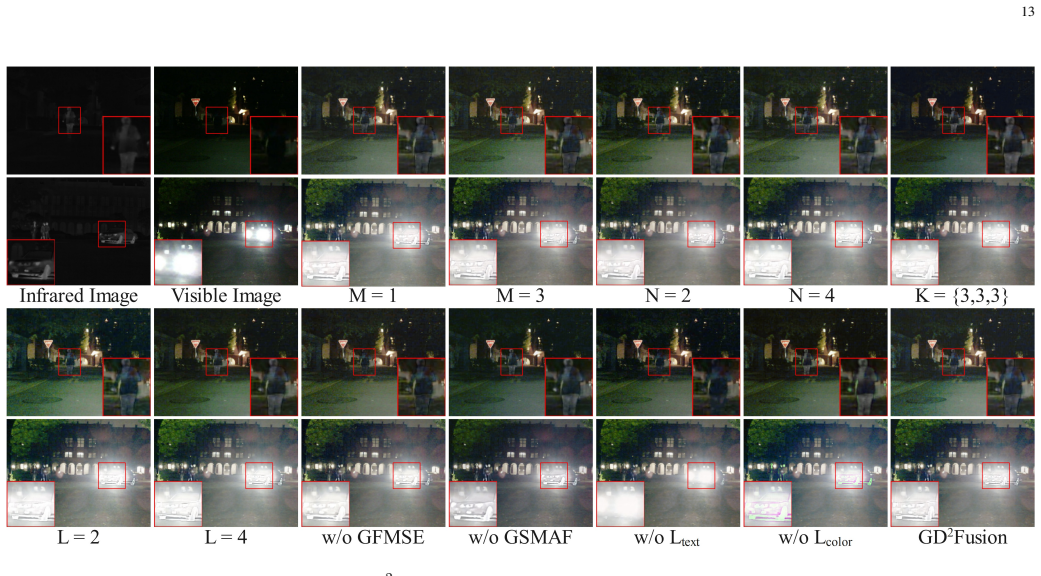
The load-bearing mechanism is prompt-guided affine modulation in two complementary domains. GFMSE applies a Haar discrete wavelet transform to each modality, separates the low-frequency approximation (luminance and contrast) from high-frequency details (texture and noise), and uses affine parameters generated from modality-specific prompt features to re-weight those sub-bands before convolutional and Transformer blocks. GSMAF concatenates the two modalities' prompt features into an aggregated guidance vector, applies channel modulation and affine transformation to the fused spatial features, then aggregates them through multi-scale convolutions with kernel sizes 3, 5, and 7 plus Transformer
What would settle it
A reference-based evaluation on held-out degradation-free pairs from the same EMS data—comparing GD2Fusion against cascaded IAT/SwinIR/MIRNet-plus-fusion pipelines—that fails to rank GD2Fusion first, or a perceptual study in which human raters prefer the cascaded outputs, would settle the claim.
Extended reading notes
Core claim
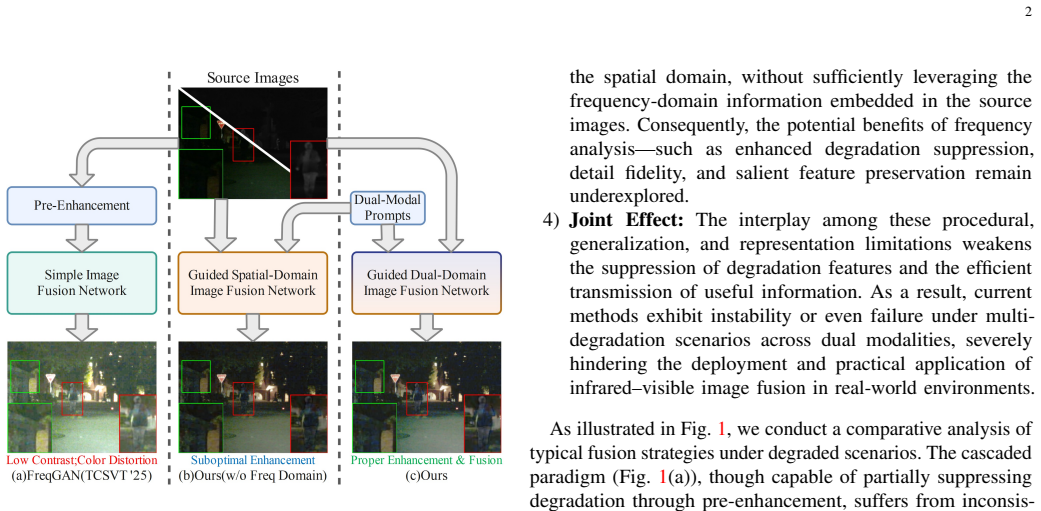
The central claim is that degradation perception and fusion should be optimized in one framework rather than staged. GD2Fusion feeds textual prompts through a frozen vision-language text encoder, producing per-modality guidance features that are injected as affine modulation into two parallel pathways: the Guided Frequency Modality-Specific Extraction (GFMSE) module, which decomposes each modality with a discrete wavelet transform and suppresses degradation in low- and high-frequency sub-bands separately, and the Guided Spatial Modality-Aggregated Fusion (GSMAF) module, which filters cross-modal degradation and aggregates multi-source spatial features. The frequency features are injected int
Load-bearing premise
The degraded-scenario superiority rests on the assumption that average gradient, edge intensity, standard deviation, and spatial frequency faithfully measure fusion quality—four no-reference metrics that can reward amplified contrast or noise as much as genuine restoration.
Editorial extensions
If this is right
- Fusion systems can drop the manual pre-enhancement stage for common dual degradations; one trained model handles low-light or overexposed visible input together with low-contrast or noisy infrared input.
- Changing the text prompt changes the degradation guidance, so the same network can be steered toward different degradation types without retraining the fusion backbone.
- Because wavelet sub-bands isolate luminance and contrast problems from noise and texture problems, the architecture can suppress each degradation class in the frequency band where it lives rather than treating the whole image uniformly.
- Downstream tasks benefit directly: on MSRS, GD2Fusion's fused outputs give YOLOv5 higher mAP than any of the seven comparison methods, suggesting better inputs for detection.
- The decoupled cascade of enhancement-then-fusion, with its own objective and feature space, is not necessary for state-of-the-art degraded fusion.
Reading between the lines
- If the mechanism is as general as it appears, the same prompt-guided dual-domain design could be extended to other paired-modality degradations—for example haze or rain in the visible image with thermal blur in the infrared—simply by writing new prompts and training on paired degraded examples.
- The training loss uses degradation-free reference images, while the degraded-scenario evaluation relies on no-reference metrics; a held-out reference-based evaluation against those clean counterparts would directly show whether the quantitative gains reflect true fidelity rather than contrast amplification.
- Since the text encoder is frozen and prompts are plain text, the framework could in principle be driven by an automatic captioner that detects degradations and writes the prompt at runtime, removing the manual selection the paper criticizes.
Editorial analysis
A structured set of objections, weighed in public.
Referee Report
Summary. The paper proposes GD2Fusion, an end-to-end infrared-visible image fusion framework for dual-source degraded scenarios. It uses frozen CLIP text features (prompts) to inject degradation-awareness into two complementary branches: a frequency-domain GFMSE module for modality-specific degradation suppression and feature extraction, and a spatial-domain GSMAF module for cross-modal degradation filtering and adaptive fusion. The network is trained with intensity, texture, and color losses against degradation-free reference images from the EMS dataset, and evaluated on EMS degraded test scenarios, MSRS/LLVIP high-quality scenarios, and a downstream object-detection task. The central claim is that GD2Fusion outperforms existing fusion algorithms and pre-enhancement-plus-fusion strategies in dual-source degraded scenarios.
Significance. If the central claim is secured, the paper would make a useful contribution: it couples VLM-based degradation perception with frequency/spatial dual-domain modeling in a single end-to-end framework, avoiding the error accumulation of cascaded pre-enhancement. The architecture is clearly described, the high-quality-input experiments (Table II) show competitive or superior performance against seven strong baselines with reference-based metrics, and the downstream detection experiment (Table V) is a positive addition. However, the paper's headline contribution—robust fusion under dual-source degradation—rests on a small set of no-reference sharpness/contrast metrics, and the manuscript contains an internal contradiction about the availability of reference images. The exact VLM prompts are not disclosed, and the most related multi-degradation baselines (DRMF, TFD2Fusion) are omitted from the experiments. These issues are load-bearing for the claimed contribution and need to be addressed.
major comments (3)
- [Sec. IV-B vs. Eqs. (10)-(12)] Section IV-B states that reference-based metrics cannot be applied because no ideal ground-truth images exist. Yet Eqs. (10)-(12) define the training loss using I_ref_ir and I_ref_vi as 'degradation-free infrared and visible reference images' obtained, per Sec. IV-A, from the EMS dataset. Since the same EMS dataset supplies the degraded test pairs, these clean references are available for the test splits. The claim in Sec. IV-B is therefore internally inconsistent. This matters because Table III is the sole quantitative support for the abstract's claim of superiority in dual-source degraded scenarios, and its four metrics are gradient/contrast statistics. Please report reference-based metrics (e.g., FMI, MI, VIF, Qabf, Qw, Qy, as in Table II) on the EMS test splits, or explain precisely why the training references cannot be used for evaluation.
- [Table III and Table IV] All degraded-scenario quantitative conclusions rest on AG, EI, SD, and SF. These no-reference metrics measure average gradient, edge intensity, standard deviation, and spatial frequency; they reward increased high-frequency content and contrast and can be inflated by over-enhancement or artifacts. The proposed loss (Eqs. 10-12) explicitly supervises intensity, gradient, and color against per-pixel maxima of the source references, so the network is trained to maximize essentially the same quantities later used to declare superiority. At minimum, add fidelity-oriented no-reference or perceptual metrics (e.g., NIQE, PIQE, BRISQUE) and/or a human study for the degraded scenario; otherwise the statement in Sec. IV-D that GD2Fusion 'consistently outperforms all competing methods across all assessed metrics' is not sufficient to support the paper's central claims.
- [Sec. III-A / Sec. IV-A] The exact textual prompts P_ir and P_vi—the core VLM guidance—are never listed. Fig. 2 shows only a schematic "Prompt"; the strings are not recoverable from the text, and code is promised only after acceptance. Since the prompts are hand-crafted for the four degradation types in EMS (Sec. IV-A), their exact content is essential for reproducibility and for assessing the generality of the approach. Please include the prompt templates in the paper or supplementary material and release code at review time. In addition, the most closely related recent methods for multi-degradation fusion, DRMF [28] and TFD2Fusion [40], are discussed in Sec. II but do not appear in Tables I-III; include them in the comparison or provide a clear justification for their exclusion.
minor comments (5)
- [Eq. (9)] The second assignment to F_local should presumably be F_global = T rmBlock^M(F_guided); currently the equation overwrites F_local, which conflicts with the use of both F_local and F_global in Eq. (4).
- [Sec. IV-B] "standard division" should be "standard deviation"; the citation [53] (Bragg grating sensors) appears unrelated to this metric and should be replaced.
- [Throughout] There are typographical inconsistencies: Index Terms contain "Languge"; Sec. III-C title uses "Model-Aggregated" while the text uses "Modality-Aggregated"; the method name is rendered inconsistently as "GD2Fusion" and "GD 2Fusion". Please unify and proofread.
- [Sec. IV-A] State explicitly that the 69/69/35/35 EMS test pairs are disjoint from the 2,278 training pairs, and describe how the degradation-free reference images used in the loss were constructed. This is needed to rule out train/test leakage and to clarify the contradiction flagged in the major comments.
- [Fig. 7] The displayed prompt text is illegible. Provide the exact infrared and visible prompt strings in the caption or in a supplementary table so readers can verify the degradation-awareness mechanism.
Circularity Check
No significant circularity: the system is an empirical neural design whose performance claims do not reduce by construction to its inputs.
full rationale
GD^2Fusion is presented as an empirical architecture with benchmark comparisons, not as a derivation from first principles. No load-bearing step reduces to its own input by construction. The training losses (Eqs. 10-12) supervise against degradation-free references, while the degraded-scenario evaluation metrics (AG, EI, SD, SF) are separate, no-reference statistics; the reported superiority in Table III is an empirical result, not a tautology. The self-citations are non-load-bearing: W-Mamba [34] appears only in related work on wavelet fusion, and the AG metric definition [51] is a standard external measure. The hand-crafted CLIP prompts match the four EMS degradation types and the degradation-aware model is tested on EMS splits from the same dataset; this is a generalization/external-validity limitation, not circularity, because the prompts are inputs rather than fitted targets and the test pairs are distinct from training pairs. A separate, non-circular inconsistency is noted: Section IV-B excludes reference-based metrics because no degradation-free ground truth is available, while Section III-D (Eqs. 10-12) explicitly trains with degradation-free references. This weakens the quantitative support for the headline claim but does not make the derivation circular.
Assumptions & free parameters
free parameters (4)
- loss weights gamma, lambda, theta =
5, 5, 6
- architecture depths N, M, L and kernel set =
N=3, M=2, L=3, k={3,5,7}
- hand-crafted degradation prompt templates =
text prompts describing low-light, overexposure, low-contrast, noise
- training scheme =
lr=2.5e-4, patch 96, batch 16, 200/100 epochs
assumptions (4)
- domain assumption DWT sub-bands localize degradation: low-frequency bands concentrate contrast attenuation and luminance shifts, high-frequency bands concentrate sensor noise.
- domain assumption Frozen CLIP text embeddings of degradation descriptions provide effective guidance when injected as affine modulation parameters.
- domain assumption The EMS test partitions (69, 69, 35, 35 pairs) are disjoint from the 2,278-pair EMS training split.
- domain assumption AG, EI, SD, and SF are valid proxies for fusion quality under degradation.
Cite this review
Pith. "Pith review of Dual-Domain Perspective on Degradation-Aware Fusion: A VLM-Guided Robust Infrared and Visible Image Fusion Framework." pith.science (2026). https://pith.science/paper/JNZBVXRV
@misc{pith2026250905000,
  author       = {Pith},
  title        = {Pith review of: Dual-Domain Perspective on Degradation-Aware Fusion: A VLM-Guided Robust Infrared and Visible Image Fusion Framework},
  year         = {2026},
  howpublished = {\url{https://pith.science/paper/JNZBVXRV}},
  note         = {Machine review of arXiv:2509.05000}
}
read the original abstract
Most existing infrared-visible image fusion (IVIF) methods assume high-quality inputs, and therefore struggle to handle dual-source degraded scenarios, typically requiring manual selection and sequential application of multiple pre-enhancement steps. This decoupled pre-enhancement-to-fusion pipeline inevitably leads to error accumulation and performance degradation. To overcome these limitations, we propose Guided Dual-Domain Fusion (GD^2Fusion), a novel framework that synergistically integrates vision-language models (VLMs) for degradation perception with dual-domain (frequency/spatial) joint optimization. Concretely, the designed Guided Frequency Modality-Specific Extraction (GFMSE) module performs frequency-domain degradation perception and suppression and discriminatively extracts fusion-relevant sub-band features. Meanwhile, the Guided Spatial Modality-Aggregated Fusion (GSMAF) module carries out cross-modal degradation filtering and adaptive multi-source feature aggregation in the spatial domain to enhance modality complementarity and structural consistency. Extensive qualitative and quantitative experiments demonstrate that GD^2Fusion achieves superior fusion performance compared with existing algorithms and strategies in dual-source degraded scenarios. The code will be publicly released after acceptance of this paper.
Figures


Figures from the paper (5 more)



Reference graph
Works this paper leans on
-
[28]
Drmf: Degradation-robust multi-modal image fusion via composable diffusion prior,
L. Tang, Y . Deng, X. Yi, Q. Yan, Y . Yuan, and J. Ma, “Drmf: Degradation-robust multi-modal image fusion via composable diffusion prior,” inProceedings of the 32nd ACM International Conference on Multimedia, 2024, pp. 8546–8555. 4
work page 2024
-
[40]
Infrared and visible image fusion via text-prior guided frequency-domain decomposition,
W. Shao and H. Liu, “Infrared and visible image fusion via text-prior guided frequency-domain decomposition,”ACM Transactions on Multimedia Computing, Communications and Applications, 2025. 5
work page 2025
-
[1]
Deep learning safety concerns in automated driving perception,
S. Abrecht, A. Hirsch, S. Raafatnia, and M. Woehrle, “Deep learning safety concerns in automated driving perception,”IEEE Transactions on Intelligent Vehicles,
-
[2]
Datransnet: dynamic attention transformer network for infrared small target detection,
C. Hu, Y . Huang, K. Li, L. Zhang, C. Long, Y . Zhu, T. Pu, and Z. Peng, “Datransnet: dynamic attention transformer network for infrared small target detection,” IEEE Geoscience and Remote Sensing Letters, 2025. 1
work page 2025
-
[3]
M. Xiao, Q. Dai, Y . Zhu, K. Guo, H. Wang, X. Shu, J. Yang, and Y . Dai, “Background semantics matter: Cross-task feature exchange network for clustered infrared small target detection with sky-annotated dataset,”arXiv preprint arXiv:2407.20078, 2024. 1
-
[4]
A review of object detection based on deep learning,
Y . Xiao, Z. Tian, J. Yu, Y . Zhang, S. Liu, S. Du, and X. Lan, “A review of object detection based on deep learning,”Multimedia Tools and Applications, vol. 79, pp. 23 729–23 791, 2020. 1
work page 2020
-
[5]
J. Qu, R. W. Liu, Y . Gao, Y . Guo, F. Zhu, and F.-Y . Wang, “Double domain guided real-time low-light image enhance- ment for ultra-high-definition transportation surveillance,” IEEE Transactions on Intelligent Transportation Systems, vol. 25, no. 8, pp. 9550–9562, 2024. 1
work page 2024
-
[6]
Degrade is upgrade: Learning degradation for low-light image enhancement,
K. Jiang, Z. Wang, Z. Wang, C. Chen, P. Yi, T. Lu, and C.-W. Lin, “Degrade is upgrade: Learning degradation for low-light image enhancement,” inProceedings of the AAAI conference on artificial intelligence, vol. 36, no. 1, 2022, pp. 1078–1086. 1
work page 2022
Show all 61 references
-
[7]
Rfn-nest: An end-to-end residual fusion network for infrared and visible images,
H. Li, X.-J. Wu, and J. Kittler, “Rfn-nest: An end-to-end residual fusion network for infrared and visible images,” Information Fusion, vol. 73, pp. 72–86, 2021. 1
2021
-
[8]
Cufd: An encoder–decoder network for visible and infrared image fusion based on common and unique feature decompo- sition,
H. Xu, M. Gong, X. Tian, J. Huang, and J. Ma, “Cufd: An encoder–decoder network for visible and infrared image fusion based on common and unique feature decompo- sition,”Computer Vision and Image Understanding, vol. 218, p. 103407, 2022. 1
2022
-
[9]
Fusiongan: A generative adversarial network for infrared and visible image fusion,
J. Ma, W. Yu, P. Liang, C. Li, and J. Jiang, “Fusiongan: A generative adversarial network for infrared and visible image fusion,”Information fusion, vol. 48, pp. 11–26,
-
[10]
Ddcgan: A dual-discriminator conditional generative adversarial network for multi-resolution image fusion,
J. Ma, H. Xu, J. Jiang, X. Mei, and X.-P. Zhang, “Ddcgan: A dual-discriminator conditional generative adversarial network for multi-resolution image fusion,” IEEE Transactions on Image Processing, vol. 29, pp. 4980–4995, 2020. 1
2020
-
[11]
Densefuse: A fusion approach to infrared and visible images,
H. Li and X.-J. Wu, “Densefuse: A fusion approach to infrared and visible images,”IEEE Transactions on Image Processing, vol. 28, no. 5, pp. 2614–2623, 2018. 1
2018
-
[12]
Sgfusion: A saliency guided deep-learning framework for pixel-level image fusion,
J. Liu, R. Dian, S. Li, and H. Liu, “Sgfusion: A saliency guided deep-learning framework for pixel-level image fusion,”Information Fusion, vol. 91, pp. 205–214, 2023. 3
2023
-
[13]
U2fusion: A unified unsupervised image fusion network,
H. Xu, J. Ma, J. Jiang, X. Guo, and H. Ling, “U2fusion: A unified unsupervised image fusion network,”IEEE Trans- actions on Pattern Analysis and Machine Intelligence, vol. 44, no. 1, pp. 502–518, 2020. 1, 3
2020
-
[14]
Ydtr: Infrared and visible image fusion via y-shape dynamic transformer,
W. Tang, F. He, and Y . Liu, “Ydtr: Infrared and visible image fusion via y-shape dynamic transformer,”IEEE Transactions on Multimedia, vol. 25, pp. 5413–5428, 2022. 1, 4
2022
-
[15]
Datfuse: Infrared and visible image fusion via dual attention transformer,
W. Tang, F. He, Y . Liu, Y . Duan, and T. Si, “Datfuse: Infrared and visible image fusion via dual attention transformer,”IEEE Transactions on Circuits and Systems for Video Technology, vol. 33, no. 7, pp. 3159–3172, 2023. 4, 7, 9
2023
-
[16]
Swinfusion: Cross-domain long-range learning for gen- eral image fusion via swin transformer,
J. Ma, L. Tang, F. Fan, J. Huang, X. Mei, and Y . Ma, “Swinfusion: Cross-domain long-range learning for gen- eral image fusion via swin transformer,”IEEE/CAA Journal of Automatica Sinica, vol. 9, no. 7, pp. 1200–1217,
-
[17]
You only need 90k parameters to adapt light: a light weight transformer for image enhancement and exposure correction,
Z. Cui, K. Li, L. Gu, S. Su, P. Gao, Z. Jiang, Y . Qiao, and T. Harada, “You only need 90k parameters to adapt light: a light weight transformer for image enhancement and exposure correction,” in33rd British Machine Vision Conference 2022, BMVC 2022, London, UK, November 21-24...
2022
-
[18]
Swinir: Image restoration using swin trans- former,
J. Liang, J. Cao, G. Sun, K. Zhang, L. Van Gool, and R. Timofte, “Swinir: Image restoration using swin trans- former,” inProceedings of the IEEE/CVF international conference on computer vision, 2021, pp. 1833–1844. 2, 12
2021
-
[19]
Lvif-net: Learning synchronous visible and infrared image fusion and enhancement under low-light conditions,
R. Chang, S. Zhao, Y . Rao, and Y . Yang, “Lvif-net: Learning synchronous visible and infrared image fusion and enhancement under low-light conditions,”Infrared Physics & Technology, vol. 138, p. 105270, 2024. 2, 4
2024
-
[20]
Text- if: Leveraging semantic text guidance for degradation- aware and interactive image fusion,
X. Yi, H. Xu, H. Zhang, L. Tang, and J. Ma, “Text- if: Leveraging semantic text guidance for degradation- aware and interactive image fusion,” inProceedings of the IEEE/CVF Conference on Computer Vision and Pattern Recognition, 2024, pp. 27 026–27 035. 2, 4, 5, 8, 9
2024
-
[21]
Fusion method for infrared and visible images by using non- negative sparse representation,
J. Wang, J. Peng, X. Feng, G. He, and J. Fan, “Fusion method for infrared and visible images by using non- negative sparse representation,”Infrared Physics & Tech- nology, vol. 67, pp. 477–489, 2014. 3
2014
-
[22]
Infrared and visible image fusion using multi-scale nsct and rolling-guidance filter,
A. Selvaraj and P. Ganesan, “Infrared and visible image fusion using multi-scale nsct and rolling-guidance filter,” IET Image Processing, vol. 14, no. 16, pp. 4210–4219,
-
[23]
Swinfuse: A residual swin transformer fusion network for infrared and visible images,
Z. Wang, Y . Chen, W. Shao, H. Li, and L. Zhang, “Swinfuse: A residual swin transformer fusion network for infrared and visible images,”IEEE Transactions on Instrumentation and Measurement, vol. 71, pp. 1–12,
-
[24]
Target-aware dual adversarial learning and a multi-scenario multi-modality benchmark to fuse infrared and visible for object detection,
J. Liu, X. Fan, Z. Huang, G. Wu, R. Liu, W. Zhong, and Z. Luo, “Target-aware dual adversarial learning and a multi-scenario multi-modality benchmark to fuse infrared and visible for object detection,” inProceedings of the IEEE/CVF conference on computer vision and pattern reco...
2022
-
[25]
Piafusion: A progressive infrared and visible image fusion network based on illumination aware,
L. Tang, J. Yuan, H. Zhang, X. Jiang, and J. Ma, “Piafusion: A progressive infrared and visible image fusion network based on illumination aware,”Information Fusion, vol. 83, pp. 79–92, 2022. 3, 8
2022
-
[26]
An unsupervised fusion method for infrared and visible image fusion under low-light condition,
S. Yang, Y . Gao, S. Ma, and K. Huang, “An unsupervised fusion method for infrared and visible image fusion under low-light condition,” inInternational Workshop on Signal Processing and Machine Learning (WSPML 2023), vol. 12943. SPIE, 2023, pp. 146–151. 4
2023
-
[27]
Divfusion: Darkness-free infrared and visible image 17 fusion,
L. Tang, X. Xiang, H. Zhang, M. Gong, and J. Ma, “Divfusion: Darkness-free infrared and visible image 17 fusion,”Information Fusion, vol. 91, pp. 477–493, 2023. 4
2023
-
[29]
A theory for multiresolution signal decom- position: the wavelet representation,
S. G. Mallat, “A theory for multiresolution signal decom- position: the wavelet representation,”IEEE transactions on pattern analysis and machine intelligence, vol. 11, no. 7, pp. 674–693, 2002. 4
2002
-
[30]
Multisensor image fusion using the wavelet transform,
H. Li, B. Manjunath, and S. K. Mitra, “Multisensor image fusion using the wavelet transform,”Graphical models and image processing, vol. 57, no. 3, pp. 235–245, 1995. 4
1995
-
[31]
Infrared and visible image fusion: Methods, datasets, applications, and prospects,
Y . Luo and Z. Luo, “Infrared and visible image fusion: Methods, datasets, applications, and prospects,”Applied Sciences, vol. 13, no. 19, p. 10891, 2023. 5
2023
-
[32]
Mfif-dwt-cnn: Multi-focus ımage fusion based on discrete wavelet trans- form with deep convolutional neural network,
D. Avcı, E. Sert, F. Özyurt, and E. Avcı, “Mfif-dwt-cnn: Multi-focus ımage fusion based on discrete wavelet trans- form with deep convolutional neural network,”Multimedia Tools and Applications, vol. 83, no. 4, pp. 10 951–10 968,
-
[33]
Wavefusionnet: Infrared and visible image fusion based on multi-scale feature encoder–decoder and discrete wavelet decomposi- tion,
R. Liu, Y . Liu, H. Wang, and S. Du, “Wavefusionnet: Infrared and visible image fusion based on multi-scale feature encoder–decoder and discrete wavelet decomposi- tion,”Optics Communications, vol. 573, p. 131024, 2024. 5
2024
-
[34]
Ex- ploring state space model in wavelet domain: An infrared and visible image fusion network via wavelet transform and state space model,
T. Zhang, Y . Zhu, J. Zhao, G. Cui, and Y . Zheng, “Ex- ploring state space model in wavelet domain: An infrared and visible image fusion network via wavelet transform and state space model,”arXiv preprint arXiv:2503.18378,
-
[35]
Vqa: Visual question answering,
S. Antol, A. Agrawal, J. Lu, M. Mitchell, D. Batra, C. L. Zitnick, and D. Parikh, “Vqa: Visual question answering,” inProceedings of the IEEE international conference on computer vision, 2015, pp. 2425–2433. 5
2015
-
[36]
Learning transferable visual models from natural language supervision,
A. Radford, J. W. Kim, C. Hallacy, A. Ramesh, G. Goh, S. Agarwal, G. Sastry, A. Askell, P. Mishkin, J. Clark et al., “Learning transferable visual models from natural language supervision,” inInternational conference on machine learning. PmLR, 2021, pp. 8748–8763. 5
2021
-
[37]
Blip: Bootstrapping language-image pre-training for unified vision-language understanding and generation,
J. Li, D. Li, C. Xiong, and S. Hoi, “Blip: Bootstrapping language-image pre-training for unified vision-language understanding and generation,” inInternational confer- ence on machine learning. PMLR, 2022, pp. 12 888– 12 900. 5
2022
-
[38]
Visual instruc- tion tuning,
H. Liu, C. Li, Q. Wu, and Y . J. Lee, “Visual instruc- tion tuning,”Advances in neural information processing systems, vol. 36, pp. 34 892–34 916, 2023. 5
2023
-
[39]
Degradation-aware image enhance- ment via vision-language classification,
J. Cai, K. Yang, J. Ding, L. Fu, L. Ouyang, J. Li, J. Shen, and Z. Meng, “Degradation-aware image enhance- ment via vision-language classification,”arXiv preprint arXiv:2506.05450, 2025. 5
2025 arXiv
-
[41]
The haar wavelet transform: its status and achievements,
R. S. Stankovic and B. J. Falkowski, “The haar wavelet transform: its status and achievements,”Computers & Electrical Engineering, vol. 29, no. 1, pp. 25–44, 2003. 6
2003
-
[42]
Zero-shot low-light image enhancement via joint frequency domain priors guided diffusion,
J. He, S. Palaiahnakote, A. Ning, and M. Xue, “Zero-shot low-light image enhancement via joint frequency domain priors guided diffusion,”IEEE Signal Processing Letters,
-
[43]
Research and application of the wavelet high-frequency coefficient direct mapping algorithm in the micro-defect target detection system of an infrared objective lens,
Y . Gao, H. Wen, H. Mei, and J. Zhang, “Research and application of the wavelet high-frequency coefficient direct mapping algorithm in the micro-defect target detection system of an infrared objective lens,”Applied Optics, vol. 63, no. 13, pp. 3489–3494, 2024
2024
-
[44]
Contrast enhancement for image based on wavelet neural network and stationary wavelet transform,
C. Zhang, X. Wang, and H. Zhang, “Contrast enhancement for image based on wavelet neural network and stationary wavelet transform,” inInternational Symposium on Neural Networks. Springer, 2006, pp. 551–556. 6
2006
-
[45]
Llvip: A visible-infrared paired dataset for low-light vision,
X. Jia, C. Zhu, M. Li, W. Tang, and W. Zhou, “Llvip: A visible-infrared paired dataset for low-light vision,” in Proceedings of the IEEE/CVF international conference on computer vision, 2021, pp. 3496–3504. 8
2021
-
[46]
Ganmcc: A generative adversarial network with multiclassifica- tion constraints for infrared and visible image fusion,
J. Ma, H. Zhang, Z. Shao, P. Liang, and H. Xu, “Ganmcc: A generative adversarial network with multiclassifica- tion constraints for infrared and visible image fusion,” IEEE Transactions on Instrumentation and Measurement, vol. 70, pp. 1–14, 2020. 9
2020
-
[47]
Sdnet: A versatile squeeze- and-decomposition network for real-time image fusion,
H. Zhang and J. Ma, “Sdnet: A versatile squeeze- and-decomposition network for real-time image fusion,” International Journal of Computer Vision, vol. 129, no. 10, pp. 2761–2785, 2021. 9
2021
-
[48]
Classification saliency- based rule for visible and infrared image fusion,
H. Xu, H. Zhang, and J. Ma, “Classification saliency- based rule for visible and infrared image fusion,”IEEE Transactions on Computational Imaging, vol. 7, pp. 824– 836, 2021. 9
2021
-
[49]
Itfuse: An interactive transformer for infrared and visible image fusion,
W. Tang, F. He, and Y . Liu, “Itfuse: An interactive transformer for infrared and visible image fusion,”Pattern Recognition, vol. 156, p. 110822, 2024. 9
2024
-
[50]
Freqgan: Infrared and visible image fusion via unified frequency adversarial learning,
Z. Wang, Z. Zhang, W. Qi, F. Yang, and J. Xu, “Freqgan: Infrared and visible image fusion via unified frequency adversarial learning,”IEEE Transactions on Circuits and Systems for Video Technology, vol. 35, no. 1, pp. 728–740,
-
[51]
Detail preserved fusion of visible and infrared images using regional saliency extraction and multi-scale image decom- position,
G. Cui, H. Feng, Z. Xu, Q. Li, and Y . Chen, “Detail preserved fusion of visible and infrared images using regional saliency extraction and multi-scale image decom- position,”Optics Communications, vol. 341, pp. 199–209,
-
[52]
Hybrid multimodality med- ical image fusion technique for feature enhancement in medical diagnosis,
B. Rajalingam and R. Priya, “Hybrid multimodality med- ical image fusion technique for feature enhancement in medical diagnosis,”International Journal of Engineering Science Invention, vol. 2, no. Special issue, pp. 52–60,
-
[53]
In-fibre bragg grating sensors,
Y .-J. Rao, “In-fibre bragg grating sensors,”Measurement science and technology, vol. 8, no. 4, p. 355, 1997. 8
1997
-
[54]
Image quality measures and their performance,
A. M. Eskicioglu and P. S. Fisher, “Image quality measures and their performance,”IEEE Transactions on communications, vol. 43, no. 12, pp. 2959–2965, 1995. 9
1995
-
[55]
A non-reference image fusion metric based on mutual information of image features,
M. B. A. Haghighat, A. Aghagolzadeh, and H. Seyedarabi, 18 “A non-reference image fusion metric based on mutual information of image features,”Computers & Electrical Engineering, vol. 37, no. 5, pp. 744–756, 2011. 9
2011
-
[56]
Information measure for performance of image fusion,
G. Qu, D. Zhang, and P. Yan, “Information measure for performance of image fusion,”Electronics letters, vol. 38, no. 7, p. 1, 2002. 9
2002
-
[57]
A new image fusion performance metric based on visual information fidelity,
Y . Han, Y . Cai, Y . Cao, and X. Xu, “A new image fusion performance metric based on visual information fidelity,” Information fusion, vol. 14, no. 2, pp. 127–135, 2013. 9
2013
-
[58]
Objective image fusion performance measure,
C. S. Xydeas, V . Petrovicet al., “Objective image fusion performance measure,”Electronics letters, vol. 36, no. 4, pp. 308–309, 2000. 9
2000
-
[59]
A new quality metric for image fusion,
G. Piella and H. Heijmans, “A new quality metric for image fusion,” inProceedings 2003 international conference on image processing (Cat. No. 03CH37429), vol. 3. IEEE, 2003, pp. III–173. 9
2003
-
[60]
A novel similarity based quality metric for image fusion,
C. Yang, J.-Q. Zhang, X.-R. Wang, and X. Liu, “A novel similarity based quality metric for image fusion,” Information Fusion, vol. 9, no. 2, pp. 156–160, 2008. 9
2008
-
[61]
Learning enriched features for fast image restoration and enhancement,
S. W. Zamir, A. Arora, S. Khan, M. Hayat, F. S. Khan, M.- H. Yang, and L. Shao, “Learning enriched features for fast image restoration and enhancement,”IEEE Transactions on Pattern Analysis and Machine Intelligence (TPAMI),
Reviewed August 5, 2026 · model on record in the stance chip above.
Discussion (0). Sign in to comment.