REVIEW 3 major objections 5 minor 92 references
Emergent Quasicrystalline Symmetry in Light-Induced Quantum Phase Transitions
T0 review · 3 major / 5 minor · reviewed 2026-08-14 · deepseek-v4-flash
Pith's one-line read Across a superradiant phase transition, a Bose-Einstein condensate in four crossed optical cavities can form a quasicrystal whose eight-fold rotational symmetry is emergent rather than imposed by the Hamiltonian.
desk verdict A clean, honest proposal for cavity-generated quasicrystalline order, but the load-bearing phase-locking is asserted rather than derived; worth refereeing with a request for a stability analysis. read the letter →
The pith
A machine-rendered reading of the paper's core claim, the machinery that carries it, and where it could break.
The reading
What carries the argument
The central object is the combined symmetry $\tilde{C}_8$, defined as the spatial eight-fold rotation $(x,y)\mapsto((x+y)/\sqrt{2},(y-x)/\sqrt{2})$ followed by the field relabeling $\hat{a}_1\to\hat{a}_2 e^{-i(\theta_1-\theta_2)}$, $\hat{a}_2\to\hat{a}_3 e^{-i(\theta_2-\theta_3)}$, $\hat{a}_3\to\hat{a}_4 e^{-i(\theta_3-\theta_4)}$, $\hat{a}_4\to\hat{a}_1 e^{-i(\theta_4-\theta_1)}$. Because the Hamiltonian is invariant under $\tilde{C}_8$ but not under $C_8$, the spatial symmetry can appear only when the cavity fields take the special phase-locked values $\alpha_j=|\alpha|e^{i\gamma_j}$ with $\gamma_j=\gamma_0-\theta_j$ or $\gamma_0+\pi-\theta_j$. This phase-locking is what converts the hidden combined symmetry into a true eight-fold rotation of the self-consistent optical potential; without it the potential would have no $C_8$ symmetry for generic field amplitudes.
What would settle it
Numerically solve the full mean-field equations (3)-(4) from many random initial field configurations; any stable fixed point with unequal field amplitudes $|\alpha_j|$ or with relative phases outside $\gamma_j=\gamma_0-\theta_j$ or $\gamma_0+\pi-\theta_j$ would falsify the phase-locking assumption and with it the emergent $C_8$ potential. Experimentally, heterodyne the four cavity output fields: the quasicrystalline phase requires exactly equal transmitted amplitudes and the locked relative phases.
Extended reading notes
Core claim
Across the superradiant transition, collective scattering of pump photons into four cavity modes with wavevectors $\mathbf{k}_1=k_0\hat{\mathbf{e}}_x$, $\mathbf{k}_3=k_0\hat{\mathbf{e}}_y$, and $\mathbf{k}_{2,4}=k_0(\hat{\mathbf{e}}_x\pm\hat{\mathbf{e}}_y)/\sqrt{2}$ builds an optical potential for the atoms. The Hamiltonian is invariant only under a combined operation $\tilde{C}_8$: an eight-fold rotation of space followed by a cyclic relabeling of the cavity fields with compensating phase shifts; it is not invariant under the spatial rotation $C_8$ alone. In the superradiant phase the steady-state fields lock to equal amplitudes and phases $\gamma_j=\gamma_0-\theta_j$ or $\gamma_0+\pi-\theta_j$, and under exactly this locking the potential acquires a true spatial $C_8$ symmetry, whose center is fixed by spontaneous breaking of four approximate $\mathbb{Z}_2$ symmetries. With sufficiently strong contact interactions the condensate occupies many minima and its momentum distribution shows eight-fold symmetric, quasicrystalline diffraction peaks; with weak interactions it localizes in one or a few of the deepest minima. The paper's central claim is that this $C_8$ symmetry is emergent: present in the low-energy states, absent from the Hamiltonian.
Load-bearing premise
The load-bearing premise is that the steady-state mean-field equations always select the special phase-locked cavity fields with equal amplitudes and phases $\gamma_j=\gamma_0-\theta_j$ or $\gamma_0+\pi-\theta_j$; this selection is asserted and observed in numerics, but it is not derived from the equations, so the $C_8$-symmetric potential is not rigorously proven to be the ground-state manifold.
Editorial extensions
If this is right
- Crossing the superradiant threshold in a four-crossed-cavity experiment should produce an eight-fold-symmetric atomic density and momentum distribution with no quasicrystalline potential imprinted from outside.
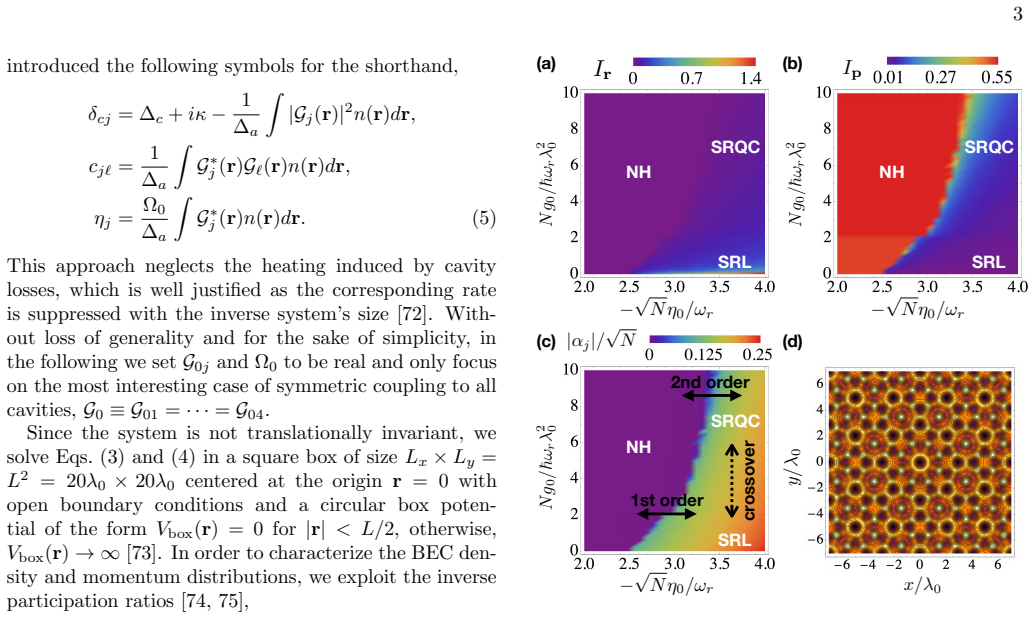
- The transition from the uniform condensate to the quasicrystalline phase is first order for weak contact interactions and second order for strong interactions, while the transition to the localized phase is first order; the localized and quasicrystalline phases are connected by a crossover.
- The common cavity-field amplitude $|\alpha|$ serves as a directly measurable order parameter, so the onset and type of ordering can be monitored in real time through the light leaving the cavities.
- The same phase-locking mechanism can be adapted to other cavity arrangements to realize emergent five- and seven-fold rotational symmetries.
Reading between the lines
- Editorial inference: the phase-locking condition is exactly what one would expect from minimizing an effective four-mode interaction energy, so a free-energy derivation could settle whether the $C_8$ manifold is the true ground state or only one of several competing steady states.
- Editorial inference: because the phase locking is a property of the dissipative steady state, the emergent $C_8$ order may survive a finite range of cavity losses and detunings; scanning those parameters in a realized setup would map the persistence of the symmetry.
- Editorial inference: the crossover from the localized to the quasicrystalline phase as interactions grow suggests an interaction-driven delocalization transition inside the quasicrystalline potential, and the inverse participation ratios used here could serve as direct signatures in time-of-flight imaging.
- Editorial inference: the same geometry with four incommensurate wavevectors may support other forbidden rotational symmetries if the cavity polarizations or angles are changed, but incommensurability constraints will determine which symmetries are actually accessible.
Signed reviews
Editorial analysis
A structured set of objections, weighed in public.
Referee Report
Summary. The paper proposes a cavity-QED setup in which four crossed linear cavities arranged at 45-degree angles are driven by a uniform pump, with a BEC placed at their common center. The authors study the mean-field steady states of the coupled atom-photon system. They claim that above the superradiant threshold the cavity fields self-organize into equal-amplitude, phase-locked configurations whose interference with the pump creates an optical potential with an eight-fold rotational symmetry (C8) that is not a symmetry of the Hamiltonian. This potential is said to be emergent because it appears only in the low-energy symmetry-broken states, generated by the spontaneous breaking of an approximate product of four Z2 symmetries. Depending on the two-body contact interaction strength, the authors identify a superradiant quasicrystalline (SRQC) phase and a superradiant localized (SRL) phase, and they present a phase diagram based on numerical solutions of the Gross-Pitaevskii equation and the steady-state cavity-field equations. The central theoretical claim is that the quasicrystalline potential is not imposed externally but arises dynamically from collective light scattering, and that sufficiently strong interactions stabilize the quasicrystalline density order.
Significance. If the phase-locking claim can be established, this is a significant conceptual proposal. It connects cavity-mediated self-organization with the physics of emergent symmetries, and it offers a realistic extension of existing two-crossed-cavity experiments to a setting that may realize quasicrystalline order without an externally imposed quasicrystalline potential. The symmetry analysis in the Supplemental Material is clean: it correctly shows that the Hamiltonian is invariant under a combined rotation-and-field-transformation operation, and that the C8 symmetry of the potential follows from the specific amplitude and phase relations. The paper also makes a concrete falsifiable prediction: the cavity-output amplitudes become equal and their phases lock to the values determined by the cavity-geometry phases, which can be monitored experimentally. The numerical simulations are extensive and produce momentum distributions with the claimed eight-fold symmetry. However, the central derivation has a gap: the steady-state field equations are not shown to admit only the phase-locked solutions, nor is it shown that these solutions are the global low-energy states.
major comments (3)
- [Mean-field approach, Eq. (4) and following paragraph] The central claim that the emergent C8-symmetric potential exists in the superradiant phase relies on the assertion that the steady-state solutions of Eq. (4) take the equal-amplitude, phase-locked form |α_j|=|α| with γ_j = γ0 − θ_j or γ0 + π − θ_j. The Supplemental Material proves only the converse: if α_j has these values, then the potential is C8-symmetric. It does not derive these values as the solutions of Eq. (4), nor does it prove that this branch globally minimizes the free energy. Other steady-state solutions with unequal |α_j| or different relative phases would produce a potential without C8 symmetry, so the existence of the SRQC phase as a low-energy state is not established by the current derivation.
- [Supplemental Material, Finite-Size Effects, Fig. S1] The authors state that in a finite system only one of the sixteen symmetry-broken states is the true ground state and the others are only metastable, and that imaginary-time propagation converges randomly to any of the sixteen states and remains there for the whole simulation. This is a direct acknowledgment that the numerical solver is sampling metastable branches and does not demonstrate ground-state selection. The paper therefore does not currently provide evidence that the phase-locked configuration is the global minimum rather than one of possibly many branches. To support the central claim, the authors should either derive the phase-locked solution from Eq. (4) (e.g., by showing that the nonlinear equations force equal amplitudes and the stated phases) or provide a numerical comparison of the energies of competing steady-state solutions, including a stability analysis of the phase-locked branch against small fluctuations.
- [Main text, paragraph after Eq. (4) and Conclusions] The terminology 'quantum phase transition' is used for the transition from the NH phase to the SRQC and SRL phases, but the analysis is entirely in terms of mean-field steady states of a driven-dissipative system; there is no spectral gap or ground-state calculation, and the order parameter |α| is a steady-state cavity amplitude. The authors should clarify whether the transition is a zero-temperature equilibrium quantum phase transition of the effective Hamiltonian or a dissipative steady-state transition, and adjust the terminology and interpretation accordingly. This distinction does not invalidate the proposal but is important for situating the claims.
minor comments (5)
- [Fig. 2 caption] The labels '1st order', '2nd order', and 'crossover' appear in Fig. 2(c) but are not defined in the caption; please state explicitly what they refer to and where the corresponding cuts are shown.
- [Main text, paragraph on center of quasicrystal] The argument that the center of the quasicrystal for mixed phase choices is shifted to infinity because the two conditions involve rational and irrational numbers is stated informally; a more precise statement of the incommensurability condition would improve clarity.
- [Supplemental Material, Eq. (S4)] The phase factors in Eq. (S4) are essential for the C8 construction, but the derivation from the polarization basis in Eq. (S2) is compressed; please spell out the decomposition of each cosine term and the resulting Rabi frequency more explicitly.
- [Throughout] There are several typographical issues, including 'saving for small finite-size effects' in the main text (should be 'save for'), and inconsistent notation for the interaction strength g0 versus g in the Supplemental figures (Fig. S2 uses Ng/ℏωrλ0^2).
- [Conclusions] The claim that 'the superradiant quasicrystalline state has an emergent symmetry' is central, but the paper does not define a precise order parameter that distinguishes the SRQC phase from the SRL phase except for the inverse participation ratios; a discussion of how the emergent C8 symmetry could be measured in the momentum distribution would strengthen the proposal.
Circularity Check
No significant circularity: the C8-symmetric potential is a derived consequence of numerically obtained field configurations, not an input.
full rationale
The paper's central claim is that an eight-fold rotational symmetry emerges in the low-energy superradiant states even though the Hamiltonian is not C8-invariant. The derivation chain is self-contained: the model Hamiltonian with four crossed cavities and the polarization-derived phases theta_j is stated explicitly, the tilde-C8 symmetry of the Hamiltonian is exhibited in Eqs. (S7)-(S8), and the C8-invariance of the optical potential for field configurations alpha_j = |alpha| e^{i gamma_j} with gamma_j = -theta_j or pi - theta_j is shown algebraically in Eq. (S10). The critical step is the claim that the steady-state solutions of Eq. (4) indeed acquire equal amplitudes and these locked phases. This is not definitionally inserted: it is reported as a property of the converged self-consistent solutions, and the Supplemental Material's finite-size section explicitly states that imaginary-time propagation converges randomly to any of the sixteen symmetry-broken states rather than being steered to them. Thus the symmetry-breaking field configuration is an output of the numerics, not a fitted parameter or an assumed ansatz used to define the result. The only soft spot is that the phase-locking is asserted from numerical solutions rather than proven analytically from Eq. (4), but that is a rigor/completeness limitation, not circular reasoning. Self-citations in the paper are contextual and are not load-bearing for the emergent-symmetry claim. No 'prediction' is equivalent by construction to an input, and no self-citation chain forces the conclusion.
Assumptions & free parameters
free parameters (3)
- cavity detuning Delta_c =
-10 omega_r
- cavity decay rate kappa =
10 omega_r
- collective coupling N G0^2 / Delta_a =
-1 omega_r
assumptions (6)
- domain assumption Mean-field approximation is valid in the thermodynamic limit, with quantum fluctuations negligible in 2D.
- domain assumption The atomic excited state can be adiabatically eliminated for large detuning Delta_a.
- domain assumption Rotating-wave approximation for the atom-photon coupling.
- domain assumption All four cavities are identical: equal frequencies, equal wavevectors |k_j|=k_0, and equal maximum couplings G_0.
- domain assumption Cavity losses do not heat the atoms; the heating rate is suppressed with inverse system size.
- domain assumption A circular box potential with open boundary conditions on a 20 lambda_0 x 20 lambda_0 square box.
Cite this review
Pith. "Pith review of Emergent Quasicrystalline Symmetry in Light-Induced Quantum Phase Transitions." pith.science (2026). https://pith.science/paper/JO6EHL7V
@misc{pith2026190801782,
  author       = {Pith},
  title        = {Pith review of: Emergent Quasicrystalline Symmetry in Light-Induced Quantum Phase Transitions},
  year         = {2026},
  howpublished = {\url{https://pith.science/paper/JO6EHL7V}},
  note         = {Machine review of arXiv:1908.01782}
}
read the original abstract
The discovery of quasicrystals with crystallographically forbidden rotational symmetries has changed the notion of the ordering in materials, yet little is known about the dynamical emergence of such exotic forms of order. Here we theoretically study a nonequilibrium cavity-QED setup realizing a zero-temperature quantum phase transition from a homogeneous Bose-Einstein condensate to a quasicrystalline phase via collective superradiant light scattering. Across the superradiant phase transition, collective light scattering creates a dynamical, quasicrystalline optical potential for the atoms. Remarkably, the quasicrystalline potential is "emergent" as its eight-fold rotational symmetry is not present in the Hamiltonian of the system, rather appears solely in the low-energy states. For sufficiently strong two-body contact interactions between atoms, a quasicrystalline order is stabilized in the system, while for weakly interacting atoms the condensate is localized in one or few of the deepest minima of the quasicrystalline potential.
Figures


Reference graph
Works this paper leans on
-
[1]
Quasicrystals: A new class of ordered structures,
Dov Levine and Paul Joseph Steinhardt, “Quasicrystals: A new class of ordered structures,” Phys. Rev. Lett. 53, 2477–2480 (1984)
1984
-
[2]
Metallic phase with long-range orientational order and no translational symmetry,
D. Shechtman, I. Blech, D. Gratias, and J. W. Cahn, “Metallic phase with long-range orientational order and no translational symmetry,” Physical Review Letters 53, 1951–1953 (1984)
1984
-
[3]
Algebraic theory of penrose 's non- periodic tilings of the plane. i,
N.G. de Bruijn, “Algebraic theory of penrose 's non- periodic tilings of the plane. i,” Indagationes Mathemat- icae (Proceedings) 84, 39–52 (1981)
1981
-
[4]
Algebraic theory of penrose 's non- periodic tilings of the plane. II,
N.G. de Bruijn, “Algebraic theory of penrose 's non- periodic tilings of the plane. II,” Indagationes Mathe- maticae (Proceedings) 84, 53–66 (1981)
1981
-
[5]
On periodic and non-periodic space fillings ofEmobtained by projection,
P. Kramer and R. Neri, “On periodic and non-periodic space fillings ofEmobtained by projection,” Acta Crys- tallographica Section A Foundations of Crystallography 40, 580–587 (1984)
1984
-
[6]
Quasicrystals and crys- talline approximants,
A. I. Goldman and R. F. Kelton, “Quasicrystals and crys- talline approximants,” Reviews of Modern Physics 65, 213–230 (1993)
1993
-
[7]
Quasicrystals: What do we know? what do we want to know? what can we know?
Walter Steurer, “Quasicrystals: What do we know? what do we want to know? what can we know?” Acta Crys- tallographica Section A Foundations and Advances 74, 1–11 (2018)
2018
-
[8]
Quantum simu- lations with ultracold atoms in optical lattices,
Christian Gross and Immanuel Bloch, “Quantum simu- lations with ultracold atoms in optical lattices,” Science 357, 995–1001 (2017)
2017
Show all 92 references
-
[9]
Matter-wave diffrac- tion from a quasicrystalline optical lattice,
Konrad Viebahn, Matteo Sbroscia, Edward Carter, Jr- Chiun Yu, and Ulrich Schneider, “Matter-wave diffrac- tion from a quasicrystalline optical lattice,” Phys. Rev. Lett. 122, 110404 (2019)
2019
-
[10]
Bose-einstein con- densates in optical quasicrystal lattices,
L. Sanchez-Palencia and L. Santos, “Bose-einstein con- densates in optical quasicrystal lattices,” Phys. Rev. A 72, 053607 (2005)
2005
-
[11]
Effect of in- teractions on the localization of a bose-einstein conden- sate in a quasiperiodic lattice,
J. E. Lye, L. Fallani, C. Fort, V. Guarrera, M. Mod- ugno, D. S. Wiersma, and M. Inguscio, “Effect of in- teractions on the localization of a bose-einstein conden- sate in a quasiperiodic lattice,” Phys. Rev. A 75, 061603 (2007)
2007
-
[12]
Loss of coherence and superfluid depletion in an optical quasicrystal,
Alberto Cetoli and Emil Lundh, “Loss of coherence and superfluid depletion in an optical quasicrystal,” Journal of Physics B: Atomic, Molecular and Optical Physics 46, 085302 (2013)
2013
-
[13]
An eight- fold optical quasicrystal with cold atoms,
Anuradha Jagannathan and Michel Duneau, “An eight- fold optical quasicrystal with cold atoms,” EPL (Euro- physics Letters) 104, 66003 (2013)
2013
-
[14]
Probing slow relaxation and many-body localization in two-dimensional quasiperiodic systems,
Pranjal Bordia, Henrik L¨ uschen, Sebastian Scherg, Sarang Gopalakrishnan, Michael Knap, Ulrich Schnei- der, and Immanuel Bloch, “Probing slow relaxation and many-body localization in two-dimensional quasiperiodic systems,” Phys. Rev. X 7, 041047 (2017)
2017
-
[15]
Semiclassical dy- namics, berry curvature, and spiral holonomy in optical quasicrystals,
Stephen Spurrier and Nigel R. Cooper, “Semiclassical dy- namics, berry curvature, and spiral holonomy in optical quasicrystals,” Phys. Rev. A 97, 043603 (2018)
2018
-
[17]
Emergence as a construct: History and issues,
Jeffrey Goldstein, “Emergence as a construct: History and issues,” Emergence 1, 49–72 (1999)
1999
-
[18]
The re-emergence of “emergence
Peter A. Corning, “The re-emergence of “emergence”: A venerable concept in search of a theory,” Complexity 7, 18–30 (2002)
2002
-
[19]
Quantum quasicrystals of spin-orbit-coupled dipolar bosons,
Sarang Gopalakrishnan, Ivar Martin, and Eugene A. Demler, “Quantum quasicrystals of spin-orbit-coupled dipolar bosons,” Phys. Rev. Lett. 111, 185304 (2013)
2013
-
[20]
Superfluid-quasicrystal in a bose-einstein con- densate,
Junpeng Hou, Haiping Hu, Kuei Sun, and Chuanwei Zhang, “Superfluid-quasicrystal in a bose-einstein con- densate,” Phys. Rev. Lett. 120, 060407 (2018)
2018
-
[21]
Theoretical model for faraday waves with multiple-frequency forcing,
Ron Lifshitz and Dean M. Petrich, “Theoretical model for faraday waves with multiple-frequency forcing,” Phys. Rev. Lett. 79, 1261–1264 (1997). 6
1997
-
[22]
Stability of colloidal qua- sicrystals,
A. R. Denton and H. L¨ owen, “Stability of colloidal qua- sicrystals,” Phys. Rev. Lett. 81, 469–472 (1998)
1998
-
[23]
Self-assembly of monatomic complex crystals and quasicrystals with a double-well interaction potential,
Michael Engel and Hans-Rainer Trebin, “Self-assembly of monatomic complex crystals and quasicrystals with a double-well interaction potential,” Phys. Rev. Lett. 98, 225505 (2007)
2007
-
[24]
Stabil- ity of quasicrystals composed of soft isotropic particles,
Kobi Barkan, Haim Diamant, and Ron Lifshitz, “Stabil- ity of quasicrystals composed of soft isotropic particles,” Phys. Rev. B 83, 172201 (2011)
2011
-
[25]
Morphology of monolayer films on quasicrys- talline surfaces from the phase field crystal model,
J¨ org Rottler, Michael Greenwood, and Benedikt Ziebarth, “Morphology of monolayer films on quasicrys- talline surfaces from the phase field crystal model,” Jour- nal of Physics: Condensed Matter 24, 135002 (2012)
2012
-
[26]
Qua- sicrystalline order and a crystal-liquid state in a soft-core fluid,
A. J. Archer, A. M. Rucklidge, and E. Knobloch, “Qua- sicrystalline order and a crystal-liquid state in a soft-core fluid,” Phys. Rev. Lett. 111, 165501 (2013)
2013
-
[27]
Con- trolled self-assembly of periodic and aperiodic cluster crystals,
Kobi Barkan, Michael Engel, and Ron Lifshitz, “Con- trolled self-assembly of periodic and aperiodic cluster crystals,” Phys. Rev. Lett. 113, 098304 (2014)
2014
-
[28]
Mosaic two- lengthscale quasicrystals,
T. Dotera, T. Oshiro, and P. Ziherl, “Mosaic two- lengthscale quasicrystals,” Nature 506, 208–211 (2014)
2014
-
[29]
Supramolecular dendritic liquid quasicrystals,
Xiangbing Zeng, Goran Ungar, Yongsong Liu, Vir- gil Percec, Andr´ es E. Dulcey, and Jamie K. Hobbs, “Supramolecular dendritic liquid quasicrystals,” Nature 428, 157–160 (2004)
2004
-
[30]
Polymeric quasicrystal: Meso- scopic quasicrystalline tiling inabc star polymers,
Kenichi Hayashida, Tomonari Dotera, Atsushi Takano, and Yushu Matsushita, “Polymeric quasicrystal: Meso- scopic quasicrystalline tiling inabc star polymers,” Phys. Rev. Lett. 98, 195502 (2007)
2007
-
[31]
Colloidal quasicrystals with 12-fold and 18-fold diffraction symmetry,
Steffen Fischer, Alexander Exner, Kathrin Zielske, Jan Perlich, Sofia Deloudi, Walter Steurer, Peter Lind- ner, and Stephan F¨ orster, “Colloidal quasicrystals with 12-fold and 18-fold diffraction symmetry,” Proceedings of the National Academy of Sciences 108, 1810–1814 (2011)
2011
-
[32]
Dodecago- nal tiling in mesoporous silica,
Changhong Xiao, Nobuhisa Fujita, Keiichi Miyasaka, Yasuhiro Sakamoto, and Osamu Terasaki, “Dodecago- nal tiling in mesoporous silica,” Nature 487, 349 EP – (2012)
2012
-
[33]
Dodecagonal qua- sicrystalline morphology in a poly(styrene-b-isoprene-b- styrene-b-ethylene oxide) tetrablock terpolymer,
Jingwen Zhang and Frank S. Bates, “Dodecagonal qua- sicrystalline morphology in a poly(styrene-b-isoprene-b- styrene-b-ethylene oxide) tetrablock terpolymer,” Jour- nal of the American Chemical Society 134, 7636–7639 (2012)
2012
-
[34]
Cold atoms in cavity-generated dynamical optical potentials,
Helmut Ritsch, Peter Domokos, Ferdinand Brennecke, and Tilman Esslinger, “Cold atoms in cavity-generated dynamical optical potentials,” Rev. Mod. Phys. 85, 553– 601 (2013)
2013
-
[35]
Collective cooling and self-organization of atoms in a cavity,
Peter Domokos and Helmut Ritsch, “Collective cooling and self-organization of atoms in a cavity,” Phys. Rev. Lett. 89, 253003 (2002)
2002
-
[36]
Dicke quantum phase transition with a superfluid gas in an optical cavity,
Kristian Baumann, Christine Guerlin, Ferdinand Bren- necke, and Tilman Esslinger, “Dicke quantum phase transition with a superfluid gas in an optical cavity,” Na- ture 464, 1301–1306 (2010)
2010
-
[37]
Dynamical instability of a bose-einstein conden- sate in an optical ring resonator,
D. Schmidt, H. Tomczyk, S. Slama, and C. Zimmer- mann, “Dynamical instability of a bose-einstein conden- sate in an optical ring resonator,” Phys. Rev. Lett. 112, 115302 (2014)
2014
-
[38]
Observation of a superradiant mott insulator in the dicke-hubbard model,
J. Klinder, H. Keßler, M. Reza Bakhtiari, M. Thorwart, and A. Hemmerich, “Observation of a superradiant mott insulator in the dicke-hubbard model,” Phys. Rev. Lett. 115, 230403 (2015)
2015
-
[39]
Supersolid for- mation in a quantum gas breaking a continuous transla- tional symmetry,
Julian L´ eonard, Andrea Morales, Philip Zupancic, Tilman Esslinger, and Tobias Donner, “Supersolid for- mation in a quantum gas breaking a continuous transla- tional symmetry,” Nature 543, 87–90 (2017)
2017
-
[40]
Monitoring and manipulating higgs and goldstone modes in a supersolid quantum gas,
Julian L´ eonard, Andrea Morales, Philip Zupancic, To- bias Donner, and Tilman Esslinger, “Monitoring and manipulating higgs and goldstone modes in a supersolid quantum gas,” Science 358, 1415–1418 (2017)
2017
-
[41]
Coupling two order parameters in a quantum gas,
Andrea Morales, Philip Zupancic, Julian L´ eonard, Tilman Esslinger, and Tobias Donner, “Coupling two order parameters in a quantum gas,” Nature Materials 17, 686–690 (2018)
2018
-
[42]
Formation of a spin texture in a quantum gas coupled to a cavity,
M. Landini, N. Dogra, K. Kroeger, L. Hruby, T. Don- ner, and T. Esslinger, “Formation of a spin texture in a quantum gas coupled to a cavity,” Phys. Rev. Lett. 120, 223602 (2018)
2018
-
[43]
Spinor self- ordering of a quantum gas in a cavity,
Ronen M. Kroeze, Yudan Guo, Varun D. Vaidya, Jonathan Keeling, and Benjamin L. Lev, “Spinor self- ordering of a quantum gas in a cavity,” Phys. Rev. Lett. 121, 163601 (2018)
2018
-
[44]
Sign-changing photon-mediated atom interactions in multimode cavity quantum electrodynamics,
Yudan Guo, Ronen M. Kroeze, Varun D. Vaidya, Jonathan Keeling, and Benjamin L. Lev, “Sign-changing photon-mediated atom interactions in multimode cavity quantum electrodynamics,” Phys. Rev. Lett.122, 193601 (2019)
2019
-
[45]
Tunable-range, photon-mediated atomic interactions in multimode cavity qed,
Varun D. Vaidya, Yudan Guo, Ronen M. Kroeze, Kyle E. Ballantine, Alicia J. Koll´ ar, Jonathan Keeling, and Ben- jamin L. Lev, “Tunable-range, photon-mediated atomic interactions in multimode cavity qed,” Phys. Rev. X 8, 011002 (2018)
2018
-
[46]
Bose–einstein condensate array in a mal- leable optical trap formed in a traveling wave cavity,
D S Naik, G Kuyumjyan, D Pandey, P Bouyer, and A Bertoldi, “Bose–einstein condensate array in a mal- leable optical trap formed in a traveling wave cavity,” Quantum Science and Technology 3, 045009 (2018)
2018
-
[47]
Pinning transition of bose-einstein condensates in optical ring resonators,
S. C. Schuster, P. Wolf, D. Schmidt, S. Slama, and C. Zimmermann, “Pinning transition of bose-einstein condensates in optical ring resonators,” Phys. Rev. Lett. 121, 223601 (2018)
2018
-
[48]
Dynamical control of or- der in a cavity-bec system,
Jayson G. Cosme, Christoph Georges, Andreas Hem- merich, and Ludwig Mathey, “Dynamical control of or- der in a cavity-bec system,” Phys. Rev. Lett.121, 153001 (2018)
2018
-
[49]
Light-induced coherence in an atom-cavity system,
Christoph Georges, Jayson G. Cosme, Ludwig Mathey, and Andreas Hemmerich, “Light-induced coherence in an atom-cavity system,” Phys. Rev. Lett. 121, 220405 (2018)
2018
-
[50]
Dynamical spin-orbit coupling of a quantum gas,
Ronen M. Kroeze, Yudan Guo, and Benjamin L. Lev, “Dynamical spin-orbit coupling of a quantum gas,” Phys. Rev. Lett. 123, 160404 (2019)
2019
-
[51]
Bose-glass phases of ultracold atoms due to cavity backaction,
Hessam Habibian, Andr´ e Winter, Simone Paganelli, Heiko Rieger, and Giovanna Morigi, “Bose-glass phases of ultracold atoms due to cavity backaction,” Phys. Rev. Lett. 110, 075304 (2013)
2013
-
[52]
Meissner-like effect for a synthetic gauge field in multimode cavity qed,
Kyle E. Ballantine, Benjamin L. Lev, and Jonathan Keeling, “Meissner-like effect for a synthetic gauge field in multimode cavity qed,” Phys. Rev. Lett. 118, 045302 (2017)
2017
-
[53]
Fragmented su- perradiance of a bose-einstein condensate in an optical cavity,
Axel U. J. Lode and Christoph Bruder, “Fragmented su- perradiance of a bose-einstein condensate in an optical cavity,” Phys. Rev. Lett. 118, 013603 (2017)
2017
-
[54]
Driven-dissipative supersolid in a ring cavity,
Farokh Mivehvar, Stefan Ostermann, Francesco Piazza, and Helmut Ritsch, “Driven-dissipative supersolid in a ring cavity,” Phys. Rev. Lett. 120, 123601 (2018)
2018
-
[55]
Cavity-quantum-electrodynamical toolbox for quantum 7 magnetism,
Farokh Mivehvar, Helmut Ritsch, and Francesco Piazza, “Cavity-quantum-electrodynamical toolbox for quantum 7 magnetism,” Phys. Rev. Lett. 122, 113603 (2019)
2019
-
[56]
Dissipation-induced instabilities of a spinor bose- einstein condensate inside an optical cavity,
E. I. Rodr´ ıguez Chiacchio and A. Nunnenkamp, “Dissipation-induced instabilities of a spinor bose- einstein condensate inside an optical cavity,” Phys. Rev. Lett. 122, 193605 (2019)
2019
-
[57]
Integrals of motion and S-matrix of the (scaled) T=Tc ising-model with magnetic-field,
A. B. Zamolodchikov, “Integrals of motion and S-matrix of the (scaled) T=Tc ising-model with magnetic-field,” International Journal of Modern Physics A 04, 4235– 4248 (1989)
1989
-
[58]
Quantum criticality in an ising chain: Ex- perimental evidence for emergent e8 symmetry,
R. Coldea, D. A. Tennant, E. M. Wheeler, E. Wawrzyn- ska, D. Prabhakaran, M. Telling, K. Habicht, P. Smeibidl, and K. Kiefer, “Quantum criticality in an ising chain: Ex- perimental evidence for emergent e8 symmetry,” Science 327, 177–180 (2010)
2010
-
[59]
Quantum critical spin-2 chain with emergent su(3) sym- metry,
Pochung Chen, Zhi-Long Xue, I. P. McCulloch, Ming- Chiang Chung, Chao-Chun Huang, and S.-K. Yip, “Quantum critical spin-2 chain with emergent su(3) sym- metry,” Phys. Rev. Lett. 114, 145301 (2015)
2015
-
[60]
Emergent quasicrystals in strongly correlated systems,
Eran Sagi and Zohar Nussinov, “Emergent quasicrystals in strongly correlated systems,” Phys. Rev. B 94, 035131 (2016)
2016
-
[61]
Collective exci- tations and supersolid behavior of bosonic atoms inside two crossed optical cavities,
J Lang, F Piazza, and W Zwerger, “Collective exci- tations and supersolid behavior of bosonic atoms inside two crossed optical cavities,” New Journal of Physics 19, 123027 (2017)
2017
-
[62]
Emergent sym- metry at superradiance transition of a bose condensate in two crossed beam cavities,
Zhigang Wu, Yu Chen, and Hui Zhai, “Emergent sym- metry at superradiance transition of a bose condensate in two crossed beam cavities,” Science Bulletin 63, 542–547 (2018)
2018
-
[63]
Emer- gence of continuous rotational symmetries in ultracold atoms coupled to optical cavities,
E. I. Rodr´ ıguez Chiacchio and A. Nunnenkamp, “Emer- gence of continuous rotational symmetries in ultracold atoms coupled to optical cavities,” Phys. Rev. A 98, 023617 (2018)
2018
-
[64]
Emergent and broken symmetries of atomic self- organization arising from gouy phase shifts in multimode cavity qed,
Yudan Guo, Varun D. Vaidya, Ronen M. Kroeze, Rhian- non A. Lunney, Benjamin L. Lev, and Jonathan Keel- ing, “Emergent and broken symmetries of atomic self- organization arising from gouy phase shifts in multimode cavity qed,” Phys. Rev. A 99, 053818 (2019)
2019
-
[65]
Gauge theory of high-temperature superconductors and strongly corre- lated fermi systems,
G. Baskaran and P. W. Anderson, “Gauge theory of high-temperature superconductors and strongly corre- lated fermi systems,” Phys. Rev. B 37, 580–583 (1988)
1988
-
[66]
Deconfined quan- tum critical points,
T. Senthil, Ashvin Vishwanath, Leon Balents, Subir Sachdev, and Matthew P. A. Fisher, “Deconfined quan- tum critical points,” Science 303, 1490–1494 (2004)
2004
-
[67]
Emergent quantum me- chanics and emergent symmetries,
Gerard 't Hooft, Arttu Rajantie, Carlo Contaldi, Paul Dauncey, and Horace Stoica, “Emergent quantum me- chanics and emergent symmetries,” in AIP Conference Proceedings, Vol. 957 (AIP, 2007) p. 154
2007
-
[68]
From physical symmetries to emergent gauge symmetries,
Carlos Barcel´ o, Ra´ ul Carballo-Rubio, Francesco Di Fil- ippo, and Luis J. Garay, “From physical symmetries to emergent gauge symmetries,” JHEP 10, 084 (2016)
2016
-
[69]
Symmetry and emergence,
Edward Witten, “Symmetry and emergence,” Nature Physics 14, 116–119 (2018)
2018
-
[70]
See Supplemental Material for the details of the deriva- tion of the effective optical potential, symmetry consid- erations, finite-size effects, orders of the quantum phase transitions, and some typical atomic density distribu- tions
-
[71]
Bose–einstein condensation versus dicke–hepp–lieb transition in an optical cavity,
Francesco Piazza, Philipp Strack, and Wilhelm Zwerger, “Bose–einstein condensation versus dicke–hepp–lieb transition in an optical cavity,” Annals of Physics 339, 135–159 (2013)
2013
-
[72]
Quantum kinetics of ultracold fermions coupled to an optical resonator,
Francesco Piazza and Philipp Strack, “Quantum kinetics of ultracold fermions coupled to an optical resonator,” Phys. Rev. A 90, 043823 (2014)
2014
-
[73]
One can use instead an azimuthally symmetric harmonic trap in an experiment. The discrete Z2 symmetries dis- cussed in the text are then absent in the system and the center of the emergent quasicrystal potential is fixed ex- ternally at the center of the trap
-
[74]
Electrons in disordered systems and the theory of localization,
D.J. Thouless, “Electrons in disordered systems and the theory of localization,” Physics Reports 13, 93–142 (1974)
1974
-
[75]
Quasiperiodic bose-hubbard model and localization in one-dimensional cold atomic gases,
G. Roux, T. Barthel, I. P. McCulloch, C. Kollath, U. Schollw¨ ock, and T. Giamarchi, “Quasiperiodic bose-hubbard model and localization in one-dimensional cold atomic gases,” Physical Review A 78 (2008), 10.1103/physreva.78.023628
2008 doi
-
[76]
Furthermore, parameter grids in the phase diagrams were somewhat coarse as the numerical simulations were quite time consuming due to the lack of periodic boundary con- ditions
The somewhat rugged boundaries are partially due to finite-size effects as discussed in Supplemental Material. Furthermore, parameter grids in the phase diagrams were somewhat coarse as the numerical simulations were quite time consuming due to the lack of periodic boundary con- ditions
-
[77]
Anderson localization of a non-interacting bose–einstein condensate,
Giacomo Roati, Chiara D’Errico, Leonardo Fallani, Marco Fattori, Chiara Fort, Matteo Zaccanti, Giovanni Modugno, Michele Modugno, and Massimo Inguscio, “Anderson localization of a non-interacting bose–einstein condensate,” Nature 453, 895–898 (2008)
2008
-
[78]
Direct observation of anderson localization of matter waves in a controlled disorder,
Juliette Billy, Vincent Josse, Zhanchun Zuo, Alain Bernard, Ben Hambrecht, Pierre Lugan, David Cl´ ement, Laurent Sanchez-Palencia, Philippe Bouyer, and Alain Aspect, “Direct observation of anderson localization of matter waves in a controlled disorder,” Nature 453, 891– 894 (2008)
2008
-
[79]
Probing quantum phases of ultracold atoms in optical lattices by transmission spectra in cavity quan- tum electrodynamics,
Igor B. Mekhov, Christoph Maschler, and Helmut Ritsch, “Probing quantum phases of ultracold atoms in optical lattices by transmission spectra in cavity quan- tum electrodynamics,” Nature Physics3, 319–323 (2007)
2007
-
[80]
Cavity-enhanced light scattering in optical lat- tices to probe atomic quantum statistics,
Igor B. Mekhov, Christoph Maschler, and Helmut Ritsch, “Cavity-enhanced light scattering in optical lat- tices to probe atomic quantum statistics,” Phys. Rev. Lett. 98, 100402 (2007)
2007
-
[81]
Supersolid-based gravimeter in a ring cavity,
Karol Gietka, Farokh Mivehvar, and Helmut Ritsch, “Supersolid-based gravimeter in a ring cavity,” Phys. Rev. Lett. 122, 190801 (2019)
2019
-
[82]
A quantum n-queens solver,
Valentin Torggler, Philipp Aumann, Helmut Ritsch, and Wolfgang Lechner, “A quantum n-queens solver,” Quan- tum 3, 149 (2019)
2019
-
[83]
Intertwined and vestigial order with ultra- cold atoms in multiple cavity modes,
Sarang Gopalakrishnan, Yulia E. Shchadilova, and Eu- gene Demler, “Intertwined and vestigial order with ultra- cold atoms in multiple cavity modes,” Phys. Rev. A 96, 063828 (2017). 8 SUPPLEMENT AL MA TERIAL Here we present the details of the derivation of the superradiant opti...
2017
-
[84]
(S2) Therefore, the electric field (S1) can be recast as ˆE(r) = ˆE+(r)ˆσ+ + ˆE−(r)ˆσ−, where ˆE+(r) =E0p + E0√ 2 [ eiπ/2(ˆa1 + ˆa†
These linear polarizations can be expressed in the basis of circular polarizations ˆσ± =∓(ˆex±iˆey)/ √ 2 as, ˆex = 1√ 2(−ˆσ+ + ˆσ−), ˆey = i√ 2(ˆσ+ + ˆσ−), ˆϵ+ = 1√ 2(e3iπ/4ˆσ+ +eiπ/4ˆσ−), ˆϵ− = 1√ 2(e5iπ/4ˆσ+ +e7iπ/4ˆσ−). (S2) Therefore, the electric field (S1) can be recast a...
-
[85]
cos(k1· r) +e5iπ/4(ˆa2 + ˆa†
-
[86]
cos(k2· r) +eiπ(ˆa3 + ˆa†
-
[87]
cos(k3· r) +e3iπ/4(ˆa4 + ˆa†
-
[88]
cos(k4· r) ] , ˆE−(r) = E0√ 2 [ eiπ/2(ˆa1 + ˆa†
-
[89]
cos(k1· r) +e7iπ/4(ˆa2 + ˆa†
-
[90]
cos(k2· r) + (ˆa3 + ˆa†
-
[91]
cos(k3· r) +eiπ/4(ˆa4 + ˆa†
-
[92]
(S3) We have assumed that the cavity fields all have an antinode at the origin r = (0, 0) by setting φj = 0 for all j
cos(k4· r) ] . (S3) We have assumed that the cavity fields all have an antinode at the origin r = (0, 0) by setting φj = 0 for all j. Let us now consider two atomic internal states {|g⟩,|e⟩}, such that their magnetic quantum numbers satisfy me− mg = 1. The Rabi frequency is the...
-
[93]
The optical potential operator, Eq. (S5), is then transformed under the C8 rotational symmetry as ˆV (r)→ ˆV′(r) = ℏ ∆a ⏐⏐⏐Ω0 + ˆa1ei(θ1−θ2)G2(r) + ˆa2ei(θ2−θ3)G3(r) + ˆa3ei(θ3−θ4)G4(r) + ˆa4ei(θ4−θ1)G1(r) ⏐⏐⏐ 2 ⁄= ˆV (r). (S7) Hence, the single-particle Hamiltonian density ˆH...
Reviewed August 14, 2026 · model on record in the stance chip above.
Discussion (0). Continue with ORCID to comment.