REVIEW 4 major objections 6 minor 64 references
Theoretical Issues in Deep Networks: Approximation, Optimization and Generalization
T0 review · 4 major / 6 minor · reviewed 2026-08-14 · deepseek-v4-flash
Pith's one-line read Standard gradient descent on exponential-type losses implicitly constrains each layer's weight directions to the unit L2 sphere, and this hidden complexity control is why overparameterized deep ReLU networks generalize.
desk verdict A coherent review with a central generalization claim that is more suggestive than proven—worth discussing, not worth citing as a result. read the letter →
The pith
A machine-rendered reading of the paper's core claim, the machinery that carries it, and where it could break.
The reading
What carries the argument
The engine of the argument is the reparameterization $W_k = \rho_k V_k$ with $\|V_k\|_2 = 1$, combined with the one-homogeneity of ReLU networks, $f(\rho V;x) = \rho f(V;x)$. The flow for the directions is governed by the tangent-gradient projector $S = I - V_k V_k^\top$, which removes the radial component of the gradient; because $S^2 = S$, the constrained and unconstrained direction dynamics have identical critical points whenever $\rho_k(t)>0$. This projector is the same device used in the weight-normalization algorithm, and it is what converts an unconstrained loss minimization into a dynamics that respects a unit-norm constraint. The margin-maximization theorem then connects the constrained minimizer to the classical max-margin classifier.
What would settle it
Train a deep ReLU network on a separable dataset with the exponential loss until the training loss is nearly zero, compute $V_k = W_k/\|W_k\|_2$ at each layer, and check whether the normalized directions satisfy the constrained critical-point condition $S\,\nabla_{W_k} L = 0$, or equivalently whether they coincide with the directions produced by weight-normalized descent from the same initialization; a convergent run whose normalized directions are not a critical point of the constrained loss would refute the claimed equivalence.
Extended reading notes
Core claim
The central claim is that standard gradient descent applied to a deep ReLU network with an exponential-type loss and no explicit regularization implicitly enforces a unit L2 norm constraint on the directions $V_k$ of each layer's weight matrices, where $W_k = \rho_k V_k$ and $\|V_k\|_2 = 1$. The paper's Fact 1 states that if the dynamics converges, the $V_k$ are precisely the minimizers under the L2 unit norm constraint; equivalently, unconstrained gradient descent and the explicitly constrained weight-normalization dynamics share their critical points because the tangent projector $S = I - V_k V_k^\top$ is idempotent. Because the network is homogeneous, $f(W;x) = \rho f(V;x)$, and the generalization bound on the normalized class controls the Rademacher complexity, the implicit constraint acts as a hidden complexity control. A further theorem shows that minimizing the exponential loss under unit-norm constraints converges to the maximum-margin solution as $\rho \to \infty$. The paper presents this mechanism as the origin of generalization in overparameterized deep networks.
Load-bearing premise
The argument assumes that the gradient-flow dynamics on the weight directions converges to a critical point, so that the implicit unit-norm constraint governs the final solution; the paper proves this convergence explicitly only for the linear single-layer case and relies on cited results for deep nonlinear networks.
Editorial extensions
If this is right
- If the central claim is correct, overparameterized networks need no explicit weight decay or other regularizer for generalization on separable classification: the gradient dynamics themselves impose the needed norm control.
- Weight normalization and, in the linear single-layer case, batch normalization are not merely optimization heuristics; they make explicit a constraint that plain gradient descent already obeys, which explains their regularizing effect.
- The constrained-minimization view implies that training an overparameterized ReLU network with an exponential-type loss is asymptotically equivalent to margin maximization, tying generalization to the geometry of the separating solution.
- Convergence rates differ: the direction error decays as $1/\log t$ under plain gradient descent and as $t^{-(1/2)\log t}$ under weight-normalized descent, so explicit normalization can reach the same margin solution faster.
- Because kernel machines are one-homogeneous, the same implicit-norm-control analysis applies to them, extending the story from deep networks to classical large-margin classifiers.
Reading between the lines
- If the implicit L2 constraint is the mechanism, then the optimizer matters as much as the loss for generalization: algorithms such as coordinate descent or sign-based updates, which have different geometries, should be expected to converge to different, possibly non-max-margin solutions on the same separable data.
- Because convergence of the direction dynamics is only proved for the linear single-layer case, the theory as stated describes the limit point rather than early-stopped iterates; extending the argument to finite-time dynamics would be a natural test of whether it explains real training runs.
- A direct empirical probe: track $V_k = W_k/\|W_k\|_2$ during ordinary training; if the account is right, the normalized directions should remain on the unit sphere and track the weight-normalization flow even when the training code performs no explicit normalization.
- If homogeneity is broken, for example by adding biases or non-homogeneous activations, the implicit unit-norm constraint may disappear; the theory then predicts that explicit regularization becomes necessary, an effect that could be tested by ablating scale invariance in a small network.
Signed reviews
Editorial analysis
A structured set of objections, weighed in public.
Referee Report
Summary. This manuscript is a review article on three theoretical questions in deep learning: approximation power, optimization of the empirical risk, and generalization of overparameterized networks. For approximation, it summarizes results showing that deep hierarchical/convolutional networks can avoid the curse of dimensionality for compositional functions while shallow networks cannot. For optimization, it argues that under exponential-type losses the global minima are highly degenerate and that SGD, through a Langevin/Boltzmann analogy and the degeneracy structure, should select global minima with high probability. For generalization, the paper proposes that standard gradient descent on the weights implicitly enforces a unit L2 norm constraint on the weight directions V_k, so that the dynamics has the same critical points as weight-normalized constrained gradient descent; combined with Theorem 3, which connects the constrained minimization to margin maximization, this is offered as an explanation of hidden complexity control in deep ReLU networks. The central claim is that this implicit unit-norm constraint is the origin of generalization despite overparameterization.
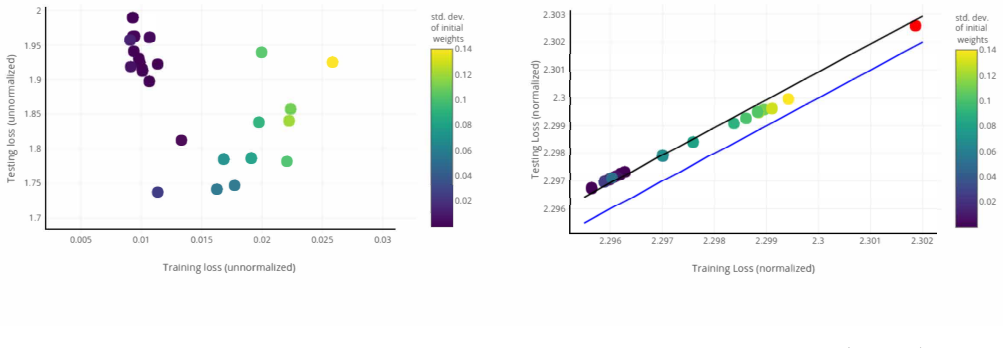
Significance. If the hidden-norm-control thesis is correct, it would provide a unified explanation of generalization in overparameterized ReLU networks and would connect the classical Rademacher-complexity view with margin theory, implicit-bias results, and normalization techniques. The manuscript has real strengths: the explicit derivation of the critical-point equivalence between standard GD and constrained dynamics in Eqs. (17)-(18) is a useful observation; the paper engages seriously with independent work by Soudry et al., Lyu and Li, and Nacson et al.; and Figures 3 and 4 provide suggestive empirical support. However, the central inference from critical-point equivalence to convergence to the constrained global minimizer is not established in the manuscript, and the key Theorem 3 is deferred to a self-cited companion memo. The paper therefore reads as a plausible synthesis whose main theorem-level claims are not yet fully verifiable from the submitted text.
major comments (4)
- [Section 3E, Eqs. (17)-(18), Fact 1] The inference from equivalence of critical points to the conclusion of Fact 1 is not justified. Equations (17) and (18) show that the constrained and unconstrained dynamics differ by a factor ρ_k^2 in the V_k flow, so their zero sets coincide; Fact 1 then states that if the dynamics converges, the V_k represent the minimizer under the L2 unit norm constraint. For the nonconvex empirical loss of a deep ReLU network this is a non-sequitur: equality of critical-point sets does not imply equality of stable attractors, and a critical point of the V-flow need not be a global constrained minimizer. Indeed, Section 2's Conjecture 1 explicitly allows the existence of non-global critical points. Convergence to a meaningful limit is proved only in the linear single-layer case in Section 3F, and the Discussion lists multilayer convergence as an open point. Please either restate this as a conjecture or supply a convergence proof that rules out convergence to non-global critical points.
- [Section 3C.1, Theorem 3] Theorem 3 is the bridge between the norm-constrained minimization and margin maximization, and hence between the paper's framework and the independent results of Lyu and Li and Nacson et al. Its proof is deferred to the self-cited CBMM Memo No. 090, and no proof or rigorous statement of conditions is given in the manuscript. Because this theorem is load-bearing for the central generalization claim, the manuscript needs a self-contained proof, or at minimum a precise statement of the assumptions and a citation to a publicly verifiable, peer-reviewed version of the result.
- [Section 3C, Eqs. (4)-(5)] The route from the uniform-convergence bound to the constrained minimization problem is incomplete. The Rademacher bound in Eq. (4) contains the term c_1 R_N(F) = c_1 ρ R_N(\tilde F), so letting ρ tend to infinity as in Eq. (5) makes this term grow without bound; taking the limit does not preserve a nontrivial uniform-convergence guarantee. The intended control presumably comes from a margin-based bound after maximizing η(\tilde f) via Theorem 3, but no margin-based generalization bound is stated. Please make explicit which bound is being minimized when ρ→∞ and how the limiting classifier controls the expected classification error.
- [Section 2, Property 1 and Conjecture 2] The abstract and Significance Statement assert that SGD 'will find with high probability the global minima,' but the body of the paper supports this only with a heuristic Langevin/Boltzmann analogy and explicitly labels the statement as Conjecture 2. Property 1 is also supported only by 'simple arguments (1)' and is not proved in the text. The optimization claims should be presented as conjectures unless the companion-memo proofs are included, and the abstract should be adjusted to match the conjectural status of this part of the argument.
minor comments (6)
- [Section 3E, Fact 1] The text 'implicitly respectss a unit L2 norm constraint' contains a typo; it should read 'implicitly respects'.
- [Section 1C] The sentence 'Let VN be the be set of all networks' contains a duplicated article; it should read 'the set of all networks'.
- [Abstract and Significance Statement] The phrase 'a the class of compositional functions' contains a typo; it should read 'a class of compositional functions'.
- [Section 3B] The sentence 'We sometime use the symbol W' should read 'We sometimes use the symbol W'.
- [References] Reference [45] lists the arXiv identifier '180.3251', which appears malformed; please check the correct identifier.
- [References] Reference [54] misspells the author name 'Kingma' as 'Kingm'.
Circularity Check
Fact 1 turns the definitional unit-norm reparametrization into a 'hidden constraint' and imports the convergence-to-minimizer premise; several supporting results are delegated to self-cited memos, though independent margin-maximization results keep the central claim from being forced.
-
self definitional
[Section 3E, Eqs. 17–18 and Fact 1]
"Define w/||w||2 = w~; thus w = ||w||2 w~ with ||w~||2 = 1. Also define S = I − w~w~T ... The key point here is that the dynamics of ˙Vk includes a unit L2 norm constraint: using the tangent gradient transform will not change the equation because S2 = S. ... Fact 1 The standard dynamical system used in deep learning, defined by ˙Wk =−∂L/∂Wk, implicitly respectss a unit L2 norm constraint on Vk with ρkVk = Wk. Thus, under an exponential loss, if the dynamics converges, the Vk represent the minimizer under the L2 unit norm constraint."
Under the change of variables W_k = ρ_k V_k with ||V_k||_2 = 1, the statement that GD 'respects a unit L2 norm constraint on V_k' is a restatement of the normalization imposed in the definition; the projected operator S = I − VV^T is just the tangent map of the unit sphere. The nontrivial conclusion, that the limit is the constrained minimizer, is not derived: Eqs. 17 and 18 show only that the critical-point sets coincide because they differ by the nonzero factor ρ_k², and equality of critical-point sets does not imply the same attractor is selected. The paper's own Discussion lists convergence of the weights for multilayer networks as open, so the explanatory content of Fact 1 is definition plus an extra, unproved convergence assumption rather than a prediction.
-
self citation load bearing
[Section 3C.1, Theorem 3]
"Then our margin maximization theorem (proved in (1)) takes the form ... Theorem 3 Consider the set of Vk,k = 1,···,K corresponding to min ||Vk||=1 L(f(ρk,Vk)) ... converges for ρ→∞ to the maximum margin of ˜f, that is to max||Vk||≤1 η(˜f)."
Theorem 3 is the bridge from the norm-constrained minimization of Eq. 6 to the max-margin solution, and it is asserted without proof in this manuscript, with the proof deferred to the authors' own CBMM Memo No. 090 (ref. 1). Since that memo is not machine-checked or otherwise independently verified within the paper, the derivation chain at this point rests on self-citation. The margin conclusion has independent support in refs. (2)–(4), so this is partial rather than total circularity, but the paper's own proof obligation is discharged only by a same-author memo.
1 more flagged steps
-
self citation load bearing
[Section 2B–2C, Property 1 and Conjecture 2]
"Simple arguments (1) suggest that the critical points which are not global minima cannot be completely degenerate. We thus have the following Property 1 Under the exponential loss, global minima are completely degenerate ... The other critical points ... less degenerate ... Together (43) and (1) suggest Conjecture 2 : ... SGD selects with high probability the global minimizers of the empirical loss, which are highly degenerate."
Property 1 and Conjecture 2 are the in-paper support for the optimization claim that SGD finds global minima with high probability. Both are explicitly sourced to the authors' own memos (refs. 1, 43, 44) and are labeled as suggested or conjectured rather than proved here. This is a self-citation chain, although it is not the main generalization derivation and the paper presents it as a conjecture rather than a theorem.
full rationale
The central generalization argument is not entirely circular: Srebro et al. (2), Lyu and Li (3), and Shpigel Nacson et al. (4) independently establish implicit-bias and margin-maximization results that support the paper's conclusion, and the uniform-convergence bound in Proposition 1 is standard. However, the paper presents its 'hidden unit-norm constraint' as a discovery when it is largely a consequence of defining V_k as the normalized direction W_k/||W_k||_2, and the step from critical-point coincidence to 'the V_k represent the minimizer' requires a convergence-to-global-minimizer premise that the paper itself lists as open for multilayer networks. Several supporting results (Theorem 3, Property 1, Conjecture 2) are delegated to the authors' own CBMM memos (1, 43, 44) rather than proved in the manuscript. Because external results supply much of the missing support, the paper is not forced by definition, but the self-citation chain and the definitional component justify a partial circularity score of 4.
Assumptions & free parameters
assumptions (4)
- domain assumption Target functions belong to the class of hierarchically local compositional functions W^{n,2}_m with a fixed binary tree architecture matching the network.
- domain assumption The data are separable and the loss is exponential-type (e.g., exponential, logistic, cross-entropy).
- domain assumption Continuous-time gradient flow is an adequate model for discrete SGD, and the V_k dynamics converges to a critical point.
- ad hoc to paper Conjectures 1 and 2 about degeneracy of minima and SGD selecting degenerate global minima.
Cite this review
Pith. "Pith review of Theoretical Issues in Deep Networks: Approximation, Optimization and Generalization." pith.science (2026). https://pith.science/paper/JOGTPT3O
@misc{pith2026190809375,
  author       = {Pith},
  title        = {Pith review of: Theoretical Issues in Deep Networks: Approximation, Optimization and Generalization},
  year         = {2026},
  howpublished = {\url{https://pith.science/paper/JOGTPT3O}},
  note         = {Machine review of arXiv:1908.09375}
}
read the original abstract
While deep learning is successful in a number of applications, it is not yet well understood theoretically. A satisfactory theoretical characterization of deep learning however, is beginning to emerge. It covers the following questions: 1) representation power of deep networks 2) optimization of the empirical risk 3) generalization properties of gradient descent techniques --- why the expected error does not suffer, despite the absence of explicit regularization, when the networks are overparametrized? In this review we discuss recent advances in the three areas. In approximation theory both shallow and deep networks have been shown to approximate any continuous functions on a bounded domain at the expense of an exponential number of parameters (exponential in the dimensionality of the function). However, for a subset of compositional functions, deep networks of the convolutional type can have a linear dependence on dimensionality, unlike shallow networks. In optimization we discuss the loss landscape for the exponential loss function and show that stochastic gradient descent will find with high probability the global minima. To address the question of generalization for classification tasks, we use classical uniform convergence results to justify minimizing a surrogate exponential-type loss function under a unit norm constraint on the weight matrix at each layer -- since the interesting variables for classification are the weight directions rather than the weights. Our approach, which is supported by several independent new results, offers a solution to the puzzle about generalization performance of deep overparametrized ReLU networks, uncovering the origin of the underlying hidden complexity control.
Figures


Figures from the paper (1 more)

Reference graph
Works this paper leans on
-
[1]
Introduction I n the last few years, deep learning has been tremendously successful in many important applications of machine learn- ing. However, our theoretical understanding of deep learning, and thus the ability of developing principled improvements, has lagged behind. A satisfactory theoretical characterization of deep learning is emerging. It covers...
-
[2]
approximation properties of deep networks 2)optimization of the empirical risk 3)generalization properties of gradient descent techniques – why the expected error does not suf- fer, despite the absence of explicit regularization, when the networks are overparametrized? A. When Can Deep Networks Avoid the Curse of Dimension- ality?.We start with the first s...
-
[3]
representation powerof deep networks 2) optimization of the empirical risk 3) generalization propertiesof gradient de- scent techniques – how can deep networks generalize despite being overparametrized – more weights than training data – in the absence of any explicit regularization? We review progress on all three areas showing that 1) for a the class of...
-
[4]
The Optimization Landscape of Deep Nets with Smooth Activation Function The main question in optimization of deep networks is to the landscape of the empirical loss in terms of its global minima and local critical points of the gradient. A. Related work. There are many recent papers studying opti- mization in deep learning. For optimization we mention wor...
work page 2019
-
[5]
implicit
Generalization Recent results by (2) illuminate the apparent absence of ”over- fitting” (see Figure 4) in the special case of linear networks for binary classification. They prove that minimization of loss functions such as the logistic, the cross-entropy and the expo- nential loss yields asymptotic convergence to the maximum margin solution for linearly se...
-
[6]
asymptotic minima
S2 =S The gradient descent dynamic system used in training deep networks for the exponential loss is given by Equation 7. Following the chain rulefor the time derivatives, the dynamics forWk is exactly (see (1)) equivalent to the following dynamics for||Wk||=ρk and Vk: ˙ρk = ∂||Wk|| ∂Wk ∂Wk ∂t =VT k ˙Wk [11] and ˙Vk = ∂Vk ∂Wk ∂Wk ∂t = Sk ρk ˙Wk [12] where...
-
[7]
Poggio T, Anselmi F , Rosasco L (2015) I-theory on depth vs width: hierarchical function composition. CBMM memo 041
work page 2015
-
[8]
Discussion A main difference between shallow and deep networks is in terms of approximation power or, in equivalent words, of the ability to learn good representations from data based on the compositional structure of certain tasks. Unlike shallow networks, deep local networks – in particular convolutional networks – can avoid the curse of dimensionality i...
Show all 64 references
-
[9]
(2019) Theory of deep learning III: Dynamics and generalization in deep networks
Banburski A, et al. (2019) Theory of deep learning III: Dynamics and generalization in deep networks. CBMM Memo No. 090
2019
-
[10]
ArXiv e-prints
Soudry D, Hoffer E, Srebro N (2017) The Implicit Bias of Gradient Descent on Separable Data. ArXiv e-prints
2017
-
[11]
CoRR abs/1906.05890
Lyu K, Li J (2019) Gradient descent maximizes the margin of homogeneous neural networks. CoRR abs/1906.05890
2019 arXiv
-
[12]
arXiv e- prints p
Shpigel Nacson M, Gunasekar S, Lee JD, Srebro N, Soudry D (2019) Lexicographic and Depth-Sensitive Margins in Homogeneous and Non-Homogeneous Deep Models. arXiv e- prints p. arXiv:1905.07325
2019 arXiv
-
[13]
Center for Brains, Minds and Machines (CBMM) Memo No
Anselmi F , Rosasco L, Tan C, Poggio T (2015) Deep convolutional network are hierarchical kernel machines. Center for Brains, Minds and Machines (CBMM) Memo No. 35, also in arXiv
2015
-
[14]
Poggio T, Rosasco L, Shashua A, Cohen N, Anselmi F (2015) Notes on hierarchical splines, dclns and i-theory, (MIT Computer Science and Artificial Intelligence Laboratory), Technical report
2015
-
[15]
Acta Numerica 8:143–195
Pinkus A (1999) Approximation theory of the mlp model in neural networks. Acta Numerica 8:143–195
1999
-
[16]
45, also in arXiv
Mhaskar H, Liao Q, Poggio T (2016) Learning real and boolean functions: When is deep better than shallow? Center for Brains, Minds and Machines (CBMM) Memo No. 45, also in arXiv
2016
-
[17]
Center for Brains, Minds and Machines (CBMM) Memo No
Mhaskar H, Poggio T (2016) Deep versus shallow networks: an approximation theory per- spective. Center for Brains, Minds and Machines (CBMM) Memo No. 54, also in arXiv
2016
-
[18]
Donoho DL (2000) High-dimensional data analysis: The curses and blessings of dimension- ality in AMS CONFERENCE ON MA TH CHALLENGES OF THE 21ST CENTURY
2000
-
[19]
Advances in Computational Mathematics pp
Mhaskar H (1993) Approximation properties of a multilayered feedforward artificial neural network. Advances in Computational Mathematics pp. 61–80
1993
-
[20]
Assuming ϵof the form ϵ∝1 logt we obtain−1 t log2t =−B 1 t log2t
We obtain (assuming normalized input||x||= 1) ˙ϵ= 1 ρe−ρvTx(x−(x+ϵ)(x+ϵ)Tx)≈1 ρe−ρvTx(x−x−xϵT−ϵxT ), [20] which has the form ˙ϵ=−1 t logt (2xϵT ). Assuming ϵof the form ϵ∝1 logt we obtain−1 t log2t =−B 1 t log2t. Thus the error indeed converges asϵ∝1 logt. A similar analysis f...
2019
-
[21]
Proceedings of the 1993 IEEE-SP Workshop
Mhaskar HN (1993) Neural networks for localized approximation of real functions in Neural Networks for Processing [1993] III. Proceedings of the 1993 IEEE-SP Workshop . (IEEE), pp. 190–196
1993
-
[22]
Mathematics of Computation 63(208):607–623
Chui C, Li X, Mhaskar H (1994) Neural networks for localized approximation. Mathematics of Computation 63(208):607–623
1994
-
[23]
Advances in Computational Mathematics 5(1):233–243
Chui CK, Li X, Mhaskar HN (1996) Limitations of the approximation capabilities of neural networks with one hidden layer. Advances in Computational Mathematics 5(1):233–243
1996
-
[24]
Notices of the American Mathematical Society (AMS) 50(5):537–544
Poggio T, Smale S (2003) The mathematics of learning: Dealing with data. Notices of the American Mathematical Society (AMS) 50(5):537–544
2003
-
[25]
F .and Pascanu R, Cho K, Bengio Y (2014) On the number of linear regions of deep neural networks
Montufar, G. F .and Pascanu R, Cho K, Bengio Y (2014) On the number of linear regions of deep neural networks. Advances in Neural Information Processing Systems 27:2924–2932
2014
-
[26]
CoRR abs/1304.7045
Livni R, Shalev-Shwartz S, Shamir O (2013) A provably efficient algorithm for training deep networks. CoRR abs/1304.7045
2013 arXiv
-
[27]
(2014) Unsupervised learning of invariant representations with low sample complexity: the magic of sensory cortex or a new framework for machine learning?
Anselmi F , et al. (2014) Unsupervised learning of invariant representations with low sample complexity: the magic of sensory cortex or a new framework for machine learning?. Center for Brains, Minds and Machines (CBMM) Memo No. 1. arXiv:1311.4158v5
2014 arXiv
-
[28]
(2015) Unsupervised learning of invariant representations
Anselmi F , et al. (2015) Unsupervised learning of invariant representations. Theoretical Com- puter Science
2015
-
[29]
CBMM memo 037
Poggio T, Rosaco L, Shashua A, Cohen N, Anselmi F (2015) Notes on hierarchical splines, dclns and i-theory. CBMM memo 037
2015
-
[30]
Center for Brains, Minds and Machines (CBMM) Memo No
Liao Q, Poggio T (2016) Bridging the gap between residual learning, recurrent neural net- works and visual cortex. Center for Brains, Minds and Machines (CBMM) Memo No. 47, also in arXiv
2016
-
[31]
arXiv preprint arXiv:1509.08101v2 [cs.LG] 29 Sep 2015
Telgarsky M (2015) Representation benefits of deep feedforward networks. arXiv preprint arXiv:1509.08101v2 [cs.LG] 29 Sep 2015
2015 arXiv
-
[32]
arXiv:1610.09887v1
Safran I, Shamir O (2016) Depth separation in relu networks for approximating smooth non- linear functions. arXiv:1610.09887v1
2016 arXiv
-
[33]
058, MIT Center for Brains, Minds and Machines), Technical report
Poggio T, Mhaskar H, Rosasco L, Miranda B, Liao Q (2016) Theory I: Why and when can deep - but not shallow - networks avoid the curse of dimensionality, (CBMM Memo No. 058, MIT Center for Brains, Minds and Machines), Technical report
2016
-
[34]
arXiv e-prints p
Daubechies I, DeVore R, Foucart S, Hanin B, Petrova G (2019) Nonlinear approximation and (deep) relu networks. arXiv e-prints p. arXiv:1905.02199
2019 arXiv
-
[35]
CoRR abs/1703.00887
Jin C, Ge R, Netrapalli P , Kakade SM, Jordan MI (2017) How to escape saddle points effi- ciently. CoRR abs/1703.00887
2017 arXiv
-
[36]
CoRR abs/1503.02101
Ge R, Huang F , Jin C, Yuan Y (2015) Escaping from saddle points - online stochastic gradient for tensor decomposition. CoRR abs/1503.02101
2015 arXiv
-
[37]
Feldman V, Rakhlin A, Shamir O
Lee JD, Simchowitz M, Jordan MI, Recht B (2016) Gradient descent only converges to min- imizers in 29th Annual Conference on Learning Theory , Proceedings of Machine Learning Research, eds. Feldman V, Rakhlin A, Shamir O. (PMLR, Columbia University, New Y ork, New Y ork, USA),...
2016
-
[38]
Du SS, Lee JD, Tian Y (2018) When is a convolutional filter easy to learn? in International Conference on Learning Representations
2018
-
[39]
(JMLR.org), pp
Tian Y (2017) An analytical formula of population gradient for two-layered relu network and its applications in convergence and critical point analysis inProceedings of the 34th International Conference on Machine Learning - Volume 70 , ICML ’17. (JMLR.org), pp. 3404–3413
2017
-
[40]
IEEE T ransactions on Information Theory 65(2):742–769
Soltanolkotabi M, Javanmard A, Lee JD (2019) Theoretical insights into the optimization land- scape of over-parameterized shallow neural networks. IEEE T ransactions on Information Theory 65(2):742–769
2019
-
[41]
(Curran Associates Inc., USA), pp
Li Y , Yuan Y (2017) Convergence analysis of two-layer neural networks with relu activation in Proceedings of the 31st International Conference on Neural Information Processing Systems , NIPS’17. (Curran Associates Inc., USA), pp. 597–607
2017
-
[42]
Brutzkus A, Globerson A (2017) Globally optimal gradient descent for a convnet with gaussian inputs in Proceedings of the 34th International Conference on Machine Learning, ICML 2017, Sydney , NSW, Australia, 6-11 August 2017. pp. 605–614
2017
-
[43]
Dy J, Krause A
Du S, Lee J, Tian Y , Singh A, Poczos B (2018) Gradient descent learns one-hidden-layer CNN: Don’t be afraid of spurious local minima inProceedings of the 35th International Conference on Machine Learning , Proceedings of Machine Learning Research, eds. Dy J, Krause A. (PMLR, ...
2018
-
[44]
CoRR abs/1811.03804
Du SS, Lee JD, Li H, Wang L, Zhai X (2018) Gradient descent finds global minima of deep neural networks. CoRR abs/1811.03804
2018 arXiv
-
[45]
(JMLR.org), pp
Zhong K, Song Z, Jain P , Bartlett PL, Dhillon IS (2017) Recovery guarantees for one-hidden- layer neural networks inProceedings of the 34th International Conference on Machine Learn- ing - Volume 70 , ICML ’17. (JMLR.org), pp. 4140–4149
2017
-
[46]
CoRR abs/1711.03440
Zhong K, Song Z, Dhillon IS (2017) Learning non-overlapping convolutional neural networks with multiple kernels. CoRR abs/1711.03440
2017 arXiv
-
[47]
arXiv e-prints
Zhang X, Yu Y , Wang L, Gu Q (2018) Learning One-hidden-layer ReLU Networks via Gradient Descent. arXiv e-prints
2018
-
[48]
Bengio S, et al
Li Y , Liang Y (2018) Learning overparameterized neural networks via stochastic gradient descent on structured data in Advances in Neural Information Processing Systems 31 , eds. Bengio S, et al. (Curran Associates, Inc.), pp. 8157–8166
2018
-
[49]
Du SS, Zhai X, Poczos B, Singh A (2019) Gradient descent provably optimizes over- parameterized neural networks in International Conference on Learning Representations
2019
-
[50]
CoRR abs/1811.08888
Zou D, Cao Y , Zhou D, Gu Q (2018) Stochastic gradient descent optimizes over- parameterized deep relu networks. CoRR abs/1811.08888
2018 arXiv
-
[51]
arXiv:1703.09833, CBMM Memo No
Poggio T, Liao Q (2017) Theory II: Landscape of the empirical risk in deep learning. arXiv:1703.09833, CBMM Memo No. 066
2017 arXiv
-
[52]
(2017) Theory of deep learning IIb: Optimization properties of SGD
Zhang C, et al. (2017) Theory of deep learning IIb: Optimization properties of SGD. CBMM Memo 072
2017
-
[53]
arXiv:180.3251 [cs, math]
Raginsky M, Rakhlin A, Telgarsky M (2017) Non-convex learning via stochastic gradient langevin dynamics: A nonasymptotic analysis. arXiv:180.3251 [cs, math]
2017
-
[54]
Guyon I, et al
Daniely A (2017) Sgd learns the conjugate kernel class of the network in Advances in Neural Information Processing Systems 30 , eds. Guyon I, et al. (Curran Associates, Inc.), pp. 2422– 2430
2017
-
[55]
CoRR abs/1811.04918
Allen-Zhu Z, Li Y , Liang Y (2018) Learning and generalization in overparameterized neural networks, going beyond two layers. CoRR abs/1811.04918
2018 arXiv
-
[56]
CoRR abs/1901.08584
Arora S, Du SS, Hu W, yuan Li Z, Wang R (2019) Fine-grained analysis of optimization and generalization for overparameterized two-layer neural networks. CoRR abs/1901.08584
2019 arXiv
-
[57]
CoRR abs/1810.05369
Wei C, Lee JD, Liu Q, Ma T (2018) On the margin theory of feedforward neural networks. CoRR abs/1810.05369
2018 arXiv
-
[58]
CoRR abs/1711.01530
Liang T, Poggio T, Rakhlin A, Stokes J (2017) Fisher-rao metric, geometry, and complexity of neural networks. CoRR abs/1711.01530
2017 arXiv
-
[59]
Bousquet O, Boucheron S, Lugosi G (2003) Introduction to statistical learning theory. pp. 169–207
2003
-
[60]
Rosset S, Zhu J, Hastie T (2003) Margin maximizing loss functions in Advances in Neural Information Processing Systems 16 [Neural Information Processing Systems, NIPS 2003, December 8-13, 2003, Vancouver and Whistler, British Columbia, Canada] . pp. 1237–1244
2003
-
[61]
IEEE T ransactions on Signal Processing 48(6):1843–1847
Douglas SC, Amari S, Kung SY (2000) On gradient adaptation with unit-norm constraints. IEEE T ransactions on Signal Processing 48(6):1843–1847
2000
-
[62]
Advances in Neural Information Processing Systems
Salimans T, Kingm DP (2016) Weight normalization: A simple reparameterization to acceler- ate training of deep neural networks. Advances in Neural Information Processing Systems
2016
-
[63]
CoRR abs/1807.09659
Liao Q, Miranda B, Banburski A, Hidary J, Poggio TA (2018) A surprising linear relationship predicts test performance in deep networks. CoRR abs/1807.09659
2018 arXiv
-
[64]
Signal Processing 55:137–139
Ferreira PJSG (1996) The existence and uniqueness of the minimum norm solution to certain linear and nonlinear problems. Signal Processing 55:137–139. Poggio et al. PNAS | August 27, 2019 | vol. XXX | no. XX | 9
1996
Reviewed August 14, 2026 · model on record in the stance chip above.
Discussion (0). Continue with ORCID to comment.