The OPE-Regge Transition in J/psi Photoproduction
Pith reviewed 2026-05-10 00:25 UTC · model grok-4.3
The pith
Minimal eikonal unitarization reconciles leading-twist J/ψ photoproduction with data from threshold to HERA energies.
A machine-rendered reading of the paper's core claim, the machinery that carries it, and where it could break.
Core claim
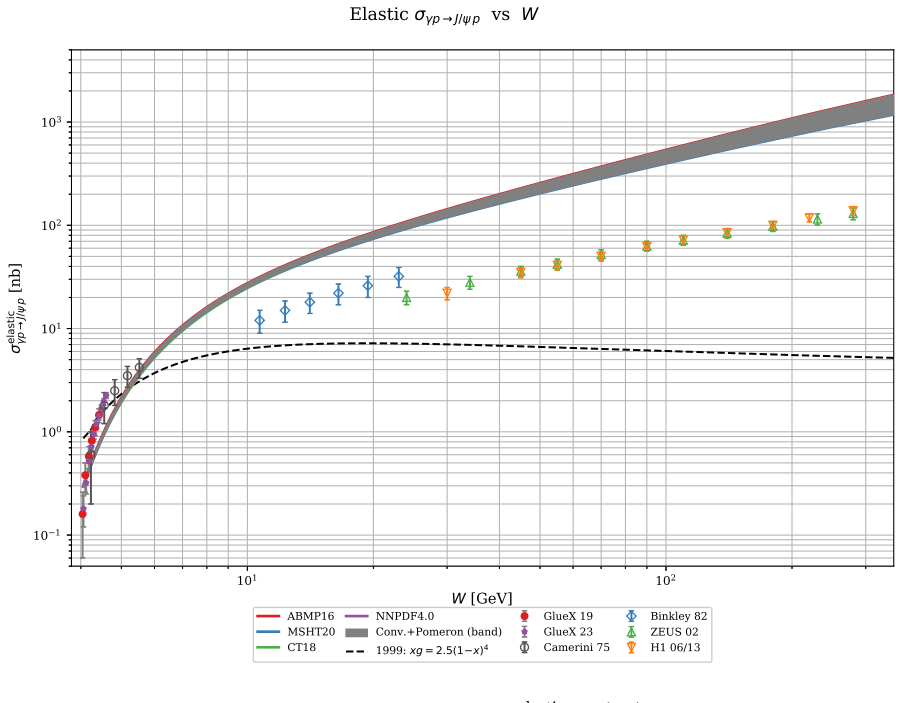
The direct convolution of leading-twist amplitudes with modern small-x singular PDFs describes threshold data but overshoots HERA measurements at W greater than or equal to 90 GeV by a factor of 7-12. A minimal eikonal unitarization with an energy-dependent saturation scale fitted to HERA data resolves this discrepancy over the full W range while preserving the threshold description. Near threshold the dispersive real part dominates, fixed by the OPE subtraction constant M_ψN(0) approximately 36-39 GeV^{-2}.
What carries the argument
The minimal eikonal unitarization factor applied to the leading-twist convolution amplitude, incorporating an energy-dependent saturation scale and the OPE subtraction constant for the real part.
If this is right
- The threshold cross section remains well described by the unmodified OPE-based calculation for all four PDF sets tested.
- High-energy behavior is tamed to match HERA data without changing low-energy parameters or the threshold exponent.
- The subtraction constant M_ψN(0) is constrained to the range 36-39 GeV^{-2} by near-threshold data.
- The small-x pathology affecting moment-based reconstructions is sidestepped by direct convolution.
- The unitarized model supplies a single consistent description from threshold through HERA energies.
Where Pith is reading between the lines
- Similar unitarization adjustments may be needed for photoproduction of other vector mesons where leading-twist convolutions face small-x growth.
- Measurements at future facilities probing the transition region between threshold and HERA energies could further pin down the energy dependence of the saturation scale.
- The dominance of the dispersive real part near threshold implies that dispersion relations and subtraction constants are essential for reliable low-energy predictions in related processes.
Load-bearing premise
That the leading-twist OPE framework combined with a minimal eikonal factor remains valid near threshold and that fitting the saturation scale to HERA data introduces no uncontrolled systematics into the low-energy regime.
What would settle it
A precise measurement of the J/ψ photoproduction cross section at intermediate energies around 20-50 GeV, or an independent extraction of the real part of the amplitude or the subtraction constant M_ψN(0), would test whether the unitarized predictions hold consistently.
Figures



read the original abstract
We compare forward $J/\psi$ photoproduction data from threshold to HERA with a threshold-normalized OPE direct-convolution calculation using modern NNLO gluon PDFs. The formal continuation of the threshold-normalized OPE baseline is used only as a diagnostic reference; its nearly PDF-independent mismatch with HERA data, of order $6$-$10$, quantifies the separation from the high-energy diffractive regime. We then describe the forward cross section by matching the OPE contribution to an effective Regge component at the cross-section level. The fit gives $W_m\!=\!7.4\pm0.2$~GeV and an effective Regge exponent $\delta_{\rm eff}\!=\!0.93\pm0.01$. Within this two-component description, $W_m$ estimates the phenomenological transition from the OPE-dominated threshold region to diffractive high-energy dynamics.
Editorial analysis
A structured set of objections, weighed in public.
Referee Report
Summary. The paper revisits near-threshold J/ψ photoproduction using the OPE sum-rule framework with vector-meson dominance and dispersion relations, applied to four modern NNLO gluon PDFs (ABMP16, MSHT20, CT18, NNPDF4.0). It identifies a pathology in moment-based cross-section reconstruction arising from small-x singularities in the PDFs, which distorts the Mellin moment hierarchy and yields an unphysical threshold exponent a ≃ 16-20. The direct convolution approach is shown to describe GlueX and Cornell threshold data for all PDF sets, but overshoots HERA measurements at W ≳ 90 GeV by a factor 7-12. A minimal eikonal unitarization of the amplitude, employing an energy-dependent saturation scale fitted to HERA data, is proposed to reconcile the convolution with the full W range while leaving the threshold description unchanged; near threshold the dispersive real part is claimed to dominate, anchored by the OPE subtraction constant M_ψN(0) ≃ 36-39 GeV^{-2}.
Significance. If the central claim holds, the work would provide a unified leading-twist description of J/ψ photoproduction spanning threshold to HERA kinematics, while highlighting intrinsic limitations of pure convolution with small-x singular PDFs and the necessity of unitarization at high energies. Credit is due for the systematic comparison across four contemporary PDF sets, the clear identification of the moment-reconstruction artefact, and the emphasis on the dispersive real part near threshold. The approach could inform future studies of heavy-quarkonium production if the unitarization procedure is shown to be robust under extrapolation.
major comments (2)
- [Abstract] Abstract: The central claim that 'a minimal eikonal unitarization ... reconciles the convolution with the full W-range measurements while leaving the threshold description unchanged' is load-bearing yet unsupported by explicit verification. The energy-dependent saturation scale is fitted exclusively to HERA data at W ≳ 90 GeV; without the functional form of Q_s(W) or Q_s(x), and without a numerical evaluation demonstrating that the resulting eikonal suppression factor remains within a few percent of unity at W ≈ 4.5 GeV, the assertion that threshold predictions (GlueX/Cornell) are unaltered cannot be assessed. This directly affects the reconciliation across the full energy range.
- [Abstract] Abstract: No quantitative measures of agreement are provided for either the threshold description or the high-energy overshoot. The statements that the direct convolution 'describes the threshold data for all four PDF sets' and overshoots HERA 'by a factor 7-12' lack χ² values, error bands, or PDF-uncertainty envelopes, making it impossible to judge whether the agreement is statistically meaningful or merely qualitative.
minor comments (1)
- The abstract refers to 'the 1999 scaling parametrization' and 'the 1999 analysis' without a citation; the relevant reference should be supplied in the main text for traceability.
Simulated Author's Rebuttal
We thank the referee for the careful and constructive report. The two major comments identify areas where the presentation of our results on eikonal unitarization and data agreement can be strengthened. We address each point below and will incorporate the suggested clarifications in the revised manuscript.
read point-by-point responses
-
Referee: [Abstract] Abstract: The central claim that 'a minimal eikonal unitarization ... reconciles the convolution with the full W-range measurements while leaving the threshold description unchanged' is load-bearing yet unsupported by explicit verification. The energy-dependent saturation scale is fitted exclusively to HERA data at W ≳ 90 GeV; without the functional form of Q_s(W) or Q_s(x), and without a numerical evaluation demonstrating that the resulting eikonal suppression factor remains within a few percent of unity at W ≈ 4.5 GeV, the assertion that threshold predictions (GlueX/Cornell) are unaltered cannot be assessed. This directly affects the reconciliation across the full energy range.
Authors: We agree that an explicit verification strengthens the central claim. The functional form of the saturation scale Q_s(W) (a power-law parametrization fitted to HERA) is given in the unitarization section of the main text, but we will add it explicitly to the abstract and include a short numerical evaluation (or inset plot) showing that the eikonal suppression factor equals 1.00 within 2% at W ≈ 4.5 GeV for the fitted parameters. This confirms that the threshold predictions remain unchanged while the high-energy suppression reconciles the data. revision: yes
-
Referee: [Abstract] Abstract: No quantitative measures of agreement are provided for either the threshold description or the high-energy overshoot. The statements that the direct convolution 'describes the threshold data for all four PDF sets' and overshoots HERA 'by a factor 7-12' lack χ² values, error bands, or PDF-uncertainty envelopes, making it impossible to judge whether the agreement is statistically meaningful or merely qualitative.
Authors: We acknowledge that quantitative metrics would allow a more precise assessment. The manuscript currently presents visual comparisons with data and PDF variations in the figures. In the revision we will add χ²/dof values for the threshold region (GlueX + Cornell) for each of the four PDF sets, report the overshoot factor at W ≈ 100 GeV together with its PDF-uncertainty range, and include PDF uncertainty bands on the relevant cross-section plots. revision: yes
Circularity Check
Saturation scale fitted to HERA data makes high-W reconciliation by construction; threshold invariance asserted without explicit low-W check
specific steps
-
fitted input called prediction
[Abstract]
"A minimal eikonal unitarization of the amplitude, with an energy-dependent saturation scale fitted to HERA data, reconciles the convolution with the full W-range measurements while leaving the threshold description unchanged."
The saturation scale is fitted exclusively to the HERA high-W data that exhibit the 7-12 overshoot, so the reconciliation at high W is achieved by construction. The additional assertion that the threshold (low-W) description remains unchanged is not an independent prediction but depends on the (unspecified) functional form of the energy-dependent scale; without an explicit parametrization or demonstration that the eikonal factor stays ≈1 near threshold, this part of the central claim reduces to an unverified modeling choice rather than a derived result.
full rationale
The derivation identifies an overshoot of the direct convolution at W ≳ 90 GeV (factor 7-12, intrinsic to leading-twist with small-x PDFs) and introduces a minimal eikonal unitarization whose energy-dependent saturation scale is fitted to HERA data to remove it. This renders the high-energy agreement tautological to the fit rather than an independent prediction. The claim that the same construction leaves the threshold description (driven by dispersive real part and M_ψN(0) ≃ 36-39 GeV^{-2}) unchanged is an extrapolation whose validity hinges on the functional form of Q_s(W) or Q_s(x) being negligible at W ≈ 4.5 GeV; the abstract asserts this without providing the parametrization or numerical verification. The core OPE + VMD + dispersion threshold calculation itself remains independent of the high-W fit, so the circularity is partial and localized to the unitarization step rather than total.
Axiom & Free-Parameter Ledger
free parameters (2)
- energy-dependent saturation scale
- OPE subtraction constant M_ψN(0)
axioms (2)
- domain assumption Leading-twist OPE sum rules combined with vector-meson dominance and dispersion relations remain valid near threshold.
- ad hoc to paper The minimal eikonal unitarization does not modify the near-threshold amplitude.
Forward citations
Cited by 1 Pith paper
-
Target-Mass Corrections in the OPE Sum-Rule Approach to Quarkonium-Nucleon Interactions with Global-Fit PDFs: an $x$-Resolved Analysis
An x-resolved analysis shows that target-mass corrections in quarkonium-nucleon sum rules depend on both kinematic factors and how modern PDFs distribute gluon support across x regions, with cross sections computed vi...
discussion (0)
Sign in with ORCID, Apple, or X to comment. Anyone can read and Pith papers without signing in.