REVIEW 2 major objections 5 minor 31 references
Regularized Context Gates on Transformer for Machine Translation
T0 review · 2 major / 5 minor · reviewed 2026-08-14 · deepseek-v4-flash
Pith's one-line read Adding regularized source-target context gates to the Transformer improves machine translation by about 1.0 BLEU on average across four datasets.
desk verdict Credible +1.0 BLEU gain from regularized context gates for Transformer, but the mechanistic claim is undercut by using the same PMI-derived labels in both training and the error analysis. read the letter →
The pith
A machine-rendered reading of the paper's core claim, the machinery that carries it, and where it could break.
The reading
What carries the argument
The load-bearing object is the context gate vector $z_i^l$, a sigmoid value per hidden unit that interpolates between the target-context stream and the source-context stream in every decoder layer; it turns the Transformer's additive residual connection into a highway-style mixture. The companion piece is the automatic label generator: for each target token $y_i$, the paper computes the strongest pointwise mutual information with any source word and with any preceding target word, and sets the training target $z_i^*$ to whichever side is stronger. This label drives the regularizer in Eq. (5), which penalizes gates whose value lies on the opposite side of 0.5 from $z_i^*$. The same labels are reused in Section 3.3 to count context-selection errors, so the machinery both trains the model and provides the paper's explanation of where translation errors come from.
What would settle it
Take a held-out sample with human word-alignment or golden source-target contribution labels, compare them with the $z_i^*$ labels from Eq. (7), and also compare BLEU when training with PMI labels versus with the human labels. A large disagreement rate, or a big BLEU gap between the two training signals, would show that PMI supervision, not the gate mechanism, is responsible for the reported gain and that the assumption that PMI tracks true context origin is wrong.
Extended reading notes
Core claim
The central claim is that adding a dimension-wise context gate and supervising it with a corpus-derived binary label improves both translation quality and interpretability of the Transformer. The model replaces the decoder's residual addition with a weighted combination: $c_i^l = \mathrm{rn}\circ\mathrm{ln}\circ\mathrm{ff}\big((1-z_i^l)\otimes t_i^l + z_i^l\otimes s_i^l\big)$, where $t_i^l$ is the target-context stream built from preceding target words and $s_i^l$ is the source-context stream built from the encoder output. The gate $z_i^l=\sigma(\mathrm{ff}(t_i^l\|s_i^l))$ is a sigmoid vector, and the supervision label $z_i^*$ is 1 if the maximum PMI between $y_i$ and any source word exceeds the maximum PMI between $y_i$ and any earlier target word, else 0. The paper's empirical finding is that this regularized gating yields an average gain of 1.0 BLEU over a strong Transformer baseline on four datasets and measurably reduces context-selection errors, whereas the unregularized gate alone gives only a modest gain.
Load-bearing premise
The load-bearing premise is that the binary label $z_i^*$ computed by comparing word-co-occurrence strengths correctly identifies whether a target word is translated from the source or generated from the target context; if corpus co-occurrence statistics mislabel this origin for a sizable fraction of words, the regularizer and the error analysis are internally consistent but not anchored to truth.
Editorial extensions
If this is right
- If the 1.0 BLEU average gain reproduces in other language pairs, Transformer systems can pick up a consistent quality improvement by replacing the residual connection with a gated mixture and adding the PMI regularizer at training time only.
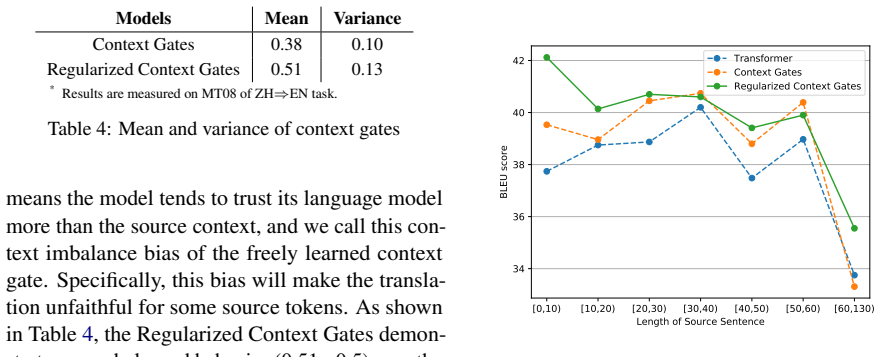
- Because the gate's average value moves from 0.38 to 0.51, the regularizer is best understood as a bias-correction term; other architectures with stronger target-context bias would need the same correction to stay faithful.
- The layer ablations indicate that regularizing every decoder layer beats regularizing any single layer, so future Transformer variants should apply the gate uniformly rather than at a chosen depth.
- The error analysis implies an upper bound on what context gating alone can fix: roughly one third of forced-decoding errors are context-selection errors, so the remaining two thirds require different mechanisms.
Reading between the lines
- A natural test is to replace the PMI-derived labels with human word alignments on a small sample; if gate behavior and BLEU change substantially, the supervision signal, not the gate structure, is doing the work.
- The same regularizer could be applied at inference time as a decoding constraint by re-ranking hypotheses whose gates more closely match the PMI labels; the paper only uses regularization during training.
- Because the context-selection errors are defined under forced decoding, an untested extension is whether the gate's online distribution at test time could be calibrated to the label distribution, which might recover gains the current BLEU numbers do not show.
- The mean gate value near 0.5 suggests the method is implicitly learning a per-dimension attention over source versus target; probing those dimensions could reveal interpretable linguistic categories, a question the paper does not address.
Signed reviews
Editorial analysis
A structured set of objections, weighed in public.
Referee Report
Summary. The paper presents Regularized Context Gates for the Transformer architecture. It first proposes a decomposition of the decoder context into source and target components (Eq. 2), introducing a context gate to rebalance them (Eqs. 3-4). Because freely learned gates show a target-side bias, the authors add a regularizer (Eq. 5) supervised by binary labels z*_i (Eq. 7) derived from pointwise mutual information in bilingual and monolingual corpora. Experiments on four translation tasks show an average improvement of about 1.0 BLEU over a strong Transformer baseline, and an error analysis (Table 3) claims that roughly one third of translation errors are context-selection errors that the regularization reduces.
Significance. The paper addresses a real phenomenon in NMT, the imbalance between source and target context, and proposes a simple, architecture-specific solution. Its strengths include the use of a strong Transformer baseline, consistent gains across six test sets (NIST MT05/06/08, WMT14, IWSLT14, IWSLT17), and a transparent modeling of supervision via PMI. If the BLEU gains are statistically reliable, the method is a useful contribution. However, the paper's explanatory claim about context-selection errors is currently supported only by an analysis that reuses the same labels that define the training supervision, so the mechanism remains unvalidated.
major comments (2)
- [Section 3.3, Eq. (7)] The context-selection error rate in Table 3 is computed using z*_i, the same PMI-based labels that serve as the regularizer's training target in Eq. (5). This makes the observed reduction in CER a measure of agreement with the training heuristic, not an independent test of whether translation errors are caused by misusing source versus target context. To support the causal claim, the authors should validate z*_i against human judgments or an independent word-alignment tool on a sample, and then recompute the error analysis on that validated subset.
- [Tables 1 and 3] The paper reports BLEU scores and error rates as point estimates without significance tests, confidence intervals, or multiple-run variance. The 1.0 BLEU average gain and the 0.5-point FER drop in Table 3 are therefore not demonstrated to be statistically reliable; the word "significantly" in Sections 3.3 and 4 is not justified. At minimum, report paired bootstrap resampling or multiple-seed variance for the main comparisons.
minor comments (5)
- [Section 3.1, Table 2] The regularization coefficient lambda is tuned on DE-EN only and fixed for all other tasks; while Table 2 shows robustness on that single task, a sensitivity analysis on a second language pair would make the transferability claim more convincing.
- [Section 2.3, Eq. (7)] The indicator notation 1_{...} is used in Eq. (7) without definition; please define it explicitly.
- [Figure 1] The word "purposed" should be "proposed," and the phonetic transcription "t¯i q´ıu" is unclear and should be replaced with a standard romanization or gloss.
- [Section 3.4] The mean and variance of context gates in Table 4 are computed over all dimensions of the gate vectors and test tokens, but this aggregation is not stated in the text; please clarify the exact computation.
- [Section 3.6] The claim that Regularized Context Gates "significantly improves" the translation of long and short sentences is not supported by significance tests; please add error bars or soften the wording.
Circularity Check
Explanatory error analysis reuses the PMI supervision labels, making the 'context selection error' reduction a self-consistency check rather than an independent mechanism.
-
self definitional
[Section 2.2 Eq. (5), Section 2.3 Eq. (7), Section 3.3 Table 3]
"the training objective is defined as follows: 𝓁 = − logP (y| x)+λ ∑_{l,i}( z∗_i max(0.5−z_l_i, 0) + (1−z∗_i ) max(z_l_i− 0.5, 0) ) ... The context selection error is defined as z∗_i (y_i) ≠ z∗_i (ŷ_i), where z∗_i is defined in equation 7."
The same z∗_i from Eq. (7) is both the supervision target in the Eq. (5) regularizer and the ground-truth label in the Section 3.3 error analysis. The regularizer is explicitly trained to push each gate toward z∗_i, so the reported reduction in 'context selection error' and the CE/FE ratio measure agreement with the very PMI heuristic used to train the gates, not an independent cause of translation quality. The BLEU gain in Table 1 is an external result, but the mechanistic explanation that improvements are caused by avoiding context-selection errors is self-consistent rather than independently validated.
full rationale
The paper's headline result—an averaged 1.0 BLEU gain over the Transformer baseline on four held-out datasets—is an external, non-circular claim. The model is compared against standard benchmarks and the BLEU metric is not derived from the proposed z∗ labels. The circularity is confined to the explanatory analysis. Equation (5) adds a hinge-style regularizer that supervises each context gate with z∗_i, defined in Eq. (7) from PMI co-occurrence counts. Section 3.3 then defines 'context selection error' using the same z∗_i and, in Table 3, credits the regularized gates with reducing that error. Thus the CER/CE-FE statistics and the 'approximately one third translation errors' statement do not independently validate the mechanism; they show the model has learned to match the PMI heuristic that was used as its training signal. This is partial circularity in the interpretation, not in the core BLEU result. The self-citation to Li et al. (2019) is not load-bearing here, and no other circular step is present. The lack of significance testing is a separate statistical concern, not a circularity issue.
Assumptions & free parameters
free parameters (2)
- regularization coefficient lambda =
1
- gate threshold for regularizer =
0.5
assumptions (2)
- domain assumption The standard Transformer decoder layer can be split into a target self-attention context and a source encoder-decoder attention context.
- domain assumption PMI co-occurrences between words in the training data are a valid proxy for lexical translation equivalence.
Cite this review
Pith. "Pith review of Regularized Context Gates on Transformer for Machine Translation." pith.science (2026). https://pith.science/paper/JONTENI2
@misc{pith2026190811020,
  author       = {Pith},
  title        = {Pith review of: Regularized Context Gates on Transformer for Machine Translation},
  year         = {2026},
  howpublished = {\url{https://pith.science/paper/JONTENI2}},
  note         = {Machine review of arXiv:1908.11020}
}
read the original abstract
Context gates are effective to control the contributions from the source and target contexts in the recurrent neural network (RNN) based neural machine translation (NMT). However, it is challenging to extend them into the advanced Transformer architecture, which is more complicated than RNN. This paper first provides a method to identify source and target contexts and then introduce a gate mechanism to control the source and target contributions in Transformer. In addition, to further reduce the bias problem in the gate mechanism, this paper proposes a regularization method to guide the learning of the gates with supervision automatically generated using pointwise mutual information. Extensive experiments on 4 translation datasets demonstrate that the proposed model obtains an averaged gain of 1.0 BLEU score over a strong Transformer baseline.
Figures

Reference graph
Works this paper leans on
-
[1]
URL: " 'urlintro :=
ENTRY address author booktitle chapter edition editor howpublished institution journal key month note number organization pages publisher school series title type volume year eprint doi pubmed url lastchecked label extra.label sort.label short.list INTEGERS output.state before.all mid.sentence after.sentence after.block STRINGS urlintro eprinturl eprintpr...
-
[2]
write newline
" write newline "" before.all 'output.state := FUNCTION n.dashify 't := "" t empty not t #1 #1 substring "-" = t #1 #2 substring "--" = not "--" * t #2 global.max substring 't := t #1 #1 substring "-" = "-" * t #2 global.max substring 't := while if t #1 #1 substring * t #2 global.max substring 't := if while FUNCTION word.in bbl.in capitalize " " * FUNCT...
-
[3]
Jimmy Lei Ba, Jamie Ryan Kiros, and Geoffrey E Hinton. 2016. https://arxiv.org/pdf/1607.06450.pdf Layer normalization . arXiv preprint arXiv:1607.06450
arXiv 2016
-
[4]
Dzmitry Bahdanau, Kyunghyun Cho, and Yoshua Bengio. 2014. https://arxiv.org/pdf/1409.0473.pdf Neural machine translation by jointly learning to align and translate . arXiv preprint arXiv:1409.0473
arXiv 2014
-
[5]
Gerlof Bouma. 2009. https://svn.spraakdata.gu.se/repos/gerlof/pub/www/Docs/npmi-pfd.pdf Normalized (pointwise) mutual information in collocation extraction . Proceedings of GSCL, pages 31--40
work page 2009
-
[6]
Kehai Chen, Rui Wang, Masao Utiyama, Eiichiro Sumita, and Tiejun Zhao. 2018. https://www.aaai.org/ocs/index.php/AAAI/AAAI18/paper/view/16060/16008 Syntax-directed attention for neural machine translation . In Thirty-Second AAAI Conference on Artificial Intelligence
work page 2018
-
[7]
Yong Cheng, Zhaopeng Tu, Fandong Meng, Junjie Zhai, and Yang Liu. 2018. https://arxiv.org/pdf/1805.06130.pdf Towards robust neural machine translation . arXiv preprint arXiv:1805.06130
arXiv 2018
-
[8]
David Chiang. 2005. https://www3.nd.edu/ dchiang/papers/chiang-acl05.pdf A hierarchical phrase-based model for statistical machine translation . In Proceedings of the 43rd Annual Meeting on Association for Computational Linguistics, pages 263--270. Association for Computational Linguistics
work page 2005
Show all 31 references
-
[9]
Maha Elbayad, Laurent Besacier, and Jakob Verbeek. 2018. https://aclweb.org/anthology/K18-1010 Pervasive attention: 2d convolutional neural networks for sequence-to-sequence prediction . arXiv preprint arXiv:1808.03867
2018 arXiv
-
[10]
Jonas Gehring, Michael Auli, David Grangier, Denis Yarats, and Yann N Dauphin. 2017. https://arxiv.org/pdf/1705.03122.pdf Convolutional sequence to sequence learning . In Proceedings of the 34th International Conference on Machine Learning-Volume 70, pages 1243--1252. JMLR. org
2017 arXiv
-
[11]
Kaiming He, Xiangyu Zhang, Shaoqing Ren, and Jian Sun. 2016. http://openaccess.thecvf.com/content_cvpr_2016/papers/He_Deep_Residual_Learning_CVPR_2016_paper.pdf Deep residual learning for image recognition . In Proceedings of the IEEE conference on computer vision and pattern ...
2016
-
[12]
Tianyu He, Xu Tan, Yingce Xia, Di He, Tao Qin, Zhibo Chen, and Tie-Yan Liu. 2018. http://papers.nips.cc/paper/8019-layer-wise-coordination-between-encoder-and-decoder-for-neural-machine-translation.pdf Layer-wise coordination between encoder and decoder for neural machine tran...
2018
-
[13]
Philipp Koehn. 2009. Statistical machine translation. Cambridge University Press
2009
-
[14]
Philipp Koehn, Franz Josef Och, and Daniel Marcu. 2003. http://www.aclweb.org/anthology/N03-1017 Statistical phrase-based translation . In Proceedings of the 2003 Conference of the North American Chapter of the Association for Computational Linguistics on Human Language Techno...
2003
-
[15]
Xintong Li, Guanlin Li, Lemao Liu, Max Meng, and Shuming Shi. 2019. https://www.aclweb.org/anthology/P19-1124 On the word alignment from neural machine translation . In Proceedings of the 57th Conference of the Association for Computational Linguistics, pages 1293--1303
2019
-
[16]
Xintong Li, Lemao Liu, Zhaopeng Tu, Shuming Shi, and Max Meng. 2018. https://www.aclweb.org/anthology/N18-1125 Target foresight based attention for neural machine translation . In Proceedings of the 2018 Conference of the North American Chapter of the Association for Computati...
2018
-
[17]
Lemao Liu, Masao Utiyama, Andrew Finch, and Eiichiro Sumita. 2016. https://arxiv.org/pdf/1609.04186.pdf Neural machine translation with supervised attention . arXiv preprint arXiv:1609.04186
2016 arXiv
-
[18]
Zhanyi Liu, Haifeng Wang, Hua Wu, and Sheng Li. 2009. http://aclweb.org/anthology/D09-1051 Collocation extraction using monolingual word alignment method . In Proceedings of the 2009 Conference on Empirical Methods in Natural Language Processing: Volume 2-Volume 2, pages 487--...
2009
-
[19]
Minh-Thang Luong, Hieu Pham, and Christopher D Manning. 2015. https://arxiv.org/pdf/1508.04025.pdf Effective approaches to attention-based neural machine translation . arXiv preprint arXiv:1508.04025
2015 arXiv
-
[20]
Shuming Ma, Xu Sun, Yizhong Wang, and Junyang Lin. 2018. https://arxiv.org/pdf/1805.04871.pdf Bag-of-words as target for neural machine translation . arXiv preprint arXiv:1805.04871
2018 arXiv
-
[21]
Haitao Mi, Zhiguo Wang, and Abe Ittycheriah. 2016. https://arxiv.org/pdf/1608.00112.pdf Supervised attentions for neural machine translation . arXiv preprint arXiv:1608.00112
2016 arXiv
-
[22]
Kishore Papineni, Salim Roukos, Todd Ward, and Wei-Jing Zhu. 2002. https://www.aclweb.org/anthology/P02-1040.pdf Bleu: a method for automatic evaluation of machine translation . In Proceedings of the 40th annual meeting on association for computational linguistics, pages 311--...
2002
-
[23]
Rico Sennrich, Barry Haddow, and Alexandra Birch. 2015. https://arxiv.org/pdf/1508.07909.pdf Neural machine translation of rare words with subword units . arXiv preprint arXiv:1508.07909
2015 arXiv
-
[24]
Rupesh Kumar Srivastava, Klaus Greff, and J \"u rgen Schmidhuber. 2015. https://arxiv.org/pdf/1505.00387.pdf Highway networks . arXiv preprint arXiv:1505.00387
2015 arXiv
-
[25]
Ilya Sutskever, Oriol Vinyals, and Quoc V Le. 2014. https://papers.nips.cc/paper/5346-sequence-to-sequence-learning-with-neural-networks.pdf Sequence to sequence learning with neural networks . In Advances in neural information processing systems, pages 3104--3112
2014
-
[26]
Zhaopeng Tu, Yang Liu, Zhengdong Lu, Xiaohua Liu, and Hang Li. 2017. http://www.aclweb.org/anthology/Q17-1007 Context gates for neural machine translation . Transactions of the Association for Computational Linguistics, 5:87--99
2017
-
[27]
Ashish Vaswani, Noam Shazeer, Niki Parmar, Jakob Uszkoreit, Llion Jones, Aidan N Gomez, ukasz Kaiser, and Illia Polosukhin. 2017. https://papers.nips.cc/paper/7181-attention-is-all-you-need.pdf Attention is all you need . In Advances in Neural Information Processing Systems, p...
2017
-
[28]
Mingming Yang, Min Zhang, Kehai Chen, Rui Wang, and Tiejun Zhao. 2020. https://search.ieice.org/bin/summary.php?id=e103-d_3_684 Neural machine translation with target-attention model . IEICE TRANSACTIONS on Information and Systems, 103(3):684--694
2020
-
[29]
Jiacheng Zhang, Yanzhuo Ding, Shiqi Shen, Yong Cheng, Maosong Sun, Huanbo Luan, and Yang Liu. 2017. https://arxiv.org/pdf/1706.06415.pdf Thumt: an open source toolkit for neural machine translation . arXiv preprint arXiv:1706.06415
2017 arXiv
-
[30]
Jiacheng Zhang, Huanbo Luan, Maosong Sun, Feifei Zhai, Jingfang Xu, Min Zhang, and Yang Liu. 2018. https://arxiv.org/abs/1810.03581 Improving the transformer translation model with document-level context . arXiv preprint arXiv:1810.03581
2018 arXiv
-
[31]
Yang Zhao, Jiajun Zhang, Zhongjun He, Chengqing Zong, and Hua Wu. 2018. http://www.aclweb.org/anthology/D18-1036 Addressing troublesome words in neural machine translation . In Proceedings of the 2018 Conference on Empirical Methods in Natural Language Processing, pages 391--400
2018
Reviewed August 14, 2026 · model on record in the stance chip above.
Discussion (0). Continue with ORCID to comment.