REVIEW 3 major objections 5 minor 44 references
Sali4Vid: Saliency-Aware Video Reweighting and Adaptive Caption Retrieval for Dense Video Captioning
T0 review · 3 major / 5 minor · reviewed 2026-08-05 · deepseek-v4-flash
Pith's one-line read Dense video captioning reaches a new state of the art by weighting frames by importance and retrieving captions from scene-aligned segments.
desk verdict Solid incremental DVC paper with clean ablations and honest limitations; the ViTT CIDEr inconsistency needs fixing before the SOTA margin is trusted. read the letter →
The pith
A machine-rendered reading of the paper's core claim, the machinery that carries it, and where it could break.
The reading
What carries the argument
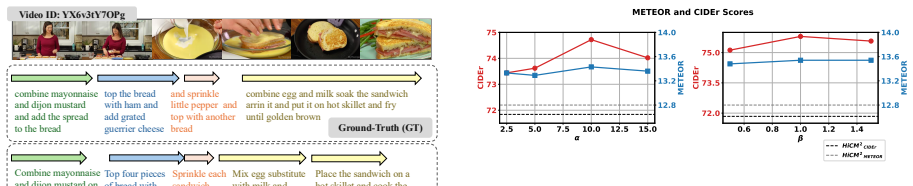
Two mechanisms carry the argument. The first is the sigmoid importance weight Wn(i) = Sigmoid(α·(i/T − ts_n/d)) × Sigmoid(α·(te_n/d − i/T)), with the maximum taken across all annotated events: a product of a sigmoid rising as the frame approaches the event start and a sigmoid falling as the frame passes the event end, producing a continuous 'center-skew' mask that up-weights the event interior while keeping soft boundary transitions, with sharpness controlled by α. The second is the adaptive segmenter, which computes the cosine difference between consecutive frames, maintains a running average segment feature, and closes a segment only when the similarity to the incoming frame falls below an
What would settle it
A concrete check: give segment-level retrieval the ground-truth event timestamps instead of similarity-derived boundaries (an oracle-segmentation version). If oracle segmentation does not clearly beat the similarity-based segmenter, then segmentation is not what drives the gain. A second check uses videos with a static background and hands-only activity, where events change but scenes do not; if the accumulated cosine difference never crosses the adaptive threshold, several events collapse into one segment and retrieval should fall back toward the fixed-size baseline behavior.
Extended reading notes
Core claim
The paper's central claim is that two supervision-shaped interventions jointly lift dense video captioning. Saliency-aware Video Reweighting converts ground-truth event timestamps into a per-frame importance weight — a left sigmoid rising toward the event start multiplied by a right sigmoid falling after the event end, with the max taken across overlapping events — and multiplies frame features by it during training, giving the visual encoder explicit temporal supervision. Semantic-based Adaptive Caption Retrieval cuts the video where accumulated frame-to-frame cosine differences cross an adaptive threshold and retrieves Top-k captions per segment, replacing fixed-size chunks that mix unrela
Load-bearing premise
The method assumes that frame-similarity dips align with real event boundaries, so when the visual signal is noisy the retrieved captions can describe the wrong events — a failure the paper's own limitation section admits still occurs.
Editorial extensions
If this is right
- The fixed-size clip-level retrieval of prior memory-augmented models can be dropped: adaptive segmentation beats it on CIDEr and F1 while removing the need to tune the window size per dataset.
- Retrieval does not hinge on an in-domain datastore: COCO and CC3M captions land within about half a CIDEr point of in-domain captions, so the gain is driven by segment alignment rather than datastore coverage.
- The reweighting operates only during training, yet it improves the model's inference-time attention inside annotated segments, so timestamp supervision survives as better learned features even though the weights are removed at test time.
- Captioning and event localization improve together, with the largest localization gain in precision (+4.76 on YouCook2, +2.57 on ViTT), indicating that visual saliency supervision sharpens boundary decisions rather than only improving description quality.
- Retrieval cost can be cut sharply with almost no loss: a 10% subset of the datastore reaches 74.92 CIDEr at roughly 2 ms per video, versus 75.80 with the full datastore.
Reading between the lines
- Because the sigmoid product is essentially a soft-edged window, the paper's results suggest a testable hypothesis: any smooth boundary-preserving mask (raised-cosine, trapezoidal) should land close to the sigmoid's +8.43 CIDEr gain, implying the soft boundary is what matters, not the logistic shape itself.
- The model already consumes speech transcripts with time tokens, so fusing transcript boundary cues with frame-similarity cut points would directly attack the noisy segments the limitation section acknowledges, since the two transition signals fail independently.
- The reweighting's dependence on timestamps points to a weakly supervised loop: use the model's own predicted boundaries as pseudo-timestamps to bootstrap reweighting on unannotated video, which the paper itself lists as future work.
- The same pair of interventions should transfer to other long-video language tasks where events are delineated by scene changes — egocentric activity narration or sports commentary — where fixed-size chunking is a known poor fit; the segmentation mechanism is content-agnostic even if the retrieval datastore would need to change.
Editorial analysis
A structured set of objections, weighed in public.
Referee Report
Summary. The paper proposes Sali4Vid, a dense video captioning framework built on Vid2Seq with two additions: (1) sigmoid-based reweighting of video features using ground-truth event timestamps during training, and (2) an adaptive, frame-similarity-based segmentation module for retrieving auxiliary captions from a training-caption datastore at segment level. The authors report state-of-the-art CIDEr scores of 75.80 on YouCook2 and 53.87 on ViTT, with consistent improvements in localization F1 in Table 2. They provide component ablations, hyperparameter sensitivity plots, attention-map analysis, and qualitative examples. The paper is clearly written and the method is simple and reproducible in principle, with code released.
Significance. If the reported numbers hold, the paper makes a modest but useful contribution: it demonstrates that timestamp supervision can be injected on the visual side during training, and that adaptive segmentation improves retrieval-augmented dense video captioning over fixed-size clip retrieval. The ablations are systematic and the design choices are reasonable. The main strengths are the simplicity of the approach, the clear ablation structure, and the release of code. However, the reported ViTT CIDEr value is internally inconsistent (53.32 vs. 53.87), and the main results are single-run without error bars, so the precise SOTA margin and its statistical reliability are not yet established.
major comments (3)
- [Section 1 / Table 1 / Section 4.1] The ViTT CIDEr score is reported as 53.32 in the Introduction (with a claimed +2.58 improvement over HiCM2's 51.29), but Table 1 and Section 4.1 report 53.87. Since 51.29 to 53.32 is +2.03, not +2.58, the claimed SOTA margin depends on which number is correct. This must be reconciled, and the released code should reproduce the final number under the official evaluation tool. As written, the central SOTA claim on ViTT is not fully verified.
- [Section 4, Tables 1-8] All reported results are from a single run, and hyperparameters alpha, beta, and k are selected on the YouCook2 validation set. The claimed gains over HiCM2, especially the ViTT +2.58 CIDEr and YouCook2 +3.96 CIDEr, have no variance estimates. Please provide multiple seed runs or confidence intervals for the main results, or at minimum report the number of seeds and justify that the margins exceed run-to-run variation.
- [Section 3.2, Eq. (7)] Eq. (7) defines D'(i) = 1 - z_cur · x_spat_{i+1}, calling this a semantic difference based on cosine similarity. The dot product equals cosine similarity only if both vectors are unit-normalized. The moving-average update in Eq. (8) does not by itself preserve unit norm, unless features are normalized after averaging. Please specify the normalization step used for z_cur and x_spat, since the adaptive segmentation behavior depends directly on this definition.
minor comments (5)
- [Section 2.1] Typo: 'HICM2' should be 'HiCM2' for consistency with the reference list and the rest of the paper.
- [Table 2] The HiCM2 row lists F1, Recall, and Precision all equal to 32.51 on YouCook2. This is unusual and should be verified; it may be a copying or formatting error.
- [Section 4.1 / Table 10] The text says 'We will revise our manuscript to include this segmentation time report,' but Table 10 already reports the numbers. This phrase appears to be a leftover editing note and should be removed or converted into a direct statement of the measured time.
- [Section 4.1] The training time statement '1h 20m total (4m 20s/epoch)' is inconsistent for 20 epochs: 4m20s × 20 = 1h26m40s. Please adjust one of the figures.
- [Figures 6-7] The y-axis label 'Precesion' is misspelled; it should be 'Precision'.
Circularity Check
No circular derivation: training-time reweighting and retrieval datastore do not leak test labels, and the SOTA claim rests on external benchmarks.
full rationale
The derivation chain is self-contained in the relevant sense. Saliency-aware Video Reweighting (Eqs. 1-5) uses ground-truth timestamps as training supervision, but Section 3.3 states explicitly that 'we perform inference without timestamp supervision and do not apply any weighting to the video features'; the reported captioning/localization numbers are produced at inference on held-out YouCook2 val and ViTT test, so the saliency weights are a training regularizer, not the predicted quantity. Semantic-based Adaptive Caption Retrieval (Eqs. 6-10) segments by cosine similarity of frame features and an adaptive threshold, with no reference to ground-truth captions or timestamps; the datastore is 'constructed from the training captions only,' and evaluation is against held-out annotations, so retrieval is not a disguised replay of the test labels. The method is benchmarked against externally developed systems (Vid2Seq, CM2, HiCM2), and the self-citations that do appear are in the concluding 'readily extended' list, not load-bearing premises. The acknowledged limitation in Section 6 (noisy segments) and the mismatch between the Abstract/Introduction ViTT CIDEr (53.32) and Table 1 (53.87) are correctness/reproducibility concerns, not circularity; no equation reduces to its own input, no fitted parameter is renamed a prediction, and no uniqueness argument is imported from the authors' prior work.
Assumptions & free parameters
free parameters (3)
- alpha (sigmoid sharpness) =
10.0
- beta (adaptive threshold scaling) =
1.0
- k (number of retrieved captions per segment) =
10
assumptions (4)
- domain assumption Cosine similarity between consecutive frames is a reliable proxy for semantic event boundaries.
- domain assumption Training with ground-truth timestamp reweighting produces features that improve inference without reweighting.
- domain assumption Retrieval from a datastore of training captions provides useful auxiliary semantic guidance at test time.
- domain assumption The Vid2Seq pretrained model is a valid base and its reproduced baseline numbers are reliable.
Cite this review
Pith. "Pith review of Sali4Vid: Saliency-Aware Video Reweighting and Adaptive Caption Retrieval for Dense Video Captioning." pith.science (2026). https://pith.science/paper/JPJXEMA6
@misc{pith2026250904602,
  author       = {Pith},
  title        = {Pith review of: Sali4Vid: Saliency-Aware Video Reweighting and Adaptive Caption Retrieval for Dense Video Captioning},
  year         = {2026},
  howpublished = {\url{https://pith.science/paper/JPJXEMA6}},
  note         = {Machine review of arXiv:2509.04602}
}
read the original abstract
Dense video captioning aims to temporally localize events in video and generate captions for each event. While recent works propose end-to-end models, they suffer from two limitations: (1) applying timestamp supervision only to text while treating all video frames equally, and (2) retrieving captions from fixed-size video chunks, overlooking scene transitions. To address these, we propose Sali4Vid, a simple yet effective saliency-aware framework. We introduce Saliency-aware Video Reweighting, which converts timestamp annotations into sigmoid-based frame importance weights, and Semantic-based Adaptive Caption Retrieval, which segments videos by frame similarity to capture scene transitions and improve caption retrieval. Sali4Vid achieves state-of-the-art results on YouCook2 and ViTT, demonstrating the benefit of jointly improving video weighting and retrieval for dense video captioning
Figures


Figures from the paper (3 more)


Reference graph
Works this paper leans on
-
[1]
online" 'onlinestring :=
ENTRY address archivePrefix author booktitle chapter edition editor eid eprint eprinttype howpublished institution journal key month note number organization pages publisher school series title type volume year doi pubmed url lastchecked label extra.label sort.label short.list INTEGERS output.state before.all mid.sentence after.sentence after.block STRING...
-
[2]
write newline
" write newline "" before.all 'output.state := FUNCTION n.dashify 't := "" t empty not t #1 #1 substring "-" = t #1 #2 substring "--" = not "--" * t #2 global.max substring 't := t #1 #1 substring "-" = "-" * t #2 global.max substring 't := while if t #1 #1 substring * t #2 global.max substring 't := if while FUNCTION word.in bbl.in capitalize " " * FUNCT...
-
[3]
Satanjeev Banerjee and Alon Lavie. 2005. Meteor: An automatic metric for mt evaluation with improved correlation with human judgments. In Proceedings of the acl workshop on intrinsic and extrinsic evaluation measures for machine translation and/or summarization, pages 65--72
2005
-
[4]
Nicolas Carion, Francisco Massa, Gabriel Synnaeve, Nicolas Usunier, Alexander Kirillov, and Sergey Zagoruyko. 2020. End-to-end object detection with transformers. In European conference on computer vision, pages 213--229. Springer
work page 2020
-
[5]
SeungJu Cha, Kwanyoung Lee, Ye-Chan Kim, Hyunwoo Oh, and Dong-Jin Kim. 2025. Verbdiff: Text-only diffusion models with enhanced interaction awareness. In Proceedings of the Computer Vision and Pattern Recognition Conference, pages 8041--8050
work page 2025
-
[6]
Soravit Changpinyo, Piyush Sharma, Nan Ding, and Radu Soricut. 2021. Conceptual 12m: Pushing web-scale image-text pre-training to recognize long-tail visual concepts. In Proceedings of the IEEE/CVF conference on computer vision and pattern recognition, pages 3558--3568
work page 2021
-
[7]
Shizhe Chen, Jia Chen, Qin Jin, and Alexander Hauptmann. 2017. Video captioning with guidance of multimodal latent topics. In Proceedings of the 25th ACM international conference on Multimedia, pages 1838--1846
work page 2017
-
[8]
Alexey Dosovitskiy, Lucas Beyer, Alexander Kolesnikov, Dirk Weissenborn, Xiaohua Zhai, Thomas Unterthiner, Mostafa Dehghani, Matthias Minderer, Georg Heigold, Sylvain Gelly, and 1 others. 2020. An image is worth 16x16 words: Transformers for image recognition at scale. arXiv preprint arXiv:2010.11929
arXiv 2020
Show all 44 references
-
[9]
Xuguang Duan, Wenbing Huang, Chuang Gan, Jingdong Wang, Wenwu Zhu, and Junzhou Huang. 2018. Weakly supervised dense event captioning in videos. Advances in Neural Information Processing Systems, 31
2018
-
[10]
Soichiro Fujita, Tsutomu Hirao, Hidetaka Kamigaito, Manabu Okumura, and Masaaki Nagata. 2020. Soda: Story oriented dense video captioning evaluation framework. In Computer Vision--ECCV 2020: 16th European Conference, Glasgow, UK, August 23--28, 2020, Proceedings, Part VI 16, p...
2020
-
[11]
Lianli Gao, Zhao Guo, Hanwang Zhang, Xing Xu, and Heng Tao Shen. 2017. Video captioning with attention-based lstm and semantic consistency. IEEE Transactions on Multimedia, 19(9):2045--2055
2017
-
[12]
Shiping Ge, Qiang Chen, Zhiwei Jiang, Yafeng Yin, Liu Qin, Ziyao Chen, and Qing Gu. 2025. Implicit location-caption alignment via complementary masking for weakly-supervised dense video captioning. In Proceedings of the AAAI Conference on Artificial Intelligence, volume 39, pa...
2025
-
[13]
Gabriel Huang, Bo Pang, Zhenhai Zhu, Clara Rivera, and Radu Soricut. 2020. Multimodal pretraining for dense video captioning. arXiv preprint arXiv:2011.11760
2020 arXiv
-
[14]
Vladimir Iashin and Esa Rahtu. 2020 a . A better use of audio-visual cues: Dense video captioning with bi-modal transformer. arXiv preprint arXiv:2005.08271
2020 arXiv
-
[15]
Vladimir Iashin and Esa Rahtu. 2020 b . Multi-modal dense video captioning. In Proceedings of the IEEE/CVF conference on computer vision and pattern recognition workshops, pages 958--959
2020
-
[16]
Dong-Jin Kim, Tae-Hyun Oh, Jinsoo Choi, and In So Kweon. 2024 a . Semi-supervised image captioning by adversarially propagating labeled data. IEEE Access, 12:93580--93592
2024
-
[17]
Minkuk Kim, Hyeon Bae Kim, Jinyoung Moon, Jinwoo Choi, and Seong Tae Kim. 2024 b . Do you remember? dense video captioning with cross-modal memory retrieval. In Proceedings of the IEEE/CVF Conference on Computer Vision and Pattern Recognition, pages 13894--13904
2024
-
[18]
Minkuk Kim, Hyeon Bae Kim, Jinyoung Moon, Jinwoo Choi, and Seong Tae Kim. 2025 a . Hicm ^2 : Hierarchical compact memory modeling for dense video captioning. In Proceedings of the AAAI Conference on Artificial Intelligence, volume 39, pages 4293--4301
2025
-
[19]
Si-Woo Kim, MinJu Jeon, Ye-Chan Kim, Soeun Lee, Taewhan Kim, and Dong-Jin Kim. 2025 b . Sync: Synthetic image caption dataset refinement with one-to-many mapping for zero-shot image captioning. arXiv preprint arXiv:2507.18616
2025 arXiv
-
[20]
Taewhan Kim, Soeun Lee, Si-Woo Kim, and Dong-Jin Kim. 2025 c . Vipcap: Retrieval text-based visual prompts for lightweight image captioning. In Proceedings of the AAAI Conference on Artificial Intelligence, volume 39, pages 4320--4328
2025
-
[21]
Ye-Chan Kim, SeungJu Cha, Si-Woo Kim, Taewhan Kim, and Dong-Jin Kim. 2025 d . Sida: Synthetic image driven zero-shot domain adaptation. arXiv preprint arXiv:2507.18632
2025 arXiv
-
[22]
Giorgos Kordopatis-Zilos, Symeon Papadopoulos, Ioannis Patras, and Ioannis Kompatsiaris. 2019. Visil: Fine-grained spatio-temporal video similarity learning. In Proceedings of the IEEE/CVF international conference on computer vision, pages 6351--6360
2019
-
[23]
Ranjay Krishna, Kenji Hata, Frederic Ren, Li Fei-Fei, and Juan Carlos Niebles. 2017 a . Dense-captioning events in videos. In Proceedings of the IEEE international conference on computer vision, pages 706--715
2017
-
[24]
Ranjay Krishna, Kenji Hata, Frederic Ren, Li Fei-Fei, and Juan Carlos Niebles. 2017 b . Dense-captioning events in videos. In Proceedings of the IEEE international conference on computer vision, pages 706--715
2017
-
[25]
Soeun Lee, Si-Woo Kim, Taewhan Kim, and Dong-Jin Kim. 2024. Ifcap: Image-like retrieval and frequency-based entity filtering for zero-shot captioning. In Proceedings of the 2024 Conference on Empirical Methods in Natural Language Processing, pages 20715--20727
2024
-
[26]
Yehao Li, Ting Yao, Yingwei Pan, Hongyang Chao, and Tao Mei. 2018. Jointly localizing and describing events for dense video captioning. In Proceedings of the IEEE conference on computer vision and pattern recognition, pages 7492--7500
2018
-
[27]
Tsung-Yi Lin, Michael Maire, Serge Belongie, James Hays, Pietro Perona, Deva Ramanan, Piotr Doll \'a r, and C Lawrence Zitnick. 2014. Microsoft coco: Common objects in context. In Computer vision--ECCV 2014: 13th European conference, zurich, Switzerland, September 6-12, 2014, ...
2014
-
[28]
Hassan Mkhallati, Anthony Cioppa, Silvio Giancola, Bernard Ghanem, and Marc Van Droogenbroeck. 2023. Soccernet-caption: Dense video captioning for soccer broadcasts commentaries. In Proceedings of the IEEE/CVF Conference on Computer Vision and Pattern Recognition, pages 5074--5085
2023
-
[29]
Youngtaek Oh, Jae Won Cho, Dong-Jin Kim, In So Kweon, and Junmo Kim. 2024. Preserving multi-modal capabilities of pre-trained vlms for improving vision-linguistic compositionality. In EMNLP 2024-2024 Conference on Empirical Methods in Natural Language Processing, Proceedings o...
2024
-
[30]
Kishore Papineni, Salim Roukos, Todd Ward, and Wei-Jing Zhu. 2002. Bleu: a method for automatic evaluation of machine translation. In Proceedings of the 40th annual meeting of the Association for Computational Linguistics, pages 311--318
2002
-
[31]
Alec Radford, Jong Wook Kim, Chris Hallacy, Aditya Ramesh, Gabriel Goh, Sandhini Agarwal, Girish Sastry, Amanda Askell, Pamela Mishkin, Jack Clark, and 1 others. 2021. Learning transferable visual models from natural language supervision. In International conference on machine...
2021
-
[32]
Colin Raffel, Noam Shazeer, Adam Roberts, Katherine Lee, Sharan Narang, Michael Matena, Yanqi Zhou, Wei Li, and Peter J Liu. 2020. Exploring the limits of transfer learning with a unified text-to-text transformer. Journal of machine learning research, 21(140):1--67
2020
-
[33]
Paul Hongsuck Seo, Arsha Nagrani, Anurag Arnab, and Cordelia Schmid. 2022. End-to-end generative pretraining for multimodal video captioning. In Proceedings of the IEEE/CVF conference on computer vision and pattern recognition, pages 17959--17968
2022
-
[34]
Ramakrishna Vedantam, C Lawrence Zitnick, and Devi Parikh. 2015. Cider: Consensus-based image description evaluation. In Proceedings of the IEEE conference on computer vision and pattern recognition, pages 4566--4575
2015
-
[35]
Bairui Wang, Lin Ma, Wei Zhang, and Wei Liu. 2018. Reconstruction network for video captioning. In Proceedings of the IEEE conference on computer vision and pattern recognition, pages 7622--7631
2018
-
[36]
Teng Wang, Ruimao Zhang, Zhichao Lu, Feng Zheng, Ran Cheng, and Ping Luo. 2021. End-to-end dense video captioning with parallel decoding. In Proceedings of the IEEE/CVF international conference on computer vision, pages 6847--6857
2021
-
[37]
Teng Wang, Huicheng Zheng, and Mingjing Yu. 2020. Dense-captioning events in videos: Sysu submission to activitynet challenge 2020. arXiv preprint arXiv:2006.11693
2020 arXiv
-
[38]
Yiwei Wei, Shaozu Yuan, Meng Chen, Xin Shen, Longbiao Wang, Lei Shen, and Zhiling Yan. 2023. Mpp-net: multi-perspective perception network for dense video captioning. Neurocomputing, 552:126523
2023
-
[39]
Hao Wu, Huabin Liu, Yu Qiao, and Xiao Sun. 2024. Dibs: Enhancing dense video captioning with unlabeled videos via pseudo boundary enrichment and online refinement. In Proceedings of the IEEE/CVF conference on computer vision and pattern recognition, pages 18699--18708
2024
-
[40]
Antoine Yang, Arsha Nagrani, Paul Hongsuck Seo, Antoine Miech, Jordi Pont-Tuset, Ivan Laptev, Josef Sivic, and Cordelia Schmid. 2023. Vid2seq: Large-scale pretraining of a visual language model for dense video captioning. In Proceedings of the IEEE/CVF Conference on Computer V...
2023
-
[41]
a henb \
Yue Zhao, Ishan Misra, Philipp Kr \"a henb \"u hl, and Rohit Girdhar. 2023. Learning video representations from large language models. In Proceedings of the IEEE/CVF Conference on Computer Vision and Pattern Recognition, pages 6586--6597
2023
-
[42]
Luowei Zhou, Chenliang Xu, and Jason Corso. 2018 a . Towards automatic learning of procedures from web instructional videos. In Proceedings of the AAAI conference on artificial intelligence, volume 32
2018
-
[43]
Luowei Zhou, Yingbo Zhou, Jason J Corso, Richard Socher, and Caiming Xiong. 2018 b . End-to-end dense video captioning with masked transformer. In Proceedings of the IEEE conference on computer vision and pattern recognition, pages 8739--8748
2018
-
[44]
Xingyi Zhou, Anurag Arnab, Shyamal Buch, Shen Yan, Austin Myers, Xuehan Xiong, Arsha Nagrani, and Cordelia Schmid. 2024. Streaming dense video captioning. In Proceedings of the IEEE/CVF Conference on Computer Vision and Pattern Recognition, pages 18243--18252
2024
Reviewed August 5, 2026 · model on record in the stance chip above.
Discussion (0). Sign in to comment.