REVIEW 4 major objections 4 minor 25 references
Implementation of controllable universal unital optical channels
T0 review · 4 major / 4 minor · reviewed 2026-08-14 · deepseek-v4-flash
Pith's one-line read A four-crystal, three-wave-plate setup can emulate almost any unital quantum channel on polarization qubits.
desk verdict The dephasing demonstration is solid and useful; the 'universal unital channel' headline outruns the evidence. read the letter →
The pith
A machine-rendered reading of the paper's core claim, the machinery that carries it, and where it could break.
The reading
What carries the argument
The carrying mechanism is the four-crystal birefringent depolarizer: four calcite crystals with alternating fast/slow axes and lengths 1–2–2–1 mm, separated by three half-wave plates at angles $\theta_1, \theta_2, \theta_3$. Each crystal splits the polarization into temporal modes; the wave-plate angles redistribute amplitude among seven discrete temporal modes. Photon detection sums over these modes, tracing out the temporal degree of freedom and leaving a mixed polarization state. Equations (8)–(10) give the channel's $D_1, D_2, D_3$ coordinates in the tetrahedron representation as functions of the angles; the dephasing operation is the one-parameter family $\theta_1 = \theta_3 = \theta_2/2$.
What would settle it
Run a dense numerical scan over $\theta_1, \theta_2, \theta_3$ with step size at most $1^\circ$ and compute the reachable $\vec{D}$ vectors from Eqs. (8)–(10) together with the allowed sign-flip and permutation rotations; if a finite open region inside the tetrahedron, such as a neighborhood of $\vec{D}=(-0.5,0.3,0.2)$, has no preimage, the 'almost every' claim is refuted.
Extended reading notes
Core claim
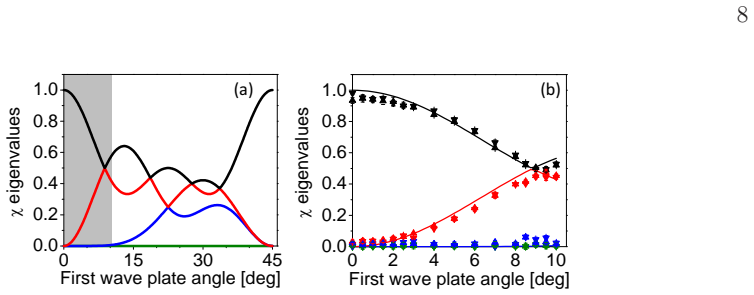
The central discovery is that the four-crystal birefringent scheme, previously used only as an isotropic depolarizer, actually spans almost the entire tetrahedron of unital qubit channels once polarization rotations are allowed. Setting $\theta_1 = \theta_3 = \theta_2/2$ makes the device approximate a dephasing channel with dephasing probability $P = \frac{-3\cos^4(4\theta_1)+2\cos^2(4\theta_1)+1}{2}$, tunable from no dephasing to complete dephasing as $\theta_1$ goes from 0 to about $9^\circ$. The approximation keeps the two smallest eigenvalues of the process matrix near zero, so the measured channel agrees with an ideal dephasing process to 97±2% average fidelity for both classical and quantum single-photon inputs, independent of the temporal envelope of the input light.
Load-bearing premise
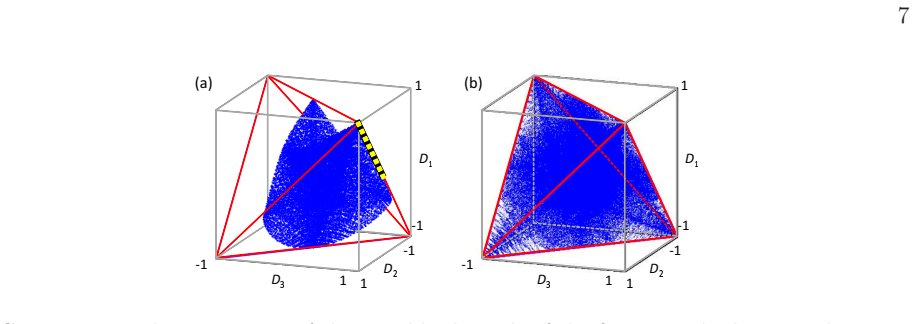
The claim that the device can emulate almost every unital channel rests on a numerical search over the three wave-plate angles, with no proof or stated sampling resolution that the search actually reveals the entire reachable set.
Editorial extensions
If this is right
- A single mode-locked optical path with three rotating wave plates can be reprogrammed to implement almost any unital qubit channel, so noise simulations need no longer be built channel-by-channel.
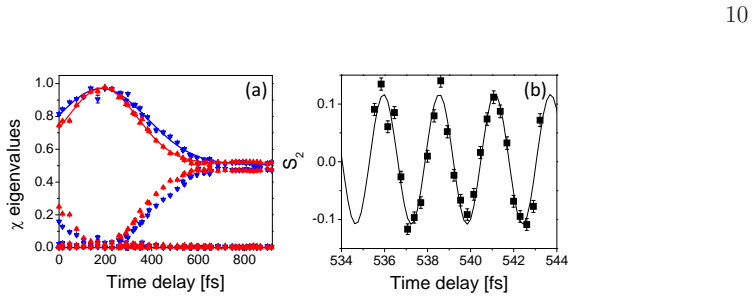
- The dephasing level is set by one angle and is known in advance, independent of the input wave-packet's coherence time, as long as the crystal delays are much longer than the coherence time.
- The same setup reproduces the dephasing process with a measured average fidelity of 97±2% for classical and quantum single-photon states, and the theoretical process fidelity is at least 99.6%.
- The scheme can be applied to bright classical light of short coherence time, acting as a programmable depolarizer, and birefringent fibers can substitute for crystals when input coherence times are longer.
Reading between the lines
- If the reachable set really fills the tetrahedron, the three wave-plate angles give a three-knob laboratory parameterization of the entire unital qubit channel space; this could be used to map channel capacities or the entanglement-breaking boundary continuously.
- The numerical coverage claim could be sharpened by an algebraic analysis of Eqs. (8)–(10): if the uncovered regions are measure-zero, 'almost every' could become 'all but a set of measure zero,' and if they are finite, the claim would need revision.
- A direct experimental map of the reachable set, obtained by performing quantum process tomography on a dense grid of angle settings, would turn the visual evidence of Fig. 2(b) into a quantitative coverage map—this is a natural follow-up the paper does not report.
- Because the scheme's action is independent of wavelength and fine temporal structure, the same crystal stack could serve as a calibration source for testing quantum error-correcting codes under a chosen unital noise model.
Signed reviews
Editorial analysis
A structured set of objections, weighed in public.
Referee Report
Summary. The manuscript proposes that a sequence of four birefringent crystals with three tunable half-wave plates can act as a controllable unital quantum channel on polarization qubits. It derives the channel's three diagonal Pauli-transfer coefficients as functions of the wave-plate angles (Eqs. (8)-(10)), numerically plots the reachable set in the tetrahedron of unital channels, and claims that, together with polarization rotations, the scheme emulates "almost every" unital qubit channel. The experimental part implements the scheme as an approximate dephasing channel with θ1=θ3=θ2/2, measures process matrices by quantum process tomography for both single-detector ("classical") and coincidence ("quantum") single-photon wave-packets, and reports good agreement with the model-derived theory, including wave-packet independence. An appendix compares the two wave-packet types using a Soleil-Babinet compensator to demonstrate their differing coherence times.
Significance. The dephasing experiment is careful and well characterized: the theoretical curve is parameter-free, the errors are obtained from Monte Carlo simulations, and the comparison between two temporal wave-packet types directly tests the decoherence mechanism in Eq. (7). If the universality claim were rigorously established, the device would be a simple and versatile tool for photonic quantum information. As it stands, however, the rigorously demonstrated contribution is a controllable approximate dephasing channel; the universal-unital-channel claim is not supported to the standard promised by the title and abstract.
major comments (4)
- [Section IV, Eqs. (8)-(10) and Fig. 2(b)] A general unital qubit channel is specified by the 3x3 real matrix D in Eq. (4), which contains three singular values plus six rotation parameters. The numerical scan tracks only the tuple {D1,D2,D3} after "ignoring rotations," and Fig. 2(b) extends the reachable set only by cyclic permutations and sign flips of the Di values, which form a finite group. The paper does not show that these operations, or the wave-plates placed after the scheme, can generate the two orthogonal factors of an arbitrary D. Consequently the statement "almost every complete positive unital qubit map can be implemented" is not established. At most, the data support a claim about channels up to orthogonal equivalence, or about a subset with fixed orientation. Please provide a rigorous characterization of the accessible D matrices, including both pre- and post-rotations, or revise the universality claim accordingly.
- [Section IV, Fig. 2(a) and Fig. 2(b)] The numerical search that underlies the "almost every" claim is not described: the manuscript gives no grid resolution, no sampling method, and no coverage fraction. The conclusion is supported only by visual inspection of a scatter plot. Please quantify the covered fraction of the tetrahedron for a stated tolerance, or provide an analytic reachability proof; otherwise the claim should be weakened to a demonstrated subset of unital channels.
- [Section IV, dephasing approximation paragraph] The assertion that "it can be proved that there is no solution to Eqs. (8)-(10)" preserving one Di = 1 while the other two have absolute values in (0,1) is stated without proof. This non-attainability is load-bearing because it justifies treating the device as only an approximate dephasing channel and restricts the usable range to θ1 ≤ 9°. Please supply the proof or a precise reference.
- [Section IV, fidelity statement] The reported 97±2% average fidelity is computed "neglecting channel rotations," although the text states that the implemented process flips the signs of S2 and S3. Comparing against an ideal dephasing channel without those sign flips is a weaker test and does not verify the actual predicted process. Please report the fidelity against the full predicted process, either including the sign flips or after applying the compensating fixed HWP, and state explicitly which target was used.
minor comments (4)
- [References [17] and main text near Eq. (4)] The name "Jamio/suppress lkowski" appears to be a rendering artifact; it should read "Jamiołkowski."
- [Fig. 2] The figure would be more informative with a statement of the number of sampled angle combinations and a color or density scale indicating how densely each region of the tetrahedron is covered.
- [Abstract and Conclusions] The abstract and conclusions repeat the universal-unital-channel claim without mentioning that only the dephasing case was experimentally demonstrated; a caveat would make the scope of the experimental evidence clearer.
- [Section IV, polarization-rotation discussion] The phrase "all allowed polarization rotations" is ambiguous: the text first describes two discrete transformations (cyclic permutations and sign flips) but the surrounding discussion implies a continuous set of rotations. Please clarify which set of rotations is meant and how it is physically implemented.
Circularity Check
No significant circularity: the theoretical dephasing curves are derived from the device model without fitting, and the universality claim is a coverage overclaim rather than a circular reduction.
full rationale
The paper's theoretical predictions, including the dephasing probability P = 1 - χm in Eq. (12), are derived directly from the model equations Eqs. (8)-(10) with the HWP angle θ1 as an input. The experimental QPT results in Fig. 3(b) are compared to these calculated curves without fitting free parameters. The claim that the four-crystal scheme can emulate almost every unital channel is supported by a numerical evaluation of the reachable region using Eqs. (8)-(10) and Fig. 2, not by fitting to the experimental data; the numerical scan being unsupported as a proof of coverage is a correctness or rigor concern, not a circularity. The paper's citations to prior work by the same authors [15, 23, 24] provide the device model and QPT procedure, but the relevant equations are restated and used as an independent model, and no uniqueness theorem or fitted parameter is imported as a substitute for derivation. The statement 'neglecting channel rotations' in computing fidelity is a weaker comparison test, but it does not make the prediction equal to the input by construction. Therefore no circular step is identifiable under the criteria requiring a specific reduction by definition or by self-citation chain.
Assumptions & free parameters
assumptions (3)
- domain assumption The input photon coherence time is much shorter than the temporal delays between the discrete polarization modes, so the modes are non-overlapping and tracing them out yields the modeled decoherence (Eq. 7: LΔn/c >> τ).
- ad hoc to paper The numerical search over the three HWP angles (Eqs. (8)-(10)) provides an exhaustive map of the reachable unital channels, so the visual coverage in Fig. 2(b) supports the 'almost every' claim.
- domain assumption The evolution through each crystal can be treated as a unitary polarization-dependent time delay, and the only decoherence mechanism is the trace over temporal modes; spatial and spectral effects are negligible.
Cite this review
Pith. "Pith review of Implementation of controllable universal unital optical channels." pith.science (2026). https://pith.science/paper/JPMTQBFF
@misc{pith2026190806341,
  author       = {Pith},
  title        = {Pith review of: Implementation of controllable universal unital optical channels},
  year         = {2026},
  howpublished = {\url{https://pith.science/paper/JPMTQBFF}},
  note         = {Machine review of arXiv:1908.06341}
}
read the original abstract
We show that a configuration of four birefringent crystals and wave-plates can emulate almost any arbitrary unital channel for polarization qubits encoded in single photons, where the channel settings are controlled by the wave-plate angles. The scheme is applied to a single spatial mode and its operation is independent of the wavelength and the fine temporal properties of the input light. We implemented the scheme and demonstrated its operation by applying a dephasing environment to classical and quantum single-photon states with different temporal properties. The applied process was characterized by a quantum process tomography procedure, and a high fidelity to the theory was observed.
Figures

Figures from the paper (1 more)
Reference graph
Works this paper leans on
-
[1]
M. A. Nielsen and I. L. Chuang, Quantum Computation and Quantum Information (Cam- bridge University, Cambridge, U.K., 2000)
work page 2000
-
[2]
Distributed quantum computation over noisy channels,
J. I. Cirac, A. K. Ekert, S. F. Huelga, and C. Macchiavello, “Distributed quantum computation over noisy channels,” Phys. Rev. A 59(6), 4249-4254 (1999)
work page 1999
-
[3]
J. l. O’Brien, A. Furusawa, and J. Vuˇ ckovi´ c, “Photonicquantum technologies,” Nature Photon. 3, 687-695 (2009)
work page 2009
-
[4]
Expe rimental observation of univer- sality in depolarized light scattering,
G. Puentes, D. Voigt, A. Aiello, and J. P. Woerdman, “Expe rimental observation of univer- sality in depolarized light scattering,” Opt. Lett. 30, 3216-3218 (2005)
work page 2005
-
[5]
Experimental purification of single qubits,
M. Ricci, F. De Martini, N. J. Cerf, R. Filip, J. Fiur´ aˇ sek, and C. Macchiavello, “Experimental purification of single qubits,” Phys. Rev. Lett. 93, 170501 (2004)
work page 2004
-
[6]
Experimental realization of optimal noise esti mation for a general Pauli channel,
A. Chiuri, V. Rosati, G. Vallone, S. P´ adua, H. Imai, S. Gi acomini, C. Macchiavello, and P. Mataloni, “Experimental realization of optimal noise esti mation for a general Pauli channel,” Phys. Rev. Lett. 107, 253602 (2011)
work page 2011
-
[7]
Fiber-op tic realization of anisotropic depo- larizing quantum channels,
M. Karpi´ nski, C. Radzewicz, and K. Banaszek, “Fiber-op tic realization of anisotropic depo- larizing quantum channels,” J. Opt. Soc. Am. B 25(4), 668-673 (2008)
work page 2008
-
[8]
Experimental verification of decoherence-free subspaces,
P. G. Kwiat, A. J. Berglund, J. B. Altepeter, and A. G. Whit e, “Experimental verification of decoherence-free subspaces,” Science 290, 498-501 (2000)
work page 2000
Show all 25 references
-
[9]
Experimental character- ization of entanglement dynamics in noisy channels,
J.-S. Xu, C.-F. Li, X.-Y. Xu, C.-H. Shi, X.-B. Zou, and G.- C. Guo, “Experimental character- ization of entanglement dynamics in noisy channels,” Phys. Rev. Lett. 103, 240502 (2009)
2009
-
[10]
Experimental control of the transition from Markovian to n on-Markovian dynamics of open quantum systems
B.-H. Liu, L. Li, Y.-F. Huang, C.-F. Li, G.-Can Guo, E.-M . Laine, H.-P. Breuer, and J. Piilo, “Experimental control of the transition from Markovian to n on-Markovian dynamics of open quantum systems” Nature Physics 7, 931934 (2011)
2011
-
[11]
Experimental four-qubi t bound entanglement,
E. Amselem and M. Bourennane, “Experimental four-qubi t bound entanglement,” Nature Phys. 5, 748-752 (2009)
2009
-
[12]
Prepa ration of pure and mixed polarization qubits and the direct measurement of figures of merit,
R. B. A. Adamson, L. K. Shalm, and A. M. Steinberg, “Prepa ration of pure and mixed polarization qubits and the direct measurement of figures of merit,” Phys. Rev. A 75, 012104 (2007)
2007
-
[13]
Environment-induced sudden death of entan glement,
M. P. Almeida, F. de Melo, M. Hor-Meyll, A. Salles, S. P. W alborn, P. H. S. Ribeiro, and L. Davidovich, “Environment-induced sudden death of entan glement,” Science 316, 579-582 (2007)
2007
-
[14]
D. F. Urrego, J.-R. ´Alvarez, O. Calder´ on-Losada, J. Svozil´ ık, M. Nu˜ nez, andA. Valencia, ”Implementation and characterization of a controllable de phasing channel based on coupling polarization and spatial degrees of freedom of light,” Opt. Express 26, 11940-11949 (2018)
2018
-
[15]
Realizing a variable isotropic depolarizer,
A. Shaham and H. S. Eisenberg, “Realizing a variable isotropic depolarizer,” Opt. Lett. 37(13), 2643-2645 (2012)
2012
-
[16]
Prescription for experi mental determination of the dynamics of a quantum black box,
I. L. Chuang and M. A. Nielsen, “Prescription for experi mental determination of the dynamics of a quantum black box,” J. Mod. Opt. 44(11-12), 2455-2467 (1997). 12
1997
-
[17]
Linear transformations which preserve trace and positive semidefiniteness of operators,
A. Jamio/suppress lkowski, “Linear transformations which preserve trace and positive semidefiniteness of operators,” Rep. Math. Phys. 3(4), 275-278 (1972)
1972
-
[18]
Information-theoreti c aspects of inseparability of mixed states,
M. Horodecki and R. Horodecki, “Information-theoreti c aspects of inseparability of mixed states,” Phys. Rev. A 54(3), 1838-1843 (1996)
1996
-
[19]
Minimal entropy of states emerging from noisy quantum channels,
C. King and M. B. Ruskai, “Minimal entropy of states emerging from noisy quantum channels,” IEEE Trans. Inf. Theory 47(1), 192-209 (2001)
2001
-
[20]
M easurement of qubits,
D. F. V. James, P. G. Kwiat, W. J. Munro, and A. G. White, “M easurement of qubits,” Phys. Rev. A 64, 052312 (2001)
2001
-
[21]
Simult aneous measurement of group and phase delay between two photons,
D. Branning, A. L. Migdall, and A. V. Sergienko, “Simult aneous measurement of group and phase delay between two photons,” Phys. Rev. A 62, 063808 (2000)
2000
-
[22]
Photonic s tate tomography,
J. B. Altepeter, E. R. Jeffrey, and P. G. Kwiat, “Photonic s tate tomography,” Adv. At. Mol. Opt. Phys. 52, 105-159 (2005)
2005
-
[23]
Quantum process tomogra phy of single-photon quantum channels with controllable decoherence,
A. Shaham and H. S. Eisenberg, “Quantum process tomogra phy of single-photon quantum channels with controllable decoherence,” Phys. Scr. T 147 , 014029 (2012)
2012
-
[24]
Realizing controllable depolarization in photonic quantum- information channels,
A. Shaham and H. S. Eisenberg, “Realizing controllable depolarization in photonic quantum- information channels,” Phys. Rev. A 83, 022303 (2011)
2011
-
[25]
Fidelity for mixed quantum states,
R. Jozsa, “Fidelity for mixed quantum states,” J. Mod. O pt. 41, 2315-2323 (1994)
1994
Reviewed August 14, 2026 · model on record in the stance chip above.
Discussion (0). Continue with ORCID to comment.