REVIEW 5 major objections 5 minor 48 references
FlexiCrackNet: A Flexible Pipeline for Enhanced Crack Segmentation with General Features Transfered from SAM
T0 review · 5 major / 5 minor · reviewed 2026-08-09 · deepseek-v4-flash
Pith's one-line read FlexiCrackNet claims that a frozen EdgeSAM encoder, fused into a U-Net through gated attention, beats twelve crack-segmentation methods on DeepCrack and transfers zero-shot to CFD and Crack500 while using fewer parameters and less…
desk verdict Solid engineering result with a good zero-shot protocol, but the paper's story that frozen SAM features are the magic ingredient is not backed by its own ablation—review it, but push for the missing baselines. read the letter →
The pith
A machine-rendered reading of the paper's core claim, the machinery that carries it, and where it could break.
The reading
What carries the argument
The load-bearing mechanism is IGAM, the information-interaction gated attention mechanism. At each of five encoder stages, the crack-specific feature map from the U-Net branch and the corresponding generic feature map from the frozen EdgeSAM encoder are resized and channel-aligned by a scaling module, concatenated, and passed through an information interaction module that emits two attention masks: one that selects meaningful regions in the general features and one that enhances relevant details in the crack features. The masked maps are added together and combined with a residual connection that preserves the original crack-specific features. IGAM's job is to let the decoder use the generic prior without letting non-crack textures and semantics from the general encoder contaminate the segmentation.
What would settle it
Run the same DeepCrack training at 512x512 with a fine-tuned SAM-Adapter or fine-tuned EdgeSAM and evaluate zero-shot on CFD; if that baseline reaches or exceeds FlexiCrackNet's reported F1 of 54.48, the claim that frozen encoder features are the better transfer path would be contradicted.
Extended reading notes
Core claim
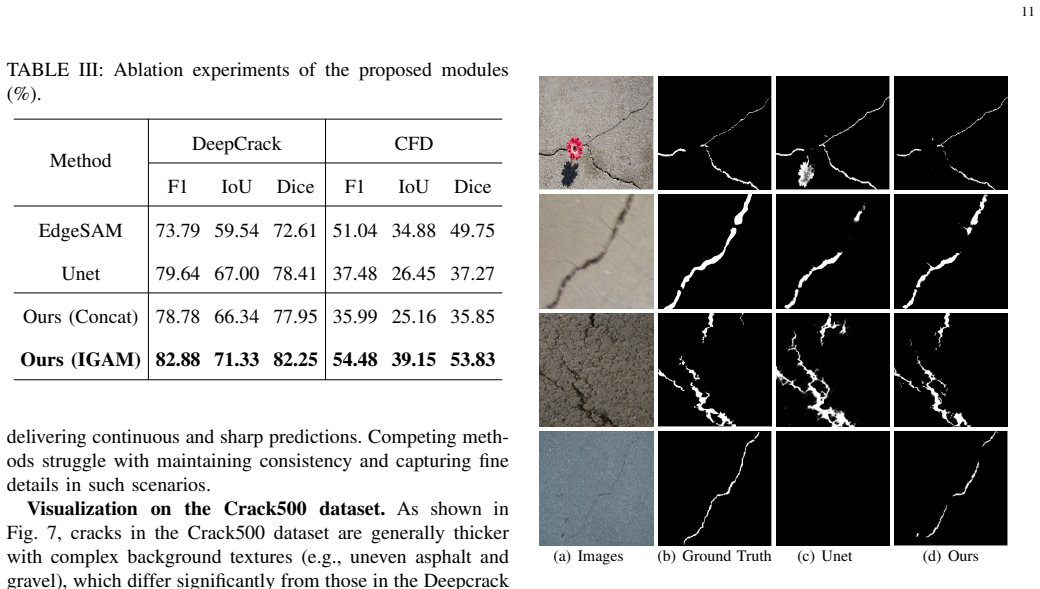
The paper's central claim is that task-agnostic features extracted by EdgeSAM's frozen CNN encoder, never fine-tuned on cracks, are a better prior for crack segmentation than training an encoder from scratch or adapting SAM at its fixed resolution. On the DeepCrack test set, FlexiCrackNet reports F1 82.88, IoU 71.33, and Dice 82.25, surpassing CrackMamba by 1.47, 2.56, and 2.00 points. On zero-shot evaluation over the CFD dataset it reports F1 54.48, IoU 39.15, and Dice 53.83, surpassing CrackMamba by 4.50, 4.75, and 4.58 points, and on zero-shot Crack500 validation it reports F1 56.85 versus CMTFNet's 48.76. The ablation attributes the gain to the IGAM fusion: replacing IGAM with plain concatenation drops F1 from 82.88 to 78.78 on DeepCrack and from 54.48 to 35.99 on CFD, while the bare U-Net baseline sits at 79.64 and 37.48. The pipeline also reports 25.63M parameters and 22.09 ms inference time, compared with CrackMamba's 75.95M parameters and 84.73 ms.
Load-bearing premise
The load-bearing premise is that the frozen EdgeSAM encoder's generic features, extracted without any crack-specific fine-tuning, are a better and more transferable source of visual prior for cracks than features from models trained or fine-tuned on crack data; the paper's evidence for this is its own reported experiments, and it does not include a direct fine-tuned-SAM comparison to test it.
Editorial extensions
If this is right
- On the three benchmark settings the paper tests, DeepCrack supervised plus CFD and Crack500 zero-shot, FlexiCrackNet reports the highest F1, IoU, and Dice among the twelve compared methods.
- Because only EdgeSAM's CNN encoder is used and its transformer decoder is dropped, the 1024x1024 input constraint of EdgeSAM no longer applies to the pipeline, which is what the paper calls flexible input resolution.
- The model is smaller and faster than the leading crack-specific baseline, with 25.63M parameters and 22.09 ms inference versus 75.95M and 84.73 ms for CrackMamba, while reporting higher accuracy on both tested domains.
- The IGAM ablation indicates that how generic features are fused matters: naive concatenation can hurt performance, while the gated attention recovers and exceeds the U-Net baseline.
Reading between the lines
- Not tested in the paper: a direct comparison against an actual fine-tuned SAM baseline such as SAM-Adapter. If frozen features match or beat fine-tuning under the same schedule, the no-fine-tuning transfer route would be established; without that comparison, the advantage over the pre-training-plus-fine-tuning paradigm is inferred rather than demonstrated.
- Not tested in the paper: input sizes other than 512x512. The claimed arbitrary-resolution flexibility follows from removing EdgeSAM's decoder, but all experiments resize inputs to 512x512, so a resolution sweep would be needed to confirm the design claim.
- The fusion mechanism is domain-agnostic, so the same frozen-encoder-plus-gated-fusion recipe could plausibly transfer to other fine-grained segmentation tasks with small datasets, such as medical or industrial defect segmentation; the paper gestures at this broader applicability in its conclusion but does not test it.
Editorial analysis
A structured set of objections, weighed in public.
Referee Report
Summary. The paper proposes FlexiCrackNet, a crack segmentation pipeline built on a U-Net encoder-decoder augmented with a frozen EdgeSAM encoder used as a generic feature extractor. The two feature streams are fused at five encoder stages by an information-interaction gated attention mechanism (IGAM) that generates attention masks for both general and crack-specific features, with a residual connection preserving the crack-specific stream. Training uses a combination of BCE and Dice losses. The method is evaluated on the DeepCrack training/test split and in a zero-shot protocol on the CFD and Crack500 datasets, comparing against twelve baselines and reporting F1, IoU, Dice, parameters, inference time, and GFLOPs. The authors report state-of-the-art results on DeepCrack and large zero-shot gains on CFD and Crack500, and claim flexibility with respect to input resolution and computational efficiency.
Significance. If the claims are confirmed, FlexiCrackNet would be a practically useful way to inject foundation-model priors into crack segmentation while avoiding the overhead of full SAM fine-tuning. The evaluation protocol is sound in its use of genuinely held-out datasets for zero-shot assessment, and the reported improvements are consistent across three datasets and multiple baselines. The authors also make the efficiency comparison transparent by reporting parameters, inference time, and GFLOPs. However, the central mechanistic claim that frozen EdgeSAM features are the source of the improvement is not isolated by the experiments, and the arbitrary-resolution claim is not tested. The lack of code release and single-run results additionally limit verification. The work is a reasonable engineering contribution, but the evidence currently supports a more modest claim than the one made in the abstract.
major comments (5)
- [§IV-F, Table III] The central claim that frozen EdgeSAM general features drive the improvement is not isolated. In Table III, replacing IGAM with plain concatenation ('Ours (Concat)') yields DeepCrack F1 78.78, below the U-Net baseline's 79.64, so the frozen EdgeSAM features are not helpful on their own; only the learned IGAM restores performance. Since Table I shows that Ours uses 25.63M parameters and 196.18 GFLOPs versus U-Net's 18.64M parameters and 101.99 GFLOPs, the +3.24 F1 gain over U-Net could plausibly come from added capacity and compute rather than from general feature transfer. A capacity-matched U-Net with comparable parameters and FLOPs should be evaluated to separate these effects.
- [§II-B, §IV-D] The paper argues that the proposed paradigm is preferable to the 'pre-training + fine-tuning' approach for SAM, but no SAM fine-tuning baseline is compared. SAM-Adapter is cited in Section II-B, and Zhou et al. [23] is described as adapting SAM for road crack segmentation, yet neither a SAM-Adapter nor a fine-tuned EdgeSAM variant appears in Tables I or II. Without such a comparison, the claimed advantage over the fine-tuning paradigm is unsubstantiated.
- [§I, §III-B, §IV-A] The claim of flexibility to 'diverse input resolutions' and 'arbitrary sizes' is not experimentally supported. Section IV-A states that all input images are resized to 512×512 pixels, and all experiments in Tables I and II use that resolution. No experiment varies the input resolution, so the decoupling of EdgeSAM from its fixed 1024×1024 input is demonstrated only architecturally, not empirically.
- [§IV-D, Tables I and II] All reported results are from single runs with no error bars or statistical significance tests. Some of the headline margins are small, for example 1.47 F1 over CrackMamba on DeepCrack and 2.45 F1 over CrackMamba on the Crack500 test set, so it is unclear whether these differences are robust to training variance. Reporting mean and standard deviation over at least three runs, or providing significance tests, would strengthen the central claim.
- [§IV-D, 'Efficiency comparison'] The statement that the method introduces only 'minimal additional computational cost' is misleading when compared to the U-Net baseline. Table I shows inference time increases from 4.59 ms for U-Net to 22.09 ms for FlexiCrackNet, and GFLOPs increase from 101.99 to 196.18. The efficiency advantage is real only relative to heavier transformer-based or SAM-based models such as CrackMamba; the comparison against the from-scratch U-Net should be stated more carefully.
minor comments (5)
- [Title] The word 'Transfered' in the title should be spelled 'Transferred'.
- [§IV-B] The dataset referred to as 'Cityforest' is commonly known as the Crack Forest Dataset (CFD); the name should be corrected for consistency with the literature.
- [Fig. 7] The figure caption lists EMCAD twice, as both (c) and (e); the second instance appears to be a typo.
- [References] There are two different DeepCrack references, [38] and [46], with different authors and years; the in-text citations should disambiguate which work is the dataset and which is the segmentation method.
- [§IV-A] The experimental configuration states that all models use 'a fixed loss function', but the paper does not specify whether this is the same BCE+Dice loss for all baselines or each baseline's original loss; clarifying this would strengthen the fairness of the comparison.
Circularity Check
No significant circularity: the zero-shot evaluations are genuinely held out and the frozen EdgeSAM features are externally pre-trained, so no fitted parameter or self-citation chain is equivalent to the claimed results.
full rationale
FlexiCrackNet's central claim is that frozen EdgeSAM encoder features, fused through a learned gating module, improve crack segmentation and zero-shot generalization. The derivation chain is experimentally grounded rather than circular. The model is trained only on the DeepCrack training split and evaluated on the DeepCrack test split, the full CFD dataset, and Crack500, none of which are used to fit any parameter of the proposed pipeline. The frozen EdgeSAM encoder is pre-trained externally (SAM/EdgeSAM) and is not fine-tuned on the target datasets, so the general-feature premise is an external input rather than a definitional restatement of the reported metrics. The ablation in Table III compares U-Net, EdgeSAM, concatenation, and IGAM; the fact that simple concatenation performs below the U-Net baseline does not indicate circularity, only that the learned fusion is necessary for the reported gains. The only apparent self-citation is reference [31] (TV-Net, which includes author X. Jiang) in the related-work discussion of encoder-decoder frameworks; it is peripheral and not load-bearing for the method's novelty or the reported numbers. Some claims, such as adaptability to arbitrary input resolutions, are unsupported because all experiments use 512x512 inputs, and the efficiency claim is weakened by the model's roughly doubled GFLOPs relative to the U-Net baseline, but those are support or correctness gaps, not circularity. No equation, fitted parameter, or self-citation chain is equivalent by construction to the claimed results, so the paper receives a low circularity score.
Assumptions & free parameters
free parameters (5)
- Initial learning rate =
0.0003
- Batch size =
2
- Number of epochs =
100
- Input resolution =
512x512
- Loss weights =
BCE and Dice with equal weight
assumptions (3)
- domain assumption Frozen CNN encoders pre-trained on large datasets provide transferable features for downstream tasks.
- domain assumption The EdgeSAM encoder's multi-scale feature maps remain meaningful at the 512x512 input resolution used in all experiments.
- standard math BCE plus Dice loss is an effective objective for crack segmentation.
invented entities (2)
-
Information-interaction gated attention mechanism (IGAM)
-
Information interaction module (IIM)
Cite this review
Pith. "Pith review of FlexiCrackNet: A Flexible Pipeline for Enhanced Crack Segmentation with General Features Transfered from SAM." pith.science (2026). https://pith.science/paper/JPPTVJCS
@misc{pith2026250118855,
  author       = {Pith},
  title        = {Pith review of: FlexiCrackNet: A Flexible Pipeline for Enhanced Crack Segmentation with General Features Transfered from SAM},
  year         = {2026},
  howpublished = {\url{https://pith.science/paper/JPPTVJCS}},
  note         = {Machine review of arXiv:2501.18855}
}
read the original abstract
Automatic crack segmentation is a cornerstone technology for intelligent visual perception modules in road safety maintenance and structural integrity systems. Existing deep learning models and ``pre-training + fine-tuning'' paradigms often face challenges of limited adaptability in resource-constrained environments and inadequate scalability across diverse data domains. To overcome these limitations, we propose FlexiCrackNet, a novel pipeline that seamlessly integrates traditional deep learning paradigms with the strengths of large-scale pre-trained models. At its core, FlexiCrackNet employs an encoder-decoder architecture to extract task-specific features. The lightweight EdgeSAM's CNN-based encoder is exclusively used as a generic feature extractor, decoupled from the fixed input size requirements of EdgeSAM. To harmonize general and domain-specific features, we introduce the information-Interaction gated attention mechanism (IGAM), which adaptively fuses multi-level features to enhance segmentation performance while mitigating irrelevant noise. This design enables the efficient transfer of general knowledge to crack segmentation tasks while ensuring adaptability to diverse input resolutions and resource-constrained environments. Experiments show that FlexiCrackNet outperforms state-of-the-art methods, excels in zero-shot generalization, computational efficiency, and segmentation robustness under challenging scenarios such as blurry inputs, complex backgrounds, and visually ambiguous artifacts. These advancements underscore the potential of FlexiCrackNet for real-world applications in automated crack detection and comprehensive structural health monitoring systems.
Figures


Figures from the paper (6 more)


Reference graph
Works this paper leans on
-
[23]
W. Zhou, H. Huang, H. Zhang, and C. Wang, “Teaching segment- anything-model domain-specific knowledge for road crack segmentation from on-board cameras,” IEEE Transactions on Intelligent Transporta- tion Systems, vol. 25, no. 12, pp. 20 588–20 601, 2024
work page 2024
-
[1]
Automation in road distress detection, diagnosis and treatment,
X. Yang, J. Zhang, W. Liu, J. Jing, H. Zheng, and W. Xu, “Automation in road distress detection, diagnosis and treatment,” Journal of Road Engineering, vol. 4, no. 1, pp. 1–26, 2024
work page 2024
-
[2]
A universal multi-view guided network for salient object and camouflaged object detection,
X. Song, P. Zhang, X. Lu, X. Hei, and R. Liu, “A universal multi-view guided network for salient object and camouflaged object detection,” IEEE Transactions on Circuits and Systems for Video Technology , vol. 34, no. 11, pp. 11 184–11 197, 2024
work page 2024
-
[3]
Computer vision frame- work for crack detection of civil infrastructure—a review,
D. Ai, G. Jiang, S.-K. Lam, P. He, and C. Li, “Computer vision frame- work for crack detection of civil infrastructure—a review,” Engineering Applications of Artificial Intelligence , vol. 117, p. 105478, 2023
work page 2023
-
[4]
Erdunet: An efficient residual double- coding unet for medical image segmentation,
H. Li, D.-H. Zhai, and Y . Xia, “Erdunet: An efficient residual double- coding unet for medical image segmentation,” IEEE Transactions on Circuits and Systems for Video Technology , vol. 34, no. 4, pp. 2083– 2096, 2024
work page 2024
-
[5]
Pixel dif- ference convolutional network for rgb-d semantic segmentation,
J. Yang, L. Bai, Y . Sun, C. Tian, M. Mao, and G. Wang, “Pixel dif- ference convolutional network for rgb-d semantic segmentation,” IEEE Transactions on Circuits and Systems for Video Technology , vol. 34, no. 3, pp. 1481–1492, 2024
work page 2024
-
[6]
Boosting salient object detection with transformer-based asymmetric bilateral u-net,
Y . Qiu, Y . Liu, L. Zhang, H. Lu, and J. Xu, “Boosting salient object detection with transformer-based asymmetric bilateral u-net,” IEEE Transactions on Circuits and Systems for Video Technology , vol. 34, no. 4, pp. 2332–2345, 2024
work page 2024
-
[7]
Z. Zhou, J. Zhang, and C. Gong, “Hybrid semantic segmentation for tunnel lining cracks based on swin transformer and convolutional neural network,” Computer-Aided Civil and Infrastructure Engineering, vol. 38, no. 17, pp. 2491–2510, 2023
work page 2023
Show all 48 references
-
[8]
Ctif-net: A cnn- transformer iterative fusion network for salient object detection,
J. Yuan, A. Zhu, Q. Xu, K. Wattanachote, and Y . Gong, “Ctif-net: A cnn- transformer iterative fusion network for salient object detection,” IEEE Transactions on Circuits and Systems for Video Technology , vol. 34, no. 5, pp. 3795–3805, 2024
2024
-
[9]
Small sample image segmen- tation by coupling convolutions and transformers,
H. Qi, H. Zhou, J. Dong, and X. Dong, “Small sample image segmen- tation by coupling convolutions and transformers,” IEEE Transactions on Circuits and Systems for Video Technology, vol. 34, no. 7, pp. 5282– 5294, 2024
2024
-
[10]
Ghostformer: Efficiently amal- gamated cnn-transformer architecture for object detection,
X. Xie, D. Wu, M. Xie, and Z. Li, “Ghostformer: Efficiently amal- gamated cnn-transformer architecture for object detection,” Pattern Recognition, vol. 148, p. 110172, 2024
2024
-
[11]
Long-short range adaptive transformer with dynamic sampling for 3d object detec- tion,
C. Wang, J. Deng, J. He, T. Zhang, Z. Zhang, and Y . Zhang, “Long-short range adaptive transformer with dynamic sampling for 3d object detec- tion,” IEEE Transactions on Circuits and Systems for Video Technology, vol. 33, no. 12, pp. 7616–7629, 2023
2023
-
[12]
A state-of-the- art survey of deep learning models for automated pavement crack segmentation,
H. Gong, L. Liu, H. Liang, Y . Zhou, and L. Cong, “A state-of-the- art survey of deep learning models for automated pavement crack segmentation,” International Journal of Transportation Science and Technology, vol. 13, pp. 44–57, 2024
2024
-
[13]
Automatic concrete defect detection and reconstruction by aligning aerial images onto semantic-rich building information model,
J. Chen, W. Lu, and J. Lou, “Automatic concrete defect detection and reconstruction by aligning aerial images onto semantic-rich building information model,” Computer-Aided Civil and Infrastructure Engineer- ing, vol. 38, no. 8, pp. 1079–1098, 2023
2023
-
[14]
Data augmentation in classification and segmentation: A survey and new strategies,
K. Alomar, H. I. Aysel, and X. Cai, “Data augmentation in classification and segmentation: A survey and new strategies,” Journal of Imaging , vol. 9, no. 2, p. 46, 2023
2023
-
[15]
Understanding and combating robust overfitting via input loss landscape analysis and regularization,
L. Li and M. Spratling, “Understanding and combating robust overfitting via input loss landscape analysis and regularization,” Pattern Recogni- tion, vol. 136, p. 109229, 2023
2023
-
[16]
Gpt-3: What’s it good for?
R. Dale, “Gpt-3: What’s it good for?” Natural Language Engineering , vol. 27, no. 1, pp. 113–118, 2021
2021
-
[17]
Learning transferable visual models from natural language supervision,
A. Radford, J. W. Kim, C. Hallacy, A. Ramesh, G. Goh, S. Agarwal, G. Sastry, A. Askell, P. Mishkin, J. Clark et al., “Learning transferable visual models from natural language supervision,” in International conference on machine learning (ICML) , 2021, pp. 8748–8763
2021
-
[18]
Segment anything,
A. Kirillov, E. Mintun, N. Ravi, H. Mao, C. Rolland, L. Gustafson, T. Xiao, S. Whitehead, A. C. Berg, W.-Y . Loet al., “Segment anything,” in Proceedings of the IEEE/CVF International Conference on Computer Vision (ICCV), 2023, pp. 4015–4026
2023
-
[19]
Detect any shadow: Segment anything for video shadow detection,
Y . Wang, W. Zhou, Y . Mao, and H. Li, “Detect any shadow: Segment anything for video shadow detection,” IEEE Transactions on Circuits and Systems for Video Technology, vol. 34, no. 5, pp. 3782–3794, 2024
2024
-
[20]
Sam-adapter: Adapting segment anything in underperformed scenes,
T. Chen, L. Zhu, C. Deng, R. Cao, Y . Wang, S. Zhang, Z. Li, L. Sun, Y . Zang, and P. Mao, “Sam-adapter: Adapting segment anything in underperformed scenes,” in Proceedings of the IEEE/CVF International Conference on Computer Vision (ICCV) , 2023, pp. 3367–3375
2023
-
[21]
Segment anything model for medical image analysis: an experimental study,
M. A. Mazurowski, H. Dong, H. Gu, J. Yang, N. Konz, and Y . Zhang, “Segment anything model for medical image analysis: an experimental study,” Medical Image Analysis , vol. 89, p. 102918, 2023
2023
-
[22]
Segment and caption anything,
X. Huang, J. Wang, Y . Tang, Z. Zhang, H. Hu, J. Lu, L. Wang, and Z. Liu, “Segment and caption anything,” in Proceedings of the IEEE/CVF Conference on Computer Vision and Pattern Recognition (CVPR), 2024, pp. 13 405–13 417
2024
-
[24]
Edgesam: Prompt-in-the- loop distillation for on-device deployment of sam,
C. Zhou, X. Li, C. C. Loy, and B. Dai, “Edgesam: Prompt-in-the- loop distillation for on-device deployment of sam,” arXiv preprint arXiv:2312.06660, 2023
2023 arXiv
-
[25]
Ecsnet: An accelerated real-time image segmentation cnn architecture for pavement crack detection,
T. Zhang, D. Wang, and Y . Lu, “Ecsnet: An accelerated real-time image segmentation cnn architecture for pavement crack detection,” IEEE Transactions on Intelligent Transportation Systems , vol. 24, no. 12, pp. 15 105–15 112, 2023
2023
-
[26]
Crackvit: a unified cnn-transformer model for pixel-level crack extraction,
J. Quan, B. Ge, and M. Wang, “Crackvit: a unified cnn-transformer model for pixel-level crack extraction,” Neural Computing and Applica- tions, vol. 35, no. 15, pp. 10 957–10 973, 2023
2023
-
[27]
A hybrid deep learning pavement crack semantic segmen- tation,
Z. Al-Huda, B. Peng, R. N. A. Algburi, M. A. Al-antari, A.-J. Rabea, and D. Zhai, “A hybrid deep learning pavement crack semantic segmen- tation,” Engineering Applications of Artificial Intelligence , vol. 122, p. 106142, 2023
2023
-
[28]
Fully convolutional networks for semantic segmentation,
J. Long, E. Shelhamer, and T. Darrell, “Fully convolutional networks for semantic segmentation,” in Proceedings of the IEEE conference on computer vision and pattern recognition (CVPR) , 2015, pp. 3431–3440
2015
-
[29]
U-net: Convolutional networks for biomedical image segmentation,
O. Ronneberger, P. Fischer, and T. Brox, “U-net: Convolutional networks for biomedical image segmentation,” in in International Conference on Medical image computing and computer-assisted intervention (MIC- CAI), 2015, pp. 234–241
2015
-
[30]
Segnet: A deep con- volutional encoder-decoder architecture for image segmentation,
V . Badrinarayanan, A. Kendall, and R. Cipolla, “Segnet: A deep con- volutional encoder-decoder architecture for image segmentation,” IEEE transactions on pattern analysis and machine intelligence , vol. 39, no. 12, pp. 2481–2495, 2017
2017
-
[31]
Tv-net: A structure- level feature fusion network based on tensor voting for road crack segmentation,
W. Zheng, X. Jiang, Z. Fang, and Y . Gao, “Tv-net: A structure- level feature fusion network based on tensor voting for road crack segmentation,” IEEE Transactions on Intelligent Transportation Systems, vol. 25, no. 6, pp. 5743–5754, 2024
2024
-
[32]
A nested unet with attention mechanism for road crack image segmentation,
X. Fan, P. Cao, P. Shi, J. Wang, Y . Xin, and W. Huang, “A nested unet with attention mechanism for road crack image segmentation,” in 2021 IEEE 6th International Conference on Signal and Image Processing (ICSIP), 2021, pp. 189–193
2021
-
[33]
Vision transformers for dense prediction,
R. Ranftl, A. Bochkovskiy, and V . Koltun, “Vision transformers for dense prediction,” in Proceedings of the IEEE/CVF international conference on computer vision (ICCV) , 2021, pp. 12 179–12 188
2021
-
[34]
Segformer: Simple and efficient design for semantic segmentation with transformers,
E. Xie, W. Wang, Z. Yu, A. Anandkumar, J. M. Alvarez, and P. Luo, “Segformer: Simple and efficient design for semantic segmentation with transformers,” Advances in neural information processing systems , vol. 34, pp. 12 077–12 090, 2021
2021
-
[35]
Vision transformer-based autonomous crack detection on asphalt and concrete surfaces,
E. A. Shamsabadi, C. Xu, A. S. Rao, T. Nguyen, T. Ngo, and D. Dias-da Costa, “Vision transformer-based autonomous crack detection on asphalt and concrete surfaces,” Automation in Construction, vol. 140, p. 104316, 2022
2022
-
[36]
A convolutional-transformer network for crack segmentation with boundary awareness,
H. Tao, B. Liu, J. Cui, and H. Zhang, “A convolutional-transformer network for crack segmentation with boundary awareness,” in2023 IEEE International Conference on Image Processing (ICIP) , 2023, pp. 86–90
2023
-
[37]
Parameter-efficient transfer 13 learning for nlp,
N. Houlsby, A. Giurgiu, S. Jastrzebski, B. Morrone, Q. De Laroussilhe, A. Gesmundo, M. Attariyan, and S. Gelly, “Parameter-efficient transfer 13 learning for nlp,” in International conference on machine learning (ICML), 2019, pp. 2790–2799
2019
-
[38]
Deepcrack: A deep hierarchical feature learning architecture for crack segmentation,
Y . Liu, J. Yao, X. Lu, R. Xie, and L. Li, “Deepcrack: A deep hierarchical feature learning architecture for crack segmentation,” Neurocomputing, vol. 338, pp. 139–153, 2019
2019
-
[39]
Automatic road crack detection using random structured forests,
Y . Shi, L. Cui, Z. Qi, F. Meng, and Z. Chen, “Automatic road crack detection using random structured forests,” IEEE Transactions on Intel- ligent Transportation Systems, vol. 17, no. 12, pp. 3434–3445, 2016
2016
-
[40]
Feature pyramid and hierarchical boosting network for pavement crack detection,
F. Yang, L. Zhang, S. Yu, D. Prokhorov, X. Mei, and H. Ling, “Feature pyramid and hierarchical boosting network for pavement crack detection,” IEEE Transactions on Intelligent Transportation Systems , vol. 21, no. 4, pp. 1525–1535, 2020
2020
-
[41]
Pyramid scene parsing network,
H. Zhao, J. Shi, X. Qi, X. Wang, and J. Jia, “Pyramid scene parsing network,” in Proceedings of the IEEE conference on computer vision and pattern recognition (CVPR) , 2017, pp. 2881–2890
2017
-
[42]
Encoder- decoder with atrous separable convolution for semantic image segmen- tation,
L.-C. Chen, Y . Zhu, G. Papandreou, F. Schroff, and H. Adam, “Encoder- decoder with atrous separable convolution for semantic image segmen- tation,” in Proceedings of the European conference on computer vision (ECCV), 2018, pp. 801–818
2018
-
[43]
Emcad: Efficient multi- scale convolutional attention decoding for medical image segmentation,
M. M. Rahman, M. Munir, and R. Marculescu, “Emcad: Efficient multi- scale convolutional attention decoding for medical image segmentation,” in Proceedings of the IEEE/CVF Conference on Computer Vision and Pattern Recognition (CVPR), 2024, pp. 11 769–11 779
2024
-
[44]
Multi-scale high-resolution vision transformer for semantic segmentation,
J. Gu, H. Kwon, D. Wang, W. Ye, M. Li, Y .-H. Chen, L. Lai, V . Chandra, and D. Z. Pan, “Multi-scale high-resolution vision transformer for semantic segmentation,” in Proceedings of the IEEE/CVF conference on computer vision and pattern recognition (CVPR) , 2022, pp. 12 094– 12 103
2022
-
[45]
Cmtfnet: Cnn and multiscale transformer fusion network for remote sensing image semantic segmentation,
H. Wu, P. Huang, M. Zhang, W. Tang, and X. Yu, “Cmtfnet: Cnn and multiscale transformer fusion network for remote sensing image semantic segmentation,” IEEE Transactions on Geoscience and Remote Sensing, vol. 61, pp. 1–12, 2023
2023
-
[46]
Deepcrack: Learning hierarchical convolutional features for crack detection,
Q. Zou, Z. Zhang, Q. Li, X. Qi, Q. Wang, and S. Wang, “Deepcrack: Learning hierarchical convolutional features for crack detection,” IEEE transactions on image processing , vol. 28, no. 3, pp. 1498–1512, 2018
2018
-
[47]
Deepcrackat: An effective crack segmentation framework based on learning multi-scale crack features,
Q. Lin, W. Li, X. Zheng, H. Fan, and Z. Li, “Deepcrackat: An effective crack segmentation framework based on learning multi-scale crack features,” Engineering Applications of Artificial Intelligence , vol. 126, p. 106876, 2023
2023
-
[48]
Topology-aware mamba for crack segmentation in structures,
X. Zuo, Y . Sheng, J. Shen, and Y . Shan, “Topology-aware mamba for crack segmentation in structures,” Automation in Construction, vol. 168, p. 105845, 2024
2024
Reviewed August 9, 2026 · model on record in the stance chip above.
Discussion (0). Continue with ORCID to comment.